
Contents
- Reformism in 19th-Century Indian Nationalism
- 1. Social and Religious Reforms
- 2. Political Reforms
- 3. Cultural Renaissance
- Anti-Reformism in 19th-Century Indian Nationalism
- 1. Radical Nationalism
- 2. The Swadeshi Movement (1905–1908)
- 3. Revolt Against Colonial Institutions
- 4. Cultural Assertion and Rejection of Westernisation
- Interplay and Evolution
- Major Social and Religious Movements in 19th Century India
- Reformism vs Anti-Reformism: Quick Comparison
- Interplay with Indian Nationalism
- Legacy and Continuing Impact
- Conclusion
- Previous Year Questions (DU BA Nationalism in India — GE)
- Frequently Asked Questions
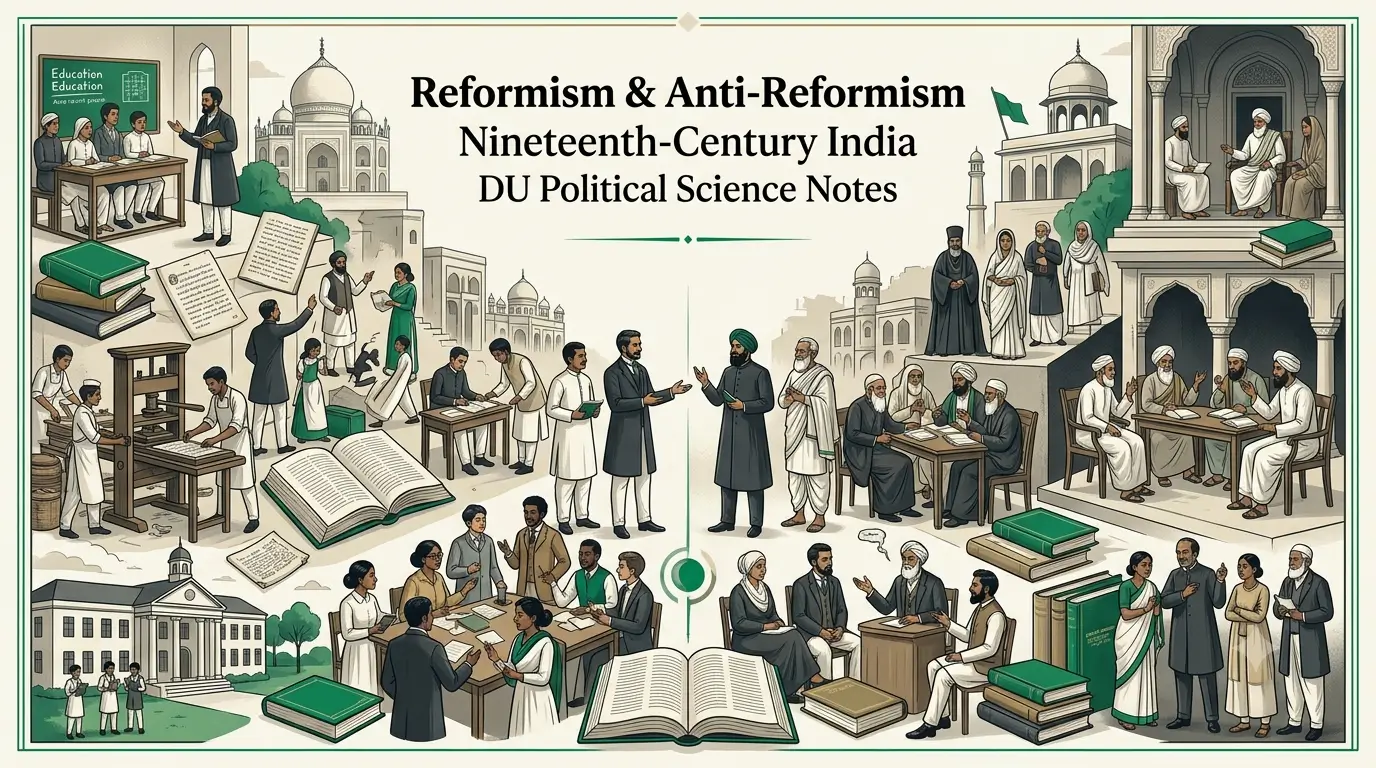
In 19th-century India, the struggle against colonial rule was shaped by two competing strategies: reformism, which sought gradual change from within the existing colonial framework, and anti-reformism, which pushed for radical resistance and a rejection of British institutions altogether. This unit — part of the DU Generic Elective paper Nationalism in India — traces how these two currents evolved, clashed, and eventually merged into the mass movement led by Mahatma Gandhi.
Reformism in 19th-Century Indian Nationalism
1. Social and Religious Reforms
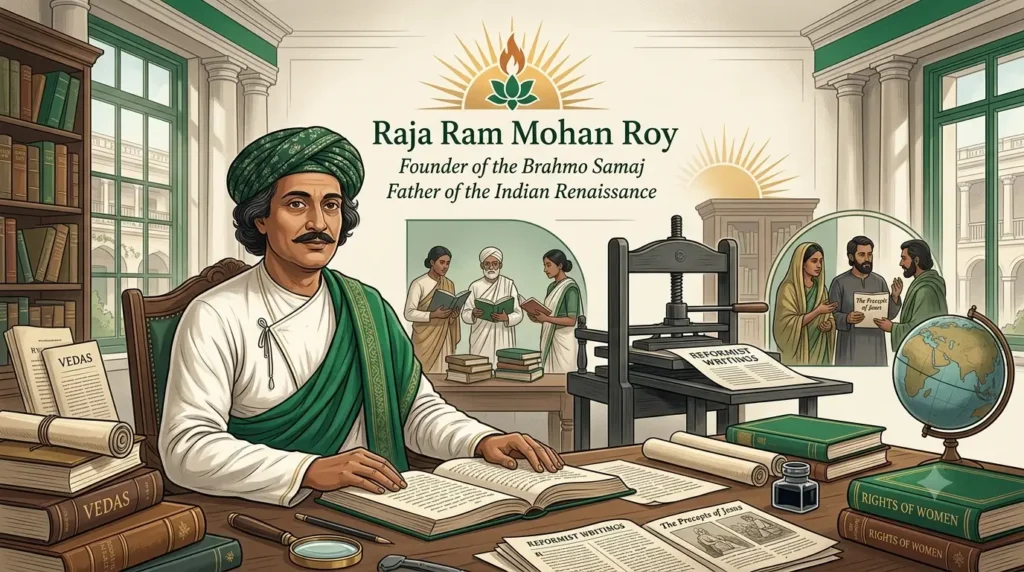
Raja Ram Mohan Roy, often called the “Father of the Indian Renaissance,” is the starting point of 19th-century reformism. He campaigned against Sati, supported women’s education, and in 1828 founded the Brahmo Samaj, a movement built on monotheism and rational inquiry.
Ishwar Chandra Vidyasagar carried this reformist current further, leading the campaign that resulted in the Widow Remarriage Act of 1856 and working extensively for women’s education in Bengal.
Jyotiba Phule, working in western India, took reformism beyond religious practice into caste — founding the Satyashodhak Samaj (1873) to challenge Brahmanical dominance and push for the education of lower-caste communities and women.
The Age of Consent Bill (1891), which raised the age of consent for marriage, became a flashpoint that revealed how divided Indian reformist and conservative opinion actually was — even moderate reformers like Bal Gangadhar Tilak opposed the Bill on the grounds of religious interference, showing the overlap and tension between reform and revivalism.
2. Political Reforms
Moderate nationalists such as Dadabhai Naoroji, Gopal Krishna Gokhale, and Womesh Chunder Bonnerjee worked through the Indian National Congress (founded 1885), pushing for constitutional change through petitions and legislative representation rather than confrontation.
The Ilbert Bill Controversy (1883) — a demand for equal legal standing between Indian and European judges — is a textbook example of this moderate, incremental approach to colonial reform.
Bodies like the Sarvajanik Sabha in Poona and similar civic associations in Calcutta and Bombay gave the educated middle class its first organised platform for political engagement, years before the INC was formed.
3. Cultural Renaissance
Swami Vivekananda, through the Ramakrishna Mission, reoriented reform toward reclaiming India’s spiritual heritage as a source of national pride rather than something to be discarded in favour of Western ideas.
Alongside this, the push for vernacular education — teaching in Bengali, Hindi, Urdu and other regional languages rather than only English — aimed to spread reformist ideas of liberty and reason beyond the small English-educated elite.
Anti-Reformism in 19th-Century Indian Nationalism
1. Radical Nationalism
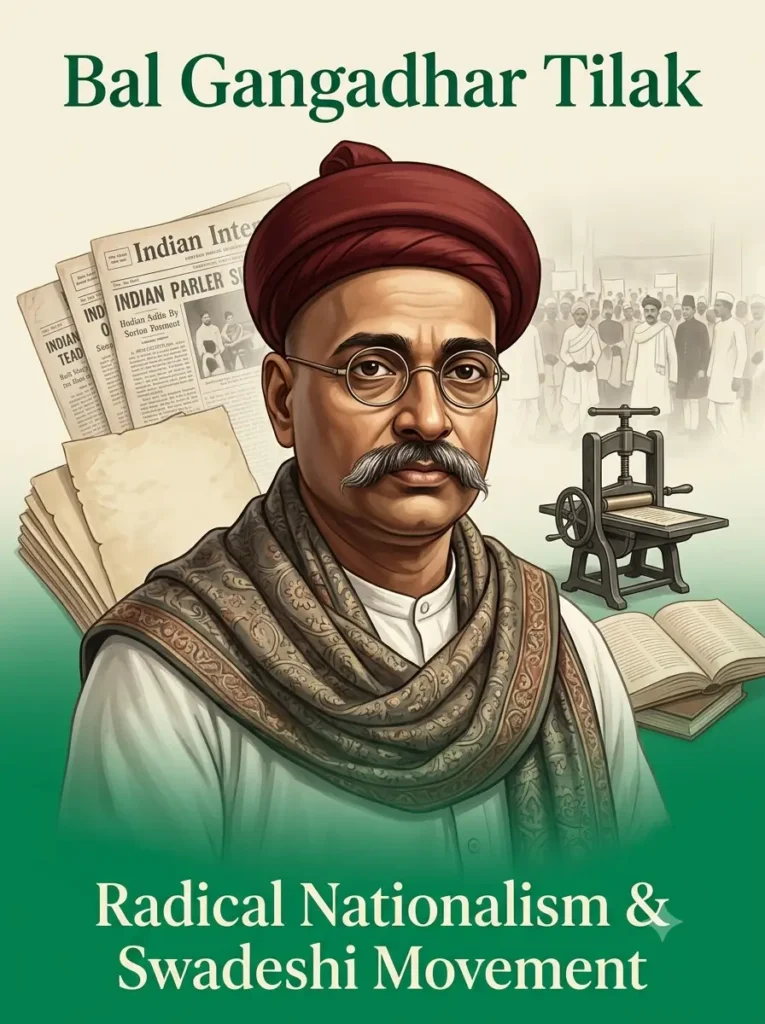
Bal Gangadhar Tilak rejected the moderate strategy of petitions, arguing instead for self-reliance (Swaraj) and mass mobilisation. His famous slogan — “Swaraj is my birthright, and I shall have it” — captured the shift toward assertive nationalism.
Tilak, along with Bipin Chandra Pal and Lala Lajpat Rai (together known as “Lal-Bal-Pal”), represented the “extremist” wing that broke from Congress moderates after 1907.
Bankim Chandra Chatterjee, through his writing (including Vande Mataram), gave anti-reformist nationalism a cultural and emotional register that reformist politics had largely lacked.
2. The Swadeshi Movement (1905–1908)
Triggered directly by Lord Curzon’s partition of Bengal in 1905, the Swadeshi Movement called for a boycott of British goods and institutions and the promotion of indigenously made products — marking a decisive shift from petitioning the colonial government to actively resisting it.
3. Revolt Against Colonial Institutions
Radical members of the INC criticised the moderates for legitimising British rule by participating in legislative councils. This tension eventually produced the 1907 Surat split within Congress.
The Non-Cooperation Movement (1920–1922), led by Mahatma Gandhi, escalated this anti-reformist logic into a nationwide, organised campaign of peaceful non-cooperation with colonial administration.
4. Cultural Assertion and Rejection of Westernisation
Anti-reformists, including Dayananda Saraswati’s Arya Samaj, promoted a “return to the Vedas” — rejecting later accretions to Hindu practice while also rejecting Western cultural influence, arguing that authentic Indian identity had to be reclaimed rather than reformed along Western lines.
It’s worth noting that Muslim reformers like Sir Syed Ahmed Khan, while promoting modern education through the Aligarh Movement, also warned that Muslim interests risked being overshadowed within a Hindu-majority Congress — a concern that would shape communal politics well into the 20th century.
Interplay and Evolution
Strategic shifts: The nationalist movement moved from moderate constitutionalism to more radical resistance largely due to the shock of Bengal’s partition and repeated disappointment with British reform promises (culminating later in the Morley-Minto Reforms of 1909, widely seen as inadequate).
The emergence of Gandhian ideology: Mahatma Gandhi’s genius was fusing both traditions — leading mass movements with the scale and defiance of anti-reformism, but executing them through disciplined, non-violent methods that echoed reformist restraint.
Legacy: The reformist–anti-reformist debate did not end with independence; it resurfaced repeatedly in post-independence debates over the pace and method of social change in India.
Major Social and Religious Movements in 19th Century India
| Movement | Founder | Year | Core Goal |
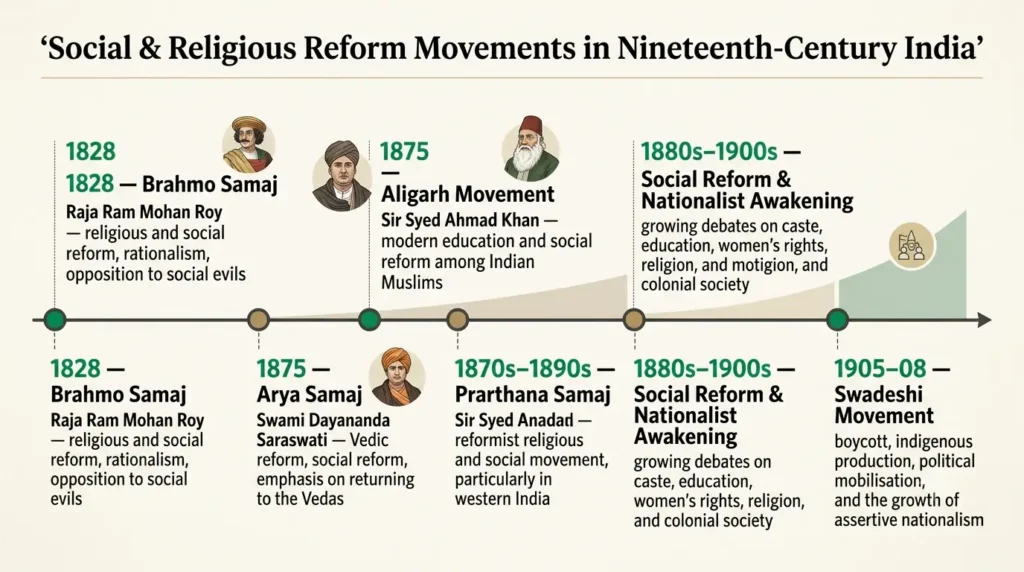
| Brahmo Samaj | Raja Ram Mohan Roy | 1828 | Monotheism, end idol worship, abolish Sati |
| Arya Samaj | Swami Dayananda Saraswati | 1875 | “Back to the Vedas,” oppose caste and idol worship |
| Ramakrishna Mission | Swami Vivekananda | 1897 | Vedanta philosophy, service to humanity |
| Theosophical Society | Blavatsky, Olcott, Judge | 1875 | Universal brotherhood, spiritual exploration |
| Aligarh Movement | Sir Syed Ahmed Khan | 1875 | Modern education for Muslims |
| Swadeshi Movement | (mass movement) | 1905–08 | Boycott British goods, promote indigenous industry |
| Sikh Reform Movements | Singh Sabha, Namdhari | Late 19th c. | Reform Sikh religious practice, strengthen identity |
| Satyashodhak Samaj | Jyotiba Phule | 1873 | Anti-caste reform, lower-caste education |
Each of these movements did more than reshape religious practice — collectively they created the intellectual vocabulary (equality, reason, self-respect) that Indian nationalism later drew on. Read more in our detailed notes on Global Social Movements and Popular Movements and Reforms in the 19th Century.
Reformism vs Anti-Reformism: Quick Comparison
| Basis | Reformism | Anti-Reformism |
| Method | Gradual, constitutional, petitions | Radical, direct action, boycott |
| Attitude to British rule | Work within the system | Resist and reject the system |
| Key figures | Ram Mohan Roy, Naoroji, Gokhale | Tilak, Lajpat Rai, Bipin Chandra Pal |
| Key institutions | INC (moderates), Brahmo Samaj | Swadeshi Movement, Arya Samaj (later phase) |
| View on Western ideas | Selectively adopted | Largely rejected, favoured revival |
| High point | 1885–1905 | 1905–1922 |
Interplay with Indian Nationalism
Cultural renaissance: These movements sparked a revival of Indian art, literature and philosophy, feeding directly into the broader sense of national pride.
Unity in diversity: By highlighting shared cultural and civilisational heritage, reform movements helped bridge regional and community divides — even as some (like the Arya Samaj’s later trajectory) also sharpened communal identity.
Political mobilisation: Many reform-movement leaders moved directly into Congress politics and social movements, translating religious reform into political organisation.
Legacy and Continuing Impact
- Intellectual awakening — questioning of orthodoxy became a habit of mind that outlasted the specific movements.
- Cultural synthesis — shared moral and spiritual values across religious lines fed into an inclusive nationalist idiom.
- Educational empowerment — the Aligarh Movement in particular shows how education became a political tool.
- Role in the independence movement — leaders like Vivekananda shaped nationalist self-understanding well beyond their own lifetimes.
- Social reform — the anti-caste and anti-Sati campaigns fed directly into the equality provisions of the Indian Constitution.
- Religious pluralism — coexistence became embedded as a national value, however imperfectly realised.
- Continued relevance — debates about gradual reform vs radical change still structure Indian political discourse today.
- Challenges and critiques — historians such as those referenced in general overviews of Indian social reform point out that most 19th-century reform was led by upper-caste, urban, English-educated elites, and its benefits filtered down slowly and unevenly.
Conclusion
The 19th-century nationalist movement in India was never a single, unified current — it was a running argument between those who wanted to reform the colonial system from within and those who wanted to overthrow it outright. Reformism gave Indian nationalism its intellectual foundations — the vocabulary of rights, equality, and reason. Anti-reformism gave it its momentum — the courage to confront colonial power directly. Gandhi’s genius, a generation later, was fusing into a single, disciplined mass movement. Understanding this tension is essential for the rest of the Nationalism in India syllabus, particularly the shift from moderate to radical politics covered in Unit 3.
Previous Year Questions (DU BA Nationalism in India — GE)
DU Previous Year Questions
Frequently asked questions from DU exam papers on this topic. Tap a question to view a quick-answer guide.
1 “Critically analyze reformism and anti-reformism during the nineteenth century.” +
2 “What was the significance of the Brahmo Samaj in 19th-century Indian reform?” +
3 “Explain the causes of the Swadeshi Movement (1905–1908).” +
4 “Discuss the differences between moderate and extremist approaches within the Indian National Congress before 1920.” +
5 “What role did the Arya Samaj play in 19th-century Indian nationalism?” +
6 “How did Mahatma Gandhi reconcile reformist and anti-reformist tendencies in the Indian national movement?” +
Frequently Asked Questions
What is the difference between reformism and anti-reformism in 19th-century India?
Reformism sought gradual change within the existing colonial system through petitions and legislative reform, led by figures like Raja Ram Mohan Roy and Dadabhai Naoroji. Anti-reformism pushed for direct resistance and rejection of colonial institutions, led by figures like Bal Gangadhar Tilak, and culminated in movements like Swadeshi and Non-Cooperation.
Who founded the Brahmo Samaj and when?
Raja Ram Mohan Roy founded the Brahmo Samaj in 1828 in Calcutta, promoting monotheism, the abolition of Sati, and education for both men and women.
What caused the Swadeshi Movement of 1905–1908?
The Swadeshi Movement was triggered by Lord Curzon’s partition of Bengal in 1905, which nationalist leaders saw as a deliberate attempt to weaken Bengali political unity along religious lines.
Who were the key leaders of the moderate (reformist) phase of Indian nationalism?
Dadabhai Naoroji, Gopal Krishna Gokhale, and Womesh Chunder Bonnerjee were the leading figures of the moderate phase, working primarily through the Indian National Congress.
How did Gandhi combine both reformist and anti-reformist ideas?
Gandhi led mass movements on the scale of anti-reformist resistance (like non-cooperation) but insisted on non-violent, disciplined methods that carried forward the moral seriousness of the reformist tradition.
Why is this unit important for the DU Nationalism in India syllabus?
It’s the direct predecessor to Unit 3 (Nationalist Politics and Expansion of its Social Base), and DU exams frequently ask essay-length questions that require you to connect the reform movements of this unit to the moderate-extremist split and mass mobilisation covered later.
Subscribe to keep reading
You've used your free notes for now. Get Delhi Pathshala Premium for unlimited access.
Subscribe — ₹29/30 days