
Contents
- Key Terms at a Glance
- Forms of Reproduction
- Sexual and Asexual Reproduction
- Types of Asexual Reproduction
- Vegetative Propagation in Agriculture: Cutting, Grafting, Layering and Tissue Culture
- Other types of asexual reproduction you may meet
- Why Sexual Reproduction Needs Meiosis (and How It Creates Variation)
- Sexual Reproduction in Flowering Plants
- Flower and Its Parts
- Pollination
- Fertilisation
- Seed Dispersal
- Sexual Reproduction in Animals
- Sexual Reproduction in Humans
- Male Reproductive System
- Female Reproductive System
- Formation of Gametes: Sperm and Egg
- Fertilisation, Pregnancy and Embryo Development
- Menstrual Cycle
- Reproductive Health and Hygiene
- Introduction to Birth Control Methods and Importance
- Practicals (Exp. 6, 7)
- Exp. 6 – Budding in Yeast and Hydra; Spore Formation in Bread Mould
- Exp. 7 – Parts of a Typical Bisexual Flower
- Optional classroom activities (not in the official practical list)
- Conclusion
- Quick Summary
- Previous Year and Practice Questions
- Frequently Asked Questions (FAQs)
- Continue Reading
- Sources and Further Reading
Quick answer: Reproduction is the biological process by which living beings produce new individuals of their own kind. It happens in two main ways. In asexual reproduction one parent produces offspring that are almost exact copies of itself. In sexual reproduction two parents contribute gametes (sex cells), which fuse to form a zygote, so the offspring show variations.
These notes cover the full CBSE Class 9 Science (2026-27) chapter Reproduction: How Life Continues from the NCERT textbook Exploration. You will go through asexual reproduction, sexual reproduction in flowering plants and animals, the human reproductive system, the menstrual cycle, pregnancy, reproductive health, contraception, and the two prescribed practicals (Exp. 6 and 7). Every definition below follows the NCERT wording, and wherever I add a small extra detail that the textbook does not state, I tell you so.
What You Will Learn
- The two forms of reproduction and exactly how they differ
- Budding, spore formation and vegetative propagation (cutting, grafting, layering, tissue culture)
- How meiosis creates variation (with the 2³ and 2²³ calculation)
- Parts of a flower, self- and cross-pollination, pollinators, fertilisation and seed formation
- Ovule vs seed and ovary vs fruit; how seeds are dispersed
- External vs internal fertilisation in animals
- Male and female reproductive systems, gametes, fertilisation, implantation, pregnancy and childbirth
- The 28-day menstrual cycle and menstrual hygiene
- Birth control methods, sexually transmitted infections (STIs) and responsible choices
- Practicals 6 and 7, practice questions and FAQs
Key Terms at a Glance
| Term | Meaning in one line (NCERT-based) |
|---|---|
| Reproduction | Biological process by which living beings produce new individuals of their own kind |
| Asexual reproduction | One parent; offspring are almost exact copies (clones) |
| Sexual reproduction | Two parents; gametes fuse; offspring show variation |
| Clone | Offspring genetically identical to its parent |
| Vegetative propagation | New plants arise from vegetative (growing) parts such as stem, leaf or buds |
| Budding | Repeated cell division at one site makes an outgrowth (bud) that separates and lives independently |
| Spore | Lightweight, usually single-celled reproductive unit of fungi |
| Mitosis | Cell division giving two daughter cells with the same chromosome number as the parent cell |
| Meiosis | Cell division that halves the chromosome number (diploid to haploid) to form gametes |
| Gamete | Haploid reproductive cell: sperm / egg in animals; male gametes in pollen and egg cell in ovule in plants |
| Pollination | Transfer of pollen grains from anther to stigma |
| Fertilisation | Fusion of male and female gametes |
| Zygote | The fertilised egg |
| Implantation | Attachment of the zygote (embryo) to the inner lining of the uterus; marks the beginning of pregnancy |
| Ovulation | Release of a mature egg from the ovary |
| Menstruation | Shedding of the uterine lining with some blood through the vagina |
| Contraception | Methods used to prevent pregnancy |
| STI | Sexually transmitted infection |
Forms of Reproduction
Sexual and Asexual Reproduction
Every organism has a definite life span. It is born, grows, matures, reproduces and eventually dies. A mango tree may grow old and die, but its seeds grow into new mango plants. That is how life on Earth continues.
Definition (NCERT): Reproduction is a biological process by which living beings produce new individuals of their own kind.
Living beings reproduce in two main ways. Learn the points of each one carefully, because the 2-mark comparison question is a favourite.
1. Asexual reproduction
- Only one parent is involved. No male and female are needed.
- No gametes are formed and nothing fuses.
- The offspring are almost exact copies of the parent, called clones. So there is no real variation.
- It is fast and uses less time and energy, which helps organisms increase their population quickly when conditions are favourable.
- Seen in many unicellular organisms (bacteria, amoeba, yeast), simple multicellular organisms (hydra, sponge) and many plants.
2. Sexual reproduction
- Two parents take part, and both contribute genetic material.
- Male and female gametes are formed: sperm (male) and egg or ovum (female) in animals.
- The gametes fuse (fertilisation) to form a zygote, which grows into the new organism.
- The offspring are not identical to the parents. They show variations, which help a species adapt to changing environments and, over many generations, contribute to evolution.
- It is slower and takes more energy.
- Seen in most complex animals, including humans, and in flowering plants.
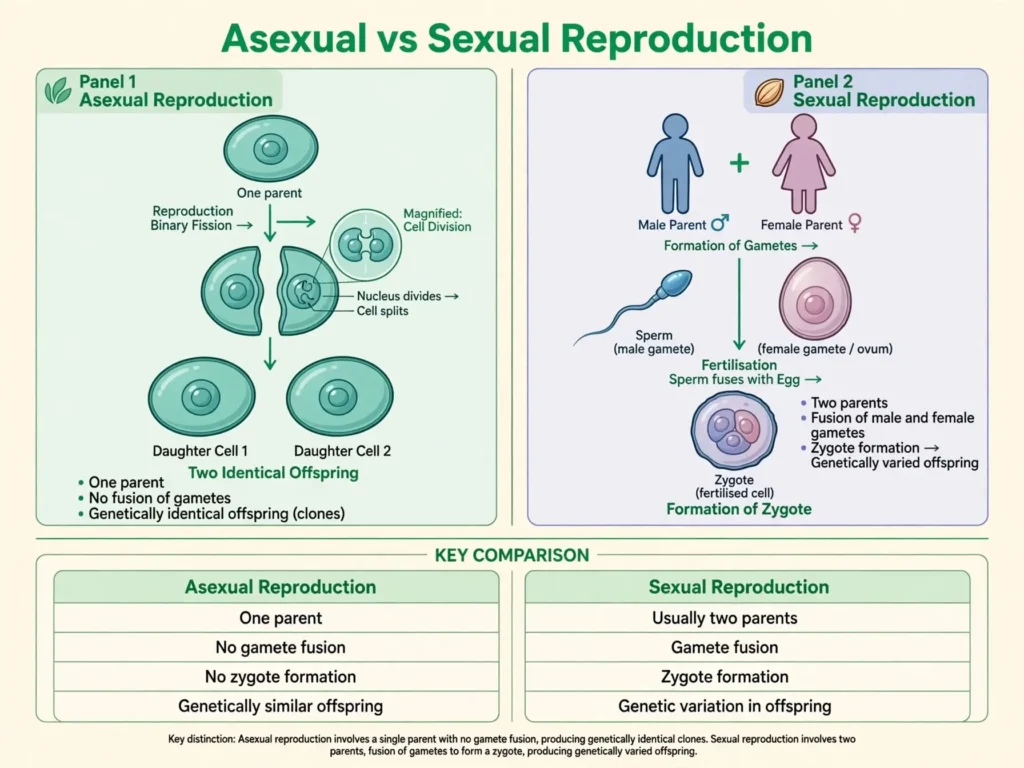
| Asexual Reproduction | Sexual Reproduction |
|---|---|
| Single parent | Two parents |
| No gametes formed | Gametes formed and fused |
| Offspring are clones; no variation | Offspring show variations |
| Fast process | Slow process |
| Examples: yeast, hydra, potato, Bryophyllum | Examples: flowering plants, most animals, humans |
Common mistake: Do not write that asexual reproduction is “only for lower organisms”. Many plants (potato, ginger, sugarcane) also reproduce asexually, even though they are flowering plants.
Exam point: Offspring of asexual reproduction are genetically identical clones. Offspring of sexual reproduction are genetically different from their parents and from each other.
Types of Asexual Reproduction
The chapter shows asexual reproduction in several ways. The three you must know best are budding, spore formation and vegetative propagation.
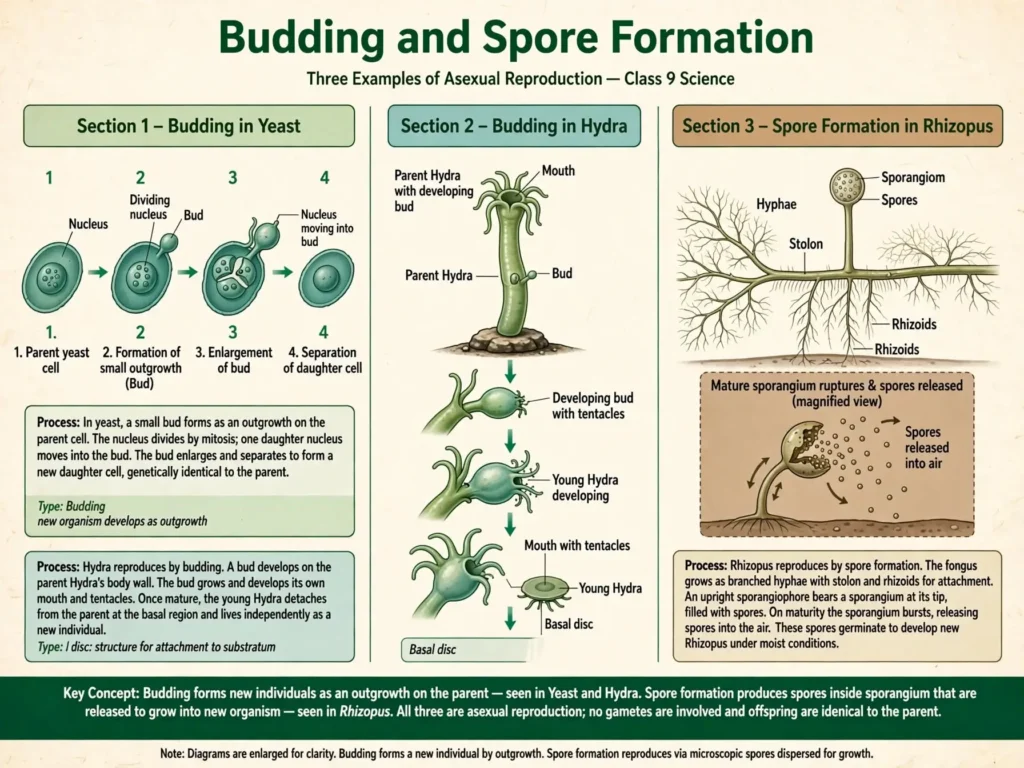
1. Budding – seen in yeast and hydra
- Repeated cell division at one particular site on the parent body produces a small outgrowth called a bud.
- The bud enlarges and separates from the parent to live independently.
- In hydra you can often see several buds on the parent’s body at the same time. In yeast, buds sometimes stay attached for a while and form short chains.
2. Spore formation – seen in fungi such as Rhizopus (bread mould) and Aspergillus
- Spores form in a sac-like structure (in Rhizopus) or on a swollen tip of a long fungal thread called a hypha (in Aspergillus).
- Spores are produced in huge numbers (millions from one mould colony), are lightweight, usually single-celled, and float easily in air currents.
- When they land on a moist, nutrient-rich surface at a suitable warmth (about 25–35 °C), they germinate quickly into new individuals. This is why a damp slice of bread grows fuzzy patches in a few days.
3. Vegetative propagation – seen in many plants
- Definition (NCERT): New plants arise from the vegetative parts, that is, from the growing parts of a plant. Only one parent is involved, so the new plants are genetically identical to it.
- Examples: potato and ginger (fleshy underground stems) sprout new plants without seeds; a money plant stem or sugarcane stem cutting grows into a new plant; Bryophyllum leaves sprout tiny plantlets along their edges.
Vegetative Propagation in Agriculture: Cutting, Grafting, Layering and Tissue Culture
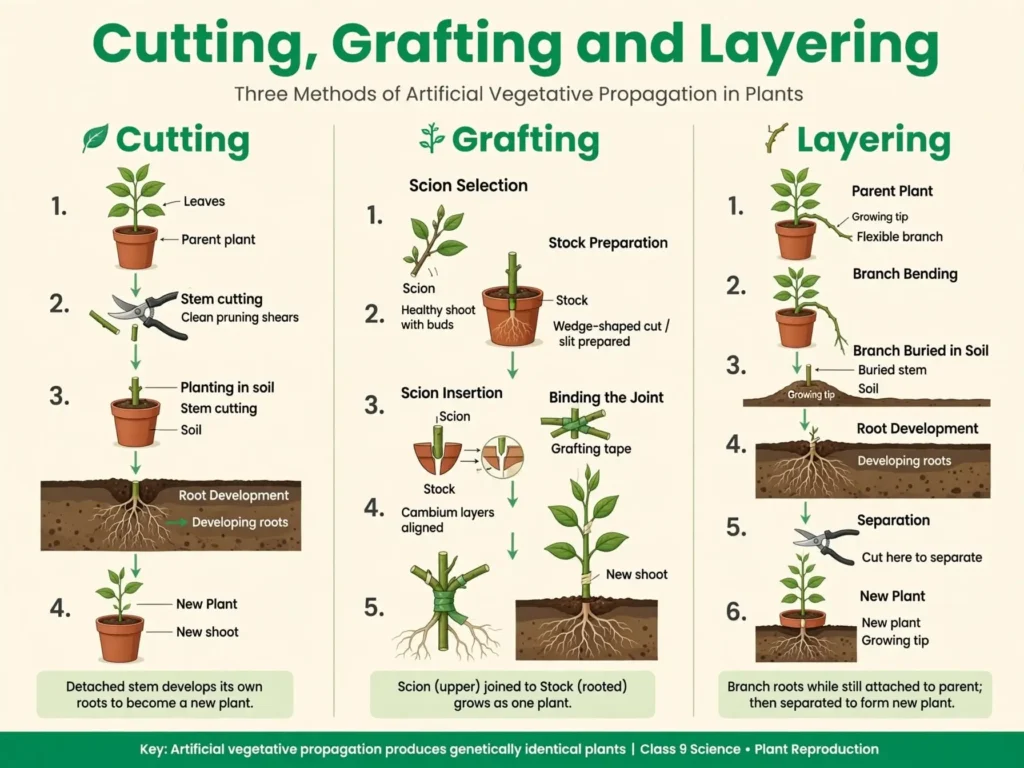
Farmers and horticulturists have adapted this natural process into four useful methods.
| Method | What is done | Typical example |
|---|---|---|
| Cutting | A piece of shoot with nodes is planted (about half its length in soil, at about 45–60°) and watered; roots develop | Rose, money plant, sugarcane |
| Grafting | A stem piece (scion) of one variety is fitted into a slit made in a rooted plant (stock) of another variety and wrapped to protect the wound until it heals | Rose varieties (NCERT activity), many fruit trees |
| Layering | A flexible twig is bent and its middle part is buried in soil while still attached to the parent; roots form in about 10–15 days, then the twig is cut from the parent | Lemon |
| Tissue culture | Mass-produced healthy plantlets are grown from a tiny piece of tissue such as the shoot tip (apical meristem) | Banana farming |
Bridging Science and Society (NCERT): Tissue culture gives farmers healthy plantlets, helps remove virus-infected plants and ensures high yields. Krishi Vigyan Kendras (KVKs) under the Indian Council of Agricultural Research (ICAR) train farmers in modern grafting, which helps them grow high-yield fruits and increase their income.
Why mitosis matters here. In all the organisms above, the central process behind asexual reproduction is mitosis, a cell division that produces two daughter cells, each with the same number of chromosomes as the parent cell. That is why the offspring are identical to the parent and are called clones. To revise mitosis and meiosis in detail, see our notes on Cell: The Building Block of Life – Class 9 Science Notes.
Did you know? (NCERT) For a long time people believed that living things arise spontaneously from non-living matter. Experiments by Louis Pasteur proved that new life always comes from pre-existing life. This strengthened the cell theory (all cells arise from pre-existing cells) and led to practices such as sterilising food and instruments.
Other types of asexual reproduction you may meet
The NCERT chapter text does not describe the following, but the CBSE syllabus asks for “types of asexual reproduction with examples”, and these appear in many references and earlier classes. Learn them as extras of lower exam priority.
| Type | How it happens | Example |
|---|---|---|
| Binary fission | The parent cell divides into two; the nucleus divides first, then the cytoplasm | Amoeba, bacteria |
| Fragmentation | The body breaks into pieces and each piece can grow into a new individual | Spirogyra |
| Regeneration | A body part grows back; in some animals a piece of the body can regrow the missing parts | Planaria (a piece can form a whole new worm); in starfish, regrowth needs the central part of the body |
Common mistakes
- Rhizopus spores form in a sac (sporangium); the sac is not a “bud”.
- A vegetatively propagated plant is not produced from a seed.
- Do not say a bud “has no nucleus”. The nucleus divides and one copy passes into the bud.
Exam point: Asexual reproduction = one parent + mitosis + clones. The sentence “genetically identical because only one parent is involved and cells divide by mitosis” answers NCERT Exercise 4 directly.
Why Sexual Reproduction Needs Meiosis (and How It Creates Variation)
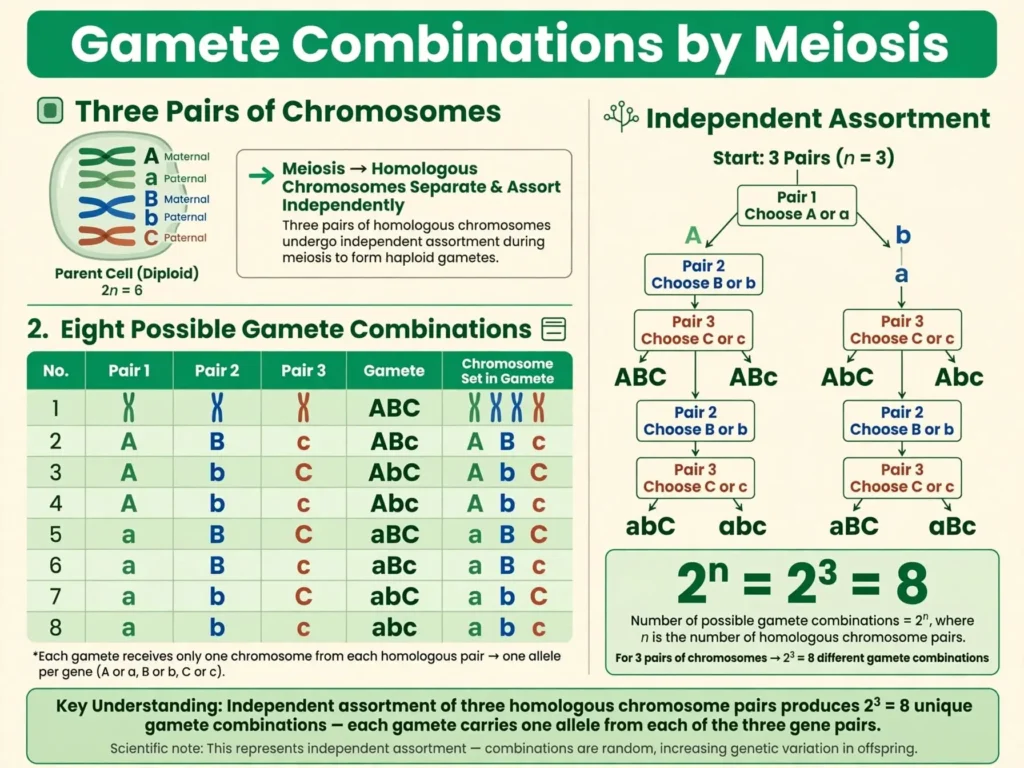
Here is a puzzle. If both parents passed on their full set of chromosomes, the chromosome number would double in every generation. Nature solves this with a special cell division called meiosis.
Definition (NCERT): Meiosis is a special type of cell division that forms gametes. In meiosis the chromosome number of the parent cell (diploid) is reduced to half (haploid) in the daughter cells. The resulting haploid cells are used only for reproduction and are called gametes.
- Chromosomes are thread-like structures in the nucleus that carry genetic information.
- Humans have 23 pairs of chromosomes, so 46 in total. Each pair has one chromosome from each of two individuals.
- During meiosis the chromosomes of each pair separate, so every gamete receives only one chromosome from each pair. A human gamete therefore has 23 chromosomes.
- In animals, male gametes are sperm and female gametes are eggs. In plants, the pollen grain contains the male gametes and delivers them to the ovule, which contains the female gamete (egg).
When a sperm (23) fuses with an egg (23), the zygote gets back 46 chromosomes. So the chromosome number stays constant from generation to generation.
How many combinations are possible? Imagine each chromosome pair carries two contrasting characters. A gamete picks one from each pair at random.
Solved Example – Counting gamete combinations
Given: 3 pairs of characters (hair colour, hair type, eye colour) in the NCERT bead activity; humans have 23 pairs of chromosomes. To find: The number of different combinations of characters a gamete can carry. Formula: Number of combinations = 2ⁿ, where n is the number of pairs (each pair gives 2 choices). Solution: For 3 pairs: 2 × 2 × 2 = 2³ = 8. For 23 pairs: 2²³ = 2¹⁰ × 2¹⁰ × 2³ = 1,024 × 1,024 × 8 = 1,048,576 × 8 = 8,388,608. Answer: 8 combinations with 3 pairs, and about 8.4 million (8,388,608) with 23 pairs.
This random mixing, followed by the fusion of two gametes, makes children genetically different from their parents and also from their siblings. Variation helps some individuals adapt better to changing surroundings (for example, tolerating low oxygen at high altitudes or digesting milk in adulthood). Over time, it contributes to evolution.
Common mistake: Do not confuse mitosis (two identical cells, same chromosome number, used in asexual reproduction and growth) with meiosis (gametes with half the chromosome number).
Exam point: “Meiosis halves the chromosome number and, through random separation of chromosomes, produces variation.”
Sexual Reproduction in Flowering Plants
Flowering plants, called angiosperms, are the most diverse group of plants on Earth. In them the flower is the reproductive organ. (Non-flowering plants such as pines also reproduce sexually; you will meet them in the next chapter.)
Flower and Its Parts
A flower is a modified shoot that carries the reproductive parts. Look at a flower bud and you will notice a green covering around the coloured parts. That is the outermost whorl.
A complete flower has four parts (whorls):
| Whorl | Part | Structure | Function |
|---|---|---|---|
| 1 (outermost) | Calyx – sepals | Thin, flat, usually green | Protect the flower in the bud stage |
| 2 | Corolla – petals | Coloured (and often fragrant) projections | Attract pollinators such as insects and birds |
| 3 | Androecium – stamens (male part) | Each stamen has a filament and an anther | Anther produces pollen grains containing male gametes; filament holds the anther |
| 4 (innermost) | Gynoecium / Pistil (female part) | Stigma (tip, flat and/or sticky), style (thin long tube) and ovary (swollen base) | Stigma receives pollen; style connects stigma to ovary; ovary contains ovules, each with an egg cell (female gamete) |
In some flowers the sepals and petals are fused. The flower is attached to the plant by a stalk (pedicel), and the swollen top of the stalk that bears the whorls is the thalamus.
Bisexual and unisexual flowers. A flower that has both stamens and pistil is bisexual (hibiscus, mustard). A flower with only one of them is unisexual (papaya, watermelon). In papaya, male and female flowers are often borne on different trees.
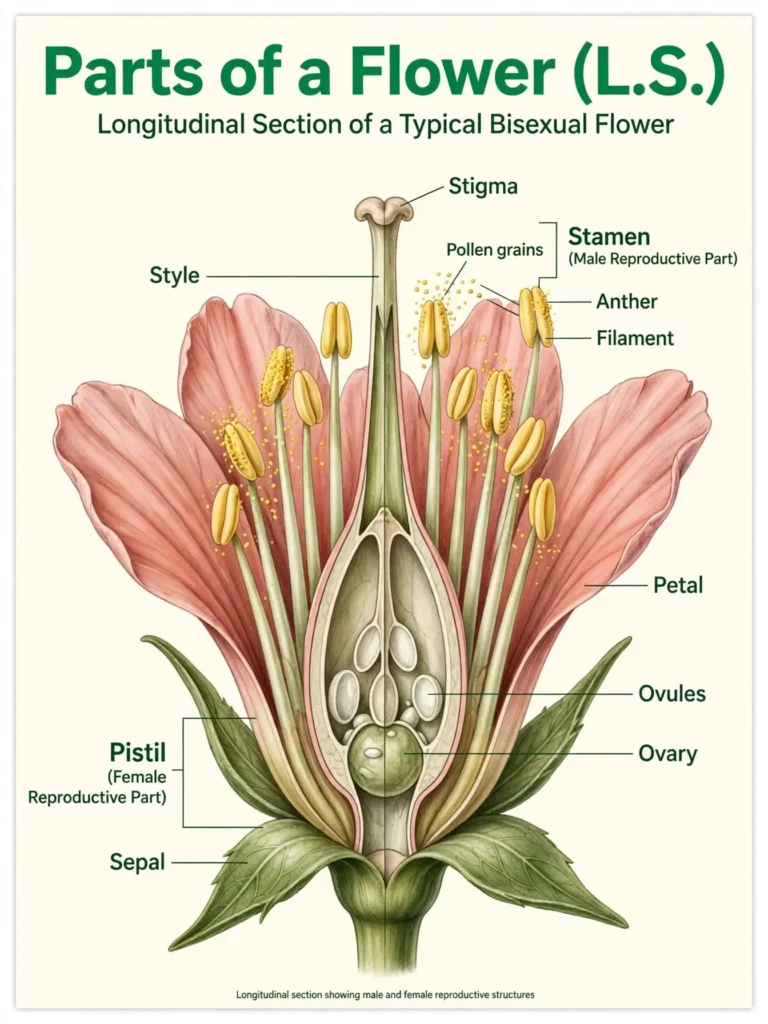
Common mistake: The ovary is the swollen base of the pistil. Students often label the whole pistil as “ovary”.
Exam point: Stamen = male (anther + filament). Pistil = female (stigma + style + ovary). Ovules inside the ovary carry the egg.
Pollination
For a flower to form fruits and seeds, pollen must reach the stigma. How do we know? NCERT Activity 11.6 uses a pea plant. Some flower buds and flowers are wrapped in muslin bags, some have their stamens removed, and one flower is left uncovered. Fruits form in every treatment except the one where the stamens were removed from the flower bud. This shows that transfer of pollen from anther to stigma is necessary for fruit formation.
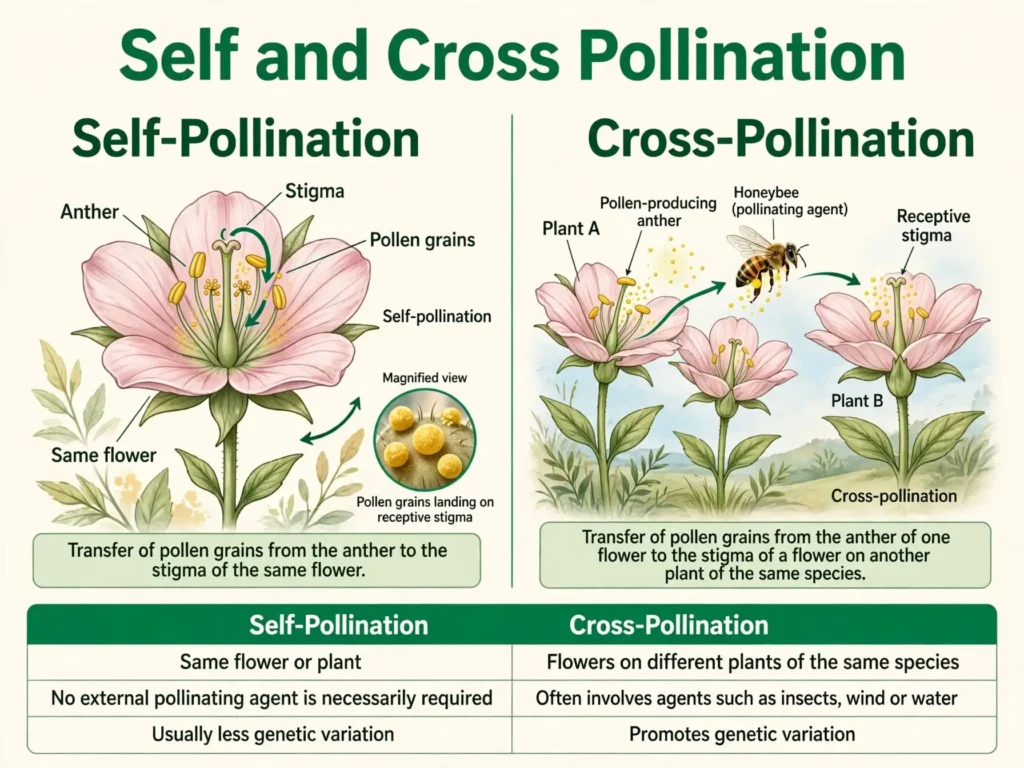
Definition (NCERT): The transfer of pollen grains from the anther to the stigma of a flower is called pollination.
Types of pollination (as defined in NCERT)
- Self-pollination – pollen is transferred to the stigma of the same flower or another flower of the same plant. Examples often given: pea, tomato, wheat.
- Cross-pollination – pollen is transferred from the anther of a flower of one plant to the stigma of a flower of another plant of the same type. It produces variation. Examples: apple, papaya, maize.
| Self-Pollination | Cross-Pollination |
|---|---|
| Within the same flower or between flowers of the same plant | Between flowers of two different plants of the same type |
| External agent is not essential | Needs an agent such as wind, water, insects or birds |
| Little or no variation | Variations are produced |
| If all flowers of a plant were only self-pollinating, genetic diversity would fall over generations | Increases genetic diversity |
Pollinators and pollination strategies (NCERT)
Pollination depends on external agents called pollinators: wind, water, insects and birds.
| Agent (technical name) | Features of the flower / pollen | Examples |
|---|---|---|
| Wind (anemophily) | Pollen light and small, produced in huge numbers; stigma long and feathery to trap pollen | Maize, wheat, rice (grasses) |
| Water (hydrophily) | Currents carry pollen from one flower to another | Vallisneria, Hydrilla |
| Insects (entomophily) | Brightly coloured, nectar-producing, fragrant flowers; pollen large, sticky or spiny; sticky stigma | Sunflower, hibiscus, marigold |
| Birds (ornithophily) | Flowers pollinated by birds such as sunbirds and the Indian white-eye | Coral tree, hibiscus |
The Greek-style technical names are not in the NCERT text; they are standard terms and are useful for diagram labels.
A note on wheat. NCERT lists wheat among wind-pollinated plants (light pollen), but in its Exercise 11 it hints that wheat flowers are mostly self-pollinated (the stamens cover the stigma and the flowers open after pollination). So in an exam, if you are asked for a clear wind-pollination example, write maize; if you write wheat, it is safest to mention that wheat is mainly self-pollinated and its light pollen can also be carried by wind.
Why do night-blooming flowers tend to be white or light-coloured? Pale flowers stand out in the dark, so night-flying pollinators can spot them more easily (NCERT Exercise 6).
Solved Example – Pollen-to-seed ratio (NCERT Activity 11.7 data)
Given: Wind-pollinated grasses (maize, wheat): pollen released per flower = 5,00,000 to 10,00,000; seeds formed = 50 to 200. Insect-pollinated plants (sunflower): pollen released per flower = 20,000 to 40,000; seeds formed = 800 to 1,000. To find: Pollen grains needed per seed (pollen-to-seed ratio) for each strategy. Formula: Pollen-to-seed ratio = number of pollen grains ÷ number of seeds formed. Solution: Wind: smallest ratio = 5,00,000 ÷ 200 = 2,500; largest ratio = 10,00,000 ÷ 50 = 20,000. Insects: smallest ratio = 20,000 ÷ 1,000 = 20; largest ratio = 40,000 ÷ 800 = 50. Answer: Wind-pollinated flowers need roughly 2,500 to 20,000 pollen grains per seed, while insect-pollinated flowers need only about 20 to 50. Insect pollination is far more efficient, at least about 50 times in these approximate figures. Even so, wind-pollinated plants rely on producing enormous amounts of pollen so that, despite huge wastage, some grains still reach a stigma. (These are approximate trends, as NCERT says.)
Common mistakes
- Pollination is not fertilisation. Pollination = pollen reaches the stigma. Fertilisation = a male gamete fuses with the egg.
- Self-pollination does not need pollinators “much”, but it still needs pollen to reach the stigma.
Exam point: “Pollination is the transfer of pollen from anther to stigma.” If two varieties of maize planted side by side form seeds only when pollen from one reaches the other, the process is cross-pollination (NCERT Pause and Ponder 3).
Bridging Science and Society (NCERT): plant breeding. Sexual reproduction in plants is used in selective breeding (choosing plants with desirable characters), artificial hybridisation (removing stamens, bagging the flower to prevent self-pollination, and manually transferring chosen pollen) and genetic engineering. These methods give high-yielding and disease-resistant varieties.
Fertilisation
Once pollen reaches a compatible stigma, a remarkable process begins.
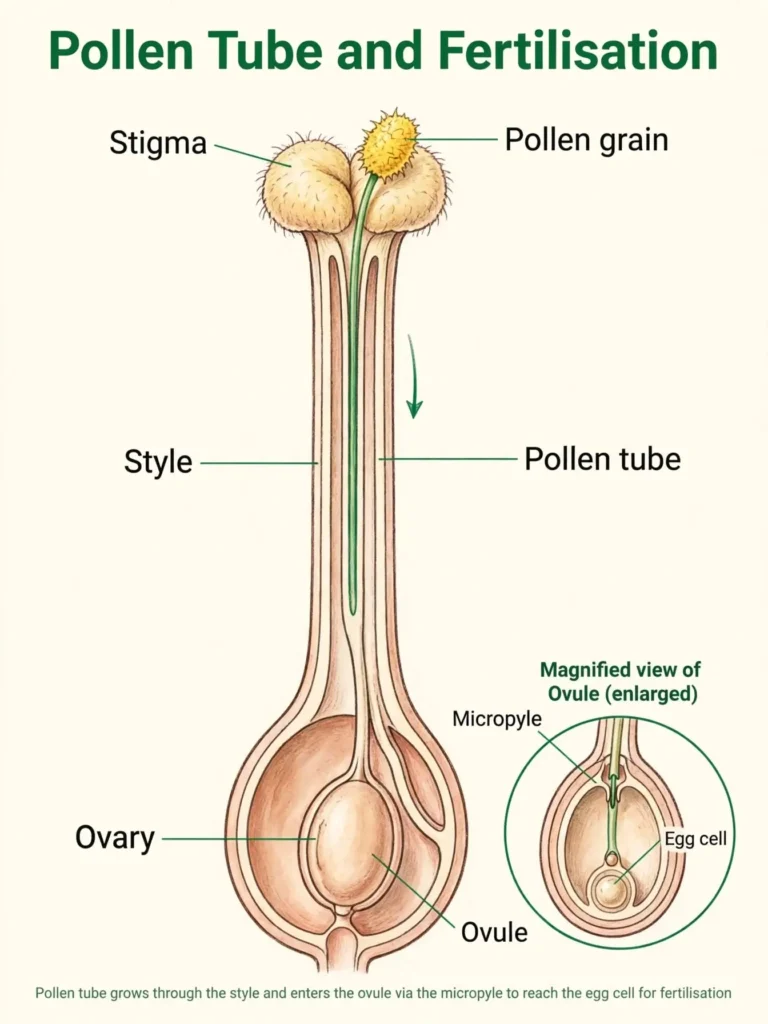
- Pollen germination. The pollen grain on the stigma grows a pollen tube, which grows down through the style into the ovary.
- Male gamete travels. The male gamete moves through the pollen tube and arrives at the ovule.
- Fertilisation. The male gamete fuses with the egg cell. This fusion of gametes is fertilisation, and it marks the beginning of a new life. The fertilised egg is the zygote, which later develops into an embryo.
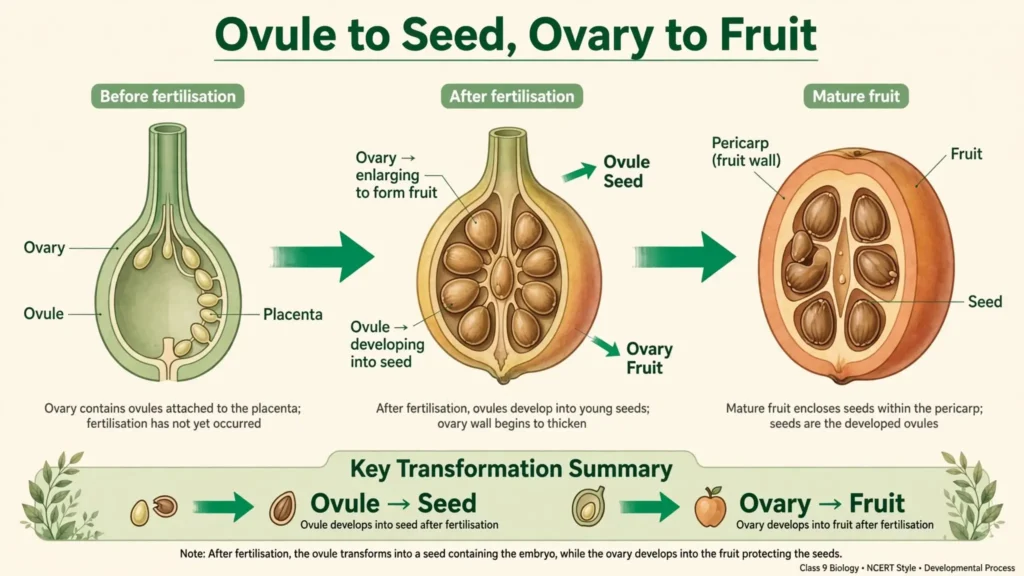
- After fertilisation. The ovary enlarges and develops into a fruit, and the ovules develop into seeds inside it. When water, air and temperature are favourable, a seed germinates and grows into a new plant.
Ovule vs seed, ovary vs fruit (a stated learning outcome of this chapter)
| Ovule | Seed |
|---|---|
| Present inside the ovary before fertilisation | Formed from the ovule after fertilisation |
| Contains the egg cell (female gamete) | Contains the embryo that grows into a new plant |
| Ovary | Fruit |
|---|---|
| Swollen base of the pistil | Formed from the ovary after fertilisation |
| Contains ovules | Contains seeds and surrounds them |
Common mistakes
- Fertilisation happens in the ovule, not “in the ovary”.
- Do not write that “the flower becomes the fruit”. Only the ovary becomes the fruit.
- Your older notes or guide books may mention double fertilisation, endosperm and “triple fusion”. These are not part of the Class 9 NCERT chapter, so you do not need them for this exam. Stay with the NCERT sequence above.
Exam point: After fertilisation: ovule → seed; ovary → fruit; zygote → embryo. Learn the sequence “pollination → pollen germination → pollen tube → fertilisation → zygote”.
Seed Dispersal
After fertilisation the ovary becomes a fruit with seeds inside. If all seeds simply dropped under the parent plant, they would compete for light, water and nutrients. So seeds have to travel.
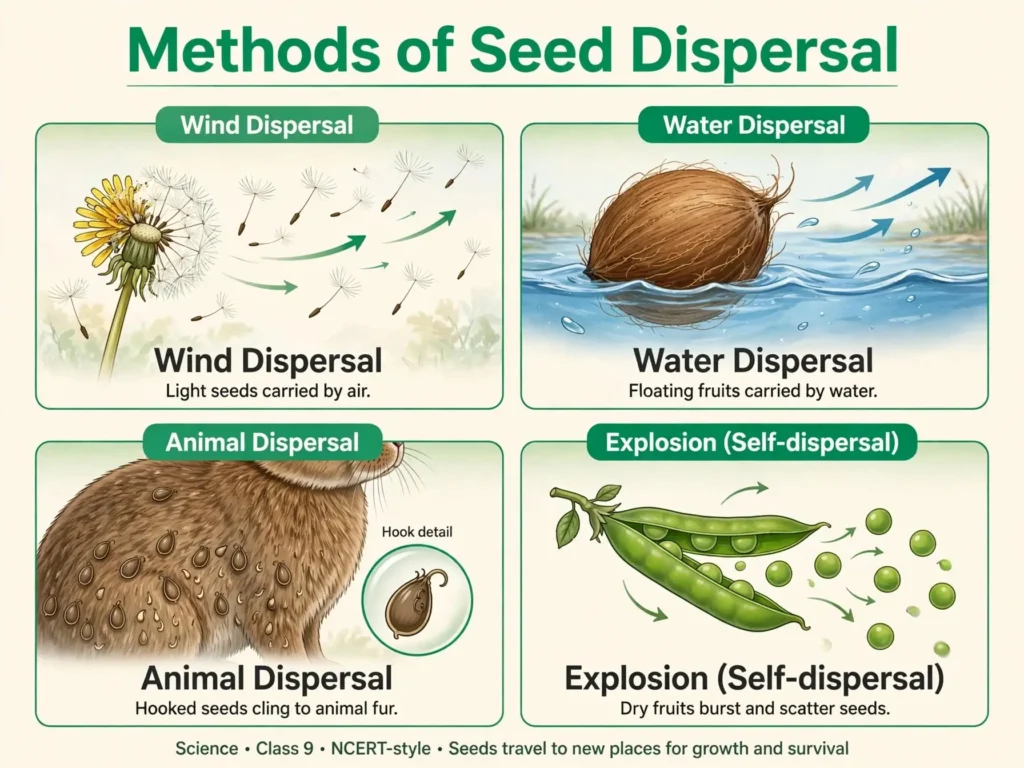
Seed dispersal is the transport of seeds away from the parent plant to other places. NCERT states that it takes place by wind, water and animals. Biotic (living) agents such as animals and abiotic (non-living) agents such as wind and water are both involved.
Why is seed dispersal needed?
- To avoid overcrowding and competition for light, water and nutrients.
- To help the species colonise new areas.
- To reduce the chance that all seeds are eaten or destroyed in one place.
| Mode | How seeds are adapted | Examples |
|---|---|---|
| Wind (anemochory) | Seeds are light, small, winged or have hairs or a “parachute” | Dandelion (hairy pappus), calotropis/madar (silky hairs), maple and drumstick (winged seeds), cotton |
| Water (hydrochory) | Seeds or fruits are spongy or have a fibrous coat so they float | Coconut (fibrous husk, the mesocarp), lotus |
| Animals (zoochory) | Hooks, spines or bristles stick to fur or clothes; or fleshy, tasty fruits are eaten and the seeds are thrown away elsewhere | Xanthium, Urena (hooks); mango, guava, tomato (fleshy fruits) |
| Explosion (autochory) (commonly taught; not described in the NCERT text) | Fruit bursts suddenly and flings seeds out | Pea, balsam, castor |
Common mistake: The outer fibrous layer of coconut is the mesocarp (husk), not the epicarp. The epicarp is just the thin outer skin.
Exam point: “Seed dispersal prevents overcrowding and helps the species survive and spread.” NCERT Pause and Ponder 2: madar and dandelion seeds are adapted for wind dispersal.
Meet a Scientist (NCERT): P. Maheshwari. Known as the “Father of Indian Embryology”, he studied plant reproductive organs. NCERT says he developed the technique of in-vitro fertilisation in flowering plants and was among the first to grow plant embryos on artificial nutrient media. His book An Introduction to the Embryology of Angiosperms (1950) became a classic.
Sexual Reproduction in Animals
This part of the chapter asks a simple question: how do the male and female gametes meet, and how do the young ones survive?
External fertilisation – fusion of sperm and egg takes place outside the female’s body, usually in water. In most fish and in frogs, the female releases eggs into water and the male releases sperm over them. Many eggs are laid, but many are destroyed by water currents or eaten by other animals.
Internal fertilisation – fusion takes place inside the female’s body, as in reptiles, birds and mammals. The fertilised egg or embryo is better protected, so the young ones have a higher chance of survival.
| Animal | Habitat | Fertilisation | Eggs produced at a time | Estimated survival of young |
|---|---|---|---|---|
| Fish | Water | External | Hundreds to thousands | Low |
| Frog | Water/land | External | 5,000 – 50,000 | Low |
| Lizard | Land | Internal | 2 – 20 | Moderate |
| Bird | Water/land | Internal | 1 – 15 | Moderate to high |
Source of figures: NCERT Table 11.4 (approximate).
- Fish, amphibians and insects lay a large number of eggs with only enough yolk to produce a larva. The larva feeds (for example on organic wastes), grows, and later transforms into the adult. Butterflies and frogs follow this pattern.
- Reptiles and birds lay eggs with enough yolk to nourish the embryo until it hatches.
- In mammals the zygote grows inside the female’s body, and the young are fed on milk after birth.
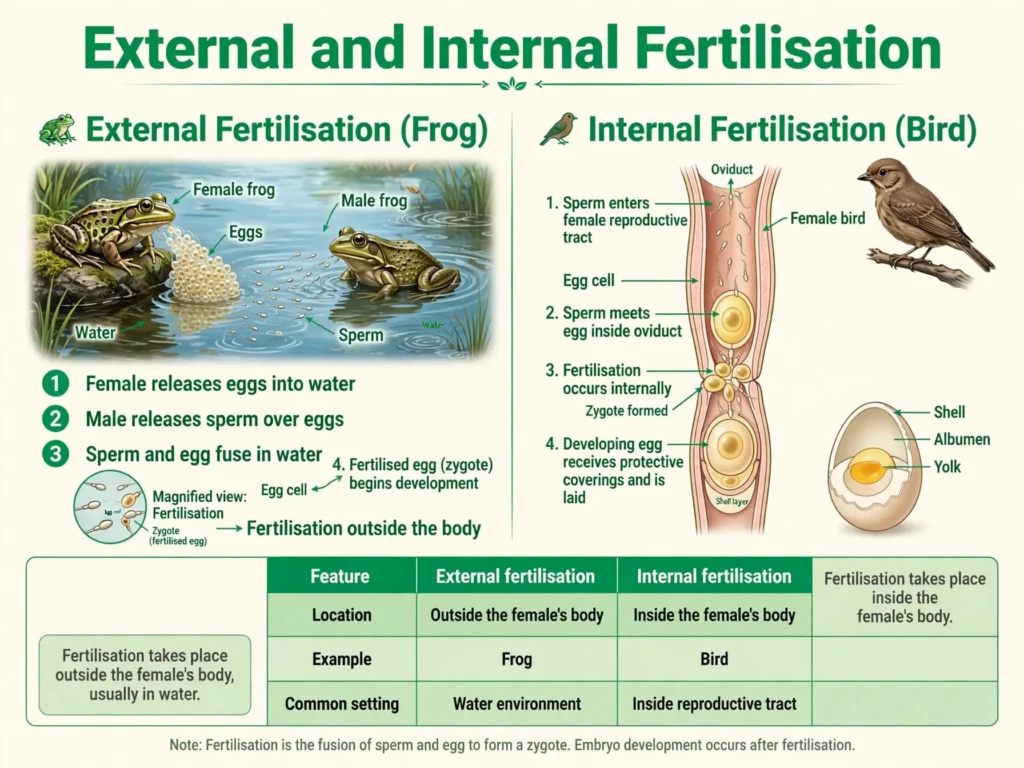
Exam point: Animals with external fertilisation produce more eggs because many are lost; internal fertilisation protects the gametes and embryo more (NCERT Pause and Ponder 4 and 5).
Sexual Reproduction in Humans
In humans, sexual reproduction needs two parents. The male parent produces the male gamete (sperm) and the female parent produces the female gamete (egg or ovum).
Reproductive maturity. As a child grows into an adult, the reproductive organs mature and begin producing gametes. This stage is called puberty; in girls it begins between about 10 and 14 years of age, and it comes with physical and emotional changes. (NCERT Pause and Ponder 6: a boy whose height increases rapidly, shoulders broaden and voice cracks is entering puberty.)
Male Reproductive System
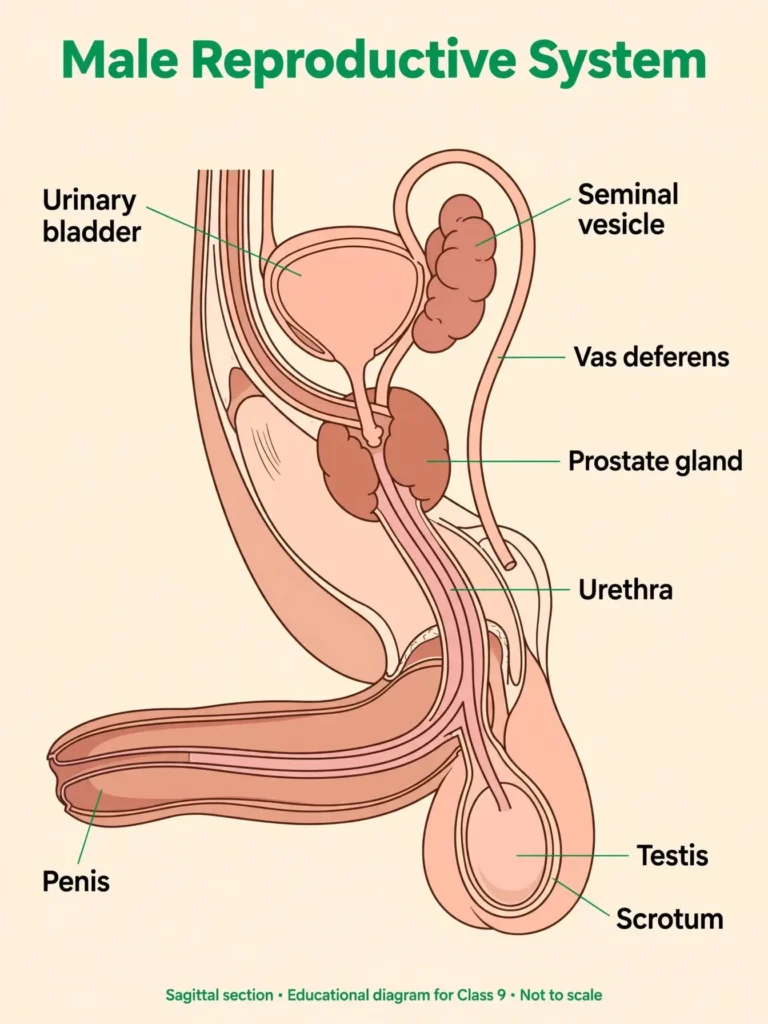
The male reproductive system produces sperm and helps transfer them into the female body.
- Testes – two oval organs lying in a pouch of skin, the scrotum. They produce sperm. Sperm are made in many coiled seminiferous tubules inside the testes. The testes also produce a hormone (testosterone) that controls sperm production and brings the changes seen in boys at puberty.
- Scrotum – a pouch of skin that holds the testes outside the abdomen. It keeps them slightly cooler (about 2–3 °C lower) than normal body temperature, which is necessary for sperm formation.
- Vas deferens (sperm duct) – a long tube through which sperm travel from the testes; it opens into the urethra.
- Glands (seminal vesicles and prostate) – add fluids that nourish the sperm and help them remain active and move. The mixture of sperm and these fluids is called semen.
- Urethra and penis – the urethra is a common passage for urine and sperm (semen). The penis transfers semen into the female body during sexual intercourse.
Why are the testes outside the body? Because sperm formation needs a temperature slightly lower than the body’s. This idea also connects to the syllabus question “Can extreme heat affect fertility?” Prolonged heat exposure of the testes can reduce sperm production.
Exam point: Sperm are formed in the seminiferous tubules of the testes; the male hormone is testosterone.
Female Reproductive System
The female reproductive system produces eggs, receives sperm, and provides protection and nourishment to the developing embryo.
- Ovaries – a pair of ovaries produce eggs and release hormones (estrogen and progesterone) that bring about the changes of puberty. At birth a girl’s ovaries already contain millions of immature eggs. From puberty onwards, usually one mature egg is released every month from one of the ovaries.
- Oviducts (fallopian tubes) – a pair of tubes connecting the ovaries to the uterus. The egg enters the oviduct after ovulation; fertilisation usually takes place here. (Extra detail: the funnel-like opening has finger-like fimbriae that catch the egg, and cilia in the lining help move the egg onward.)
- Uterus (womb) – a bag-like, muscular organ where the foetus develops. Its inner lining is the endometrium, which becomes thick and rich in blood vessels each month.
- Cervix – the narrow passage through which the uterus opens into the vagina.
- Vagina – receives sperm during intercourse and serves as the birth canal at childbirth.
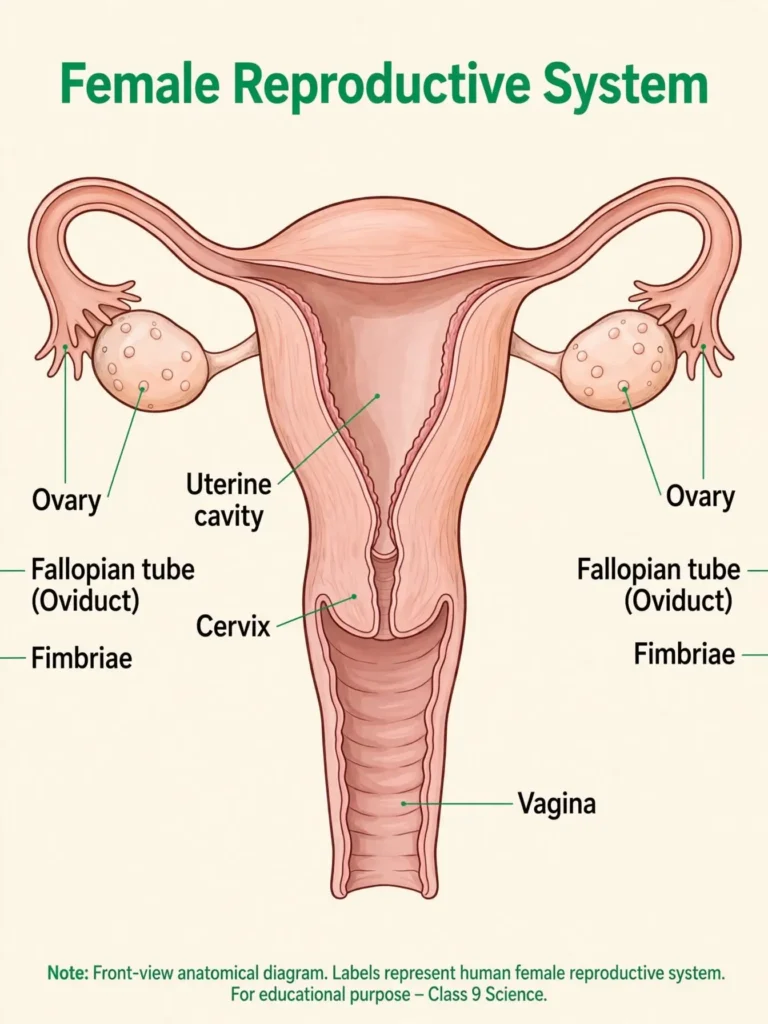
Exam point: Egg is formed in the ovary; fertilisation occurs in the oviduct (fallopian tube); the embryo implants and develops in the uterus.
Formation of Gametes: Sperm and Egg
The formation of gametes is called gametogenesis. It takes place in the testes (sperm) and the ovaries (eggs), and it happens by meiosis, so the chromosome number is reduced from 46 to 23.
- In males, gametogenesis produces numerous, tiny, motile (moving) sperm.
- In females, gametogenesis produces a single large egg at a time.
| Feature | Sperm | Egg |
|---|---|---|
| Size | Very small | Large |
| Number produced | Millions | Few |
| Stored nutrients | Absent | Present |
| Motility | Actively motile | Non-motile |
| Chromosomes | 23 | 23 |
Based on NCERT Table 11.5.
Structure of a sperm. NCERT describes a sperm as having a head containing genetic material and a long tail that helps it swim towards the egg. (Extra detail useful for diagrams: the head also carries a cap called the acrosome with enzymes that help it enter the egg, and a short middle piece packed with mitochondria supplies energy for swimming.)
Structure of an egg. The egg is large, round and non-motile, with a nucleus (23 chromosomes), cytoplasm with stored nutrients, and a protective covering.
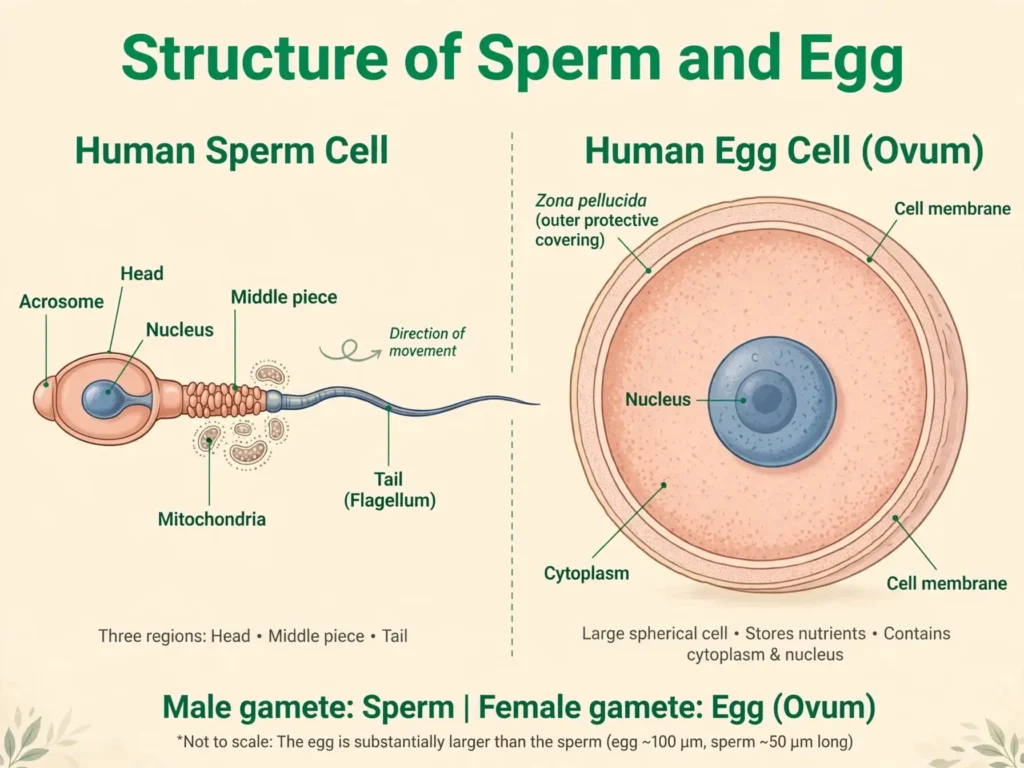
Common mistake: Do not say the sperm and egg are “diploid”. Both are haploid (23 chromosomes). The zygote is diploid (46).
Fertilisation, Pregnancy and Embryo Development
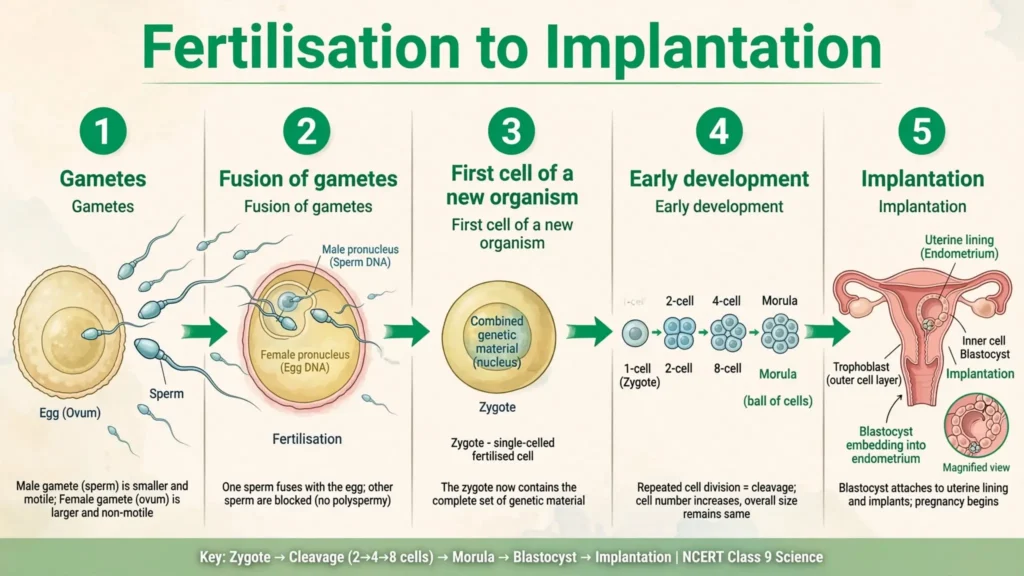
Fertilisation in humans is internal and, in a typical case, happens in the oviduct.
- Egg released. Before ovulation the uterine lining thickens. At ovulation the egg travels from the ovary into the oviduct.
- Sperm reach the egg. During sexual intercourse, millions of sperm enter through the vagina, swim through the reproductive tract and may reach the egg in the oviduct.
- Zygote formation. If a sperm meets the egg and fuses with it, a zygote (46 chromosomes) forms. Only one sperm fuses with the egg.
- Cell divisions and implantation. The zygote undergoes a series of mitotic divisions while travelling towards the uterus, forming a ball of cells (the blastocyst, an extra term). It then implants into the thick inner lining of the uterus to receive nourishment. Implantation marks the beginning of pregnancy. It typically occurs about 6 to 10 days after fertilisation (the range reported goes up to about 12 days).
- Development. The embryo grows. (Extra detail: a structure called the placenta forms between the uterine wall and the embryo and is connected to it by the umbilical cord; it supplies food and oxygen and removes wastes.)
Pregnancy and childbirth (NCERT)
- Pregnancy lasts about nine months and is divided into three stages called trimesters.
- First trimester: the fertilised egg develops into an embryo during the first two months and major organs start forming. From about the ninth week the developing embryo is called a foetus.
- Second trimester: the foetus grows bigger and stronger, and the mother can usually feel its movements.
- Third trimester: the baby grows rapidly and gets ready for life outside the womb.
- Childbirth: strong contractions of the uterine muscles push the foetus out through the birth canal. If a normal birth is not possible or safe, doctors may use medical or surgical procedures.
- Medical note: counting from the last menstrual period, doctors usually describe a full-term pregnancy as roughly 40 weeks (about 280 days). For Class 9, “about nine months” is the NCERT statement.
Care of mother and baby. Breastfeeding is essential because mother’s milk gives complete nutrition and protects the infant from many diseases. A pregnant woman needs a balanced diet rich in proteins, vitamins and minerals, regular check-ups, adequate rest and emotional support. She should avoid smoking, alcohol and any medicine without medical advice. Some mothers experience anxiety and fatigue after delivery (post-partum depression); it is recognised and treatable, and talking to a doctor, nurse or ASHA worker helps. More than 10 lakh ASHA workers promote hygiene, immunisation and family planning across India (NCERT).
What determines a baby’s biological sex? (NCERT) Females have XX and males have XY sex chromosomes. The mother always contributes an X chromosome. The father contributes either X (baby is female, XX) or Y (baby is male, XY). So it is the father’s chromosome that determines the baby’s sex.
Meet a Scientist (NCERT): IVF. In-vitro fertilisation (IVF) is a technique in which an egg and sperm are combined outside the female body, usually in a laboratory dish; the fertilised egg is then placed in the uterus. A baby born this way is commonly called a “test tube baby”, although the process actually happens in a culture dish. NCERT records that in 1978 Subhash Mukhopadhyay of Kolkata pioneered India’s first test-tube baby, Kanupriya Agarwal (nicknamed Durga).
Common mistakes
- Fertilisation and implantation are different events. Fertilisation = sperm + egg fuse (oviduct). Implantation = embryo attaches to the uterine wall.
- The embryo is called a foetus from about the 9th week, not “after 3 months” as some notes say.
Exam point: Fertilisation in humans is internal. A human zygote has 46 chromosomes.
Menstrual Cycle
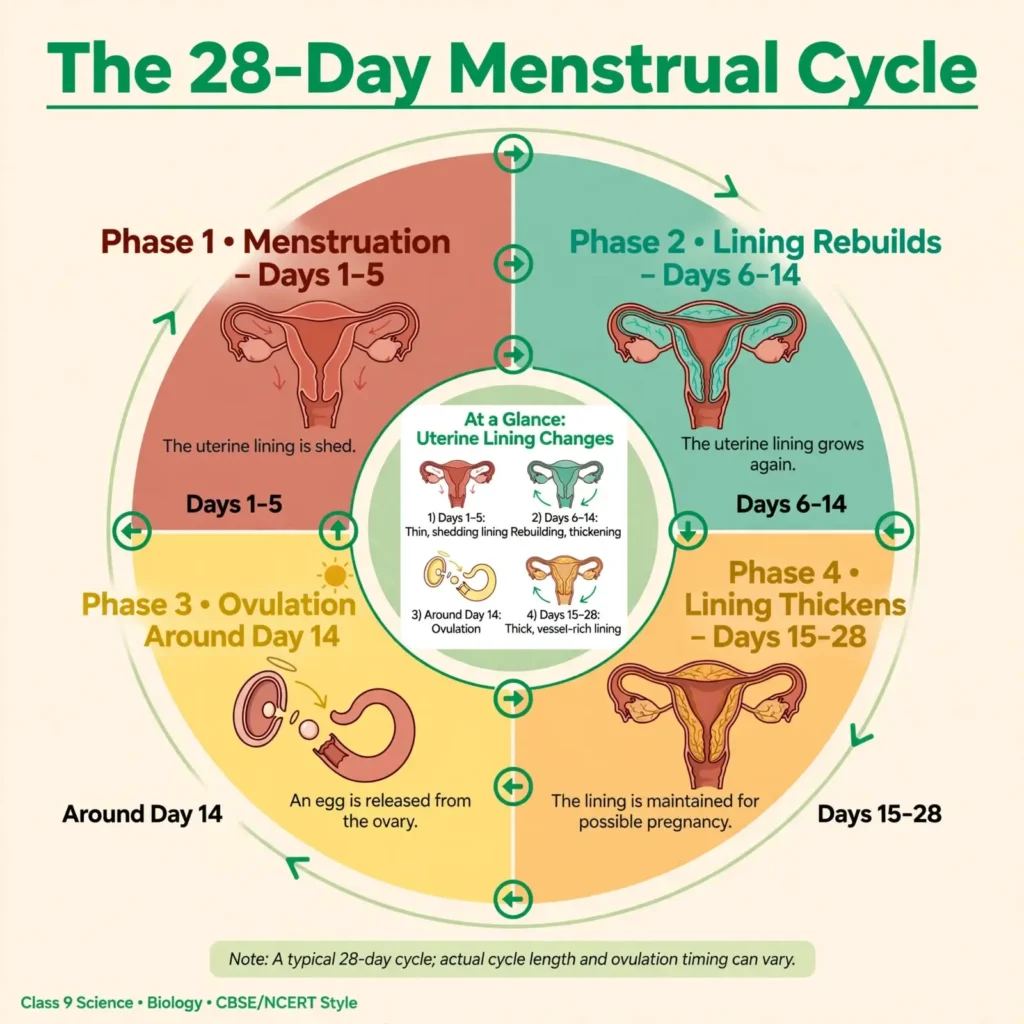
If the egg is not fertilised, it stays viable for about a day and then degenerates. The inner lining of the uterus, which had become thick and rich in blood vessels, is no longer needed, so it sheds. This lining, with some blood, leaves the body through the vagina. This process is called menstruation (a period) and usually lasts 3 to 7 days.
Definition (NCERT-based): The cycle of ovulation, preparation of the uterus and menstruation, which repeats typically every 21–35 days (often around 28 days), is called the menstrual cycle. It starts at puberty and continues until menopause, around the age of 50.
The four stages of a typical 28-day cycle
| Days | Stage | What happens |
|---|---|---|
| Day 1 – 5 | Menstruation | The uterine lining is shed with some blood |
| Day 6 – 14 | Lining rebuilds (egg matures) | The uterine lining gradually rebuilds while an egg starts maturing in the ovary |
| Day 14 | Ovulation | The ovary releases a mature egg |
| Day 15 – 28 | Lining thickens further | The lining becomes thicker and rich in blood vessels; if there is no fertilisation, it begins to break down at about day 28 and the cycle repeats |
Solved Example – Predicting the next period (NCERT Pause and Ponder 7)
Given: Cycle length = 28 days; last period began on 5 March. To find: The date of the next period (and the likely day of ovulation). Formula: Next period = first day of last period + cycle length. Solution: 5 March + 28 days. March has 31 days, so 5 + 28 = 33, and 33 − 31 = 2. This gives 2 April. (Check by counting: if 5 March is day 1, then 1 April is day 28, so day 29, the start of the next cycle, is 2 April.) Ovulation is about day 14, which is 5 + 13 = 18 March. Answer: The next period is most likely on 2 April; ovulation is expected around 18 March.
Why does the cycle stop during pregnancy? (NCERT Exercise 5) After fertilisation, the zygote implants in the thick uterine lining, which is needed to nourish the developing embryo. The lining therefore is not shed, and menstruation does not occur until after the baby is born.
Is ovulation always on day 14? (NCERT Exercise 13) No. Day 14 is typical only for a 28-day cycle. Cycle length varies from person to person, usually 21–35 days, and can change from month to month, so the day of ovulation shifts too. Roughly, ovulation occurs about 14 days before the next period starts.
Menstrual hygiene (NCERT)
- Use clean menstrual products such as sanitary pads (preferably biodegradable), tampons or menstrual cups.
- Wash the genital area with water; avoid soap, as it can disturb the natural bacterial balance.
- Wash hands with soap and water before and after changing a pad.
- Change pads every 4–6 hours, or more often if the flow is heavy.
- Wrap used pads in newspaper or their wrapper and put them in a bin; do not flush them. Dry reusable pads completely before reuse.
- Menstruation is a sign of a healthy reproductive system, not something to be ashamed of.
Common mistakes
- The first day of bleeding is Day 1; do not count from ovulation.
- Hormone names such as FSH and LH, and terms like corpus luteum, belong to higher classes. NCERT Class 9 says only that hormones regulate these changes, so a simple, correct statement is enough.
- Menarche (the first period) and menopause: NCERT gives puberty onset at about 10–14 years and menopause at around 50 years.
Exam point: Menstrual cycle ≈ 28 days (range 21–35); ovulation around day 14; menstruation lasts about 3–7 days.
Reproductive Health and Hygiene
Introduction to Birth Control Methods and Importance
Reproductive health means well-being, physical, mental and social, in matters of the reproductive system. It includes healthy reproductive organs, correct knowledge, hygiene and responsible decisions.
Becoming sexually mature is not the same as being ready for adult responsibility. Sexual maturity (sperm production in boys, menstrual cycles in girls) happens gradually, but emotional maturity takes longer. Being emotionally mature means handling feelings, communicating clearly and making thoughtful decisions. Responsible choices help prevent unplanned pregnancies and infections and support healthy relationships.
Simple hygiene habits
- Keep the private parts clean with water, and wear clean, comfortable cotton underwear.
- Wash hands before and after using the toilet.
- Do not ignore itching, unusual discharge or other signs of infection. See a doctor.
- Follow the menstrual hygiene practices described above.
- Eat a balanced diet, exercise, and get correct information about adolescent changes.
Sexually Transmitted Infections (STIs). Because sexual activity involves close physical contact, some infections can pass from an infected person to an uninfected person. These are STIs and include gonorrhoea, herpes, syphilis, genital warts and HIV (which can eventually lead to AIDS). Some of them are not yet curable. Using condoms can prevent their transmission and also helps prevent pregnancy.
Birth control (contraception) means methods used to prevent pregnancy.
Why is birth control important?
- It helps in controlling population growth.
- It allows a proper gap between children, so mother and children stay healthy.
- It helps prevent early or unwanted pregnancies and protects a mother’s health.
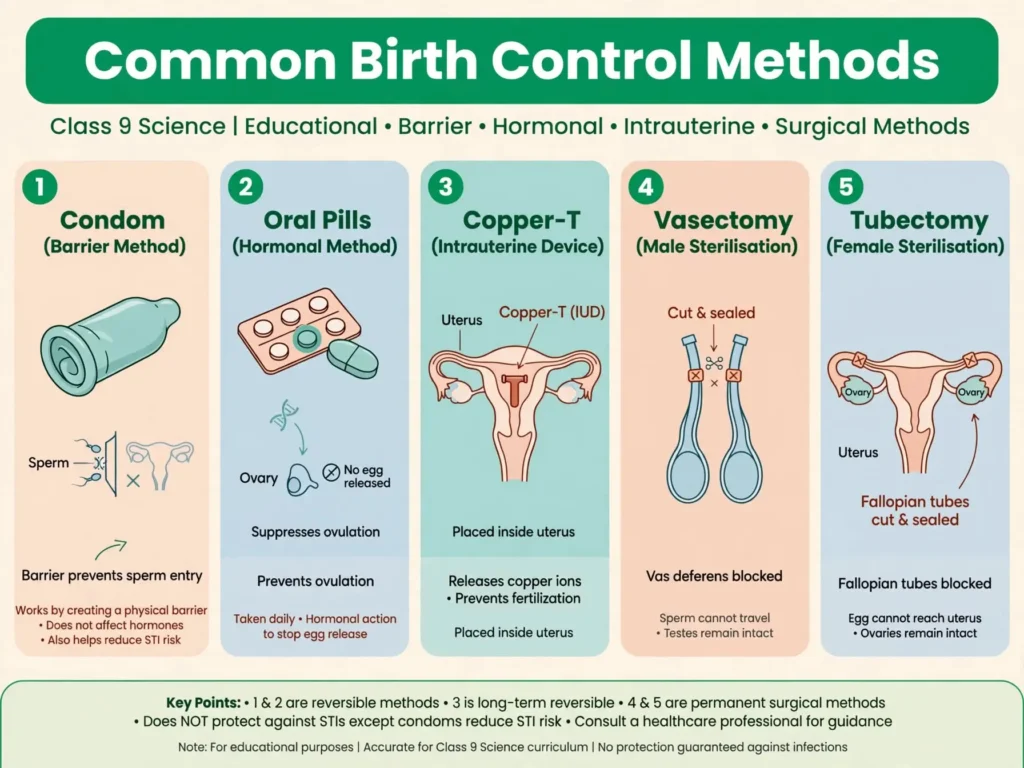
Birth control methods
| Method | How it works | Points to remember | In NCERT text? |
|---|---|---|---|
| Barrier methods – condoms, vaginal covers | Stop sperm from reaching the egg | Condoms also help protect against STIs | Yes |
| Oral pills (hormonal) | Medicines that change the release of eggs by altering hormones | May have side effects; they do not protect against STIs | Yes |
| Intra-uterine devices (IUDs), e.g., Copper-T | Placed in the uterus by a doctor to prevent pregnancy | May sometimes irritate the uterus; Copper-T 375 works for about 5 years and Copper-T 380A for about 10 years in India’s family-planning programme | Yes (duration is supplementary) |
| Surgical methods | Vasectomy (males): the vas deferens is blocked so sperm cannot come out. Tubectomy (females): the fallopian tubes are blocked so the egg and sperm cannot meet | Meant to be permanent; very highly effective, but no method is described as 100 per cent | Yes |
| Natural method (fertile-period awareness) | Avoiding intercourse around the fertile period | Less reliable because ovulation day varies from cycle to cycle | No (extra) |
Abortion and the law (NCERT). In some cases an unwanted pregnancy can be removed by surgery, generally only within the first trimester when the embryo is very small. This is called abortion. Sex-selective abortion, driven by a preference for a particular gender, leads to a serious imbalance in the sex ratio, so prenatal sex determination is strictly prohibited by law in India.
Bridging Science and Society (NCERT). Indian scientists at the Central Drug Research Institute (CDRI), Lucknow, developed the world’s first non-steroidal and non-hormonal oral contraceptive pill. It is taken once a week and is provided free through the National Family Planning Programme.
Common mistakes
- Oral pills prevent pregnancy but do not protect against STIs. Only barrier methods like condoms reduce STI risk (NCERT Pause and Ponder 10).
- Do not call vasectomy “female sterilisation”. Vasectomy is for males; tubectomy is for females.
Exam point: Condoms prevent both pregnancy and STIs; oral pills act on hormones; Copper-T is an IUD; vasectomy and tubectomy are surgical, permanent methods.
Practicals (Exp. 6, 7)
The CBSE 2026-27 practical list for Class 9 Science names these two experiments for this chapter.
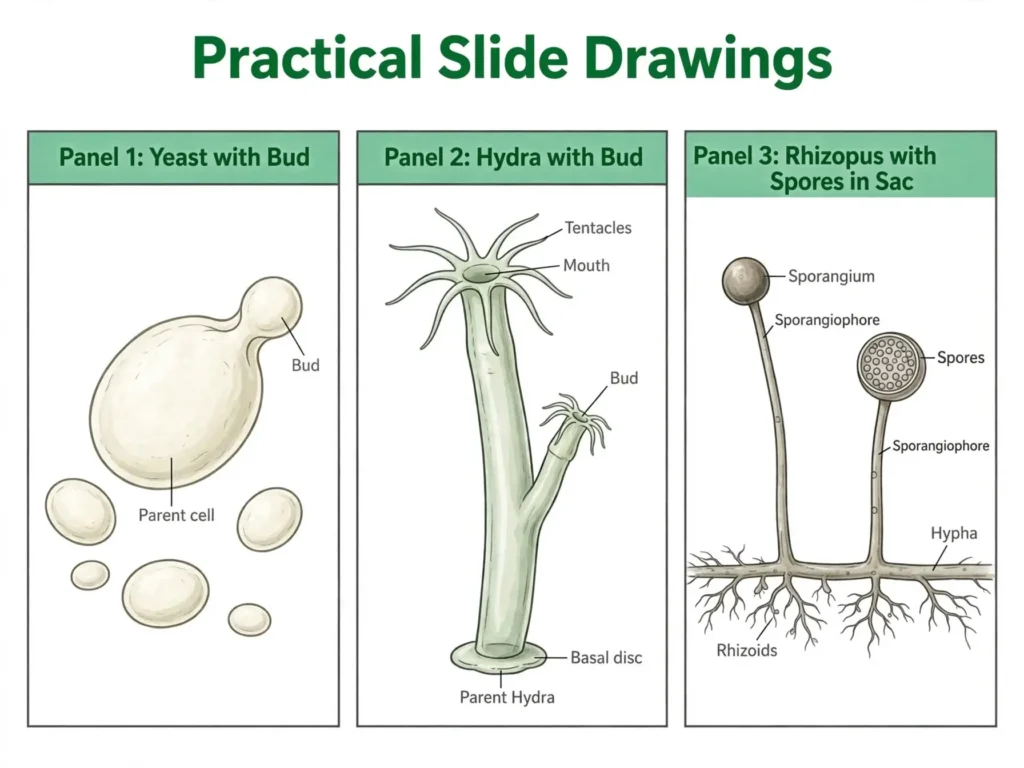
- Exp. 6: To study (a) budding in yeast and Hydra, and (b) spore formation in bread mould, with the help of prepared slides.
- Exp. 7: To study and identify different parts of a typical bisexual flower; draw labelled diagrams.
Exp. 6 – Budding in Yeast and Hydra; Spore Formation in Bread Mould
Aim: To observe budding in yeast and hydra and spore formation in bread mould.
Materials required: Compound microscope, prepared slides of yeast budding, hydra budding and Rhizopus sporangia; (for the NCERT activity version) yeast granules, sugar solution (1 g sugar in 10 mL water), test tube with cotton plug, glass slide, coverslip, dropper, bread or roti, plastic or steel box (moist chamber) with cotton and tissue paper, magnifying glass, cotton blue stain, needle.
Procedure
- Place the prepared slide of yeast on the stage and observe first under low power (10X), then high power (about 40X).
- (Activity 11.2 if you make your own slide) Put 20 mL of sugar solution in a test tube, add a pinch of yeast, plug with cotton and keep it in a warm place for 1–2 hours. Place a small drop on a slide, cover with a coverslip and observe.
- Observe the prepared slide of hydra with buds.
- Observe the prepared slide of bread mould (Rhizopus). (Activity 11.3 version: moisten a slice of bread, keep it in a moist chamber in a warm, dark place, and observe daily for about 3 days without touching the mould. With your teacher’s guidance, transfer a little mould to a slide with cotton blue stain and observe.)
- Draw neat labelled diagrams.
Observations
- Yeast: small, round outgrowths (buds) emerge from the parent cells; the bud is smaller than the parent, and buds may stay attached for a while.
- Hydra: the parent body shows a bud on its side, which later detaches to become a new hydra. Several buds may be seen at the same time.
- Bread mould: thread-like hyphae with a round sac at the tip; tiny round spores are seen inside the sac.
Conclusion: Yeast and hydra reproduce asexually by budding; bread mould reproduces by forming spores.
Precautions: Do not move the slide while observing. Do not touch the mould directly or smell it closely; handle it only under your teacher’s guidance and wash your hands afterwards. Keep the moist chamber warm (25–35 °C) and moist but not dripping.
Exp. 7 – Parts of a Typical Bisexual Flower
Aim: To study and identify the parts of a bisexual flower and draw labelled diagrams.
Materials required: A fresh bisexual flower (hibiscus or china rose is a good choice), forceps, blade, magnifying lens or dissecting microscope, white paper.
Procedure
- Hold the flower and look from the outer whorl to the inner whorl.
- Identify and separate the sepals (green), petals (coloured), stamens and pistil. Note whether sepals and petals are fused.
- Look at a stamen: identify the filament and the anther, and see the pollen grains.
- Look at the pistil: identify the stigma, style and ovary.
- Cut a transverse and a longitudinal section of the ovary and observe the ovules.
- Record your observations in a table and draw labelled diagrams.
Observation table (like NCERT Table 11.1):
| Part | Present? | Colour / feature | Function |
|---|---|---|---|
| Sepal | Yes | Green, thin | Protects the bud |
| Petal | Yes | Coloured | Attracts pollinators |
| Stamen | Yes | Anther + filament | Produces pollen (male) |
| Pistil | Yes | Stigma, style, ovary | Receives pollen; ovules inside ovary (female) |
Conclusion: A bisexual flower has both male (stamen) and female (pistil) reproductive parts.
Viva voce – quick answers
- Which part produces pollen? The anther.
- Where are the ovules? Inside the ovary.
- What is a bisexual flower? One that has both stamens and pistil.
- Which is the outermost whorl? The calyx (sepals).
- Why do yeast cells bud best in sugar solution? The sugar provides food and warmth lets them become active.
- Which asexual method does bread mould use? Spore formation.
Optional classroom activities (not in the official practical list)
- Pollen germination. NCERT Exercise 10 describes slides with pollen in sugar solutions of 0%, 2.5%, 5%, 7.5% and 10%. A simple version: put a drop of about 10% sugar solution on a slide, dust fresh pollen (for example from hibiscus) on it, cover, and look under a microscope after some time (germination can take from several minutes to an hour or more). You may see a pollen tube growing from a pollen grain. Teacher’s note: research labs use the Brewbaker–Kwack medium (about 10% sucrose with small amounts of boric acid and calcium nitrate), and the best medium varies from species to species; for Class 9, sugar solution alone is what NCERT uses.
- Pea-flower pollination experiment (Activity 11.6) with muslin bags, as described under Pollination.
- Extra slides sometimes shown in schools: binary fission in amoeba and the T.S. of testis and ovary. These are not in the CBSE 2026-27 list, so treat them as bonus observations.
Conclusion
Reproduction is what keeps every species going. Some organisms, such as yeast, hydra, bread mould and plants like potato and Bryophyllum, can make copies of themselves from a single parent. Others, including flowering plants and humans, combine gametes from two parents, which shuffles chromosomes and creates the variation that helps species adapt. In a flower, pollination brings pollen to the stigma, a pollen tube carries the male gamete to the ovule, and after fertilisation the ovule becomes a seed and the ovary becomes a fruit. In humans, sperm made in the testes meet an egg made in the ovary, usually in the oviduct, and the zygote implants in the uterus. If no fertilisation happens, the monthly menstrual cycle repeats. Understanding all of this also helps you make informed, responsible choices about health, hygiene and contraception.
Quick Summary
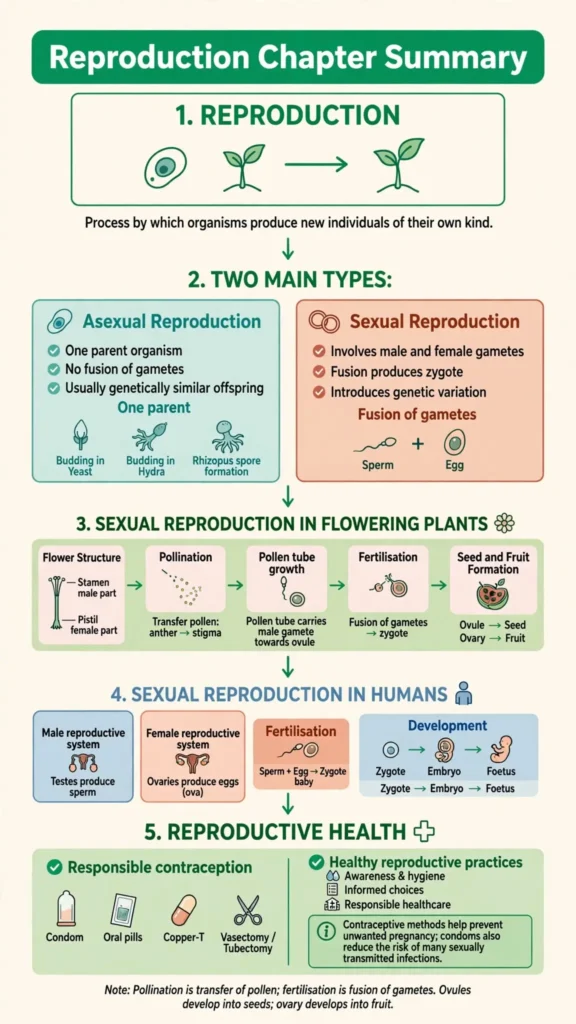
- Reproduction produces new individuals of the same kind. Asexual = one parent, mitosis, clones (budding in yeast and hydra, spores in Rhizopus, vegetative propagation by cutting, grafting, layering, tissue culture). Sexual = two parents, gametes fuse, variation.
- Meiosis halves the chromosome number (46 → 23) and shuffles characters: 2³ = 8 combinations with 3 pairs, 2²³ = 8,388,608 with 23 pairs.
- Flowers: stamen (male) and pistil (female). Pollination (anther → stigma; self or cross) → pollen tube → fertilisation → zygote → embryo; ovule → seed, ovary → fruit. Seeds are dispersed by wind, water and animals.
- Humans: testes (sperm, testosterone, outside the body for a lower temperature), ovaries (eggs), fertilisation in the oviduct, implantation in the uterus, pregnancy about nine months in three trimesters; zygote has 46 chromosomes. Menstrual cycle ≈ 28 days (21–35), ovulation around day 14, menstruation 3–7 days.
- Reproductive health: hygiene, menstrual care, STIs (gonorrhoea, herpes, syphilis, genital warts, HIV/AIDS), and contraception (condom, pills, Copper-T, vasectomy, tubectomy). Condoms also help protect against STIs.
Previous Year and Practice Questions
Class 9 Science Ch 11 Previous Year Questions
Frequently asked questions from CBSE exam papers on Reproduction: How Life Continues. Tap a question to view a quick-answer guide.
1 Define reproduction. Why is it considered a vital biological process? +
2 Distinguish between asexual and sexual reproduction. Give one example of each. +
3 Explain vegetative propagation in plants. How is it useful in agriculture? +
4 Describe the process of budding in yeast with the help of a diagram. +
5 What is pollination? Differentiate between self-pollination and cross-pollination. +
6 A flower’s anthers are removed before it matures. Later, pollen from another plant of same species is dusted onto its stigma and seeds are produced. Which process has been ensured? +
7 Explain the role of meiosis in sexual reproduction. How does it contribute to genetic variation? +
8 Describe the structure of a pistil and explain its role in fertilisation. +
9 Why do animals with external fertilisation produce a large number of eggs? +
10 Explain the menstrual cycle in human females. What happens if fertilisation does not occur? +
11 A couple uses oral contraceptive pills but not condoms. Which risks remain and why? +
12 When does a farmer prefer asexual vs sexual methods of reproduction for crop production? +
Frequently Asked Questions (FAQs)
Do I need to learn double fertilisation for Class 9?
No. Double fertilisation, endosperm and triple fusion appear in senior classes. In Class 9 NCERT, the male gamete fuses with the egg to form a zygote, the ovule becomes a seed and the ovary becomes a fruit.
Is wheat self-pollinated or wind-pollinated?
The NCERT text lists wheat among plants with light, wind-carried pollen, but wheat flowers are mainly self-pollinating (NCERT Exercise 11 hints at this). For a safe wind-pollination example, use maize.
What is the difference between pollination and fertilisation?
Pollination is the transfer of pollen from the anther to the stigma. Fertilisation is the fusion of the male gamete (carried by the pollen tube) with the egg in the ovule, forming a zygote.
Why do the testes lie outside the body?
Sperm formation needs a temperature slightly lower than body temperature, roughly 2–3 °C lower. The scrotum keeps the testes cooler.
Is the menstrual cycle always 28 days, and does ovulation always occur on day 14?
No. 28 days is only an average. The cycle typically ranges from 21 to 35 days, and ovulation occurs about 14 days before the next period, so its day changes with cycle length.
Why does menstruation not occur during pregnancy?
After the zygote implants, the thick uterine lining is needed to nourish the embryo, so it is not shed.
Why do farmers use grafting, layering or tissue culture instead of seeds?
These are vegetative propagation methods. They produce genetically identical plants quickly, so desirable qualities such as fruit quality or yield are preserved, and tissue culture can give healthy, virus-free plantlets on a large scale.
Which birth control methods protect against STIs?
Condoms (barrier methods) reduce the risk of STIs and also prevent pregnancy. Oral pills, IUDs and surgical methods prevent pregnancy but do not protect against STIs.
Continue Reading
Continue Reading — Class 9 Science (NCERT Exploration)
Sources and Further Reading
Sources and Further Reading — Class 9 Science (NCERT Exploration)
Subscribe to keep reading
You've used your free notes for now. Get Delhi Pathshala Premium for unlimited access.
Subscribe — ₹29/30 days