
Contents
- What You Will Learn
- Key Terms at a Glance
- Biodiversity and Why We Classify
- What Is Biodiversity?
- Why Do We Classify Organisms?
- Levels of Classification (Hierarchy)
- Five Kingdom Classification
- Whittaker’s Five Kingdoms: Key Features with Examples
- Kingdom Monera
- Kingdom Protista
- Kingdom Fungi
- Kingdom Plantae
- Kingdom Animalia
- Ecological Role of Diverse Organisms and Lichens
- Three Domains of Life
- Major Divisions of Plants and Animals
- Plants
- 1. Thallophyta (Algae)
- 2. Bryophyta: the “Amphibians” of the Plant Kingdom
- 3. Pteridophyta: the First Vascular Plants
- 4. Gymnosperms: Naked-Seed Plants
- 5. Angiosperms: Flowering Plants (Covered-Seed Plants)
- Animals
- A. Invertebrates
- B. Vertebrates
- Binomial Nomenclature
- Rules of Binomial Nomenclature
- Importance of Binomial Nomenclature
- Scientific Names to Remember
- Acellular Entities: Viruses
- How Were Viruses Discovered?
- Structure of a Virus
- Living and Non-living Features
- Types of Viruses and Examples
- Diseases Caused by Viruses
- Importance of Viruses
- Practical (Exp. 8)
- Procedure
- Observations: What to Write
- Precautions
- Viva Questions
- Conclusion
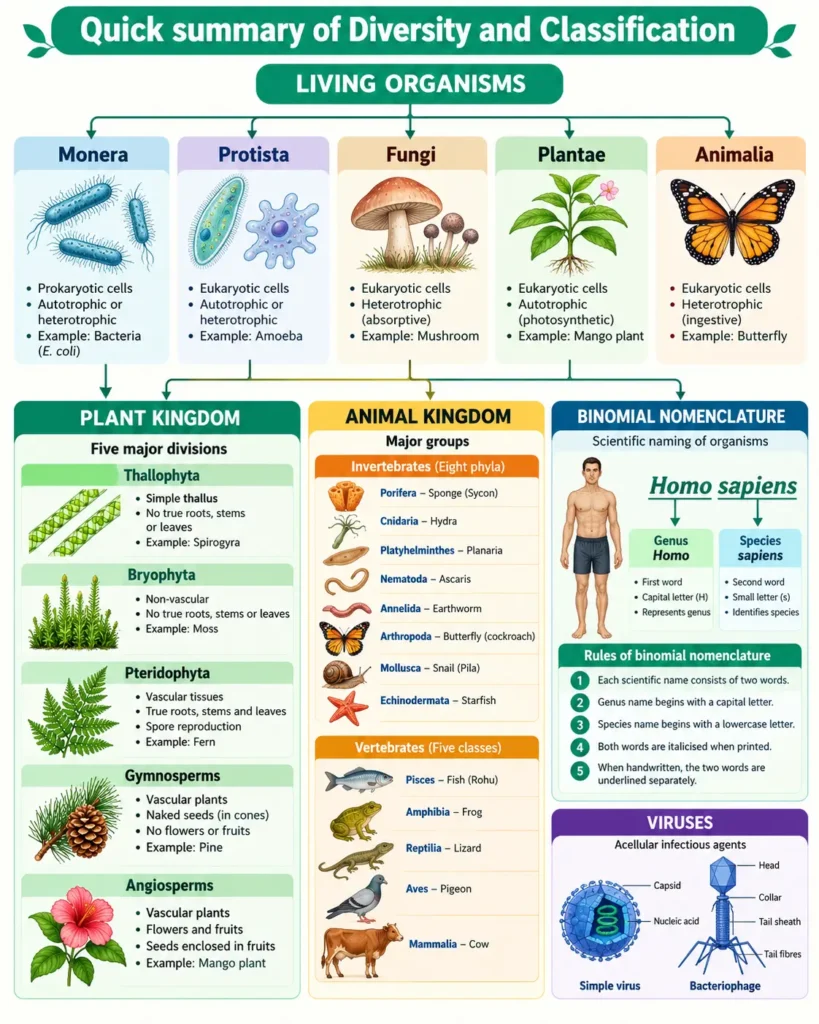
- Quick Summary
- Previous Year and Practice Questions
- Frequently Asked Questions
- Continue Reading
- External References
Quick answer: Scientists classify living things into groups so that the millions of organisms on Earth can be studied in an orderly way. R.H. Whittaker’s Five Kingdom system (1969) places all cellular organisms in Monera, Protista, Fungi, Plantae and Animalia. Plants are divided into five major groups and animals into several phyla. Every organism gets a two-part scientific name under binomial nomenclature, and viruses, which are acellular, are kept outside the five kingdoms. These notes cover all of that, plus the three-domain view, the ecological role of organisms, the Exp. 8 practical, practice questions and FAQs, for the CBSE session 2026-27.
Note for students: The 2026-27 NCERT Science textbook for Class 9 is called Exploration. This topic is Chapter 12 in the book and is titled Patterns in Life: Diversity and Classification. The CBSE curriculum document lists the same chapter as “Diversity” in Unit I, World of Living. The older textbook had a similar topic as Chapter 7, Diversity in Living Organisms. The core ideas are alike, but the chapter number, activities and exercise questions are different, so always follow your own textbook and teacher.
What You Will Learn
| In this chapter you will learn… | Where to find it |
|---|---|
| What biodiversity is and why we classify organisms | Biodiversity and Why We Classify |
| Whittaker’s five kingdoms with features and examples | Five Kingdom Classification |
| How the three-domain system looks at life at the molecular level | Three Domains of Life |
| The five major divisions of plants | Plants |
| The major phyla of invertebrates and the five classes of vertebrates | Animals |
| Rules of scientific naming and why they matter | Binomial Nomenclature |
| Why viruses are acellular and how they differ from cells | Acellular Entities: Viruses |
| What to observe and write in Exp. 8 | Practical (Exp. 8) |
| Practice questions, case-based questions and FAQs | Practice Questions |
Key Terms at a Glance
| Term | Meaning in one line |
|---|---|
| Biodiversity | The great variety of living organisms found in all habitats on Earth |
| Classification | Grouping of organisms on the basis of similarities and differences |
| Kingdom | The largest group in the five-kingdom system (Monera, Protista, Fungi, Plantae, Animalia) |
| Prokaryote / Eukaryote | Organism whose cells have no true nucleus / have a true nucleus with a membrane |
| Autotroph / Heterotroph | Organism that makes its own food / depends on others for food |
| Saprophyte | Organism that feeds on dead and decaying matter |
| Thallus | Plant body not differentiated into root, stem and leaves |
| Vascular tissue | Xylem and phloem, the tissues that carry water and food in plants |
| Gymnosperm / Angiosperm | Plant with naked seeds / plant with seeds enclosed in a fruit |
| Phylum | A major group of animals sharing a basic body design |
| Binomial nomenclature | Two-name system of scientific naming: Genus + species |
| Acellular | Not made of cells (as in viruses) |
| Capsid | The protein coat of a virus |
| Obligate parasite | An organism that can multiply only inside a living host cell |
Biodiversity and Why We Classify
What Is Biodiversity?
Think of a walk from a snow-covered Himalayan slope to a coral reef near the Andaman Sea. On the way you would meet microscopic algae, towering trees, jellyfish, insects and eagles. This huge variety of living things is called biodiversity. It is not just “many species”; it is a web in which every organism has a job.
- Tiny algae in the oceans release much of the oxygen we breathe.
- Fungi and bacteria decompose fallen leaves and dead matter and return nutrients to the soil.
- Bees, birds and bats pollinate flowers.
- Green plants capture sunlight and make the food on which nearly all life depends.
Humans depend on this variety for food, shelter, medicines and livelihood. Farmers, for example, have kept many crop varieties alive for centuries because each has some useful trait.
Why Do We Classify Organisms?
Imagine a library in which no book is arranged in any order. Finding one book would take forever. Classification is the arranging system of the living world.
- It makes the study of millions of organisms easy.
- It shows which organisms are closely related and which are far apart.
- It helps us identify an unknown organism by matching its features with a group.
- It helps in farming and conservation. If we can tell a pollinator from a pest, or a useful fungus from a harmful one, we can protect crops and habitats better.
Basis of classification: Scientists look at features such as the type of cell (prokaryotic or eukaryotic), the number of cells (unicellular or multicellular), how the body is organised, and the mode of nutrition. For plants and animals we also look at body design, presence of vascular tissue, seeds, symmetry and backbone, as you will see below.
Levels of Classification (Hierarchy)
Groups are arranged like a ladder, from the biggest group to the smallest:
Kingdom → Phylum → Class → Order → Family → Genus → Species
For plants, the word division is often used in place of phylum. Each step down the ladder holds organisms that are more and more alike. Here is the human being as an example.
| Rank | Example (human) |
|---|---|
| Kingdom | Animalia |
| Phylum | Chordata |
| Class | Mammalia |
| Order | Primates |
| Family | Hominidae |
| Genus | Homo |
| Species | Homo sapiens |
Exam point: Genus and species are the two lowest levels, and they form the scientific name. Check your textbook to see how far your teacher wants this ladder learnt; for most answers the names of the ranks and one example are enough.
Five Kingdom Classification
Whittaker’s Five Kingdoms: Key Features with Examples
There are millions of organisms on Earth. To study them easily, scientists classify them.
Definition: Classification is the grouping of organisms on the basis of similarities and differences in structure, nutrition and body organisation.
In 1969, the American biologist R.H. Whittaker proposed the Five Kingdom Classification. He placed all cellular organisms into five large groups called kingdoms. For Class 9, remember the three main criteria he used:
- Cell structure: prokaryotic or eukaryotic
- Body organisation: unicellular or multicellular
- Mode of nutrition: autotrophic (makes its own food) or heterotrophic (depends on others)
(Whittaker also took evolutionary relationships into account, but Class 9 questions focus on these three.)
Kingdom Monera
Monera is the kingdom of bacteria and their relatives. It is the only kingdom made of prokaryotes.
- Prokaryotic: no true nucleus and no membrane-bound organelles. The genetic material lies loose in the cytoplasm. (You can revise the difference in our notes on prokaryotic and eukaryotic cells.)
- Unicellular: each organism is a single cell.
- Cell wall: most members have a cell wall. In bacteria it is made of peptidoglycan. A few members, such as Mycoplasma, have no cell wall at all.
- Nutrition: some are autotrophic (the cyanobacteria, also called blue-green algae, make food by photosynthesis) and many are heterotrophic (most bacteria).
- Examples: E. coli and other bacteria, Anabaena (a cyanobacterium), Mycoplasma.
- Some are useful (they help make curd and fix nitrogen); some cause diseases.
Common mistake: Calling cyanobacteria “plants” because they photosynthesise. They are prokaryotes, so they belong to Monera. They also have no chloroplasts.
Kingdom Protista
Protista contains unicellular eukaryotes.
- Eukaryotic: a true nucleus is present.
- Mostly unicellular and mostly found in water or moist places.
- Nutrition: autotrophic (for example Euglena in light, and diatoms) or heterotrophic (protozoans such as Amoeba and Paramecium). Euglena can do both, which makes it a favourite exam example.
- Movement: many move with pseudopodia (Amoeba), cilia (Paramecium) or a flagellum (Euglena).
- Examples: Amoeba, Paramecium, Euglena, diatoms.
Kingdom Fungi
Fungi include yeasts, moulds and mushrooms.
- Eukaryotic. Most are multicellular; yeast is the well-known unicellular exception.
- Cell wall made of chitin.
- Nutrition: heterotrophic. Most are saprophytes that feed on dead and decaying matter, so they act as decomposers. Some fungi are parasites, and some live in partnership with other organisms (see lichens below).
- Body is made of thread-like hyphae, and a network of hyphae forms a mycelium.
- Examples: yeast, Rhizopus (bread mould), mushroom (Agaricus), Penicillium.
Common mistake: Treating a mushroom as a plant. It has no chlorophyll, no photosynthesis and a chitin wall, so it is a fungus.
Kingdom Plantae
- Eukaryotic and multicellular.
- Cell wall made of cellulose.
- Autotrophic: they make food by photosynthesis using chlorophyll.
- Non-motile: the whole plant stays fixed in one place.
- Examples: Spirogyra and other multicellular algae, moss, fern, pine, mango and all flowering plants.
(In Whittaker’s system, unicellular algae go to Protista and multicellular algae such as Spirogyra go to Plantae.)
Kingdom Animalia
- Eukaryotic and multicellular.
- No cell wall.
- Heterotrophic, holozoic: they take in food and digest it inside the body.
- Motile: most animals can move from place to place. Some, such as adult sponges, are fixed.
- Examples: sponges, Hydra, earthworm, insects, fish, birds, humans.
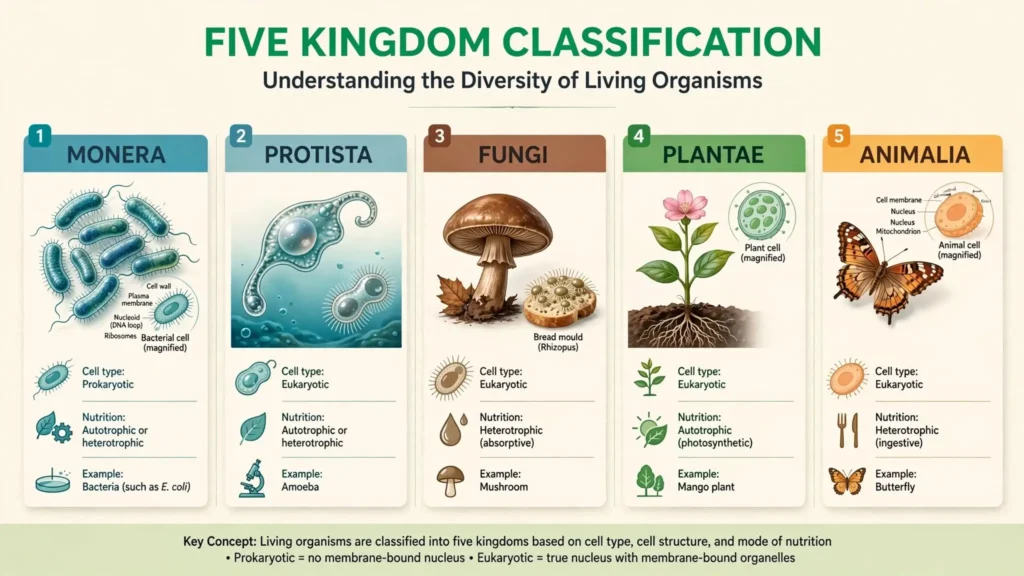
For the exam, learn this table:
| Kingdom | Cell type | Body | Nutrition | Example |
|---|---|---|---|---|
| Monera | Prokaryotic | Unicellular | Autotrophic or heterotrophic | Bacteria, Anabaena |
| Protista | Eukaryotic | Unicellular | Autotrophic or heterotrophic | Amoeba, Paramecium, Euglena |
| Fungi | Eukaryotic | Mostly multicellular (yeast is unicellular) | Heterotrophic, mostly saprophytic | Mushroom, yeast |
| Plantae | Eukaryotic | Multicellular | Autotrophic | Mango, fern |
| Animalia | Eukaryotic | Multicellular | Heterotrophic, holozoic | Humans, fish |
Exam point: Whittaker gave five kingdoms on the basis of cell structure, body organisation and mode of nutrition. Monera is the only prokaryotic kingdom; the other four are eukaryotic.
Ecological Role of Diverse Organisms and Lichens
Different kingdoms do different jobs in nature: plants and cyanobacteria are the producers, animals are the consumers, and fungi and many bacteria are the decomposers. Without decomposers, dead leaves and bodies would pile up and nutrients would never return to the soil.
Organisms also depend on each other. A good example is a lichen, which is a partnership between a fungus and an alga (or a cyanobacterium) living together. The alga or cyanobacterium makes food by photosynthesis, and the fungus gives support and holds water and minerals. Lichens can grow on bare rock and tree bark, and they are sensitive to air pollution, so their presence or absence tells us something about the air.
Three Domains of Life
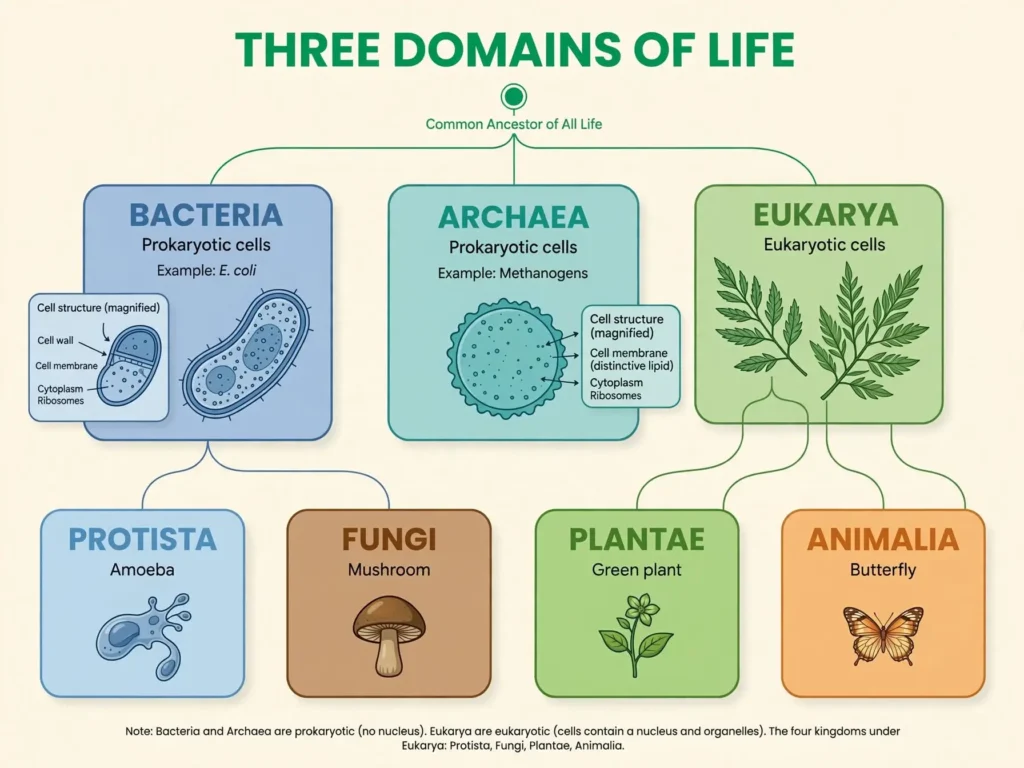
The five-kingdom system is based mainly on cell structure, body organisation and nutrition. Scientists later compared molecules such as ribosomal RNA, and the results led to another view. In 1990, Carl Woese, Otto Kandler and Mark Wheelis proposed that all cellular life should be placed in three big groups called domains, which sit above the kingdoms:
- Bacteria
- Archaea
- Eukarya
- Both Bacteria and Archaea are prokaryotic, but they are very different at the molecular level. In the five-kingdom system both were placed together in Monera.
- Eukarya contains all organisms with a true nucleus: Protista, Fungi, Plantae and Animalia.
- Many archaea live in extreme places such as very salty water, hot springs or oxygen-free mud.
| Five-kingdom view (Whittaker, 1969) | Three-domain view (Woese et al., 1990) |
|---|---|
| Based on cell structure, body organisation, nutrition | Based on molecular comparison (such as ribosomal RNA) |
| Monera is one kingdom | Monera’s members are split into Bacteria and Archaea |
| Highest level is the kingdom | Domain is a level above the kingdom |
Exam point: The syllabus asks you only to recognise the three domains and the idea that they are based on molecular evidence. You do not need to learn the details of archaeal biochemistry.
Major Divisions of Plants and Animals
Plants
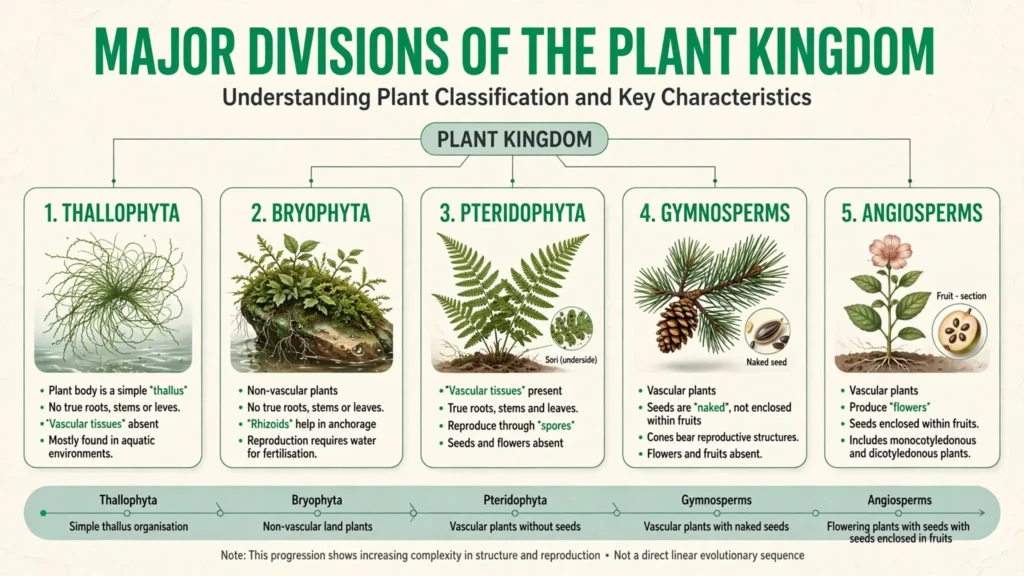
The plant kingdom is divided into five major divisions. The basis is a set of simple questions:
- Is the plant body differentiated into root, stem and leaves?
- Are special tissues for carrying water (vascular tissue) present?
- Does the plant produce seeds?
- Are the seeds naked, or enclosed inside a fruit?
1. Thallophyta (Algae)
- The body is not differentiated into root, stem and leaves. Such a body is called a thallus.
- No vascular tissue (no xylem and phloem).
- Mostly live in water.
- Examples: Spirogyra, Ulva, Chara.
2. Bryophyta: the “Amphibians” of the Plant Kingdom
- The body is differentiated into a stem-like and leaf-like structure but has no true roots. Thread-like rhizoids hold the plant in place instead.
- No vascular tissue.
- They live on land but need water for sexual reproduction, so they are called the amphibians of the plant kingdom.
- Examples: moss (Funaria), Marchantia, Riccia.
3. Pteridophyta: the First Vascular Plants
- The body is differentiated into true root, stem and leaves.
- Vascular tissue (xylem and phloem) is present. They are the first group in the sequence with a transport system.
- No seeds. They reproduce by spores.
- Examples: ferns, Marsilea, horsetail (Equisetum).
4. Gymnosperms: Naked-Seed Plants
- Root, stem, leaves and vascular tissue are present.
- Seeds are formed, but they are naked, which means they are not enclosed inside a fruit.
- Most are woody, evergreen plants. The leaves of pine and deodar are needle-like, but not every gymnosperm has needle leaves; Cycas has large, feather-like leaves.
- Examples: Cycas, Pinus (pine), deodar (Cedrus).
5. Angiosperms: Flowering Plants (Covered-Seed Plants)
- The most advanced and most widespread group of plants.
- Flowers are present for reproduction, and vascular tissue is present.
- Seeds are enclosed inside a fruit, which develops from the ovary of the flower.
- They are divided on the basis of the number of cotyledons (seed leaves) in the seed:
| Monocots | Dicots |
|---|---|
| One cotyledon in the seed | Two cotyledons in the seed |
| Wheat, rice, maize | Mango, gram, pea, mustard |
Comparison table for quick revision
| Group | Body differentiated? | Vascular tissue | Seeds | Example |
|---|---|---|---|---|
| Thallophyta | No (thallus) | Absent | No | Spirogyra |
| Bryophyta | Partly (no true roots; has rhizoids) | Absent | No | Moss |
| Pteridophyta | Yes | Present | No (spores) | Fern |
| Gymnosperms | Yes | Present | Yes, naked | Pinus |
| Angiosperms | Yes | Present | Yes, inside fruit | Mango |
Common mistakes
- Writing that pteridophytes were the first land plants. Bryophytes also live on land. Pteridophytes are the first with vascular tissue.
- Writing “all gymnosperms have needle-like leaves.”
- Mixing up naked seeds (gymnosperms) and covered seeds (angiosperms).
Exam point: Pteridophyta is the first division with vascular tissue. Gymnosperms have naked seeds; angiosperms have seeds covered inside a fruit.
Animals
The animal kingdom is divided into many groups called phyla (singular: phylum). The basis is body design, symmetry, presence of a backbone and other features. First, the big split:
- Invertebrates: no backbone.
- Vertebrates: backbone present. They belong to Phylum Chordata, subphylum Vertebrata.
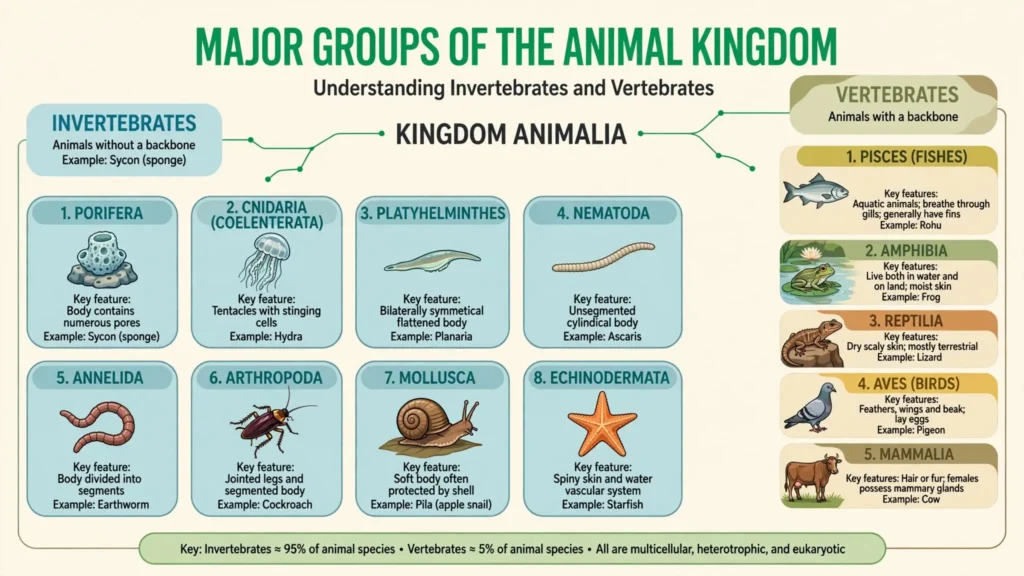
A. Invertebrates
| Phylum | Key features | Examples |
|---|---|---|
| Porifera (pore-bearing animals) | Body with many pores; fixed (non-moving) as adults | Sponge (Sycon) |
| Coelenterata (Cnidaria) | Sac-like body with tentacles around the mouth; live in water | Hydra, jellyfish |
| Platyhelminthes (flatworms) | Flat body; no true body cavity; many are parasites | Planaria, liver fluke, tapeworm |
| Nematoda (roundworms) | Cylindrical, unsegmented body | Ascaris, Wuchereria |
| Annelida (segmented worms) | Body divided into segments; true body cavity | Earthworm, leech |
| Arthropoda | Largest phylum; jointed legs; hard exoskeleton of chitin | Cockroach, spider, prawn, butterfly |
| Mollusca | Soft body, usually with a shell and a muscular foot | Snail, Pila, octopus |
| Echinodermata | Spiny skin; live only in the sea | Starfish, sea urchin |
B. Vertebrates
| Class | Key features | Examples |
|---|---|---|
| Pisces (fishes) | Live in water; breathe through gills; streamlined body with fins; cold-blooded | Rohu, shark |
| Amphibia | Live both in water and on land; moist skin; the young (tadpole) breathe with gills, adults with lungs and skin | Frog, toad, salamander |
| Reptilia (creeping animals) | Scaly skin; breathe through lungs; cold-blooded; most lay eggs on land | Lizard, snake, turtle, crocodile |
| Aves (birds) | Feathers and beak; forelimbs changed into wings; warm-blooded; lay eggs | Crow, parrot, pigeon |
| Mammalia | Mammary glands to feed the young; hair on the body; warm-blooded; most give birth to young ones | Humans, cow, dog, whale, bat |
Common mistakes
- Calling the whale a fish. It lives in water but breathes with lungs and feeds milk to its young, so it is a mammal. The bat is a flying mammal, not a bird.
- Writing that every mammal gives birth. A few, such as the platypus, lay eggs; “most mammals give birth” is the safe line.
- Writing that every reptile lays eggs. Most do, but some snakes and lizards give birth.
- Writing that all arthropods have three body parts. That is true of insects such as the cockroach and butterfly, not of every arthropod.
Exam point: Arthropoda is the largest phylum of the animal kingdom. All vertebrates have a backbone.
Binomial Nomenclature
In everyday life one organism has many names. The mango is aam in Hindi, and people in other states call it by other names. Using local names causes confusion when scientists from different places want to talk about the same organism.
To solve this, every organism is given one scientific name that is the same all over the world. This system is called binomial nomenclature.
Definition: Binomial nomenclature is a system of naming organisms with two names. The first name is the genus (generic name) and the second is the species (specific name).
The system was made popular by the Swedish naturalist Carolus Linnaeus, who is often called the father of modern taxonomy. You will see “Systema Naturae, 1758” quoted in many notes. That edition is the starting point for animal names, while for plants the starting point is his Species Plantarum of 1753. For the exam, writing “Linnaeus” is enough unless your teacher asks for the year.
Rules of Binomial Nomenclature
Examiners often ask for two or three rules, so learn all of them.
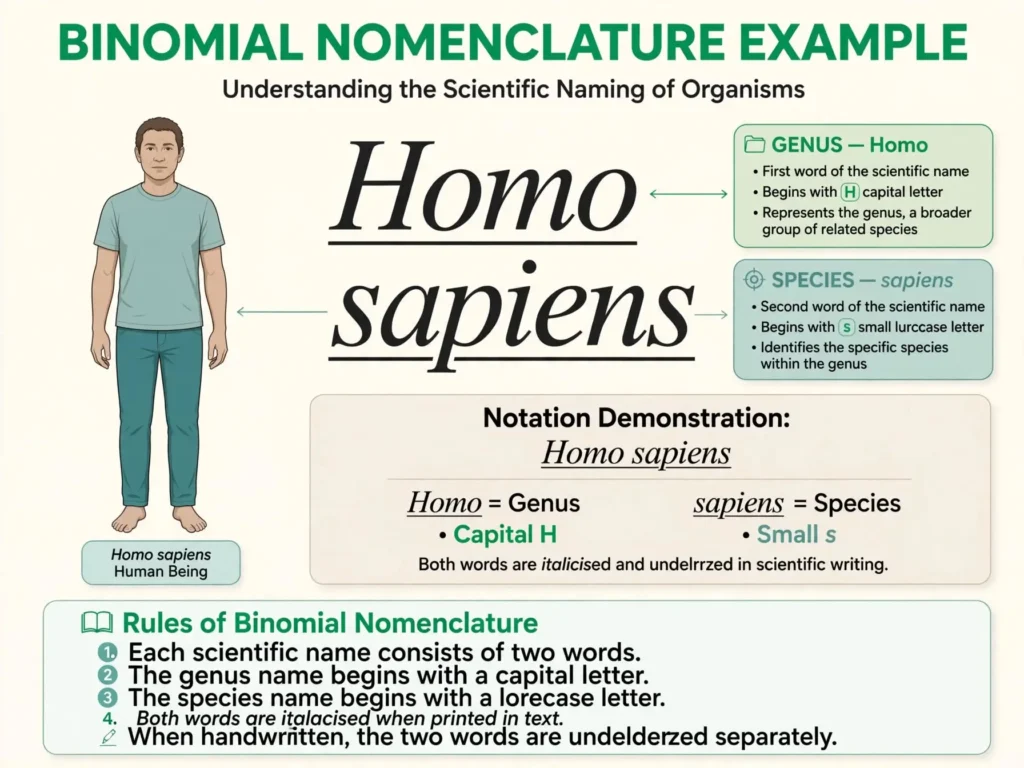
- The name has two parts: genus + species. In Homo sapiens, Homo is the genus and sapiens is the species. In Mangifera indica (mango), Mangifera is the genus and indica is the species.
- The genus name begins with a capital letter and the species name begins with a small letter.
- When printed, the name is in italics. When handwritten, the genus and the species are underlined separately. Example: Homo sapiens in print, and <u>Homo</u> <u>sapiens</u> in handwriting.
- Several species can share one genus name, but each species has its own species name within that genus. The tiger (Panthera tigris) and the lion (Panthera leo) share the genus Panthera. A species word can also appear in different genera, as indica does in Mangifera indica (mango) and Azadirachta indica (neem), but the full two-word name is never the same for two different organisms.
- Names are in Latin or Latinised form. Latin was long the common language of scholars, and it belongs to no single country.
Importance of Binomial Nomenclature
- It gives one correct, uniform name to an organism all over the world, so there is no confusion.
- It shows relationship: organisms in the same genus are closely related.
- It makes study and identification easier.
Scientific Names to Remember
| Common name | Scientific name |
|---|---|
| Human | Homo sapiens |
| Mango | Mangifera indica |
| Neem | Azadirachta indica |
| Pea | Pisum sativum |
| Housefly | Musca domestica |
| Tiger | Panthera tigris |
| Lion | Panthera leo |
Common mistake: Writing the genus in small letters, or the species with a capital letter, or forgetting to underline the two words separately when writing by hand.
Exam point: Binomial nomenclature means a two-name system, genus + species; the genus has a capital letter, the species has a small letter, and the name is written in italics when printed.
Acellular Entities: Viruses
Viruses are very small entities that are not included in Whittaker’s five kingdoms. The reason is simple: the five-kingdom system classifies organisms made of cells, and a virus is not made of cells.
Definition: Viruses are acellular entities, which means they are not made of cells. They show some features of living things and some of non-living things, so they are often described as a borderline between the living and the non-living.
How Were Viruses Discovered?
- 1892: The Russian scientist Dmitri Ivanovsky passed sap from diseased tobacco leaves through a filter fine enough to stop bacteria. The filtered sap still made healthy plants sick. He suspected a tiny bacterium or a bacterial poison.
- 1898: The Dutch scientist Martinus Beijerinck repeated the experiment and concluded that the cause was not a bacterium but a new kind of infectious agent that multiplies inside living cells of the host plant. He used the word virus for it. (Virus is a Latin word meaning poison.)
- 1935: The American biochemist Wendell M. Stanley crystallised the tobacco mosaic virus and showed that the crystals, when dissolved again, were still infectious.
Structure of a Virus
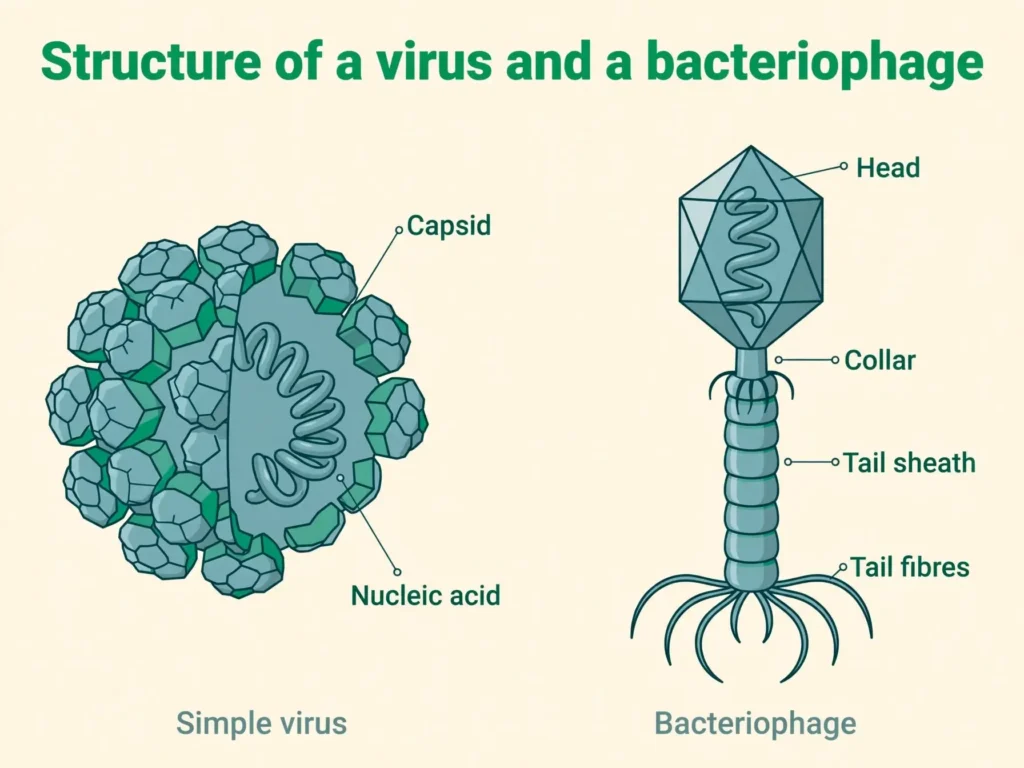
A virus is very simple. It has only two parts:
- A central core of genetic material, which is either DNA or RNA, never both.
- An outer protein coat called the capsid.
- There is no cell wall, no cytoplasm and no organelles such as mitochondria or ribosomes. That is why viruses are called acellular.
- Viruses are much smaller than bacteria and can be seen only with an electron microscope. Their size is usually measured in nanometres (nm); 1 nm is one-billionth of a metre. Most viruses fall roughly between 20 nm and 300 nm, though a few giant viruses are larger.
Living and Non-living Features
| Behaviour of viruses inside a host cell | Behaviour of viruses outside a host cell |
|---|---|
| They take over the host cell’s machinery, reproduce and multiply | They do not respire, grow or carry out metabolism |
| They have genetic material (DNA or RNA) that can change (mutate) | They can be crystallised like a chemical and stored |
Because they can multiply only inside a living host cell, viruses are called obligate parasites. Outside the host they stay inert.
Is a virus living or non-living? Scientists do not fully agree. Some say a virus is a non-living particle that becomes active when it enters a cell; others say that its ability to multiply and evolve makes it a form of life. For Class 9, write that viruses show characters of both and are acellular.
Types of Viruses and Examples
| Type | What it infects | Example | Genetic material |
|---|---|---|---|
| Bacteriophage | Bacteria | T2 phage | DNA |
| Plant virus | Plants | Tobacco mosaic virus (TMV), which causes mosaic disease in tobacco | RNA |
| Animal virus | Animals, including humans | Influenza virus, HIV (causes AIDS), coronavirus that causes COVID-19 | RNA |
| Animal virus | Animals, including humans | Smallpox virus | DNA |
Note that animal viruses can have either RNA or DNA, so do not write that all animal viruses are DNA viruses or all are RNA viruses.
Diseases Caused by Viruses
- In humans: common cold, influenza, AIDS, polio, smallpox, dengue, COVID-19, rabies.
- In plants: mosaic disease of tobacco, leaf curl of tomato.
- In animals: foot-and-mouth disease of cattle.
Importance of Viruses
Most of the viruses you study in school are disease-causing, but not every virus is harmful to humans. Some bacteriophages are used in research and in genetic engineering. Weakened or inactivated viruses (or parts of them) are used to prepare vaccines, and scientists also use modified viruses as carriers in gene therapy.
Common mistakes
- Writing that a virus has “both DNA and RNA”.
- Calling a virus a “cell” or saying it has a nucleus.
- Saying that viruses are classified in the Kingdom Monera because they are small.
Exam point: A virus is acellular, made of nucleic acid (DNA or RNA) plus a protein capsid, can be crystallised, is an obligate parasite, and is not placed in the five kingdoms. Ivanovsky showed the filterable agent in 1892, and Beijerinck explained it in 1898.
Practical (Exp. 8)
Aim: To study and identify specimens (or virtual specimens, slides or models) of different groups of organisms and write their important features.
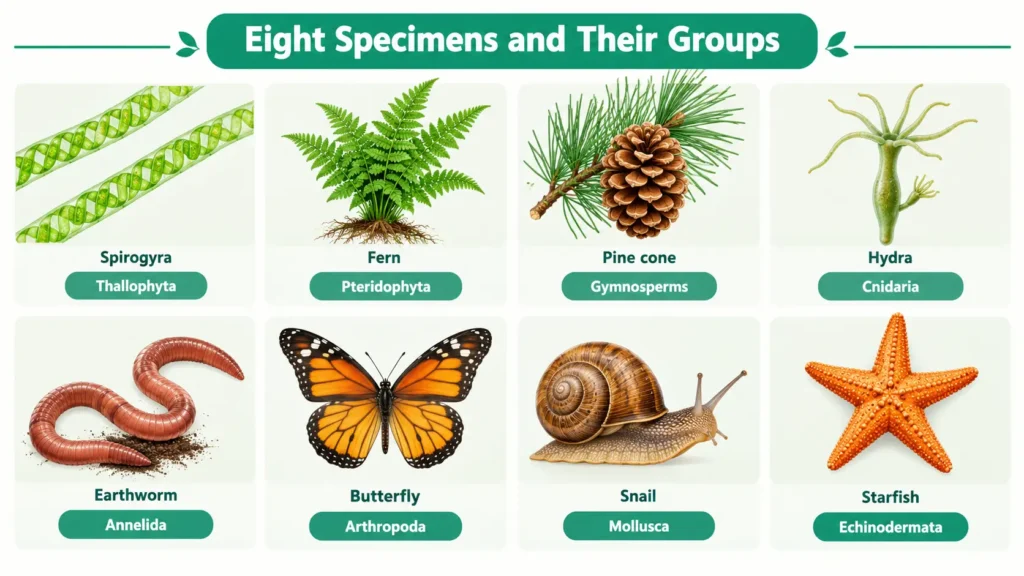
The CBSE practical list for 2026-27 names these specimens for Exp. 8:
- (a) Spirogyra, mushroom, moss, fern, pine cone
- (b) Amoeba, Hydra, tapeworm, Ascaris, earthworm, butterfly, snail, starfish
Your school may also show charts or models of other organisms from this chapter, such as bacteria, bread mould, mustard, sponge, cockroach, fish, frog, pigeon, human, TMV and bacteriophage. Practical work is assessed under “Subject Enrichment (Practical Work)”, which carries 5 marks in the 20-mark internal assessment; how your school divides the marks among experiments is its own decision.
Materials required: Charts, models, preserved specimens and prepared slides of the organisms above, a compound microscope and a hand lens.
Procedure
- Look at each specimen, slide or chart carefully.
- Note the body structure: is there a root, stem and leaves? Is the body flat, round or segmented? Are legs, wings or a shell present?
- Check for vascular tissue, flowers, seeds or a backbone wherever the specimen allows.
- Decide the kingdom and the group (division or phylum).
- Draw a neat labelled diagram and write two or three identifying features.
Observations: What to Write
A. Plants and fungi (syllabus list (a))
| Specimen | Group | What you see |
|---|---|---|
| Spirogyra | Thallophyta (algae) | Green thread-like filament; no root, stem or leaves; spiral chloroplast visible under the microscope |
| Mushroom | Fungi | Umbrella-shaped; stalk and cap with gills; no chlorophyll |
| Moss (Funaria) | Bryophyta | Small green leafy structure; rhizoids instead of roots; no vascular tissue |
| Fern | Pteridophyta | Root, stem and leaves; vascular tissue; spores on the underside of leaves; no seeds |
| Pine cone | Gymnosperm | Cone bearing naked seeds; needle-like leaves on the tree; evergreen |
B. Animals (syllabus list (b))
| Specimen | Group | What you see |
|---|---|---|
| Amoeba (slide) | Protista (Kingdom) | Single cell of changing shape; blunt finger-like pseudopodia; a nucleus |
| Hydra | Coelenterata | Sac-like body; tentacles around the mouth |
| Tapeworm | Platyhelminthes | Flat, ribbon-like body made of many small parts; lives as a parasite |
| Ascaris | Nematoda | Long, round, unsegmented body that tapers at both ends |
| Earthworm | Annelida | Long body divided into many segments |
| Butterfly | Arthropoda | Jointed legs, wings, antennae, hard outer covering |
| Snail | Mollusca | Soft body inside a coiled shell; muscular foot |
| Starfish | Echinodermata | Star-shaped body with arms; spiny skin; found in the sea |
C. Other specimens your school may show
| Specimen | Group | What you see |
|---|---|---|
| Bacteria (slide) | Monera | Tiny rod-shaped cells; no true nucleus |
| Bread mould (Rhizopus) | Fungi | White, cottony mycelium of hyphae; black sporangia on top |
| Mustard plant | Angiosperm | True root, stem, leaves, flowers and fruits; seeds enclosed in the fruit |
| Sponge | Porifera | Many pores on the body |
| Cockroach | Arthropoda | Jointed legs; hard exoskeleton; head, thorax and abdomen |
| Fish | Pisces | Streamlined body; fins; gills |
| Frog | Amphibia | Smooth, moist skin; webbed feet; lives in water and on land |
| Pigeon | Aves | Feathers, beak, wings, lays eggs |
| Human (chart or model) | Mammalia | Hair; mammary glands; gives birth to young ones |
| Bacteriophage (model) | Virus | Tadpole-like; head with DNA, tail and tail fibres; infects bacteria |
| TMV (model) | Virus | Rod-shaped; RNA inside a protein coat |
Precautions
- Handle preserved specimens carefully and do not touch them with bare hands; use forceps and gloves if your teacher gives them.
- Handle slides and the microscope gently, and keep your diagrams neat.
- Write scientific names correctly: genus with a capital letter, species with a small letter, in italics or underlined separately, as in Mangifera indica.
- Do not confuse naked seeds (gymnosperm) with covered seeds (angiosperm).
- Do not confuse a tapeworm (flatworm) with a segmented annelid because both look “banded”.
Viva Questions
| Question | Answer |
|---|---|
| Who gave the Five Kingdom Classification? | R.H. Whittaker |
| Which kingdom has only prokaryotes? | Monera |
| Which plant group is called the amphibian of the plant kingdom? | Bryophyta |
| Which plant group has naked seeds? | Gymnosperms |
| Which phylum is the largest in the animal kingdom? | Arthropoda |
| Why are viruses not placed in the five kingdoms? | They are acellular and show characters of both living and non-living things |
| Which phylum does the starfish belong to? | Echinodermata |
Conclusion
Nature looks like a jumble of countless forms, yet it follows patterns, and classification is the way we read those patterns. Whittaker’s five kingdoms sort cells by structure and food habits; plants are sorted by body plan, vascular tissue and seeds; animals by body design and backbone; and Linnaeus’s two-name system gives each organism a single name that works worldwide. Viruses remind us that nature does not always fit neat boxes, and the three-domain view shows that classification keeps improving as new evidence arrives. Learn the tables, practise the diagrams and be careful with the common mistakes listed above.
Quick Summary
- Five kingdoms (Whittaker, 1969): Monera (only prokaryotes), Protista, Fungi (chitin wall, mostly saprophytic), Plantae (cellulose wall, autotrophic) and Animalia (no wall, holozoic), based on cell structure, body organisation and nutrition. The three-domain view (1990) groups life into Bacteria, Archaea and Eukarya.
- Plants in order of complexity: Thallophyta (thallus) → Bryophyta (rhizoids) → Pteridophyta (first vascular, spores) → Gymnosperms (naked seeds) → Angiosperms (flowers, seeds inside fruit; monocots and dicots).
- Animals: invertebrates (Porifera, Coelenterata, Platyhelminthes, Nematoda, Annelida, Arthropoda, Mollusca, Echinodermata) and vertebrates (Pisces, Amphibia, Reptilia, Aves, Mammalia). Arthropoda is the largest phylum.
- Binomial nomenclature: Genus (capital) + species (small), in italics or separately underlined, after Linnaeus. Example: Homo sapiens.
- Viruses: acellular, DNA or RNA plus a protein capsid, obligate parasites, can be crystallised, kept outside the five kingdoms.
Golden tip: Remember the plant sequence Thallophyta → Bryophyta → Pteridophyta (first vascular) → Gymnosperms (naked seeds) → Angiosperms (covered seeds). In a scientific name, the genus gets a capital and the species gets a small letter. A virus is just DNA or RNA plus a protein coat.
Previous Year and Practice Questions
Class 9 Science Ch 12 – Previous Year Questions
Frequently asked questions from CBSE exam papers on Patterns in Life: Diversity and Classification. Tap a question to view a quick-answer guide.
1 Define biodiversity and explain its importance for life on Earth. +
2 What are endemic species? Name two endemic species found in India and explain why biodiversity hotspots are important. +
3 How does the five-kingdom classification system group organisms? List the five kingdoms and describe key features of any two. +
4 Classify the following organisms into their respective kingdoms: Amoeba, Mushroom, Spirogyra, Bacteria, and Earthworm. +
5 Why are viruses not placed in any of the five kingdoms? Explain with reasons. +
6 Differentiate between gymnosperms and angiosperms based on their key features. +
7 Explain the hierarchical nature of classification with an example. +
8 What is binomial nomenclature? Write scientific names of tiger and mango, and rules for writing. +
9 Both pteridophytes and bryophytes lack flowers and seeds, yet they are placed in different groups. Explain. +
10 How do fossils provide evidence for the evolution of biodiversity? +
11 Meena and Hari observed an animal in garden. Which option confirms it is an insect: bilateral body, jointed legs, cylindrical body, little segmentation? +
12 What are threats to biodiversity, and how do human activities contribute to its decline? +
Frequently Asked Questions
Are cyanobacteria (blue-green algae) plants?
No. Cyanobacteria are prokaryotes, so they belong to Monera. They make food by photosynthesis, but they have no chloroplasts and no true nucleus.
Can two organisms have the same species name?
Two different organisms cannot have the same full two-word name. But the species word may repeat in different genera. For example, indica appears in Mangifera indica (mango) and Azadirachta indica (neem). Different species in one genus, like Panthera tigris and Panthera leo, share the genus word.
Are viruses living or non-living?
Scientists do not fully agree. Inside a host cell they multiply and carry mutations, which looks like life. Outside, they do not grow or respire and can even be crystallised. For Class 9, write that viruses show characters of both and are acellular.
Why is a mushroom not a plant?
A mushroom has no chlorophyll, so it cannot make its own food. It takes food from dead matter, and its cell wall is made of chitin, not cellulose. These are fungus features.
Why are whales and bats mammals?
Mammals are defined by mammary glands, hair and breathing through lungs. A whale breathes through lungs and feeds milk to its young. A bat is a flying mammal, and its wings are a different structure from a bird’s feathered wings.
Do all mammals give birth to young ones?
Most do, but a few mammals, such as the platypus, lay eggs. Write “most mammals give birth” to be safe.
Which should I write in the exam, five kingdoms or three domains?
Write the five-kingdom classification for any question about kingdoms. Mention the three domains only when the question asks for them or asks for a classification based on molecular evidence.
Is this chapter the same as the old Chapter 7, Diversity in Living Organisms?
The topic is similar, but the new textbook gives it a new number (12), a new title and new exercise questions, and the 2026-27 CBSE curriculum also names viruses and the three domains in this unit. Study from the book your school follows.
Continue Reading
- Cell: The Building Block of Life – Class 9 Science Notes (NCERT Exploration, Chapter 2): read this to revise prokaryotic and eukaryotic cells before the kingdoms.
- Tissues in Action – Class 9 Science Notes (NCERT Exploration, Chapter 3)
- Reproduction: How Life Continues – Class 9 Science Notes (Chapter 11, same Unit I)
External References
Continue Reading — Class 9 Science: Chapter 12 (Exploration)
Subscribe to keep reading
You've used your free notes for now. Get Delhi Pathshala Premium for unlimited access.
Subscribe — ₹29/30 days