
Contents
- Key terms at a glance
- 1. Introduction to Hindutva and Hinduism
- Definitions and Key Concepts
- Historical Evolution
- Importance in Indian Political Thought
- 2. Vinayak Damodar Savarkar
- Early Life and Influences
- Role in the Indian Independence Movement
- Life timeline (quick revision)
- The clemency-petition debate
- Key Writings and Ideas
- 3. Hindutva: The Idea
- What is Hindutva?
- Difference between Hinduism and Hindutva
- Hindu Rashtra and the nation–state distinction
- Main Ideas of Hindutva
- 4. Savarkar’s Hindutva in Context
- Background
- Main Work: Essentials of Hindutva
- Social reform and rationalism
- Political positions: Mahasabha, Partition and Gandhi
- Political and Social Effects
- 5. Important Comparisons
- Savarkar and Gandhi
- Savarkar and other thinkers in DSC-14
- 6. Hindutva after Savarkar: the RSS, Jana Sangh and BJP
- 7. Critique and Debate
- Major criticisms
- Ambedkar’s “two nations” objection
- Debates in Indian Society and Politics
- 8. Contemporary relevance
- 9. Conclusion
- Summary of Key Points
- Reflection on the Continuing Relevance of Savarkar’s Ideas
- Legacy of Savarkar in Modern Indian Political Thought
- Final Thought
- Continue Reading
- University of Delhi Previous Year Questions
- FAQs
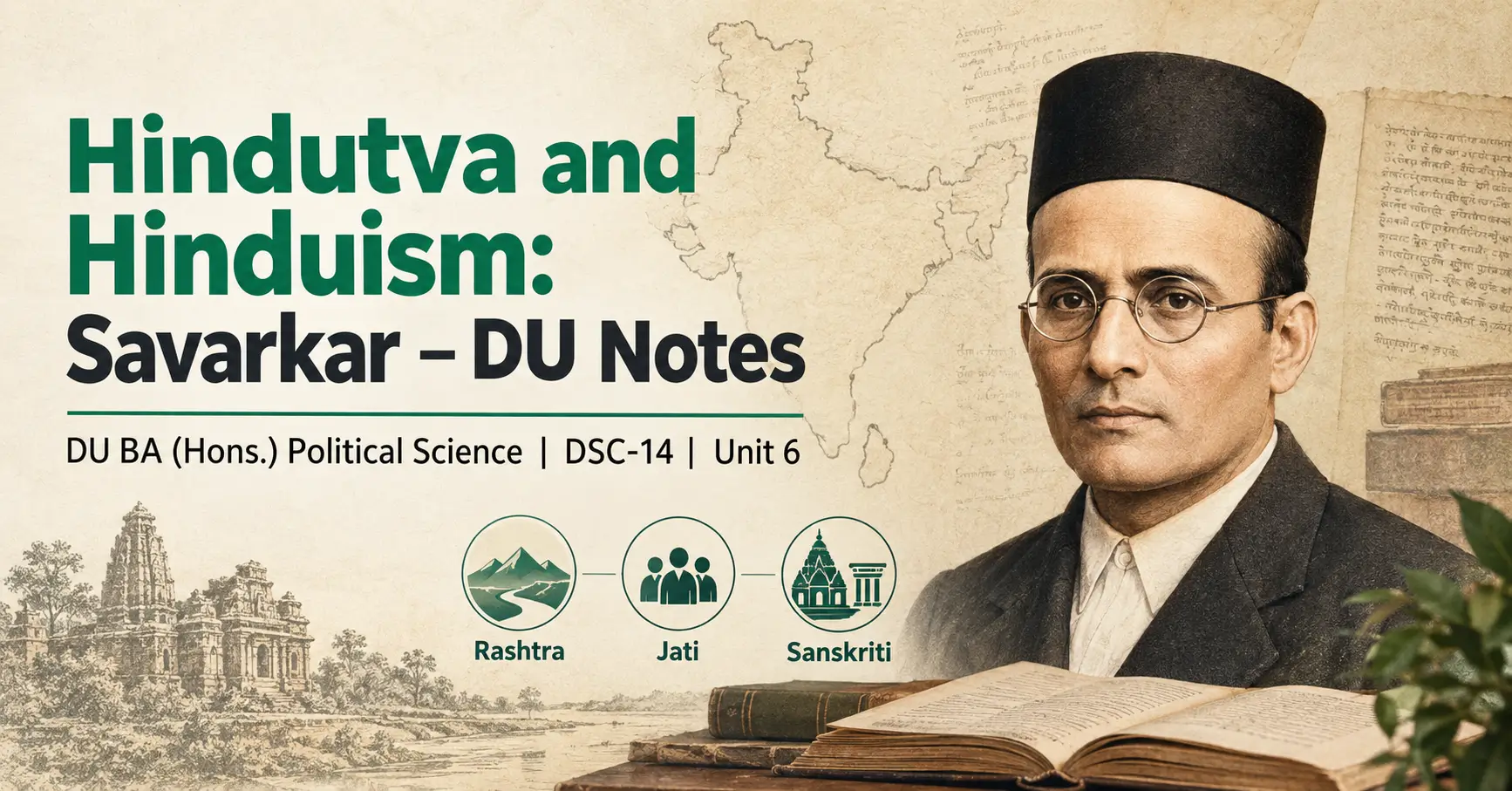
In this post, you will find notes for Unit 6: Hindutva and Hinduism (Savarkar) of DSC-14: Modern Indian Political Thought, BA (Hons.) Political Science, Semester 5, University of Delhi. The notes explain what Savarkar actually argued in Essentials of Hindutva, how his idea differs from Hinduism as a religion, and where scholars and political actors disagree about him. Where historians dispute a point, the disagreement is stated openly, because that is exactly how a good DU answer is written.
Syllabus check (University of Delhi, UGCF 2022): DSC-14, Unit VI, Hindutva and Hinduism: Savarkar (8 hours). Prescribed readings: V. D. Savarkar, Essentials of Hindutva (1922–23), and Vikram Sampath, Savarkar: A Contested Legacy, 1924–1966 (Penguin Random House India, 2021). The same unit appears in the BA Programme paper Modern Indian Political Thought (MDSC-5B). Savarkar is also studied in GE-1 Ideas in Indian Political Thought (Unit VI, “Hindutva: Savarkar”) and in the Semester 6 DSE Understanding Savarkar. You can check this in the official DU Semester 5 Political Science syllabus.
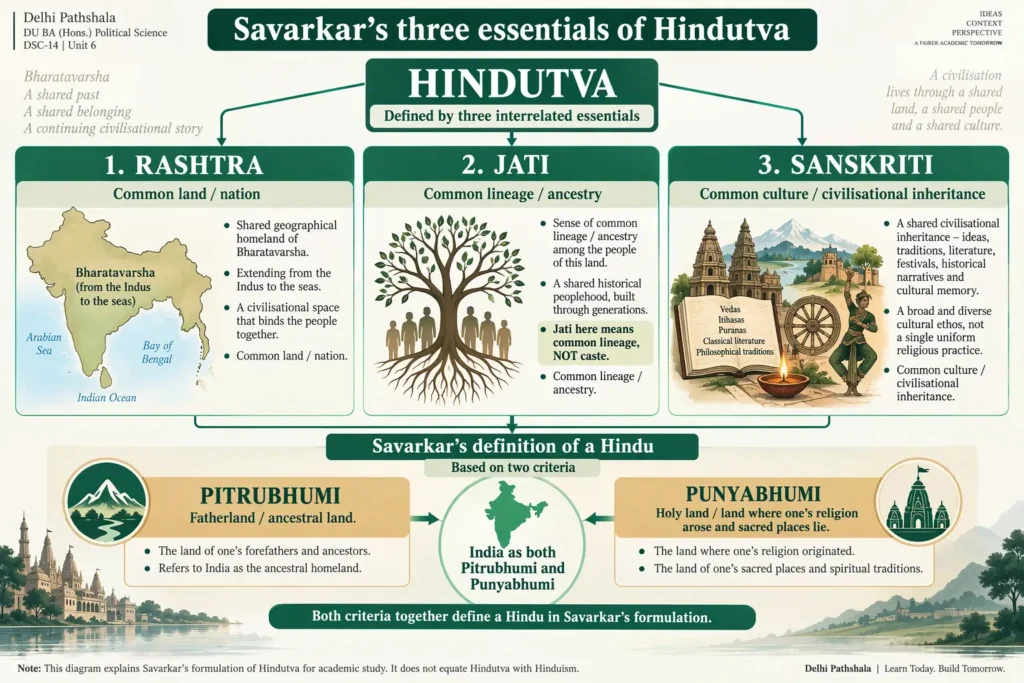
What is Hindutva according to Savarkar? In Essentials of Hindutva (published 1923), Savarkar uses the word Hindutva (“Hindu-ness”) for an identity wider than the Hindu religion. A Hindu, he argues, is a person who regards the land from the Indus to the seas as both Pitrubhumi (fatherland) and Punyabhumi (holy land, the cradle of one’s religion). Hindutva rests on three bonds: a common nation or territory (Rashtra), a common lineage or blood (Jati) and a common culture or civilisation (Sanskriti). Hinduism, in his view, is only one part of Hindutva.
Key terms at a glance
| Term | Hindi | Meaning in Savarkar’s usage |
|---|---|---|
| Hindutva | हिंदुत्व | “Hindu-ness”: the whole identity of the Hindu people (thought, history, culture and polity), not only their religion |
| Rashtra | राष्ट्र | The common land or nation; the first of the three essentials |
| Jati | जाति | Common lineage or “race”. In this text it does not mean caste, a frequent exam mistake |
| Sanskriti | संस्कृति | Shared culture or civilisational inheritance |
| Pitrubhumi | पितृभूमि | Fatherland, the land of one’s ancestors (also spelt Pitribhumi / Pitrabhumi) |
| Punyabhumi | पुण्यभूमि | Holy land, where one’s religion arose and its sacred places lie |
| Hindu Rashtra | हिंदू राष्ट्र | The “Hindu nation”; the theme of his Hindu Mahasabha speeches (1937–43) |
| Shuddhi | शुद्धि | Ritual “purification” or reconversion into the Hindu fold, which Savarkar supported |
| Akhand Hindustan | अखंड हिंदुस्थान | Undivided India; his political opposition to Partition |
1. Introduction to Hindutva and Hinduism
Definitions and Key Concepts
- Hindutva: Savarkar developed the idea in Essentials of Hindutva, written in 1922 while he was confined at Ratnagiri and published in 1923 under the pseudonym “A Maratha”. The pamphlet was smuggled out of prison and published by V. V. Kelkar of Nagpur. It treats India as a Hindu nation held together by shared land, ancestry and culture, not by religion alone.
- One book, three titles: When the text was reprinted in 1928 it was retitled Hindutva: Who is a Hindu? You will therefore see Essentials of Hindutva, Hindutva and Hindutva: Who is a Hindu? in different books and answers. They all refer to the same work, and the DU syllabus uses Essentials of Hindutva.
- Hinduism: A wide-ranging religion and philosophy with many beliefs, texts and practices, including traditions that are theistic, monistic and even atheistic. Savarkar treated Hinduism as a religious system and as only one part of Hindutva.
- Key difference: Hinduism is a religion, while Hindutva (in Savarkar’s usage) is a national, cultural and political identity that counts Hindus, Sikhs, Jains and Buddhists as part of one Hindu community. That grouping is itself contested; the Sikh writer Bhai Kahn Singh Nabha, for example, argued in a well-known tract that Sikhs are not Hindus (Hum Hindu Nahin).
Did Savarkar coin the word “Hindutva”? Not exactly. Several accounts trace the word to the Bengali writer Chandranath Basu, whose 1892 book Hindutva: Hindur Prakrita Itihas used it for a religious-cultural worldview rather than a political programme. A 2026 report on the scholar Amiya Sen’s work even suggests that Bankim Chandra Chatterjee had used the term earlier still, though that claim is for you to treat as a scholarly suggestion, not as settled fact. What is not in dispute is that Savarkar gave the word its political meaning and made it famous. A safe exam sentence is: “Savarkar did not invent the word, but he theorised and popularised it.”
Historical Evolution
- Ancient roots: Hindu civilisation is thousands of years old, and texts such as the Vedas, Upanishads, Mahabharata and Ramayana shaped Hindu belief and practice. The word “Hindu” itself began as a geographical label connected with Sindhu (the Indus). Savarkar’s own definition uses this geography: the land from Sindhu to Sindhu, that is, from the Indus to the sea.
- Nineteenth-century reform and colonial categories: Movements such as the Brahmo Samaj and the Arya Samaj (founded in Bombay in 1875) tried to reform Hindu belief and practice. Meanwhile the colonial census sorted Indians into fixed religious categories, and the Hindu share of the population recorded in the census fell from about 74% in 1881 to 68% in 1931. According to the historian Christophe Jaffrelot, this fed a sense among some Hindu writers that Hindus were a “dying race”, as in U. N. Mukherji’s 1909 pamphlet Hindus: A Dying Race.
- The Khilafat moment (1919–22): The Khilafat movement briefly allied Muslim leaders with the Congress. That alliance collapsed after Gandhi withdrew the non-cooperation movement in 1922, and Hindu–Muslim relations deteriorated. Essentials of Hindutva was written in precisely this political atmosphere.
- Savarkar’s contribution (1923): He presented Hindutva as a national identity wider than religion, linking land, lineage (Jati) and culture. His critics, among them Christophe Jaffrelot and Chetan Bhatt, read this as an ethnic form of nationalism influenced by European ideas of race and nation; his supporters read it as civilisational and cultural.
- After Independence: Gandhi’s assassination in January 1948 was followed by a government crackdown on both the RSS and the Hindu Mahasabha. The Bharatiya Jana Sangh was founded in 1951 and the Bharatiya Janata Party (BJP) in 1980. How far these organisations carried Savarkar’s ideas forward is itself debated (see Section 6).
Importance in Indian Political Thought
- A rival theory of the nation: Hindutva offers an answer to “who belongs to the nation?” that is very different from the answers in Unit 2 (Vivekananda, Tagore and Gandhi on nation and nationalism) and from Gandhi and Tilak’s idea of self-rule in Unit 5 (Swaraj).
- Cultural nationalism: In Savarkar’s account India is a Hindu civilisation. Critics argue that this places non-Hindus in the position of guests of the state rather than members of the nation; defenders argue that his criterion is cultural and civilisational and that he accepted equal citizenship for all.
- Political mobilisation: Hindutva has shaped debates on secularism, minority rights and national identity, and it remains a reference point in discussions of the Ram Janmabhoomi movement, the Citizenship Amendment Act (CAA) and the Uniform Civil Code (UCC). Commentators differ on how directly these developments follow from Savarkar’s text, so use them in answers as contested illustrations, not as proven consequences.
2. Vinayak Damodar Savarkar
Early Life and Influences
- Born: 28 May 1883 in Bhagur, near Nashik, Maharashtra, in a Chitpavan Brahmin family. He died in Bombay on 26 February 1966, after a prolonged self-imposed fast.
- Education: He studied at Fergusson College in Pune and went to London in 1906 to study law at Gray’s Inn. Biographical accounts say that Bal Gangadhar Tilak supported his application for the scholarship that took him abroad.
- Influences:
- Tilak and the Swadeshi mood: The militant nationalism of the early 1900s shaped his politics.
- The 1857 Revolt: He read 1857 as a national war of independence rather than a “mutiny”.
- European nationalism: In England he studied revolutionary and nationalist thought, including the Italian nationalist Giuseppe Mazzini, whose life he translated into Marathi.
- Abhinav Bharat Society: He was associated with this secret revolutionary society and, in London, with the India House circle of revolutionaries.
Role in the Indian Independence Movement
- Revolutionary activities:
- Savarkar spread revolutionary ideas and was accused of helping to arrange the smuggling of pistols to India.
- He wrote The Indian War of Independence (1857). It was published in 1909 and banned by the British authorities almost immediately.
- Arrest and Cellular Jail:
- Arrested in London in March 1910 (not 1909) and sent to India for trial in connection with revolutionary conspiracies, including the killing of the Nashik magistrate A. M. T. Jackson. During the journey back he made a famous attempt to escape at Marseilles in July 1910.
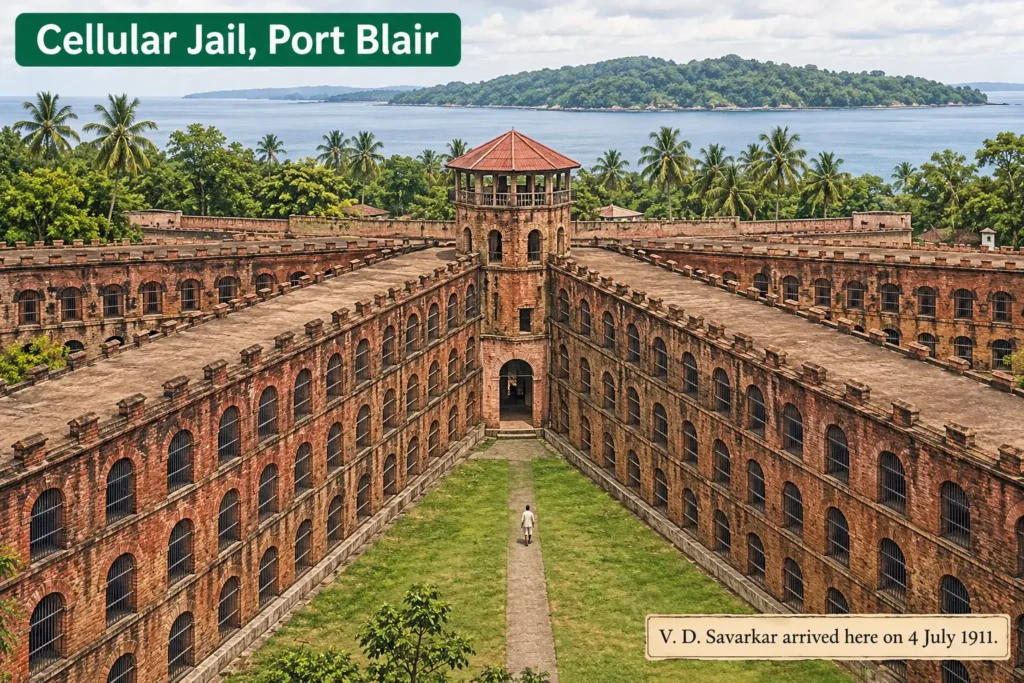
- He was sentenced to 50 years (two life terms) in December 1910 and reached the Cellular Jail in the Andaman Islands on 4 July 1911. He spent about ten years there. In May 1921 he was moved to jails on the mainland (first Alipore, then Ratnagiri).
- Essentials of Hindutva was written in 1922 in Ratnagiri jail, not in the Andamans.
- Release and restrictions: He was released conditionally on 6 January 1924. He had to stay in Ratnagiri district and keep away from political activity, and those restrictions were lifted only in 1937.
- Later years and Hindutva: He rejected Gandhi’s non-violent method and the Congress strategy and became a leading voice of Hindu nationalism. He served as president of the Hindu Mahasabha from 1937 to 1943. In 1948 he was arrested as an accused in the Gandhi assassination case and acquitted in February 1949; historians and commentators continue to debate his wider political responsibility for the atmosphere of the time.
Life timeline (quick revision)
| Year | Event |
|---|---|
| 1883 | Born at Bhagur, near Nashik (28 May) |
| 1906 | Goes to London to study law (Gray’s Inn); active in the India House circle |
| 1909 | The Indian War of Independence published and promptly banned |
| 1910 | Arrested in London (March); Marseilles escape attempt (July); sentenced to 50 years (December) |
| 1911 | Reaches Cellular Jail, Andamans (4 July); first clemency petition (30 August) |
| 1921 | Moved from the Andamans to jails on the mainland (May) |
| 1922–23 | Writes Essentials of Hindutva in Ratnagiri jail (1922); published under the name “A Maratha” (1923) |
| 1924 | Released with restrictions (6 January); Ratnagiri Hindu Sabha founded (23 January) |
| 1928 | Text reprinted as Hindutva: Who is a Hindu? |
| 1931 | Patit Pavan Mandir opened at Ratnagiri |
| 1937–43 | Restrictions lifted; president of the Hindu Mahasabha |
| 1948–49 | Tried in the Gandhi assassination case; acquitted (10 February 1949) |
| 1966 | Dies in Bombay (26 February) |
The clemency-petition debate
Savarkar submitted several clemency petitions to the colonial government, the first in August 1911, soon after reaching the Andamans. This is among the most contested chapters of his life, so answer it with both positions:
- Critics argue that the petitions, and the fact that he largely stopped criticising British rule after his release, show a break with his earlier revolutionary politics.
- Supporters argue that petitioning was a tactical move open to any prisoner, meant to regain the freedom to work for the nation. In 2021 Defence Minister Rajnath Singh stated publicly that Savarkar filed petitions on Gandhi’s advice, a claim that other commentators and fact-checkers examined and disputed.
Vikram Sampath’s biography (a prescribed reading) is written from a sympathetic stance. Read at least one critical scholarly account alongside it, such as Vinayak Chaturvedi’s Hindutva and Violence (2022) or Janaki Bakhle’s Savarkar and the Making of Hindutva (Princeton University Press, 2024), before writing a balanced answer.
Key Writings and Ideas
| Work | Year | Main argument or significance |
|---|---|---|
| The Indian War of Independence (1857) | 1909 | Challenges the British description of 1857 as a “mutiny” and reads it as a national war of independence. Written before Hindutva, it praises Hindu–Muslim cooperation in 1857, which is why scholars compare it with his later position. |
| Essentials of Hindutva (Hindutva: Who is a Hindu?) | 1923 (reprinted 1928) | Defines Hindutva and “Hindu”: land, lineage and culture; Pitrubhumi and Punyabhumi; Hindutva is wider than Hinduism. The core text of Unit 6. |
| Hindu Pad-Padshahi | 1925 | A history of the Maratha state, written in English, that reflects his interest in Hindu political power. |
| Majhi Janmathep (My Transportation for Life) | 1927 | Memoir of his imprisonment in the Andamans. |
| Hindu Rashtra Darshan | 1949 (compilation) | A collection of his presidential speeches at the Hindu Mahasabha, useful for his later political position. |
| Six Glorious Epochs of Indian History (Saha Soneri Pane) | 1963 (Marathi); English translation 1971 | His reading of Indian history as a long contest between Hindu society and foreign invaders; scholars debate how selective this reading is. |
Savarkar’s ideas became foundational for Hindutva politics, but how directly they shaped the RSS and the BJP is debated, as explained in Section 6.
3. Hindutva: The Idea
What is Hindutva?
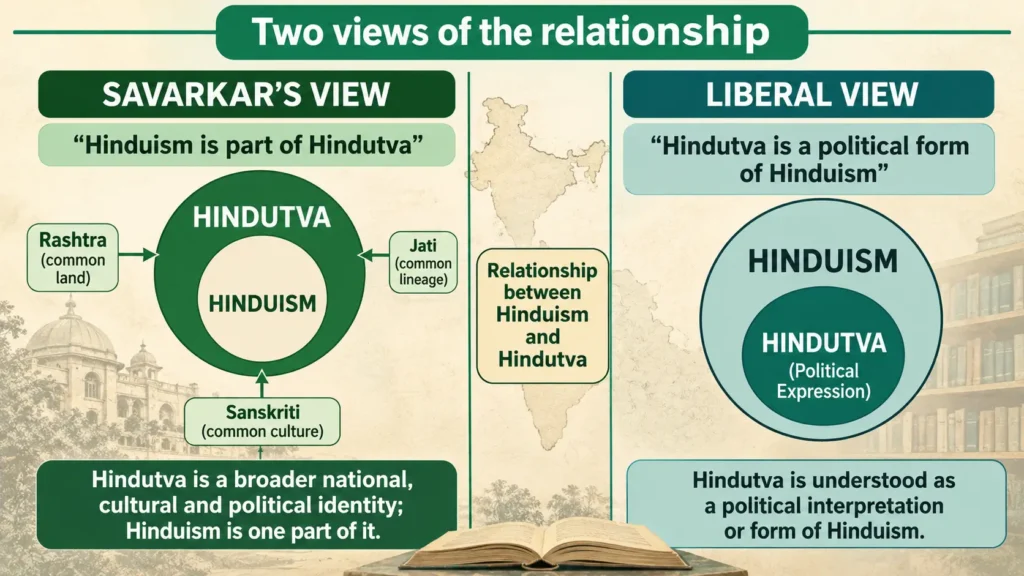
Savarkar opens Essentials of Hindutva by warning that the word cannot be understood as a mere label. In his famous formulation, “Hindutva is not a word but a history”, and not only a religious history but a “history in full”. He means that Hindutva covers every department of Hindu thought and activity, which is why he insists it cannot be reduced to Hinduism. Hinduism, he says, is a derivative of Hindutva and one part of it.
The three essentials of Hindutva
- Rashtra (common nation or land): Hindus are bound together by the land of Bharatavarsha, which he describes as stretching from the Indus to the seas. For Savarkar this land is not just territory; it is a living homeland.
- Jati (common lineage or “race”): Hindus share a common ancestry and “blood”. In this text Jati means lineage or race, not caste. Savarkar says that Hindus of every caste and sect belong to one blood. Scholars such as Christophe Jaffrelot and Chetan Bhatt read this emphasis as an attempt to play down caste divisions inside Hindu society. They also note that Savarkar does not demand strict racial purity, because he allows people who converted away to return to the Hindu fold through shuddhi.
- Sanskriti (common culture or civilisation): Hindus share a civilisational inheritance, a common history, literature, law, rites and festivals, developed over centuries on that land.
Savarkar’s definition of a Hindu
Savarkar defined a Hindu as someone who sees India as:
- Pitrubhumi (Fatherland): the land of their ancestors.
- Punyabhumi (Holy Land): the land where their religion arose and where its sacred places lie.
Who is included and who is left out?
- Hindus, Sikhs, Jains and Buddhists are included, because both their fatherland and their holy land lie inside India.
- Muslims and Christians may regard India as their fatherland, but their holy lands (in Savarkar’s account, in Arabia and Palestine) lie outside it. Under his test they therefore fall outside the Hindu community. He allowed that a convert could return through shuddhi.
- Critics argue that the holy-land test is, in effect, a religious test of belonging and that it leaves citizens permanently on the margins of the “nation”. Defenders reply that his criterion is cultural and civilisational rather than a statement of religious hatred, and that he accepted equal rights for all citizens under the state. Both positions are part of the debate, and a strong answer shows both.
Difference between Hinduism and Hindutva
| Hinduism | Hindutva (as Savarkar defines it) |
|---|---|
| A religion with diverse beliefs and practices. | A national, cultural and political identity built on land, lineage and civilisation. |
| Based on sacred texts such as the Vedas and the Bhagavad Gita, and on varied local traditions. | Defined by shared history and culture; “a history”, not a creed. |
| Includes many sects and even atheism. | Emphasises Hindu unity and a common identity. |
| Centres on personal spirituality and religious freedom. | Seeks to protect Hindu culture and strength through political organisation. |
| As a faith it has no single membership test. | Has a membership test: Pitrubhumi plus Punyabhumi, which in Savarkar’s definition leaves out Muslims and Christians. |
| For Savarkar, Hinduism is one part of Hindutva. | For critics, Hindutva is a political form or subset of Hinduism. |
| Savarkar’s own religious stance: scholars describe him as agnostic or atheist and as a rationalist. | Hindutva is therefore not a defence of Hindu belief as such; it is a theory of the nation. |
Which comes first, Hinduism or Hindutva? The scholar Arvind Sharma, writing in Education About Asia, makes a useful point: for many liberals, Hinduism comes first and Hindutva is a later political development of it, while for Hindu nationalists Hindutva comes first and Hinduism is a part of it. Savarkar’s own argument belongs to the second view. You can read the original discussion in “On the Difference between Hinduism and Hindutva” (Association for Asian Studies).
Hindu Rashtra and the nation–state distinction
In his Hindu Mahasabha speeches (1937–43) Savarkar separated the nation from the state. As summarised in a political-science study resource (PolSci Institute), the argument runs like this: the state should not be built on communal lines and should treat all citizens as equals, while the nation beneath it remains essentially Hindu in culture. His critics ask whether this distinction is stable, because if the nation is the deeper identity and the state only its administrative frame, then non-Hindus can be treated as citizens but not as members of the nation. Ambedkar made a sharper point about the same structure (see Section 7). For exams, remember the two-part answer: equal citizenship in the state, Hindu identity in the nation, followed by the critique.
Main Ideas of Hindutva
- Cultural nationalism
- India is, in Savarkar’s account, a Hindu nation.
- Indian identity is rooted in a Hindu civilisation that shares land, lineage and culture.
- Shared heritage
- Hindus of all castes and sects share a common ancestry and culture.
- He promotes Hindu unity as a basis for national strength.
- Strength and defence
- He supports a strong, organised Hindu society able to defend itself.
- He rejected Gandhian non-violence as a political method and justified force. His slogan, often quoted from the Mahasabha years, was to “Hinduise all politics and militarise Hindudom”. Accounts of the Mahasabha under his presidency also record support for military training of Hindus during the Second World War.
- Native and foreign; reconversion
- Savarkar’s history of India (see Six Glorious Epochs) treats the centuries after Mahmud of Ghazni’s invasions as a long conflict that “welded” Hindus into a nation. Critics say this historical reading casts Muslims as perpetual outsiders.
- Because a convert’s holy land would lie outside India, he supported shuddhi (reconversion) to bring converts back. (Older notes call this “ghar wapsi”; that phrase belongs to later politics.)
- Political involvement
- He urged Hindus to organise politically; his own vehicle was the Hindu Mahasabha.
- Later organisations such as the RSS, Jana Sangh/BJP and VHP drew on Hindutva in varying ways, a relationship examined in Section 6.
4. Savarkar’s Hindutva in Context
Background
- Early 1900s nationalism: Indian nationalism was rising under British rule. Gandhi built a mass movement on non-violence and Hindu–Muslim cooperation, while Savarkar justified armed resistance and, after the Khilafat episode, doubted that Hindu–Muslim unity could anchor the nation.
- Intellectual influences: His thinking drew on the 1857 Revolt, European nationalism (Mazzini in his early years) and Hindu historical memory. Scholars including Michael Dusche and Christophe Jaffrelot add that the German jurist J. K. Bluntschli’s idea of a “principal nation” influenced his thinking about race and nation; others, including his defenders, stress his originality and his response to the colonial census and to colonial claims about Hindu weakness.
- Prison and the text: In Ratnagiri jail he wrote Essentials of Hindutva in 1922; it appeared the next year under a pseudonym.
Main Work: Essentials of Hindutva
- Published in 1923 under the pen name “A Maratha” (spelt “A Mahratta” in some books), and reprinted in 1928 as Hindutva: Who is a Hindu?
- Key points:
- Hindutva is not the same as Hinduism. Hinduism is a religion; Hindutva is a national identity built on land, lineage and culture.
- Who is a Hindu? A person who regards India as both Pitrubhumi and Punyabhumi (see Section 3).
- The Hindu nation: India should be a nation whose character is Hindu. The word “Hindutva” therefore points to politics and culture, not worship.
- Strength and unity: Hindus need to be united and strong to protect the nation.
- Method: The text is a political argument about identity, not a theological treatise. This is why scholars treat it as a work of political theory rather than of religion.
Social reform and rationalism
Notes that mention only the exclusion side of Hindutva miss a part of Savarkar that examiners also expect.
- Anti-untouchability work in Ratnagiri (1924–37): He campaigned against untouchability and for inter-caste dining, and in 1931 the Patit Pavan Mandir opened in Ratnagiri for Hindus of all castes, including those then called untouchable. He described rigid caste hierarchy as something to be discarded, in his view because it blocked Hindu unity.
- Rationalism: Scholars who study his writings, such as Siegfried Wolf, describe him as an agnostic or atheist who attacked superstition and urged Hindus to adopt science and technology. Even his support for cow protection is described as being based on economic utility rather than devotion.
- The tension critics point out: If Savarkar judged every custom by reason and usefulness, why did he build national belonging on a holy-land test that reason cannot easily defend? The question is a standard analytical point for a 15-mark answer.
- Savarkar and Ambedkar on caste: Ambedkar held that the shastras themselves had to be rejected. Savarkar believed that reform and reinterpretation within Hindu society could achieve social unity. Vinayak Chaturvedi argues that Ambedkar’s open denunciation of Hinduism and his later turn to Buddhism sat uneasily with Savarkar’s programme of pan-Hindu unity.
Political positions: Mahasabha, Partition and Gandhi
- Hindu Mahasabha president, 1937–43: He tried to turn the Mahasabha into a more political organisation. During the Second World War the Mahasabha under him supported the recruitment of Hindus into the armed forces and opposed the 1942 Quit India movement.
- Partition: He opposed the Partition of India and supported the idea of Akhand Hindustan. Ambedkar summarised his position as an acceptance that India contains two nations, which should live together in one country under one constitution (see Section 7).
- Opposition to Gandhi’s views: Savarkar rejected Gandhi’s non-violence and criticised the Congress for what he called appeasement of Muslim demands, beginning with the Khilafat alliance. Congress leaders rejected that charge, and historians continue to debate it.
- The Gandhi assassination case: Nathuram Godse had been a member of the Hindu Mahasabha. Savarkar was arrested on 5 February 1948 and acquitted on 10 February 1949. His supporters treat the verdict as final vindication; his critics point to the wider political climate of the time. Historians still debate the question.
Political and Social Effects
- Political influence:
- Inspired the Hindu Mahasabha, influenced the thinking of the RSS and shaped the vocabulary of Hindu nationalism, though the link with the RSS and the BJP is more complicated than older notes suggest (Section 6).
- Shaped debates on secularism and religious identity in India.
- Hindu–Muslim relations:
- His account of Islam and Christianity as having holy lands outside India, and his reading of medieval history as a conflict, deepened the argument that Muslims and Christians stand outside the Hindu nation.
- He supported shuddhi (reconversion) to bring converts back to the Hindu fold.
- Opposition to Gandhi’s views:
- Disagreed with Gandhi’s non-violence and his strategy of Hindu–Muslim unity.
- Criticised the Congress for being too accommodating of Muslim demands, a charge the Congress rejected.
- Impact on modern Indian politics:
- Hindutva became a reference point for Hindu nationalist movements, including debates over the Ram Janmabhoomi movement and the Citizenship Amendment Act (CAA). Scholars differ on how far such developments are really “applications” of Savarkar’s text. Treat them as contested illustrations.
5. Important Comparisons
Savarkar and Gandhi
| Aspect | Savarkar | Gandhi |
|---|---|---|
| Idea of the nation | Hindu nation bound by land, lineage and culture (Hindutva) | A nation of many communities, in which swaraj includes self-rule over the self |
| Religion and politics | Religion is one part of Hindutva; Hindutva itself is political and civilisational | Politics should be guided by ethics and religion in a broad sense (truth and non-violence) |
| Means | Justified armed resistance and military strength | Insisted that means and ends cannot be separated; non-violence as method |
| Hindu–Muslim relations | Doubted that Hindu–Muslim unity could be the basis of the nation after the Khilafat episode | Treated Hindu–Muslim unity as central to swaraj |
| Modernity | Welcomed science and technology | Criticised modern industrial civilisation in Hind Swaraj |
| Caste and untouchability | Campaigned against untouchability within a pan-Hindu unity programme | Campaigned against untouchability; his approach was challenged by Ambedkar |
Read the Gandhi side in the notes on Swaraj: Tilak and Gandhi.
Savarkar and other thinkers in DSC-14
| Thinker (unit) | Point of comparison with Savarkar |
|---|---|
| Vivekananda (Unit 2) | Both draw on Hindu civilisation, but Vivekananda uses Hinduism and Vedanta as a spiritual and universal message, whereas Savarkar separates Hindutva from the religion and gives it a political, territorial meaning. The scholar A. Raghuramraju argues that reformers like Vivekananda and Dayanand used “Hinduism”, not “Hindutva”, to promote humanism. |
| Tagore (Unit 2) | Tagore warned in his lectures on nationalism that the nation-state can become an organised, aggressive power; Savarkar builds nationhood on an exclusive Hindu identity and on strength. Together they give you a useful contrast on whether nationalism is a threat or a necessity. |
| Ambedkar (Unit 3) | Both opposed untouchability, but Ambedkar attacked the scriptural basis of caste, while Savarkar sought unity through reform inside a pan-Hindu frame. Ambedkar also argued that Savarkar and Jinnah agreed on the “two nations” premise. |
| Deendayal Upadhyay (Unit 3) | Compare Savarkar’s definition of the Hindu nation with Upadhyay’s Integral Humanism (1964), the philosophy of the Bharatiya Jana Sangh. The relationship between Savarkar and the organisations that grew into the BJP was itself complicated (Section 6). |
| Tilak (Unit 5) | Savarkar was inspired by Tilak’s militant nationalism, but a pluralistic reading of Tilak (as some scholars argue) differs from Savarkar’s ethnic definition. |
For the other units, see the notes on Nation and Nationalism and State and Democracy.
6. Hindutva after Savarkar: the RSS, Jana Sangh and BJP
Many older notes simply say that Savarkar’s ideas “inspired the RSS and the BJP”. That is too simple, and DU examiners reward the more careful version.
- Savarkar was not an RSS member. Vikram Sampath, whose biography is a prescribed reading, has said that Savarkar was never part of the RSS, although his brother Ganesh Savarkar was among its founders with K. B. Hedgewar, and that there was a long-running feud between Savarkar and the RSS, especially after M. S. Golwalkar became its head. You can read Sampath’s explanation in this Business Today interview.
- Influence is still real. A scholarly excerpt in ThePrint records that Hedgewar admired Savarkar’s ideas and was influenced by them, but was cautious about protecting the RSS’s own structure. The same excerpt notes that Savarkar criticised the RSS for what he saw as a purely cultural orientation. See the ThePrint excerpt.
- After 1948 the relationship between Savarkar’s Hindu Mahasabha and the RSS remained strained. The RSS then helped build a political party of its own, the Bharatiya Jana Sangh (1951), with the former Hindu Mahasabha leader Syama Prasad Mookerjee in a leading role. The BJP was formed in 1980.
- What to write in an exam: Savarkar’s Essentials of Hindutva supplied the vocabulary and the founding text of Hindu nationalism; the RSS, Jana Sangh and BJP are separate organisations with their own strategies and sometimes different ideological emphases. “Savarkar → RSS → BJP” is therefore a simplification that scholars qualify.
For the party-system side of the story, read the notes on Political Parties and the Party System in India (DSC-15, Unit 1).
7. Critique and Debate
Major criticisms
- Exclusion of minorities
- Critics say that the Punyabhumi test places Muslims and Christians outside the Hindu nation however long their families have lived in India. The Hindu nation, in this reading, is built on a religious criterion.
- Defenders answer that the criterion is cultural and civilisational and that Savarkar accepted equal citizenship in the state.
- A politicised and narrowed Hinduism
- Critics argue that Hindutva turns a traditionally diverse and spiritual religion into a political identity. Arvind Sharma’s description of the “liberal” view (Hinduism first, Hindutva as a later political development) captures this concern.
- Supporters argue that Savarkar was defending a civilisation, not a faith, and was reacting to a colonial order that treated Hindus as weak and divided.
- Tension with secularism
- The Constitution defines citizenship by law and birth, not by ancestry or holy land. Critics argue that an idea of a Hindu nation sits uneasily with this civic nationalism and with religious freedom and minority rights.
- Supporters respond that Indian secularism has itself been selective and that cultural belonging and equal citizenship can coexist.
- Violence and intolerance
- Vinayak Chaturvedi’s argument in Hindutva and Violence (2022), as summarised by Srinath Raghavan in The India Forum, is that Savarkar treated violence as part of Hindutva and saw non-violent creeds such as Buddhism as a danger to the Hindu nation.
- Critics also associate Hindutva-linked organisations with riots and mob violence. This is a contested claim, and supporters of Hindutva reject it.
- Borrowed European ideas
- Scholars such as Jaffrelot and Bhatt describe the essentials of Hindutva as shaped by European theories of race and nation, and Martha Nussbaum has called the text a “European product”. Defenders stress the Indian historical roots of his argument and his responses to colonial classification.
- Reason versus a religious test
- A recurring analytical point is that Savarkar, a rationalist who urged scientific thinking, nevertheless drew the boundary of the nation by the location of holy lands.
Ambedkar’s “two nations” objection
In Pakistan or the Partition of India, B. R. Ambedkar observed that Savarkar and Jinnah, though bitter opponents on Partition, agreed on one premise: that India contains two nations, a Hindu nation and a Muslim nation. Jinnah wanted two states; Savarkar wanted the two nations to live in one state, under a single constitution. For Ambedkar this shared premise weakened Savarkar’s claim to be a unifier. (A quotation with page reference should be checked in the original edition before it is used in an answer.)
Debates in Indian Society and Politics
- Hindutva versus secularism
- Supporters say Hindutva is about cultural pride and civilisational belonging, not religious hatred. A defender’s reading in Open magazine argues that Savarkar’s Hindutva was a response to exclusive religious identities and that it can be read as religious pluralism sustained by cultural nationalism.
- Critics argue it weakens India’s diversity and secular foundations.
- Hindutva in politics
- The BJP is widely described as drawing on Hindutva to mobilise Hindu voters, though the BJP’s relationship to Savarkar’s text is more qualified than that sentence suggests (Section 6).
- Public disputes such as the Ram Mandir, the Citizenship Amendment Act (CAA) and the Uniform Civil Code (UCC) are often discussed in Hindutva terms. Treat them as contested illustrations in an answer, and give each side’s argument.
- “Soft Hindutva”
- Commentators use the label for parties such as the Congress when they adopt Hindu symbols or religious outreach while keeping a secular stance. Critics raise the question of whether this signals a weakening of secular politics; others see it as ordinary electoral competition.
- Caste and Hindutva
- Hindutva claims to unite Hindus across castes, and Savarkar’s Ratnagiri reforms are cited in support of that claim. Critics, following B. R. Ambedkar, argue that Hindutva does not seriously challenge the caste order and that it puts unity above justice for Dalits. Ambedkar also argued that real reform required rejecting the authority of the shastras.
8. Contemporary relevance
- Public recognition: Port Blair’s airport was renamed Veer Savarkar International Airport on 4 May 2002, and a portrait of Savarkar was unveiled in Parliament on 26 February 2003, according to reports. Supporters read these as overdue recognition of a freedom fighter; critics saw them as a political choice by the government of the day.
- In the DU curriculum: In 2023 the University of Delhi’s Academic Council approved a full elective paper on Savarkar for the Political Science (Hons.) programme alongside the Unit 6 reading in DSC-14. The student organisation NSUI protested the decision, while other teachers’ and students’ groups welcomed it. The syllabus itself states the learning goal as appreciating the plurality within modern Indian thought, so you are expected to read him critically and fairly.
- Identity politics and the idea of the nation: Debates on citizenship, secularism, majority–minority relations and national identity still use his terms. The question to carry into an answer is whether a nation should be defined by shared civic membership (as the Constitution does) or by shared culture and lineage (as Hindutva does).
- Global comparison: Christophe Jaffrelot has described contemporary India as an “ethnic democracy”, and several scholars compare Hindutva with other ethnic nationalisms. Others reject such comparisons. One argument in Open magazine is that Hindutva is better compared with the view that a country has a defining ethos (like Anglo-Protestant culture in the United States) than with religious fundamentalism. A good answer reports both sides.
- Savarkar and the contemporary “Hindutva” movements: Because modern movements draw selectively on his text, it helps to separate what Savarkar wrote from what later organisations and politicians claim in his name. For example, he defended cow protection on utilitarian rather than devotional grounds, which differs from some later campaigns.
9. Conclusion
Summary of Key Points
- Savarkar’s Hindutva defines Indian identity through shared land, lineage and culture (Rashtra, Jati and Sanskriti) and through the idea of a Pitrubhumi that is also a Punyabhumi, not through religion alone.
- Hindutva versus Hinduism: for Savarkar, Hinduism is a religion and one part of Hindutva; Hindutva is a national identity aimed at a Hindu nation. Liberal critics reverse the order and treat Hindutva as a political development of Hinduism.
- Major contribution: Essentials of Hindutva (1923; reprinted as Hindutva: Who is a Hindu? in 1928) became the founding text of Hindu nationalism, influencing the Hindu Mahasabha and later movements, with the RSS and BJP relationship being more complicated than older notes suggest.
- Debates and criticism:
- Supporters see cultural pride, a response to colonial humiliation and a reformer’s record.
- Critics argue that it excludes minorities, narrows Hinduism, borrows European ideas of race and threatens secular citizenship, and they question Savarkar’s record during and after imprisonment.
- Modern relevance: Hindutva continues to shape debates on citizenship, religious freedom and national identity, which is why it is part of the syllabus.
Reflection on the Continuing Relevance of Savarkar’s Ideas
- Rise of Hindu nationalism: Hindutva remains a major political and intellectual force, and Savarkar is a central, though contested, reference.
- Policy debates: Questions such as the Ram Mandir, the CAA and the UCC are often discussed in relation to Hindutva. Scholars disagree about how directly they are connected to Savarkar’s own argument.
- Secularism and national identity: Indian secularism is repeatedly debated, which keeps his definition of the nation in view.
- Changing public image: Once a figure treated cautiously in mainstream public life, he has received official recognition from governments and a place in the university syllabus, and each step has drawn both applause and protest.
Legacy of Savarkar in Modern Indian Political Thought
- Founding thinker of Hindutva: He gave Hindu nationalism its central concept, even though the word existed before him.
- A polarising figure:
- Supporters see him as a patriot, revolutionary, historian and social reformer who wanted a strong, united India.
- Critics see him as divisive, arguing that his ideas exclude minorities, that his clemency petitions undercut his image as a revolutionary, and that he stood opposed to Gandhi’s vision of unity.
- Academic standing: His work is studied in universities, and the serious scholarly literature now includes both admiring and critical studies.
Final Thought
Savarkar’s Hindutva remains a powerful and controversial idea. Whether one sees him as a visionary, a divisive figure or a mixture of both, the most useful exam habit is to state clearly what he argued, show how he reached those conclusions, and then weigh the strongest arguments on each side.
Continue Reading
- Swaraj: Bal Gangadhar Tilak, Mohandas Karamchand Gandhi: the previous unit (Unit 5), needed for the Savarkar–Gandhi comparison.
- Nation and Nationalism: Swami Vivekananda, Rabindranath Tagore and Gandhi: Unit 2, for rival ideas of cultural and civic nationalism.
- State and Democracy: Nehru, Upadhyay, Lohia and Ambedkar: Unit 3, for Ambedkar’s critique and Upadhyay’s Integral Humanism.
- Political Parties and the Party System in India: DSC-15 Unit 1, which follows the party-system story from the Congress system to the rise of the BJP.
- Understanding Modern Indian Political Thought: Unit 1, for the larger framework of the paper.
University of Delhi Previous Year Questions
For more papers, see the DU BA Political Science PYQs 2023–2024 page and the Political Science PYQ category.
DU Previous Year Questions
Verified questions from DU examination papers on Savarkar’s concept of Hindutva and its distinction from Hinduism. Tap a question to view a quick-answer guide.
1 Examine how Savarkar distinguished between ‘Hindutva’ and “Hinduism” in his work ‘Hindutva: Who is a Hindu?’ +
2 Examine the concept of Hindutva as elaborated by Savarkar. +
3 Examine Savarkar’s views on Hindutva. Discuss his … (remainder of the question is illegible in the available paper). +
4 Write a short note on Savarkar’s views on Hindutva. +
5 Write a short note on Savarkar’s concept of “Hindutva”. +
FAQs
Which unit and paper does Savarkar belong to in DU’s BA (Hons.) Political Science?
Savarkar is Unit VI (Hindutva and Hinduism: Savarkar, 8 hours) of DSC-14, Modern Indian Political Thought, in Semester 5. The prescribed readings are his Essentials of Hindutva and Vikram Sampath’s Savarkar: A Contested Legacy, 1924–1966. He also appears in the BA Programme paper (MDSC-5B), in GE-1 Ideas in Indian Political Thought and in the Semester 6 DSE Understanding Savarkar.
What is Savarkar’s definition of a Hindu?
A Hindu is a person who regards the land from the Indus to the seas as both fatherland (Pitrubhumi) and holy land (Punyabhumi), the cradle of their religion. Savarkar also grounds Hindutva in a common nation, common lineage and common culture.
Did Savarkar coin the word “Hindutva”?
Not in the strict sense. The Bengali writer Chandranath Basu used the word in 1892 in a religious and cultural sense, and one scholar has suggested even earlier use by Bankim Chandra Chatterjee. Savarkar gave it a political meaning and made it widely known in 1923.
Which title should I write for his book in the exam?
Write “Essentials of Hindutva (1923), also published as Hindutva: Who is a Hindu? (1928)”. Add that it was first published under the pen name “A Maratha”. The DU syllabus uses Essentials of Hindutva.
Does “Jati” mean caste in Savarkar’s Hindutva?
No. In this text Jati means common lineage or “race”. Scholars see it partly as an attempt to stress what unites Hindus across castes, but they also note that it ties national belonging to ancestry.
Why are Sikhs, Jains and Buddhists counted but Muslims and Christians not?
Because of the Punyabhumi test: the holy lands of Sikhs, Jains and Buddhists lie inside India, whereas Savarkar placed the holy lands of Muslims and Christians outside it. This is the most contested part of his definition. Critics call it a religious test of belonging, while defenders call it a cultural criterion. Some Sikh thinkers have also disputed being classed as Hindus at all.
Was Savarkar religious?
Scholars describe him as an agnostic or atheist and a rationalist who criticised superstition, even though he used religious language for political purposes. This is why Hindutva, in his usage, is not a defence of Hindu belief but a theory of the nation.
Was Savarkar a member of the RSS? Is Hindutva the BJP’s official ideology?
Savarkar was not an RSS member, and his relationship with the RSS was strained, as his biographer Vikram Sampath notes. Hindutva is a major influence on Hindu nationalist organisations, but write “Hindutva has influenced the RSS and BJP” rather than “the BJP’s ideology is Savarkar’s Hindutva”, because the relationships are more complicated.
Did Savarkar support the two-nation theory?
He opposed the Partition of India and supported Akhand Hindustan. B. R. Ambedkar argued, however, that Savarkar and Jinnah agreed that India contained two nations and differed only on whether they should share one state. State both points in your answer.
Why is Savarkar controversial?
Because several debates meet in one figure: the exclusionary side of his definition of a Hindu, the clemency petitions, his opposition to Gandhi’s methods, his trial and acquittal in the Gandhi assassination case, and the political use of his legacy today. His admirers point to his revolutionary record, his history writing and his work against untouchability.
How should I answer “Hindutva is not Hinduism” questions?
Use four steps: (1) Savarkar’s claim that Hinduism is a part of Hindutva; (2) the three essentials and the two “lands”; (3) the liberal counter-view that Hindutva is a political form of Hinduism; (4) a short evaluation. The comparison table in Section 3 gives you the structure.
How does Savarkar’s 1909 book on 1857 fit with his 1923 Hindutva?
The Indian War of Independence (1909) praised Hindu–Muslim cooperation in 1857, while Essentials of Hindutva (1923) drew a sharp line around the Hindu nation. Scholars link the change to the political events between the two, such as the Khilafat movement and the collapse of the Congress–Khilafat alliance, and debate how complete the break was.
Subscribe to keep reading
You've used your free notes for now. Get Delhi Pathshala Premium for unlimited access.
Subscribe — ₹29/30 days