

Contents
- Word Meanings / Glossary
- Swadeshi and Early Revolutionary Movements
- The Swadeshi Movement (1905-1911)
- Reason: Partition of Bengal (1905)
- Goals of the Swadeshi Movement
- Strategies and Implementation
- Boycott of British Goods
- National Education Movement
- Mass Mobilization
- Role of Different Social Groups
- Early Revolutionary Activities
- Rise of Secret Societies
- Motivations
- Notable Revolutionaries
- Revolutionary Actions
- Assassinations and Attempts
- Propaganda and Publications
- British Control and Reactions
- Strict Laws
- Trials and Punishments
- Impact on the Freedom Struggle
- Inspiring Future Generations
- Integration with Mainstream Nationalism
- Key Takeaways
- Previous Year Questions
- FAQs
Quick Answer: The Swadeshi Movement (1905–1911) began as a protest against the Partition of Bengal, calling for a boycott of British goods and support for Indian industries. It ran alongside the rise of secret revolutionary societies like the Anushilan Samiti, which pursued armed resistance against British rule.
Part of “Unit 2: Early Nationalism” — DSC-2 hub. Previous: Moderates and Extremists Nationalists.
Word Meanings / Glossary
| Term | Meaning |
|---|---|
| Swadeshi | “Of one’s own country” — promoting Indian-made goods |
| Boycott | Refusal to buy/use British goods as protest |
| Kala Pani | “Black Water” — nickname for the Cellular Jail, Andaman Islands |
| Sedition | Speech or action inciting rebellion against the state |
Swadeshi and Early Revolutionary Movements
The Swadeshi Movement (1905-1911)
Reason: Partition of Bengal (1905)
The Swadeshi Movement started because the British decided to split Bengal in 1905. They said this was for better management, claiming Bengal was too big to handle. However, their real reason was to weaken the Indian nationalist movement by dividing people based on religion. They created East Bengal for Muslims and West Bengal for Hindus. This “Divide and Rule” tactic aimed to create conflicts between the two groups, making it harder for them to unite against British rule.
Many people in India, especially in Bengal, were very angry about this split, seeing it as an attack on their unity. The movement, especially the Extremists in the Indian National Congress, saw this as a chance to gather people to oppose British rule. The Swadeshi Movement became a strong movement, calling for a boycott of British goods and support for local industries as a way to protest British control.
Goals of the Swadeshi Movement
Economic Self-Sufficiency The main goal of the Swadeshi Movement was to make India economically self-sufficient. British rules harmed local industries by encouraging the import of British goods. The Swadeshi Movement wanted to change this by promoting the use of Indian products and lessening dependence on foreign goods. By supporting local industries like textiles and handicrafts, they aimed to weaken British control over India’s economy. Boycotting foreign goods was seen as a way to empower Indians and create a stronger local economy.
Support for Local Industries Another important goal was to promote local industries, especially textiles. Leaders like Bal Gangadhar Tilak and Lala Lajpat Rai stressed the need for industries that would meet Indian people’s needs and create jobs. The movement encouraged starting handloom industries and cotton mills. This was seen as a way to challenge British economic control, which had kept India dependent on British imports. By boosting local industries, the Swadeshi Movement aimed to make India more independent economically.
Political Protest Against British Policies The Swadeshi Movement was also a political protest against British policies, especially the partition of Bengal. It pushed for self-governance, which meant that Indians should make their own decisions instead of being ruled by foreigners. The movement called for rejecting British rule and asserting Indian rights. Besides boycotting foreign goods, it included public meetings, protests, and petitions. This marked a shift toward more direct resistance and showed growing anger toward British policies. The protest was not just about the partition but also against the overall British control that oppressed India.
The Swadeshi Movement was an important early effort in India’s fight for independence. It brought many people together and offered a clear plan to oppose British rule. While it started with the issue of Bengal’s partition, its wider aims of economic independence and political protest set the stage for future movements. It also began a stronger sense of nationalism that would grow in the following years.
Strategies and Implementation
Boycott of British Goods
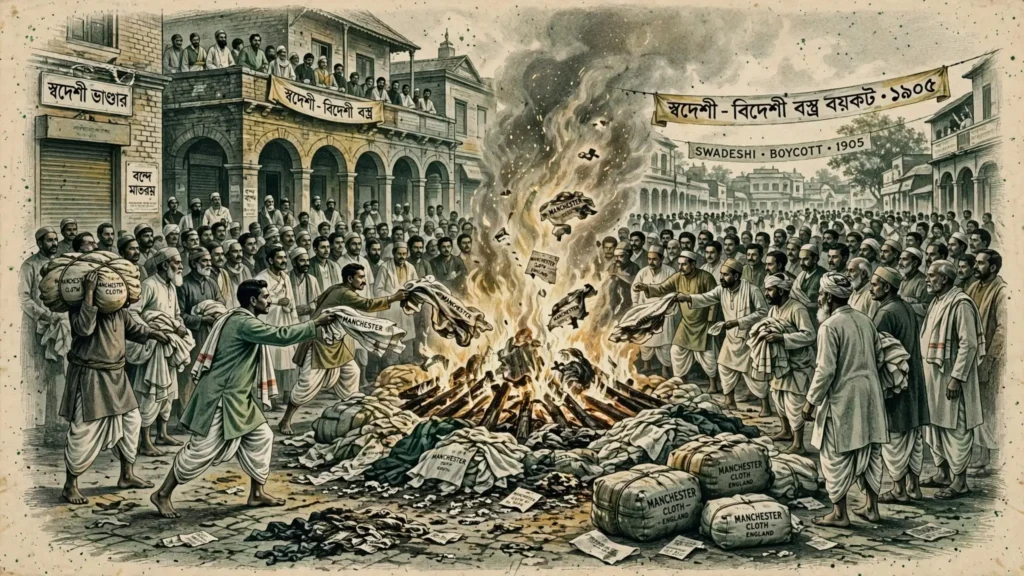
Public Burnings of Foreign Cloth During the Swadeshi Movement, many people protested against British goods by boycotting them, especially British cloth. In cities like Kolkata, people gathered to burn British textiles in public bonfires as a way to show their resistance to British control over the economy. This act not only rejected British imports but also celebrated India’s own textile industry. Nationalist leaders organized these events, which were emotional and involved people from different backgrounds. The goal was to put economic pressure on British manufacturers and promote local craftsmanship, particularly in handloom, which the British had harmed with their policies.
Encouragement of Local Products The Swadeshi Movement also encouraged people to buy local products. This included promoting Indian-made textiles and other goods like pottery, leather, and metalwork. Local markets were set up, and people were urged to support Indian products, fostering national pride and economic independence. The movement aimed to help local artisans and small industries create products to replace British imports, making self-sufficiency a main goal. Reviving local crafts and traditional industries was seen as a way to combat the negative effects of British economic policies.
National Education Movement
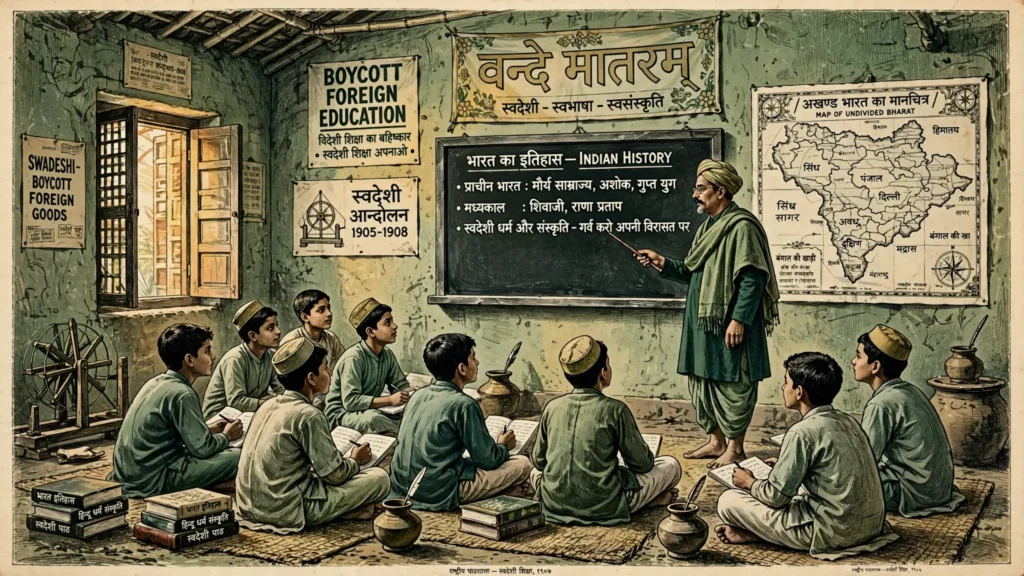
Establishment of National Schools and Colleges A key part of the Swadeshi Movement was the focus on national education to empower people and promote nationalism. Nationalist leaders rejected the British education system and established schools and colleges that highlighted Indian culture, history, and values. Leaders like Lala Lajpat Rai and Bipin Chandra Pal advocated for education that would nurture a sense of nationalism. The aim was to create institutions where students could learn about their own heritage instead of a British-centered curriculum. This led to the creation of many educational institutions, including the National Council of Education, which set the stage for future educational reforms in India.
Emphasis on Indian History and Culture The National Education Movement stressed the importance of teaching Indian history and culture, aiming to revive pride in India’s past and traditions. It opposed the colonial view that portrayed Indian culture as inferior. Subjects like ancient Indian history, literature, and art were highlighted, encouraging students to take pride in their heritage. Education was viewed not just as a way to gain knowledge but also as a means of national awakening and resistance to colonial rule. Rabindranath Tagore also promoted cultural revival through literature and music, reinforcing the connection to India’s roots.
Mass Mobilization
Use of Songs and Literature (Rabindranath Tagore’s “Amar Shonar Bangla”) The Swadeshi Movement recognized the importance of culture and emotion in bringing people together. Rabindranath Tagore’s song “Amar Shonar Bangla” (My Golden Bengal) became a symbol of resistance and unity. Tagore’s writings, along with other nationalist poets, inspired people by evoking pride in their nation. Songs, poems, and literature were used to spread nationalist ideas and raise awareness about the movement’s goals. These cultural expressions helped unite Indians from different regions and social backgrounds under the Swadeshi Movement.
Festivals and Melas as Platforms for Protest Festivals and melas (fairs) became important venues for protests and spreading nationalist ideas. The Swadeshi Movement cleverly used cultural and religious events to mobilize people. Leaders like Bal Gangadhar Tilak used festivals such as Ganesh Chaturthi for political purposes, using these gatherings to promote unity. Public meetings, processions, and mass gatherings were held during these events, where speeches were made, and songs of resistance were sung. The aim was to foster a sense of national solidarity through community activities, effectively combining politics with culture. This approach was particularly effective in reaching rural populations who were familiar with festivals and melas.
Role of Different Social Groups
Involvement of Students, Women, and Workers The Swadeshi Movement was one of the first mass movements in India to include students, women, and workers actively. Students played a key role in organizing protests and rallies. Many schools became centers of nationalist activity, teaching young people about self-rule and resistance. Women, who had not been involved in politics before, joined the movement by organizing boycotts of foreign goods, protesting, and supporting local industries. They also contributed through cultural activities like singing patriotic songs and spinning khadi. Workers, especially in cities, became important supporters of the movement as they sought better working conditions and joined in the boycotts of British goods.
Expansion Beyond Bengal to Other Regions While Bengal was the main center of the Swadeshi Movement, its impact spread to other parts of India over time. The movement’s focus on local goods, boycotts, and education resonated with people nationwide. Similar protests were organized in Maharashtra, Gujarat, and Punjab, promoting local industries. The movement inspired new generations of nationalist leaders who would play key roles in the later independence struggle. The Swadeshi Movement marked the start of a nationwide resistance to British rule, breaking regional and social barriers and creating a more unified nationalist movement that would continue to grow.
In summary, the Swadeshi Movement used various strategies to mobilize people and challenge British rule. By boycotting British goods, promoting local products, establishing national education institutions, and using cultural expressions like songs and festivals, the movement encouraged widespread participation from different social groups. It set the stage for larger, more inclusive movements in India’s fight for independence. The Swadeshi Movement was not just a challenge to British economic policies but also a significant moment in the rise of Indian nationalism, showing the strength of collective action, cultural pride, and self-reliance against colonial oppression.
Early Revolutionary Activities
Rise of Secret Societies
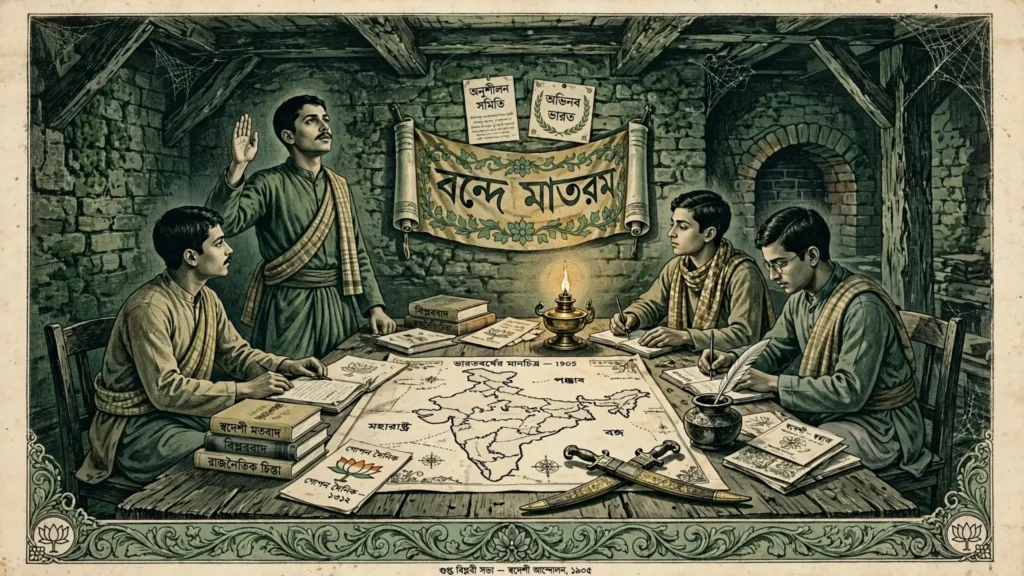
Anushilan Samiti in Bengal The Anushilan Samiti was created in the late 1800s in Bengal. It started as a group to promote fitness but soon became a secret organization aimed at ending British rule in India using revolutionary actions. The members wanted independence and believed in fighting against British control. They helped spread revolutionary thoughts in Bengal and were involved in bombings and attacks on British officials. Unlike the Indian National Congress, which preferred peaceful methods, the Samiti focused on direct action.
Abhinav Bharat Society in Maharashtra The Abhinav Bharat Society was founded by Vinayak Damodar Savarkar in 1904. This group also believed that armed resistance was necessary for India’s independence. They aimed to inspire young Indians to take action and promoted a strong sense of nationalism. The society was linked to several assassination attempts on British officials and supported Hindu nationalism as part of the independence movement. They believed in a strong and self-sufficient India, free from colonial rule.
Motivations
Disillusionment with Moderate Methods Many young nationalists felt frustrated with the Indian National Congress’s slow and peaceful approach to gaining rights and representation. They believed that the British government was not listening to their demands and that non-violent methods like petitions were not enough. This led them to seek more direct and forceful ways to fight against British oppression.
Inspired by International Revolutionary Movements Indian revolutionaries were also motivated by successful nationalist movements in other countries like Ireland, Russia, and Italy. They looked to these movements for inspiration, believing that armed resistance was the only way to gain freedom from British colonial rule.
Notable Revolutionaries
Aurobindo Ghosh: From Extremism to Spiritualism Aurobindo Ghosh was a key revolutionary leader in the early 1900s. He was involved in planning attacks against British officials and inspired many with his speeches for Indian freedom. However, after a time of intense activism, he turned away from politics to focus on spirituality, becoming a respected figure in Indian philosophy.
Bhikhaji Cama: Voice of Freedom from Abroad Bhikhaji Cama was one of the first Indian women to join the nationalist movement. She became frustrated with the moderate approach of the Congress and moved to Europe to gain international support for India’s independence. Cama made speeches and distributed literature about India’s struggle and famously raised the Indian national flag at a conference in Paris in 1907.
V.D. Savarkar: Ideologue and Activist Vinayak Damodar Savarkar was a strong revolutionary figure who promoted Hindu nationalism. He believed in armed resistance and was involved in plotting an assassination of a British official. Savarkar was arrested and spent many years in prison. Later, he shifted away from revolutionary politics but left a lasting impact on India’s independence movement.
The early revolutionary activities of groups like the Anushilan Samiti and Abhinav Bharat marked an important change in India’s fight for independence. These groups focused on armed resistance in response to frustrations with British rule. Influenced by global movements, they sought change through direct action. Key figures like Aurobindo Ghosh, Bhikhaji Cama, and V.D. Savarkar played significant roles, and their actions greatly influenced India’s struggle for freedom.
Revolutionary Actions
Assassinations and Attempts
Killing of British Officials (e.g., Curzon Wyllie) Revolutionaries used the assassination of British officials as a strong way to resist colonial rule. They aimed to create fear among the British and show that Indians would no longer accept their control. A famous case was the killing of Sir Curzon Wyllie in 1909 by Indian nationalist Madan Lal Dhingra in London. Dhingra believed that such actions were important to free India from British rule. His actions inspired many in India, and after his trial and execution, he became a symbol of the fight for independence.
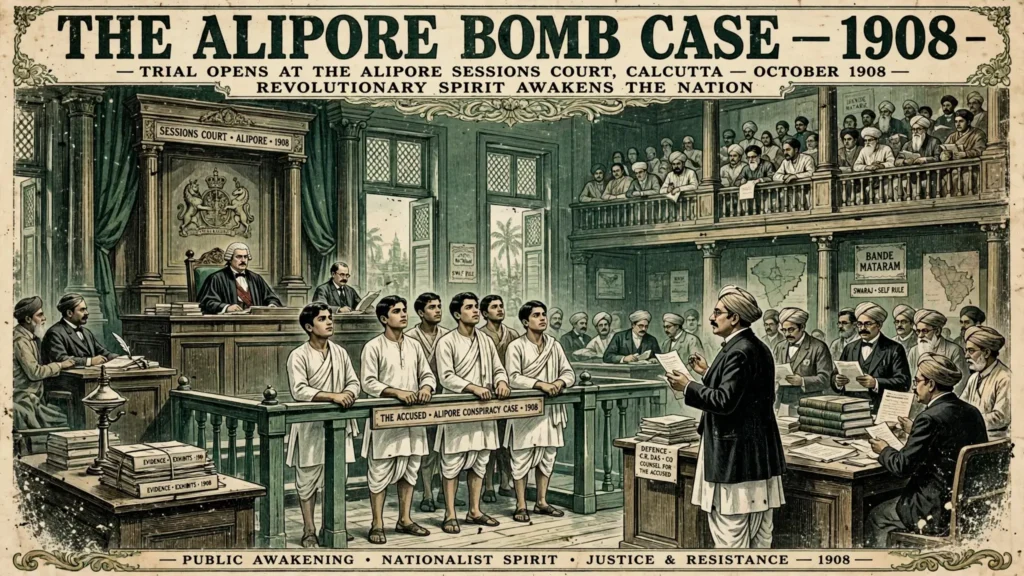
Alipore Bomb Case (1908) The Alipore Bomb Case in 1908 was another key event in the fight against British rule. It involved a plan by revolutionaries in Bengal to kill British officials using bombs. The plan went wrong when a bomb exploded early, killing several revolutionaries. Many involved, including leaders like Aurobindo Ghosh and Bagha Jatin, were arrested. This case received a lot of attention and highlighted the rising tensions between the British and Indian revolutionaries. Although Ghosh was later found not guilty, the trial brought revolutionary actions into public view and showed that some Indians were ready to use violence for independence. It also made bombings a common tactic in later revolutionary efforts in India.
Propaganda and Publications
Distribution of Pamphlets and Literature In addition to violent actions, revolutionary groups also worked on spreading their ideas through writings. They distributed pamphlets and other printed materials that called for revolution, criticized British rule, and justified using violence. Revolutionaries like Bhikhaji Cama and Lala Lajpat Rai printed and shared this literature to inspire people in India to act. These writings not only pushed for self-rule (Swaraj) but also highlighted the exploitation of India by the British. They were often shared secretly, making them an important part of underground efforts.
Establishment of Indian Press Abroad Another crucial part of the revolutionary movement was creating Indian press outlets in other countries. Revolutionaries knew it was important to share India’s struggles with the world to gain support. Bhikhaji Cama helped start Indian publications in Europe, like Ghadar and Indian Sociologist, which challenged British views and encouraged Indians living abroad to support the independence movement. These publications reported on British wrongdoings in India, called for freedom, and spread revolutionary ideas. The Indian press abroad played a key role in connecting the global Indian community to the fight for independence and other anti-colonial movements worldwide.
In summary, revolutionary actions during this time included assassinations and violence against British officials, as well as spreading ideas through literature and establishing press outlets abroad. Events like the assassination of Curzon Wyllie and the Alipore Bomb Case showed a more radical approach to the struggle for independence, while the distribution of revolutionary writings helped gain support both in India and among Indians living overseas. These actions, though controversial, were vital to India’s growing resistance against British rule and contributed to the larger movement for freedom.
British Control and Reactions
Strict Laws
Prevention of Seditious Meetings Act To deal with rising protests and unrest, the British government in India created strict laws to stop public opposition and revolutionary ideas. One such law, the Prevention of Seditious Meetings Act (1907), allowed British officials to stop gatherings that were seen as rebellious, especially those discussing anti-British actions. This law aimed to suppress protests and political meetings that could lead to rebellion. It limited people’s freedom to express their views and gather, making it hard for nationalists and revolutionaries to gain support. These actions were part of a larger plan by the British to control the growing nationalist movements in India.
More Monitoring and Censorship As revolutionary activities increased, the British government stepped up monitoring across India. They kept an eye on known nationalist leaders and their actions. British agents infiltrated revolutionary groups and gathered information. Newspapers and pamphlets with anti-colonial messages were censored, and printing presses that published such material were often closed down. The goal was to stop revolutionary ideas from spreading and silence critics of British rule. The British authorities imposed bans on the press and restricted the publication of works by certain nationalist leaders to prevent a united nationalist front and to silence calls for independence through education and media.
Trials and Punishments
Deportation and Harsh Sentences To further control revolutionary actions, the British government deported and gave harsh sentences to revolutionary leaders and activists. Many nationalists were arrested on charges like rebellion and conspiracy. After trials, some leaders were sent into exile or to faraway places. For example, Vinayak Damodar Savarkar, a key figure in the revolutionary movement, was given a life sentence and sent to the Cellular Jail in the Andaman Islands. Deportation was used to separate these leaders from the public, reducing their influence. Many faced long prison sentences or execution for violent actions against British officials.
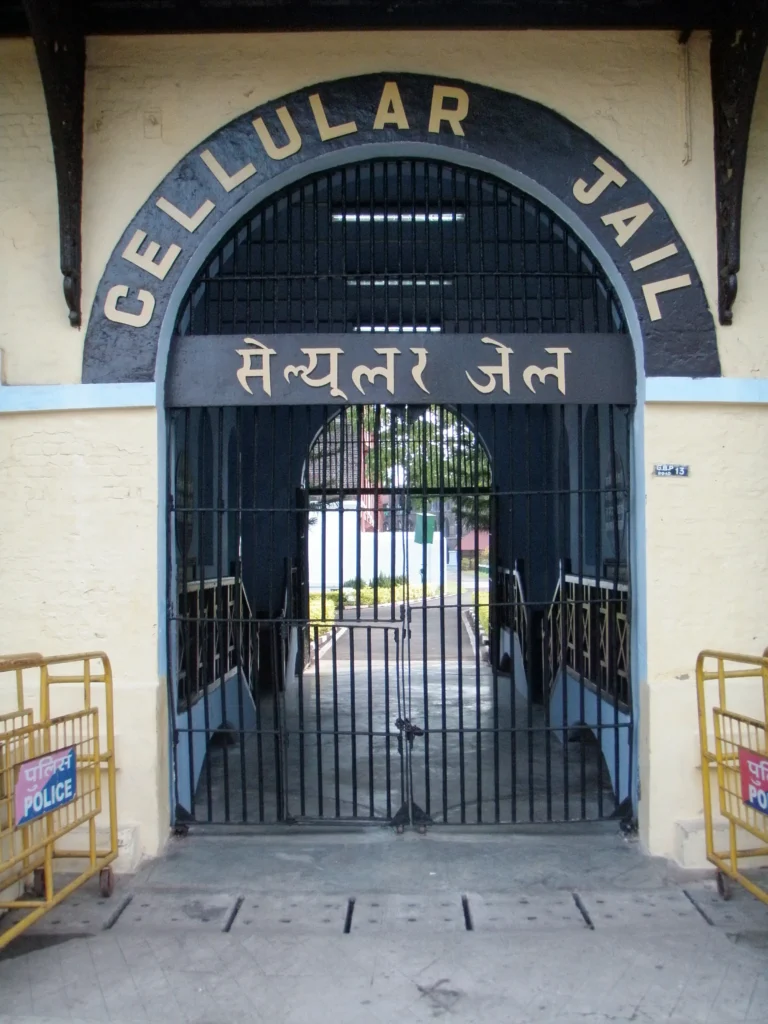
Cellular Jail in Andaman (Kala Pani) The Cellular Jail in the Andaman Islands, known as Kala Pani (meaning “Black Water”), became a symbol of British oppression. It was a high-security prison for political prisoners, particularly revolutionaries. The jail was notorious for its harsh conditions: prisoners were kept in solitary confinement, forced to work hard, and faced brutal treatment. They were isolated from each other and the outside world, symbolizing the British attempt to crush the Indian freedom movement. Many well-known revolutionaries, like Veer Savarkar, spent years in this prison. The terrible conditions and treatment of the prisoners sparked public outrage and fueled nationalist sentiment in India. The stories of suffering from those imprisoned there increased anger towards British rule, highlighting the oppressive nature of colonial control.
In short, the British response to rising nationalist movements in India included strict laws, physical punishment, and exile. The Prevention of Seditious Meetings Act and other laws were used to limit public gatherings and suppress dissent. Increased surveillance, press censorship, and many arrests were part of the British efforts to control the push for independence. The trials and deportations of revolutionary leaders, especially those sent to the Cellular Jail, were key parts of British repression. However, these actions also strengthened the determination of Indian nationalists and contributed to the growing resistance against British rule.
Impact on the Freedom Struggle
Inspiring Future Generations
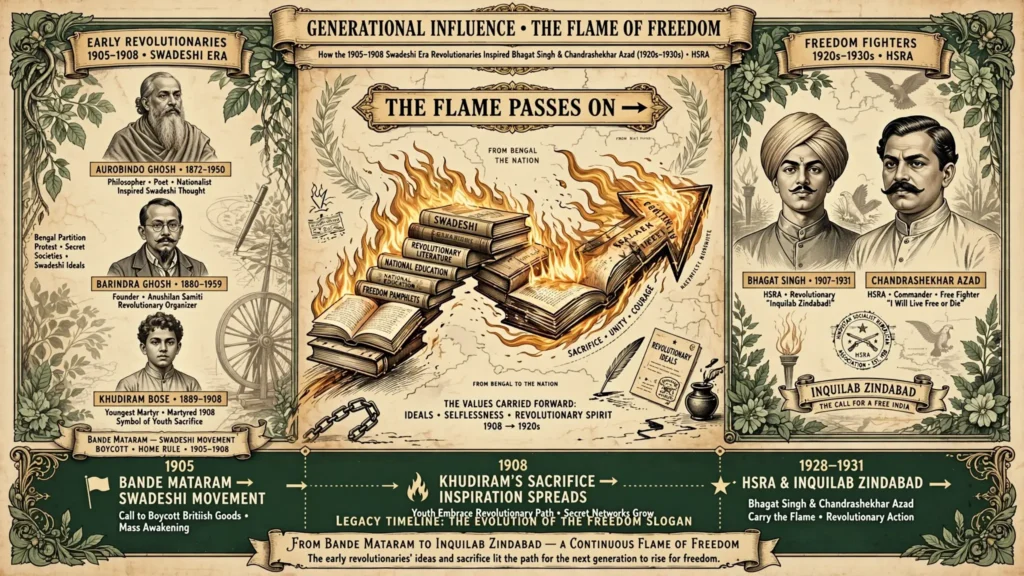
Influence on Bhagat Singh and Chandrashekhar Azad The revolutionary movements in the early 1900s, such as the Swadeshi Movement and groups like the Anushilan Samiti and Abhinav Bharat Society, greatly inspired later freedom fighters like Bhagat Singh and Chandrashekhar Azad. The bravery and sacrifices of earlier revolutionaries encouraged these young leaders to fight against British rule using stronger methods.
Bhagat Singh was particularly inspired by the idea of fighting back violently and wanting self-rule. He admired the sacrifices of past revolutionaries and believed the youth could shape India’s future. Chandrashekhar Azad had similar beliefs and took part in many revolutionary activities, including the notable Mainpuri Conspiracy. Their actions, like the Lahore Conspiracy Case and the Jallianwala Bagh massacre, showed their dedication to India’s independence through direct action.
The earlier movements set the stage for future freedom fighters who were willing to use more radical and sometimes violent means to achieve independence.
Ideological Foundations for Later Movements The ideas from early revolutionary movements influenced later nationalist movements. Leaders like Bal Gangadhar Tilak and Lala Lajpat Rai encouraged a strong sense of pride in Indian culture and the need for self-reliance. This thinking was embraced by later figures like Bhagat Singh, who argued that India could only gain freedom through forceful resistance and mass action. The creation of secret societies, armed resistance, and the focus on self-reliance played a big role in shaping later groups like the Hindustan Socialist Republican Association in the 1920s and 1930s.
Integration with Mainstream Nationalism
Reconciliation with Moderate Leaders Although early revolutionaries often disagreed with the Moderates in the Indian National Congress (INC), the harsh treatment from the British led to a stronger unity between the two groups. The brutality of British actions, like the Jallianwala Bagh Massacre (1919), made even the Moderates realize that stronger actions were needed against British rule. Leaders like Gopal Krishna Gokhale, Dadabhai Naoroji, and Surendranath Banerjee initially sought reforms and cooperation with the British but later understood that these methods were not enough to gain independence.
The Non-Cooperation Movement (1920), led by Mahatma Gandhi, was a key moment where moderates and extremists came together. Gandhi, who once criticized violent methods, began to unite peaceful resistance with the goals of radical groups. This partnership changed the freedom struggle by bringing together different parts of Indian society for the common goal of self-rule. The extreme methods of revolutionaries were not ignored but were included in a broader movement that engaged many people.
Recognition of the Need for Mass Support The early revolutionary movements also helped people realize that India’s fight for independence needed support from the masses, not just a few elite leaders. Radical leaders understood that real independence required the involvement of many people. The Swadeshi Movement highlighted the importance of participation from various groups — students, workers, women, and farmers — in protests, boycotts, and promoting local goods. This wide involvement made the struggle more inclusive and showed the strength of collective action against British control.
The lessons from these early movements were crucial when Mahatma Gandhi launched campaigns like the Salt March and Quit India Movement. By including the masses, Gandhi’s efforts went beyond the limits of elite-led groups and became the main force in India’s fight for freedom.
In conclusion, the Swadeshi Movement and early revolutionary activities had a big impact on the freedom struggle in both the short and long term. They inspired future revolutionaries like Bhagat Singh and Chandrashekhar Azad, who learned from their predecessors. The radical approach of these revolutionaries also affected mainstream nationalism, with leaders like Gandhi and Nehru acknowledging the need for mass support to achieve independence. The combination of radical and moderate methods helped create a united front against British colonialism, laying the groundwork for the success of the Indian independence movement.
Key Takeaways
The Swadeshi Movement and early revolutionary activity marked India’s shift from elite petition-politics to mass-based resistance — a turning point that reshaped the nationalist movement’s methods and scale for decades to come. Looking at these chapters of history shows the passion and complexity of India’s fight for independence — different ideas and methods worked together in a lively struggle, with each playing a special role in the bigger goal.
Previous Year Questions
Previous Year Questions — Swadeshi Movement & Revolutionary Nationalism
Important questions from previous year exam patterns on this topic. Tap a question to view a quick-answer guide.
1 Discuss the causes and impact of the Swadeshi Movement (1905–1911). +
2 Examine the role of secret revolutionary societies like the Anushilan Samiti in the freedom struggle. +
3 Write a short note on the Alipore Bomb Case. +
4 How did the British respond to the rise of revolutionary nationalism? +
5 How did early revolutionary movements influence Bhagat Singh and Chandrashekhar Azad? +
6 Discuss the role of the National Education Movement during the Swadeshi era. +
FAQs
What caused the Swadeshi Movement?
The 1905 Partition of Bengal by the British, widely seen as a divide-and-rule tactic, triggered the Swadeshi Movement’s call to boycott British goods and support Indian industries.
What does “Swadeshi” mean?
“Swadeshi” means “of one’s own country” — it refers to the promotion and use of Indian-made goods over foreign imports.
What was the Anushilan Samiti?
A secret revolutionary society founded in Bengal that evolved from a fitness organisation into a group pursuing armed resistance against British rule.
Why is the Cellular Jail called “Kala Pani”?
“Kala Pani” (Black Water) refers to the Cellular Jail in the Andaman Islands, notorious for its brutal, isolating conditions for political prisoners like Savarkar.
What was the Alipore Bomb Case?
A 1908 case in which a Bengal revolutionary plot to bomb British officials went wrong when the bomb exploded prematurely, leading to the arrest of leaders like Aurobindo Ghosh.
How did the Swadeshi Movement influence Gandhi’s later campaigns?
Its emphasis on mass participation, boycotts, and self-reliance directly shaped Gandhi’s Non-Cooperation Movement (1920-22) and the Salt March (1930).
Subscribe to keep reading
You've used your free notes for now. Get Delhi Pathshala Premium for unlimited access.
Subscribe — ₹29/30 days