
Contents
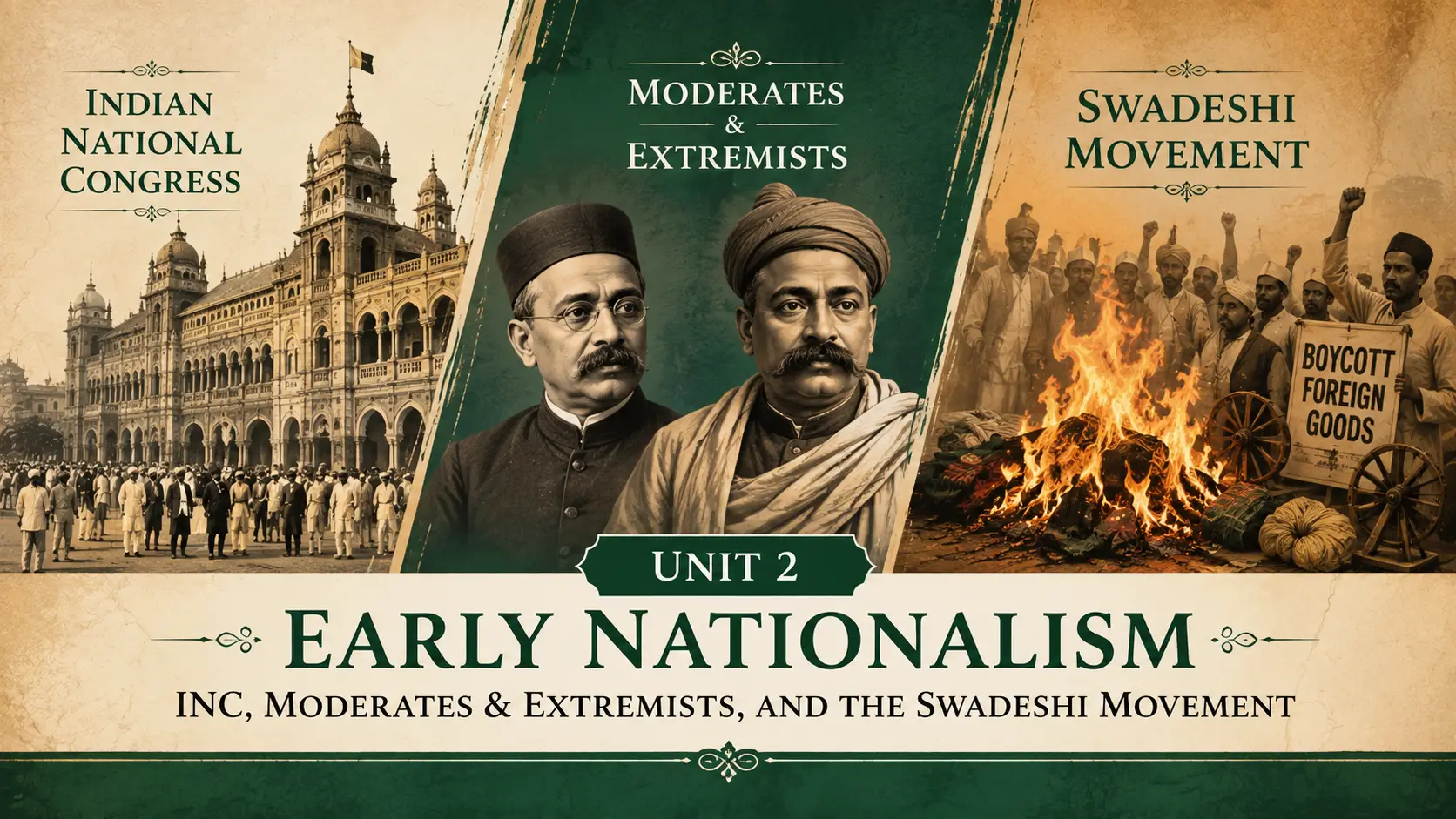
Quick Answer: Unit 2 (“Early Nationalism”) of DSC-2 covers three linked topics: the founding of the Indian National Congress in 1885, the ideological split between its Moderate and Extremist wings, and the Swadeshi Movement along with early revolutionary activity (1905–1911). Use the three linked notes below for full unit-wise coverage.
In this post, an overview of “Unit 2: Early Nationalism” from “DSC-2: History of India – VIII: c. 1857–1950” is given, along with links to detailed topic-wise notes.
📚 Topics in This Unit
1. Emergence of the Indian National Congress (INC)
Covers the background after 1857, rise of early political associations, A.O. Hume’s role, and the INC’s first session in 1885. 👉 Read full notes: Emergence of Indian National Congress (INC).
2. ‘Moderates’ and ‘Extremists’ Nationalists
Covers the ideological divide within the INC, key leaders on both sides, and the 1907 Surat Split. 👉 Read full notes: Moderates and Extremists Nationalists.
3. Swadeshi and Early Revolutionary Movements
Covers the Swadeshi Movement (1905–1911), rise of secret revolutionary societies, and British repression. 👉 Read full notes: Swadeshi and Early Revolutionary Movements
Quick Comparison: Moderates vs Extremists
| Aspect | Moderates | Extremists |
|---|---|---|
| Period of dominance | 1885–1905 | 1905–1918 |
| Methods | Petitions, prayers, dialogue | Boycott, Swadeshi, direct action |
| Faith in British justice | High | Low/none |
| Key leaders | Naoroji, Gokhale, Bonnerjee | Tilak, Pal, Lajpat Rai |
| Social base | Educated urban elite | Wider, mass-based |
(Full comparison table with more rows is in the Moderates and Extremists notes.)
FAQs
What are the three main topics under Unit 2: Early Nationalism?
The Emergence of the Indian National Congress (1885), the Moderates-Extremists divide (including the 1907 Surat Split), and the Swadeshi Movement with early revolutionary activities (1905–1911).
Why did the Indian National Congress split into Moderates and Extremists?
The two groups disagreed over methods — Moderates favoured petitions and constitutional dialogue, while Extremists demanded direct action like boycott and Swadeshi. This came to a head at the 1907 Surat Session.
What triggered the Swadeshi Movement?
The 1905 Partition of Bengal by the British, seen as a “divide and rule” tactic, triggered the Swadeshi Movement’s call to boycott British goods and support Indian industries.
Subscribe to keep reading
You've used your free notes for now. Get Delhi Pathshala Premium for unlimited access.
Subscribe — ₹29/30 days