
Contents
- Comparison Table: Moderates vs Extremists
- ‘Moderates’ and ‘Extremists’ Nationalists
- Understanding ‘Moderates’ and ‘Extremists’
- Differences in Ideas
- Changes in the INC
- The Moderates
- Key Leaders
- Beliefs and Strategies
- Contributions and Criticisms
- The Extremists
- Important Leaders
- Basic Beliefs
- Methods and Actions
- Publications and Propaganda
- The Surat Split of 1907
- Reasons for the Split
- Events of the Split
- Effects
- Impact on the Nationalist Movement
- Short-Term Consequences
- Long-Term Significance
- Key Takeaways
- Previous Year Questions
- FAQs
Quick Answer: The Moderates (1885–1905) sought reform through petitions and dialogue with the British, while the Extremists (from 1905) demanded direct action — boycott, Swadeshi, and Swaraj. Their conflict peaked at the 1907 Surat Session, splitting the INC into two factions.
Part of “Unit 2: Early Nationalism” — DSC-2 hub. Previous: Emergence of INC. Next: Swadeshi Movement.
Comparison Table: Moderates vs Extremists
| Aspect | Moderates | Extremists |
|---|---|---|
| Active period | 1885–1905 (dominant) | 1905 onwards (rising) |
| Methods | Petitions, memorandums, dialogue | Boycott, Swadeshi, passive resistance, direct action |
| Attitude to British rule | Faith in British justice and fair play | Distrust; saw British rule as fundamentally exploitative |
| Goal | Gradual self-governance within Empire | Swaraj (complete self-rule) |
| Social base | Educated, urban middle/upper class | Broader — students, youth, wider public |
| Key leaders | Dadabhai Naoroji, Gopal Krishna Gokhale, W.C. Bonnerjee, Pherozeshah Mehta | Bal Gangadhar Tilak, Bipin Chandra Pal, Lala Lajpat Rai |
| Signature idea | Naoroji’s “Drain Theory” | Tilak’s “Swaraj is my birthright” |
‘Moderates’ and ‘Extremists’ Nationalists
Understanding ‘Moderates’ and ‘Extremists’
Differences in Ideas
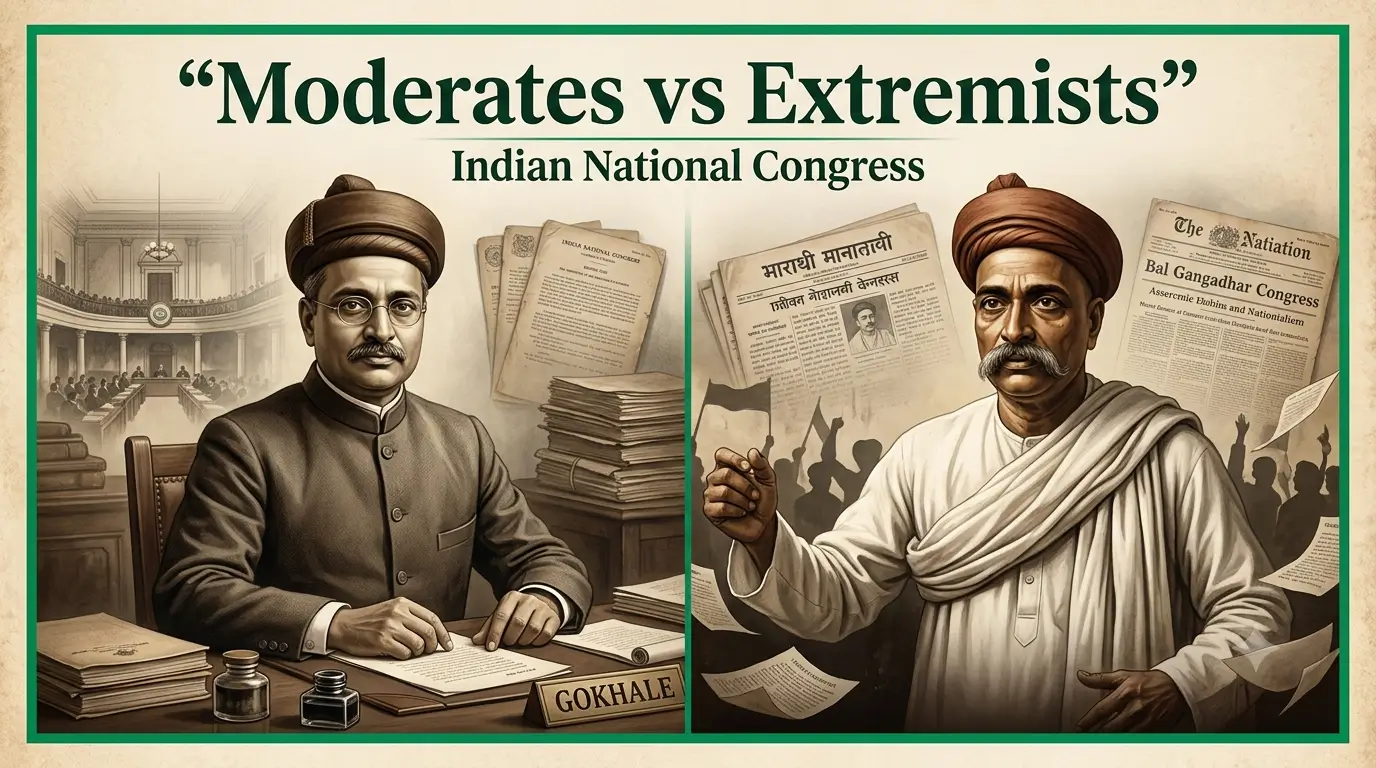
Ways to Self-Governance: The Indian National Congress (INC) had two main groups: the Moderates and the Extremists, who had different ideas on how to get self-governance for India.
Moderates: The Moderates wanted to achieve self-governance slowly and through peaceful means. They believed in working within the current British system, asking for changes and rights through discussions and petitions. They thought that by talking and getting support from the British public, the British government would eventually allow India more freedom. Key leaders included Dadabhai Naoroji, Gopal Krishna Gokhale, and Womesh Chunder Bonnerjee.
Extremists: The Extremists were more aggressive in their approach. They thought the Moderates were too slow and wanted quicker and bigger changes. They criticized the British for exploiting India and believed that independence could only come through strong protests and direct action. Important leaders were Bal Gangadhar Tilak, Bipin Chandra Pal, and Lala Lajpat Rai.
Views on British Rule: Moderates believed that working with the British was possible and that changing their policies from within was the best way to get self-rule. They hoped that by being loyal and cooperative, the British would recognize India’s efforts and allow more self-governance.
In contrast, the Extremists saw British rule as unfair and harmful. They were less willing to collaborate and believed that true independence would come from mass protests and rejecting British control.
Changes in the INC
Early Cooperation: At first, both the Moderates and Extremists worked together in the INC towards the shared goal of self-governance, using petitions and discussions to ask for reforms. They focused on including Indians in government councils and improving civil services.
Growing Divisions: Over time, their different approaches led to disagreements within the INC. The Moderates wanted to continue with their peaceful methods, while the Extremists were frustrated with the slow changes and the British government’s refusal to listen. This tension peaked in 1907 during the INC meeting in Surat, where the two groups split. The Moderates, led by Gopal Krishna Gokhale and Pherozeshah Mehta, and the Extremists, led by Bal Gangadhar Tilak, could not find common ground.
This split was a key moment in the INC’s history. Although it weakened the organization at first, it also opened the door for new ideas in the independence movement. The Extremists began to advocate for more direct actions, like boycotts and promoting self-reliance (Swadeshi), while the Moderates remained focused on discussions and legal methods. This divide would shape the future of India’s struggle for freedom.
In short, the difference between the Moderates and Extremists in the INC was not just about strategy but also about their views on British rule and how to achieve self-governance. Initially, both groups worked together, but as time went on, their differences grew, leading to a split that changed India’s political scene.
The Moderates
Key Leaders
Dadabhai Naoroji: The Grand Old Man of India Dadabhai Naoroji was a key leader in the Indian National Congress and is known as the “Grand Old Man of India.” He was important in the early nationalist movement and criticized British rule for taking India’s wealth. He created the “Drain Theory,” showing how British policies harmed India’s economy. In 1892, he became the first Indian elected to the British Parliament, where he spoke about India’s issues. He aimed to get more Indian representation in British institutions.
Gopal Krishna Gokhale: The Mentor of Gandhi Gopal Krishna Gokhale was a respected leader and mentor to Mahatma Gandhi. He believed in making gradual changes and working with the British government. He focused on education, social improvements, and better opportunities for Indians. Gokhale helped start the Servants of India Society, which aimed to educate Indians and enhance their living conditions.
Pherozeshah Mehta and Surendranath Banerjee Pherozeshah Mehta and Surendranath Banerjee were also important leaders. Mehta was a lawyer who worked for reforms in Indian civil services and rights for Indians in government. Banerjee was a significant figure in the early Indian National Congress, advocating for constitutional methods and greater political participation for Indians. Both helped develop the INC and aimed for dialogue with the British government.
Beliefs and Strategies
Faith in British Justice and Fair Play The Moderates believed that the British government would be fair if they understood Indian problems. They thought that by using peaceful methods, like petitions and discussions, they could persuade the British to make reforms and allow more Indian involvement in governance.
Advocacy for Constitutional Reforms The Moderates sought constitutional reforms, such as more Indian representation in government, civil service improvements, better education, and expanded political rights. They believed that loyalty and cooperation with the British would help India gain self-governance. They worked to inform both the British and Indians about the benefits of gradual reform.
Use of Diplomacy and Legal Methods The Moderates used diplomacy, petitions, and legal approaches to achieve their goals. They focused on peaceful actions, like petitions to the British government and Congress resolutions, to push for reforms. They believed that dialogue and legal means could help establish Indian self-governance without violence.
Contributions and Criticisms
Economic Critique of Colonialism (Drain Theory) One major contribution from the Moderates, especially Naoroji, was the “Drain Theory.” He argued that the British were taking India’s wealth, which harmed the economy and caused poverty. This theory supported the idea of Indian self-rule and raised awareness about the negative effects of British colonialism.
Limited Mass Mobilization A key criticism of the Moderates was their failure to engage the masses in their reform efforts. They mainly focused on educated and urban Indians, neglecting the rural population. This lack of broader support made their movement less effective, especially as more radical groups began to seek stronger action for independence.
Criticized for Being Elitist and Slow The Moderates were often seen as elitist since their strategies mostly suited educated and upper-middle-class Indians. Their slow approach to reform was viewed as ineffective in dealing with urgent political and economic issues in India. This led to frustrations that contributed to the rise of Extremists, who wanted quicker and more aggressive changes.
In summary, the Moderates were important in the early Indian nationalist movement, advocating for constitutional reforms and critiquing colonialism while working within the British system for self-governance. However, their gradual methods, limited mass appeal, and perceived elitism made it hard for them to create widespread political change, leading to the emergence of more radical groups within the INC.
The Extremists
Important Leaders
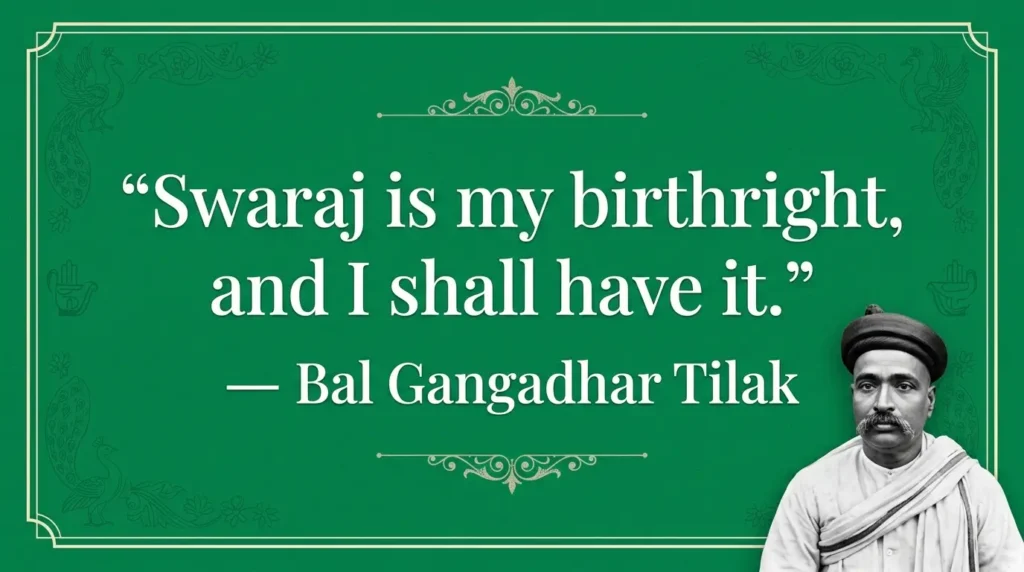
Bal Gangadhar Tilak: Lokmanya and Radical Nationalist Bal Gangadhar Tilak is a famous and influential leader in the Extremist group of Indian nationalism. Known as “Lokmanya” (beloved by the people), Tilak pushed for strong actions to gain self-rule for India. He criticized British rule and believed that India could only achieve independence through direct action and strong nationalism. His slogan “Swaraj is my birthright, and I shall have it” inspired many nationalists. Tilak also helped revive Hindu festivals like Ganesh Chaturthi to promote national pride and unity. He contributed not just in politics but also in social and cultural reforms, focusing on education.
Lala Lajpat Rai: The Lion of Punjab Lala Lajpat Rai was a key nationalist and a well-known leader in the Extremist group. Called the “Lion of Punjab,” he fought hard for Indian independence and worked for the people’s welfare. He opposed British rule and led protests, including the non-cooperation movement in Punjab. Rai also focused on education and social reform, helping lower castes and advocating for women’s rights. His strong resistance to British rule led to him being severely beaten during a protest in 1928, which contributed to his death.
Bipin Chandra Pal: The Father of Revolutionary Thought Bipin Chandra Pal was an important leader in the Extremist movement and is known as the “Father of Revolutionary Thought” in India. He believed that the British would not give India freedom peacefully and called for more direct and aggressive actions. Pal promoted national self-reliance and encouraged young people to oppose British rule. He was key in sharing revolutionary ideas and supported the Swadeshi movement, inspiring many nationalists to fight against colonial rule.
Basic Beliefs
Strong Nationalism and Self-Reliance The Extremists believed in strong nationalism, wanting India to be completely independent from British rule. Unlike the Moderates, who wanted gradual changes and cooperation with the British, the Extremists thought India could not be free without taking control of its future. They stressed self-reliance and urged Indians to depend on their own resources rather than British support, promoting local industries and rejecting foreign goods.
Demand for Swaraj (Self-Rule) A main goal of the Extremists was Swaraj or self-rule. They believed India should be governed by Indians and that British control was unfair. Swaraj meant not just having more say in the government, but complete independence from British rule. The Extremists felt that India had the right to govern itself.
Focus on Cultural Revival The Extremists aimed to revive India’s culture, traditions, and heritage. They believed British rule damaged Indian values and wanted to restore ancient traditions by promoting Indian languages, arts, and religious practices. This cultural revival was seen as important for national unity and pride in India’s history.
Methods and Actions
Swadeshi and Boycott Movements The Extremists were active in the Swadeshi (self-reliance) and boycott movements in the early 1900s. The Swadeshi movement was a reaction to British policies hurting Indian industries. The Extremists encouraged people to stop using British goods and support local products. This weakened the British economy and helped Indian industries grow. Boycotting foreign goods became a symbol of Indian resistance and promoted national pride. (For full detail, see the Swadeshi Movement notes.)
Using Local Languages to Reach Many People The Extremists used local languages to connect with the masses. They realized that to reach more people, they needed to avoid the English language and speak in languages like Marathi, Bengali, and Hindi. This helped spread nationalist ideas and build a strong link with ordinary people, who had been left out of discussions led by English-educated elites.
Gatherings and Festivals The Extremists effectively used festivals and public events to spread their message and gather support. For example, Bal Gangadhar Tilak revived the Ganesh Chaturthi festival to unite Hindus and promote nationalism. These events included speeches and cultural activities aimed at raising awareness of nationalism and also served as opportunities for organizing protests and rallies.
Publications and Propaganda
Newspapers: Kesari (Marathi) and Maratha (English) The Extremists understood the importance of newspapers in spreading their ideas. Publications like Kesari (in Marathi) and Maratha (in English) were essential for rallying against British rule. Run by leaders like Bal Gangadhar Tilak, these newspapers shared revolutionary ideas and criticisms of British policies, helping to shape public opinion in favor of independence.
Focus on National Education The Extremists highlighted national education to awaken the Indian people. They supported creating schools that taught Indian culture, history, and values. This education aimed to instill pride in India’s heritage and foster nationalism. The Extremists believed education was vital for preparing future generations to fight for independence.
In summary, the Extremists played a key role in the Indian nationalist movement, pushing for direct action, self-rule, and the revival of Indian culture. Led by figures like Bal Gangadhar Tilak, Lala Lajpat Rai, and Bipin Chandra Pal, they used mass mobilization, cultural revival, and publications to spread their message and challenge British rule. Their confrontational methods laid the groundwork for the more radical phases of the independence struggle.
The Surat Split of 1907
Reasons for the Split
Different Approaches to Fighting: The main reason for the Surat Split was the different ways of fighting for freedom between the Moderates and the Extremists. The Moderates wanted to use peaceful methods like petitions and talking with the British, while the Extremists wanted to take strong actions like mass protests against British rule.
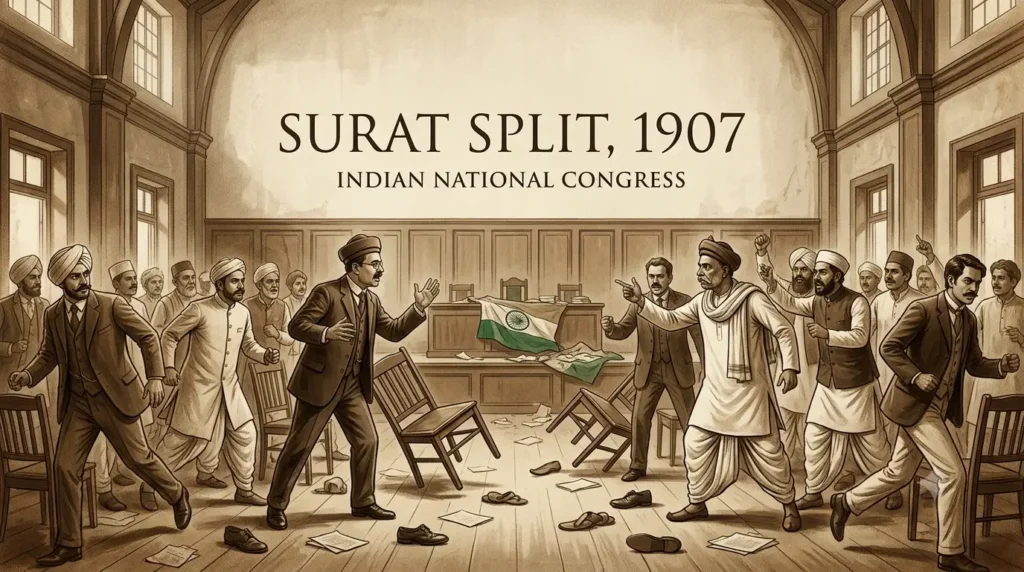
Conflict at the Surat Meeting of the INC: The conflict between the two groups became serious at the Surat Meeting in 1907. The Moderates and Extremists could not work out their differences, which led to a fight that split the Indian National Congress (INC) into two groups.
Events of the Split
Chaos at the Meeting: The Surat Meeting of 1907 was very chaotic because the Extremists faced strong opposition from the Moderates. The meeting turned into chaos with loud arguments and personal attacks. This was a key moment in the INC’s history, showing that the Extremists and Moderates could not settle their issues.
Removal of Extremist Leaders: After the chaos, Extremist leaders like Bal Gangadhar Tilak were removed from the INC, and the Moderates took control of the group. This created a clear split in the movement, with the Moderates leading the INC for the next few years.
Effects
Temporary Weakening of the National Movement: The Surat Split temporarily made the national movement weaker. With the Extremists gone, the INC became more moderate and less active, leading to a time of relative inaction in the fight for Indian independence. The split created a divide that slowed down the independence movement for several years.
British Taking Advantage of Division: The British used this division within the INC to weaken the Indian nationalist movement. They played the Moderates and Extremists against each other and made it seem like the INC was divided and unable to unite, which hurt the national struggle.
Lessons for Future Unity: The Surat Split taught a lesson for the future of the Indian freedom struggle. It showed the risks of being divided and the need for unity among Indian nationalists. It also showed that political differences should be managed carefully, as fighting among themselves could be used by colonial rulers to their advantage.
The Surat Split of 1907 was an important moment in India’s fight for independence, causing a temporary setback and showing the difficulties of staying united in the nationalist movement.
Impact on the Nationalist Movement
Short-Term Consequences
British Repression The rise of the Extremist group in the Indian National Congress and the tensions with the Moderates led to more resistance against British rule. In response, the British took harsh actions to control growing nationalist feelings. They banned public gatherings, protests, and restricted newspapers. Leaders like Bal Gangadhar Tilak were arrested, and newspapers such as Kesari and Maratha were censored or shut down. The British increased their watch over revolutionary activities. These actions aimed to stop the unrest and keep control, but many Indians saw this as proof that the British were not willing to make real changes or respect Indian needs.
Decrease in Nationalist Activities The split between the Moderates and Extremists, especially the violent events during the 1907 Surat split, weakened the Indian National Congress and slowed down nationalist efforts. The fighting between the two groups and the British repression caused a short pause in organized political activities. Many leaders were jailed or sidelined, and the focus turned to internal disagreements instead of uniting against British rule. After the split, there was a temporary drop in nationalist activity, though the dissatisfaction with British rule remained.
Long-Term Significance
Foundation for Mass Movements Even with the short-term decline in nationalist efforts, the actions and ideas of both the Moderates and Extremists laid the groundwork for future mass movements in India’s fight for independence. The growing anger toward British rule and the demand for self-governance encouraged more people to join the national movement. The Extremists’ focus on mass gatherings, protests, and supporting local goods helped the public see the national movement as important to their lives. The Swadeshi movement, in particular, encouraged more everyday people to get involved in the struggle for freedom.
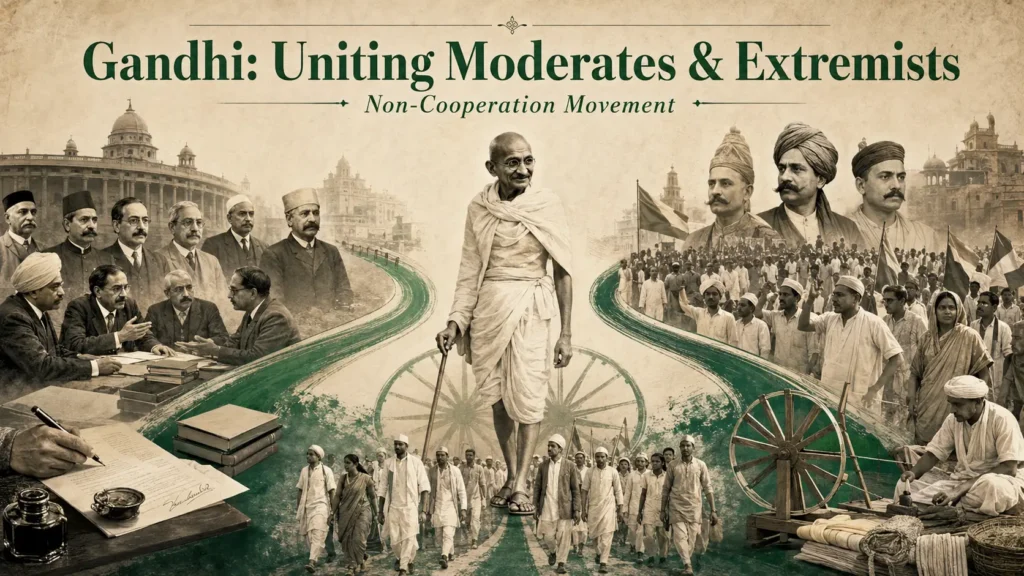
Influence on Gandhi’s Strategies The Extremists’ emphasis on mass participation, direct actions, and cultural revival significantly influenced Mahatma Gandhi. Initially working with the Moderates, Gandhi later adopted some of the Extremists’ methods, especially their focus on non-cooperation, self-reliance, and boycotts. His strategies during the Non-Cooperation Movement (1920-22) and the Salt March (1930) were inspired by the earlier movements led by the Extremists. Gandhi used peaceful but mass protests to challenge British rule, building on the Extremist ideas while highlighting nonviolence.
Need for Inclusive Approaches A key lesson from the divide between the Moderates and Extremists was the importance of an inclusive approach to the nationalist movement. The split showed the need to bring together different social and regional groups. As the struggle for independence continued, leaders like Gandhi, Jawaharlal Nehru, and Subhas Chandra Bose understood that to achieve true independence, the movement needed to unite various social classes, castes, religious groups, and regions. This shift towards an inclusive nationalism was essential for gaining broader support and ensuring the freedom struggle represented the hopes of all Indians.
In summary, while the immediate effects of the divide between the Extremists and Moderates led to British repression and a temporary slowdown in organized nationalist efforts, the long-term importance of this time was significant. It set the stage for mass movements, influenced leaders like Gandhi, and highlighted the need for inclusive strategies in India’s fight for independence. The tensions of this period ultimately shaped the future of the Indian freedom movement.
Key Takeaways
The Moderate-Extremist divide was not just about tactics but about fundamentally different visions of what “self-governance” should mean — a tension that would echo through the rest of India’s freedom struggle.
Previous Year Questions
Previous Year Questions — Moderates and Extremists in the INC
Important questions from previous year exam patterns on this topic. Tap a question to view a quick-answer guide.
1 Compare and contrast the ideologies and methods of the Moderates and Extremists in the INC. +
2 Discuss the causes and consequences of the Surat Split of 1907. +
3 Write a short note on Bal Gangadhar Tilak’s contribution to Extremist nationalism. +
4 What was the “Drain Theory,” and who propounded it? +
FAQs
What is the main difference between Moderates and Extremists?
Moderates sought gradual reform through petitions and dialogue with the British, while Extremists demanded direct action like boycott and Swadeshi to achieve complete Swaraj.
What was the Surat Split?
The Surat Split of 1907 was the formal division of the Indian National Congress into Moderate and Extremist factions, triggered by a dispute over Congress leadership and strategy.
Who were the “Lal-Bal-Pal” leaders?
Lala Lajpat Rai, Bal Gangadhar Tilak, and Bipin Chandra Pal — the three most prominent Extremist leaders of the early 1900s.
What is the Drain Theory?
Dadabhai Naoroji’s theory arguing that British colonial policies systematically drained India’s wealth to Britain, worsening Indian poverty.
Subscribe to keep reading
You've used your free notes for now. Get Delhi Pathshala Premium for unlimited access.
Subscribe — ₹29/30 days