
Contents
- Defining the Scope of Justice
- Why This Debate Matters Today
- National Justice
- Why Focus on National Justice?
- Key Theories Supporting National Justice
- Case Studies
- Global Justice
- Arguments for a Global Scope of Justice
- Key Theories Supporting Global Justice
- Case Studies
- National vs Global Justice: Comparison Table
- Key Debates and Critiques
- Contemporary Case Studies
- DU Previous Year Questions
- FAQs
- Related Reading (Internal Links)
- External Authoritative Links
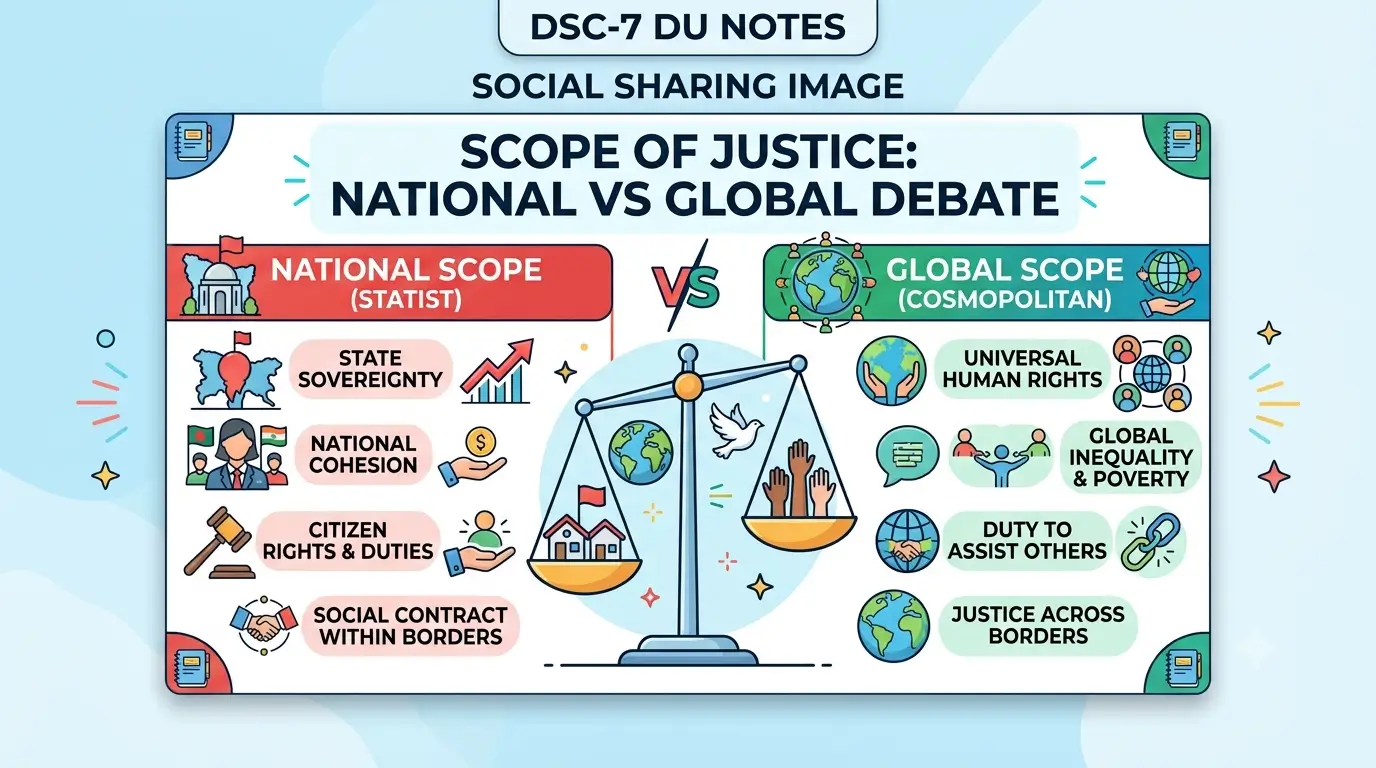
Should fairness stop at a country’s border, or should it apply to every human being on the planet? This is the central question behind one of DU’s most frequently asked DSC-7 debates — national justice vs global justice.
Defining the Scope of Justice
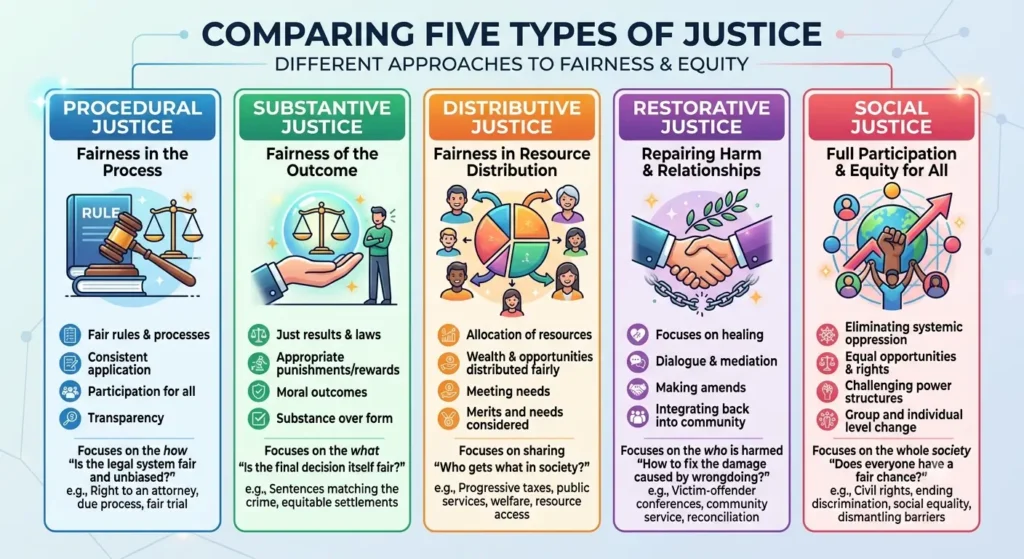
Before comparing national and global justice, it helps to know the different lenses through which “justice” itself is studied:
| Type of Justice | What It Focuses On | Example |
|---|---|---|
| Procedural Justice | Fairness of the process, not the outcome | Everyone gets a fair hearing in court |
| Substantive Justice | Fairness of the actual outcome | Whether wealth/resources are actually shared fairly |
| Distributive Justice | How goods, wealth, and opportunities are shared | Rawlsian justice, utilitarian justice |
| Restorative Justice | Repairing harm rather than only punishing | Truth and reconciliation processes |
| Social Justice | Broad fight against structural inequality | Human rights and equality movements |
Why This Debate Matters Today
The national vs global justice question has become urgent because of:
- Global inequality and poverty between rich and poor nations
- Human rights and social movements (civil rights, gender equality, environmental justice)
- Political and legal accountability — how far institutions like the UN can act
- Economic systems — capitalism, socialism, and questions of fair distribution
- Climate change — a problem no single nation can solve alone
- Emerging technology — access to AI and biotech raising new fairness questions
National Justice
National justice holds that fairness and redistribution obligations apply primarily among the citizens of a single country.
Why Focus on National Justice?
- Social contract theory (Hobbes, Locke, Rousseau) — obligations arise from an agreement among citizens of one state
- Cultural and historical context — each nation’s values shape what counts as “fair” locally
- Political and economic unity — shared laws create social stability
- Sovereignty and self-determination — each country decides justice on its own terms
- Practicality — enforcing justice within one state is easier than coordinating globally
Key Theories Supporting National Justice
| Thinker/Theory | Core Idea |
|---|---|
| John Rawls | Justice applies primarily within a society bound by common laws — see our detailed post on Rawls’ Theory of Justice |
| Yael Tamir (Liberal Nationalism) | Shared national identity strengthens fair policymaking |
| Michael Sandel (Communitarianism) | National justice reflects shared social and cultural bonds |
| Philip Pettit (Republican Theory) | Justice means freedom from domination within a political community |
Case Studies
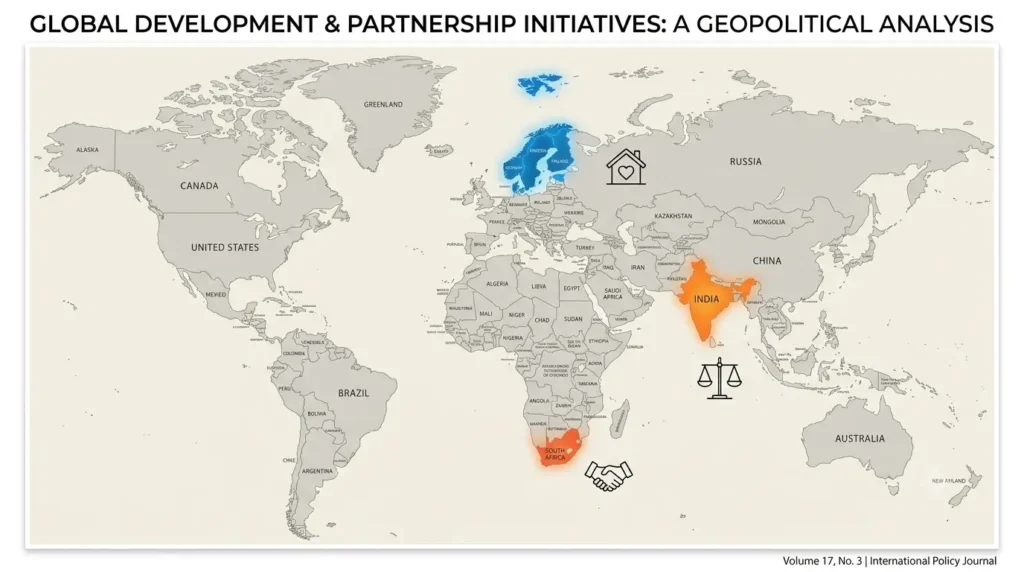
- Scandinavian model (Norway, Sweden, Denmark) — strong welfare states built on national redistribution
- Post-apartheid South Africa — truth commissions and affirmative action to correct historical injustice
- India’s reservation policy — affirmative action for historically disadvantaged groups
- U.S. Civil Rights Movement — national legal reform (Civil Rights Act) to secure equal rights
Global Justice
Global justice argues that fairness obligations extend beyond borders to all human beings.
Arguments for a Global Scope of Justice
- Moral cosmopolitanism — everyone deserves equal moral consideration, regardless of nationality
- Global inequality and poverty — wealthy nations have a duty to help address extreme deprivation
- Universal human rights — codified in the UDHR, applicable everywhere
- Environmental justice — poorer nations suffer disproportionately from a crisis they didn’t cause
- Global interconnectedness — pandemics, economic crises, and conflict cross borders
Key Theories Supporting Global Justice
| Thinker/Theory | Core Idea |
|---|---|
| John Rawls (The Law of Peoples) | Justice principles should extend between nations, alongside respect for sovereignty |
| Martha Nussbaum & Peter Singer (Cosmopolitanism) | Equal moral worth of all persons everywhere |
| Thomas Pogge (Global Egalitarianism) | Rich nations bear responsibility for harms caused by the global economic system |
| David Schlosberg (Global Environmental Justice) | Wealthy nations should support poorer ones facing climate harm |
Case Studies
- Paris Agreement (2015) — global climate cooperation, though enforcement remains weak
- United Nations & UDHR — global human rights framework, with limited enforcement power
- Global Fund (AIDS, TB, Malaria) — international health resource-sharing
- Oxfam’s anti-poverty advocacy — pushing for debt relief and fair aid
National vs Global Justice: Comparison Table
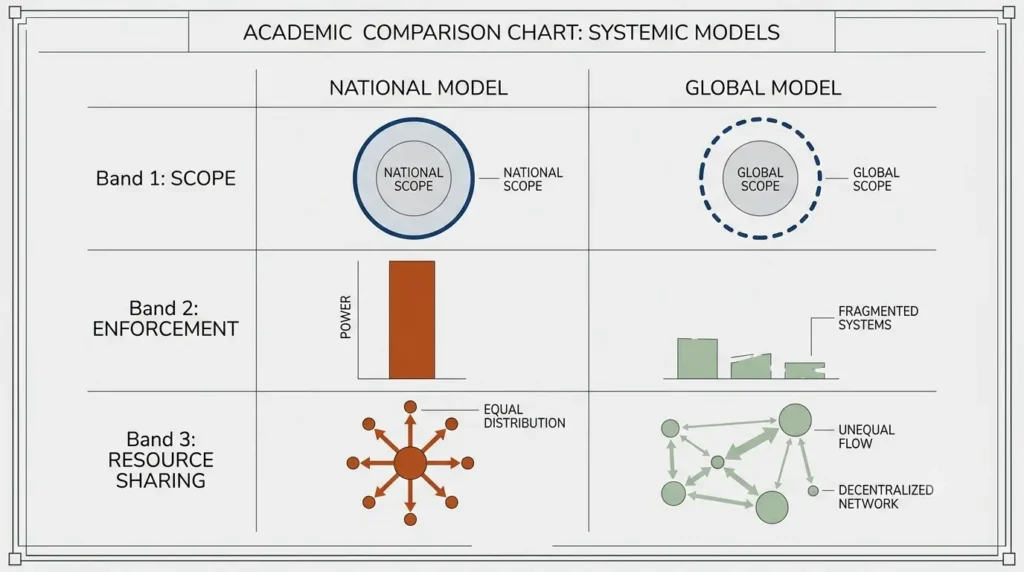
| Dimension | National Justice | Global Justice |
|---|---|---|
| Scope | Limited to citizens of one country | Extends to all people worldwide |
| Resource Sharing | Taxes, welfare, public services within a state | Debt relief, foreign aid, trade fairness |
| Human Rights Basis | Defined by domestic law | Seen as universal, protected by international bodies |
| Enforcement | Elections, courts, national police | No single global authority; relies on cooperation/treaties |
| Key Strength | Practical, accountable, culturally rooted | Addresses problems no single nation can solve alone |
| Key Weakness | Ignores cross-border injustice | Hard to enforce; nations resist ceding sovereignty |
Key Debates and Critiques
- Sovereignty vs. Global Responsibility — should international bodies override a nation’s right to self-govern?
- Practicality — critics call global justice idealistic given how differently nations operate
- Moral Loyalty vs. National Identity — do citizens owe more to compatriots than to strangers abroad?
- Wealth Sharing — should rich nations be obligated to redistribute wealth globally, and would this hurt their own economies?
Contemporary Case Studies
- Global debt crisis — Zambia, Mozambique, and Ecuador’s debt burdens vs. the Jubilee 2000 debt-cancellation campaign
- Refugee crisis — over 100 million people displaced globally, testing the limits of international asylum law
- COVID-19 vaccine access — wealthy nations vaccinated populations rapidly while COVAX-reliant nations lagged, a stark test case for global justice in practice
DU Previous Year Questions
- What do you understand by the scope of justice? Discuss the debate between national and global justice.
- Distinguish between procedural and substantive justice with examples.
- “Justice cannot be confined within national borders in an interconnected world.” Discuss.
- Examine the arguments for and against global justice.
- Discuss the relevance of distributive justice in addressing global inequality.
- Write a short note on cosmopolitanism as a theory of global justice.
FAQs
What is the difference between national and global justice?
National justice limits fairness obligations to citizens of one country, while global justice argues that fairness should apply to all people worldwide, regardless of nationality.
What are the main types of justice studied in political theory?
Procedural, substantive, distributive, restorative, and social justice are the main categories.
What is moral cosmopolitanism?
The view that all people, regardless of nationality, deserve equal moral consideration and treatment.
Did Rawls support global justice?
Partially — in The Law of Peoples (1999), Rawls extended some justice principles internationally, but he still limited the Difference Principle mainly to individual nations, which is why cosmopolitan thinkers like Thomas Pogge criticized him.
Why is the national vs global justice debate important today?
Because problems like climate change, pandemics, and extreme poverty cross national borders and cannot be solved through national policy alone.
Related Reading (Internal Links)
- John Rawls Theory of Justice – DSC-7 Notes
- What is Justice? Procedural and Substantive Justice
- Understanding Equality of Opportunity and Equality of Outcome
- Natural, Moral and Legal Rights – DSC-7
- DSC-7: Political Theory Concepts and Debates — full unit list
External Authoritative Links
Subscribe to keep reading
You've used your free notes for now. Get Delhi Pathshala Premium for unlimited access.
Subscribe — ₹29/30 days