
Contents
- A) Justice: Procedural and Substantive
- 1. Definition of Justice
- – Understanding the Concept of Justice
- – Distinction between Procedural and Substantive Justice
- Procedural vs Substantive Justice — Quick Comparison Table
- Summary of the Distinction
- 2. Procedural Justice
- – Definition and Key Principles
- – The Role of Fair Procedures
- – Theories Supporting Procedural Justice
- – Case Studies Illustrating Procedural Justice
- Summary
- 3. Substantive Justice
- – Definition and Key Principles
- – The Focus on Outcomes and Fair Distribution
- – Theories Supporting Substantive Justice
- – Case Studies Illustrating Substantive Justice
- Summary
- 4. Comparative Analysis
- – Comparing Procedural and Substantive Justice
- – Debates and Critiques
- – Nozick’s Critique — Bridge to “Rawls and His Critics” (Unit 3-b)
- Key Takeaways
- Previous Year Questions (PYQs) — DSC-7 Unit 3(a)
- FAQs
In this post, notes of “Unit 3: Justice (A) — Justice: Procedural and Substantive” from “DSC – 7: Political Theory: Concepts and Debates“ are given, which is helpful for BA (Hons.) Political Science students of Delhi University appearing for their Semester 3 exams.
A) Justice: Procedural and Substantive
1. Definition of Justice
Justice means treating people fairly and respecting their rights in a society. It is about making sure everyone gets what they deserve in terms of rights, duties, and resources.
Justice can be seen in different areas like law, morals, society, and politics, but it mainly focuses on fairness, equality, and protecting individual rights.
– Understanding the Concept of Justice
Justice is mainly about fairness, equality, and doing what is right. Here are some important parts of justice:
– Fairness: Treating everyone the same, without bias. – Equality: Making sure everyone has the same rights and opportunities. – Rights Protection: Protecting people’s legal and human rights. – Accountability: Making sure people and organizations are responsible for their actions. – Retribution and Restitution: Justice includes punishing those who do wrong (retribution) or fixing the harm done (restitution).
How justice is applied can change based on different cultures, politics, and laws. It can involve sharing resources fairly or enforcing laws that help individuals in society.
– Distinction between Procedural and Substantive Justice
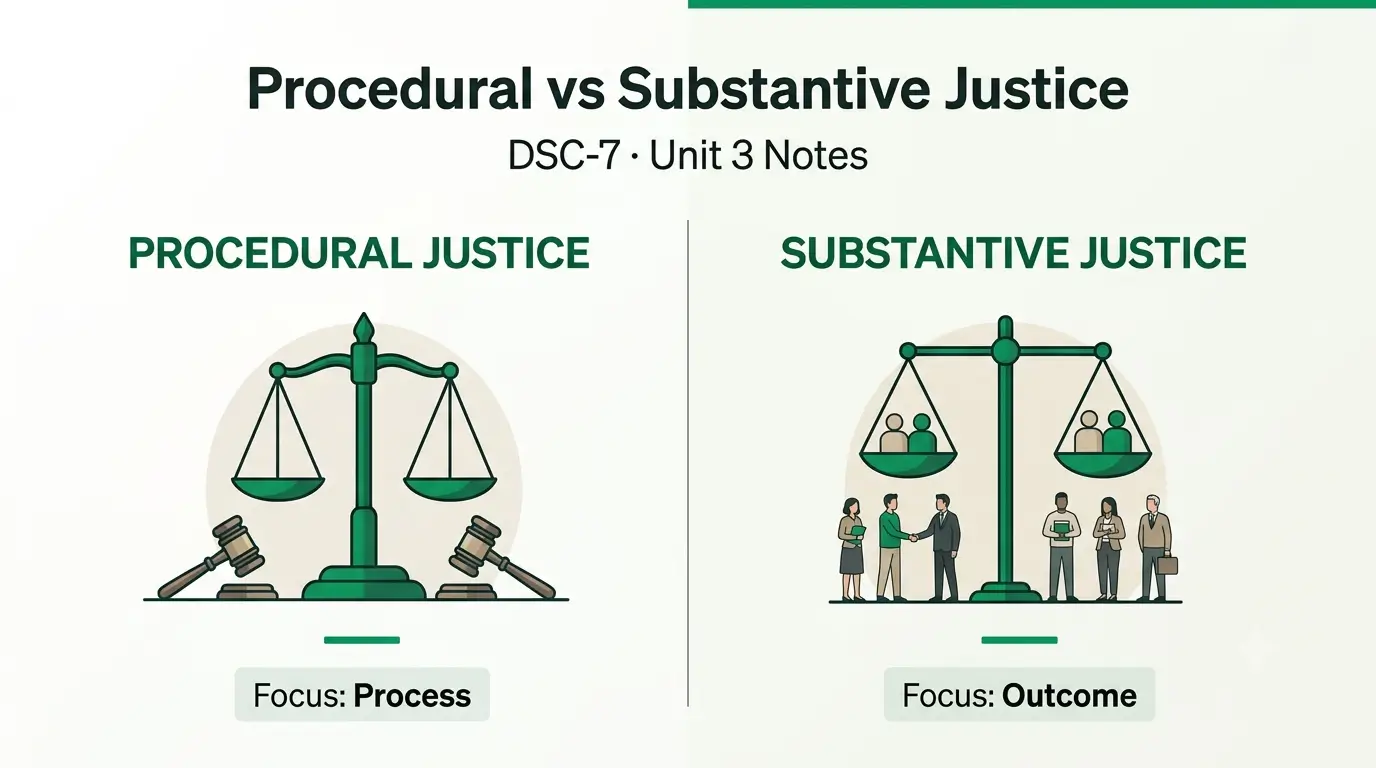
- Procedural Justice: Procedural justice is about how fair the processes are that lead to decisions. It looks at whether decisions are made fairly and openly, not just at the results. Key points include:
– Impartiality: Making sure the processes are fair and unbiased. – Consistency: Using the same processes for similar cases. – Voice: Allowing people to share their side of the story. – Transparency: Ensuring everyone understands the rules and processes.
In legal matters, procedural justice is important because it guarantees that everyone gets a fair trial and that their rights are protected.
- Substantive Justice: Substantive justice is about the fairness of the actual decisions made. It ensures that people get what they deserve based on their situation, which includes fair sharing of resources, rights, or punishments. It includes:
– Distributive Justice: Fairly sharing resources and benefits in society. – Corrective Justice: Fixing wrongs in a way that restores fairness. – Equity and Equality: Making sure everyone gets what they deserve based on their needs and contributions.
Substantive justice looks at not just the outcomes but also whether those outcomes are fair according to moral, legal, or social standards.
Procedural vs Substantive Justice — Quick Comparison Table
| Basis | Procedural Justice | Substantive Justice |
|---|---|---|
| Focus | Fairness of the process/method used to reach a decision | Fairness of the actual outcome or result |
| Key Question | “Was the decision reached fairly?” | “Is the decision itself fair?” |
| Core Principles | Impartiality, consistency, voice, transparency | Equality, equity, need, desert, restitution |
| Associated Thinkers | John Rawls (pure procedural justice), Tom Tyler, Gerald Leventhal | John Rawls (difference principle), Robert Nozick (entitlement — critiques redistribution), Utilitarians |
| Political Leaning | Classical liberalism (minimal state) | Welfare/egalitarian traditions (state intervention) |
| Indian Example | Maneka Gandhi v. Union of India (1978) — fair procedure under Article 21 | Reservation policy under Articles 15(4)/16(4); MGNREGA |
| Main Critique | Fair process can still produce unfair/unequal outcomes | Hard to agree on what counts as a “fair” outcome; may override individual rights |
Summary of the Distinction
– Procedural Justice: Focuses on how fair and clear the processes are for making decisions. – Substantive Justice: Focuses on how fair the actual decisions or outcomes are, ensuring people are treated justly based on their needs and merits.
Both types of justice are essential for a fair society, with procedural justice ensuring fair methods for decision-making, and substantive justice ensuring fair results.
2. Procedural Justice
Procedural justice means fairness in the way decisions are made and disputes are settled. It focuses on how decisions happen rather than just the results. People are more likely to accept decisions if they believe the way those decisions were made was fair.
– Definition and Key Principles
Procedural justice is about fair processes for making decisions. It can be just as important, or even more important, than the outcomes. If people think the process is fair, they will see the outcomes as valid, even if those outcomes aren’t what they wanted.
Key principles of procedural justice include:
- Voice: People should have the chance to share their opinions and concerns.
- Neutrality: Decision-makers should be fair and unbiased, making choices based on facts.
- Consistency: Rules should be applied the same way in similar situations.
- Transparency: The process should be clear and understandable for everyone involved.
- Respect: Everyone should be treated with dignity, and their rights should be protected.
- Accountability: Decision-makers should explain their choices and be responsible for them.
– The Role of Fair Procedures
Fair procedures are key to building trust in justice systems. When people see the processes as fair, they are more likely to trust the system, even if the results don’t go their way. This is especially true in legal and government matters:
– People are more likely to accept decisions if they believe the process was fair. – Fair procedures help lessen anger and build trust in decisions. – In places like courts and workplaces, fair procedures lead to better teamwork and stronger community ties. – They also prevent misuse of power, keeping decision-makers within fair boundaries.
– Theories Supporting Procedural Justice
Several theories explain why fair processes are vital:
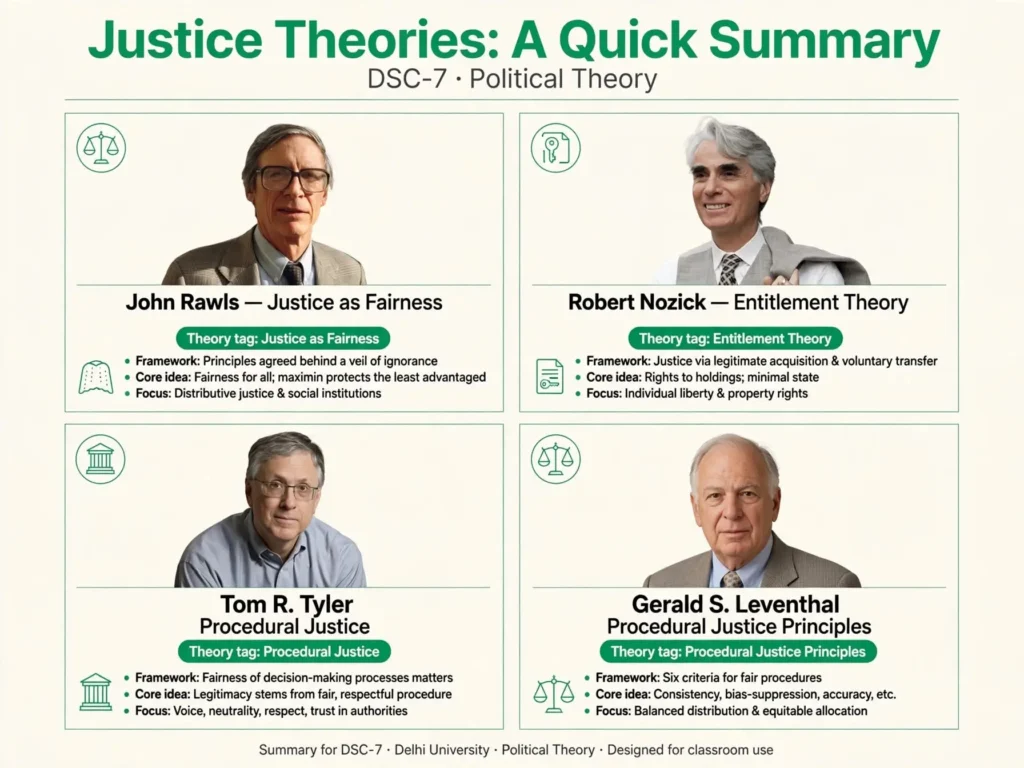
- Leventhal’s Six Criteria: Gerald Leventhal suggested six rules for fair procedures: – Consistency: Apply rules the same way for everyone. – Bias Suppression: Keep the decision-making free from bias. – Accuracy: Use correct information for decisions. – Correctability: Allow for fixing mistakes in the process. – Representativeness: Fairly include all relevant views. – Ethicality: Follow moral and ethical standards.
- Tyler’s Theory: Tom Tyler’s theory states that how fair a process feels affects how people see authorities as legitimate. If people think the process is fair: – They are more likely to follow laws and rules. – They view authorities as legitimate. – Fairness helps maintain order and reduces conflict, even if the results aren’t favorable.
- Rawls’ Theory: John Rawls believed in “justice as fairness,” saying fairness in processes is key to justice. He argued that systems should ensure fair procedures and outcomes for everyone. (Read the full breakdown in our John Rawls Theory of Justice notes — internal, dofollow)
- Social Contract Theory: This theory suggests that a fair government or legal system is based on an agreement among people to follow rules for mutual benefit. Procedural justice makes sure that the way laws are made and enforced is fair and clear.
– Case Studies Illustrating Procedural Justice
- The U.S. Court System: Fair trials are crucial in the U.S. legal system. If defendants feel treated unfairly, it can harm the legitimacy of the outcome. For example, the Miranda v. Arizona case ensured that defendants’ rights were upheld, reinforcing fairness in the legal process.
- Maneka Gandhi v. Union of India (1978) — India’s landmark procedural justice case: In this case, a 7-judge bench of the Supreme Court of India held that the “procedure established by law” under Article 21 must be fair, just, and reasonable — not arbitrary. The Court ruled that Maneka Gandhi’s passport could not be impounded without giving her a fair hearing (audi alteram partem). This judgment linked Articles 14, 19, and 21 together (the “Golden Triangle”) and is the single most important Indian case for understanding procedural justice — a must-know for DU exams.
- International Criminal Court (ICC): The ICC focuses on fair trials for serious crimes. For instance, in the trial of Thomas Lubanga Dyilo, found guilty on 14 March 2012 of recruiting child soldiers and sentenced to 14 years’ imprisonment, the court emphasized fairness and transparency, building trust in the justice system.
- Workplace Disputes: In workplaces, fair procedures help maintain trust. Companies that follow clear and fair steps in employee dismissals keep morale high and reduce lawsuits. A study found that employees who saw their workplace procedures as fair were less likely to sue, even if the decision didn’t go their way.
- Public Policy and Social Movements: During the Civil Rights Movement, African Americans sought fair processes in addition to equal rights. The Voting Rights Act of 1965 aimed to ensure fair and transparent voting processes, especially in areas with a history of discrimination.
Summary
Procedural justice is crucial for trust in legal, social, and organizational systems. It highlights the importance of fair processes like consistency, neutrality, transparency, and respect for rights.
Following these principles can lead to better cooperation and acceptance, even if the results aren’t always what everyone wants. Theories like Leventhal’s, Tyler’s, and Rawls’ emphasize the importance of procedural justice, as shown by various case studies — from the U.S. Miranda ruling to India’s own Maneka Gandhi judgment.
3. Substantive Justice
Substantive justice means making sure that the results of decisions are fair. It looks at how people are treated based on what they need, what they have done, their rights, and what they deserve. This is different from procedural justice, which is more about how decisions are made.
– Definition and Key Principles
Substantive justice is about what is fair when it comes to sharing resources, benefits, and responsibilities. It aims for fair outcomes so that everyone gets what they should, based on fairness principles like equality, need, and merit. Here are some key ideas:
- Equality: Everyone should be treated the same and have equal access to resources unless there is a good reason for different treatment.
- Equity: This means people should get help and resources based on their needs or contributions. Some might need more support to be treated fairly.
- Need: People with greater needs (like the poor or sick) should get more help to ensure fairness.
- Desert: People should get rewards or consequences based on what they do. For example, someone who works hard may deserve more recognition.
- Restitution: If someone has been wronged, justice means fixing the harm, often through compensation.
– The Focus on Outcomes and Fair Distribution
Substantive justice is mainly about the results of decisions and making sure resources are shared fairly. This includes:
- Fair Distribution: It looks at how benefits and burdens are shared fairly among people.
- Entitlements: People have rights to certain basic needs and fair treatment. Substantive justice makes sure these rights are respected.
- Balancing Interests: It aims to consider everyone’s needs and rights to achieve fairness for all.
– Theories Supporting Substantive Justice
Several theories help understand substantive justice and how to achieve fairness:
- Utilitarianism: This idea says the best action is the one that brings the most happiness for everyone. It suggests resources should be shared to help society as a whole, but it may allow some unfairness if it benefits many.
- Rawls’ Theory of Justice: John Rawls believes justice should be fair for everyone, especially the least advantaged. He suggests making decisions as if you don’t know your own position in society (the “veil of ignorance”) to ensure fairness. (— Stanford Encyclopedia of Philosophy: John Rawls)
- Libertarianism (Robert Nozick) (expanded): This view focuses on individual rights and believes justice means respecting what people rightfully own. Nozick’s entitlement theory opposes redistributing wealth through the state, arguing that a distribution is just if it arose through just acquisition and voluntary exchange — regardless of how unequal the outcome looks. This is the core of his famous critique of Rawls, covered in detail in our John Rawls Theory of Justice notes.
- Communitarianism: This idea values community and believes justice involves looking out for the common good and ensuring everyone benefits.
- Capability Approach: This approach emphasizes making sure people have the abilities they need to live good lives. It supports fair resource distribution to help everyone reach their potential.
– Case Studies Illustrating Substantive Justice
- Civil Rights Movement: This movement worked to ensure fair treatment and rights for African Americans, leading to laws that corrected historical wrongs.
- The New Deal: During the Great Depression, programs were created to help those in need and address economic inequality.
- Affirmative Action: These policies aim to give historically disadvantaged groups equal opportunities in education and jobs.
- Reservation Policy in India (NEW): Articles 15(4) and 16(4) of the Indian Constitution allow the state to make special provisions for socially and educationally backward classes, SCs and STs, in education and public employment. This is a textbook Indian example of substantive justice — the state actively intervenes to correct historical and structural inequality rather than simply applying the same rule to everyone.
- MGNREGA (NEW): The Mahatma Gandhi National Rural Employment Guarantee Act guarantees 100 days of wage employment to rural households, directly targeting need-based fairness — another strong Indian example examiners expect students to cite.
- Universal Healthcare: Systems like the NHS provide healthcare to everyone, focusing on need rather than ability to pay.
- Environmental Justice: This movement fights for fair treatment of communities facing environmental hazards, ensuring everyone has equal protection.
Summary
Substantive justice is about achieving fair outcomes based on principles like equality and need. It aims for a fair sharing of resources and correcting inequalities. Various theories explain how to achieve fairness, and real-life examples — from the American New Deal to India’s own reservation policy and MGNREGA — show its importance in promoting fairness in society.
4. Comparative Analysis
Both procedural and substantive justice aim for fairness, but they look at it in different ways. The main difference is their focus: procedural justice is about how decisions are made, while substantive justice is about whether the results of those decisions are fair.
– Comparing Procedural and Substantive Justice
– Procedural Justice: – Focus: Makes sure the way decisions are made is fair and clear. – Key Principles: Voice, Neutrality, Consistency, Transparency, Respect and accountability – Outcome: Procedural justice ensures that the decision-making process is fair, even if the result is not what everyone wants.
– Substantive Justice: – Focus: Ensures that the outcomes of decisions are fair and just. – Key Principles: Equality, Equity, Need-based approach, Corrective justice – Outcome: Substantive justice aims for fair results in distributing resources, opportunities, and rights.
– Key Differences:
- Process vs. Outcome: Procedural justice looks at how decisions are made, while substantive justice looks at the fairness of the results.
- Focus on Fairness: Procedural justice cares about fair processes, while substantive justice cares about fair impacts and addressing inequalities.
- Legitimacy: Procedural justice builds trust in systems by ensuring fair methods, even if not everyone likes the results. Substantive justice works to ensure fair distribution of resources and rights.
- Legal Systems: Procedural justice in law makes sure trials are fair. Substantive justice checks if the outcomes of legal decisions are fair. In Indian law specifically, Maneka Gandhi v. Union of India (1978) blurred this line by reading a “substantive due process” requirement into Article 21’s procedural language — meaning even a legally valid procedure must also produce a fair, non-arbitrary outcome.
– Debates and Critiques
Both types of justice have their debates and criticisms.
1. Procedural Justice Debate: Critiques: Unjust Outcomes (fair processes can still lead to unfair results), Overemphasis on Process (focusing too much on procedures can ignore fairness in results), Access Issues (fair processes can be hard for some people to access). Support: Trust (important for maintaining trust in systems), Prevents Bias (fair processes reduce arbitrary decisions).
2. Substantive Justice Debate: Critiques: Focus on Equality (some think focusing too much on equality can limit personal freedom), Redistributive Injustice (enforcing fairness through redistribution can be unfair to individuals), Defining Fairness (hard to agree on what a fair distribution looks like). Support: Addressing Inequality (important for fixing historical inequalities), Human Rights (supports basic needs and dignity).
– Nozick’s Critique — Bridge to “Rawls and His Critics” (Unit 3-b)
Robert Nozick directly challenged Rawls’ substantive, redistribution-friendly vision of justice. In his entitlement theory, Nozick argued that if a distribution of goods arises through just acquisition and voluntary transfer, it is just — no matter how unequal it looks, and the state has no right to redistribute it to achieve a “fairer” pattern. Interestingly, critics point out that Nozick’s own principle of rectification (correcting past injustices in how property was originally acquired) could itself justify large-scale redistribution, since much historical wealth was acquired through conquest, colonialism, or fraud. This tension between Rawls and Nozick is the foundation of the next syllabus sub-topic — read the complete comparison in our Rawls and His Critics notes.
—
Balancing Procedural and Substantive Justice: Finding a balance between procedural and substantive justice is a big challenge.
– Procedural justice supporters say fair processes are key for a legitimate system, but recognize that outcomes can still be unfair. – Substantive justice supporters argue that fair processes are not enough if the results are still unjust. They stress that justice needs to consider people’s needs and rights.
Some approaches, like Restorative Justice, combine both by ensuring fair processes and addressing harm in the community. This tension between national fairness standards and universal fairness is explored further in our Scope of Justice: National vs Global Justice Debate notes.
Key Takeaways
Procedural and substantive justice are both important for fairness, but they approach it differently. Procedural justice focuses on the fairness of processes, while substantive justice focuses on fair outcomes. Indian jurisprudence (Maneka Gandhi v. Union of India) and Indian welfare policy (reservation, MGNREGA) both show how the two ideas work together in practice. The challenge is to find a way to balance both to address inequalities effectively.
Previous Year Questions (PYQs) — DSC-7 Unit 3(a)
DU Previous Year Questions — Unit III: Justice
Important DU Previous Year Questions and practice questions covering Procedural Justice, Substantive Justice, Rawls and his Critics, and the Scope of Justice — National vs Global.
1 Discuss John Rawls’ theory of justice in the light of the feminist and communitarian critiques. +
2 Write a critical essay on John Rawls’ theory of Justice. +
3 Examine the concept of global justice. +
4 Short Note: Global Justice. +
5 What do you understand by global justice? Comment on the difference between Procedural Justice and Substantive Justice. +
6 “Rawls has sought to achieve the goal of substantive justice through the methodology of procedural justice.” Elucidate. +
7 What is Justice? Explain the concept of justice. +
8 Distinguish between Procedural Justice and Substantive Justice. +
9 What is the difference between Formal Justice, Procedural Justice and Substantive Justice? +
10 What are Rawls’ ‘Original Position’ and ‘Veil of Ignorance’? How do they function as a procedural device? +
11 What are Rawls’ two principles of justice? +
12 What is Nozick’s critique of Rawls through the Entitlement Theory? +
13 What is Global Justice? Is justice limited only to the nation-state? +
14 Explain the relationship between Procedural Justice and Substantive Justice. Is one incomplete without the other? +
15 Critically analyse John Rawls’ concept of ‘Justice as Fairness’. +
16 Discuss the Communitarian critique of Rawls’ theory of justice with reference to Michael Sandel and Michael Walzer. +
17 Discuss the Feminist critique of Rawls’ theory of justice with reference to Susan Moller Okin. +
18 Has Rawls sought to achieve substantive justice through the methodology of procedural justice? Evaluate. +
19 How does Amartya Sen’s Capabilities Approach differ from Rawls’ theory of justice? Does it provide a better account of substantive justice? +
20 Debate the Scope of Justice — National vs Global. Discuss the Cosmopolitan view in contrast with the Communitarian or Nationalist view. +
D1 Procedural Justice — What should you focus on? +
D2 Substantive Justice — What should you focus on? +
D3 Rawls’ Key Argument — How does procedural method lead to substantive justice? +
D4 How should a 15-mark answer on Rawls and Justice be structured? +
D5 How should a Global Justice answer be structured? +
FAQs
What is the main difference between procedural and substantive justice?
Procedural justice focuses on whether the process used to reach a decision was fair, while substantive justice focuses on whether the actual outcome or result of that decision is fair.
Who gave the concept of “pure procedural justice”?
John Rawls, in his book A Theory of Justice (1971), introduced the concept of pure procedural justice — where there is no independent standard of a fair outcome; a fair procedure itself determines a fair result.
What is an example of substantive justice in India?
The reservation policy under Articles 15(4) and 16(4) of the Indian Constitution, and welfare schemes like MGNREGA, are commonly cited Indian examples of substantive justice, since both aim at correcting real-world inequality rather than just following a neutral rule.
How does Nozick criticize Rawls’ theory of justice?
Nozick argues through his entitlement theory that a distribution of resources is just if it results from just acquisition and voluntary exchange, regardless of the resulting inequality — and that the state has no right to redistribute wealth to achieve a “fairer” pattern, as Rawls’ difference principle suggests.
Which Indian Supreme Court case is most important for understanding procedural justice?
Maneka Gandhi v. Union of India (1978), where the Court held that “procedure established by law” under Article 21 must be fair, just, and reasonable, not arbitrary — effectively merging procedural and substantive due process in Indian constitutional law.
Is procedural justice more important than substantive justice?
Neither is “more important” — political theorists generally treat them as complementary. Procedural justice supporters argue fair process builds legitimacy even when outcomes disappoint; substantive justice supporters argue fair process alone is meaningless if the outcome remains unjust. Most real-world systems (like restorative justice) try to balance both
Subscribe to keep reading
You've used your free notes for now. Get Delhi Pathshala Premium for unlimited access.
Subscribe — ₹29/30 days