
Contents
- What is Justice as Fairness?
- Who Was John Rawls?
- The Original Position
- The Veil of Ignorance
- Two Principles of Justice
- Rawls’ “A Theory of Justice” — Key Arguments
- Rawls’ Influence on Political Philosophy
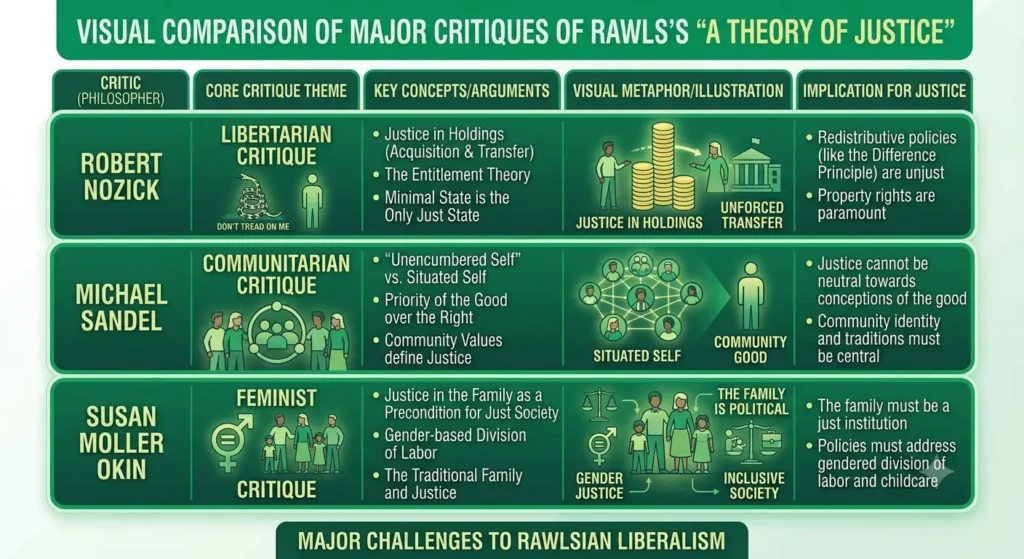
- Critiques of Rawls
- Nozick’s Wilt Chamberlain Example (worth remembering for exams)
- Contemporary Relevance
- DU Previous Year Questions
- FAQs
- Related Reading
- External Authoritative Links
What is Justice as Fairness?
John Rawls’ A Theory of Justice (1971) is one of the most influential works in 20th-century political philosophy. Rawls argued that justice should be understood as fairness — a set of principles that free and equal people would agree to if they were choosing the basic rules of society without knowing their own place in it.
This single idea reshaped how modern democracies talk about equality, rights, and redistribution.
Who Was John Rawls?
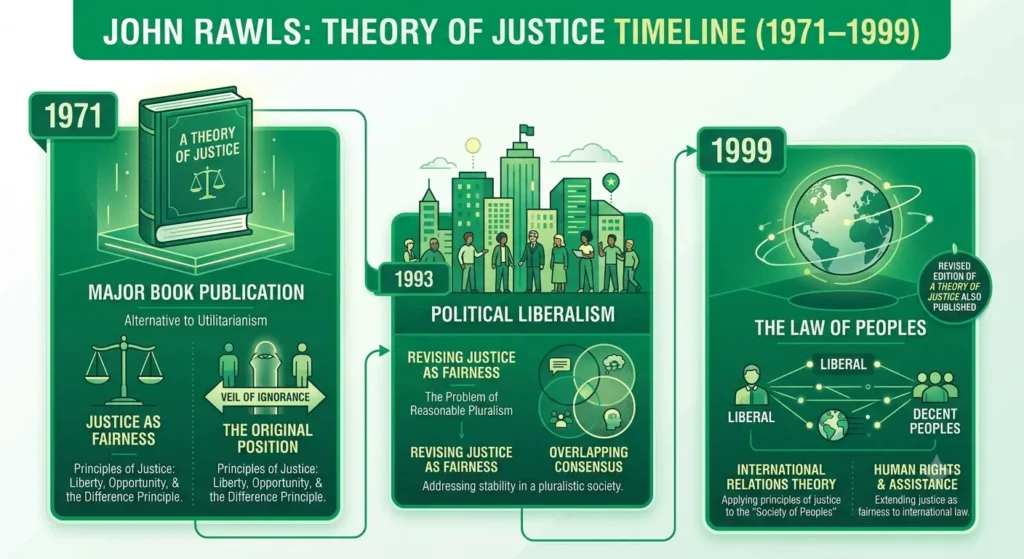
John Rawls (1921–2002) was an American political philosopher who taught for decades at Harvard University. Writing in the aftermath of World War II, he wanted to design a theory of justice that could work for people holding very different moral and religious beliefs. His three major works were:
| Work | Year | Core Contribution |
|---|---|---|
| A Theory of Justice | 1971 | Original Position, Veil of Ignorance, Two Principles of Justice |
| Political Liberalism | 1993 | Concept of “public reason”; justice among people with different worldviews |
| The Law of Peoples | 1999 | Extends justice principles to the international/global level |
The Original Position
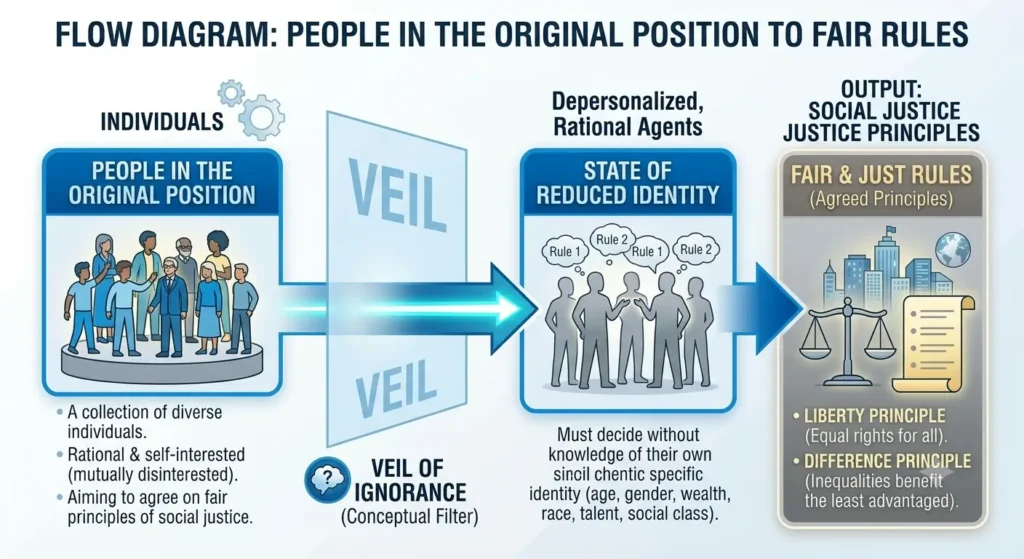
The original position is Rawls’ famous thought experiment. Imagine a group of people tasked with designing the rules of their future society — but before they know anything about the role they’ll occupy in it. This hypothetical starting point is meant to strip away self-interest and bias, so that the resulting principles are genuinely fair to everyone.
The Veil of Ignorance
The veil of ignorance is the mechanism that makes the original position work. Behind this veil, people don’t know their own:
- Gender, race, or ethnicity
- Wealth or social class
- Talents, intelligence, or physical ability
- Religious or moral beliefs
Because no one knows whether they’ll end up rich or poor, majority or minority, Rawls argues they will rationally choose rules that protect the worst-off person — since that worst-off person could turn out to be them.
Two Principles of Justice
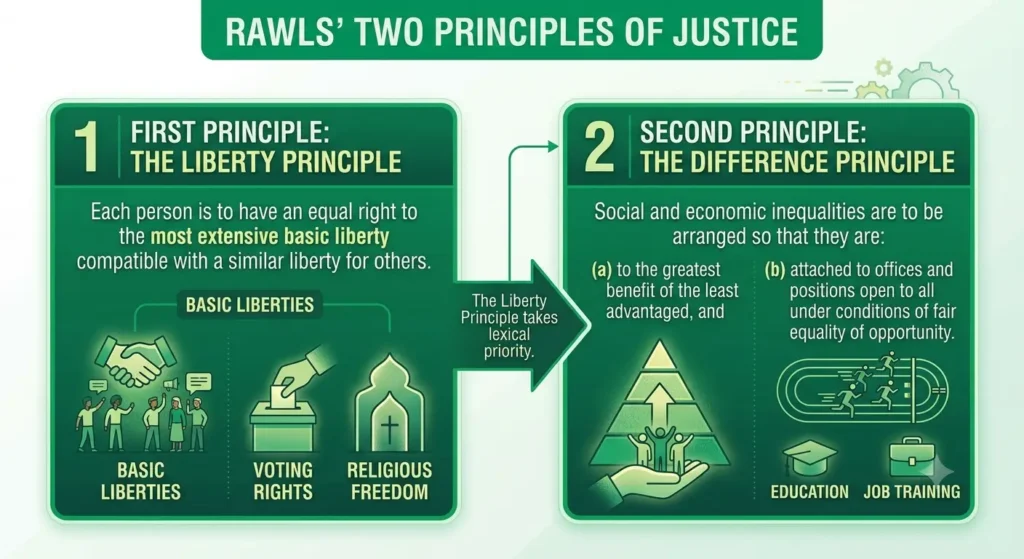
Rawls says people behind the veil would agree on two principles, in a strict order of priority:
| Principle | What It Means | Example |
|---|---|---|
| 1. Liberty Principle | Everyone gets an equal right to basic freedoms — speech, assembly, voting, personal safety | A citizen’s right to vote cannot be traded away even for economic benefit |
| 2(a). Fair Equality of Opportunity | Positions and jobs must be open to all, regardless of background | Merit-based, need-blind access to education |
| 2(b). Difference Principle | Inequality is only justified if it benefits the least advantaged | A tax-funded scholarship scheme that improves outcomes for poor students |
Rawls insists Principle 1 (liberty) always comes before Principle 2 — basic freedoms cannot be sacrificed for economic gain.
Rawls’ “A Theory of Justice” — Key Arguments
- Justice as Fairness vs. Utilitarianism — Rawls rejects utilitarianism’s logic of maximizing total happiness regardless of who benefits. For Rawls, fairness to the least advantaged matters more than aggregate welfare.
- Rejecting historical entitlement — Justice, for Rawls, isn’t about how wealth was historically acquired; it’s about designing fair rules going forward.
- Justice as Public Reason — In his later work, Rawls argued that a just society needs principles that citizens holding different worldviews can still agree on.
For further primary-source reading, see the Stanford Encyclopedia of Philosophy entry on Rawls and Rawls’ original text on JSTOR.
Rawls’ Influence on Political Philosophy
- Liberal Egalitarianism — supports universal healthcare, progressive taxation
- Revival of Social Contract Theory — modern discussions on legitimacy of institutions
- Political Liberalism — shaped debates on pluralism and multiculturalism
- Global Justice (Law of Peoples) — extended fairness principles across borders (read the full debate in our companion post linked below)
Critiques of Rawls
Rawls’ theory, despite its influence, has faced sustained criticism from multiple schools of thought.
| Critic / School | Core Objection | Key Work |
|---|---|---|
| Robert Nozick (Libertarian) | Redistribution violates individual property rights; the Difference Principle is coercive | Anarchy, State, and Utopia (1974) |
| Michael Sandel (Communitarian) | Rawls’ “unencumbered self” ignores community, culture, and shared identity | Liberalism and the Limits of Justice (1982) |
| Susan Moller Okin (Feminist) | Rawls ignores gender injustice inside the family/private sphere | Justice, Gender, and the Family (1989) |
| G.A. Cohen (Marxist) | Difference Principle treats symptoms of inequality, not capitalism’s structural causes | — |
| Thomas Pogge / Joshua Cohen (Rawls’ own students) | Difference Principle should apply globally, not just within states | — |
Nozick’s Wilt Chamberlain Example (worth remembering for exams)
Nozick argued that if fans voluntarily pay to watch a basketball star play, the resulting wealth gap is just — because the exchange itself was fair, regardless of whether it helps the worst-off. This directly challenges Rawls’ Difference Principle.
Contemporary Relevance
Rawls’ framework still shapes real-world debates:
- Economic policy — progressive taxation, universal basic income, welfare debates
- Healthcare & education — arguments for universal access
- Environmental/climate justice — protecting the most vulnerable from climate harm
- Global justice — extended in The Law of Peoples (explored in depth in our companion post on National vs Global Justice)
Modern critics like Martha Nussbaum and Amartya Sen argue Rawls’ “ideal theory” doesn’t grapple enough with real-world inequality, while Kimberlé Crenshaw’s concept of intersectionality questions whether the veil of ignorance can account for overlapping identities like race and gender together.
DU Previous Year Questions
Based on recurring patterns in DU B.A. Political Science end-semester papers:
- What is justice? Critically examine Rawls’ theory of justice. (Common recurring question)
- Examine Rawls’ theory of justice.
- Discuss the Original Position and the Veil of Ignorance as devices of representation.
- Explain the two principles of justice given by Rawls. How are they prioritized?
- Critically evaluate Nozick’s critique of Rawls’ Difference Principle.
- “Rawls’ theory is too idealistic to apply to the real world.” Discuss.
- Write a short note on Rawls’ concept of Justice as Fairness. (Short-note style question)
FAQs
What is Rawls’ theory of justice in simple words?
It’s the idea that a society is just when its rules are ones that free and equal people would choose without knowing their own place in that society — ensuring fairness rather than self-interest.
What are the two principles of justice given by Rawls?
The Liberty Principle (equal basic freedoms for all) and the Second Principle, which includes Fair Equality of Opportunity and the Difference Principle (inequality is fine only if it benefits the least advantaged).
What is the veil of ignorance?
A hypothetical condition in which people designing society’s rules don’t know their own gender, race, wealth, or abilities — forcing them to choose fair rules for everyone.
Who criticized Rawls’ theory of justice?
Major critics include Robert Nozick (libertarian), Michael Sandel (communitarian), Susan Moller Okin (feminist), and Marxist theorists like G.A. Cohen.
Is Rawls’ theory of justice relevant today?
Yes — it continues to influence debates on taxation, healthcare policy, climate justice, and global inequality.
Related Reading
- Understanding Equality of Opportunity and Equality of Outcome
- What is Justice? Procedural and Substantive Justice
- Natural, Moral and Legal Rights – DSC-7
- Scope of Justice: National vs Global Justice Debate
- DSC-7: Political Theory Concepts and Debates — full unit list
- DU Political Science Syllabus 2024
External Authoritative Links
Subscribe to keep reading
You've used your free notes for now. Get Delhi Pathshala Premium for unlimited access.
Subscribe — ₹29/30 days