
Contents
- 1. Introduction to Rights
- Definition of Rights
- Types of Rights
- Historical Context of Rights
- 2. Natural Rights
- Philosophical Foundations of Natural Rights
- 1. John Locke (1632–1704)
- 2. Thomas Hobbes (1588–1679)
- Characteristics of Natural Rights
- Examples of Natural Rights
- Criticism and Evolution of Natural Rights
- 3. Moral Rights
- Ethical Foundations of Moral Rights
- 1. Immanuel Kant (1724–1804)
- 2. John Stuart Mill (1806–1873)
- Characteristics of Moral Rights
- Examples of Moral Rights
- Criticism of Moral Rights
- 4. Legal Rights
- Sources of Legal Rights
- Jurisprudence
- Characteristics of Legal Rights
- Examples of Legal Rights
- 5. Rights under the Indian Constitution
- 6. Comparison of Natural, Moral, and Legal Rights
- Similarities
- Differences
- 7. Case Studies and Applications
- Right to Life
- Freedom of Speech
- Right to Property
- Right to Education
- Conclusion
- 8. Previous Year Questions (DU BA Political Science — Political Theory: Concepts and Debates)
- 9. FAQs
In this post, notes of Unit 4: Rights (a) Rights: Natural, Moral, and Legal from DSC – 7: Political Theory: Concepts and Debates are covered in detail — useful for B.A. (Hons.) Political Science students preparing for Semester 3 exams. This unit follows Unit 3: Justice — Procedural and Substantive and leads into the debate on Human Rights: Universalism vs Cultural Relativism.
1. Introduction to Rights
Rights are basic claims that tell us what we can do or expect in a society. They give people the power to act or be treated in certain ways, protecting individuals from unfair treatment and ensuring fairness, justice, and freedom.
Definition of Rights
Rights are claims that a person or group has, usually recognized by laws, social rules, or ethical beliefs. Some common types include:
- Natural Rights: basic rights everyone has just by being human, like the right to live and be free.
- Civil Rights: rights given by a society’s laws, like the right to vote and speak freely.
- Human Rights: rights that apply to all people everywhere, as stated in international agreements like the Universal Declaration of Human Rights (UDHR).
Types of Rights
- Natural Rights — universal, not dependent on laws (e.g., right to life, freedom, property)
- Civil Rights — protected by a country’s laws (e.g., freedom of speech, fair trial)
- Political Rights — participation in government (e.g., right to vote, contest elections)
- Economic Rights — earning a livelihood and fair working conditions
- Social Rights — access to education and healthcare
- Cultural Rights — practising religion and cultural identity
- Environmental Rights — clean air, water, and protection from environmental harm
Historical Context of Rights
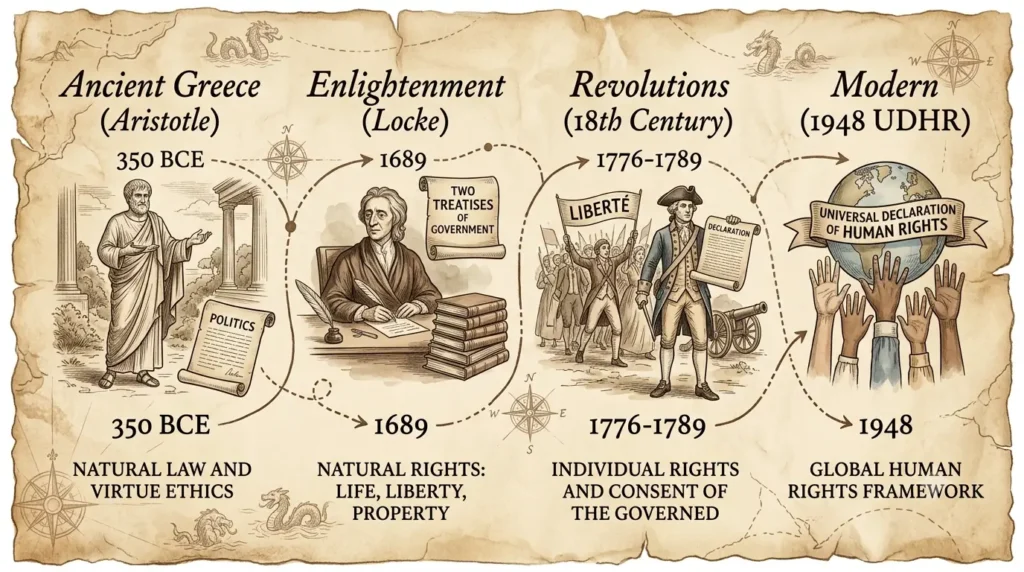
- Ancient Foundations: Aristotle discussed justice and the individual’s role in society.
- The Enlightenment (17th–18th century): John Locke developed modern ideas about natural rights.
- American and French Revolutions: the U.S. Declaration of Independence and the French Declaration formalized rights language.
- Post-World War II: the 1948 UDHR set a global standard for human dignity.
- Contemporary Struggles: ongoing movements for equality continue to expand rights.
2. Natural Rights
Natural rights are rights that everyone has simply because they are human — not dependent on laws, governments, or society.
Philosophical Foundations of Natural Rights
1. John Locke (1632–1704)
Locke, in Two Treatises of Government (1689), argued that everyone is born with inalienable rights: life, liberty, and property. In the state of nature people were free but at risk of conflict, so they formed governments through a social contract to protect these rights. Locke’s ideas heavily influenced the American Declaration of Independence (1776).
2. Thomas Hobbes (1588–1679)
In Leviathan (1651), Hobbes argued that without government, life would be “solitary, poor, nasty, brutish, and short.” He believed people surrender freedoms to a strong ruler in exchange for order — the core natural right being self-preservation.
Characteristics of Natural Rights
- Inalienable — cannot be given up
- Universal — apply to all humans
- Pre-existing Governments — exist before any state is formed
- Individual — protect individuals from harm, including by the state
- Equal for All — same protection for everyone
Examples of Natural Rights
Right to life, right to liberty, right to property, right to pursue happiness, right to justice.
Criticism and Evolution of Natural Rights
- Utilitarian critics (Jeremy Bentham) argue rights should be based on social benefit, not abstract ideas — Bentham famously called natural rights “nonsense upon stilts.”
- Marxist critics argue natural rights mainly protect the interests of the propertied class.
Despite criticism, natural rights remain foundational to modern political thought and to international human rights law.
3. Moral Rights
Moral rights are based on ethics and fairness rather than law or politics.
Ethical Foundations of Moral Rights
1. Immanuel Kant (1724–1804)
Kant’s Categorical Imperative holds that we should act only in ways we’d want everyone else to act. Every person has dignity, giving rise to a right to autonomy and a right to respect.
2. John Stuart Mill (1806–1873)
Mill’s utilitarianism judges actions by their outcomes. His harm principle holds that people should be free to act as they wish as long as it doesn’t harm others — protecting freedom of expression and personal autonomy.
Characteristics of Moral Rights
Ethical basis, universal, inalienable, independent of legal systems, focused on individual and collective well-being, and create a duty in others to respect them.
Examples of Moral Rights
Right to life, right to liberty, right to privacy, right to fair treatment, right to autonomy, right to freedom of expression.
Criticism of Moral Rights
- Conflicting rights — e.g., free speech vs privacy
- Cultural relativism — what counts as a “basic right” varies by culture
- Abstract nature — hard to define or enforce without laws
4. Legal Rights
Legal rights are recognized, protected, and enforced by a legal system, and can be upheld in courts.
Sources of Legal Rights
- Constitutions — e.g., the U.S. Bill of Rights
- Statutes and Legislation — laws passed by legislative bodies
- Case Law — precedents set by courts
- International Treaties — e.g., the UDHR
Jurisprudence
- Natural Law Theory — law should reflect universal moral principles
- Legal Positivism — law is a set of rules made by authorities, independent of morality
- Critical Legal Studies — law reflects and reinforces existing power structures
Characteristics of Legal Rights
Recognized by law, enforceable in courts, clearly defined, limited/conditional (e.g., free speech restrictions), enforced by the state, and formally equal before the law.
Examples of Legal Rights
Right to life and personal security, freedom of speech, fair trial, privacy, property rights, labour rights, political rights, right to education and healthcare, social security rights.
5. Rights under the Indian Constitution
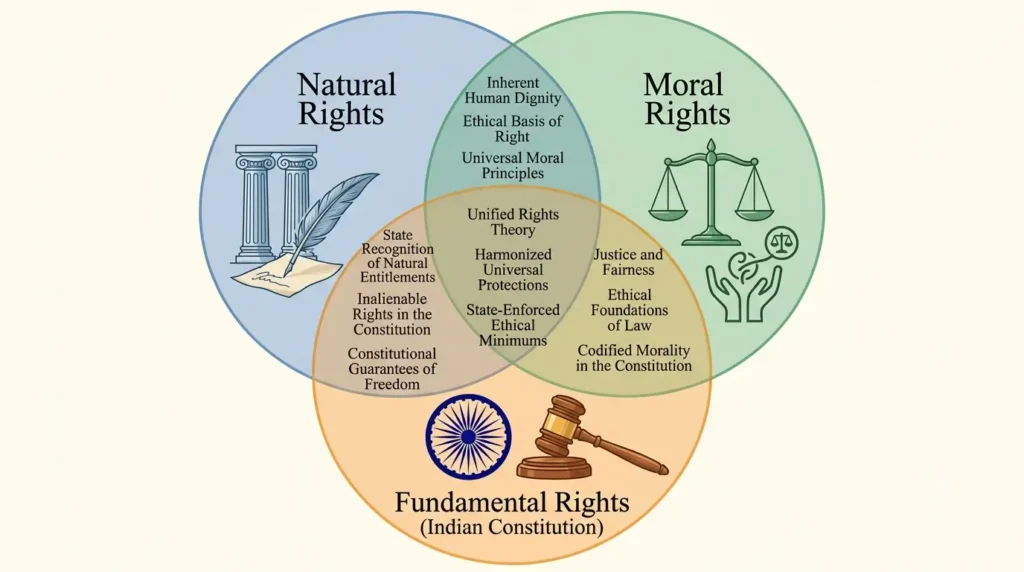
The Indian Constitution blends all three categories of rights studied above into a single legal-moral-natural framework:
- Fundamental Rights (Part III, Articles 12–35) are the legal expression of natural and moral rights — enforceable directly in the Supreme Court under Article 32. They include the Right to Equality (Art. 14–18), Right to Freedom (Art. 19–22), Right against Exploitation (Art. 23–24), Right to Freedom of Religion (Art. 25–28), Cultural and Educational Rights (Art. 29–30), and the Right to Constitutional Remedies (Art. 32).
- Article 21 (Right to Life and Personal Liberty) has been judicially expanded by the Supreme Court to include rights not explicitly written in the text — such as the right to privacy (K.S. Puttaswamy v. Union of India, 2017) and the right to a clean environment — showing how natural/moral reasoning gets absorbed into legal rights through interpretation.
- Directive Principles of State Policy (Part IV, Articles 36–51) function closer to moral rights — they express what the state ought to do (welfare, equitable distribution, education) but are not directly enforceable in court (Article 37), mirroring the natural-rights vs legal-rights distinction discussed by Locke and Hobbes.
- Fundamental Duties (Article 51A), added by the 42nd Amendment, reflect the idea — discussed under moral rights above — that rights and duties are correlative.
This is also the point most DU answers are expected to make: Indian constitutional rights show the natural/moral/legal categories are not watertight — they overlap and reinforce each other in practice.
6. Comparison of Natural, Moral, and Legal Rights
Similarities
All three protect individual dignity and freedom, are human-centred, aspire to universality, and legal rights are often shaped by moral and natural rights principles in practice.
Differences
| Aspect | Natural Rights | Moral Rights | Legal Rights |
|---|---|---|---|
| Foundation | Human nature or reason | Ethical principles | Created by laws/authorities |
| Enforceability | Not enforceable by law | Not enforceable by law | Enforceable by the state through courts |
| Scope | Universal for all humans | Universal or culture-based | Specific to national/international law |
| Nature | Inherent, independent of laws | Based on personal/social ethics | Dependent on state recognition |
| Example | Right to life, liberty | Right to be treated with dignity | Right to vote, fair trial, property |
7. Case Studies and Applications
Right to Life
Locke treats it as a natural right; Kant grounds it morally in human dignity; legally, it’s protected under the UDHR and, in India, under Article 21. The U.S. case Roe v. Wade (1973) illustrates how natural/moral claims about a right to life can conflict with a legally recognized right to bodily autonomy.
Freedom of Speech
Recognized as natural, defended morally by Mill’s harm principle, and codified legally (e.g., the U.S. First Amendment; Article 19(1)(a) in India). Schenck v. United States (1919) shows courts balancing this right against public safety.
Right to Property
Locke ties it to natural rights; Mill balances it against the collective good; legally it is protected but qualified (e.g., Kelo v. City of New London, 2005, where the U.S. Supreme Court allowed government acquisition of private property for development).
Right to Education
Rousseau treated it as natural to human development; morally it’s tied to equal opportunity; legally, Brown v. Board of Education (1954) enforced equal access, and in India, the Right to Education is read into Article 21A.
Conclusion
Natural, moral, and legal rights are connected but differ in source and enforcement. Natural rights derive from philosophy, moral rights from ethics, and legal rights from law and the state. As the Indian Constitution shows, these categories overlap heavily in practice — understanding all three, and how they interact with concepts like Justice and Equality from earlier units, is essential for DSC-7 exams.
8. Previous Year Questions (DU BA Political Science — Political Theory: Concepts and Debates)
(Actual questions from DU Political Science examination papers — good for last-minute revision.)
- Discuss the evolution of the idea of rights. (Political Theory: Concepts and Debates, DU exam)
- Distinguish between legal and moral conceptions of rights. (Political Theory: Concepts and Debates, DU exam)
- Write a short note on Natural Rights.
- Write a short note on Rights and Obligations.
- Discuss the theories of natural rights propounded by Locke and Hobbes. How do they differ?
- “Natural rights are nonsense upon stilts” — Critically examine Bentham’s critique.
- Examine the relationship between Fundamental Rights and Directive Principles in the Indian Constitution.
9. FAQs
What is the main difference between natural rights and legal rights?
Natural rights exist independently of any government or law — they’re considered inherent to being human. Legal rights, on the other hand, are created and enforced by the state and can be changed, expanded, or withdrawn through legislation.
Are moral rights the same as human rights?
Not exactly. Moral rights are grounded in ethics and conscience and aren’t legally enforceable. Human rights often overlap with moral rights in content (e.g., dignity, freedom) but are also codified in international law like the UDHR, giving them a legal dimension moral rights lack on their own.
How does the Indian Constitution combine natural, moral, and legal rights?
Fundamental Rights (Part III) give natural/moral claims legal, enforceable form. Directive Principles (Part IV) express moral/aspirational goals that aren’t directly enforceable in court. Judicial interpretation of Article 21 has repeatedly pulled moral and natural-rights reasoning into enforceable legal rights.
Who gave the theory of natural rights?
John Locke is the most influential natural rights theorist, arguing for the rights to life, liberty, and property in Two Treatises of Government (1689). Thomas Hobbes also discussed natural rights, though he emphasized self-preservation and justified a strong sovereign.
Why did Bentham call natural rights “nonsense upon stilts”?
Jeremy Bentham, a utilitarian, rejected the idea of rights that exist independently of law. He believed only legally recognized and enforceable rights were real, and that abstract “natural” rights had no practical basis — hence his famous dismissal.
Is the right to privacy a natural, moral, or legal right in India?
It’s a good example of overlap: philosophically it’s argued as a natural/moral right tied to human dignity, and it became a legal right in India only after the Supreme Court’s 2017 K.S. Puttaswamy judgment read it into Article 21.
Subscribe to keep reading
You've used your free notes for now. Get Delhi Pathshala Premium for unlimited access.
Subscribe — ₹29/30 days