
Contents
- Introduction
- Unit 1 at a glance
- The four DU essential readings for Unit 1
- 1. Definition and Scope of Public Policy
- Classic definitions you can quote
- Key features of public policy
- Policy, law, scheme and decision: what is the difference?
- Types of public policy
- Importance in Governance and Administration
- 2. Making Policies
- Main People Involved:
- Steps in Making Policies:
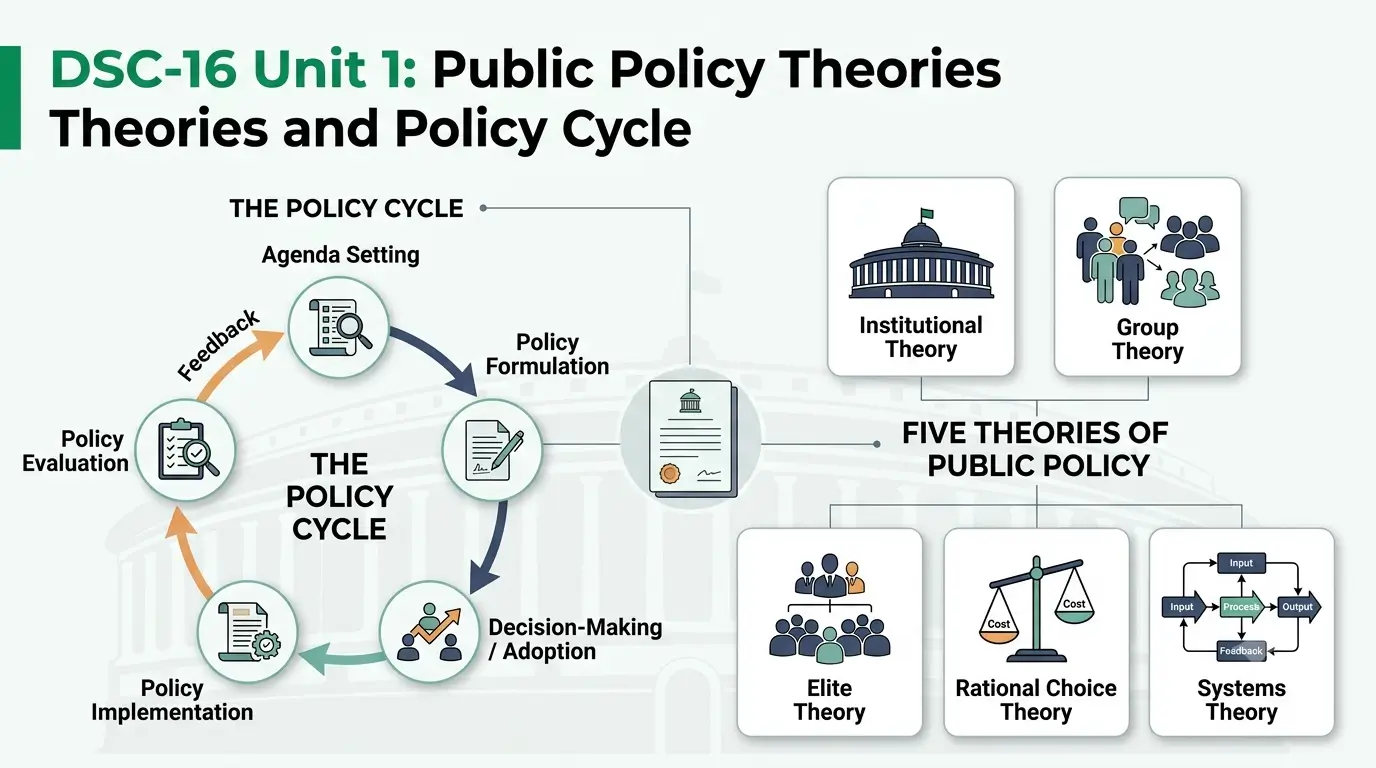
- The policy cycle at a glance
- How do decision-makers actually choose? Three models
- 3. Putting Policies into Action
- Tools for Implementation:
- Challenges in Implementation:
- Why the gap between intention and result?
- 4. Evaluating Policies
- Evaluation Criteria:
- Evaluation Methods:
- Other useful distinctions
- What happens after evaluation?
- Theories of Public Policy
- 1. Elite Theory
- Main Idea and Background:
- Elites and Policymaking:
- Critiques of Elite Theory:
- 2. Group Theory
- Pluralism and Interest Groups:
- Group Competition in Policymaking:
- Strengths and Weaknesses of Group Theory:
- 3. Incremental Theory
- Concept of Incrementalism:
- Advantages of Small Changes:
- Critiques of Incremental Theory:
- 4. Political System Theory
- Understanding Policy as a System:
- Inputs, Processes, Outputs, and Feedback:
- Real-World Application:
- 5. Public Process Theory
- Focus on Policy-Making Procedures:
- Role of Public Participation and Transparency:
- Challenges for an Inclusive Process:
- Criticism of the stages (process) approach
- Important Comparisons
- Criticism and Limitations (unit-wide)
- Contemporary Relevance
- Quick Revision
- Conclusion:
- Continue Reading
- University of Delhi Previous Year Questions
- Frequently Asked Questions
- Sources and Further Reading
Introduction
Unit 1 of DSC-16: Public Policy (BA (Hons.) Political Science, Semester 6, University of Delhi) is titled Introduction, and the official syllabus gives it 8 teaching hours. It has two parts:
- Formulation, implementation and evaluation of public policy
- Theories of Public Policy: Elite Theory, Group Theory, Incremental Theory, Political System Theory and Public Process Theory
The first part tells you how a policy travels from a problem to a result. The second part gives you five different lenses for asking why policies turn out the way they do, and whose interests they serve. Examiners like answers that use both parts together, so these notes keep them in one place and connect them.
The notes follow the syllabus order. Each section gives you the core idea, the thinker’s actual argument, an example you can use in an answer, and the criticisms that earn marks. If you want the official wording of the whole semester, see the DU BA (Hons.) Political Science syllabus page or the official DU Semester VI syllabus PDF.
Studying GE-8 (Introduction to Public Policy) instead? That paper is different. Its Unit 2 covers Elite, Group, Incremental and Rational Choice theory, and its Unit 3 covers the process of public policy. Use our GE-8 notes on theoretical approaches to public policy and GE-8 notes on the process of public policy for that paper. This page is written for DSC-16 and follows its syllabus, including Political System Theory and Public Process Theory.
Unit 1 at a glance
| Syllabus topic | Key idea in one line | Key names | Section |
|---|---|---|---|
| Definition and scope | Public policy is what governments choose to do, or not do, to deal with public problems | Dye, Easton, Lasswell and Kaplan | Part 1 |
| Formulation | Agenda, design, decision and legitimation turn a problem into a policy | Lasswell, Kingdon | Part 2 |
| Implementation | Policy only counts when it is delivered, and delivery often falls short | Pressman and Wildavsky, Lipsky | Part 3 |
| Evaluation | Judging a policy by results, cost and fairness | Dunn | Part 4 |
| Elite Theory | Policy reflects the preferences of a ruling minority | Mosca, Pareto, Michels, Mills | Part 5.1 |
| Group Theory | Policy is the outcome of competition among organised groups | Bentley, Truman, Dahl | Part 5.2 |
| Incremental Theory | Policy moves by small adjustments to what already exists | Lindblom | Part 5.3 |
| Political System Theory | Policy is the output of a system that converts demands and supports | Easton | Part 5.4 |
| Public Process Theory | Policy is the product of a sequence of political activities, and of how open that process is | Dye, Lasswell | Part 5.5 |
The four DU essential readings for Unit 1
The syllabus lists four readings for this unit. Read their abstracts at least, because teachers sometimes frame questions around them.
| Reading (as listed by DU) | How it connects to these notes |
|---|---|
| Howlett, M. and Cashore, B. (2014). Conceptualizing Public Policy, in Engeli and Allison (eds.), Comparative Policy Studies. Palgrave Macmillan | A conceptual introduction to what counts as public policy. Use it for Part 1 |
| Kitschelt, H. (1986). Four Theories of Public Policy Making and Fast Breeder Reactor Development. International Organization, 40(1), 65–104 | A comparative study of how competing policy-making theories explain nuclear reactor policy in France, the United States and West Germany. Use it as a model of testing theories against a real case |
| Mead, L. M. (2013). Teaching public policy: Linking policy and politics. Journal of Public Affairs Education | Connects the study of policy to the study of politics. Use it for the point that policy cannot be separated from power |
| Teune, H. (1977). Macro Theoretical Approaches to Public Policy Analysis: The Fiscal Crisis of American Cities. The Annals of the American Academy of Political and Social Science, 434, 174–185 | A macro-level example of theory applied to policy analysis |
A note on honesty: these notes explain the five theories from their original thinkers and standard textbooks (mainly Thomas Dye’s Understanding Public Policy, which is also on the DU additional reading list). They do not claim to summarise the four readings above in full. Where a reading is mentioned, only its title and published details are stated.
1. Definition and Scope of Public Policy
Definition of Public Policy:
Public policy is a collection of rules, laws, and actions created by the government to solve problems, reach goals, or help the people. These policies can be local, regional, or national and guide how the government acts.
In simple words, public policy is how the government meets the needs and challenges of its people. It includes many areas like healthcare, education, economy, social support, the environment, and safety.
Classic definitions you can quote
Different scholars stress different things. A good answer picks two or three and compares them.
| Scholar | Definition (in brief) | What it stresses |
|---|---|---|
| Thomas Dye | Public policy is whatever governments choose to do or not to do | Choice, and the fact that inaction is also a policy choice |
| David Easton | Policy is part of the authoritative allocation of values for a society | Power and values: government decides who gets what, and the decision binds everyone |
| Harold Lasswell and Abraham Kaplan (1950) | A projected programme of goals, values and practices | Planning and purpose |
Key features of public policy
- Purposive: it aims at some goal, even if the goal is disputed.
- Authoritative: it is made or backed by those with legal power, so citizens are expected to comply.
- Includes inaction: a decision not to act is a policy too. Bachrach and Baratz (1962) called the hidden side of this “non-decision-making”, where powerful actors keep some issues off the agenda altogether.
- A process over time: a policy is a pattern of decisions and actions, not a single announcement.
- Public in its reach: it affects people beyond those who made it, unlike a private firm’s decision.
Policy, law, scheme and decision: what is the difference?
| Term | Meaning | Example (illustration) |
|---|---|---|
| Policy | The broad course of action and its goals | A national goal of universal school education |
| Law | A binding legal rule passed by the legislature | An Act of Parliament that gives children a right to education |
| Programme or scheme | A specific, funded activity to carry the policy out | A mid-day meal scheme in schools |
| Decision | One choice at one moment | A ministry’s order to expand the scheme to more states |
| Administration | The daily machinery that carries decisions out | Block and district education offices |
Types of public policy
Theodore Lowi’s well-known typology (1964, developed in 1972) classifies policies by the kind of power they use. It is useful in answers because each type tends to produce a different kind of politics.
| Type | What it does | Illustration |
|---|---|---|
| Distributive | Gives benefits to specific groups, paid for from general funds | Subsidies and grants |
| Regulatory | Sets rules that limit behaviour | Pollution standards, safety rules |
| Redistributive | Moves resources from one social group to another | Progressive taxation with welfare spending |
| Constituent | Creates or changes government structures | Setting up a new commission or reorganising a ministry |
The examples are illustrations to help you remember each type, not Lowi’s own cases. For a longer treatment of definition, features and types, see our GE-8 explainer on what public policy is: definition, types, features and scope.
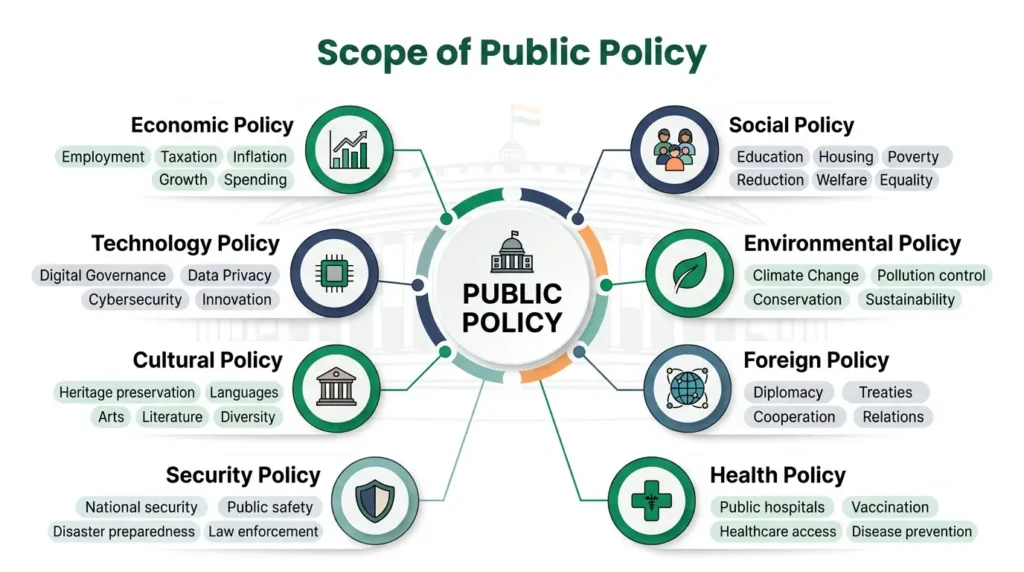
Scope of Public Policy:
Public policy covers many important areas, such as:
- Economic Policy: Rules about taxes, jobs, and the economy.
- Social Policy: Rules about welfare, housing, health, education, and poverty.
- Environmental Policy: Rules about protecting the environment and dealing with climate change.
- Foreign Policy: How a government interacts with other countries.
- Health Policy: Plans to improve public health and healthcare services.
- Security and Law Enforcement Policy: Rules about crime prevention and national security.
- Cultural Policy: Rules about protecting culture, heritage and the arts, and promoting equality and social justice in cultural life.
- Technology and Innovation Policy: Rules about new technologies and their impact.
Importance in Governance and Administration
1. Framework for Decision-Making: Public policy gives a way for governments to make informed decisions. It helps ensure that choices are based on clear goals and facts, allowing the government to achieve results in areas like health and education.
2. Problem-Solving: Public policies help solve specific problems in society, like reducing unemployment or fighting poverty. Good policies can change society for the better by offering solutions to common issues.
3. Accountability and Transparency: A clear policy-making process makes the government answerable to the people. When policies and goals are clear, citizens can understand and hold the government responsible for its actions.
4. Promotes Equity and Justice: Public policy can help reduce inequality by ensuring fair access to resources and opportunities. Policies that support social justice and equal rights help create a fairer society.
5. Economic and Social Development: Well-planned public policies support economic growth and social progress. They help build infrastructure and improve the quality of life for citizens.
6. Governance Efficiency: Good public policy helps the government work better. Clear rules help officials do their jobs consistently and use resources wisely.
7. Conflict Resolution: Public policies help resolve conflicts in society. By addressing issues like inequality and public service concerns, they help maintain peace and order.
Conclusion:
Public policy is vital for government effectiveness, as it provides a clear way to tackle the challenges faced by society. It helps promote the well-being of citizens, ensures government transparency, and supports a balanced society.
Good public policy can lead to positive economic and social results for the nation. At the same time, remember Mead’s point from the DU reading list: policy and politics are linked, so a policy always reflects some contest over whose problems count.
2. Making Policies
Policy formulation is the stage where a government turns a problem into a proposed course of action. In the policy-cycle language used by most textbooks, it covers agenda setting, design, decision and legitimation.
Main People Involved:
- Government:
- The government is the main player in creating policies. Elected leaders like the president or lawmakers start and approve policy ideas. Political parties also influence policies based on their beliefs and goals.
- Government offices (like ministries) help by providing knowledge, resources, and plans for putting policies into action.
- In India: the executive means the Union Council of Ministers headed by the Prime Minister, which aids and advises the President under Article 74 of the Constitution. Major policies pass through Cabinet, and many need Parliament to make a law or approve funds. State governments make policy on state subjects.
- Bureaucracy:
- The bureaucracy includes public workers in government who help create and sometimes carry out policies. They give important information and insights based on their experience in areas like healthcare and education.
- They help turn broad political ideas into practical policies that can be used in the real world.
- Interest Groups:
- Interest groups are organizations that represent specific parts of society (like environmental groups or labor unions). They work to influence policy by advocating for their interests.
- They can shape what issues are addressed by rallying public support or talking directly to policymakers.
Other actors also matter in practice:
| Actor | Role in formulation | Illustration |
|---|---|---|
| Legislature | Debates, amends and passes policy as law or budget | Parliamentary committees examining a Bill |
| Judiciary | Interprets the law and can force or block policy through judicial review | Court directions to government in public interest cases |
| Policy institutions and think tanks | Supply research, options and advice | NITI Aayog, which replaced the Planning Commission on 1 January 2015, is the Union government’s policy think tank |
| Media and public opinion | Draw attention to problems and frame them | Press coverage pushing an issue onto the agenda |
| Civil society and social movements | Raise neglected problems and press for change | Campaigns that preceded the Right to Information Act, 2005 (commonly credited to groups such as the MKSS in Rajasthan) |
| International organisations | Influence through advice, funding and agreements | Global climate and development commitments |
| Local governments | Add local knowledge and later carry policy out | Panchayats and municipalities |
Steps in Making Policies:
- Setting the Agenda:
- Setting the agenda is about figuring out which issues need government attention. Public opinion, media coverage, and crises help decide which issues are prioritized.
- Issues that are urgent or of great public interest (like healthcare or the environment) often get more attention.
- Designing Policies:
- After an issue is identified, designing policies involves finding the best way to tackle it. This includes gathering information, analyzing the problem, and looking at possible solutions.
- Policy designers create different options and evaluate their costs, benefits, and practicality.
- Making Decisions:
- In the decision-making stage, policymakers (like lawmakers) choose which policy to adopt. They consider the positives and negatives, public opinion, and may negotiate with interest groups.
- Political beliefs and public support can influence this decision.
- Legitimation (an important step the simple three-step list leaves out):
- Legitimation means gaining formal approval and public acceptance. It can mean a vote in the legislature, an executive order, a court ruling or a public consultation.
- Dye’s process model lists legitimation as a separate activity between formulation and implementation, so name it in your answer.
The policy cycle at a glance
| Stage | Key question | Typical actors | Output |
|---|---|---|---|
| Problem identification and agenda setting | Which problems deserve attention? | Media, movements, parties, crises | A recognised public problem |
| Formulation and design | What could we do? | Bureaucrats, experts, committees | Policy options |
| Decision and legitimation | What will we do, and who approves? | Cabinet, legislature, courts | An adopted policy or law |
| Implementation | How do we deliver it? | Agencies, frontline staff, local bodies | Programmes and services |
| Evaluation | Did it work, for whom, at what cost? | Evaluators, auditors, citizens | Findings and feedback |
| Change or termination | Continue, revise or end? | Government and legislature | Revised or ended policy |
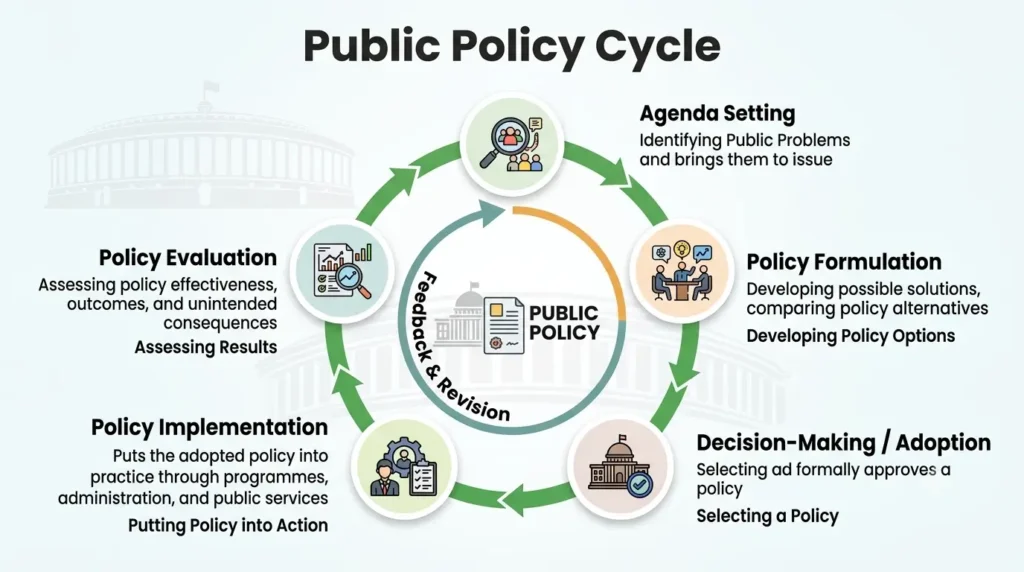
Textbooks differ on the number of stages. Lasswell (1956) proposed seven functional categories of the decision process, and many modern textbooks use five or six. Pick one version, name its author, and stay consistent.
How do decision-makers actually choose? Three models
| Model | Idea | Who proposed it |
|---|---|---|
| Rational-comprehensive | List goals, compare all options, pick the best | Ideal model in many textbooks |
| Incremental | Compare only options close to the current policy | Lindblom (Part 5.3) |
| Mixed scanning | Look broadly at fundamental choices, then in detail only at promising ones | Etzioni (1967) |
Two further ideas explain why policy is not always orderly. Cohen, March and Olsen’s garbage can model (1972) describes decisions as the meeting of problems, solutions and participants in loosely organised settings. Kingdon’s multiple streams account (1984) says change happens when a problem, a solution and political will come together at the same moment. For Herbert Simon’s bounded rationality and Michael Howlett’s policy design framework, which the DU syllabus places in Unit 2, see our DSC-16 Unit 2 notes on policy design, monitoring and state capacity.
3. Putting Policies into Action
Implementation is the stage where a policy’s words become services, rules and money reaching people. A well-designed policy can still fail here.
Tools for Implementation:
- Laws and Rules:
- Laws and rules created by government bodies set the foundation for how policies are carried out. Once a policy is approved, government agencies create specific guidelines for its application.
- Government Agencies:
- Government agencies are mainly responsible for carrying out policies. They create programs, manage resources, and ensure policies are followed as intended.
- Public-Private Partnerships:
- Sometimes, public-private partnerships are used. Private companies or NGOs may help implement policies through agreements with the government.
- Monitoring and Enforcement:
- Monitoring (like audits and inspections) is important to ensure policies are followed. For example, environmental rules may be checked through inspections.
- Funding:
- Policy implementation often needs funding to ensure programs have enough money. This includes budget allocations and grants to support policy goals.
Governments also choose between kinds of instruments. A regulation commands, a subsidy or tax changes incentives, and an information campaign tries to persuade. Choosing among these is the subject of policy design, which Unit 2 covers.
Challenges in Implementation:
- Resource Limitations:
- Limited resources can make it hard to implement policies well. Not having enough staff or money can delay goals.
- Slow Bureaucracy:
- The bureaucratic process can be slow and resistant to change, causing delays in policy execution.
- Lack of Coordination:
- Policies often need many agencies or levels of government to work together. Poor communication can lead to confusion.
- Resistance:
- Some policies face pushbacks from political opponents or the public, which can slow down or stop implementation.
- Unrealistic Goals:
- Policies that are too ambitious may struggle to meet their goals, leading to disappointment and public backlash.
Why the gap between intention and result?
The scholarly study of implementation began with Pressman and Wildavsky’s Implementation (1973). Their basic insight is that the more links there are between a decision and its delivery, and the more agencies must agree at each link, the smaller the chance that the result will match the plan. Two traditions followed:
| Top-down view | Bottom-up view | |
|---|---|---|
| Starting point | The policy decision and its goals | Frontline workers and target groups |
| Key idea | Clear goals, control and resources produce success | Local discretion and adaptation shape what policy really is |
| Risk | Rigid, blind to local conditions | Uneven delivery, drift from policy goals |
Michael Lipsky’s idea of street-level bureaucrats (teachers, police, nurses, social workers) belongs to the bottom-up view: their daily choices effectively make policy. Lipsky’s book is a DU reading in Unit 4, so see our notes on Unit 4: Politics of Policy too. In India, a common source of the implementation gap is that many welfare programmes are designed at the Centre but delivered by states and local bodies, so coordination, funds and staff all matter. For decentralisation, local government and state capacity in more depth, go to the Unit 2 notes linked above.
4. Evaluating Policies
Evaluation asks whether a policy worked, for whom, and at what cost. Its findings feed back into agenda setting, so it links the end of the cycle to the start of the next one.
Evaluation Criteria:
- Efficiency:
- Efficiency looks at how well resources are used to achieve policy goals. A policy is efficient if it gets results without wasting money or time.
- Effectiveness:
- Effectiveness checks if a policy meets its goals. If the policy improves healthcare or reduces pollution as intended, it is effective.
- Equity:
- Equity considers if the policy is fair. It asks if the benefits are shared fairly among different groups in society.
These three are the core. William Dunn’s widely used framework for policy analysis adds three more, giving six criteria:
| Criterion | Question it asks |
|---|---|
| Effectiveness | Did the policy achieve the intended result? |
| Efficiency | How much effort or money did the result cost? |
| Adequacy | Even if it worked, is the result big enough to solve the problem? |
| Equity | Are costs and benefits distributed fairly among groups? |
| Responsiveness | Does it meet the needs and preferences of the people it targets? |
| Appropriateness | Is the result actually worth having, given society’s values? |
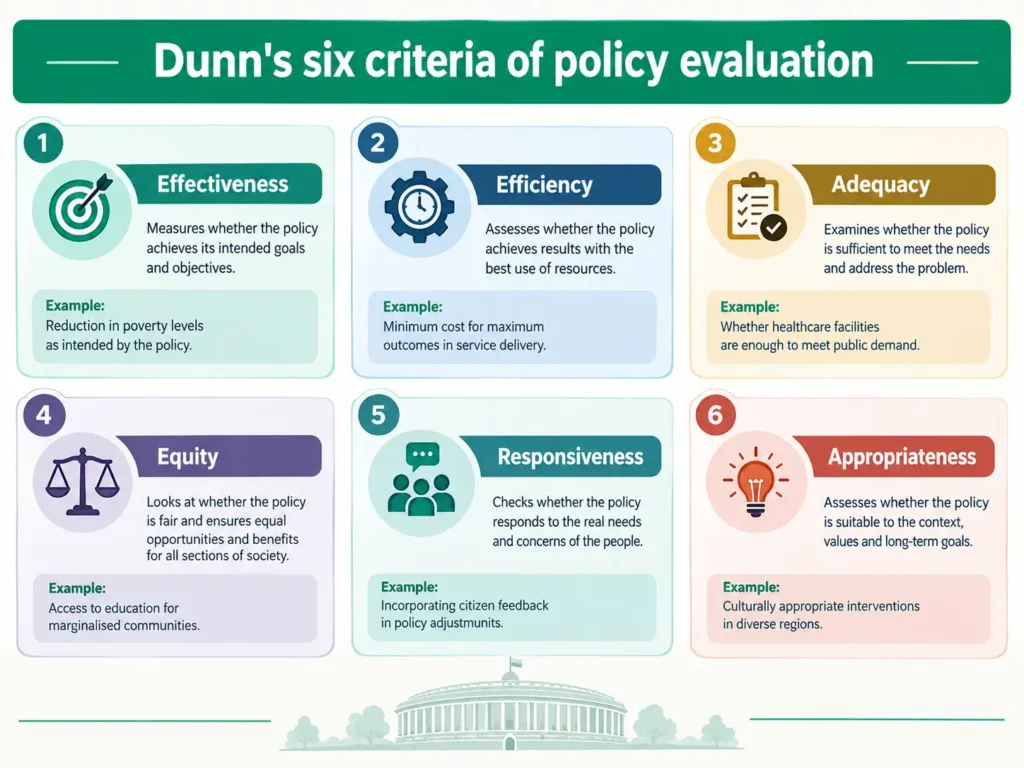
Example for revision: a scheme may be effective (it reaches its targets) and efficient (low cost), yet not adequate if the targets were set too low to end the problem, and not equitable if the poorest households are missed.
Evaluation Methods:
- Qualitative Methods:
- These methods focus on non-numeric data to assess the policy’s broader impact. They include:
- Interviews: Talking to people involved in the policy to gather insights.
- Focus Groups: Discussing with groups of stakeholders about their experiences.
- Case Studies: Looking at specific examples of how the policy worked.
- Content Analysis: Analyzing media and public opinion about the policy.
- Quantitative Methods:
- These methods use numerical data to measure policy outcomes. Examples include:
- Surveys: Collecting data from many people to see how the policy impacted them.
- Statistical Analysis: Using numbers to analyze changes before and after the policy.
- Cost-Benefit Analysis: Comparing the costs of implementing the policy to the benefits it brings.
- Impact Assessments: Evaluating how the policy affects the target population and society.
Other useful distinctions
| Distinction | Meaning |
|---|---|
| Formative vs summative | Formative evaluation improves a policy while it runs; summative evaluation judges it at the end |
| Process vs impact | Process evaluation checks whether delivery followed the plan; impact evaluation checks what changed for people |
| Cost-benefit vs cost-effectiveness | Cost-benefit puts a money value on benefits; cost-effectiveness compares the cost of reaching the same outcome when benefits cannot be priced |
| Experimental and quasi-experimental designs | Use comparison or control groups to show that the policy, not something else, caused the change |
Monitoring is not evaluation. Monitoring tracks delivery continuously while a policy is running; evaluation judges results and worth, usually at milestones or at the end. Our Unit 2 notes cover monitoring tools such as indicators and social audits.
Who evaluates in India? The Development Monitoring and Evaluation Office (DMEO) works under NITI Aayog; it was created in 2015 by reorganising the older Programme Evaluation Organisation (a National Institute of Labour Economics Research and Development document describes this revamp). Independent audit and social audit add other checks. Evaluation methods and the DU readings on evaluation (Anderson, Linder and Peters, Provus, Purdon and colleagues) are the subject of Unit 3, covered in our DSC-16 Unit 3 notes on public policy evaluation.
What happens after evaluation?
Findings can lead to continuing the policy, revising it, or ending it. Textbook treatments, such as Penn State’s public policy course materials, note that termination is rare, because programmes build supporters and routines that resist being closed.
Conclusion:
- Making, implementing, and evaluating policies are important steps in ensuring policies work well. Policymakers must consider the key players, the stages of policy development, and the tools available for effective implementation.
- Evaluating policies based on efficiency, effectiveness, and fairness helps the government improve its actions and better serve the public.
- The stages are linked in a loop: evaluation produces feedback, feedback changes the agenda, and the cycle starts again. The five theories below explain why this loop works as it does in real life.
Theories of Public Policy
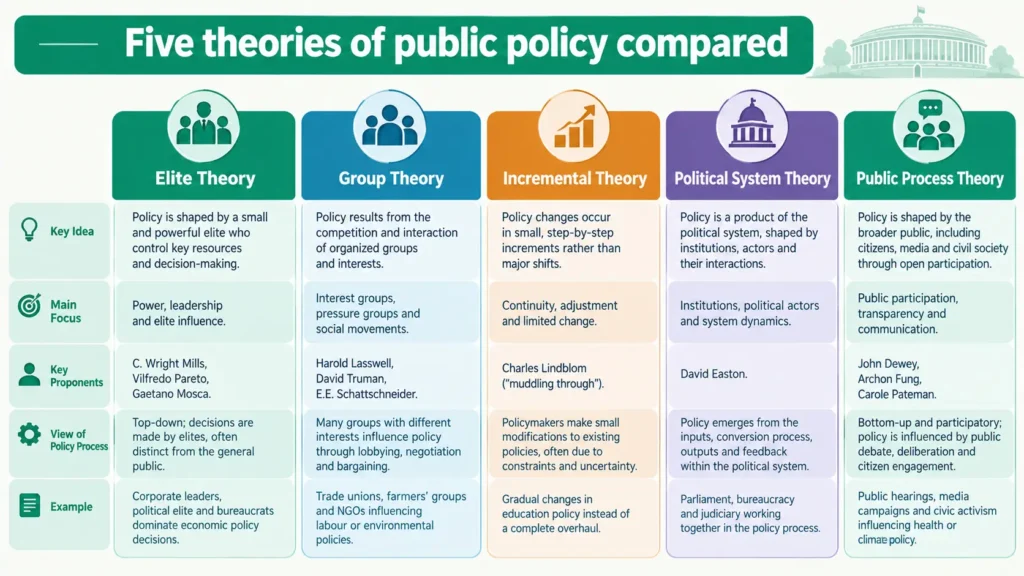
The syllabus names five theories. Thomas Dye’s Understanding Public Policy, which is on the DU additional reading list, calls such theories models and gives each a one-line label. He also stresses that most real policies are best explained by a combination of models, so treat them as lenses and not as rival truths.
| Theory | Dye’s one-line label | Who holds power | How policy changes | Main criticism |
|---|---|---|---|---|
| Elite | Policy as elite preference | A small ruling minority | Slowly, when elites agree | Treats elites as one block and plays down democratic pressure |
| Group | Policy as group equilibrium | Many competing organised groups | By bargaining and compromise | Ignores unorganised people and unequal resources |
| Incremental | Policy as variations on the past | Dispersed decision-makers adjusting existing policy | In small steps | Can freeze injustice and block bold reform |
| Political System | Policy as system output | The system as a whole, responding to demands and supports | Through feedback loops | A “black box” that says little about who shapes demands |
| Public Process | Policy as political activity in stages | Actors at each stage | Through a sequence of activities | Real policy is not neatly sequential |
1. Elite Theory
Main Idea and Background:
- Elite theory says that a small group of powerful people, called elites, have most of the control over political decisions. It claims that even in democracies, real power lies with elites like business leaders, military officials, and politicians.
- This idea comes from thinkers like Gaetano Mosca and Vilfredo Pareto, who wrote in the late nineteenth and early twentieth centuries and said that a minority always rules. C. Wright Mills added to this in his book The Power Elite (1956), showing how corporate, military, and political elites are connected in the U.S.
Fuller background.
- The “classical elite theorists” are usually listed as Mosca, Pareto and Robert Michels. Mosca’s The Ruling Class first appeared in Italian in 1896 (English translation 1939), so the tradition begins in the late nineteenth century.
- Mills’s power elite was made of three groups: corporate chiefs, the political directorate and the military leadership.
| Thinker | Main idea |
|---|---|
| Gaetano Mosca | Every society is ruled by an organised minority, the “political class”, which justifies its rule through a “political formula”; its strength lies in organisation |
| Vilfredo Pareto | Elites have superior qualities in their field; history shows a “circulation of elites”, with new elites replacing old ones (his “lions” rule by force, “foxes” by cunning) |
| Robert Michels | The “iron law of oligarchy”: any large organisation, even a democratic party, ends up run by a few leaders |
| C. Wright Mills | In the modern United States, power is concentrated in the top positions of corporate, political and military institutions, and these three circles overlap |
Classical writers argued that elite rule is unavoidable. Mills argued that it is a fact about modern institutions that should be criticised. Note this difference, since it separates “inevitability” from “critique” in an answer.
Elites and Policymaking:
- According to elite theory, elites are the main decision-makers and shape policies. While regular people can vote, they have little real power over policy. Elites set the political agenda and decide how to solve social issues.
- Elites influence policy by controlling important institutions like the government and media. Different elite theorists explain why they hold power differently: Pareto stressed superior personal qualities, Mosca stressed organisation, and Mills stressed position in powerful institutions.
In Dye’s reading, elite theory says that policy does not reflect the demands of the masses; it reflects the values of the governing elite, so policy changes are more likely to be gradual adjustments than revolutions. For a policy-oriented example, think of debates about how business interests shape economic policy in India. The DU readings in Unit 4 (Kochanek on business lobbying; Sinha on the business-state relationship) belong to this debate, and our Unit 4: Politics of Policy notes cover it.
Critiques of Elite Theory:
- Democratic deficit: Critics say elite theory weakens democracy by suggesting that regular citizens have little say in policy.
- Oversimplification: Some argue it oversimplifies power by treating all elites as the same, ignoring their different interests.
- Ignoring other influences: The theory often overlooks other influences like social movements and public opinion that can also affect policy.
The pluralist reply (a debate to cite with names). Robert Dahl’s Who Governs? (1961), a study of decision-making in New Haven, argued that different groups won on different issues and that power was spread, not held by one elite. Elite theorists answer that Dahl looked only at visible decisions; Bachrach and Baratz (1962) said real power also works by keeping issues off the agenda. Present this as a live disagreement, not a closed question. Other common criticisms are that elite theory can be circular (it defines elites by power, then explains power by being an elite) and hard to test.
2. Group Theory
Pluralism and Interest Groups:
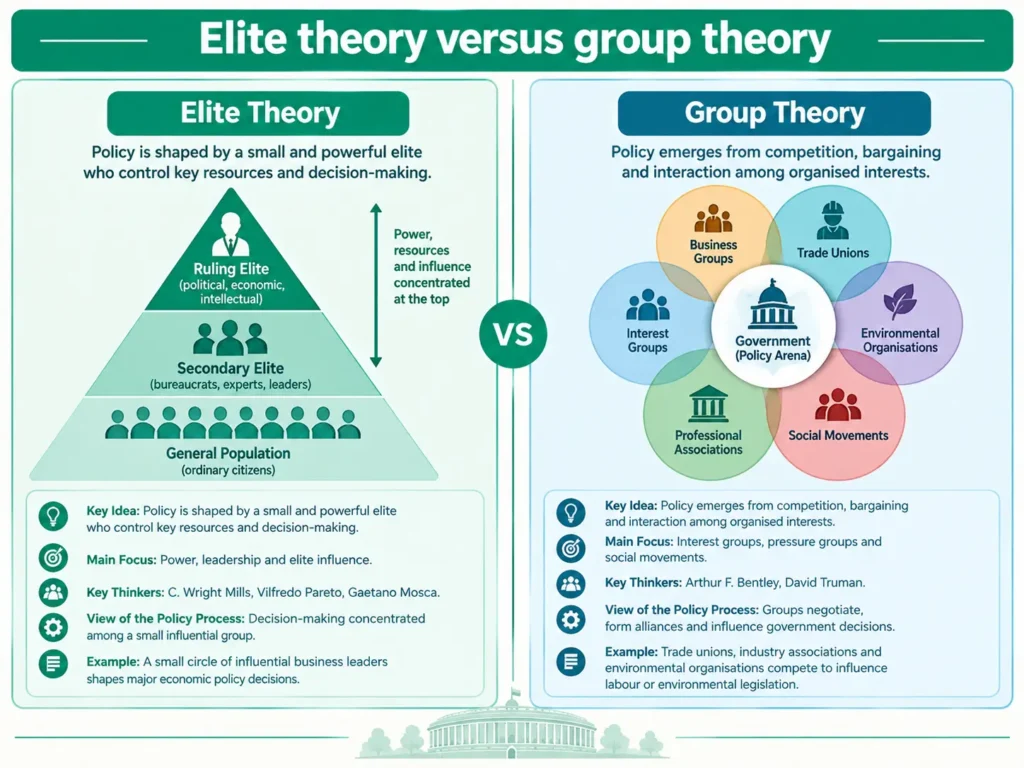
- Group theory, especially in pluralism, says that policy is shaped by many competing interest groups, such as labor unions and environmental organizations, which represent different parts of society.
- Pluralism argues that power is spread among many groups, not just a few elites. These groups compete to influence policy, leading to decisions that reflect a variety of interests.
Where the idea comes from. The group approach is traced to Arthur Bentley’s The Process of Government (1908), which treated groups pressing on one another as the basic material of politics. David Truman’s The Governmental Process (1951) and Earl Latham’s The Group Basis of Politics (1952) developed it, and Dahl’s pluralism (above) is the best-known later version. Scholars debate how directly modern interest group theory descends from Bentley, so say “Bentley is usually named as the starting point” and not “Bentley founded it”. In Dye’s summary, policy at any time is the equilibrium reached in the struggle among groups, and the government’s role is to set the rules of the group struggle, balance claims and enforce compromises.
Group Competition in Policymaking:
- In group theory, policies come from the interactions of different groups. For instance, environmentalists may want stricter pollution laws, while businesses may want fewer regulations. Policies are often a compromise between these competing interests.
- This theory suggests that no single group can dominate policy for too long, as new groups keep appearing to challenge the established ones.
A simple Indian illustration: when a government proposes a change in farm marketing rules, farmer organisations, traders, consumer groups and state governments all lobby, protest or negotiate, and the final policy reflects the balance among them. Use this only as an illustration of the theory, not as a claim about one particular episode.
Strengths and Weaknesses of Group Theory:
- Strengths:
- Diversity representation: Acknowledges the variety of interests in society.
- Encourages involvement: Promotes people organizing and participating in politics.
- Weaknesses:
- Power imbalance: Not all groups have the same resources or influence, so wealthier groups may dominate the process.
- Overemphasis on competition: Assumes that competition leads to fair outcomes, which may not always be true.
Further criticisms, with names for the long answer:
- Olson (1965), The Logic of Collective Action: large groups with diffuse interests find it hard to organise because individuals can free-ride, while small, concentrated groups organise easily. So the group “market” is not neutral.
- Schattschneider (1960), The Semisovereign People: the world of organised pressure groups is biased towards the better-off, and many people are outside it.
- Lowi (1969), The End of Liberalism: a policy process driven by group bargaining can hand public power to organised interests (“interest-group liberalism”).
- Neglect of the state: the theory treats government as a referee and plays down its own interests and the bureaucracy’s role.
3. Incremental Theory
Concept of Incrementalism:
- Incremental theory suggests that policy changes are usually small and gradual rather than big and sudden. Policymakers often prefer small adjustments to existing policies instead of sweeping reforms.
- Charles Lindblom argued that policymakers make decisions step-by-step, considering the immediate effects of small changes rather than taking large risks.
Lindblom’s argument in detail. In “The Science of ‘Muddling Through'” (Public Administration Review, 1959), Lindblom contrasted two ways of making decisions:
| Root method (rational-comprehensive) | Branch method (successive limited comparisons, “muddling through”) | |
|---|---|---|
| Goals | Clarified and ranked first | Mixed up with the choice of means |
| Options | All possible options reviewed | Only options close to the present policy |
| Test of a good policy | Best fit to goals | Agreement among decision-makers |
| Feasible for complex problems? | Lindblom said no | Yes, and it is what administrators do |
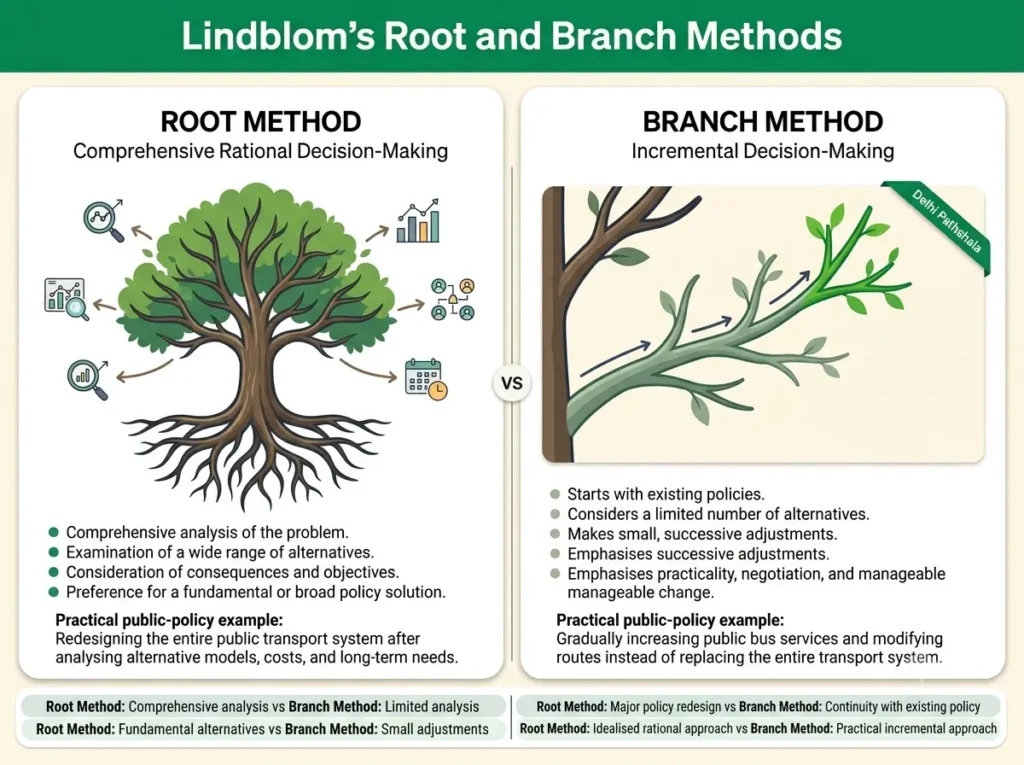
He argued that the root method is impossible for complex problems because people lack the information, time and capacity to use it, and that the branch method is what real administrators follow. In “Still Muddling, Not Yet Through” (1979) he developed the idea further, and Braybrooke and Lindblom’s A Strategy of Decision (1963) set out “disjointed incrementalism”. Lindblom also stressed that when many groups adjust to one another, the result can be reasonable even without a central plan (partisan mutual adjustment). Notice that Lindblom’s claim is both descriptive (this is how policy is made) and, to a degree, prescriptive (this is a sensible way to make it). In Dye’s wording, policy is a set of variations on past policy.
A familiar illustration: yearly changes to tax rates and subsidy levels usually adjust last year’s figures instead of redesigning the whole system.
Advantages of Small Changes:
- Practicality: Small changes are easier to agree on and less disruptive.
- Stability: Allows for ongoing improvement without major upheaval.
- Lower risk: Smaller changes carry less risk of failure since they can be adjusted quickly.
Critiques of Incremental Theory:
- Policy stagnation: Critics say it can prevent necessary large reforms and lead to complacency.
- Status quo bias: It may reinforce existing inequalities by focusing on minor tweaks instead of big issues.
- Missed chances: Some problems require bold solutions, which incrementalism may not address.
Two named alternatives: Amitai Etzioni’s mixed scanning (1967) suggests combining a broad look at fundamental choices with detailed analysis of selected ones, and the rational-comprehensive model remains the benchmark critics use. Also note the link with Herbert Simon’s bounded rationality: both say decision-makers have limited capacity, which is why this unit and Unit 2 belong together.
4. Political System Theory
Understanding Policy as a System:
- Political system theory, developed by scholars like David Easton, sees policymaking as part of a larger system where public demands are processed to create policies.
- This theory emphasizes how different parts of the political system interact and influence each other, creating a cycle of input, output, and feedback.
Easton’s framework. David Easton set out this approach in The Political System (1953) and developed it in A Framework for Political Analysis and A Systems Analysis of Political Life (both 1965). He defined politics as the authoritative allocation of values for a society, and he pictured the political system as sitting in an environment from which it receives inputs and to which it sends outputs. In Dye’s wording, policy is the output of the political system.
Inputs, Processes, Outputs, and Feedback:
- Inputs: Public demands and needs that influence the political system.
- Processes: How these inputs are turned into decisions, including policy making and negotiations.
- Outputs: The laws and policies created in response to public demands.
- Feedback Loops: Responses from the public and effects of policies shape future demands and decisions.
| Easton’s term | Meaning | Illustration |
|---|---|---|
| Environment | Everything outside the system that affects it (social, economic, political, international) | An economic slowdown |
| Demands | Claims made on the system | Farmers asking for price support |
| Supports | Backing that keeps the system working: acceptance of the community, regime and authorities | Voting, paying taxes, obeying the law |
| Conversion (the “black box”) | Inside processes that turn inputs into decisions | Cabinet, legislature, bureaucracy |
| Outputs | Authoritative decisions and actions | A new law, a scheme |
| Outcomes | What happens in society afterwards (Easton separates these from outputs) | Whether incomes actually rose |
| Feedback | Reactions to outputs that create new demands or change support | Protests or praise after the scheme |
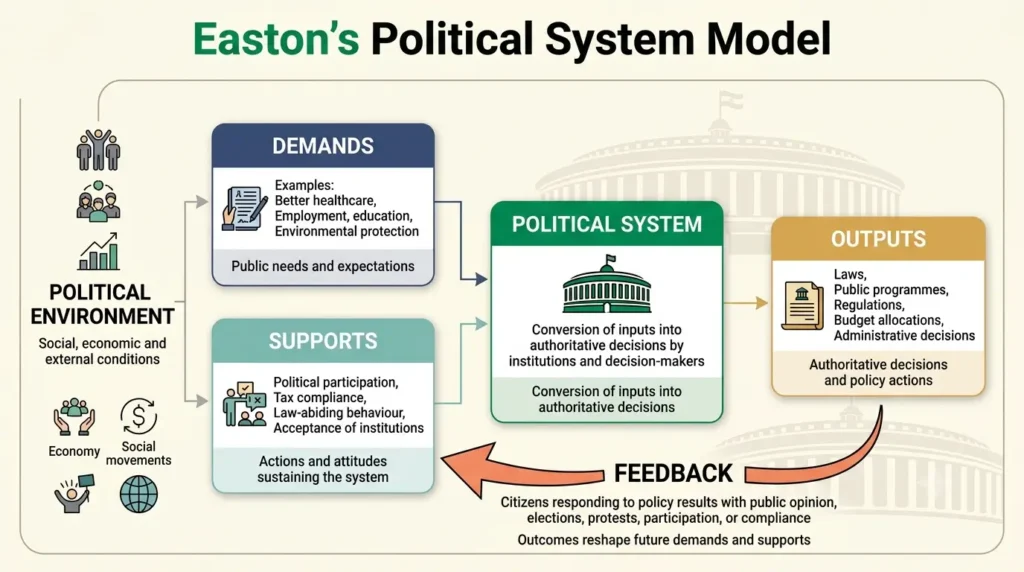
Easton’s central question was how a political system persists when demands and stress keep coming, and the feedback loop is his answer: the system adjusts by reading the reaction to its own outputs.
Real-World Application:
- This theory helps analyze how governments react to public needs and how feedback shapes future policies. For example, a healthcare policy might emerge from public calls for better services, leading to reforms that affect future healthcare decisions.
- An Indian illustration: long campaigns for a legal right to food are commonly cited as an input (demand) that fed into the National Food Security Act, 2013 (output). Later debates about coverage and delivery then act as feedback. Treat this as an illustration of the model, since scholars explain the Act through several factors.
Criticism. The model is very general, so it is hard to test; the “black box” says little about who shapes demands or how power inside the system works; and it can wrongly suggest that all demands enter on equal terms. Critics also argue that its emphasis on persistence and balance gives it a bias towards stability. Elite and group theories can be seen as filling in what happens inside the black box.
5. Public Process Theory
Read this first. The DU syllabus names “Public Process Theory” but does not define it, and there is no single standard theory under exactly this label. In textbooks, the nearest established idea is the process model in Thomas Dye’s Understanding Public Policy, which studies policy as a series of political activities. Many student notes instead describe it as an approach built on participation and transparency. Both readings appear below, since an examiner could intend either. Where your teacher has defined the term, follow your teacher’s wording.
Focus on Policy-Making Procedures:
- Public process theory highlights the importance of how decisions are made, emphasizing fairness and public involvement in the policy-making process.
- It stresses the need for transparency and citizen engagement in developing policies.
Reading A: the process model (Dye). Here policy is studied as a sequence of political activities: problem identification, agenda setting, formulation, legitimation, implementation and evaluation. It tells us when and where in the process different actors can influence policy, but, as Dye notes, it says less about the content of policy. This is the same cycle you studied in Parts 2 to 4, which is why the syllabus places it in a unit that begins with formulation, implementation and evaluation. For a fuller account of the cycle and its models, see our GE-8 notes on the process of public policy.
Reading B: the participation approach (original emphasis of this page). Here the key claim is that the quality of the process matters: fair procedures and real public involvement make policy more legitimate.
Role of Public Participation and Transparency:
- Public participation is key, suggesting policies should be created with input from citizens, such as through public meetings and consultations.
- Transparency helps people see how decisions are made and who is responsible, ensuring accountability.
Indian examples of participatory and transparent procedures: the Gram Sabha at village level, the Right to Information Act, 2005, and social audits of public works. See the Unit 2 notes for social audits and local government.
Challenges for an Inclusive Process:
- Resource and access issues: Not everyone has equal access to the policy process; some groups may have more influence due to money or connections.
- Voter apathy: Low civic engagement can limit public participation.
- Complexity: The policy process can be hard to understand, making it tough for the public to engage.
Criticism of the stages (process) approach
Critics, such as Paul Sabatier, have argued that the stages model is only a heuristic: it describes a tidy sequence but does not explain why things happen, and real policy-making is not linear. Stages overlap, loop back and sometimes skip. Lasswell’s seven categories (1956) and later cycles all share this limit. Kingdon’s multiple streams and the garbage can model (Part 2) were developed partly to explain what the stages picture misses.
Important Comparisons
| Comparison | Point 1 | Point 2 |
|---|---|---|
| Elite vs Group theory | Power concentrated in a minority; the masses are passive | Power spread among competing groups; policy is a compromise |
| Elite vs Marxist thinking | Elite rule rests on organisation, position or quality, and can change hands | Rule rests on class and ownership of the means of production |
| Group theory vs pluralism | Bentley and Truman: groups as the unit of analysis | Dahl: power is dispersed across many centres in a democracy |
| Incremental vs rational-comprehensive | Small, tested steps from the status quo | Full review of goals and all options |
| Incremental vs mixed scanning | Look only near the present policy | Combine a broad scan with detailed study of a few options |
| Political System vs Public Process | Policy as output of an environment-linked system with feedback | Policy as the result of stages of political activity |
| Output vs outcome (Easton) | What government decides and does | What changes in society afterwards |
| Monitoring vs evaluation | Continuous tracking of delivery | Judging results and worth |
Criticism and Limitations (unit-wide)
- Models are lenses, not rival truths. Dye himself says most policies combine rational planning, incrementalism, group competition, elite preferences, political processes and institutional influences.
- They were built mostly on Western, especially American, cases. Using them for India needs care about different state structures, federalism and the role of local government.
- Each theory hides something. Elite theory hides competition; group theory hides inequality; incrementalism hides the need for bold change; systems theory hides power inside the black box; the process model hides non-linear politics.
- The syllabus term “Public Process Theory” is loosely defined, which makes it a place where answers can differ legitimately.
Contemporary Relevance
- Evidence and evaluation. The creation of NITI Aayog (2015) and its Development Monitoring and Evaluation Office shows a stated shift towards monitoring outcomes. The Aspirational Districts Programme (launched January 2018, covering 112 districts, according to NITI Aayog explainers) is often cited as an example of ranking-based, data-driven monitoring. Whether such dashboards improve outcomes is debated, which makes a good critical point.
- Elite and group lenses in current debates. Lobbying by business bodies, farmers’ organisations or professional associations can be analysed with group theory, while questions about who gets a seat at the table in drafting bodies connect to elite theory.
- Participation tools. The Right to Information Act and social audits give citizens access to the policy process, which is the heart of the participation reading of Public Process Theory.
Quick Revision
| Term | One-line meaning |
|---|---|
| Public policy | Government’s chosen course of action (or inaction) on public problems |
| Agenda setting | Deciding which problems get government attention |
| Legitimation | Gaining formal approval and acceptance |
| Implementation gap | Distance between policy intention and delivered result |
| Dunn’s six criteria | Effectiveness, efficiency, adequacy, equity, responsiveness, appropriateness |
| Elite theory | Policy as elite preference (Mosca, Pareto, Michels, Mills) |
| Iron law of oligarchy | Large organisations end up ruled by a few (Michels) |
| Group theory | Policy as group equilibrium (Bentley, Truman) |
| Pluralism | Power dispersed among many groups (Dahl) |
| Incrementalism | Policy as small variations on the past (Lindblom) |
| Root vs branch | Full review vs successive limited comparisons |
| Political system theory | Policy as system output (Easton) |
| Demands and supports | The two kinds of input in Easton’s model |
| Process model | Policy as stages of political activity (Dye) |
Key dates: Bentley, The Process of Government (1908) · Mosca, The Ruling Class (Italian 1896; English 1939) · Michels, Political Parties (1911) · Truman, The Governmental Process (1951) · Easton, The Political System (1953) · Mills, The Power Elite (1956) · Lasswell’s seven categories (1956) · Lindblom, “The Science of ‘Muddling Through'” (1959) · Dahl, Who Governs? (1961) · Easton, A Systems Analysis of Political Life (1965) · Olson, The Logic of Collective Action (1965) · Pressman and Wildavsky, Implementation (1973) · Lindblom, “Still Muddling, Not Yet Through” (1979) · NITI Aayog replaces Planning Commission (1 January 2015).
Conclusion:
Each of the theories of public policy gives a different view on how policies are created and assessed. Elite theory focuses on the power of small elites, while group theory highlights interest groups.
Incrementalism supports gradual changes, political system theory looks at the whole system, and public process theory stresses fairness and public involvement (and, in Dye’s version, the stages through which policy moves). Each theory has its strengths and weaknesses, together providing a complete picture of the policy process.
For exam answers, the strongest approach is to connect the two halves of the unit. Use the policy cycle to describe what happens (formulation, implementation, evaluation), then use a theory to explain why it happens that way and whose interests it serves. Name the thinker, state the argument in your own words, add one clearly labelled illustration, and finish with a criticism or a competing theory. The next step in the paper is Unit 2, on policy design and implementation.
Continue Reading
Continue Reading — DSC-16 & GE-8 Public Policy Notes
University of Delhi Previous Year Questions
Note: Check the official University of Delhi examination pages and our DU Political Science previous year question papers hub for real papers.
DU Previous Year Questions
Frequently asked questions from DU exam papers on this topic. Tap a question to view a quick-answer guide.
1 What is Policy Analysis? Discuss the process of Policy Analysis. [DU 2019, 2023] +
2 Discuss the meaning, nature and significance of public policy. Describe the different stages of public policy making. [DU 2024, 2023] +
3 Examine the major models employed in the analysis of public policy. [DU 2023, 2024] +
4 Define incrementalism. Discuss its various models of Public Policy. [DU 2019] +
5 Describe Policy Analysis in the context of liberal theory of state. [DU 2019] +
6 What is Marxist theory of state? Explain its role in Policy Analysis. [DU 2019, 2022] +
7 Discuss public policy making with reference to: a) Policy Implementation b) Evaluation of Public Policy c) Policy Cycle [DU – Short Notes – Every Year] +
8 What is policy analysis? How does it provide maximum information about likely and actual consequences of a proposed policy? [DU 2022] +
Frequently Asked Questions
Is “Public Process Theory” the same as Dye’s process model?
They are closely related, but the DU syllabus does not define the term. Dye’s process model studies policy as a series of political activities from problem identification to evaluation. Many notes also describe Public Process Theory as stressing participation and transparency. The safest answer explains both and says which one you are using.
What is the difference between Elite Theory and Group Theory?
Elite theory says power sits with a small ruling minority and policy reflects its preferences. Group theory says policy comes out of competition among many organised groups. Elite theory sees concentration; group theory sees dispersal.
Is Elite Theory the same as Marxism?
No. Classical elite theorists such as Mosca and Pareto argued that rule by a minority is a feature of all societies, and that elites can be replaced by other elites. Marxists trace rule to class and ownership of production. Mills is sometimes placed between the two because he linked elites to institutions.
Does incrementalism say policy should change in small steps, or that it does?
Both. Lindblom described how administrators actually decide, and he also argued that this method is sensible for complex problems. Critics accept the description more readily than the recommendation.
Why is Easton’s political system called a “black box”?
The model shows inputs going in and outputs coming out but treats the inside processes as a single box. Critics say this leaves open who decides inside the box and how.
Which theory best explains policy-making in India?
No single one. Group and elite lenses help with lobbying and business influence, incrementalism with budgets and schemes, and the systems and process models with how demands and feedback move through the state. Dye himself says real policies combine several models.
How many stages does the policy cycle have?
It depends on the author. Lasswell proposed seven functional categories in 1956, and textbooks commonly use five or six. Name your source and stay consistent.
What is the difference between monitoring and evaluation?
Monitoring continuously tracks whether a policy is being delivered as planned. Evaluation judges what it achieved and whether it was worth it. Monitoring is covered in Unit 2 and evaluation in depth in Unit 3.
Do I have to read Kitschelt, Teune, Mead and Howlett and Cashore for the exam?
They are listed as essential readings, so it helps to read at least their abstracts. These notes do not summarise them in full. Ask your teachers which parts they emphasise.
How is this unit different from GE-8 (Introduction to Public Policy)?
GE-8 Unit 2 covers Elite, Group, Incremental and Rational Choice theory, and GE-8 Unit 3 covers the process of public policy. DSC-16 Unit 1 instead covers Political System Theory and Public Process Theory. Use the notes that match your paper.
How should I structure a 10-mark answer on a theory?
Define the theory in one line, name the thinker and the work, state two or three assumptions, add a clearly labelled example, give one or two criticisms (with names where you can), and end by linking it to another theory or to the policy cycle.
Sources and Further Reading
- Official DU Semester VI Political Science syllabus (DSC-16), Office of Academic Affairs
- Dye, T. R. Understanding Public Policy, listed under additional readings in the DU syllabus (editions vary)
- Kitschelt, H. (1986). Four Theories of Public Policy Making and Fast Breeder Reactor Development. International Organization, 40(1), 65–104. Cambridge University Press page
- Lindblom, C. E. (1959). The Science of “Muddling Through”. Public Administration Review, 19(2), 79–88
- Easton, D. (1953). The Political System; (1965). A Framework for Political Analysis; (1965). A Systems Analysis of Political Life. For a university course summary of Easton’s model, see Penn State World Campus, PADM 507, Lesson 2
- On the origin of group theory: Bentley’s relevance for group theory (SAGE journal article) and Pragmatism and the Group Theory of Politics (Cambridge, American Political Science Review)
- On implementation, evaluation and policy termination in the stages model: Penn State World Campus, PL SC 490, Lesson 5
- On the DMEO and the Programme Evaluation Organisation: NILERD training programme document on monitoring and evaluation
- Mosca, G. The Ruling Class; Michels, R. Political Parties; Mills, C. W. The Power Elite (1956); Bentley, A. The Process of Government (1908); Truman, D. The Governmental Process (1951); Dahl, R. Who Governs? (1961); Olson, M. The Logic of Collective Action (1965); Pressman, J. and Wildavsky, A. Implementation (1973)
Subscribe to keep reading
You've used your free notes for now. Get Delhi Pathshala Premium for unlimited access.
Subscribe — ₹29/30 days