
Contents
- Introduction
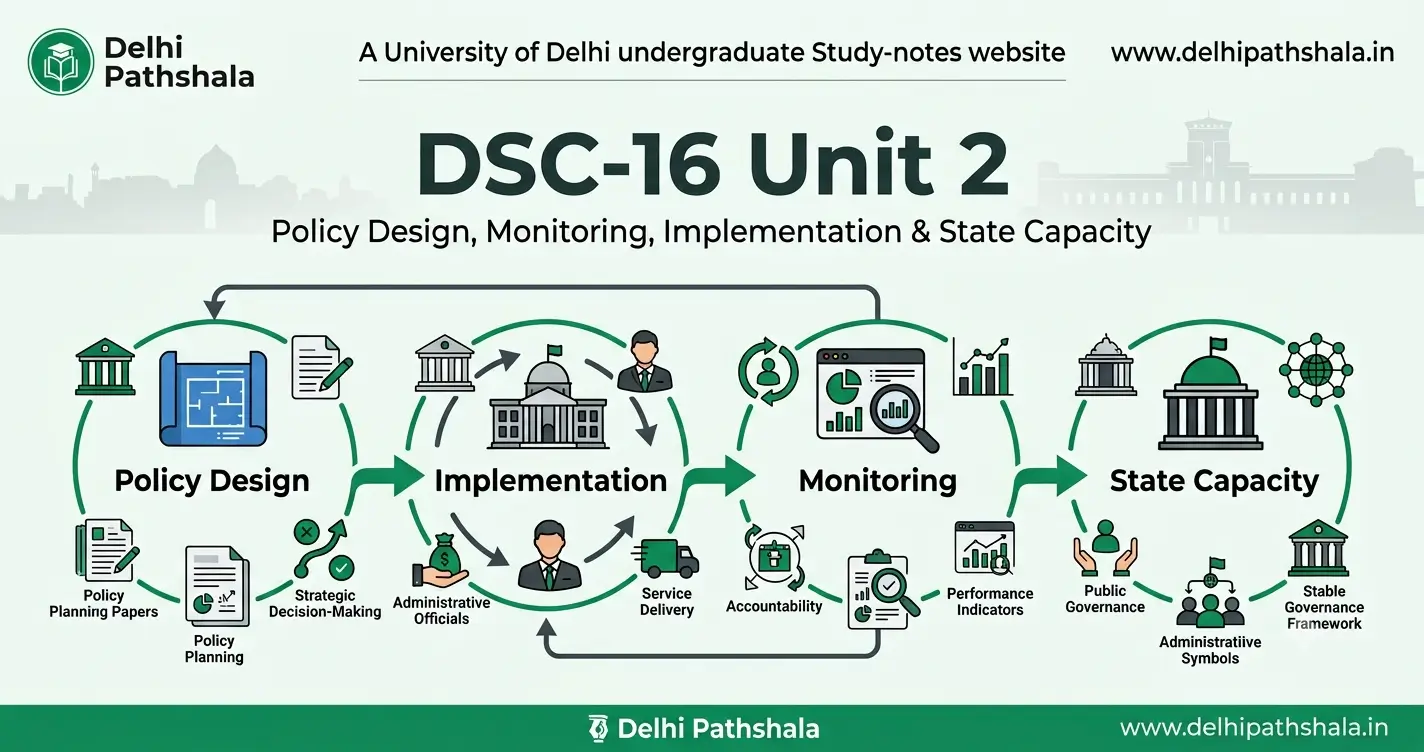
- Unit 2 at a glance
- Part 1: Policy Design: What, Who, How and Why
- 1.1 What is policy design?
- 1.2 Howlett’s four questions: What, Who, How and Why
- What is designed: goals, means and instruments
- Who designs: the policy advisory system
- How they design: design space, governance modes and fit
- Why they design that way: the role of ideas
- Examples for exams
- Criticism and limits of policy design
- 1.3 Herbert Simon: bounded rationality and decision-making
- Bounded rationality
- Satisficing
- Why this matters for public policy
- Simon’s impact on modern policy design
- Practical implications for policymaking
- Criticism
- Howlett and Simon together
- Part 2: Policy Monitoring: Tools and Techniques
- 2.1 What is policy monitoring?
- Monitoring and evaluation are not the same
- Importance of monitoring
- 2.2 Monitoring tools
- Quantitative tools
- Qualitative tools
- Participatory and technology-based tools
- 2.3 Techniques for effective monitoring
- Creating indicators
- Data collection and reporting
- Challenges in policy monitoring
- Part 3: Policy Implementation, Decentralization and Local Government
- 3.1 Understanding policy implementation
- Steps to implement a policy
- Main players in implementation
- Why implementation fails: the implementation gap
- 3.2 Decentralization in governance
- Types of decentralization
- Benefits of decentralization
- Challenges of decentralization
- 3.3 Local government in policy implementation
- Role of local governments
- The constitutional basis in India: 73rd and 74th Amendments
- Examples of local implementation
- Challenges for local governments in India
- Part 4: Building State Capacity
- 4.1 What is state capacity and why it matters
- 4.2 Francis Fukuyama’s ideas
- Scope versus strength
- Four nested aspects of stateness
- Capacity as a sign of state strength
- Ways to improve state capacity
- Criticism of Fukuyama’s approach
- 4.3 Ways to build capacity
- Training civil servants
- Public-private partnerships
- Using technology and innovation
- Important Comparisons
- Criticism and Limitations (Unit-wide)
- Contemporary Relevance
- Quick Revision
- Conclusion
- Continue Reading
- University of Delhi Previous Year Questions
- Frequently Asked Questions
- Sources and Further Reading
Introduction
Unit 2 of DSC-16: Public Policy (BA (Hons.) Political Science, Semester 6, University of Delhi) is titled Public Policy Design and Implementation, and the syllabus gives it 14 teaching hours. That is the biggest block after Unit 4, so it deserves proper attention. The syllabus lists four topics under it:
- Policy Design: What, Who, How and Why (Michael Howlett) and Herbert Simon
- Policy Monitoring: Tools and Techniques
- Policy Implementation, Decentralization and Local Government in Public Policy implementation
- State Capacity Building (Francis Fukuyama)
These notes follow that order. Each part gives you the core idea, the thinker’s actual argument, examples you can use in an answer, and the criticisms examiners like to see. If you need the official wording of the syllabus and the full semester structure, see the DU BA (Hons.) Political Science syllabus page.
One practical tip before you start. The DU readings for this unit are specific: Howlett’s chapter “Policy Design: What, Who, How and Why?” (2014), Jones (2002) on Simon and bounded rationality, Waterman and Wood (1993) on policy monitoring, Bandyopadhyay (1996) and Crawford and Hartmann (2008) on decentralisation, and Fukuyama’s State-Building (2004) along with his article “The Imperative of State-Building” (Journal of Democracy, 2004). The full list is in the official DU syllabus PDF. Where these notes say “Howlett argues” or “Fukuyama argues”, the claim has been checked against these sources.
Unit 2 at a glance
| Syllabus topic | Key source or thinker | Core idea in one line | Section |
|---|---|---|---|
| Policy design | Michael Howlett (2014) | Design means linking policy goals to the instruments meant to achieve them; four questions: what is designed, who designs, how, and why | Part 1 |
| Bounded rationality | Herbert Simon (1947, 1955) | Decision-makers are intendedly rational but limited, so they satisfice rather than optimise | Part 1 |
| Policy monitoring | Waterman and Wood (1993) and general M&E practice | Systematically tracking implementation and outputs to check progress and keep agencies accountable | Part 2 |
| Implementation, decentralisation, local government | Pressman and Wildavsky, Lipsky, Sabatier and Mazmanian; 73rd and 74th Amendments | Policies succeed or fail on the ground; local bodies are the delivery layer | Part 3 |
| State capacity | Francis Fukuyama (2004) | A state’s strength (how well it enforces rules) is different from its scope (how much it tries to do) | Part 4 |
Part 1: Policy Design: What, Who, How and Why
1.1 What is policy design?
Policy design is the deliberate effort to define policy goals and to link them to the instruments (tools) that are expected to achieve those goals. Howlett describes it as the systematic effort to develop efficient and effective policies by applying knowledge about policy means, gained from experience and reasoning, to courses of action that are likely to succeed within a specific context.
In plain words, policy design is the stage where a government moves from “we want to solve this problem” to “this is the combination of goals, laws, incentives, institutions and procedures we will use”. It mostly happens during policy formulation and prepares the ground for implementation.
Why it matters. In public administration, good design is key to using resources wisely against social problems. Well-made policies are more likely to succeed, waste less and promote accountability. Good design also makes implementation easier, sets clear goals and makes results measurable, which is important for good governance.
1.2 Howlett’s four questions: What, Who, How and Why
Michael Howlett (Simon Fraser University) wrote the chapter “Policy Design: What, Who, How and Why?” in L’instrumentation de l’action publique (Presses de Sciences Po, 2014), the DU essential reading for this topic. A point students often miss: the four words are not four steps in a procedure. They are four questions that the study of policy design must answer, and each one has its own research tradition.
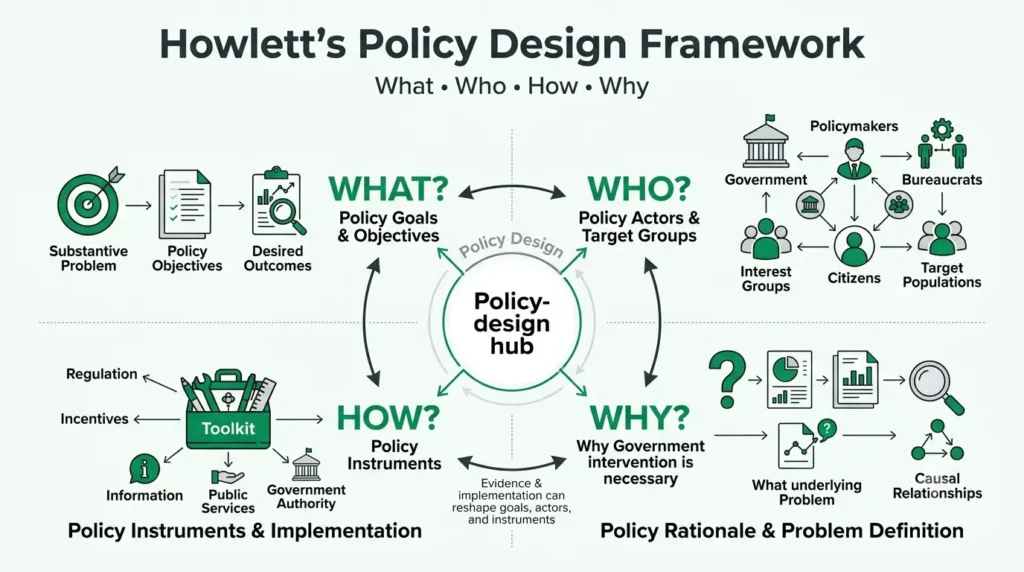
| Question | What Howlett asks | Short answer from the chapter |
|---|---|---|
| What is designed? | What is the object of design? | Policy alternatives, made of policy goals (aims, objectives, targets) and policy means (implementation preferences, tools and their calibrations or “settings”) |
| Who designs? | Which actors shape the design? | A policy advisory system: decision-makers, knowledge producers and knowledge brokers, inside and outside government |
| How do they design? | By what process, within what limits? | Within a “design space” set by governance modes and earlier policies, aiming for coherence, consistency and congruence |
| Why do designers design the way they do? | What explains their choices? | The ideas they hold: worldviews, paradigms and causal stories |
A simple memory aid you will find in many notes reads the four words as “goal, actors, methods, reasons”. It is easy to remember and not wholly wrong, but it is not Howlett’s own scheme, so in an answer present the version in the table above.
What is designed: goals, means and instruments
Howlett says designers create policy alternatives, which are different combinations of goals and means. The goals range from abstract aims to specific targets. The means range from general implementation preferences (for example, a preference for using laws rather than markets) to specific tools and their exact settings, such as the size of a subsidy or the strictness of a rule.
Instruments get special attention because they are the techniques through which a government’s goals are actually pursued. Howlett separates two kinds:
| Substantive instruments | Procedural instruments | |
|---|---|---|
| What they do | Directly affect the production, distribution and consumption of goods and services in society | Affect the behaviour of actors involved in policy-making and implementation, and only indirectly the outcome |
| Examples | Licensing, subsidies, quotas, product standards, safety and employment standards, price regulation, information labels | Consultations, advisory committees, adding actors to policy networks, changing access rules, setting up investigatory commissions, reorganising government |
| Simple way to remember | They change what happens in society | They change how the policy game is played |
Howlett quotes the idea that procedural tools “structure the game without determining its outcome”. Real policies usually combine both kinds. For example, a regulation on production (substantive) paired with an advisory committee that informs and legitimises the regulator (procedural).
Who designs: the policy advisory system
Howlett points out that politicians in authoritative positions ultimately make policy, but they rely on advice from civil servants and others when the alternatives are shaped into coherent designs. He pictures a policy advisory system with three kinds of participants: decision-makers (cabinets, parliaments, senior officials), knowledge producers (universities, statistical agencies, research institutes) and knowledge brokers (government research staff, commissions, think tanks, interest groups) who repackage knowledge for decision-makers.
He also groups advisers into four communities:
| Proximate (close to decisions) | Peripheral | |
|---|---|---|
| Government sector | Core actors: central agencies, executive staff, professional policy analysts | Public sector insiders: commissions, committees, task forces, research councils, international organisations |
| Non-governmental sector | Private sector insiders: consultants, political party staff, pollsters, donors | Outsiders: public interest groups, business associations, trade unions, academics, think tanks, media, international NGOs |
The practical lesson is that core actors have the most influence over the fine details of a design (targets and tool settings), while the public and outsiders have more influence over broad aims.
How they design: design space, governance modes and fit
Policy designers never start with a blank sheet. They work inside a design space, a set of options that is already narrowed by the governance context. Howlett describes three nested levels:
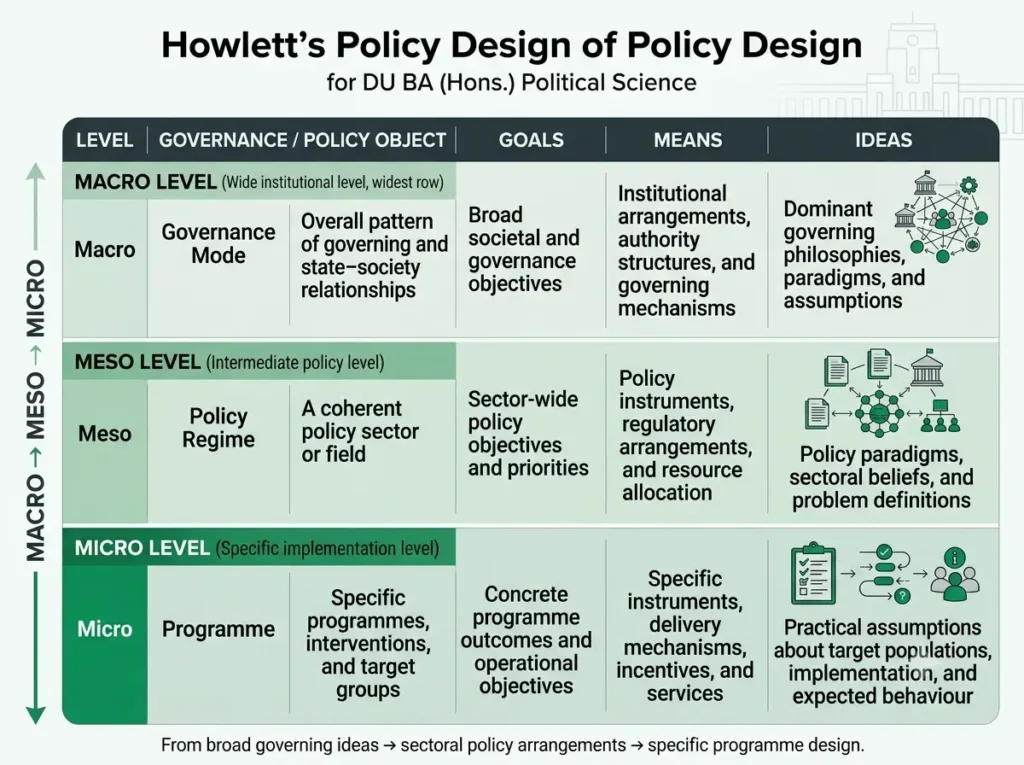
| Level | What it contains | Ideas that shape it | Typical actors |
|---|---|---|---|
| Macro: governance mode | General abstract aims and general implementation preferences (for example, a legal mode prefers laws; a market mode prefers market tools) | Worldviews and ideologies | Public, outsiders, insiders |
| Meso: policy regime | Operationalisable objectives and policy tools | Policy paradigms | Public and private sector insiders, core actors |
| Micro: programme level | Specific targets and tool calibrations | Causal stories | Core actors |
Because of this nesting, a choice made at a higher level limits what can sensibly be chosen at a lower level. A government that has already committed to a legal-regulatory mode, for example, will find some market-based tools hard to introduce.
Howlett also stresses three tests of a good design, associated with his work with Rayner and with Kern: coherence (new elements are logically linked to the overall aims), consistency (the tools work together) and congruence (goals and means do not work at cross-purposes). Since most policy areas already have older policies, he describes two ways in which existing mixes go wrong:
- Layering: new goals and instruments are added to old ones without removing them, which can leave incoherent aims and inconsistent tools.
- Drift: goals change while the instruments stay the same, so the means no longer fit the ends.
In such cases designers usually patch or restructure what exists instead of designing something entirely new. Complex design also needs analytical and administrative capacity, which links this section to Fukuyama’s discussion in Part 4.
Why they design that way: the role of ideas
Howlett’s final question asks why designers choose as they do. His answer is ideas, at different levels of abstraction and with different effects:
| Background (long-term, taken for granted) | Foreground (specific and debated) | |
|---|---|---|
| Normative (values) | Public sentiments | Symbolic frames |
| Cognitive (cause-and-effect beliefs) | Policy paradigms | Programme ideas |
Public sentiments and symbolic frames mainly influence goals. Paradigms and programme ideas mainly influence the choice of means. A policy paradigm is a set of background assumptions that limits the range of options that policy elites consider useful and worth debating.
Examples for exams
The examples below show how to apply the four questions. They are illustrations, not Howlett’s own case studies.
- Healthcare in Canada. What: universal access to hospital and physician services, pursued through public funding and conditions attached to federal transfers. Who: federal and provincial governments, health ministries, providers and the public. How: through federal legislation (the Canada Health Act) and public financing. Why: the belief that access to care should not depend on ability to pay.
- Climate change. What: lower greenhouse gas emissions, through targets, carbon pricing or regulation. Who: governments, regulators, scientists, businesses and environmental groups. How: a mix of substantive tools (taxes, standards) and procedural tools (stakeholder consultations). Why: the scientific consensus on warming combined with differing worldviews on how much the state or the market should do.
Criticism and limits of policy design
- Not everything can be “designed”. Dryzek and Ripley (1988) questioned whether policies can be designed the way a house or a piece of furniture is, and Howlett acknowledges this high level of contingency in decision-making. Politics, opportunism and timing (for example, Kingdon’s “policy windows”) can matter more than careful planning.
- A technocratic bias. A Sciences Po working paper on policy design and instrumentation argues that the design literature remains rooted in a technocratic tradition and gives too little weight to politics. Howlett’s own conclusion accepts that design is a “missing link” in policy studies and that many older ways of thinking about instruments are out of date.
- Unequal access. Howlett notes that the design process is usually less open to public scrutiny than other stages of policy-making.
1.3 Herbert Simon: bounded rationality and decision-making
Who was Simon? Herbert A. Simon (1916–2001) worked across public administration, economics, psychology and computer science. His book Administrative Behavior (1947) argued that decision-making is the heart of administration. He received the 1978 Nobel Memorial Prize in Economic Sciences for his research on decision-making in organisations, and the Nobel committee called Administrative Behavior “epoch-making”. Simon’s papers in the mid-1950s, including “A Behavioral Model of Rational Choice” (1955), developed the ideas of bounded rationality and satisficing.
Bounded rationality
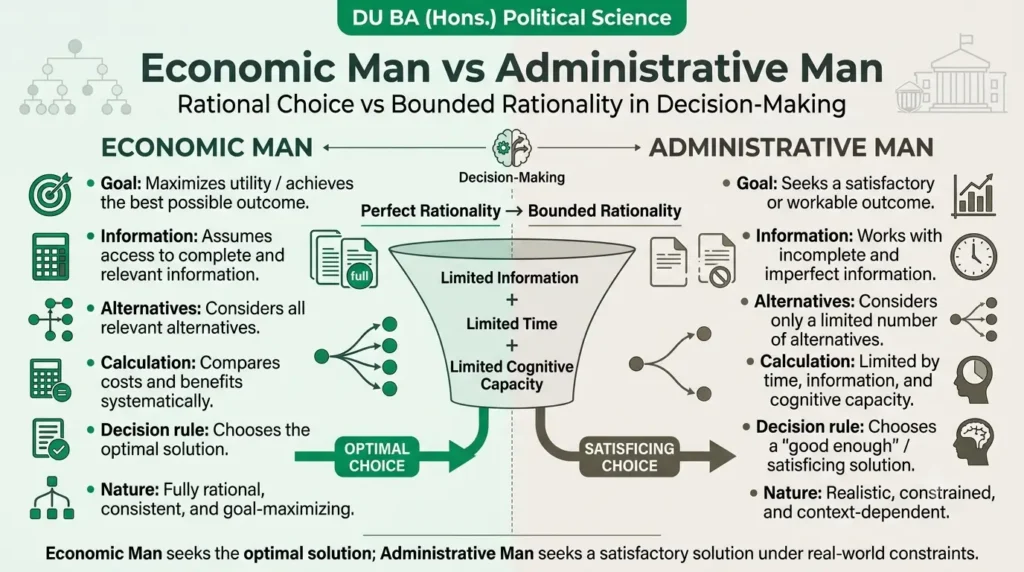
Traditional models assumed an “economic man” who has complete information, can calculate every option and maximises utility. Simon showed that real decision-makers, the “administrative man”, are intendedly rational but limited: they work with incomplete information, limited time and limited cognitive capacity. This is bounded rationality, and the word “bounded” does not mean irrational. Simon argued that psychologists use a procedural idea of rationality (how a decision is reached) while economists use a substantive one (whether the outcome is optimal), and that administrative theory must take the procedural view seriously.
Satisficing
Because of these limits, decision-makers do not search for the single best option. They look for one that is good enough, an option that meets a minimum set of acceptable criteria. Simon called this satisficing, a blend of “satisfy” and “suffice”, and he saw it as a sensible response to real constraints, not as a failure.
| Rational-comprehensive (economic man) | Bounded rationality (administrative man) | |
|---|---|---|
| Information | Complete | Incomplete and costly |
| Aim | Maximise, find the best option | Satisfice, find an acceptable option |
| Search | All alternatives considered | Alternatives examined one after another until one is adequate |
| Time and mind | Unlimited | Limited |
| Result in policy | Comprehensive, optimal plans | Workable, adjustable, often gradual policies |
Why this matters for public policy
Bryan Jones (2002), the DU reading on Simon, argues that Simon’s behavioural model of choice gives a micro-level foundation for studying organisations and policy, and that policy studies have not yet fully absorbed it. In public policy, bounded rationality helps explain why decisions are made without full information, and why policies often change in steps instead of through grand redesigns. Simon’s ideas influenced Lindblom’s well-known “science of muddling through” (1959) and Wildavsky’s work on budgeting. For related theories in this paper, including incrementalism, see the notes on theoretical approaches to public policy.
Simon’s impact on modern policy design
Simon’s work encourages flexible policies that can change as new information arrives, and it suggests that policymakers should aim for “good enough” results where perfection is not available. In education policy, for instance, decision-makers often have to act without knowing how well different teaching methods will work in different settings. Instead of searching for a “perfect” policy, they may choose approaches likely to work in most cases and plan to adjust after feedback.
Practical implications for policymaking
Simon himself described how decisions are made. He did not write a manual for policy design, so the points below are implications that scholars and practitioners draw from his ideas:
- Small steps. Policymakers may prefer gradual changes that allow learning and adjustment as information improves.
- Involving others. Since no one knows everything, including different stakeholders brings in different information and perspectives.
- Monitoring and evaluation. Policymakers should build ways to watch results and revise, which leads directly to Part 2.
Criticism
Bounded rationality and satisficing explain how decisions are made; they do not tell organisations how they should be designed. Critics have also noted that the framework gives limited attention to values and power in decision-making, which is why Unit 4 of this paper looks at the politics of policy.
Howlett and Simon together
| Howlett | Simon | |
|---|---|---|
| Main question | What do policy designers create, who designs, how and why? | How do people actually decide under limits? |
| Focus | Goals, instruments, advisory systems, governance context | Cognitive and organisational limits on decisions |
| Shared theme | Design is constrained, so designers must work with context | Rationality is limited, so “good enough” is the realistic standard |
Public policy design is a complex process that requires looking at the “What, Who, How and Why” highlighted by Howlett. Herbert Simon’s insights into bounded rationality remind us that perfect decision-making is not always possible, encouraging policymakers to be flexible, adaptable and realistic. Understanding both leads to policymaking that is effective and practical in uncertain situations.
Part 2: Policy Monitoring: Tools and Techniques
2.1 What is policy monitoring?
Policy monitoring means keeping track of how public policies are being put into action and what results they produce. It involves gathering and analysing information to see whether a policy is working as planned and achieving its goals. In the technical literature, Waterman and Wood (1993) introduced “policy monitoring” as a policy-analytic technique. Using data from the US Environmental Protection Agency’s Hazardous Waste Division, they showed how tracking an agency’s outputs over time can reveal what influences the agency’s behaviour. In their case, EPA enforcement responded to signals from outside the agency, including relevant congressional committees.
The main goals of policy monitoring are:
- Checking performance: to see whether the policy is giving the expected results.
- Ensuring accountability: making sure public funds are used wisely and decision-makers answer for their actions.
- Finding problems: spotting issues early so they can be fixed.
- Guiding future policies: offering insights for future policymaking or changes to existing policies.
Monitoring and evaluation are not the same
Students often mix these up. A standard way to separate them is shown below (this is the widely used textbook distinction, not tied to one author):
| Monitoring | Evaluation | |
|---|---|---|
| When | Continuous, during implementation | Periodic, often at milestones or after completion |
| Question | Is the policy being carried out as planned? | Did it work, why or why not, and was it worth the cost? |
| Focus | Inputs, activities, outputs, early outcomes | Outcomes, impact, efficiency, fairness |
| Use | Course correction and accountability | Judgement, learning and decisions about continuing or redesigning |
Evaluation has its own unit (Unit 3), so keep your answer here focused on monitoring.
Importance of monitoring
Policy monitoring is vital for open and accountable government. By regularly checking how policies are working, decision-makers can ensure that resources are not wasted and that public needs are met. It also lets citizens and other groups see how policies are progressing and hold leaders responsible for failures. This ongoing feedback tells policymakers whether a policy is working and allows informed changes.
2.2 Monitoring tools
Quantitative tools
These tools measure and analyse data that can be shown numerically and are useful for understanding the overall effects of a policy.
- Surveys: collect data from many people to measure public opinion or the effects of policies. For example, a survey might check how attitudes towards smoking change after new smoking laws.
- Statistical analysis: methods that look at data over time to find links between policies and results, for instance trends in unemployment, school performance or crime rates after a policy change.
- Key Performance Indicators (KPIs): specific measures of how well a policy or programme is doing compared with its goals. In healthcare, a KPI might measure how long patients wait for services.
Qualitative tools
These tools help understand the experiences and feelings of the people affected by a policy, capturing details that numbers can miss.
- Interviews: one-to-one conversations with stakeholders such as policymakers or affected people. Talking to teachers, for example, can reveal how education changes work in classrooms.
- Focus groups: a small group discusses its thoughts and experiences about a policy, which can show public feelings about topics like social services or healthcare.
- Content analysis: looking at written or visual material, such as policy documents or news reports, to find common themes or public opinion.
Participatory and technology-based tools
- Social audit. A social audit is a participatory method in which the people a programme is meant to serve compare official records with what has actually happened on the ground. In India it is best known from MGNREGA (2005), where Section 17 made Gram Sabhas responsible for social audits of works, and the Audit of Schemes Rules, 2011, framed with the CAG, set out the procedure and created independent Social Audit Units. Andhra Pradesh began social audits as early as 2006 and is often treated as the reference model; research on that experience is available in this ISID study on social audits and MGNREGA delivery. Note on currency: MGNREGA has since been repealed and replaced by the VB–G RAM G Act, 2025, which came into force on 1 July 2026; reports indicate that social audits have been retained, so check the current rules before quoting section numbers in an answer.
- Dashboards, management information systems and GIS mapping. Digital systems can collect near real-time data (for example from mobile apps or online reporting) and show it on maps and dashboards. The usefulness depends on data quality, and technology cannot replace field verification.
| Quantitative | Qualitative | Participatory | |
|---|---|---|---|
| Examples | Surveys, statistics, KPIs | Interviews, focus groups, content analysis | Social audits, public hearings |
| Strength | Measures scale and trends | Explains why, captures experience | Builds accountability and local ownership |
| Weakness | Misses context | Hard to generalise | Needs capacity and independence to work |
2.3 Techniques for effective monitoring
Creating indicators
Indicators track whether a policy’s goals are being met. To create good indicators:
- Set clear goals: first identify what the policy aims to achieve, for example measuring air quality to reduce pollution.
- Ensure accuracy: indicators should reflect the policy’s goals and be easy to measure over time.
- Align with goals: use both short-term and long-term indicators to capture the full impact.
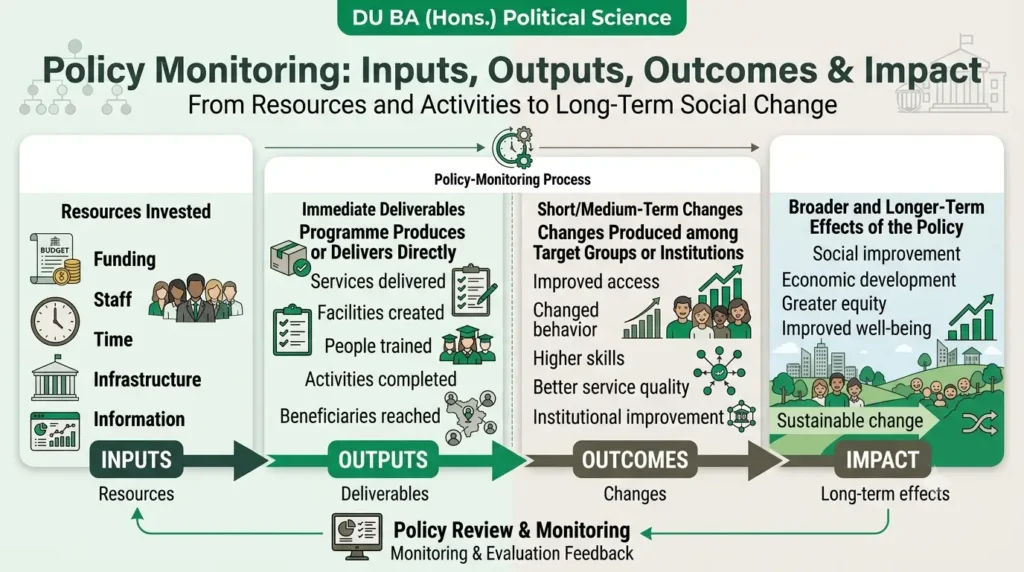
It also helps to separate inputs (money, staff), outputs (what is delivered, such as meals served), outcomes (changes for people, such as better attendance) and impact (longer-term change). In a child nutrition programme, short-term indicators could track enrolment numbers, while long-term ones could measure obesity rates or academic improvements linked to better nutrition. Counting outputs alone can give a false picture of success.
Data collection and reporting
Successful monitoring depends on how data is gathered and shared:
- Set clear data collection rules: decide who collects data, how often, and exactly what is needed.
- Use technology for real-time data: digital tools improve accuracy and speed, for example mobile apps for immediate feedback on services.
- Create clear reporting systems: accessible reports, such as annual reports or online dashboards, support accountability and give the public understandable information.
Challenges in policy monitoring
- Data issues: necessary data may be unavailable or inaccurate, especially in developing countries.
- Political pressure: there may be pressure to present results in line with political interests, which can bias information.
- Limited resources: monitoring needs time, money and skills, which can be scarce.
- Complex measurements: some effects are hard to quantify. Measuring the effect of a policy on community well-being, for example, needs detailed qualitative data.
- Independence: monitors who depend on the implementing department may hesitate to report failures. This is one reason independent social audit units were created.
Policy monitoring is key to making sure public policies work and that decision-makers are accountable. Using both quantitative and qualitative tools, together with clear indicators, sound data collection and good reporting, gives policymakers helpful insights. Challenges such as data problems, political interference and limited resources must be tackled for proper policy assessment and adjustment.
Part 3: Policy Implementation, Decentralization and Local Government
3.1 Understanding policy implementation
Policy implementation is how a government puts its decisions into action to affect people. It is the stage that turns the intentions of laws and programmes into practical delivery, and even a well-designed policy can fail here.
Steps to implement a policy
- Setting clear goals: the goals should be clear and achievable before starting.
- Creating a plan: detailed plans on how to achieve the goals, including who does what and when.
- Allocating resources: enough money, staff and tools to carry out the policy.
- Building institutions: new organisations may be needed, or existing ones strengthened, to manage the policy.
- Coordinating and communicating: different groups need to work together and communicate regularly.
- Monitoring and evaluating: keep checking progress and make changes if necessary.
- Getting feedback and making changes: feedback after launch helps improve the policy if problems appear.
Main players in implementation
- Government agencies: carry out policies at national and local levels.
- Public officials: government workers who implement policies daily.
- Political leaders: elected leaders guide the process.
- NGOs and civil groups: help with certain policies, especially in health and welfare.
- Private companies: sometimes help with tasks such as construction or service delivery.
- Citizens: community involvement is important for policies that need public participation.
Why implementation fails: the implementation gap
The scholarly study of implementation began with Pressman and Wildavsky’s Implementation (1973), a study of a US federal programme in Oakland, California, whose long subtitle speaks of “great expectations” dashed. Their key insight, sometimes called the thesis of incongruent implementation, is that the more links there are between intention and result, the smaller the chance that implementation will match the plan. Two competing approaches then developed:
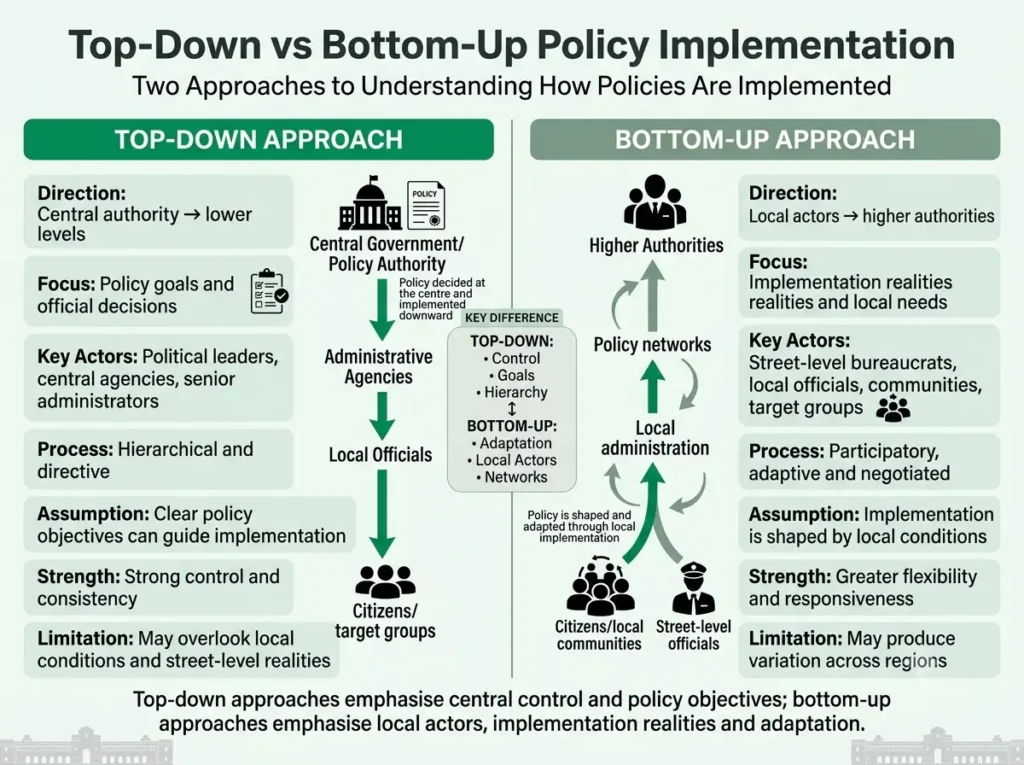
| Top-down | Bottom-up | Hybrid (later “third generation”) | |
|---|---|---|---|
| Starting point | The policy decision and its goals | Local actors, target groups and street-level workers | Combines both |
| Key names | Pressman and Wildavsky (1973), Sabatier and Mazmanian (1980) | Lipsky (1980), Elmore, Hjern | Later scholars trying to bridge the two |
| Success depends on | Clear objectives, a sound causal theory, hierarchical control, resources and committed implementers | Discretion and local adaptation by frontline workers | Central direction with local flexibility |
| Risk | Rigid, ignores local realities | Uneven delivery, drift from policy goals | Needs coordination and trust |
Street-level bureaucrats (Michael Lipsky, 1980) are workers such as teachers, police officers, nurses and social workers who deal directly with citizens and have real discretion. Lipsky’s argument is that they do not merely deliver policy; through their daily choices they effectively make it. In India, frontline health workers and village-level officials are common illustrations.
For a wider view of how implementation sits within the policy cycle, see process of public policy.
3.2 Decentralization in governance
Decentralization means spreading authority and responsibility from the central government to local governments, to make government more responsive and better suited to local needs.
Types of decentralization
| Type | Meaning |
|---|---|
| Political | Local governments get decision-making power |
| Administrative | Local levels take on administrative tasks |
| Fiscal | Local governments manage finances for public services |
| Market | The private sector helps provide public services |
The four-way classification above is the one commonly used in the decentralisation literature (political, administrative, fiscal and market); in the DU readings, Crawford and Hartmann (2008) discuss decentralisation in Africa, and Bandyopadhyay (1996) writes on administration, decentralisation and good governance.
Benefits of decentralization
- Better response: local governments understand their community’s needs better.
- More accountability: citizens can hold local governments accountable.
- Efficient service: local governments can manage services better without too much central control.
- Empowerment: local involvement encourages community participation.
- Innovation: local governments can try new ideas to solve problems.
Challenges of decentralization
- Capacity limitations: local governments may lack resources or skills.
- Fragmentation: poor coordination can lead to inconsistent policies across regions.
- Regional inequality: some areas may have less access to services.
- Political issues: resistance to decentralised power, especially in strong central government systems.
- Corruption risks: local governments may face corruption without proper oversight, and local elites can capture decisions.
3.3 Local government in policy implementation
Role of local governments
- Service delivery: essential services such as education, healthcare and sanitation.
- Planning and development: creating and managing local development plans.
- Regulation: enforcing laws and making local rules.
- Engaging citizens: involving the community in decision-making.
The constitutional basis in India: 73rd and 74th Amendments
Local government in India gained constitutional status through two amendments passed in 1992:
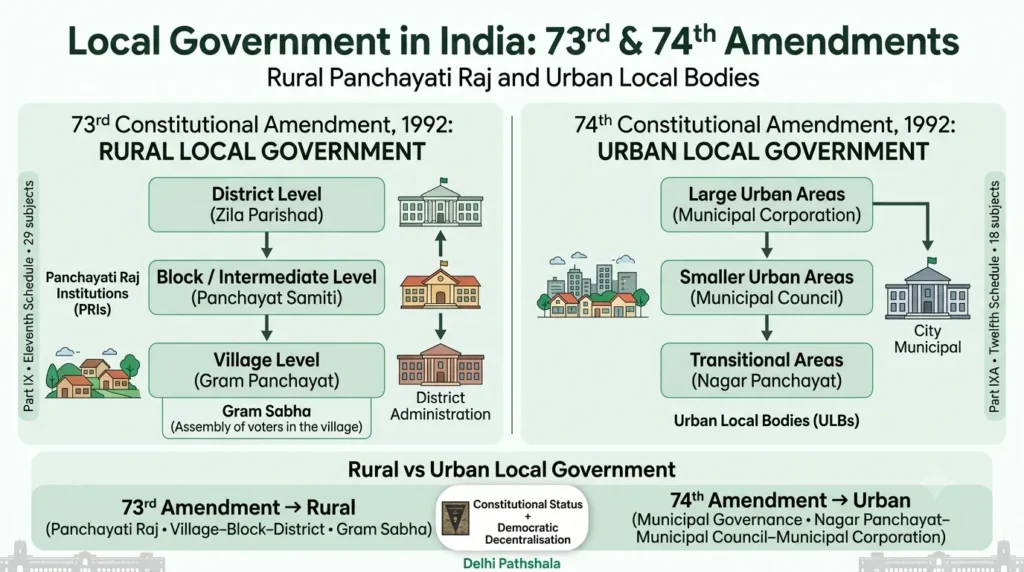
| 73rd Amendment (rural) | 74th Amendment (urban) | |
|---|---|---|
| Institutions | Panchayati Raj Institutions (Gram Panchayat, intermediate level, Zila Parishad) | Municipalities (Nagar Panchayat, Municipal Council, Municipal Corporation) |
| New part of Constitution | Part IX, Articles 243 to 243-O | Part IX-A, Articles 243-P to 243-ZG |
| New Schedule | Eleventh Schedule: 29 subjects | Twelfth Schedule: 18 functions |
| Came into force | 24 April 1993 (celebrated as National Panchayati Raj Day) | 1 June 1993 |
| Key features | Gram Sabha, regular elections, reservation of seats for SC/ST and women, State Finance Commission (Article 243-I) | Elected municipal bodies, ward committees, reservation of seats, State Finance Commission |
The 73rd Amendment does not apply to certain areas, including Nagaland, Meghalaya and Mizoram. A key point for implementation: the amendments list the functions, but actually transferring them is left to state legislatures. Scholars therefore speak of the “three Fs” of effective decentralisation, funds, functions and functionaries, and note that many of the 29 panchayat subjects remain controlled by state departments. This gap between constitutional text and practice is a strong analytical point for a long answer.
Examples of local implementation
- Brazil, participatory budgeting: in Porto Alegre, citizens help decide how part of the municipal budget is spent, which is widely studied as a model of participatory local governance (Patrick Heller compares it with Kerala and South Africa in his work on democratic decentralisation).
- Kerala, People’s Plan Campaign (1996): the state devolved 35–40 per cent of its development budget to local governments and gave them discretionary budgeting powers, along with structures to involve citizens in planning. It has been described as the most ambitious effort to build local institutions of participatory democratic governance in the subcontinent, and research on it is available in Heller, Harilal and Chaudhuri’s study in World Development. Outcomes varied across local governments, so present it as an influential experiment, not a flawless success.
- Kenya, devolution: Kenya’s 2010 constitutional reforms created county governments with responsibility for services such as health, and the case is often used in comparative discussions of devolution. Scholars disagree on how much it improved access, so treat it as a comparison case.
Challenges for local governments in India
- Limited funds: many local governments struggle to finance essential services.
- Skills shortage: they often lack trained staff for effective policy execution.
- Political interference: decisions may be influenced by party politics rather than community needs.
- Coordination issues: multiple levels of government can create confusion.
- Weak public participation: many citizens are not engaged in local decision-making despite laws encouraging it.
Implementing policies is a vital step in making plans work. It needs careful planning, resource management and ongoing feedback. Decentralisation makes government more responsive and accountable but brings challenges such as limited resources. Local governments are essential in this process but often face financial hurdles and political interference. Successful examples show that when resources and public participation are prioritised, local implementation can be very effective.
Part 4: Building State Capacity
4.1 What is state capacity and why it matters
State capacity is how well a government can create and enforce rules, keep order, provide services and uphold laws. It shows how effectively a government can use its power and meet its duties, such as managing resources and ensuring people’s well-being.
A useful classroom breakdown (not Fukuyama’s own scheme) separates:
- Administrative capacity: how well government offices and workers manage public services; this needs trained staff and good processes.
- Coercive capacity: the ability to enforce laws and maintain security through police and military.
- Legitimacy: how far citizens see the government as fair and just; trust makes people follow laws more willingly.
- Financial capacity: the ability to collect taxes, manage money and spend it wisely.
- Political capacity: the ability to maintain stable political systems and handle political issues with societal support.
State capacity and good governance. Good governance relies on strong state capacity. A capable government can provide services like healthcare and education, enforce laws and support economic growth. Weak capacity can lead to poor governance, corruption and unrest. If public services are poorly run, people become unhappy; if law enforcement is weak, crime may rise. Capacity also connects back to Part 1, because designing and managing complex policy mixes demands real analytical and administrative ability.
4.2 Francis Fukuyama’s ideas
Francis Fukuyama is a political scientist best known for The End of History and the Last Man and later work on political order. His book State-Building: Governance and World Order in the 21st Century (Cornell University Press, 2004) is the DU text. He also wrote “The Imperative of State-Building” in the Journal of Democracy (2004), also on the syllabus. His starting concern is that weak or failed states are the source of many serious global problems, and that we know far less about building strong institutions than we think. You can hear him present the argument in this Carnegie Council talk on State-Building.
Scope versus strength
Fukuyama’s central move is to separate two things that people often run together:
- Scope of the state: the range of functions a government takes on. A modest-scope state might do little beyond maintaining order, enforcing contracts and defence; a wide-scope state also handles welfare, industry and much else.
- Strength of the state: the ability to plan and carry out policy and to enforce laws cleanly and transparently, the Weberian ability to make rules stick.
Treating the two as one leads to confusion. A state can be large but weak, or small but strong. Fukuyama maps them on two axes, giving four quadrants:
| Strong institutions | Weak institutions | |
|---|---|---|
| Wide scope | Large, effective state (for example, some welfare states) | Over-extended state: attempts too much, delivers little |
| Narrow scope | Limited, effective state | Minimal, ineffective state |
He argues that the broad lesson from evidence is that the strength of state institutions matters more than the scope of state functions, and that cutting back state scope without building strength can leave a country worse off. The distinction between state-building (strengthening institutions such as the army, police, judiciary and central bank) and nation-building (creating the social, cultural and historical bonds that hold a nation together) is another point he stresses, since outsiders can contribute to the first more easily than the second.
Four nested aspects of stateness
Fukuyama says that to understand institutional supply we must look at four nested aspects:
- Organisational design and management (the domain of public administration and management studies)
- Political system design (institutional design for the state as a whole)
- Basis of legitimation (why citizens accept the regime)
- Cultural and structural factors (informal institutions, values and traditions)
He points out that formal knowledge about administration can be transferred across countries, but that does not mean strong institutions can simply be engineered or exported, which is why local conditions matter so much.
Capacity as a sign of state strength
If you want to connect Fukuyama to the three ingredients that many notes list (control of force, a skilled bureaucracy, and legitimacy), the link is this: the Weberian ability to enforce rules corresponds to control of force, organisational design and management corresponds to a skilled bureaucracy, and the basis of legitimation corresponds to legitimacy. This mapping is a study aid, not Fukuyama’s formal list. For Fukuyama, strength shows in how well a state manages functions such as infrastructure, healthcare and education.
Ways to improve state capacity
Writers on state capacity, including Fukuyama in his policy-oriented discussions, point to measures like these. Treat them as common recommendations in the governance literature, and keep in mind Fukuyama’s own caution that there is no simple formula for institutional reform:
- Reforming institutions: strengthening agencies and legal systems with training and the right tools.
- Creating professional civil services: hiring on merit instead of political connections.
- Encouraging democratic accountability: institutions should respond to citizens and leaders should be accountable.
- Building public trust: fair governance, transparency and reduced corruption.
Criticism of Fukuyama’s approach
- Measurement. Fukuyama himself notes that there is no commonly accepted measure of the strength of state institutions.
- Exporting institutions is hard. His own argument implies that donors and outsiders cannot easily transplant strong institutions, which limits the practical value of state-building advice.
- Ideological critiques. A review in the Mises Review (Spring 2005) read the book from a libertarian standpoint, arguing that the proposed remedy of a strong state in a limited domain still depends on trusting the state to behave well.
4.3 Ways to build capacity
Training civil servants
Investing in the training of civil servants is key to improving capacity, since they carry out policy. Strategies include:
- Education and skills: giving civil servants the knowledge and skills they need.
- Leadership development: training future leaders in governance and ethics.
- Fair hiring practices: merit-based selection of the best candidates.
- Performance evaluation: clear standards to assess and improve work.
Public-private partnerships
Collaborating with private companies can help build capacity, especially in infrastructure and services. Governments partner with private firms to build roads and power plants, to deliver healthcare and education more effectively, and to bring in new ideas and technologies. The caution is that partnerships need strong regulation and monitoring; otherwise public accountability can weaken.
Using technology and innovation
Technology can improve efficiency and transparency. Key strategies include:
- Digital governance: online platforms for services can reduce waste and improve access.
- Data use: governments can use data to make better decisions and allocate resources wisely.
- Automating processes: technology can simplify and speed up government work, reducing mistakes and corruption.
- Cybersecurity: protecting data is important to keep public trust as digital tools spread.
State capacity is vital for good governance. It allows governments to create and enforce rules and provide services. Thinkers like Fukuyama highlight that strong institutions, the power to enforce rules and public trust are essential. Training civil servants, forming partnerships and adopting technology are common strategies, but they work only when they fit local conditions.
Important Comparisons
| Comparison | Point 1 | Point 2 |
|---|---|---|
| Substantive vs procedural instruments (Howlett) | Change what is produced or consumed | Change how actors behave in the policy process |
| Economic man vs administrative man (Simon) | Maximises with complete information | Satisfices with limited information |
| Monitoring vs evaluation | Ongoing tracking of implementation | Judgement of results and worth |
| Top-down vs bottom-up implementation | Starts from policy goals and control | Starts from local actors and discretion |
| Scope vs strength (Fukuyama) | How much the state does | How well the state does it |
| State-building vs nation-building (Fukuyama) | Strengthening state institutions | Building shared social and cultural bonds |
| 73rd vs 74th Amendment | Rural: Part IX, 29 subjects | Urban: Part IX-A, 18 functions |
Criticism and Limitations (Unit-wide)
- Design is only part of the story. Howlett’s own sources admit that policy-making is contingent and political, so even a coherent design may not survive the political process.
- Simon describes more than he prescribes. His model explains decisions but does not give a blueprint for institutions.
- Monitoring can be captured. Without independent monitors, reporting can drift towards what officials want to show.
- Decentralisation depends on the centre. Constitutional status does not guarantee funds, functions and functionaries, which remain state-dependent in India.
- Capacity is hard to build from outside. Fukuyama’s own argument stresses limits on transferring institutions.
Contemporary Relevance
- Redesign and monitoring in practice. India’s rural employment guarantee has been through a major redesign: Parliament enacted the VB–G RAM G Act, 2025, and the Ministry of Rural Development notified that it would come into force on 1 July 2026, replacing MGNREGA. Whatever your view of the change, it is a live example for Howlett’s ideas of redesign (replacing and restructuring earlier policy), for monitoring (technology-based tracking and social audits) and for federal implementation (the Centre–state relationship). Details are changing, so verify current provisions from official sources and see this SCC Online report on the commencement notification.
- Local planning. Kerala’s People’s Plan Campaign has been scaled up in idea at the national level, with the Ministry of Panchayati Raj’s 2018 “Sabki Yojana, Sabka Vikas” campaign for Gram Panchayat Development Plans drawing on the same approach (as reported by secondary sources).
- Bounded rationality and data. Digital tools extend what policymakers can know, but Simon’s point survives: attention and capacity remain limited, which is why good systems filter and prioritise information.
Quick Revision
| Term | One-line meaning |
|---|---|
| Policy design | Deliberate linking of goals to instruments |
| Substantive instrument | Affects production and consumption directly |
| Procedural instrument | Affects policy-process behaviour |
| Design space | The set of feasible options narrowed by context |
| Coherence, consistency, congruence | Tests of a good policy mix |
| Layering / drift | Adding without removing / goals change while tools stay |
| Bounded rationality | Rationality limited by information, time and cognition |
| Satisficing | Choosing a “good enough” option |
| Policy monitoring | Systematic tracking of implementation and outputs |
| Social audit | Community verification of records against reality |
| Implementation gap | Difference between policy intention and delivered result |
| Street-level bureaucrat | Frontline worker with discretion (Lipsky) |
| Decentralisation | Transfer of power to lower levels |
| Three Fs | Funds, functions, functionaries |
| State scope / strength | What the state does / how well it does it |
Key dates: Simon, Administrative Behavior (1947) · Simon, “A Behavioral Model of Rational Choice” (1955) · Simon, Nobel Prize (1978) · Pressman and Wildavsky, Implementation (1973) · Lipsky, Street-Level Bureaucracy (1980) · Sabatier and Mazmanian (1980) · 73rd and 74th Amendments passed 1992, in force 24 April and 1 June 1993 · Kerala People’s Plan Campaign (1996) · Fukuyama, State-Building (2004) · Howlett, “Policy Design: What, Who, How and Why?” (2014).
Conclusion
Unit 2 moves along a logical path: design the policy (Howlett and Simon), monitor its progress, implement it through institutions, including local governments, and make sure the state has the capacity to do all of this (Fukuyama). The strongest answers connect these four parts. Poor design limits what implementation can do; weak capacity undermines monitoring; and decentralisation changes who designs, who implements and who is held accountable. When you write an exam answer, name the thinker, state the argument in your own words, add one verified example (Kerala’s People’s Plan, a social audit, a Canadian or climate illustration) and finish with a criticism.
Continue Reading
- DU BA (Hons.) Political Science Syllabus (Semester 1 to 6): check how Public Policy DSC-16 fits in the programme
- Theoretical Approaches to Public Policy: elite, group and incremental theories that connect with Simon’s ideas
- Process of Public Policy: formulation and implementation stages in more detail
University of Delhi Previous Year Questions
University of Delhi Previous Year Questions
Section A — Policy Design: Howlett and Herbert Simon
1 Discuss the concept of Policy Design. Explain Michael Howlett’s framework of What, Who, How and Why in policy design. +
Year / Paper: DU DSC-16, Unit II — reported in the supplied 2022 paper trend
Hint: Define policy design and explain Howlett’s four dimensions systematically.
Suggested Answer Focus: What refers to policy instruments and objectives; Who identifies actors and stakeholders; How concerns the process and combination of instruments; Why addresses the policy problem, rationale and objectives. Use a suitable policy example where relevant. Source-Attributed
2 What do you understand by Policy Design? How does Howlett explain the “What, Who, How and Why” of policy making? Give an example of Canadian healthcare or climate policy. +
Year / Paper: Probable — based on Howlett’s Unit II framework
Hint: Begin with the meaning of policy design and apply each of Howlett’s four questions to a concrete policy case.
Suggested Answer Focus: Policy goals, instruments, target groups, policy actors, implementation arrangements and the underlying rationale; demonstrate how the four dimensions interact in policy formulation. Probable
3 Explain Herbert Simon’s concept of Bounded Rationality and decision-making. Discuss its relevance in Public Policy Design. +
Year / Paper: DU DSC-16, Unit II — reported in the supplied 2023 paper trend
Hint: Explain why policy-makers cannot make decisions with complete information, unlimited time or unlimited cognitive capacity.
Suggested Answer Focus: Limits of information, cognition and time; bounded rationality; administrative decision-making; realistic policy choices and the implications of these constraints for policy design. Source-Attributed
4 Critically examine Simon’s idea of ‘satisficing’ vs ‘optimizing’ in policy design. How does it challenge the Rational Model? +
Year / Paper: Probable — based on Herbert Simon’s Unit II framework
Hint: Contrast the search for an optimal solution with Simon’s idea of choosing a satisfactory and feasible alternative.
Suggested Answer Focus: Rational-comprehensive model, information constraints, cognitive limitations, satisficing, administrative behaviour and why bounded rationality offers a more realistic account of policy decision-making. Probable
Section B — Policy Monitoring: Tools and Techniques
5 What is Policy Monitoring? Discuss various tools and techniques of policy monitoring. +
Year / Paper: DU DSC-16, Unit II — 2023
Hint: Define policy monitoring and distinguish the quantitative and qualitative tools used to track policy performance.
Suggested Answer Focus: Surveys, statistical analysis, indicators and KPIs; interviews, focus groups and content analysis; data collection, performance tracking, feedback and the use of monitoring evidence for policy adjustment. Source-Attributed
6 Why is policy monitoring crucial for the success of public policies, and how does it contribute to the broader policy-making process? +
Year / Paper: DSC-16, Unit II — 2024 solved paper
Hint: Explain monitoring as a continuous process that connects policy implementation with evidence-based evaluation and adjustment.
Suggested Answer Focus: Tracking outcomes, identifying implementation problems, accountability, feedback, evidence-based decision-making, corrective action and improving the effectiveness and responsiveness of public policy. Source-Attributed
7 Write a short note on Policy Monitoring Tools. +
Hint: Classify monitoring tools into quantitative and qualitative techniques.
Suggested Answer Focus: Surveys, statistical analysis, KPIs and indicators; interviews, focus groups and content analysis; explain how each helps assess implementation and policy performance. Probable
Section C — Policy Implementation and Decentralization
8 What is Policy Implementation? Discuss the steps and main actors involved in policy implementation. +
Year / Paper: Probable — based on Unit II
Hint: Explain implementation as the stage in which policy decisions are translated into programmes, rules and administrative action.
Suggested Answer Focus: Policy directives, administrative agencies, resources, coordination, target groups, frontline officials, monitoring and feedback; explain how implementation links policy design with outcomes. Probable
9 Write a short note on: (a) Policy Implementation. +
Year / Paper: DU DSC-16, Unit II — reported in the supplied 2022 and 2024 paper trends
Hint: Define implementation and briefly explain how policy decisions are translated into administrative action.
Suggested Answer Focus: Implementation process, institutions and actors, administrative capacity, resources, coordination, implementation gap and the relationship between policy objectives and actual outcomes. Source-Attributed
10 Discuss various models / approaches to policy implementation. Which is more suitable for India: the Top-down or Bottom-up approach? +
Year / Paper: Probable — based on Unit II
Hint: Compare the assumptions and strengths of top-down and bottom-up approaches before applying them to the Indian context.
Suggested Answer Focus: Central policy goals and administrative control in the top-down model; local actors, frontline officials and contextual adaptation in the bottom-up model; conclude with a balanced assessment for India’s diverse administrative and social settings. Probable
11 Examine the role of Decentralization and Local Government in public policy implementation. Refer to the 73rd and 74th Amendments. +
Year / Paper: DU DSC-16, Unit II — reported in the supplied 2022 paper trend
Hint: Explain how decentralization can bring implementation closer to citizens and connect the discussion with Panchayati Raj Institutions and Urban Local Bodies.
Suggested Answer Focus: Political, administrative and fiscal decentralization; 73rd and 74th Constitutional Amendments; local participation, accountability, service delivery, local capacity and the challenges of implementing policies through local governments. Source-Attributed
12 What are the major challenges in policy implementation in India? Suggest measures to improve it. +
Year / Paper: Probable — based on Unit II
Hint: Identify the gap between policy formulation and outcomes and then suggest institutional and administrative remedies.
Suggested Answer Focus: Resource constraints, coordination problems, bureaucratic capacity, political interference, weak local institutions, information gaps, accountability and implementation gaps; suggest capacity building, monitoring, coordination and decentralization. Probable
13 Write a short note on Decentralization and its types: political, administrative, fiscal and market decentralization. +
Hint: Define decentralization and distinguish its major forms.
Suggested Answer Focus: Transfer of political authority, administrative functions, fiscal resources and responsibilities, and market-oriented forms of decentralization; explain their relevance to public policy implementation. Probable
14 Write a short note on the Implementation Gap. +
Hint: Explain why intended policy outcomes may differ from actual outcomes during implementation.
Suggested Answer Focus: Difference between policy objectives and actual delivery, institutional capacity, resources, coordination, discretion of implementing actors, local conditions and monitoring mechanisms. Probable
Section D — State Capacity Building: Francis Fukuyama
15 What do you understand by State Capacity? Why does it matter for good governance? +
Year / Paper: Probable — based on Francis Fukuyama’s Unit II theme
Hint: Define state capacity and connect it with the ability of public institutions to formulate and implement policies effectively.
Suggested Answer Focus: Institutional effectiveness, administrative competence, policy implementation, public service delivery, rule enforcement, accountability and the relationship between state capacity and good governance. Probable
16 Examine Francis Fukuyama’s views on State Building and State Capacity. What are the ways to build state capacity? +
Year / Paper: DU DSC-16, Unit II — reported in the supplied 2024 paper trend
Hint: Explain Fukuyama’s understanding of state-building and the importance of institutional capacity.
Suggested Answer Focus: Effective institutions, bureaucratic competence, administrative capacity, control over the legitimate use of force, institutional legitimacy and the relationship between state strength and governance outcomes. Source-Attributed
17 Discuss Fukuyama’s three traits of an effective state: Control of Force, Skilled Bureaucracy and Legitimacy. +
Year / Paper: Probable — based on Fukuyama’s State Capacity framework in Unit II
Hint: Explain each trait separately and show how they contribute to effective state action.
Suggested Answer Focus: State control over legitimate force, professional and capable bureaucracy, institutional legitimacy and public acceptance; conclude by linking these traits to effective policy implementation and governance. Probable
18 Write a short note on Bounded Rationality. +
Hint: Define Simon’s concept and explain the limits imposed by information, time and cognitive capacity.
Suggested Answer Focus: Limits of rational calculation, satisficing, administrative decision-making and relevance to realistic public policy design. Probable
19 Write a short note on State Capacity. +
Hint: Define state capacity and identify its major institutional dimensions.
Suggested Answer Focus: Administrative competence, institutional effectiveness, policy implementation, bureaucratic capability, legitimacy and the capacity of the state to deliver public goods and services. Probable
Section E — Unit II Paper & Syllabus Reference
i DSC-16: Public Policy — Unit II: Public Policy Design and Implementation +
(a) Policy Design: What, Who, How and Why — Michael Howlett; Herbert Simon
(b) Policy Monitoring: Tools and Techniques
(c) Policy Implementation: Decentralization and Local Government in Public Policy Implementation
(d) State Capacity Building: Francis Fukuyama
Exam Trend: The supplied paper analysis identifies Howlett, Simon, Policy Monitoring, Decentralization, Policy Implementation and Fukuyama’s State Capacity as recurring Unit II themes in the 2022–2024 papers.
Frequently Asked Questions
Are Howlett’s “What, Who, How, Why” four steps of making a policy?
No. They are four questions that the study of policy design has to answer: what is designed, who designs it, how they do it, and why they make the choices they do. Treating them as steps is a common mistake.
Is Howlett’s “Who” the people who implement the policy?
In Howlett’s chapter, “Who” refers to the designers and advisers: decision-makers, knowledge producers and knowledge brokers inside and outside government. Implementers are a related but separate topic.
Is bounded rationality the same as irrationality?
No. Simon’s point is that people try to be rational but are limited by information, time and cognitive capacity. Satisficing is a sensible response to those limits.
Is Simon’s idea the same as incrementalism?
They are related but different. Simon explains why decision-makers settle for good-enough options. Incrementalism, associated with Lindblom’s “muddling through”, is a model of gradual policy change that was influenced by Simon’s ideas.
What is the difference between monitoring and evaluation?
Monitoring tracks implementation while it is happening. Evaluation judges results and worth, usually at milestones or after completion. Unit 3 covers evaluation.
Which monitoring tools should I mention in a long answer?
Group them: quantitative (surveys, statistics, KPIs), qualitative (interviews, focus groups, content analysis) and participatory or technology-based (social audits, dashboards). Add indicators, reporting and challenges.
Why were the 73rd and 74th Amendments important for implementation?
They gave local governments constitutional status, regular elections and State Finance Commissions, creating the delivery layer for rural and urban policy. Their limit is that transferring funds, functions and staff remains in state hands.
What is the difference between state-building and nation-building in Fukuyama?
State-building strengthens institutions such as the army, police, judiciary and central bank. Nation-building creates the shared cultural and social bonds of a nation, which outsiders find much harder to create.
Does a strong state mean a big state?
No. In Fukuyama’s framework, strength is how well the state enforces rules and delivers its functions, while scope is how many functions it takes on.
Which examples are safe to use in exams?
Use examples you can describe accurately: Kerala’s People’s Plan Campaign (1996), social audits under MGNREGA (now replaced), the 73rd and 74th Amendments. Label illustrations (such as Canada or climate policy) as illustrations.
Where can I read the actual sources?
Start with the readings listed in the official DU syllabus: Howlett’s chapter, Jones (2002), Waterman and Wood (1993) and Fukuyama (2004). Links are in the sources list below.
Where can I find actual previous year papers for DSC-16?
Check the official University of Delhi examination pages and the previous year question paper section of Delhi Pathshala. The questions in this article are labelled probable, because they were not confirmed as past papers.
Sources and Further Reading
- Official DU syllabus, Semester VI, Political Science (DSC-16)
- Howlett, M. (2014). Policy Design: What, Who, How and Why? In C. Halpern, P. Lascoumes and P. Le Galès (eds.), L’instrumentation de l’action publique. Paris: Presses de Sciences Po. Author-hosted copy · Publisher page
- Jones, B. (2002). Bounded Rationality and Public Policy: Herbert A. Simon and the Decisional Foundation of Collective Choice. Policy Sciences, 35(3), 269–284. Springer
- Schwarz (2022). Bounded Rationality, Satisficing, Artificial Intelligence, and Decision-Making in Public Organizations: The Contributions of Herbert Simon. Public Administration Review. Wiley
- Waterman, R. and Wood, B. (1993). Policy Monitoring and Policy Analysis. Journal of Policy Analysis and Management, 12(4), 685–699. Wiley
- Hupe, P. (2011). The Thesis of Incongruent Implementation: Revisiting Pressman and Wildavsky. Public Policy and Administration. SAGE
- Fukuyama, F. (2004). State-Building: Governance and World Order in the 21st Century. Ithaca: Cornell University Press. Carnegie Council talk
- Heller, P., Harilal, K.N. and Chaudhuri, S. (2007). Building Local Democracy: Evaluating the Impact of Decentralization in Kerala, India. World Development. ScienceDirect
- Afridi, F. and Iversen, V. Social audits and MGNREGA delivery: Lessons from Andhra Pradesh. ISID
- Also on the DU list: Bandyopadhyay, D. (1996), Economic and Political Weekly, 31(48); Crawford, G. and Hartmann, C. (2008), Amsterdam University Press; Fukuyama (2004), “The Imperative of State-Building”, Journal of Democracy, 15(2), 17–31.
Subscribe to keep reading
You've used your free notes for now. Get Delhi Pathshala Premium for unlimited access.
Subscribe — ₹29/30 days