
Contents
- (a) Policy Formulation
- Stages of Policy Formulation
- Models of Policy Formulation
- Actors in Policy Formulation
- Factors in Policy Formulation
- Tools and Techniques of Policy Formulation
- Challenges of Policy Formulation
- 📊 Quick Comparison: Formulation vs Implementation vs Evaluation
- (b) Policy Implementation
- Definition and Dimensions of Policy Implementation
- Actors and Factors Involved in Policy Implementation
- Models and Approaches of Policy Implementation
- Challenges of Policy Implementation
- (c) Policy Evaluation
- Definition and Purpose of Policy Evaluation
- Methods and Criteria of Policy Evaluation
- Actors and Factors Involved in Policy Evaluation
- Challenges of Policy Evaluation
- 📝 Previous Year Questions (Process of Public Policy)
- ❓ Frequently Asked Questions (FAQ)
In this post, you’ll find complete notes of Unit 3: Process of Public Policy, from Generic Elective – 8: Introduction to Public Policy, prepared for B.A. (Hons.) students at Delhi University. This unit covers the three core stages of the policy process — Policy Formulation, Policy Implementation, and Policy Evaluation — along with their models, actors, factors, tools, and real-world Indian examples. If you’ve already read Unit 2: Theoretical Approaches to Public Policy, this unit builds directly on those foundations.
(a) Policy Formulation
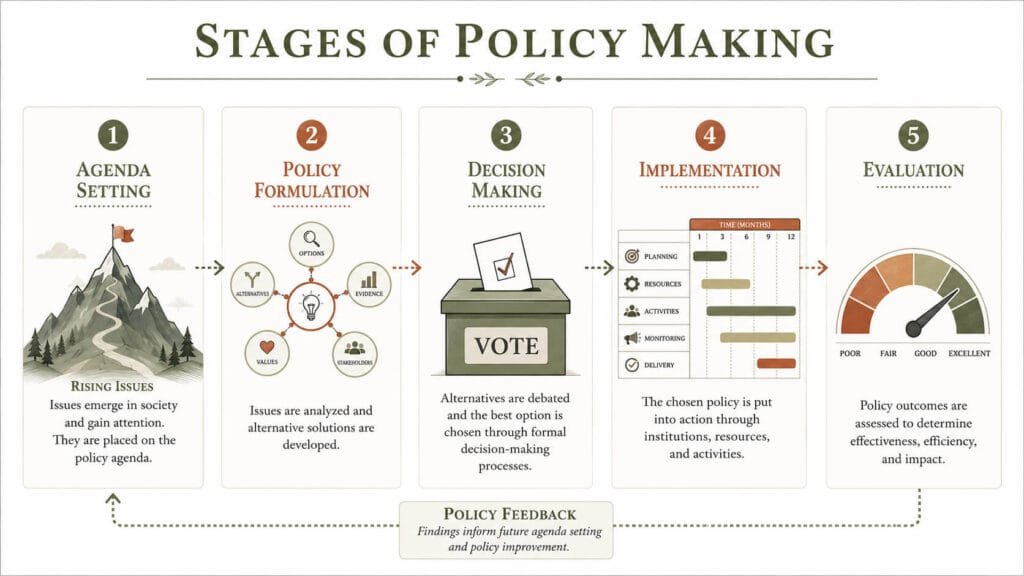
Policy formulation in public policy involves a series of stages and often follows specific models to ensure a systematic and effective approach to decision-making and implementation. While the exact number of stages and models can vary, here is a common framework outlining the key stages and models of policy formulation:
Stages of Policy Formulation
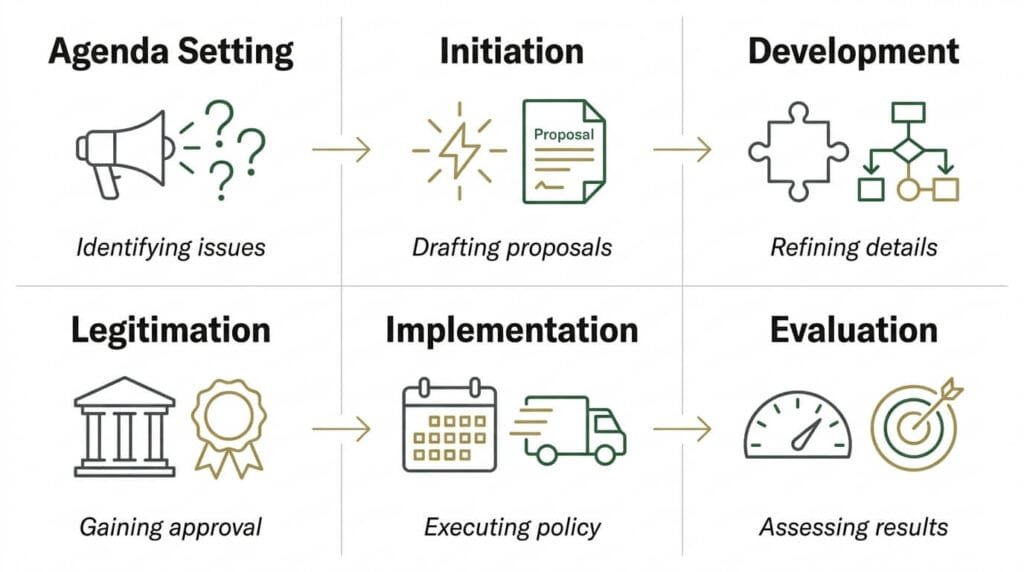
- Agenda Setting: Identification of a problem or an issue that requires government attention. Influenced by public opinion, political priorities, crises, or expert recommendations.
- Policy Initiation: The process by which a potential solution or policy proposal is introduced. Can be initiated by government officials, interest groups, experts, or other stakeholders.
- Policy Development or Formulation: In-depth analysis and development of policy options. Consideration of costs, benefits, feasibility, and potential impacts. Involvement of experts, stakeholders, and policymakers.
- Policy Legitimation: Gaining approval and support for the proposed policy. Involves political debate, hearings, consultations, and negotiations. Aims to build consensus and legitimacy for the proposed policy.
- Policy Implementation: The translation of policy into action. Involves creating detailed plans, allocating resources, and establishing responsible agencies. Monitoring and adjusting the policy as needed during implementation.
- Policy Evaluation: Assessing the effectiveness, efficiency, and equity of the policy. Informs policymakers about the success or failure of the policy. May lead to adjustments, revisions, or termination of the policy.
📌 Real Example (India): The National Education Policy (NEP) 2020 is a textbook case of agenda setting and policy legitimation — years of expert committee reports (Kasturirangan Committee), public consultations, and stakeholder negotiations preceded its final approval by the Union Cabinet. Read the official NEP 2020 document to see how these stages played out in practice.
Models of Policy Formulation
- Rational Model: Assumes a systematic and logical approach to decision-making. Involves identifying goals, generating alternatives, evaluating options, and selecting the most rational solution.
- Incremental Model: Suggests that policy changes are often made incrementally, building on existing policies. Changes are gradual and may result from small adjustments rather than comprehensive overhauls.
- Garbage Can Model: Describes decision-making as a fluid and dynamic process. Decision-makers have various solutions and problems available, and decisions may result from the convergence of these elements.
- Advocacy Coalition Framework: Emphasizes the role of advocacy coalitions in policy formulation. Views policymaking as the result of competition and cooperation among coalitions with different beliefs and preferences.
- Institutional Model: Focuses on the role of institutions, rules, and procedures in shaping policy outcomes. Highlights the influence of organizational structures and processes on decision-making.
- Network Governance Model: Recognizes the importance of networks of actors, both public and private, in shaping policy. Collaboration and communication among various actors play a central role in decision-making.
It’s essential to note that these stages and models are not always linear or strictly followed in practice. The policymaking process is often dynamic and influenced by various factors, including political considerations, public opinion, and external events. According to political scientist Harold Lasswell, one of the founders of policy sciences, the policy process can be broken down into distinct functional stages — a framework that still underlies most modern models used today. (Britannica: Harold Lasswell)
Actors in Policy Formulation
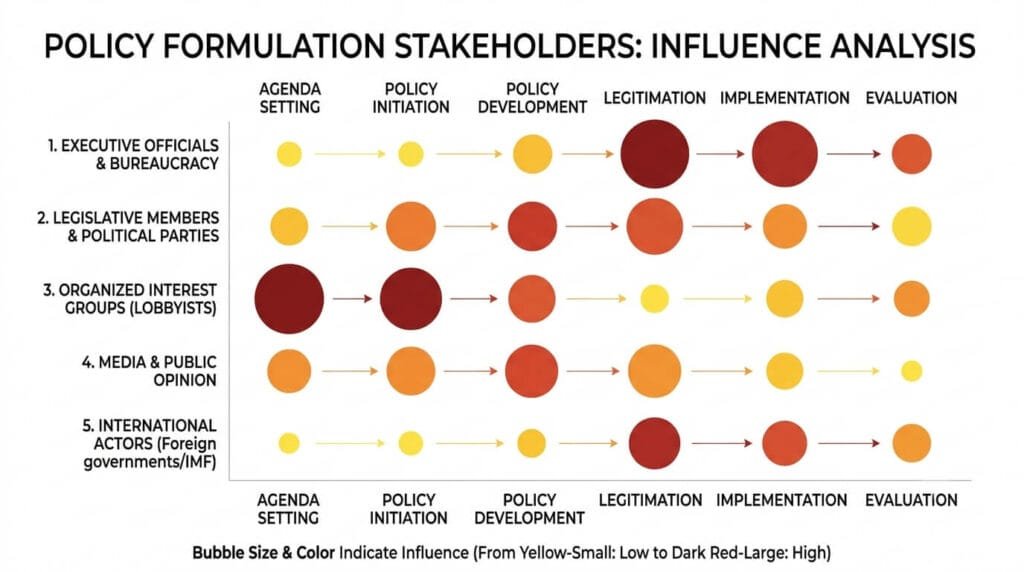
- Government Officials: Elected officials, such as legislators and executives, play a central role in policymaking. Government agencies and bureaucrats are responsible for conducting research, drafting policy proposals, and overseeing implementation.
- Political Parties: Political parties influence policy formulation through their platforms, ideologies, and legislative agendas.
- Interest Groups: Advocacy groups, industry associations, and NGOs actively engage in policy formulation, providing expertise and lobbying for specific policies.
- Experts and Think Tanks: Academics, researchers, and think tanks contribute expertise and research to inform policy decisions.
- Media: Plays a crucial role in shaping public opinion and influencing the policy agenda.
- International Organizations: Entities like the UN, World Bank, and IMF influence national policies through recommendations, guidelines, and funding.
- Public: Public opinion and feedback are vital in democratic societies, through hearings, surveys, and consultations.
- Judiciary: Courts can shape policies through legal interpretation, decisions, and judicial review of constitutionality.
- Private Sector: Businesses and industry associations advocate for policies aligned with their interests.
- Local Government: Provides valuable input during formulation and executes policies at the grassroots level.
Factors in Policy Formulation
- Problem Identification: Policies often emerge in response to perceived problems; problem framing influences the subsequent policy response.
- Political Context: Ideology, party platforms, and electoral cycles shape the policy agenda.
- Economic Factors: Inflation, unemployment, growth, and fiscal constraints are critical.
- Social and Cultural Factors: Social norms, values, and demographic trends shape policies related to education, healthcare, and welfare.
- Technological Changes: Create new challenges and opportunities in cybersecurity, privacy, and innovation.
- Legal and Regulatory Framework: Existing laws provide the foundation for new policy development.
- Global Influences: International agreements and globalization necessitate coordination with other countries.
- Media Influence: Framing of issues in the media impacts public perception and policymaker priorities.
- Historical Context: Historical events shape collective memory and institutional practices.
- Environmental Factors: Sustainability and climate change drive environmental and resource-management policies.
For a deeper dive into how these actors and factors interact, see our detailed post on Formulation, Implementation, Evaluation and Theories of Public Policy.
Tools and Techniques of Policy Formulation
- Research and Analysis: Policy research and data collection (literature reviews, case studies, statistical methods, surveys).
- Stakeholder Analysis: Stakeholder mapping, power-interest grids, and engagement assessments.
- Policy Modeling: Quantitative models (cost-benefit analysis, economic models) and qualitative models (flowcharts, conceptual diagrams).
- Cost-Benefit Analysis (CBA): Evaluates costs and benefits, monetary and non-monetary, to determine economic efficiency.
- SWOT Analysis: Examines Strengths, Weaknesses, Opportunities, and Threats of a policy option.
- Policy Delphi: Structured, iterative rounds of expert surveys to build consensus on complex issues.
- Scenario Planning: Anticipates future scenarios to prepare for uncertainty.
- Focus Groups: Small, diverse discussion groups to gauge public opinion and reactions.
- Policy Workshops and Brainstorming: Facilitated sessions to generate ideas and refine options.
- Policy Mapping: Visual representation of relationships between elements of a policy issue.
- Regulatory Impact Assessment (RIA): Systematic assessment of the economic, social, and environmental impacts of proposed regulations.
- Pilot Programs and Experiments: Small-scale testing before full-scale rollout.
- Policy Briefs and Memos: Concise documents summarizing analysis, options, and recommendations.
- Policy Advocacy and Lobbying: Building support for specific policy options among stakeholders.
- Public Consultation and Participation: Town halls, hearings, surveys, and online platforms to enhance transparency and legitimacy.
Challenges of Policy Formulation
Policy formulation is a complex process shaped by political dynamics, public opinion, and the nature of the issue at hand. Key challenges include:
- Problem Definition and Agenda Setting — Defining the problem is subjective; policymakers face agenda overload from competing demands.
- Policy Development — Information gaps and inherent policy complexity make it difficult to design comprehensible policies.
- Political Considerations — Partisan politics and short-term electoral focus can hinder well-designed policy.
- Stakeholder Management — Balancing diverse interests, and avoiding capture by powerful interest groups.
- Implementation Challenges — Resource constraints and bureaucratic resistance from implementing agencies.
- Evaluation and Monitoring — Data limitations and time lags delay accurate assessment of outcomes.
- Public Engagement — Limited public awareness or apathy restricts meaningful participation.
- Global and Environmental Factors — International dependencies and environmental uncertainties limit policy options.
- Legal and Ethical Issues — Existing legal frameworks and ethical dilemmas constrain policy choices.
- Policy Learning and Adaptation — Resistance to change and reluctance to learn from past failures.
- Technological Advances — Rapid change outpaces policy, raising privacy and security concerns.
- Crisis Response — Urgency during crises can lead to rushed, poorly analyzed decisions.
Addressing these challenges requires transparency, diverse stakeholder engagement, evidence-based decision-making, and continual evaluation and learning.
📊 Quick Comparison: Formulation vs Implementation vs Evaluation
| Aspect | Policy Formulation | Policy Implementation | Policy Evaluation |
|---|---|---|---|
| Core Question | What should be done? | How is it being done? | Did it work? |
| Key Actors | Legislators, experts, interest groups | Bureaucrats, frontline workers, agencies | Auditors, researchers, citizens |
| Main Output | A policy proposal / law | Programs, rules, on-ground action | Reports, recommendations, revisions |
| Common Model | Rational Model, Incremental Model | Top-Down Model, Bottom-Up Model | Cost-Benefit Analysis, CEA |
| Typical Challenge | Problem definition, agenda overload | Resource constraints, red tape | Data limitations, attribution |
(b) Policy Implementation
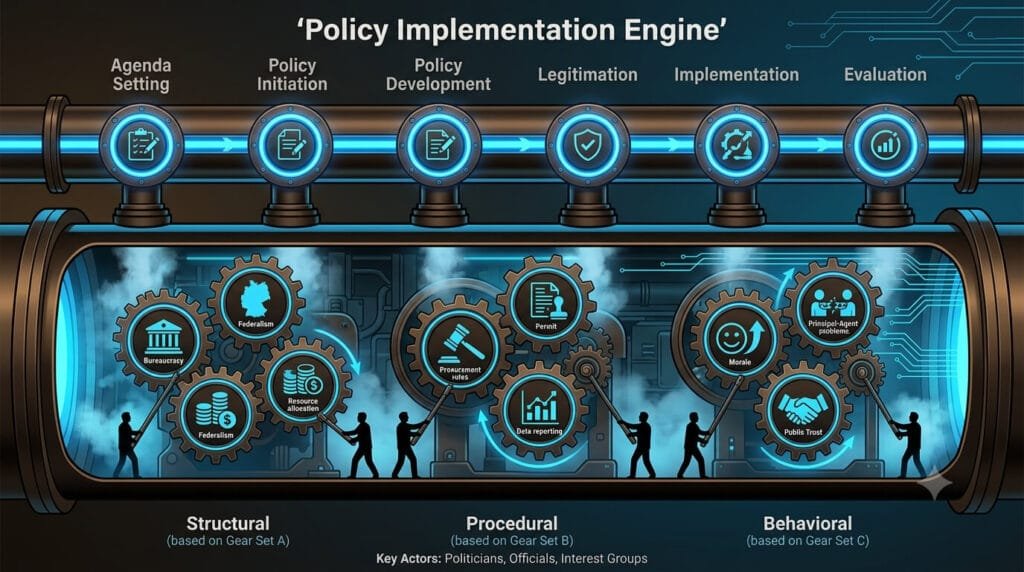
Definition and Dimensions of Policy Implementation
Policy implementation refers to the process of translating a government’s decisions, laws, and intentions into actions and outcomes. It is the stage where policies move from ideas and plans to actual practices and results on the ground. Successful implementation is crucial for achieving intended goals and addressing societal issues.
Dimensions of Policy Implementation:
- Structural Dimension: Organizational and institutional aspects — allocation of responsibilities, new agencies, coordination mechanisms, clear lines of authority.
- Procedural Dimension: Methods and procedures — guidelines, protocols, decision-making processes, feedback mechanisms.
- Behavioral Dimension: Attitudes, skills, and motivations of policymakers, administrators, and frontline implementers.
- Cultural Dimension: Shared values, norms, and beliefs that influence acceptance or resistance to policy changes.
- Political Dimension: Political actors, power dynamics, coalition-building, and managing conflicts of interest.
- Resource Dimension: Financial, human, technological, and material resources necessary for implementation.
- Monitoring and Evaluation Dimension: Continuous assessment of implementation progress via monitoring systems and data collection.
- External Dimension: Role of NGOs, international agencies, and the private sector in influencing outcomes.
📌 Real Example (India): The Jal Jeevan Mission shows all these dimensions at work — central government led formulation, but implementation depends on state governments, Panchayati Raj institutions, and local community participation (structural + political + external dimensions combined). Visit the official Jal Jeevan Mission portal for implementation data.
Actors and Factors Involved in Policy Implementation
- Government Agencies and Departments: Translate policy directives into concrete actions within their jurisdiction.
- Frontline Implementers: Teachers, healthcare workers, police, and social workers delivering services at the grassroots level.
- Public Officials and Bureaucrats: Oversee and manage the implementation process, allocate resources.
- Elected Officials: Influence implementation through legislation, budgets, and advocacy.
- Non-Governmental Organizations (NGOs): Provide expertise, resources, and on-ground support.
- Private Sector: Complies with regulations and contributes to goals like environmental sustainability.
- Community Organizations: Serve as intermediaries between government and community.
- International Organizations: Contribute funding, technical assistance, and expertise.
- Media and Advocacy Groups: Shape public opinion and hold policymakers accountable.
- Academic and Research Institutions: Provide evidence-based insights for policy design and implementation.
Factors Influencing Policy Implementation:
- Political Will: Commitment of leaders is crucial for overcoming resistance and sustaining efforts.
- Policy Design and Clarity: Well-designed, clearly defined policies are more likely to succeed.
- Resource Allocation: Adequate financial, human, and technological resources are essential.
- Stakeholder Engagement: Involving stakeholders fosters collaboration and reduces resistance.
- Public Support: Broad public backing increases the likelihood of compliance and success.
- Legal and Regulatory Framework: A supportive legal environment facilitates implementation.
- Institutional Capacity: Strong institutions ensure structures and skills are in place.
- Monitoring and Evaluation Mechanisms: Regular assessment allows for timely adjustments.
- External Factors: Economic conditions, global trends, and geopolitical events require adaptive strategies.
- Communication and Information Dissemination: Clear, consistent communication builds understanding and support.
Models and Approaches of Policy Implementation
- Top-Down Model: Policies are formulated at the highest levels and transmitted down through the administrative hierarchy for execution.
- Bottom-Up Model: Emphasizes input from lower levels/grassroots organizations; policies emerge from front-line experience and needs.
- Incremental Approach (Implementation Stage): Policymakers build on existing policies, gradually adapting them in response to new information — distinct from the incremental formulation model above, but applied here to how implementation itself evolves.
- Garbage Can Approach (Implementation Stage): Implementation occurs in a fluid, sometimes chaotic environment where problems, solutions, and decision-makers converge unpredictably.
- Stages Model: Breaks the policy process into agenda-setting, formulation, adoption, implementation, and evaluation — each with distinct actors and considerations.
- Policy Network Model: Focuses on relationships among a network of actors — government agencies, interest groups, experts — who collaborate to implement policy.
- Institutional Analysis and Development (IAD) Framework: Examines how rules, norms, and decision-making structures within organizations shape implementation outcomes.
- Policy Transfer Model: Explores how policies are adapted from one jurisdiction/context to another.
- Advocacy Coalition Framework (Implementation Stage): Coalitions with similar beliefs shape how a policy is actually carried out, not just how it was formulated.
- Kingdon’s Multiple Streams Framework: Three streams — problems, policies, and politics — must converge for a policy window to open and implementation to proceed.
Challenges of Policy Implementation
- Lack of Clarity in Policy Goals — Ambiguous goals make it hard to develop measurable strategies.
- Insufficient Resources — Inadequate funding, staffing, or technology slows or derails execution.
- Bureaucratic Red Tape — Complex processes and excessive regulation delay implementation.
- Resistance to Change — Stakeholders may resist due to fear of the unknown or loss of power.
- Political Interference — Changes in leadership can shift priorities mid-implementation.
- Inadequate Monitoring and Evaluation — Without robust mechanisms, it’s hard to assess impact or adjust course.
- Complexity of the Issue — Multiple stakeholders and intricate systems make effective execution difficult.
- Lack of Coordination — Poor coordination among agencies leads to duplication and inefficiency.
- Inadequate Stakeholder Involvement — Excluding key stakeholders reduces support and understanding.
- Unforeseen External Factors — Economic crises, disasters, or pandemics can disrupt timelines and priorities.
(c) Policy Evaluation
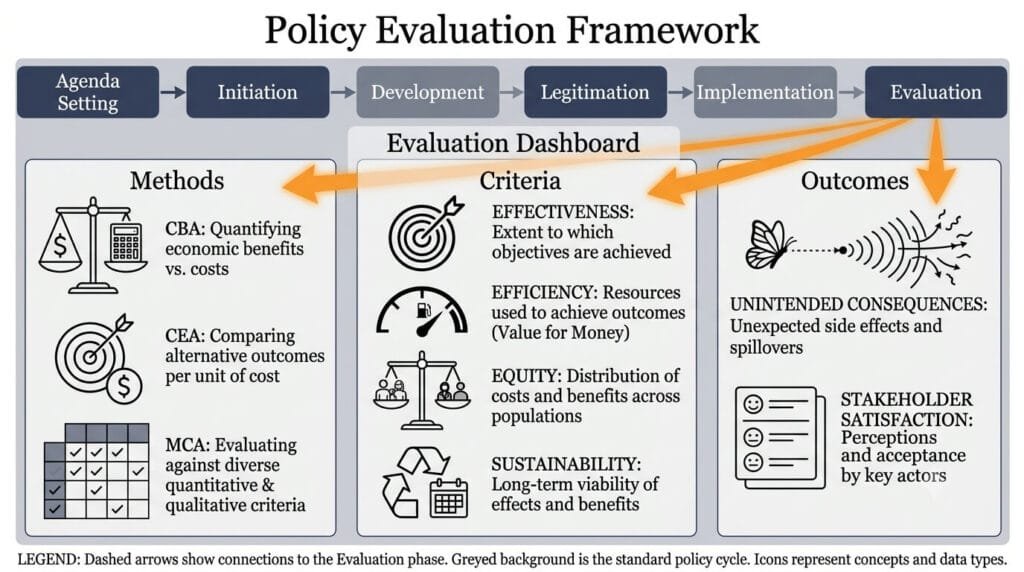
Definition and Purpose of Policy Evaluation
Policy evaluation is a systematic process used to assess the design, implementation, and impact of public policies. It involves collecting and analyzing data to determine whether a policy achieved its intended objectives and to understand its effects on stakeholders and the broader community.
Key components and purposes:
- Assessment of Policy Goals and Objectives: Determines whether intended outcomes are well-defined and aligned with community needs.
- Examination of Policy Implementation: Identifies gaps between planned and actual implementation.
- Analysis of Policy Impact: Assesses direct/indirect effects and identifies unintended consequences.
- Cost-Benefit Analysis: Compares overall societal benefits against costs incurred.
- Stakeholder Feedback: Incorporates diverse perspectives beyond quantitative data.
- Recommendations for Improvement: Evidence-based suggestions for modification or revision.
- Learning and Accountability: Promotes organizational learning and accountability in governance.
Methods and Criteria of Policy Evaluation
Methods:
- Quantitative Data Analysis: Statistical measures like employment rates, income levels, or health outcomes.
- Qualitative Data Analysis: Interviews, focus groups, case studies for deeper understanding.
- Cost-Benefit Analysis (CBA): Compares monetary costs versus benefits; net benefit is the key criterion.
- Cost-Effectiveness Analysis (CEA): Compares relative costs of alternatives achieving the same outcome.
- Experimental and Quasi-Experimental Designs: Controlled methods to establish causation.
- Surveys and Questionnaires: Gauge public attitudes, opinions, and satisfaction.
- Process Evaluation: Assesses fidelity and quality of implementation.
- Comparative Case Studies: Compares outcomes of similar policies across different contexts.
Criteria:
- Effectiveness: Extent to which the policy achieves its intended outcomes.
- Efficiency: Relationship between inputs (resources) and outputs (results).
- Equity: Fairness and distributional impact across social groups.
- Feasibility: Practicality given existing resources and constraints.
- Sustainability: Capacity to generate long-term benefits without negative side effects.
- Legitimacy: Perceived authority and acceptability among stakeholders.
- Adaptability: Ability to respond to changing circumstances.
- Accountability: Mechanisms for transparency and monitoring.
- Acceptability: Degree to which the public and stakeholders embrace the policy.
- Coherence: Consistency with other existing policies and broader societal goals.
📌 Real Example (India): Ayushman Bharat (PM-JAY) is regularly evaluated on effectiveness (number of hospitalizations covered), efficiency (cost per beneficiary), and equity (rural vs urban access) — a good example of multi-criteria policy evaluation in action. See NITI Aayog’s evaluation reports for reference.
Actors and Factors Involved in Policy Evaluation
- Government Agencies: Internal evaluation units provide an insider perspective on their own policies.
- External Evaluators: Independent organizations bring objectivity and expertise.
- Legislators and Policymakers: Set evaluation priorities and use results for decisions.
- Stakeholders: Provide input and feedback, sometimes serving on evaluation committees.
- Academic Researchers: Contribute research design and data analysis expertise, as covered in our Public Policy Evaluation notes.
- Citizens and the Public: Provide perspectives on real-life impact through surveys and consultations.
- Advocacy Groups and NGOs: Ensure specific group interests are represented in evaluations.
- International Organizations: Assess impact of global/transnational policies across borders.
Key factors: policy goals and objectives, evaluation criteria, data availability and quality, timing and duration, budget and resources, political climate, external shocks, public opinion, cultural and social factors, and communication of findings.
Challenges of Policy Evaluation
- Complexity of Policy Interventions — Multifaceted policies make it hard to attribute outcomes to one intervention.
- Attribution and Causation — External factors and confounding variables complicate cause-and-effect claims.
- Time Lags — Effects may not be observable immediately; short-term evaluations can miss long-term impact.
- Data Limitations and Quality — Limited or outdated data affects the accuracy of evaluations.
- Political Interference — Pressure to align findings with political agendas can compromise objectivity.
- Resource Constraints — Limited funding and skilled personnel restrict scope and depth.
- Stakeholder Engagement — Power imbalances can exclude marginalized voices from evaluation.
- Unintended Consequences — Evaluators must anticipate effects that aren’t immediately apparent.
- Context Sensitivity — Findings from one setting may not transfer directly to another.
- Subjectivity and Bias — Evaluator bias can affect objectivity; requires transparency and rigor.
- Resistance to Change — Stakeholders may resist accepting findings that call for policy change.
- Lack of Standardized Metrics — Absence of consistent measures makes cross-policy comparison difficult.
- Communication and Utilization — Translating complex results into actionable insight is challenging.
- Ethical Dilemmas — Confidentiality and participant well-being pose challenges in sensitive evaluations.
- Dynamic Policy Environment — Rapidly changing conditions can outpace the evaluation process.
Addressing these challenges requires methodological rigor, transparency, stakeholder engagement, and continuous learning by policymakers and evaluators alike.
📝 Previous Year Questions (Process of Public Policy)
Note: These are commonly recurring question patterns confirmed from DU GE Introduction to Public Policy papers and student question banks. Please cross-check exact wording/marks against your semester’s official question paper before exam prep.
- What is the process of Public Policy? Discuss its major stages.
- Explain the various models of policy formulation with suitable examples.
- Discuss the actors and factors involved in policy implementation.
- Differentiate between the Top-Down and Bottom-Up models of policy implementation.
- What is policy evaluation? Explain its key methods and criteria.
- Discuss the major challenges faced during policy implementation in India.
- Explain the Rational Model and Incremental Model of policy formulation. How do they differ?
- What is the role of stakeholders in the policy process?
❓ Frequently Asked Questions (FAQ)
What are the three main stages of the public policy process?
The three core stages are Policy Formulation, Policy Implementation, and Policy Evaluation — though some frameworks break this further into agenda-setting, formulation, legitimation, implementation, and evaluation.
What is the difference between policy formulation and policy implementation?
Policy formulation is the process of designing and deciding on a policy — identifying the problem, generating alternatives, and selecting a course of action. Policy implementation is putting that decision into actual practice through agencies, resources, and frontline action.
What are the main models of policy formulation?
The main models include the Rational Model, Incremental Model, Garbage Can Model, Advocacy Coalition Framework, Institutional Model, and Network Governance Model.
What is the Top-Down vs Bottom-Up model of implementation?
In the Top-Down model, policies are decided at the highest level of government and passed down for execution. In the Bottom-Up model, implementation is shaped by the experiences and needs of frontline/grassroots actors, with higher levels providing support.
What criteria are used to evaluate a public policy?
Common criteria include effectiveness, efficiency, equity, feasibility, sustainability, legitimacy, adaptability, accountability, acceptability, and coherence.
Why is policy evaluation important?
It provides evidence-based feedback on whether a policy achieved its goals, helping policymakers decide whether to continue, modify, or terminate it — closing the feedback loop for future agenda-setting.
Related reading: Theoretical Approaches to Public Policy | Public Policy: Case Studies | Public Policy Design and Implementation | Public Policy Evaluation
Subscribe to keep reading
You've used your free notes for now. Get Delhi Pathshala Premium for unlimited access.
Subscribe — ₹29/30 days
1 thought on “Process of Public Policy Notes – Formulation, Implementation & Evaluation (GE-8, Unit 3)”