
Contents
- What the DU Syllabus Asks in Unit 3
- Political Dimensions
- The concept and evolution of sovereignty
- Historical Development
- Key Features of Sovereignty
- Evolution of Sovereignty
- Contemporary Debates
- Hedley Bull: Beyond the State System?
- The challenges and opportunities of globalization for state sovereignty
- Challenges of Globalization for State Sovereignty
- Opportunities of Globalization for State Sovereignty
- Balancing Act
- Three views of the state under globalisation
- Jessica Mathews: Power Shift
- The role and relevance of international law and organizations
- International Law
- Role
- Relevance
- International Organizations
- Role
- Relevance
- The emergence and impact of regional and sub-regional groupings
- Emergence of Regional and Sub-regional Groupings
- Impact of Regional and Sub-regional Groupings
- The issues and debates on human rights, democracy and global governance
- Human Rights
- Issues
- Democracy
- Issues
- Global Governance
- Issues
- Shift from State to Market
- The rise and decline of the welfare state
- Rise of the Welfare State
- Context
- Decline of the Welfare State
- Context
- Was there really a decline? A scholarly debate
- Sovereignty in the Context of the Welfare State
- Rise
- Decline
- The neoliberal agenda and its implications for state intervention
- Key Tenets of the Neoliberal Agenda
- Implications for State Intervention
- Susan Strange: The Declining Authority of States
- The dynamics and consequences of market integration and liberalization
- Dynamics of Market Integration and Liberalization
- Consequences of Market Integration and Liberalization
- The problems and prospects of development and inequality in a globalized world
- Problems
- Prospects
- Strategies for Addressing Problems and Enhancing Prospects
- The alternatives and responses to neoliberalism and globalization
- Alternatives to Neoliberalism and Globalization
- Responses to Neoliberalism and Globalization
- Important Comparisons at a Glance
- Is the State Really Declining? Criticism and Limits of the Thesis
- Contemporary Relevance: Examples from 2020 to 2026
- Conclusion
- Continue Reading
- University of Delhi Previous Year Questions
- FAQs
Is the state still the boss in its own house? That one question sits under everything in Unit 3 of GE-7 (Politics of Globalisation). Capital moves across borders in seconds, the WTO and the IMF set rules that governments follow, regional blocs share powers, and NGOs and corporations now act in spaces that once belonged only to states. Yet states still tax, police, legislate and wage war. This unit asks you to hold both pictures at once and decide how far each one is true.
Quick answer — what is a sovereign state in a globalised world? A sovereign state in a globalised world is a state that still holds supreme legal authority over its territory and people, but exercises that authority amid cross-border markets, international law, regional blocs and global institutions. Unit 3 asks whether that authority is eroding, being shared, or simply changing form.
These notes cover both parts of the syllabus: 3.1 Political Dimensions (sovereignty, international law and organisations, regional groupings, human rights, democracy and global governance) and 3.2 Shift from State to Market? (the welfare state, neoliberalism, market integration, development and inequality, and the alternatives to neoliberal globalisation). Where scholars disagree, we show you the disagreement with names attached, because that is exactly what DU examiners reward. If you are new to the paper, read the GE-7 Unit 1 notes on conceptualising globalisation first; the hyperglobalist, sceptic and transformationalist framework introduced there is applied to the state here.
What the DU Syllabus Asks in Unit 3
Unit III of GE-7 is titled Sovereign State in a Globalised World and has nine teaching hours in the University of Delhi syllabus for GE-7. It has two sub-units, each tied to specific essential readings.
| Sub-unit | Prescribed essential reading (as listed in the DU syllabus) | What you should be able to do |
|---|---|---|
| 3.1 Political Dimensions | Hedley Bull, “Beyond the State System?” (in Held and McGrew, The Global Transformations Reader); A. Elizabeth and M. V. Ozioko, Effect of Globalisation on Sovereignty of States (UN document, 2000) | Explain sovereignty and how globalisation challenges, shares or reshapes it; discuss international law, organisations and regional groupings |
| 3.2 Shift from State to Market? | Susan Strange, “The Declining Authority of States” (in Lechner and Boli, The Globalization Reader); Jessica T. Mathews, “Power Shift” (in Held and McGrew) | Argue whether authority is moving from states to markets and non-state actors; explain the welfare state, neoliberalism and responses to them |
| Suggestive readings (listed for the paper as a whole, but closest to this unit) | Gottlieb, Nation against State; Smith and Naím, Altered States; Hardt and Negri, Empire (“Passages of Sovereignty”); Stiglitz, Globalization and Its Discontents Revisited | Use for extra depth and for higher-scoring examples in long answers |
These notes summarise the arguments of Bull, Strange and Mathews from their well-known positions; they are not a substitute for reading the prescribed pieces.
Political Dimensions
This is syllabus point 3.1. It asks what sovereignty means, how globalisation tests it, and how international law, international organisations, regional blocs and global norms on human rights and democracy reshape what a state can do.
The concept and evolution of sovereignty
Sovereignty is one of the oldest and most contested ideas in political theory and international relations. In its simplest form it means the supreme authority of a state within its own borders, together with its independence from outside control. The idea did not appear fully formed. It was built up over centuries by lawyers, kings, philosophers and diplomats, and it is still being rewritten.
Historical Development
- Medieval Europe: overlapping authorities, not one supreme ruler. Medieval Europe had no sovereign state in the modern sense. The Pope, the Holy Roman Emperor, kings, feudal lords and free cities all claimed authority over the same people and land, and these claims overlapped. Kings did claim to rule by God’s grace, but the well-developed doctrine of the divine right of kings, under which a monarch answers to God alone and not to Pope or parliament, belongs mainly to the sixteenth and seventeenth centuries, when kings were fighting to free themselves from these rival authorities. This overlap matters later, because Hedley Bull’s idea of a “new medievalism” (discussed below) borrows its picture of fragmented authority from this period.
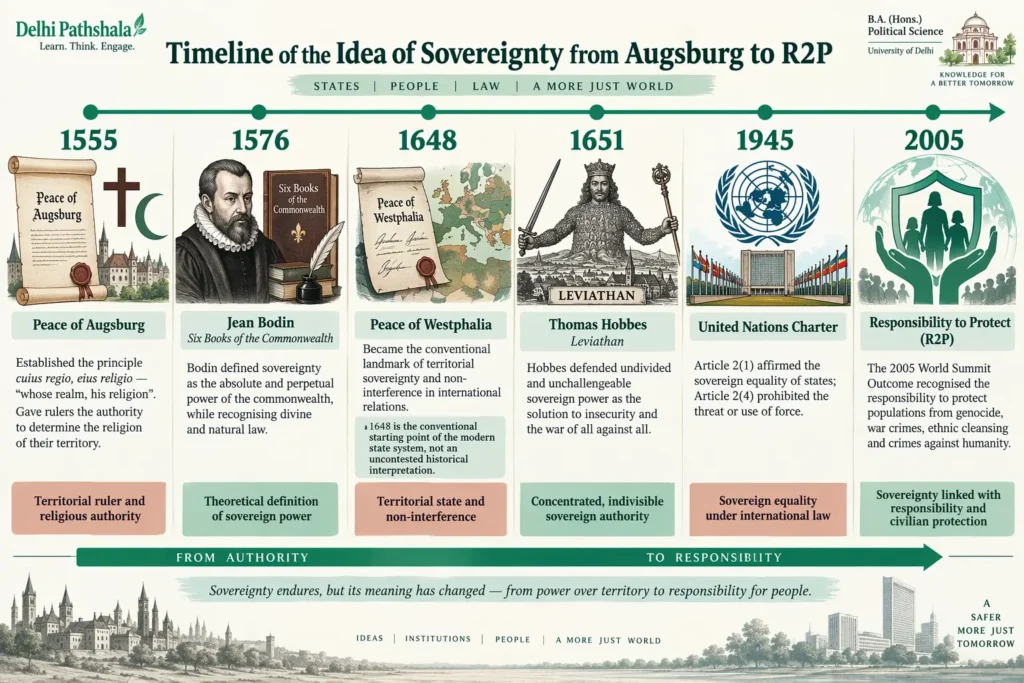
- Bodin and Hobbes: sovereignty gets a definition. The French thinker Jean Bodin, in Six Books of the Commonwealth (1576), gave the first systematic account: sovereignty is the absolute and perpetual power of a commonwealth, the power to make law without needing the consent of anyone else within the state. For Bodin the sovereign was still bound by divine and natural law. Thomas Hobbes, in Leviathan (1651), went further. He grounded sovereignty in a social contract and argued that sovereign power must be undivided and unchallengeable, because a divided authority would drag people back to a war of all against all. Rousseau later turned the argument around by locating sovereignty in the people through the general will (popular sovereignty), and John Austin, in The Province of Jurisprudence Determined (1832), reduced it to a legal fact: the sovereign is the person or body habitually obeyed and not in the habit of obeying anyone else. Hugo Grotius is usually credited with sharpening the external side, the independence of a state from foreign control. Later, pluralists such as Harold Laski attacked the idea that the state alone has supreme authority, arguing that churches, unions and associations also command loyalty.
- Augsburg (1555) and Westphalia (1648): the turning points. The principle cuius regio, eius religio (“whose realm, his religion”) comes from the Peace of Augsburg of 1555, which allowed each prince within the Holy Roman Empire to choose between Catholicism and Lutheranism for his own territory. It is often wrongly attached to Westphalia. The Peace of Westphalia (1648) is really two treaties, signed at Osnabrück and Münster, that ended the Thirty Years’ War. They reaffirmed the Augsburg settlement and extended recognition to Calvinism within the Empire. IR textbooks treat 1648 as the birth of the modern state system, with states as the primary actors, recognising each other’s territorial authority and not interfering in each other’s internal affairs. This picture is known as Westphalian sovereignty.
- The “Westphalian myth”: a scholarly debate you should know. Not everyone accepts this story. Andreas Osiander (2001), in an influential article in International Organization, argued that the standard IR account of Westphalia is a myth. He found that the treaties were concerned almost entirely with the constitutional arrangements of the Holy Roman Empire and do not set up a system of equal sovereign states; the “Westphalian” label, he argued, owes more to nineteenth- and twentieth-century fixation on sovereignty than to the seventeenth-century texts. Other scholars accept that 1648 is better read as a symbol than as a single founding moment, while still holding that the territorial state became dominant in Europe during this long period. In an exam, present Westphalia as the conventional starting point of the modern sovereign state, and add that historians have challenged how much it actually changed. That one sentence marks you out from a memorised answer.
- Sovereign equality becomes universal after 1945. The Westphalian model began as a European arrangement. It spread worldwide through colonisation, and then, after decolonisation, through the UN Charter (1945), which is founded on the sovereign equality of its members (Article 2(1)), forbids the threat or use of force against other states (Article 2(4)), and bars the UN from intervening in matters essentially within domestic jurisdiction, except when the Security Council acts under Chapter VII (Article 2(7)). Many post-colonial states, including India, guarded their newly won sovereignty fiercely for exactly this reason.
Key Features of Sovereignty
- Territoriality. Sovereignty is tied to territory. A state has supreme authority within its geographic boundaries, and other states are expected to respect its territorial integrity.
- Exclusive authority. A sovereign state alone makes and enforces law, collects taxes and maintains order in its territory. Max Weber described the state as the body that successfully claims the monopoly of legitimate physical force within a territory.
- Recognition. Sovereignty depends partly on being recognised by other states. The Montevideo Convention (1933) lists the classic criteria of statehood: a permanent population, a defined territory, a government, and the capacity to enter into relations with other states. Recognition matters for taking part in treaties, the UN and global trade.
- Internal and external dimensions. Internal sovereignty is supreme authority over society within the state; external sovereignty is independence from outside authority and equal standing with other states.
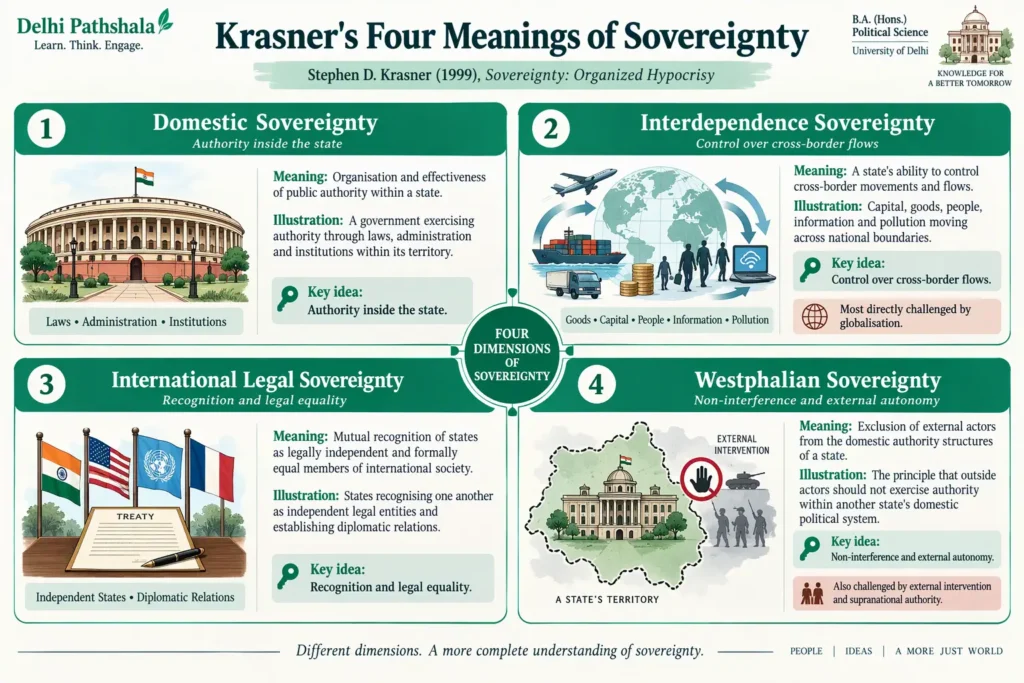
Stephen Krasner (1999), in Sovereignty: Organized Hypocrisy, warns that “sovereignty” is used to mean four different things, and mixing them is the most common reason students go wrong. This table is worth memorising.
| Krasner’s meaning | What it refers to | Is globalisation a threat? |
|---|---|---|
| Domestic sovereignty | How authority is organised inside a state and how effectively it is exercised | Yes, if markets, courts abroad or technology limit what a government can really control |
| Interdependence sovereignty | A state’s ability to control flows across its borders (capital, goods, people, information, pollution) | Strongly challenged; this is where globalisation bites hardest |
| International legal sovereignty | Mutual recognition of states as legal equals | Largely intact; recognition remains the basis of statehood |
| Westphalian sovereignty | Exclusion of outside actors from a state’s internal authority structures | Challenged when states accept intervention, human rights scrutiny or supranational law |
Krasner’s own conclusion is that the Westphalian principle has often been violated in practice, through invitation, coercion or treaty, so that sovereignty is “organized hypocrisy”: states routinely say one thing and do another. This is why, in many questions, you can argue that globalisation does not abolish sovereignty so much as exposes how partial it always was.
Evolution of Sovereignty
- Globalisation and interdependence. Environmental problems, human rights norms, financial flows and trade have bound states together so tightly that no state can claim absolute independence in practice. Robert Keohane and Joseph Nye described this as complex interdependence: multiple channels of contact between societies, in which military force is not always the most useful tool.
- International organisations. The UN, the WTO and similar bodies carry a degree of authority above individual states. States usually accept these limits voluntarily, in exchange for cooperation, which is why many scholars describe this as pooling or sharing sovereignty and not losing it.
- Human rights. Growing global attention to human rights has narrowed the idea that what a state does to its own people is nobody else’s business. The international community has intervened, or at least debated intervening, where states are accused of gross violations.
- Regional integration. Blocs such as the European Union involve member states sharing law-making powers in defined areas, which undermines the idea of exclusive, indivisible authority.
Contemporary Debates
- Responsibility to Protect (R2P). The International Commission on Intervention and State Sovereignty proposed the idea in its 2001 report. In paragraphs 138 and 139 of the 2005 World Summit Outcome Document, world leaders accepted that each state has the responsibility to protect its population from genocide, war crimes, ethnic cleansing and crimes against humanity, and that the international community should help states do so and take collective action if a state manifestly fails. In this view sovereignty is not just a right to be left alone but also a responsibility. The idea remains contested: NATO’s 1999 intervention in Kosovo took place without Security Council authorisation, and the Security Council’s 2011 resolution on Libya (Resolution 1973) was later criticised by states that had abstained, including India, Brazil, China, Russia and Germany, who argued that the mandate was stretched.
- Cybersecurity, data and the information age. Data flows cross borders without passports. States respond with data-localisation rules, platform regulation and, at times, blocking of apps or services, which are attempts to rebuild control over information flows. These are sometimes called digital sovereignty measures.
- Nationalism versus global governance. Movements that stress “taking back control” clash with institutions that try to solve shared problems, such as climate change and pandemics, through cooperation. Brexit is the best-known case.
In summary, sovereignty has travelled from a feudal and royal idea to a much more layered concept in which a state’s legal supremacy remains largely intact while its practical room for manoeuvre is shaped by markets, law, norms and neighbours. The tension between sovereignty and an interconnected world continues to shape political debate, and every part of this unit is a variation on it.
Hedley Bull: Beyond the State System?
The first prescribed reading for 3.1 is Hedley Bull’s discussion of whether the state system might be replaced. Bull, a leading figure of the English School of International Relations, argued in The Anarchical Society (1977) that states form an “international society”: an anarchy, with no world government, but one held together by shared rules and institutions such as diplomacy, international law and the balance of power. He then asked what could replace this system. The options he considered included a world government, a return to something like the overlapping loyalties of the Middle Ages, and a system in which states remain but share their authority with other bodies.
The idea students must know is “new medievalism”: a possible future in which authority is divided among regional institutions, global bodies, and sub-national and private actors, much as in medieval Europe, instead of being concentrated in sovereign states. Bull did not claim this had arrived; his point was that the state system was not the only possible way to organise political life, and that signs of change, such as regional integration, transnational organisations and the spread of technology, made the question worth asking. His own view was more cautious than the hyperglobalists’: he saw the state system as still the dominant organisation of world politics, while changes at the edges might weaken it over time.
Exam tip: Bull is useful because he answers “what comes after the state?” without declaring that the state is dead. Set him beside Strange (who says authority has leaked from the state to markets) and Mathews (who says power has shifted to non-state actors) to show three different kinds of challenge to the state.
The challenges and opportunities of globalization for state sovereignty
Globalisation, the growing interconnection of economies, cultures and societies across borders, presents challenges and opportunities for sovereignty at the same time. The two lists below are best read together, because the same development (say, open financial markets) can be a threat on one page of your answer and an opportunity on the next.
Challenges of Globalization for State Sovereignty
- Economic interdependence. Challenge: States depend on one another for trade, investment and financial stability, which limits how freely any government can set its own economic policy. Impact: A decision taken by another government, a rating agency or an international financial institution can change what a state can afford to do. A sharp interest-rate change in a major economy, for example, can push capital out of emerging markets and force their governments to respond whether they want to or not.
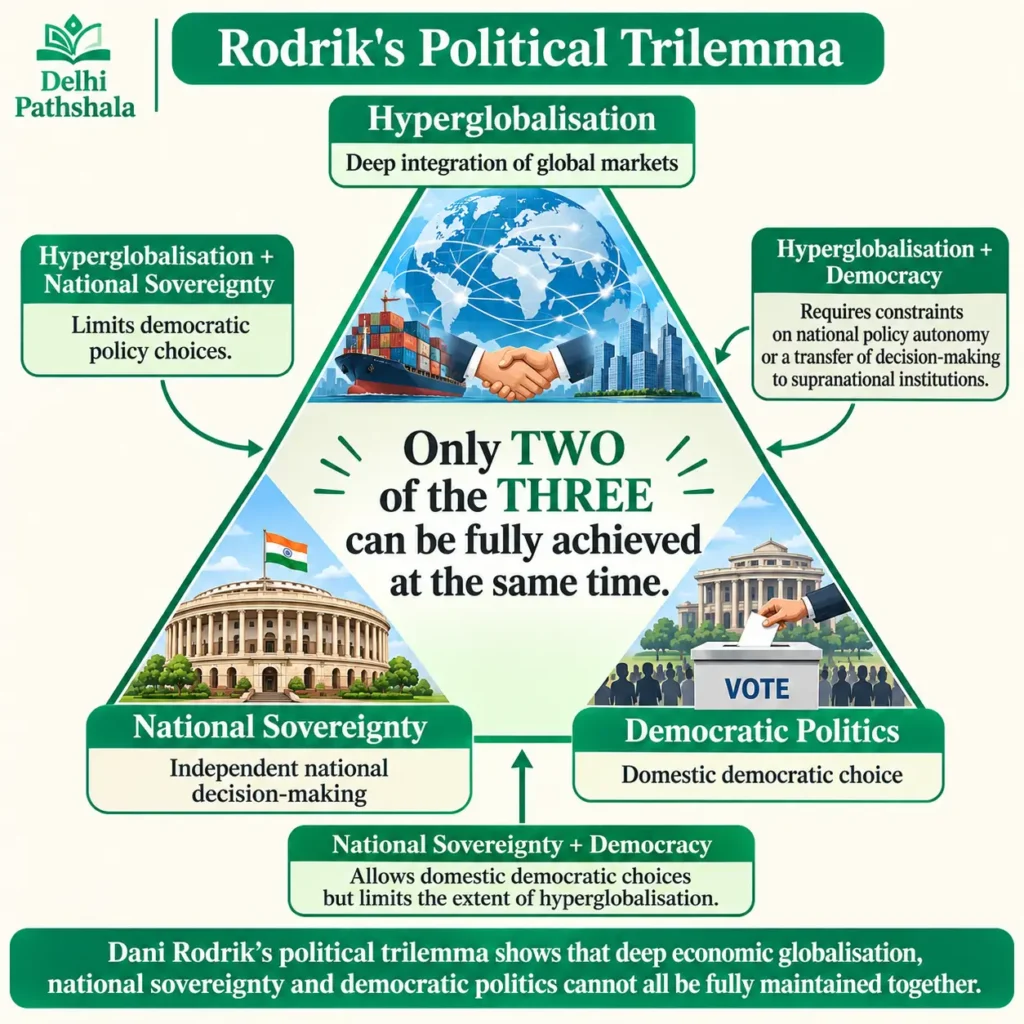
- Mobile capital and financial markets. Challenge: Money can leave a country faster than a law can be passed. Impact: Governments that fear capital flight may avoid raising corporate taxes or tightening regulation, even when voters want it. Dani Rodrik’s well-known “political trilemma” puts the choice sharply: a country cannot have full economic globalisation, national sovereignty and democratic politics all at once; it can have at most two.
- Supranational organisations. Challenge: Bodies such as the European Union involve states delegating certain powers to a higher authority. Impact: Member states must follow decisions made at that level in areas such as trade rules, competition and the movement of people, which limits their autonomy in those fields.
- Global governance and regulation. Challenge: Climate change, trade and public health often need global solutions, and international agreements may impose rules that restrict national choices. Impact: States may have to meet global standards even when these conflict with domestic preferences.
- Transnational crime and terrorism. Challenge: Terrorism, organised crime and cyber threats ignore borders. Impact: Fighting them requires intelligence-sharing and joint operations, which means giving up some of the exclusive control over security that sovereignty implies.
- Digital platforms and data flows. Challenge: Information, finance and services now move through global digital platforms that no single state controls. Impact: Governments struggle to apply national law to firms operating across borders, which is why many have started to assert data sovereignty (see the contemporary examples below).
Opportunities of Globalization for State Sovereignty
- Economic growth and development. Opportunity: Trade, foreign direct investment and access to global markets can raise growth. Impact: A state that grows richer has more resources to spend on its people, and can use that capacity to strengthen the state itself.
- Technology and innovation. Opportunity: Information and technology move across borders. Impact: States can borrow ideas and tools, from digital public services to medical research, and build capacity at home faster than they could alone.
- Cultural exchange and diversity. Opportunity: People, ideas and traditions mix. Impact: Societies are enriched, and states can build more inclusive public cultures, though scholars (see Unit 2) also warn that cultural exchange can be one-sided.
- International cooperation. Opportunity: Global problems such as pandemics, climate change and poverty can only be tackled collectively. Impact: Cooperation reinforces the idea that sovereignty is not necessarily lost but adapted to new realities. A state that cannot control a river, a virus or a currency on its own may regain effective control by cooperating with others, a point made by theorists of interdependence.
Balancing Act
Globalisation therefore forces states into a balancing act. It weakens some traditional features of sovereignty, such as exclusive control of borders and economic policy, but it also opens routes to growth, development and shared problem-solving. States must navigate strategically, adapting to an interconnected world while protecting the aspects of national sovereignty they most value. Whether globalisation feels like a threat or an opportunity depends on a state’s policies, capacity and bargaining power: a large economy with a strong bureaucracy and military bargains from a very different position than a small, indebted state.
Three views of the state under globalisation
David Held and his co-authors, in Global Transformations (1999), sorted the globalisation debate into three camps. We cover the full framework in the GE-7 Unit 1 notes; here is how each camp answers the Unit 3 question about the state.
| Hyperglobalists | Sceptics | Transformationalists | |
|---|---|---|---|
| Core claim about the state | Global markets are replacing the state as the centre of power; the nation-state is becoming irrelevant or “unnatural” | Globalisation is exaggerated; states remain the central actors and often drive the process | Globalisation is real and the state is being reshaped, not erased: its powers are being redistributed |
| Typical thinkers | Kenichi Ohmae, The End of the Nation State (1995); Susan Strange is often placed here | Paul Hirst and Grahame Thompson, Globalisation in Question (on the DU Unit 1 reading list); Linda Weiss, The Myth of the Powerless State (1998) | David Held and Anthony McGrew; Saskia Sassen, Losing Control? (1996); Peter Evans, “The Eclipse of the State?” (1997) |
| Evidence they use | Capital mobility, multinational firms, global financial markets | Most trade and investment still flows between a few regions; states built and run the institutions that make globalisation possible | State capacities are being reconfigured: some authority moves up (to global bodies), out (to markets and firms) and down (to regions and cities) |
| Weakness | Underestimates what states still control: taxes, borders, armies, law | Can underplay how new the speed and scale of digital finance really are | A less quotable thesis; harder to test |
A caution on labels: scholars do not always agree where individual thinkers belong. Susan Strange is usually listed with the hyperglobalists because she argues that markets have become masters over governments, but some political scientists classify her as a transformationalist, since her work stresses that authority is being diffused among many institutions and not simply handed to markets. When you cite a thinker in the exam, say “usually seen as” rather than treating the label as a fact.
Jessica Mathews: Power Shift
The second reading for the unit, Jessica T. Mathews’ “Power Shift” (Foreign Affairs, January–February 1997), makes a different argument from Strange’s. Mathews argued that the post-1648 pattern, in which power and decision-making rested firmly with national governments, was ending. The reasons she gave were the information revolution, which gave individuals and groups cheaper ways to organise across borders, and the rise of non-governmental organisations (NGOs), which began to influence rule-making, agenda-setting and monitoring in areas from the environment to human rights. In her view, the state was not disappearing, but it was sharing power with business, civil society and international organisations.
A well-documented example of this kind of power shift is the campaign against landmines. A coalition of NGOs, the International Campaign to Ban Landmines, worked with a group of governments to produce the Mine Ban Treaty (1997), and the campaign shared the 1997 Nobel Peace Prize. Several major states, including India, have not joined the treaty, which is a useful reminder that non-state actors can set the agenda without being able to compel states to follow it.
Mathews versus Strange, in one line: Strange stresses authority moving to markets, so the main rival to the state is economic; Mathews stresses power moving to non-state actors, civil society as well as business, so the main rival is organised society across borders. Both agree that the state-centred picture of the world is incomplete. See the Unit 4 notes on international institutions for the institutions through which some of this power is exercised.
The role and relevance of international law and organizations
International law and international organisations shape how states behave and make cooperation possible. They are also the main way in which states choose to limit their own sovereignty, which is why the topic belongs in a unit about sovereignty.
International Law
Role
- Regulating state behaviour. International law gives a framework for how states deal with each other, covering human rights, armed conflict, trade and the environment. Example: The UN Charter sets out the basic principles of international relations, including the prohibition of the use of force (Article 2(4)) and the peaceful settlement of disputes.
- Protecting human rights. International human rights law sets common standards for individuals regardless of nationality. Example: The Universal Declaration of Human Rights (1948) and later conventions deal with the right to life, freedom of expression and the prohibition of torture. For the philosophical debate behind this, see our notes on human rights: universalism or cultural relativism.
- Facilitating international cooperation. Treaties and agreements allow states to enter binding commitments on shared problems. Example: The Paris Agreement on climate change and the agreements of the World Trade Organization show how law supports cooperation on global issues.
- Peaceful settlement of disputes. International law offers mechanisms that reduce the chance of disputes becoming wars. Example: The International Court of Justice (ICJ) is the principal judicial organ of the UN and settles legal disputes between states that consent to its jurisdiction.
Relevance
- Global interconnectedness. Where one state’s actions affect many others, a shared legal framework helps prevent conflict. Example: Cross-border pollution, terrorism and infectious diseases all need legal cooperation.
- Humanitarian concerns. International law protects vulnerable people and holds individuals to account. Example: The International Criminal Court (ICC), created by the Rome Statute (adopted 1998, in force 2002), prosecutes individuals for genocide, war crimes and crimes against humanity; since 2018 it can also exercise jurisdiction over the crime of aggression.
- Normative framework. International law sets shared standards that shape what states regard as acceptable. Example: The Geneva Conventions set standards for the treatment of prisoners of war and civilians in armed conflict.
A limit worth stating: international law depends largely on state consent and has weak enforcement. The ICC, for instance, can only act where states are parties to the Rome Statute or the Security Council refers a case, and several major powers, including India, the United States, China and Russia, are not parties. Another sign of the limits is the World Trade Organization’s appeals body, which has been unable to hear appeals since December 2019 because members could not agree on appointing judges (see the contemporary relevance section). Law constrains states, but states also decide how far to be constrained.
International Organizations
Role
- Promoting international cooperation. International organisations are platforms where states discuss problems, share information and coordinate policy. Example: The United Nations is a forum for issues ranging from peace and security to development and human rights.
- Peacekeeping and conflict resolution. The UN deploys peacekeepers and supports mediation. Example: UN missions in places such as Kosovo and South Sudan aim to maintain stability.
- Economic cooperation and development. The World Bank and the International Monetary Fund provide finance and policy advice. Example: The World Bank funds infrastructure, poverty-reduction and sustainable development programmes. These bodies also attach conditions to loans, which is where the sovereignty debate becomes sharp (see 3.2 below and the Unit 4 notes).
- Humanitarian assistance. International organisations provide aid after disasters and conflicts. Example: The UN High Commissioner for Refugees (UNHCR) protects and assists refugees and displaced people.
Relevance
- Addressing global challenges. Pandemics, climate change and terrorism cannot be solved by one state. Example: The World Health Organization (WHO) coordinates responses to health emergencies and sets international health standards.
- Rule-making and standardisation. International bodies develop norms that create a level playing field. Example: The International Civil Aviation Organization (ICAO) sets standards for air travel safety.
- Conflict prevention and resolution. Regional and global bodies help to keep peace in conflict-prone regions. Example: The African Union and sub-regional organisations often lead on conflicts in Africa.
- Human rights advocacy. International organisations monitor states and hold them to account. Example: The Office of the High Commissioner for Human Rights (OHCHR) works within the UN system to promote and protect human rights.
In summary, international law and organisations are the legal and institutional backbone of global governance. They also show a key point for your answers: states usually accept these limits voluntarily, so many scholars read the growth of international law as a use of sovereignty (a state can bind itself by treaty) as much as a loss of it. At the same time, powerful states can ignore, leave or reshape these bodies, which keeps the relationship uneven.
The emergence and impact of regional and sub-regional groupings
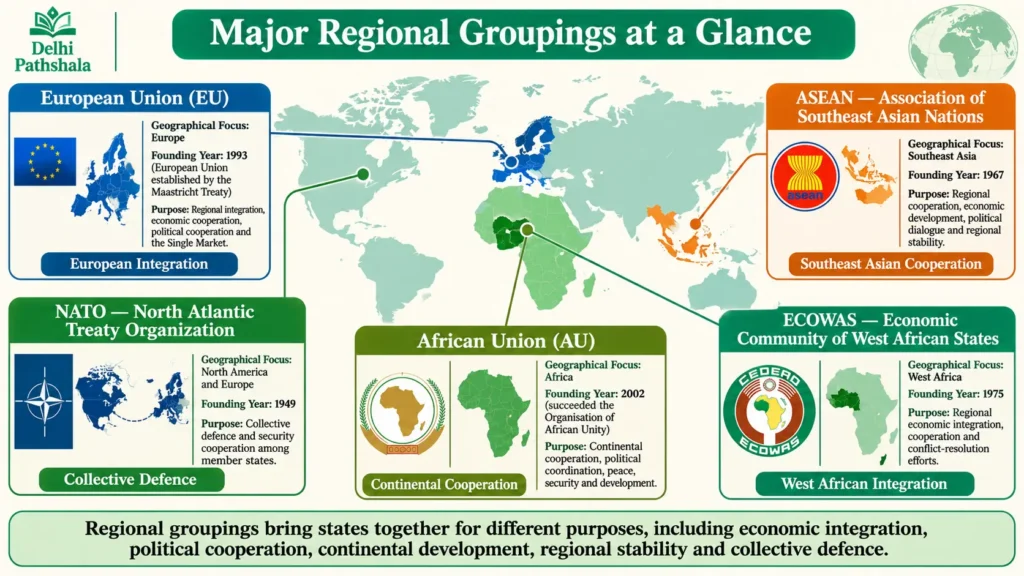
Regional and sub-regional groupings shape international relations through economic cooperation, political dialogue and integration. They arise from geographical closeness, cultural ties or shared economic interests, and they are central to the sovereignty debate because they show how states choose to pool authority.
Emergence of Regional and Sub-regional Groupings
- Geographical proximity and cultural affinities. Neighbours form groupings to improve cooperation and handle shared problems. Example: The Association of Southeast Asian Nations (ASEAN), founded in 1967, promotes political and economic cooperation in Southeast Asia. For India, the South Asian examples to know are SAARC and BIMSTEC.
- Economic interests. Trade and investment opportunities drive many groupings. Example: The European Union began as an economic community, to promote trade and integration among European states, and has since grown into a political union.
- Political and security cooperation. States facing common threats form groupings for collective security. Example: The North Atlantic Treaty Organization (NATO), founded in 1949, was established for mutual defence among North American and European countries.
- Development goals. Some groupings aim at shared development goals such as poverty reduction and infrastructure. Example: The African Union (AU), which succeeded the Organization of African Unity in 2002, promotes economic integration and development across the continent.
Impact of Regional and Sub-regional Groupings
- Economic integration. Groupings remove trade barriers and harmonise regulation. Example: The EU Single Market allows the free movement of goods, services, capital and people among members.
- Political cooperation. Regional bodies are platforms for dialogue and conflict prevention. Example: The Organization of American States (OAS) promotes political cooperation and democratic governance in the Americas.
- Security and defence. Groupings contribute to collective security through joint exercises and cooperation. Example: NATO’s collective defence commitment is the best-known case; other security groupings exist in Eurasia, but their membership and activity have shifted over time, so check current status before citing one.
- Cultural and social collaboration. Regional bodies encourage people-to-people ties and a sense of regional identity. Example: The Gulf Cooperation Council (GCC) promotes cultural exchange and collaboration among its members.
- Capacity building and technical cooperation. Regional organisations help members build capacity to deal with common problems. Example: The Association of Caribbean States focuses on regional cooperation on sustainable development, disaster risk reduction and climate change.
- Negotiating power in global affairs. Acting together raises the bargaining power of members. Example: The Pacific Alliance, formed by several Latin American countries, seeks to deepen economic integration and improve global competitiveness.
- Conflict resolution. Regional organisations can respond faster and more closely to local crises. Example: The Economic Community of West African States (ECOWAS), founded in 1975, has been involved in conflict resolution in West Africa, including in Liberia and Sierra Leone.
Pooling versus losing sovereignty. The EU is the strongest case of shared sovereignty, since member states make binding law together in many fields. But groupings are not one-way streets. The United Kingdom held a referendum in June 2016 and left the EU on 31 January 2020, a campaign run on the idea of “taking back control.” In West Africa, Mali, Burkina Faso and Niger formally left ECOWAS on 29 January 2025 after a dispute that began with the 2023 coup in Niger, and formed their own Alliance of Sahel States. India’s decision not to join the Regional Comprehensive Economic Partnership (RCEP) in November 2019 is another example of a state weighing economic integration against domestic concerns. These cases show that states can pull out as well as pool, which is a strong argument for the claim that sovereignty has changed but not vanished.
In conclusion, regional groupings have become major actors in international relations. They deliver cooperation and stability, but their impact varies with the depth of integration, the commitment of members and the strength of their institutions.
The issues and debates on human rights, democracy and global governance
Human rights, democracy and global governance are deeply connected topics, and each shows how outside actors now claim a say in matters that used to be a state’s internal business.
Human Rights
Issues
- Universalism versus relativism. The tension between the universality of human rights and cultural relativism remains central. Some argue that human rights apply to every person; others stress the importance of cultural context and national sovereignty in defining and applying rights. The charge that “universal” rights reflect Western values is made most often by states defending their sovereignty, and critics reply that governments, not cultures, are usually the ones invoking relativism.
- Civil and political rights versus economic and social rights. There is a long-running debate about whether freedoms such as expression and political participation should come before rights such as education, health and work, and how to balance the two. The two International Covenants of 1966 split the two categories into separate treaties, a legacy of Cold War divisions.
- Humanitarian intervention versus state sovereignty. This raises the question of whether outsiders may use force to stop atrocities. The debate is sharpest in cases of armed intervention for humanitarian reasons, such as Kosovo (1999) and Libya (2011), and it led to the R2P framework described above.
- Accountability for violations. Making sure that violators are held to account is a persistent challenge. The effectiveness of international tribunals such as the ICC, and of national mechanisms, is still debated.
Democracy
Issues
- Democracy promotion versus cultural sensitivity. When external actors promote democracy through assistance or intervention, questions arise about imposing Western models on diverse societies.
- Democratic backsliding. Some countries that adopted democracy are seeing leaders weaken institutions, restrict civil liberties and concentrate power, which raises the question of how, or whether, outsiders should respond.
- Inclusivity and representation. The inclusion of women, minorities and indigenous groups in democratic life is still debated. Equal participation and the protection of minority rights remain difficult.
- Erosion of civic space. Restrictions on expression, assembly and association in some regions raise concerns about the health of democratic institutions and the role of civil society.
Global Governance
Issues
- Power imbalances and global inequality. Structures such as the UN Security Council are criticised for reflecting the power balance of 1945, with five permanent members holding a veto. Calls for reform ask for more representative and inclusive institutions.
- Nationalism versus global cooperation. The rise of nationalist movements, and the priority they give to national interest, challenges the ability of global governance to deal with climate change, pandemics and migration.
- Global economic governance. The IMF and the World Bank are criticised for their effect on developing countries, and there are calls for reforms to make global economic governance fairer and more inclusive.
- Environmental governance. Global governance of climate change is a major concern. Debates focus on whether international agreements are adequate and whether they can be enforced.
In summary, these issues overlap and reflect the changing nature of international relations. Balancing universal principles against local context, correcting power imbalances and building accountable governance are the main challenges.
Shift from State to Market
This is syllabus point 3.2. Note the question mark in the title: the syllabus is asking you whether authority has really shifted from states to markets, not telling you that it has. A good answer weighs the evidence on both sides.
The rise and decline of the welfare state
The welfare state is a system in which the government plays a central role in providing social and economic support to citizens, through health care, education, pensions, unemployment benefit and other services. Its story is closely tied to the story of sovereignty, because the welfare state was one of the clearest uses of a state’s power within its own borders.
Rise of the Welfare State
Context
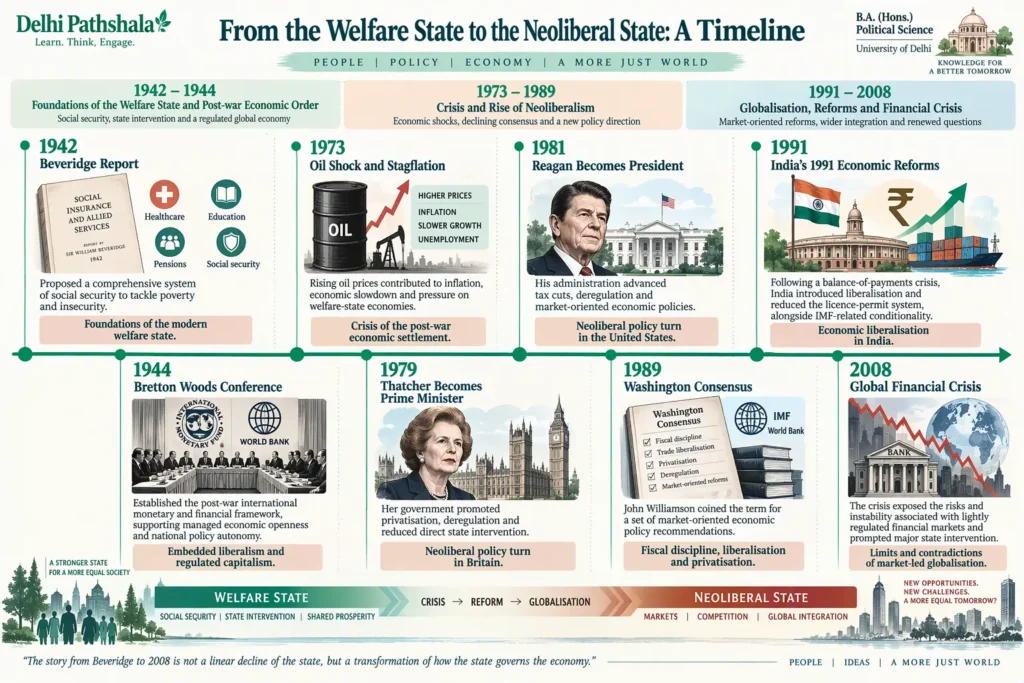
- Post-World War II era. The welfare state gained momentum after 1945, especially in Western democracies. The Depression and the war had exposed deep inequalities, and there was a strong wish to build a fairer society. In Britain, the Beveridge Report (1942) set out a plan for social insurance and the National Health Service followed in 1948.
- Key principles: the social contract. The welfare state rested on a social contract: citizens accept the authority of the state, and the state provides a safety net, including access to health care, education and social services.
- Economic prosperity. Strong growth in the post-war decades gave governments the money to invest in social programmes, including social security, public education and universal health care in many countries.
- Political ideologies. Social democratic ideas and Keynesian economics, which argued that government spending could stabilise the economy, shaped the welfare state. Governments saw social spending as a way of keeping the economy steady and society cohesive.
- The international setting: “embedded liberalism.” The Bretton Woods system of 1944 let governments run welfare and full-employment policies behind controls on capital movements. John Ruggie (1982) called this compromise embedded liberalism, and Karl Polanyi’s The Great Transformation (1944) had argued that societies will always try to protect themselves from unregulated markets. In this period, open trade and a strong welfare state went together.
- Different welfare regimes. Gøsta Esping-Andersen (1990) argued that there is no single welfare state; he identified three regime types, liberal (limited, means-tested support), conservative-corporatist (benefits linked to employment and status) and social democratic (universal and generous). This matters because globalisation did not affect all of them in the same way.
Decline of the Welfare State
Context
- Economic challenges. Economic downturns in the 1970s, including the oil shock of 1973 and the stagflation that followed, led to worries about whether expensive welfare programmes could be sustained. Rising public debt pushed some governments to rethink social spending.
- Globalisation. Rising trade and capital mobility raised fears for the competitiveness of national economies. Some argued that generous welfare provision, and the taxes that pay for it, could drive investment elsewhere.
- Ideological shifts. A shift towards neoliberalism stressed free markets and a smaller state. This outlook, associated with Margaret Thatcher (UK prime minister from 1979) and Ronald Reagan (US president from 1981), called for cutting back the welfare state.
- Demographic change. Ageing populations in many developed countries increased the strain on pensions and health systems, adding to worries about financial sustainability.
Was there really a decline? A scholarly debate
The word “decline” is itself disputed. Paul Pierson, in Dismantling the Welfare State? (1994), studied Reagan and Thatcher and concluded that welfare states proved far more resistant to cuts than expected, because their beneficiaries are numerous and organised, so major retrenchment was politically costly. A second argument, sometimes called the compensation thesis, associated with Dani Rodrik (1998) and Geoffrey Garrett (1998), holds that more open economies often have bigger governments, because people exposed to global competition demand social protection in return. Against both, the “race to the bottom” argument says that competition for investment pushes governments to cut taxes and protections. The best exam answer states that evidence is mixed: cuts and restructuring did occur, especially in the liberal regimes, but the welfare state has been more durable than the strongest versions of the decline story suggest.
Sovereignty in the Context of the Welfare State
Rise
- National sovereignty. During the rise of the welfare state, governments asserted their authority to deal with social problems within their borders. The state was seen as the main body responsible for citizens’ well-being.
- The social contract as an expression of sovereignty. Setting up the welfare state was in many ways an expression of state sovereignty, since governments took on responsibility for social and economic rights.
Decline
- Global pressures. The decline of the welfare state is linked to challenges to national sovereignty from global economic pressure. Governments faced limits in keeping large welfare programmes while staying competitive.
- International economic institutions. The IMF and the World Bank, by prescribing economic policies, affected the ability of states to shape their own welfare policies. Their lending conditions often required austerity measures and cuts in social spending, a pattern seen in the structural adjustment programmes imposed on many developing countries in the 1980s and 1990s.
- Market forces. The rise of neoliberalism changed the meaning of sovereignty to stress market forces and individual responsibility. As the state’s role in social services shrank, so did popular ideas of what state sovereignty meant in the economic and social sphere.
An Indian angle. In India, the 1991 reforms followed a balance-of-payments crisis and an IMF loan with conditions attached, and they opened the economy and reduced the role of the licence-permit system. Yet the state did not simply retreat from welfare: the Mahatma Gandhi National Rural Employment Guarantee Act (2005) and the National Food Security Act (2013) expanded legal entitlements. Use this pair in an answer to show that economic opening and social provision can run side by side, which supports the transformationalist reading of the state.
In summary, the rise and decline of the welfare state are tied to the changing meaning of sovereignty. Its rise reflected confidence in the state’s capacity to protect citizens; its decline, where it happened, was shaped by global economic pressure, market ideology and international institutions. The tension between social protection and global competitiveness still shapes debate about the role of the state.
The neoliberal agenda and its implications for state intervention
Neoliberalism is an economic and political philosophy that favours limited government intervention, free markets and individual freedom. It came into prominence in the late twentieth century and shaped economic policy and governance across much of the world. Its intellectual roots lie with thinkers such as Friedrich Hayek (The Road to Serfdom, 1944) and Milton Friedman, and the Mont Pelerin Society, founded in 1947, was an early network for these ideas. It became policy in the 1980s under Thatcher and Reagan, and was spread to developing countries through the IMF and World Bank. The set of reforms often urged on developing countries became known as the Washington Consensus, a term coined by the economist John Williamson in 1989.
Key Tenets of the Neoliberal Agenda
- Free-market economics. Free markets are seen as the most efficient allocators of resources, so barriers to trade and competition should be reduced and government interference in markets minimised.
- Deregulation. Unnecessary regulations on business should be removed, because deregulation is believed to encourage innovation, efficiency and growth.
- Privatisation. State-owned enterprises and services, such as utilities, transport and in some cases health care, should be transferred to the private sector.
- Fiscal discipline. Balanced budgets, lower public spending and lower taxation are favoured, to create a business-friendly climate and prevent excessive public debt.
- Individualism. Personal initiative, enterprise and individual responsibility are stressed.
- Globalisation. Neoliberalism favours the free movement of goods, services and capital across borders, and the reduction of trade barriers.
Implications for State Intervention
- Reduced role of the state. Governments should step back from direct involvement in business and let markets determine outcomes.
- Market-oriented reforms. Policy involves lowering trade barriers, privatising state enterprises and introducing competition in regulated sectors.
- Deregulation and flexibility. This can mean relaxing labour and environmental rules to attract investment.
- Privatisation of public services. Services such as health, education and utilities can shift from state to private provision.
- Austerity measures. Public spending is reduced, social programmes are cut and fiscal discipline is stressed in the name of economic stability.
- Weakened social safety nets. Reduced welfare spending can weaken unemployment benefit and other support for vulnerable people.
- Income inequality. Critics argue that neoliberal policies widen income inequality, since gains go disproportionately to the wealthy while the programmes that help low-income groups shrink.
- Global economic integration. Integration can bring greater exposure to downturns and crises, and a possible loss of domestic control over economic policy.
- Challenges to democracy. Critics argue that concentrating economic power in few hands can weaken democratic equality.
A common misunderstanding. Neoliberalism does not mean “no state.” Critics and supporters alike point out that creating and protecting markets, from enforcing contracts and property rights to managing money, takes a strong state. David Harvey, in A Brief History of Neoliberalism (2005), reads neoliberalism as a political project that restored the power of economic elites, and not simply as a retreat of the state. So when a question asks about “the shift from state to market,” it is safest to say that the form of state activity has changed (from provider to regulator and enabler) even where the state’s overall weight has not fallen.
In summary, the neoliberal agenda has far-reaching implications for state intervention. Proponents say it brings efficiency and individual freedom; critics point to its costs for social equity, public services and democratic governance. The argument over how much the state should do continues to shape economic policy.
Susan Strange: The Declining Authority of States
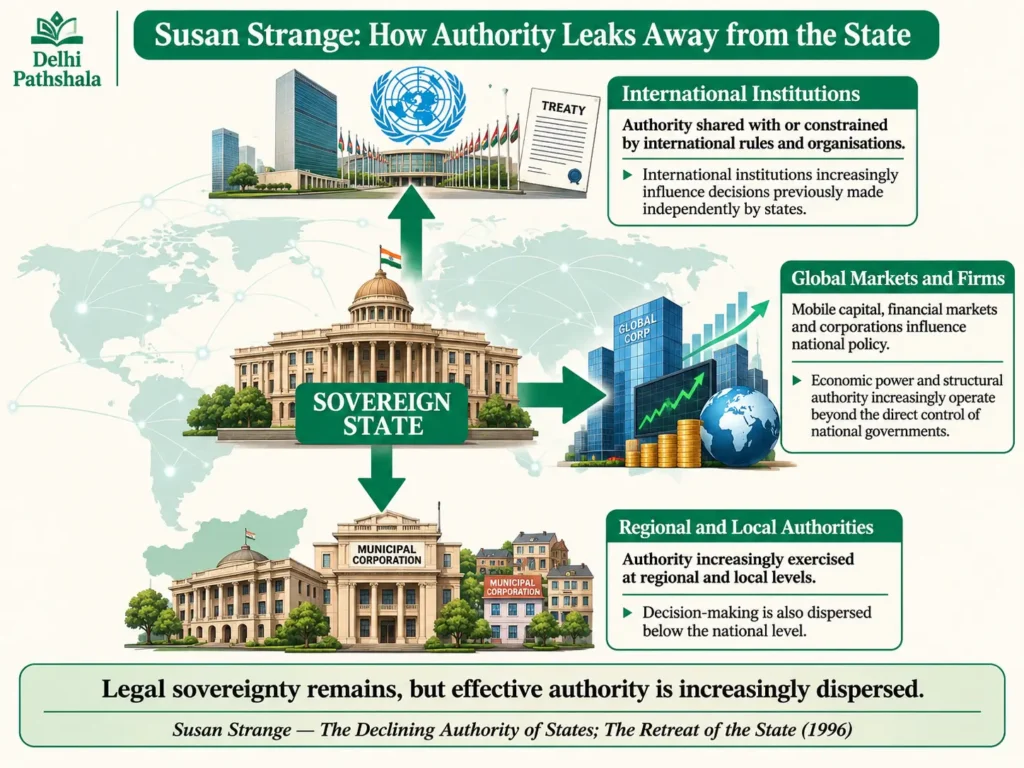
The first of the two prescribed readings for 3.2 is Susan Strange’s “The Declining Authority of States”, which draws on her book The Retreat of the State (1996). It is the most direct statement of the case that authority has shifted from states to markets.
Her main argument (in paraphrase). Strange argued that the authority of governments, large and small, strong and weak, has been weakened by technological and financial change and by the integration of national economies into one global market. Where states were once masters of markets, she said, markets have become the masters over governments on many crucial issues. She also argued that authority has not just vanished: it has leaked to other bodies, including international institutions, financial markets, large corporations and, for some matters, regional and local authorities. For Strange, the key issue was structural power, the power to shape the framework within which others operate (for example, the rules of finance and production), and she thought that this kind of power was moving away from states.
Why she matters for Unit 3. Strange gives you a clear, quotable position for the “decline” side of the debate. She also supports the argument that the sovereignty question is not mainly legal. States remain legally sovereign, but legal sovereignty may be hollow if markets decide what governments can do in practice.
Criticism. Linda Weiss (1998) argues in The Myth of the Powerless State that strong states adapt and sometimes use global integration to their advantage, and Hirst and Thompson doubt that the economy is as globalised as the decline thesis assumes. Others point out that states created many of the rules of the global economy (for example, by choosing to liberalise capital flows), so their loss of authority was in part a decision. Finally, the 2008 financial crisis showed governments rescuing banks on a huge scale, which is hard to square with a powerless state.
The dynamics and consequences of market integration and liberalization
Market integration and liberalisation are the processes by which economies open to international trade, lower barriers to the movement of goods, services and capital, and adopt free-market principles. They have large consequences for individual countries, regional blocs and the world economy.
Dynamics of Market Integration and Liberalization
- Trade liberalisation. Countries lower tariffs, quotas and other trade barriers. This encourages specialisation and comparative advantage, with countries concentrating on what they produce relatively well.
- Financial liberalisation. Opening financial markets reduces restrictions on capital movement. It can attract foreign capital and raise liquidity, but it can also expose economies to volatility and crises.
- Deregulation. Reducing government regulation can raise competition, innovation and efficiency in industries such as telecommunications, energy and transport.
- Privatisation. Moving state-owned enterprises into private hands is meant to improve efficiency and reduce the load on public finances, but it can raise worries about social equity and market concentration.
- Global value chains. Production is split across countries, with different stages located where costs or skills are best. Firms optimise across borders, and states compete to attract the stages they want.
- Regional integration. Countries form blocs, such as the EU and ASEAN, to deepen economic ties, win economies of scale and increase competitiveness.
Consequences of Market Integration and Liberalization
- Economic growth. Wider market access, efficiency and competition can raise growth.
- Job displacement and creation. Jobs are lost in industries that cannot compete and created in those that gain from comparative advantage.
- Consumer benefits. Consumers often gain a wider range of goods and services at lower prices.
- Income inequality. Liberalisation can produce wealth for some while others in exposed industries struggle.
- Financial volatility. Capital flows can be unpredictable, leading to crises and downturns.
- Social welfare concerns. Critics argue that liberalisation can lead to cuts in safety nets and public services, harming vulnerable groups.
- Global interconnectedness. Integration fosters interdependence and, in the best case, cooperation among nations.
- Environmental impact. More economic activity can mean resource depletion and pollution.
- National sovereignty. International agreements and organisations influence domestic policy.
- Potential for regional conflict. Intense competition and economic disparities can raise tensions, especially where historical rivalries exist.
Sovereignty and the state-market question. Rodrik’s trilemma (introduced earlier) summarises the dilemma. If a country pursues deep integration and wants to keep democratic politics, it has to give up some national policy independence; if it wants to keep national policy independence and democracy, it has to limit integration. Different states have chosen differently. The EU has leaned towards deeper integration, and the United Kingdom’s Brexit campaign pushed in the opposite direction. Since about 2018, trade wars, export controls and “economic security” policies show that governments can and do use state power to reshape global markets, which suggests that the market’s authority over the state is not as complete as the strongest “decline” arguments imply.
In conclusion, market integration and liberalisation bring growth, efficiency and cooperation, but also inequality, social costs and disruption to traditional industries. Balancing these requires careful policy and attention to social and environmental goals.
The problems and prospects of development and inequality in a globalized world
Development and inequality in a globalised world are linked problems. Globalisation, with its growing economic, political and cultural connections, has both positive and negative effects on both.
Problems
- Global economic inequality. Some regions have grown rapidly while others lag, widening gaps between countries.
- Income inequality within countries. Even in countries that benefit from globalisation, some groups do not share in the gains. Branko Milanovic’s much-discussed “elephant curve” (2016) suggests that the middle classes of rich countries saw weak income growth in recent decades relative to people in the global middle and the very top, though the interpretation of the curve is debated among economists.
- Exploitation of labour. In some developing countries, workers face poor conditions, low wages and few rights, especially in export manufacturing.
- Environmental degradation. Rapid growth strains natural resources and contributes to climate change, and developing countries often bear a heavy share of the damage.
- Debt burden. Developing countries may accumulate large debts while trying to join the global economy, and debt service can divert money from social services and infrastructure.
- Cultural homogenisation. The spread of dominant cultural values can wear down local traditions and identities.
- Access to technology. The digital divide leaves some regions and groups unable to take full part in the global economy.
Prospects
- Economic development opportunities. New markets, foreign investment and trade can stimulate growth.
- Poverty reduction. Higher economic activity can create jobs, improve education and encourage enterprise.
- Knowledge and technology transfer. Developing countries can benefit from advances made elsewhere.
- Global cooperation on challenges. Globalisation creates platforms to deal with climate change, pandemics and transnational crime.
- Enhanced access to information. Greater access to information and education can empower individuals and communities.
- Cultural exchange and diversity. Exchange can enrich societies with ideas, art and traditions.
- Regional and global governance. The need for collective action has produced institutions and agreements to frame cooperation.
- Sustainable development practices. There is growing recognition that environmental, social and economic goals must be integrated.
Strategies for Addressing Problems and Enhancing Prospects
- Fair trade practices. Help producers, particularly in developing countries, to receive fair wages and humane conditions.
- Investing in education. Education builds skills and adaptability in a changing economy.
- Environmental conservation and sustainable development. Reduce the environmental costs of growth.
- Debt relief and responsible financing. Free resources for development priorities.
- Social safety nets. Spread the gains of growth more fairly within countries.
- Digital inclusion. Extend access to technology and digital skills.
- Promoting inclusive global governance. Reform international institutions so that the Global South has a real voice. Joseph Stiglitz’s Globalization and Its Discontents (2002), on the Unit 4 reading list, argues that global economic institutions have often served the interests of rich countries.
In conclusion, the problems and prospects of development and inequality are intertwined. Balancing the benefits of globalisation with strategies to correct its harms needs coordinated action at local, national and international levels.
The alternatives and responses to neoliberalism and globalization
Critiques of neoliberalism and globalisation have produced both alternative ideas and practical responses. The first list describes alternative models; the second describes what people and governments have actually done.
Alternatives to Neoliberalism and Globalization
- Social democracy. Keeps a market economy but gives the state a stronger role in regulation and redistribution, with social safety nets, workers’ rights and public services.
- Progressive economic policies. Aim to reduce inequality through progressive taxation, redistribution and public investment in education, health and infrastructure.
- Fair trade. Promotes ethical and sustainable trading relationships, with fair wages, safe working conditions and environmental protection.
- Post-development theory. Challenges the Western-centred idea of development and proposes models that give priority to local knowledge, cultural diversity and context-specific, sustainable development. (This links to the Unit 2 notes on Eurocentrism and post-colonialism.)
- Degrowth. Questions the pursuit of endless economic growth and calls for a more sustainable and equitable use of resources, with well-being valued over GDP growth.
- Localism and community development. Builds resilient local economies, supports small business and promotes community self-sufficiency.
- Eco-socialism. Combines socialist ideas with environmental sustainability, including public ownership of key industries and redistribution.
- Post-capitalism. Explores a move beyond capitalist structures towards more cooperative, decentralised economic systems.
Responses to Neoliberalism and Globalization
- Social movements. Grassroots movements, such as the 1999 protests against the WTO in Seattle, the World Social Forum (first held in Porto Alegre in 2001) and Occupy Wall Street (2011), have protested against inequality and corporate power. For the full treatment, see the Unit 5 notes on responses and resistances to globalisation.
- Policy reforms. Some countries have tried to strengthen labour rights, regulate financial markets and invest in social programmes.
- Re-nationalisation. Some governments have taken key industries back into public control. Bolivia’s nationalisation of its hydrocarbon sector in 2006 is a frequently cited case.
- International cooperation for reform. There are calls to reform the IMF and the World Bank to make them more representative of developing countries.
- Resistance to trade agreements. Opposition to deals such as the Trans-Pacific Partnership (TPP) and the Transatlantic Trade and Investment Partnership (TTIP) reflected worries about sovereignty and workers’ rights. The United States withdrew from the TPP in 2017 and the remaining members went on to conclude a revised agreement in 2018 (the CPTPP); TTIP talks stalled.
- Responsible business practices. Activism has pressed firms towards ethical and sustainable behaviour, including fair labour practice and corporate social responsibility.
- Development of local economies. Community-based initiatives aim to counter homogenising effects and give communities more say over their economic future.
- Alternative economic models. The solidarity economy, cooperatives and community currencies seek to create more inclusive economic structures.
- Digital activism. Technology and social media have helped raise awareness and mobilise support for alternatives.
- Economic nationalism and populism. Not all responses come from the left. Nationalist and populist movements, including the Brexit campaign, have also attacked globalisation, in the name of national control and cultural identity. Polanyi’s idea of a “double movement”, in which societies push back against unregulated markets, is often used to explain why backlash appears on both the left and the right. India’s Atmanirbhar Bharat campaign, announced in 2020, is a policy example of the emphasis on self-reliance in a globalised economy.
In summary, the alternatives and responses to neoliberalism and globalisation are many, from policy reform to grassroots movements. The common thread is a belief that the state and society need to have more say over how markets work.
Important Comparisons at a Glance
These tables are for revision. Do not memorise them in place of the explanations above; use them to check that your answer has the main contrasts.
1. Westphalian sovereignty versus sovereignty in a globalised world
| Feature | Conventional Westphalian picture | Sovereignty under globalisation |
|---|---|---|
| Who holds authority | The territorial state, supreme and exclusive | States share authority with international bodies, regional blocs, markets and non-state actors |
| Border control | Strong control over people, goods and ideas | Capital, data, pollution and disease cross borders with limited control |
| Source of limits | Other states’ power and balance of power | Treaties, institutions, markets, norms (human rights, R2P) |
| Typical state behaviour | Non-interference in domestic affairs | Accepting scrutiny and, in some cases, intervention |
| What changed | The practice of sovereignty (how it is used), more than the legal claim to it |
2. Keynesian welfare state versus neoliberal state
| Feature | Keynesian welfare state (c. 1945–1970s) | Neoliberal state (c. 1980s onward) |
|---|---|---|
| Role of the state | Provider and economic manager | Regulator and enabler of markets |
| Economic ideas | Keynes; demand management, full employment | Hayek, Friedman; free markets, sound money |
| Social policy | Universal or generous public services (varying by regime) | Targeted support, privatisation, individual responsibility |
| International setting | Bretton Woods, capital controls (“embedded liberalism”) | Capital mobility, Washington Consensus, WTO |
| Key leaders associated | Attlee government (UK), post-war social democrats | Thatcher, Reagan |
| Main criticism | Cost, inefficiency, dependency | Inequality, insecurity, weaker public services |
3. Bull, Strange and Mathews on the state
| Hedley Bull | Susan Strange | Jessica Mathews | |
|---|---|---|---|
| Main question | What could replace the state system? | Where has the state’s authority gone? | Who is gaining power as the state shares it? |
| Main claim | The state system may be eroded by overlapping authorities (“new medievalism”) but remains dominant | Authority has leaked, mainly to markets and to firms, and states have lost structural power | Power is shifting to NGOs, business and civil society as information flows freely |
| Rival to the state | Regional and global institutions, sub-state actors | Global markets and corporations | Non-state, civil-society and business actors |
| Tone | Cautious, long-term | Strongly “decline” | Transformationalist |
Is the State Really Declining? Criticism and Limits of the Thesis
A good exam answer never ends with “the state is dead” or “nothing has changed.” It weighs the evidence. Here is how to set it out.
Evidence that sovereignty has weakened:
- Capital markets and credit-rating agencies punish policies they dislike, and governments adjust.
- Loan conditions from the IMF and the World Bank have shaped the economic policy of many developing states.
- Cross-border threats, from pandemics to cyber-attacks, cannot be managed by one state.
- Human rights norms and R2P have weakened the idea that internal affairs are strictly private.
- Regional integration, most of all in the EU, involves real transfers of law-making power.
Evidence that the state remains strong or is simply changing:
- States still tax, legislate, police borders and monopolise legitimate force. Strong states, such as the United States and China, have used trade, sanctions and technology policy as instruments of power.
- States built the rules of globalisation in the first place, and can change or leave them, as Brexit, the exit of Mali, Burkina Faso and Niger from ECOWAS, and the United States’ departure from the WHO show.
- After 11 September 2001 states expanded surveillance and security powers, and during COVID-19 they closed borders and restricted exports within weeks. These are not the actions of powerless states.
- The 2008 financial crisis showed that when markets fail, they turn to the state.
- Krasner argues that sovereignty was never as complete as the textbook picture suggests, so globalisation exposes limits that always existed.
The unequal state. The effects are not the same for everyone. Large, rich and well-organised states shape global rules; small, poor or indebted states mostly receive them. This is why Global South and post-colonial writers (see Unit 2) often say that globalisation redistributes sovereignty unevenly instead of simply reducing it.
A balanced conclusion you can use: Globalisation has not ended the sovereign state, but it has changed what sovereignty means in practice. Legal sovereignty remains largely intact; effective control over economic, informational and environmental flows is shared and uneven. The state is therefore better described as transformed than as declining, though its transformation has affected strong and weak states very differently.
Contemporary Relevance: Examples from 2020 to 2026
Use one or two of these in a long answer to show that you can link theory to events. They are especially good for the question of whether states can leave or reshape global arrangements.
Brexit (2016–2020). The UK voted to leave the EU in June 2016 and left on 31 January 2020. Supporters called it reclaiming sovereignty; critics pointed to the economic costs of leaving a shared market. It is a standard example of the nationalism-versus-integration debate.
The United States leaves the WHO (January 2026). The US government’s HHS fact sheet states that the United States formally exited the World Health Organization on 22 January 2026, after the one-year notice period that followed an executive order of 20 January 2025. Associated Press reporting notes that the US is legally required to give a year’s notice and to pay outstanding dues, and that public health experts warned the exit could weaken global responses to outbreaks. Use it to show that a state can exercise sovereignty by leaving an international body, while also showing how much cooperation on health depends on the participation of major powers. (See the Unit 4 notes for the WHO’s role.)
Three Sahel states leave ECOWAS (January 2025). AFP reported that Mali, Niger and Burkina Faso officially left ECOWAS on 29 January 2025, after tensions that began with the July 2023 coup in Niger, and have formed their own Alliance of Sahel States. AllAfrica reported that in October 2026 the two sides held ministerial talks in Dakar on a framework for cooperation, which suggests that exit does not necessarily mean complete separation. The case shows regional organisations can lose members as well as gain them.
The WTO’s appeals body (since December 2019). Scholarly work in International Affairs describes how the WTO’s Appellate Body stopped operating in December 2019 because the United States blocked the appointment of judges; a Jakarta Post report of 1 November 2026 says it remains unable to hear appeals. Some members use an interim appeal arrangement instead. The case shows how a powerful state can limit the reach of an international legal body, an example of the limits of global law.
Data and digital sovereignty. The EU’s GDPR (in force since 2018) applies to organisations handling the data of people in the EU, wherever they are based, and India enacted the Digital Personal Data Protection Act in 2023. India also blocked dozens of Chinese-linked apps in 2020 under its IT law. These are attempts to rebuild state control over information flows that cross borders.
Trade wars and economic security (since 2018). Tariffs, export controls and investment screening, used by several major economies, show governments using state power to reshape market outcomes, a challenge to the idea that markets simply override states.
Conclusion
Unit 3 asks you to hold two ideas together. The first is that the sovereign state, defined by supreme authority over a territory and recognition by other states, remains the basic unit of world politics. The second is that globalisation has changed the setting in which that authority is used, through mobile capital, global law and institutions, regional blocs, rights norms, and non-state actors.
The scholars you meet in this unit give you different answers. Bull asks what might come after the state system and cautiously suggests it is not the only possible form. Strange argues that markets have taken much of the authority states once held. Mathews points to a wider shift of power towards business and civil society. Against them, sceptics, from Hirst and Thompson to Weiss, and Krasner’s argument about “organized hypocrisy,” warn against exaggeration. In 3.2, the history of the welfare state and of neoliberalism shows that the state’s role has changed (from provider towards regulator and enabler) without disappearing, and the alternatives to neoliberal globalisation, from social democracy to degrowth, show that the shape of that role is still being fought over.
If you are asked whether globalisation has weakened the sovereign state, the safest reasoned position is that legal sovereignty remains, effective sovereignty is shared and unequal, and the state is better understood as transformed than as declining. Whatever view you take, name the thinkers, give an example, and show you have weighed the other side.
Continue Reading
Continue your GE-7 preparation
- GE-7 Unit 4: Role of International Institutions: the World Bank, IMF, WTO, G-20 and WHO, the institutions behind the state-market shift discussed above.
- GE-7 Unit 1: Conceptualising Globalisation: the hyperglobalist, sceptic and transformationalist framework in full.
- GE-7 Unit 2: Globalisation, a Eurocentric Project?: post-colonial critiques that show how unevenly sovereignty is distributed.
- GE-7 Unit 5: Responses and Resistances to Globalisation: the social movements behind the “responses to neoliberalism” section.
- Human Rights: Universalism or Cultural Relativism: the philosophical debate behind the human rights issues in 3.1.
University of Delhi Previous Year Questions
University of Delhi Previous Year Questions | दिल्ली विश्वविद्यालय पिछले वर्ष के प्रश्न
GE-7: Politics of Globalisation (UPC 2324002007), Semester II, Unit 3 – Sovereign State in a Globalised World. The following questions are drawn from actual DU question papers and related examination papers. DU does not officially label questions by syllabus unit; these questions are mapped to Unit 3 based on their subject matter. Tap a question to view a quick-answer guide.
1 Critically assess the impact of globalization on the state sovereignty. Has globalization weakened or transformed state power? Analyse. +
Discuss the transformation of state sovereignty under globalisation. Explain the hyperglobalist, sceptical and transformationalist perspectives. Examine the influence of multinational corporations, international institutions, global markets and transnational networks on state autonomy. Conclude that sovereignty has been transformed rather than completely eliminated. Long Answer
2 What are the major threats to state sovereignty? Do you think that globalisation has hastened the demise of the nation state? +
Discuss the challenges posed by global capital, multinational corporations, international organisations, supranational institutions and cross-border movements. Evaluate whether these developments have made nation-states obsolete or merely changed their functions and capacities. Support your argument with contemporary examples. Long Answer
3 Examine the political dimensions of Globalization. How has it influenced governance and state authority? +
Explain the political dimensions of globalisation through changing state authority, international cooperation, global governance and the growing role of non-state actors. Discuss how international institutions, regional organisations and global networks influence domestic policymaking and governance. Long Answer
4 Discuss the proposition that globalization has led to a shift from state to market. Substantiate your argument with suitable examples. +
Explain the shift towards market-oriented governance, privatisation, liberalisation and deregulation. Discuss neoliberalism and the changing role of the welfare state. Use examples of global trade, financial markets and economic crises to show both the growing influence of markets and the continuing importance of state intervention. Long Answer
5 Has globalisation shifted the frame of the international system from the nation-state to the global market? Discuss. +
Examine the growing influence of global markets and transnational economic forces over nation-states. Use Susan Strange to explain the structural power of markets and contrast this with the arguments of Hirst and Thompson and Linda Weiss regarding the continuing capacity of states. Discuss welfare-state restructuring, neoliberalism and Dani Rodrik’s globalisation trilemma. Long Answer
6 What is the political dimension of globalisation? Has globalization weakened state sovereignty? +
Define the political dimension of globalisation and explain its impact on sovereignty. Distinguish between legal sovereignty and the actual capacity of states to make independent decisions. Discuss international law, global institutions, regional groupings and the growing influence of non-state actors. Refer to Stephen Krasner’s four meanings of sovereignty. Long Answer
7 Do you think globalisation has posed a challenge to state’s sovereignty? Give suitable arguments in support of your answer. +
Discuss the challenges to state sovereignty arising from global economic integration, international organisations, multinational corporations and cross-border political processes. Explain both the limitations and new opportunities created by globalisation. This is an older CBCS formulation but remains relevant to the present Unit 3 syllabus. Long Answer
8 What are the impacts of globalisation on the sovereignty and territoriality of the nation-state? Explain. +
Distinguish between sovereignty and territoriality. Explain how global flows of capital, information, technology, people and goods challenge the traditional control of territorial borders. Discuss the influence of supranational institutions, international law and regional organisations while examining the continuing importance of territorial states. Long Answer
9 Define globalisation. Discuss its consequences on state sovereignty. +
Begin with a definition of globalisation and then examine its economic, political and institutional consequences for state sovereignty. Discuss the hyperglobalist, sceptical and transformationalist approaches, highlighting both the constraints on state autonomy and the continuing role of governments. Long Answer
10 The idea of the nation-state is on the decline in the era of globalisation. Analyse. +
Present arguments supporting and opposing the decline of the nation-state. Examine global economic integration, international institutions, transnational corporations and regional cooperation. Contrast these developments with the state’s continuing role in regulation, crisis management, welfare provision and national security. Conclude with a balanced assessment of the changing rather than disappearing nation-state. Long Answer
11 Write a short note on Global Governance. +
Define global governance as the system of rules, institutions and processes through which global issues are managed beyond the authority of any single state. Discuss the roles of the United Nations, WTO, IMF, World Bank, international law, regional organisations and non-state actors. Explain how global governance affects national policy autonomy. Short Note
12 Write short notes on Global Governance, WTO and Multinational Corporations (MNCs). +
Prepare separate short notes explaining the role of global governance, the WTO’s influence on international trade rules and the economic and political power of multinational corporations. Focus on how these institutions and actors influence domestic policy, economic regulation and the autonomy of nation-states. Short Note
FAQs
Which readings are prescribed for Unit 3, and do I need to read them?
The DU syllabus lists Hedley Bull’s “Beyond the State System?” and the Elizabeth and Ozioko UN document for 3.1, and Susan Strange’s “The Declining Authority of States” and Jessica Mathews’ “Power Shift” for 3.2. Our notes explain Bull, Strange and Mathews, but examiners expect you to have at least read the short pieces. Even a page of each in your own words will lift your answers.
What is the difference between a state, a nation and a nation-state?
A state is a political body with territory, population, government and sovereignty. A nation is a community that shares a sense of identity, history or culture. A nation-state is a state whose people see themselves as one nation, though few states match this ideal fully. Globalisation debates usually say “nation-state” but are mostly about the state’s power.
Has globalisation really weakened state sovereignty, or is that exaggerated?
Both are partly true, which is why you must not pick a side without weighing the other. Effective control over capital, data and the environment is shared and has weakened. Legal sovereignty and the capacity to tax, legislate and use force have largely survived. A good conclusion is that sovereignty has been transformed and that its effects differ between strong and weak states.
What did the Peace of Westphalia actually do, and why is it called a myth?
The treaties of 1648 ended the Thirty Years’ War and settled the constitutional and religious order of the Holy Roman Empire. Textbooks treat them as the birth of the sovereign state system. Andreas Osiander argued that this story is a later invention, since the treaties did not create a system of equal sovereign states. Say “conventionally seen as the starting point” in exams.
Where does “cuius regio, eius religio” come from?
It comes from the Peace of Augsburg (1555), which let German princes choose Lutheranism or Catholicism for their territories. Westphalia in 1648 reaffirmed this and added Calvinism. It is a common error to credit it to Westphalia alone.
Why does the syllabus title have a question mark in “Shift from State to Market?”
Because the unit wants you to test the claim, not accept it. The “shift” is argued by Strange and others, while sceptics argue that states drive markets and that the state’s role has changed rather than shrunk. A strong answer deals with both.
How is Mathews’ “Power Shift” different from Strange’s argument?
Strange says authority is moving from states to markets. Mathews says power is moving from states to a wider group of non-state actors, including NGOs and businesses, helped by the information revolution. Strange’s central rival to the state is the market; Mathews’s is organised society across borders.
Did the welfare state really decline because of globalisation?
The evidence is mixed. Many governments cut or restructured benefits after the 1970s, especially in liberal welfare regimes. But Pierson found welfare states to be resilient, and Rodrik and Garrett argued that open economies often spend more on social protection. In India, post-1991 reforms coexisted with new entitlement laws such as MGNREGA (2005) and the National Food Security Act (2013).
How does India fit into this unit?
India is useful for examples. The 1991 reforms show how a balance-of-payments crisis and IMF conditions shaped economic policy. Its decision not to join RCEP in 2019 shows a state weighing integration against domestic interests. The Digital Personal Data Protection Act (2023) and the 2020 app bans show attempts at digital sovereignty. India’s abstention on the 2011 Security Council resolution on Libya shows its caution about intervention in the name of human rights.
How do I structure a long answer on “Has globalisation weakened state sovereignty?”
Use five steps. (1) Define sovereignty and mention Westphalia briefly, with Krasner’s distinctions. (2) Present the case for weakening: interdependence, markets, institutions, rights norms, regional blocs. (3) Present the case against: state capacity, Brexit-type exits, 2008 and COVID-19 responses, unequal impacts. (4) Bring in thinkers: Strange and Mathews on one side, Hirst and Thompson and Weiss on the other, Bull as the cautious middle. (5) End with a clear, reasoned verdict that sovereignty has been transformed. Aim for one example per paragraph.
Subscribe to keep reading
You've used your free notes for now. Get Delhi Pathshala Premium for unlimited access.
Subscribe — ₹29/30 days