
Contents
- Is Globalisation New? Historical Perspectives
- Approaches to Understanding Globalisation
- The Great Globalisation Debate: Hyperglobalists vs Sceptics vs Transformationalists
- Dimensions of Globalisation at a Glance
- Key Institutions You Must Know for This Unit
- Timeline: Globalisation Through History
- Related Units in This Paper
- DU Previous Year Questions (Unit 1)
- FAQs
If you’ve just started GE-7: Politics of Globalisation in DU, this first unit can feel overwhelming — everyone throws around the word “globalisation” but nobody agrees on what it actually means. That’s the point of Unit 1. It doesn’t hand you a clean definition; it hands you a debate, and your exam answers are expected to reflect that debate rather than a textbook one-liner.
This guide covers exactly what the syllabus asks for: is globalisation new, how do scholars approach it, and what’s the “great globalisation debate” that examiners love to test.
Is Globalisation New? Historical Perspectives
This is the exact phrase your syllabus uses, and it’s usually the first essay-type question examiners ask. There are two broad camps:
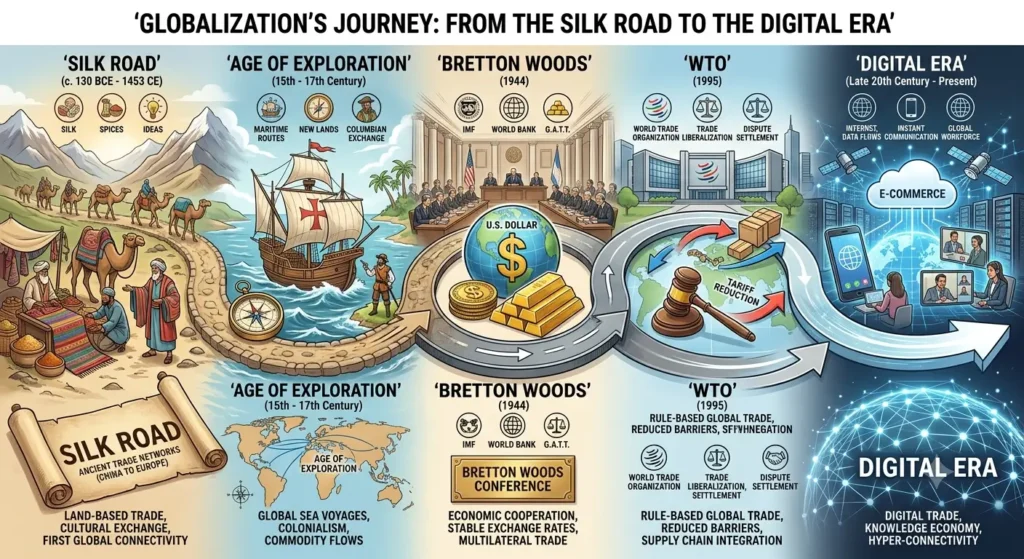
The “globalisation is old” camp points to the Silk Road (1st century BCE onward), which connected China to the Mediterranean through trade, and to the Age of Exploration (15th–17th centuries), when the Columbian Exchange moved crops, people, and diseases between the Old and New Worlds. If globalisation just means “cross-border exchange,” it’s centuries old.
The “globalisation is genuinely new” camp argues that what we have today is different in kind, not just degree — near-instant communication, 24/7 financial markets, and supply chains that span dozens of countries for a single product. Scholars like Anthony Giddens describe this as an intensification of worldwide social relations, where something happening in one place is shaped by events occurring far away, almost in real time — a speed and density of connection earlier eras never had.
For your DU answer: don’t pick one side and stop there. The strongest answers acknowledge historical continuity (trade routes, empires, migration) and explain what’s structurally different about the post-1990s wave — especially the role of digital technology and financial deregulation.
Approaches to Understanding Globalisation
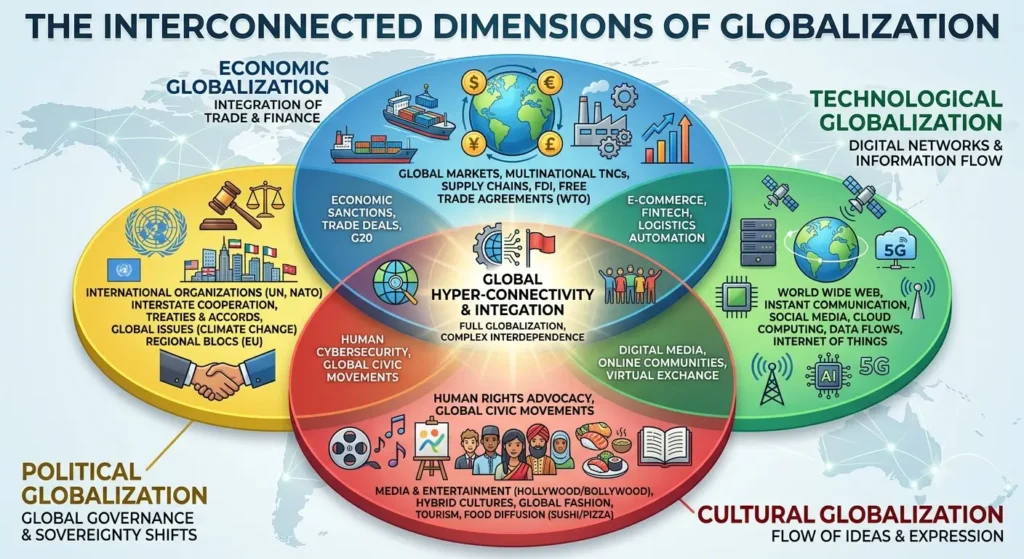
Your syllabus splits globalisation into dimensions rather than giving you one master definition. The four you need to be fluent in:
- Economic globalisation — trade flows, foreign direct investment (FDI), and the rise of multinational corporations operating across borders
- Political globalisation — the growing role of international institutions like the UN, WTO, and IMF in setting rules that individual states then follow (see our detailed GE-7 Unit 4 notes on international institutions for a deep dive)
- Cultural globalisation — the spread of media, language, and consumption patterns, which raises the homogenisation-vs-hybridity question you’ll revisit in Unit 2’s Eurocentrism debate
- Technological globalisation — internet penetration and ICT as both a driver and an outcome of the other three dimensions
A useful concept scholars use here is Roland Robertson’s glocalisation — the idea that global products and ideas don’t simply flatten local cultures; they get adapted to fit local tastes (think how McDonald’s menus differ by country).
The Great Globalisation Debate: Hyperglobalists vs Sceptics vs Transformationalists
This three-way framework is the single most-tested concept in Unit 1. Memorising it as a table (rather than a paragraph) will save you in the exam hall.
| Perspective | Core View | Strength | Main Critique |
|---|---|---|---|
| Hyperglobalist | Globalisation is an irreversible, all-encompassing force; the nation-state’s power is declining as a single global economy emerges | Captures real, far-reaching shifts in trade, finance, and culture | Underestimates how much states still control (taxation, borders, military) |
| Sceptic | Globalisation is exaggerated; the nation-state remains the central actor, and most “global” trade is actually regional | Highlights the continued importance of national policy and sovereignty | Can downplay genuinely new levels of interconnectedness (e.g., instant digital finance) |
| Transformationalist | Globalisation is real but its outcomes are open-ended — states are being reshaped, not erased, and they adapt, resist, or redirect global forces | Most nuanced; avoids the all-or-nothing trap of the other two | Harder to state as a single, quotable thesis in an exam answer |
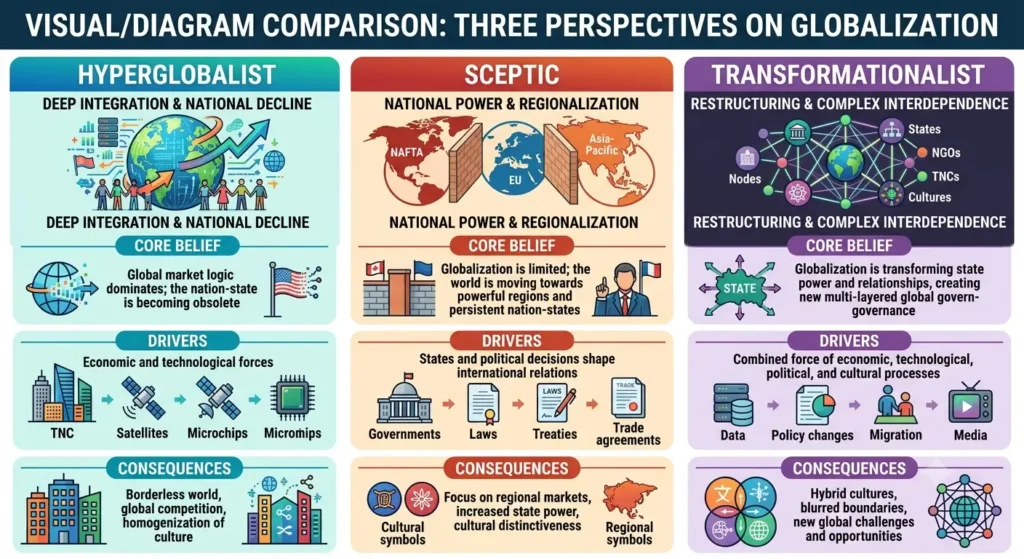
Examiners often ask you to “critically examine” or “compare and contrast” these three — structure your answer exactly like the table above: view, strength, critique, for each.
Dimensions of Globalisation at a Glance
| Dimension | What It Measures | Example Indicator |
|---|---|---|
| Economic | Trade and investment flows | Volume of exports/imports, FDI inflows |
| Political | Cooperation through global institutions | UN/WTO/IMF membership and influence |
| Cultural | Spread and blending of cultural products | Reach of global media, language dominance |
| Technological | Digital connectivity | Internet penetration, ICT infrastructure |
| Social | Movement of people | Migration patterns, diaspora networks |
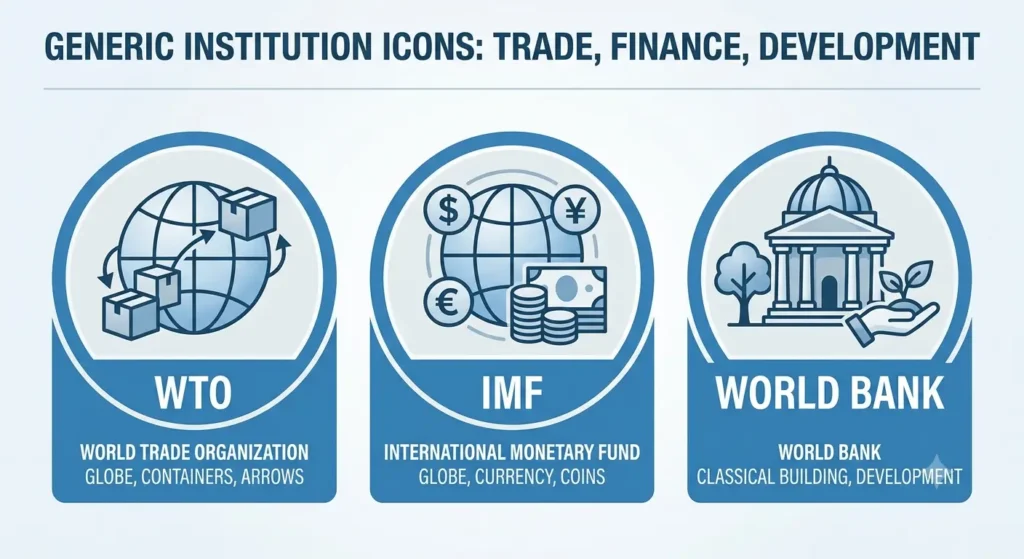
Key Institutions You Must Know for This Unit
You’ll see these referenced constantly in both Unit 1 debates and later units:
- World Trade Organization (WTO) — regulates and facilitates rules of trade between member nations
- International Monetary Fund (IMF) — oversees international monetary cooperation and financial stability
- World Bank — provides financing and policy advice for development projects in poorer countries
- United Nations reporting on globalisation and interdependence — useful for understanding the UN’s own framing of globalisation’s opportunities and risks
For the full institutional breakdown (World Bank, IMF, WTO, G-20 in detail), see our GE-7 Unit 4 notes.
Timeline: Globalisation Through History
- 1st century BCE–14th century CE — Silk Road connects China to the Mediterranean
- 15th–17th centuries — Age of Exploration and the Columbian Exchange
- 1944–1948 — Bretton Woods Conference creates the IMF and World Bank; GATT signed
- 1995 — WTO established, replacing GATT
- 1990s onward — Digital revolution accelerates “contemporary globalisation”
Related Units in This Paper
- GE-7 Unit 2: Globalisation — A Eurocentric Project?
- GE-7 Unit 4: Role of International Institutions
- GE-7 Unit 5: Responses and Resistances to Globalisation
- Browse all Political Science GE notes
DU Previous Year Questions (Unit 1)
- What do you understand by globalisation? Discuss the debate between “globalists” and “sceptics.”
- Is globalisation a new phenomenon, or does it have historical roots? Explain with examples.
- Discuss the international context in which the process of globalisation intensified after the end of the Cold War.
- What is the “great globalisation debate”? Critically examine the hyperglobalist, sceptic, and transformationalist positions.
- Give an account of the political and economic dimensions of globalisation.
- Examine the relationship between the state and the market in the era of globalisation.
- Write a short note on Eurocentrism in the context of globalisation theory. (bridges into Unit 2)
FAQs
Is globalisation a new phenomenon or has it always existed?
Both views have merit. Trade and cultural exchange go back to the Silk Road and earlier, but most scholars agree that the speed, scale, and interconnectedness of today’s globalisation — driven by digital technology and financial integration — is historically unprecedented.
What are the three main perspectives on globalisation for DU exams?
Hyperglobalist (sees an irreversible global economy replacing state power), Sceptic (argues the nation-state remains dominant), and Transformationalist (sees globalisation as real but open-ended in its outcomes).
What is glocalisation?
A term coined in relation to Roland Robertson’s work, describing how global products, ideas, or practices get adapted to local contexts rather than simply erasing them — for example, a global fast-food chain adjusting its menu for regional tastes.
Which institutions are most important for GE-7 Unit 1?
The WTO, IMF, and World Bank are the three you’ll be expected to reference, especially when discussing political and economic dimensions of globalisation.
How should I structure a “compare and contrast” answer on globalisation theories?
Use a table format mentally even if writing in prose: state each perspective’s core view, one strength, and one critique — examiners reward this structure over a single flowing paragraph.
Subscribe to keep reading
You've used your free notes for now. Get Delhi Pathshala Premium for unlimited access.
Subscribe — ₹29/30 days