
Contents
- Peasants Social Movements
- 1. Deccan Riots (1875–1882)
- 2. Champaran Satyagraha (1917)
- 3. Kheda Satyagraha (1918)
- 4. Moplah Rebellion (1921)
- 5. Bardoli Satyagraha (1928)
- 6. Telangana Armed Struggle (1946–1951)
- 7. Naxalite Movement (Late 1960s Onward)
- Key Takeaways: Peasant Movements
- Tribals Social Movements
- 1. The Birsa Movement (1899–1900)
- 2. The All India Adivasi Mahasabha (1938)
- 3. Tana Bhagat Movement (1914–1919)
- 4. Telangana Struggle (1946–1951)
- 5. The Santal Rebellion (1855–56)
- 6. The Bhumkal Rebellion (1910)
- Key Takeaways: Tribal Movements
- Workers Social Movements
- Background: Industrialization and Labor Exploitation
- Formation of Trade Unions
- 1. Bombay Mill Strike (1928)
- 2. Kanpur Textile Workers’ Strike (1930)
- 3. Mazdoor Sabha and Workers’ Unity (1928)
- 4. Formation of All India Trade Union Congress — AITUC (1920)
- 5. Impact of the Great Depression
- 6. Trade Union Act of 1926
- 7. Role of Communist Leaders
- 8. Link with the Nationalist Movement
- Impact and Legacy
- Key Takeaways: Workers’ Movements
- Women’s Social Movements
- 1. Social Reform Movements in the 19th Century
- 2. Women’s Role in the Nationalist Movement
- 3. Women’s Issues and Social Movements
- 4. Women’s Role in Post-1920s Movements
- 5. Post-Independence Period
- 6. Contemporary Women’s Movements
- Key Takeaways: Women’s Movements
- Anti-Caste Movements
- 1. Jyotirao Phule and Satyashodhak Samaj
- 2. Dr. B.R. Ambedkar and the Dalit Movement
- 3. Periyar E.V. Ramasamy and the Self-Respect Movement
- 4. Mahatma Gandhi and the Harijan Movement
- 5. Contemporary Movements
- Key Takeaways: Anti-Caste Movements
- Comparison Table: Movements at a Glance
- DU Previous Year Questions
- FAQs
The Indian national movement was never a single, uniform struggle. Alongside the mainstream Congress-led politics, distinct social movements of peasants, tribals, workers, women, and oppressed castes ran their own parallel struggles — against landlords, colonial revenue policy, industrial exploitation, patriarchy, and caste hierarchy. These movements form a core part of Unit 4 of Nationalism in India (GE syllabus) and are frequently tested in DU exams. This post covers each movement in detail, with a quick-revision comparison table, previous year questions, and FAQs.
Peasants Social Movements
Peasant movements were integral to the Indian nationalist movement, reflecting the socio-economic issues faced by rural communities and their resistance against oppressive land revenue policies, exploitative tenancy systems, and overall agrarian distress.
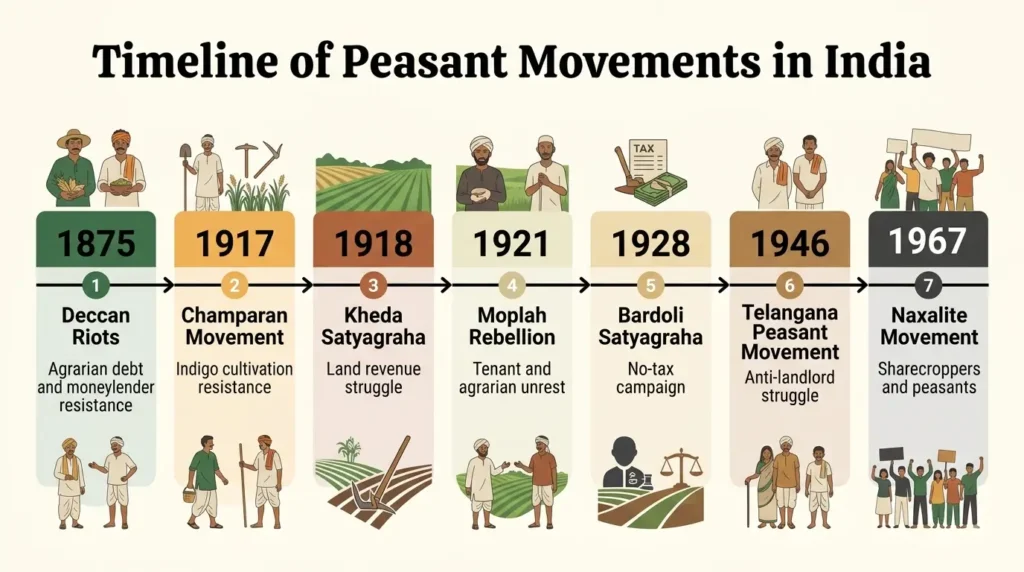
1. Deccan Riots (1875–1882)
Background: The Deccan Riots were a series of agrarian protests in the Bombay Deccan region during the late 19th century. Peasants protested against oppressive revenue collection, increased taxes, and unjust economic policies of moneylenders. Read more on the Deccan Riots on Wikipedia.
Leadership and Outcomes: Leaders like Vasudev Balwant Phadke played a key role in mobilizing peasants. While the movement did not achieve major policy changes, it marked an early expression of rural discontent and led to the Deccan Agriculturists’ Relief Act (1879).
2. Champaran Satyagraha (1917)
Background: Led by Mahatma Gandhi, the Champaran Satyagraha was launched in Bihar against the forced cultivation of indigo (the tinkathia system), oppressive taxes, and exploitation by British planters. More detail: Champaran Satyagraha — Wikipedia.
Leadership and Outcomes: Gandhi’s intervention led to the end of the oppressive indigo cultivation system. The Champaran Satyagraha marked one of Gandhi’s early experiments with nonviolent resistance in India.
3. Kheda Satyagraha (1918)
Background: In Kheda, Gujarat, peasants faced crop failure, and despite this, the British administration demanded full land revenue.
Leadership and Outcomes: Led by Sardar Patel and supported by Gandhi, the Kheda Satyagraha emphasized nonviolent resistance. The British eventually relaxed revenue collection in Kheda due to the peasants’ resilience. Kheda Satyagraha — Wikipedia.
4. Moplah Rebellion (1921)
Background: The Moplah Rebellion, centered in Malabar, Kerala, was a peasant uprising against oppressive landlords and British policies, with both agrarian and religious dimensions. Moplah Rebellion — Wikipedia.
Leadership and Outcomes: The rebellion faced severe repression, and leaders like the Ali brothers were arrested. While it did not achieve its objectives, it marked resistance against social and economic injustices.
5. Bardoli Satyagraha (1928)
Background: The Bardoli Satyagraha, led by Sardar Patel, was a protest against enhanced land revenue rates imposed during a famine. Bardoli Satyagraha — Wikipedia.
Leadership and Outcomes: Sardar Patel’s leadership and the unity of the peasants compelled the British to roll back the increased taxes, showcasing the effectiveness of nonviolent resistance.
6. Telangana Armed Struggle (1946–1951)
Background: A communist-led peasant uprising against feudal landlords in the Telangana region of Hyderabad state. Telangana Rebellion — Wikipedia.
Leadership and Outcomes: Communists played a crucial role; the movement demanded land reforms and social justice, and though it faced repression, it contributed to agrarian reforms in independent India.
7. Naxalite Movement (Late 1960s Onward)
Background: An offshoot of the communist movement, originating in Naxalbari, West Bengal, as a peasant uprising against landlords. Naxalite Movement — Wikipedia.
Leadership and Outcomes: The movement aimed at radical land reforms through armed struggle. It faced severe repression but influenced ongoing debates on land reforms and social justice.
➤ Also see: Formation of All India Kisan Sabha — the umbrella peasant organisation that linked many of these regional struggles nationally (add internal link here once you publish a dedicated Kisan Sabha post).
Key Takeaways: Peasant Movements
Peasant movements during the Indian national movement were diverse, reflecting regional variations and specific socio-economic challenges. They highlighted issues such as oppressive land revenue, exploitative tenancy systems, and broader agrarian distress. Leadership by figures like Gandhi, Patel, and communist leaders shaped the agrarian dimension of nationalism, laying the groundwork for post-independence agrarian reforms.
Tribals Social Movements
Tribal communities in India have a long history of resistance, autonomy, and struggles for their rights, identity, and socio-economic well-being.
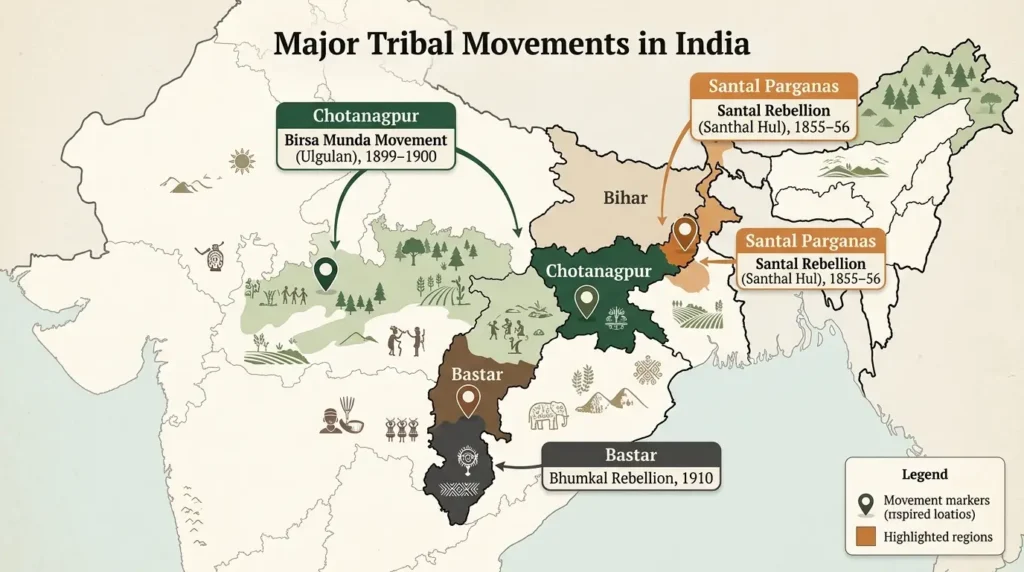
1. The Birsa Movement (1899–1900)
Leader: Birsa Munda | Region: Chotanagpur Plateau (now Jharkhand) Objectives: Resistance against British land policies and revenue systems; assertion of tribal identity and cultural autonomy. Significance: Birsa Munda mobilized the Munda community against the British and missionaries, laying the groundwork for tribal consciousness. Birsa Munda — Wikipedia.
2. The All India Adivasi Mahasabha (1938)
Leaders: Jaipal Singh Munda, Thakkar Bapa, Ram Singh Munda Objectives: Advocacy for tribal rights and protection of tribal lands; representation of tribal interests in legislative bodies. Significance: Jaipal Singh Munda advocated for tribal representation in the Constituent Assembly.
3. Tana Bhagat Movement (1914–1919)
Leaders: Jatra Oraon, Dharanidhar Oraon | Region: Bihar (now Jharkhand) Objectives: Resistance against moneylenders and oppressive practices; promotion of socio-religious reforms. Significance: A socio-religious movement emphasizing worship of one God and rejection of social evils.
4. Telangana Struggle (1946–1951)
Region: Telangana, Hyderabad state Objectives: Peasant and tribal uprising against feudal landlords and the Nizam’s rule; demands for land reforms. Significance: Tribals actively participated alongside peasants, with a profound impact on land relations.
5. The Santal Rebellion (1855–56)
Leaders: Sidhu and Kanhu Murmu | Region: Santal Parganas (now Jharkhand) Objectives: Opposition to oppressive British revenue policies and encroachment of tribal lands. Santal Hul — Wikipedia. Significance: One of the earliest documented tribal uprisings against British colonial policies.
6. The Bhumkal Rebellion (1910)
Region: Bastar, Chhattisgarh Objectives: Opposition to oppressive forest laws and taxation; assertion of tribal rights over forest resources. Significance: Protest against exploitation of tribal communities by British officials and non-tribal settlers.
Key Takeaways: Tribal Movements
Tribal social movements reflected the unique challenges faced by different communities across regions, seeking to protect rights, assert cultural autonomy, and resist economic exploitation. Many of these struggles continue to shape tribal identity and policy discourse in contemporary India.
Workers Social Movements
The workers’ movements were crucial components of the broader struggle against British colonial rule, addressing exploitation and inequality inherent in the colonial industrial system.
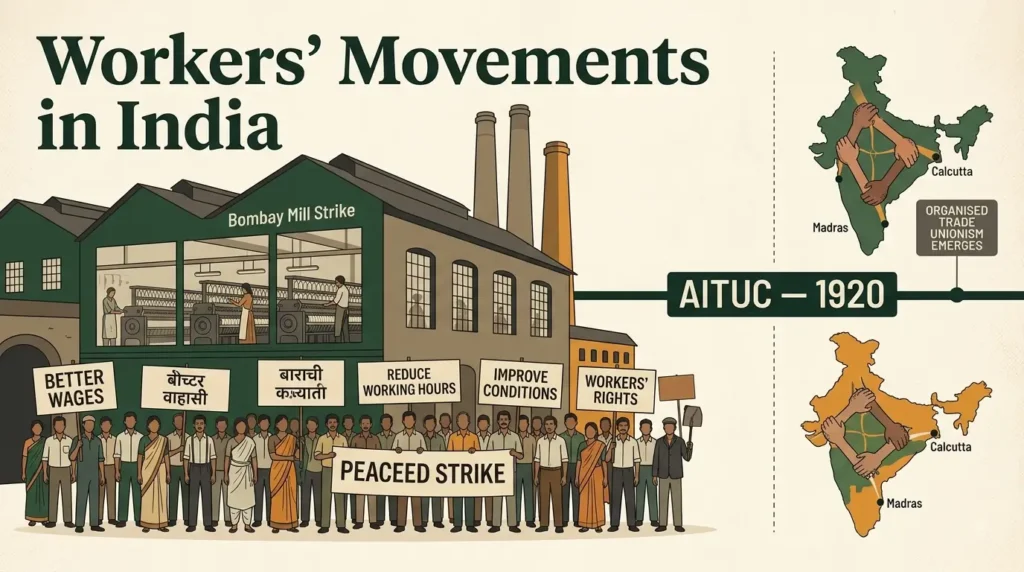
Background: Industrialization and Labor Exploitation
The advent of industrialization under British rule led to the growth of factories and industries. Workers, both in factories and agricultural settings, faced harsh working conditions, low wages, and lack of basic rights.
Formation of Trade Unions
The early 20th century witnessed the formation of trade unions to address workers’ grievances. Leaders like N.M. Lokhande and N.M. Joshi played significant roles in organizing workers.
1. Bombay Mill Strike (1928)
One of the earliest and most significant workers’ strikes occurred in the textile mills of Bombay in 1928. Workers demanded better wages, improved working conditions, and recognition of their right to organize.
2. Kanpur Textile Workers’ Strike (1930)
Textile workers in Kanpur went on strike demanding an eight-hour workday and higher wages — a strike that had a profound impact on workers’ movements across the country.
3. Mazdoor Sabha and Workers’ Unity (1928)
Mazdoor Sabha played a crucial role in uniting workers across different industries; workers’ unity became a rallying cry against exploitation.
4. Formation of All India Trade Union Congress — AITUC (1920)
Leaders like Lala Lajpat Rai and Joseph Baptista formed the AITUC, which became a platform for workers to voice concerns and press for rights.
5. Impact of the Great Depression
The Great Depression of the 1930s exacerbated economic hardships, leading to increased worker discontent and more frequent strikes.
6. Trade Union Act of 1926
This Act legalized the formation of trade unions and granted them legal recognition, providing workers a more organized means to negotiate with employers.
7. Role of Communist Leaders
Communist leaders, including S.A. Dange and Shaukat Usmani, actively participated in workers’ movements, advocating for a socialist transformation of society.
8. Link with the Nationalist Movement
Workers’ movements were closely linked to the broader nationalist movement. Trade unions aligned with the Indian National Congress and other political entities.
Impact and Legacy
The workers’ movements highlighted the need for labor rights, better working conditions, and fair wages, contributing to the eventual recognition of workers’ rights in independent India, and influencing post-independence labor laws around industrial disputes and conditions of employment. Workers’ movements have continued post-independence, addressing minimum wages, social security, and labor rights.
Key Takeaways: Workers’ Movements
The social movements of workers were pivotal in addressing exploitative colonial-era conditions. They contributed to the broader struggle for independence while laying the foundation for the recognition of workers’ rights in independent India’s socio-economic fabric.
Women’s Social Movements
Women played a crucial role in the Indian national movement, contributing significantly to movements addressing gender inequality, social reform, and political rights.
1. Social Reform Movements in the 19th Century
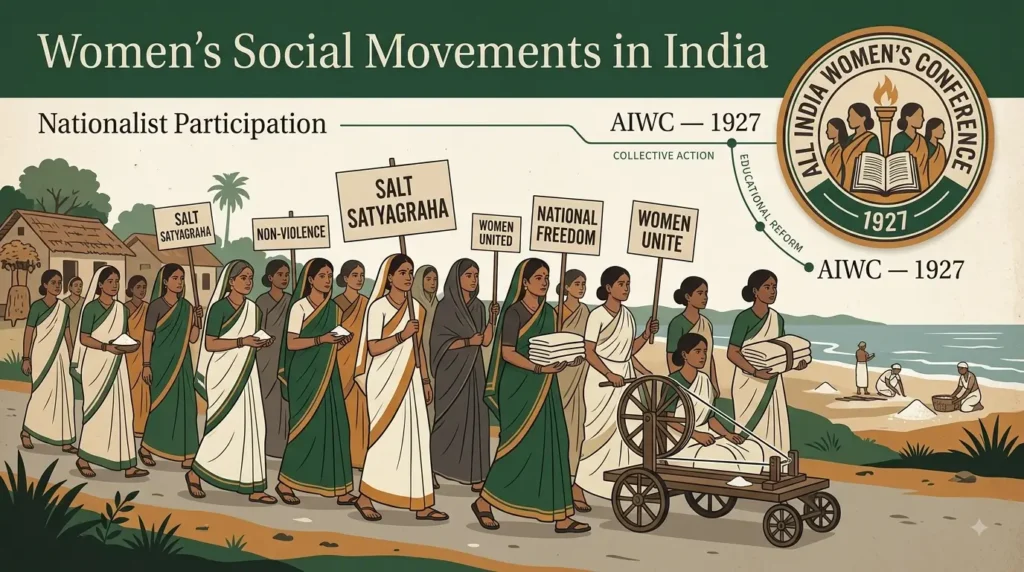
Raja Ram Mohan Roy’s Efforts: Advocated for women’s education and the abolition of practices like Sati. Formation of Women’s Organizations: Women actively participated in social reform movements — the Banga Mahila Samiti (1863) in Bengal and Poona Seva Sadan (1909) in Maharashtra were among the early women’s organizations.
2. Women’s Role in the Nationalist Movement
Formation of Women’s Associations: The All India Women’s Conference (AIWC) was established in 1927 to address social issues and promote women’s participation in the nationalist movement. Participation in Nonviolent Protests: Prominent women leaders like Sarojini Naidu and Annie Besant were actively involved in marches, picketing, and civil disobedience campaigns.
3. Women’s Issues and Social Movements
Abolition of Purdah System: Reformers like Begum Rokeya Sakhawat Hossain advocated for the abolition of purdah. Anti-Child Marriage Movement: Activists including Rukhmabai worked against child marriage and for raising the age of consent. Women’s Education: Leaders like Pandita Ramabai and Fatima Sheikh played key roles in promoting girls’ education. Temperance Movements: Women actively participated in temperance movements against alcoholism.
4. Women’s Role in Post-1920s Movements
Salt Satyagraha and Civil Disobedience: Women made significant contributions to the Salt Satyagraha (1930) and Civil Disobedience Movement (1930–1934). Quit India Movement (1942): Women played a vital role in protests, strikes, and underground activities.
5. Post-Independence Period
Constitutional Rights: The Indian Constitution (1950) provided women with constitutional rights and equal opportunities. Legal Reforms: The Dowry Prohibition Act (1961) and Equal Remuneration Act (1976) addressed women’s issues. Reservation for Women: Reservation in Panchayati Raj gave women political representation.
6. Contemporary Women’s Movements
Contemporary movements focus on violence against women, sexual harassment, and gender inequality — the “Nirbhaya” protests of 2012 highlighted the need for stronger safety measures, alongside ongoing emphasis on women’s economic empowerment.
Key Takeaways: Women’s Movements
Women’s involvement in social movements was multifaceted — spanning social reform, nationalist struggle, and post-independence advocacy for gender equality and justice, shaping India’s socio-political landscape at every stage.
Anti-Caste Movements
Anti-caste movements addressed social inequality, discrimination, and the caste-based hierarchy prevalent in Indian society, with reformers advocating for the annihilation of caste.
1. Jyotirao Phule and Satyashodhak Samaj
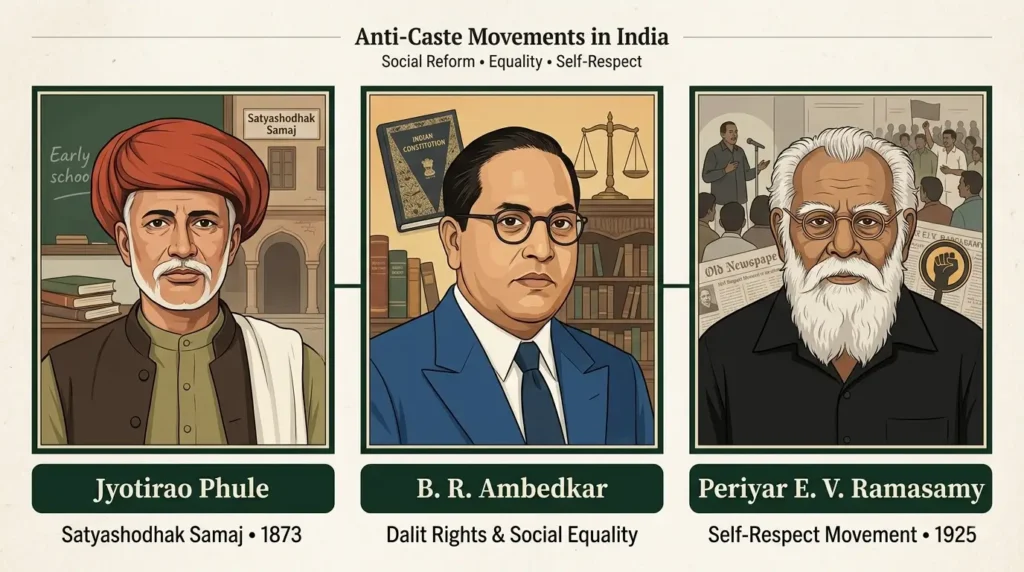
Initiation: Jyotirao Phule founded the Satyashodhak Samaj in 1873, challenging Brahminical dominance and promoting education for all, regardless of caste. Key Principles: Advocated for upliftment of oppressed castes and abolition of untouchability. Contributions: Phule’s work laid the foundation for future anti-caste movements.
2. Dr. B.R. Ambedkar and the Dalit Movement
Dalit Conference (1916): Ambedkar organized the Bahishkrit Hitakarini Sabha in 1924 for the welfare of untouchables. Mahad Satyagraha (1927): Dalits asserted their right to access water from a public tank in Mahad, Maharashtra. Poona Pact (1932): Ambedkar negotiated the Poona Pact with Gandhi, ensuring reserved seats for Dalits in legislatures.
3. Periyar E.V. Ramasamy and the Self-Respect Movement
Formation of Dravidar Kazhagam (1944): Periyar founded the Dravidar Kazhagam, promoting self-respect and challenging Brahminical dominance. Rationalism and Social Justice: The Self-Respect Movement sought to eradicate caste discrimination and promote rational thinking and equality.
4. Mahatma Gandhi and the Harijan Movement
Harijan Sevak Sangh (1932): Gandhi worked for the welfare of Dalits, whom he referred to as “Harijans.” Temple Entry Movements: Gandhi supported the right of Dalits to enter temples and worship freely. Critique: Gandhi’s approach was criticized by some for not radically challenging the underlying Varna system.
5. Contemporary Movements
Dalit Panther Movement (1972): Emerged in Maharashtra, inspired by the Black Panther Party in the US, addressing discrimination and marginalization. Ambedkarite Movement: Continues to advocate for Dalit rights and dignity, emphasizing Ambedkar’s teachings.
Key Takeaways: Anti-Caste Movements
Anti-caste movements challenged the deeply entrenched caste system, advocating for social justice, equality, and the annihilation of untouchability. Leaders like Phule, Ambedkar, and Periyar laid the foundation for a more inclusive and egalitarian India — a conversation that continues to shape caste-related discourse today.
Comparison Table: Movements at a Glance
| Movement | Leader(s) | Year | Region | Key Outcome |
|---|---|---|---|---|
| Deccan Riots | Vasudev Balwant Phadke | 1875–82 | Bombay Deccan | Deccan Agriculturists’ Relief Act (1879) |
| Champaran Satyagraha | M.K. Gandhi | 1917 | Bihar | End of indigo tinkathia system |
| Kheda Satyagraha | Sardar Patel, Gandhi | 1918 | Gujarat | Revenue relief for peasants |
| Bardoli Satyagraha | Sardar Patel | 1928 | Gujarat | Rollback of enhanced revenue |
| Birsa Movement | Birsa Munda | 1899–1900 | Chotanagpur | Tribal identity assertion |
| Santal Rebellion | Sidhu, Kanhu Murmu | 1855–56 | Santal Parganas | Earliest tribal uprising vs. British |
| Bombay Mill Strike | Trade unions | 1928 | Bombay | Push for workers’ rights |
| AITUC formed | Lala Lajpat Rai | 1920 | All-India | National labour platform |
| AIWC formed | Sarojini Naidu & others | 1927 | All-India | Women’s political voice |
| Mahad Satyagraha | Dr. B.R. Ambedkar | 1927 | Maharashtra | Dalit right to public water access |
| Poona Pact | Ambedkar, Gandhi | 1932 | All-India | Reserved seats for Dalits |
| Self-Respect Movement | Periyar E.V. Ramasamy | 1944 | Tamil Nadu | Anti-Brahminical social reform |
DU Previous Year Questions
(Format matches DU BA Political Science GE — Nationalism in India exam pattern)
DU Previous Year Questions
Frequently asked questions from DU exam papers on this topic. Tap a question to view a quick-answer guide.
1 Discuss the nature and significance of peasant movements during the Indian national movement. +
2 Examine the role of tribal movements in shaping resistance against colonial rule. +
3 Analyse the growth of the working-class movement in colonial India and its relationship with the nationalist movement. +
4 Examine the role played by Indian women in the nationalist movement. +
5 Write a short note on the Poona Pact (1932). +
6 What was the Satyashodhak Samaj? +
7 Write a short note on the Self-Respect Movement. +
8 “Anti-caste movements were as central to Indian nationalism as the freedom struggle itself.” Discuss. +
Continue Reading — [Unit/Course label yahan likho]
FAQs
What are the five major categories of social movements covered in Unit 4 of Nationalism in India?
Peasant movements, tribal movements, workers’ movements, women’s movements, and anti-caste movements.
Who led the Champaran Satyagraha and why is it significant?
Mahatma Gandhi led the Champaran Satyagraha in 1917 against the forced indigo cultivation system. It is significant as one of Gandhi’s first experiments with organised nonviolent resistance in India.
What was the significance of the Poona Pact of 1932?
The Poona Pact, negotiated between Dr. B.R. Ambedkar and Mahatma Gandhi, ensured reserved legislative seats for Dalits, replacing the separate electorate proposed under the Communal Award.
What distinguished tribal movements from mainstream peasant movements?
Tribal movements, such as the Birsa Movement and Santal Rebellion, combined economic grievances (land, forest rights) with a strong assertion of distinct cultural identity and autonomy — a dimension less central to general peasant uprisings.
What role did the AITUC play in the workers’ movement?
Formed in 1920 by leaders including Lala Lajpat Rai, the All India Trade Union Congress became the first national platform uniting workers across industries to press for labour rights.
Which organisation represented Indian women at the national level during the freedom struggle?
The All India Women’s Conference (AIWC), established in 1927, represented women’s interests and promoted their participation in the nationalist movement.
Subscribe to keep reading
You've used your free notes for now. Get Delhi Pathshala Premium for unlimited access.
Subscribe — ₹29/30 days