
Contents
- Women’s Movement in Colonial Period
- Social reform movements and women’s issues
- Women’s participation in the nationalist movement in India
- Impact of colonialism and modernity on women’s status and identity
- Women’s Movement in Post-Independence Period
- The constitutional and legal framework for women’s rights
- The emergence and evolution of the women’s movement
- The major issues and campaigns of the women’s movement
- Women’s Movement in Contemporary Period
- Diversity and intersectionality
- Role in democratic politics
- Comparison Table: Waves of the Women’s Movement in India
- Previous Year Questions (DU GE-9)
- FAQs
The women’s movement in India did not begin as a single, organised campaign — it grew out of the 19th-century social reform movement, was carried forward by women themselves during the freedom struggle, and matured into a rights-based movement after Independence. This unit traces that journey in three broad phases: the colonial period, the post-Independence period, and the contemporary period — exactly as required for your GE-9 exam.
Women’s Movement in Colonial Period
Social reform movements and women’s issues
The roots of the women’s movement in India lie in the 19th-century social reform movement, led largely by male reformers who brought women’s issues into public debate for the first time.
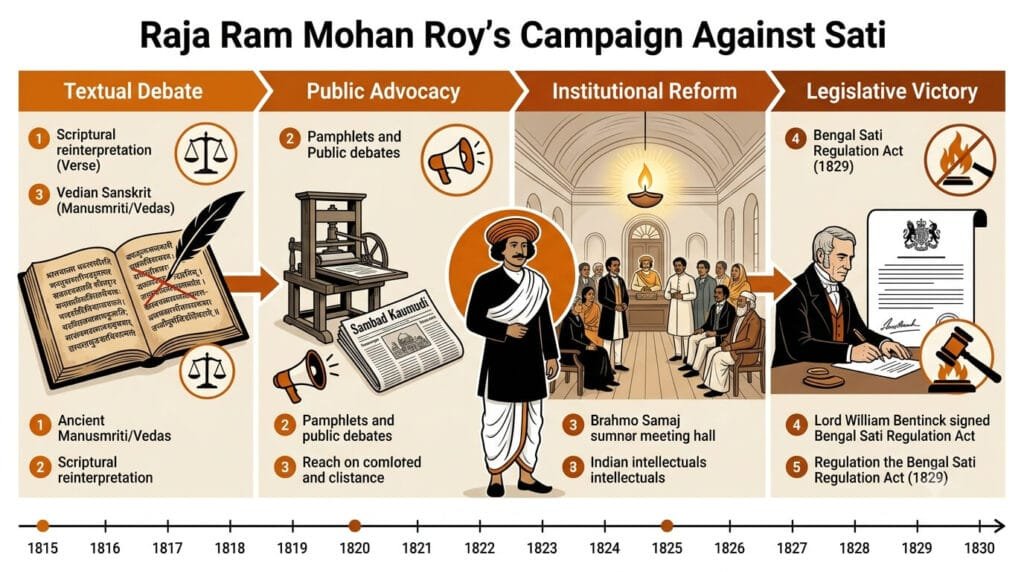
- Raja Ram Mohan Roy and the Abolition of Sati Roy campaigned against sati through writings and speeches from 1818 onwards. His efforts led the East India Company to declare sati illegal and punishable in 1829. He also opposed child marriage and polygamy, and advocated female education and property rights for women. His organisation, the Brahmo Samaj, institutionalised many of these reforms.
- Ishwar Chandra Vidyasagar and Widow Remarriage Vidyasagar’s campaign led to the Hindu Widows’ Remarriage Act, 1856, and he was a strong advocate of formal education for girls.
- Early Women’s Organisations
- Sakhi Samiti (1882) — founded by Swarna Kumari Devi (Rabindranath Tagore’s sister); later became a craft centre for widows.
- Bharat Mahila Parishad, Bharat Stri Mahamandal, Women’s Indian Association (WIA), National Council of Women in India (NCWI) — organised at the national level to demand education, legal reform, and voting rights.
- Women Reformers
- Savitribai Phule — often regarded as India’s first modern feminist; opened the first school for girls in Pune (1848) with Jyotirao Phule.
- Pandita Ramabai — pioneer of women’s education and widow welfare.
- Tarabai Shinde — author of Stri Purush Tulana (1882), an early feminist critique of patriarchy.
- Begum Rokeya Sakhawat Hossain — pioneer of Muslim women’s education in Bengal.
- Key Issues Addressed Sati, child marriage, purdah (seclusion), dowry, widow remarriage, and access to education were the central concerns of this era — not to be confused with the Western first-wave/second-wave feminist timeline, which followed a different trajectory (see comparison table below for how they differ).
Women’s participation in the nationalist movement in India
Women moved from being subjects of reform to agents of political change during the freedom struggle.
- Leadership Roles — Sarojini Naidu, Annie Besant, Kamala Nehru, and Aruna Asaf Ali held key positions in the Indian National Congress (INC) and the All India Women’s Conference (AIWC), founded in 1927.
- Mass Movements — Large-scale participation in the Non-Cooperation Movement (1920–22) and Civil Disobedience Movement (1930–34).
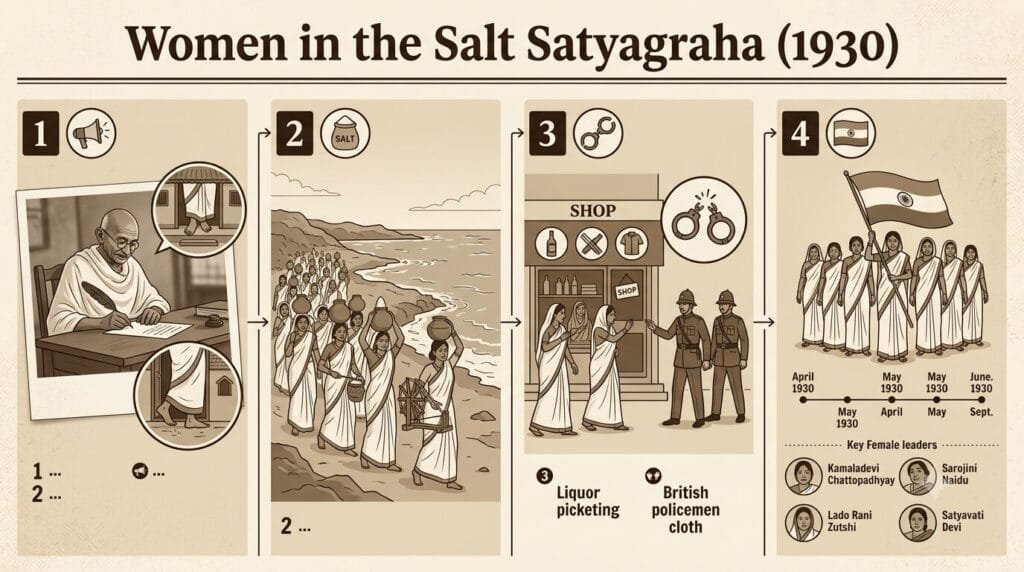
- Salt Satyagraha (1930) — Kasturba Gandhi and many others joined Gandhi’s march to the Arabian Sea in defiance of the salt tax.
- Quit India Movement (1942) — Aruna Asaf Ali and Usha Mehta organised underground resistance and radio broadcasts.
- Boycott of Foreign Goods — Women popularised khadi as a symbol of swadeshi resistance.
- Constituent Assembly — Post-1947, women such as Sarojini Naidu, Hansa Mehta, and Durgabai Deshmukh contributed to drafting the Indian Constitution.
Impact of colonialism and modernity on women’s status and identity
Colonialism reshaped patriarchal structures — colonial law brought some legal protection but rarely challenged deep-rooted gender norms, and women’s labour was frequently undervalued in the colonial economy. Anti-colonial resistance, however, also empowered many women and gave rise to early feminist consciousness.
Modernity expanded access to education and employment, altered family structures, and enabled legal reform in marriage and inheritance — though implementation remained uneven and often created tension between traditional and modern expectations for women.
Women’s Movement in Post-Independence Period
The constitutional and legal framework for women’s rights
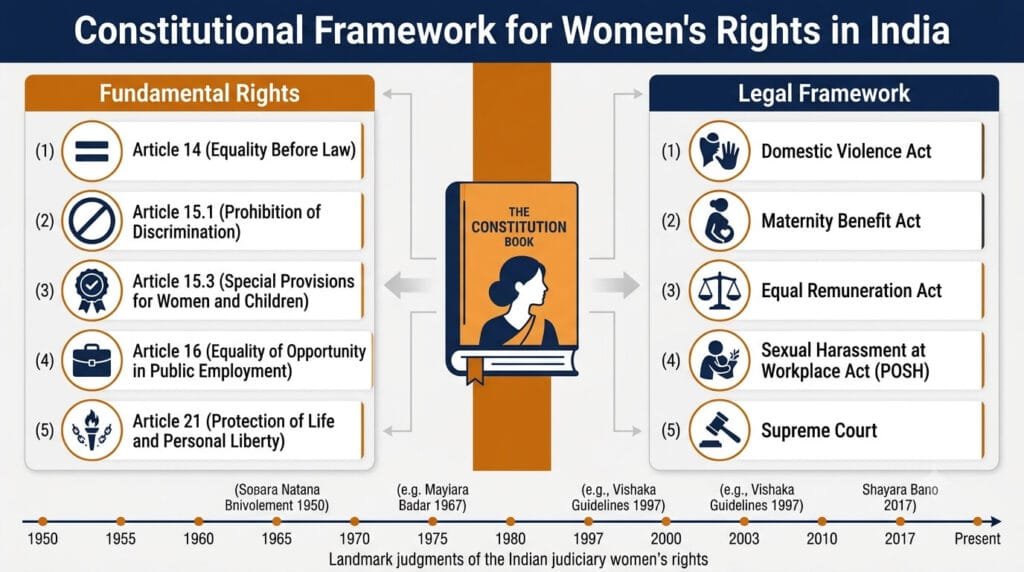
- Constitutional Guarantees — Article 14 (equality before law), Article 15 (prohibition of discrimination), Article 16 (equality of opportunity), and Article 15(3) (special provisions for women and children).
- Key Legislation — Hindu Marriage Act (1955), Hindu Succession Act (1956), Dowry Prohibition Act (1961), Maternity Benefit Act (1961), Medical Termination of Pregnancy Act (1971), Protection of Women from Domestic Violence Act (2005), Sexual Harassment of Women at Workplace (POSH) Act (2013).
- International Commitments — India ratified the CEDAW (Convention on the Elimination of All Forms of Discrimination Against Women) in 1993.
- Political Reservation — 73rd and 74th Constitutional Amendments (1992) reserved one-third seats for women in panchayats and municipalities; the Nari Shakti Vandan Adhiniyam (2023) provides for 33% reservation for women in the Lok Sabha and state assemblies.
The emergence and evolution of the women’s movement
Post-Independence lull (1950s–60s): With the “common enemy” of colonial rule gone, the movement fragmented; gender discrimination was not yet seen as a distinct issue from broader socio-economic struggles.
First Wave (1970s–80s):
- The Towards Equality Report (1974), prepared by the Committee on the Status of Women in India (authored by Vina Mazumdar and Lotika Sarkar), is widely regarded as the document that relaunched the women’s movement in independent India — it exposed declining sex ratios and pushed women-sensitive policymaking onto the national agenda.
- The Emergency (1975–77) saw women’s groups resist authoritarian rule.
- The Mathura rape case (1979) triggered nationwide protests and led to the Criminal Law (Amendment) Act, 1983, reforming rape laws.
Second Wave (1980s–90s):
- The Shah Bano case (1985) sparked debate on Muslim women’s rights and the Uniform Civil Code.
- The Vishakha Guidelines (1997), arising from a Supreme Court judgment, laid down the first framework against workplace sexual harassment (later codified as the POSH Act, 2013).
- Global influence from the Beijing Conference (1995).
Third Wave (2000s–present):
- Focus on intersectionality — caste, class, religion, and sexuality within the gender question.
- The Nirbhaya case (2012) led to the Criminal Law (Amendment) Act, 2013, and the Justice Verma Committee reforms.
- The #MeToo movement in India (2018) brought renewed attention to workplace harassment.
- Rise of digital/online activism.
The major issues and campaigns of the women’s movement
- Dowry and dowry deaths — legal reform and social campaigns against the practice.
- Violence against women — domestic violence, sexual assault, and trafficking (Mathura 1979, Nirbhaya 2012).
- Reproductive rights and health — access to safe abortion, family planning, maternal health.
- Reservation for women — political representation debates culminating in the 2023 Reservation Act.
- Triple Talaq and Uniform Civil Code — debates on religion-neutral personal law (Triple Talaq criminalised in 2019).
- Unpaid labour, care work, and sex work — a core Unit 6 theme in your GE-9 syllabus; see our detailed notes on Women and Labour: Unpaid Work, Reproductive and Care Work, Sex Work
Women’s Movement in Contemporary Period
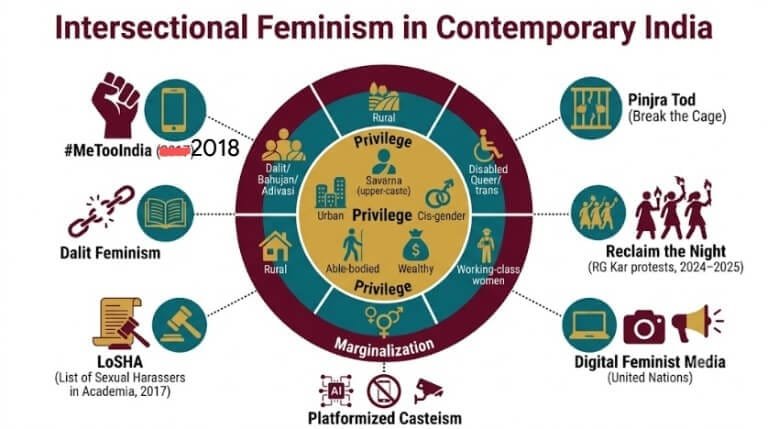
Diversity and intersectionality
Contemporary women’s movements in India are shaped by caste (Dalit and Adivasi women’s movements), religion (personal law debates), class (urban vs rural concerns — land rights vs workplace pay gaps), and sexuality (overlap with the LGBTQ+ rights movement).
Role in democratic politics
Women’s movements continue to influence legislation (dowry, domestic violence, POSH), push for greater political representation, and hold the state accountable for implementing gender-related policy — often through grassroots panchayat-level participation as well as national advocacy.
Comparison Table: Waves of the Women’s Movement in India
| Phase | Time Period | Key Focus | Landmark Events |
|---|---|---|---|
| Social Reform Era | 19th century | Sati, widow remarriage, education | Abolition of Sati (1829), Widow Remarriage Act (1856) |
| Nationalist Phase | 1920s–1947 | Political participation, suffrage | Salt Satyagraha (1930), Quit India (1942) |
| Post-Independence Lull | 1950s–60s | Nation-building, fragmented activism | Constitution adopted (1950) |
| First Wave | 1970s–80s | Legal inequality, violence | Towards Equality Report (1974), Mathura Case (1979) |
| Second Wave | 1980s–90s | Personal law, workplace harassment | Shah Bano Case (1985), Vishakha Guidelines (1997) |
| Third Wave | 2000s–present | Intersectionality, digital activism | Nirbhaya Case (2012), #MeToo India (2018) |
Previous Year Questions (DU GE-9)
Based on past GE Political Science (“Women and Politics in India: Concepts and Debates”) examination papers and syllabus emphasis.
Confirmed past-paper question:
- Discuss the women’s movement in India since the 1970s and explain its impact on women’s rights. (long-answer, appeared in a past DU exam)
Likely/practice questions based on exam pattern and syllabus weightage:
- Trace the emergence and evolution of the women’s movement in India from the colonial to the post-Independence period.
- Examine the role of women in India’s nationalist movement.
- What was the significance of the Towards Equality Report (1974) for the Indian women’s movement?
- Discuss the impact of the Shah Bano case and the Mathura rape case on legal reform in India.
- Write short notes on: (a) Vishakha Guidelines (b) 73rd Constitutional Amendment (c) #MeToo movement in India.
- How does intersectionality shape the contemporary women’s movement in India?
FAQs
Who started the women’s movement in India?
The women’s movement in India was pioneered by reformers such as Raja Ram Mohan Roy and Ishwar Chandra Vidyasagar in the 19th century, and carried forward by women themselves — notably Savitribai Phule, Tarabai Shinde, and Begum Rokeya Sakhawat Hossain.
Who was the first feminist in India?
Savitribai Phule is widely regarded as India’s first feminist — a 19th-century social reformer and educator who opened the first school for girls in India.
What was the Towards Equality Report?
It was the 1974 report of the Committee on the Status of Women in India, which exposed declining sex ratios and discriminatory practices, and is credited with relaunching the women’s movement in independent India.
What is the difference between the women’s movement in India and the West?
The Indian movement began with male-led social reform against practices like sati and child marriage in the 19th century, was shaped by the anti-colonial struggle, and only became autonomous and rights-focused after the 1974 Towards Equality Report — unlike the West, where suffrage-led first-wave feminism began independently of an anti-colonial movement.
What is the significance of the Vishakha Guidelines?
Issued by the Supreme Court in 1997, they were India’s first legal framework against sexual harassment at the workplace, later formalised as the POSH Act, 2013.
Related Notes (GE-9 — Women and Politics in India):
- Nature of Law, State for Women and Women’s Rights notes
- (GE-9) Unit-5: Violence Against Women
- BA (Hons.) Political Science — Full Notes
- DU Syllabus 2026-27
External References (for further reading — link out to these):
Subscribe to keep reading
You've used your free notes for now. Get Delhi Pathshala Premium for unlimited access.
Subscribe — ₹29/30 days