
Contents
- About the Author
- Biography of Amrita Pritam
- Famous Works by Amrita Pritam
- Importance in Literature
- About the “I Say unto Waris Shah” Poem
- Title and Original Language
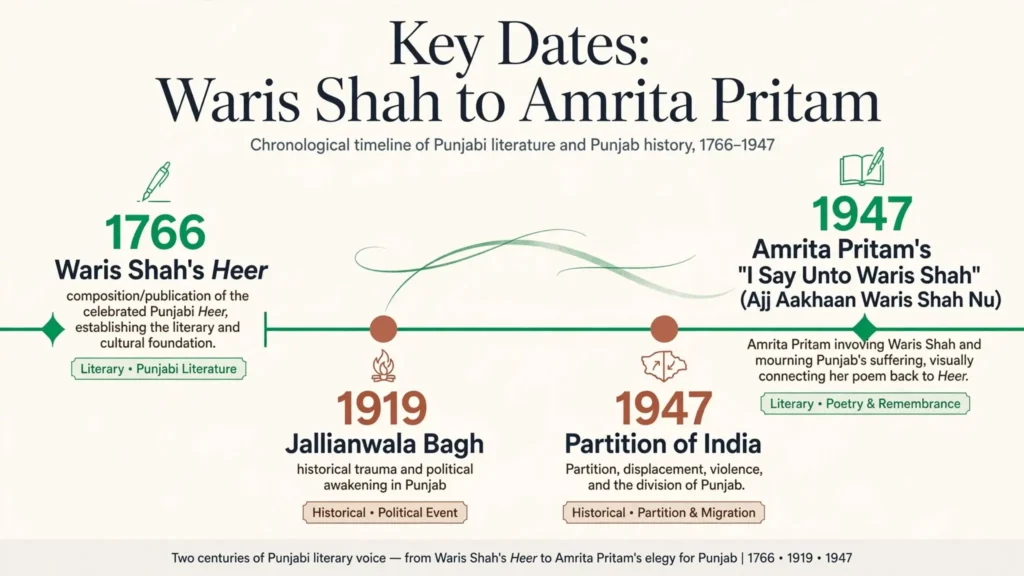
- When was it written and published?
- Historical Context: Partition in Punjab
- Who was Waris Shah, and why Heer Ranjha?
- Key Facts
- I Say unto Waris Shah Summary
- Short summary
- Movement-by-movement summary
- Key lines
- Explanation
- Analysis of I Say unto Waris Shah
- Characters and Voices in the Poem
- Themes of I Say unto Waris Shah
- Symbols in the Poem
- Critical Analysis
- Form: lament, refrain and ring composition
- Literary techniques
- Literary Style
- Narrative Technique
- Translation matters: the DSC-12 angle
- Critical debates and reception
- Historical and contemporary perspective
- Limitations and criticisms
- Comparing the Poem with Other Partition Texts
- Conclusion
- Continue Reading
- University of Delhi Previous Year Questions
- Frequently Asked Questions
- References and Further Reading
I Say unto Waris Shah is the English title of Amrita Pritam’s Punjabi poem Ajj Aakhaan Waris Shah Nu, a lament for Punjab addressed to the eighteenth-century poet who gave Punjabi its best-loved version of the Heer–Ranjha romance. Pritam composed it in the closing months of 1947, when she was a refugee travelling by train after the Partition of Punjab. In this post you will find the poem’s background, a movement-by-movement summary, characters, themes, symbols, literary techniques, the debates around it, Delhi University-style questions and FAQs.
For Delhi University students, the poem belongs to BA (Hons.) English, Semester 4, DSC-12: Indian Writing in English Translation, Unit III, where it is read along with Thangjam Ibopishak Singh’s poems and Joseph Macwan’s The Stepchild. The prescribed text is N.S. Tasneem’s translation, printed in Modern Indian Literature: An Anthology (ed. K.M. George, vol. 3, Sahitya Akademi, 1992), according to the University of Delhi’s Semester IV syllabus document. You will also see the poem called “Today I Say unto Waris Shah”, “To Waris Shah”, “Today I Invoke Waris Shah” or “Ode to Waris Shah”. These are all the same poem under different translated titles.
About the Author
Biography of Amrita Pritam
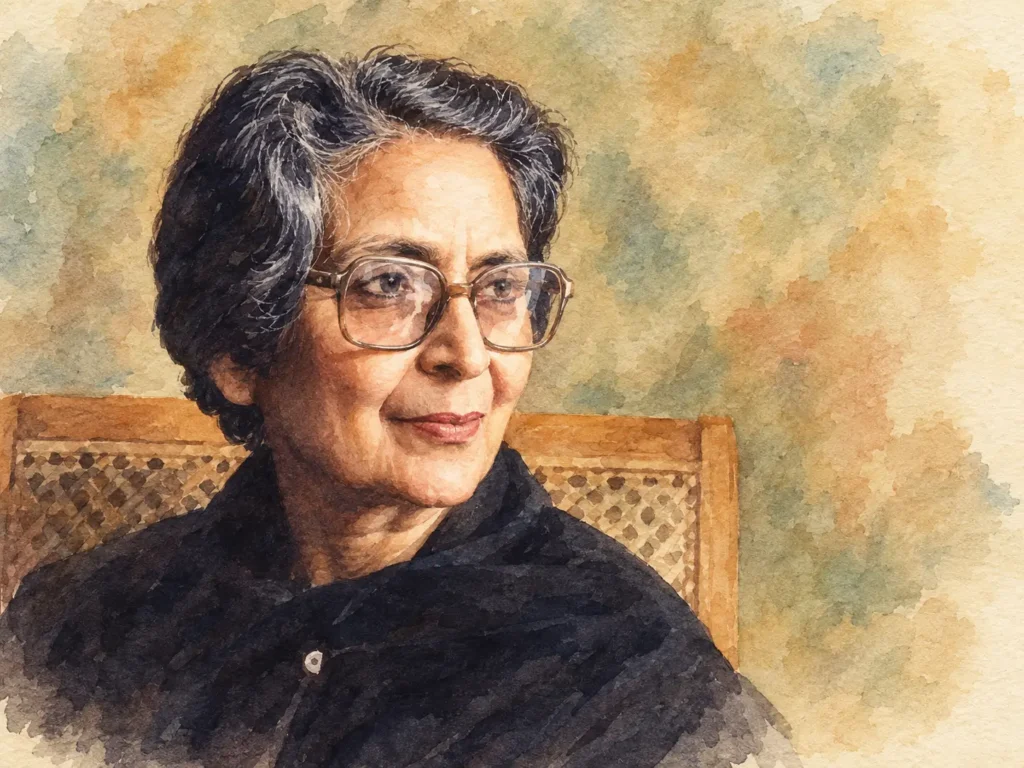
Amrita Pritam was born on 31 August 1919 in Gujranwala, in what was then British Punjab and is now Pakistan, and she died in Delhi on 31 October 2005. She grew up in Lahore, where she began publishing as a teenager; her first collection, Thandian Kirnan, appeared in 1935 when she was fourteen. In August 1947 she had to leave Lahore with her two small children and almost nothing else. She spent a period in Dehradun, then moved to Delhi, where she lived and worked for the rest of her life, including a long stint at the Punjabi service of All India Radio until 1961.
Her own account of that year, in her autobiography Raseedi Ticket (English: The Revenue Stamp), is the key to this poem. She describes a night train journey on which she felt the wind wailing over the sorrow Partition had brought, and says that words from Waris Shah’s Heer kept returning to her mind. The poem took shape there. (This account is quoted and discussed in Nirupama Dutt’s 2017 article on Scroll.in, listed in the references below.)
Famous Works by Amrita Pritam
Pritam wrote in Punjabi and Hindi and produced well over a hundred books of poetry, fiction, essays, biography and autobiography. Some works worth knowing for exams:
- Ajj Aakhaan Waris Shah Nu (1947): the poem in these notes, and the work she is most widely remembered for.
- Sunehade (also spelt Suneray): the poetry collection that won her the Sahitya Akademi Award in 1956.
- Pinjar (The Skeleton, 1950): her Partition novel, centred on the character Puro and on violence against women. It was adapted into the film Pinjar (2003).
- Raseedi Ticket (The Revenue Stamp): her autobiography.
Honours include the Padma Shri (1969), the Bharatiya Jnanpith Award (1981) and the Padma Vibhushan (2004). She was also a nominated member of the Rajya Sabha from 1986 to 1992.
Importance in Literature
Pritam is central to twentieth-century Punjabi literature and to Partition writing in India. Her early poetry was romantic and progressive in tone; after 1947 her work turned increasingly towards women’s experience of violence, loss and displacement. She wrote in a period when few women were allowed a public voice, and she used it plainly and often at a personal cost. Nirupama Dutt calls her a pioneering woman poet of Punjabi, which is a safer description than the often-repeated claim that she was “the first” woman Punjabi poet.
About the “I Say unto Waris Shah” Poem
Title and Original Language
The poem is in Punjabi. Its first line, Ajj aakhaan Waris Shah nu, kitton qabraan vichon bol, is usually rendered as “Today I call upon Waris Shah: speak from within the graves.” The poem was written in Punjabi and is regularly reproduced in both the Gurmukhi and Shahmukhi scripts, which is part of why it belongs to Punjabis on both sides of the border. English versions exist by several translators, including N.S. Tasneem (the DU text), Khushwant Singh, Nirupama Dutt and, according to some sources, Pritam herself.
When was it written and published?
This is one of the places where sources disagree, so it is worth knowing the safe formulation for an answer:
- Composition: late 1947, on the train journey described in Pritam’s autobiography. Dutt’s Scroll.in article, which marks the poem’s seventieth anniversary in 2017, treats it as a 1947 poem.
- First print: sources give different years. Some study notes say 1948; other guides give 1949. Dutt notes that the poem circulated in Pakistan while still unpublished in India, was translated into English there and published, and that Faiz Ahmed Faiz read it while in jail.
For an exam, write “composed in 1947, soon after Partition” and avoid committing to a print year unless your teacher has specified one.
Historical Context: Partition in Punjab
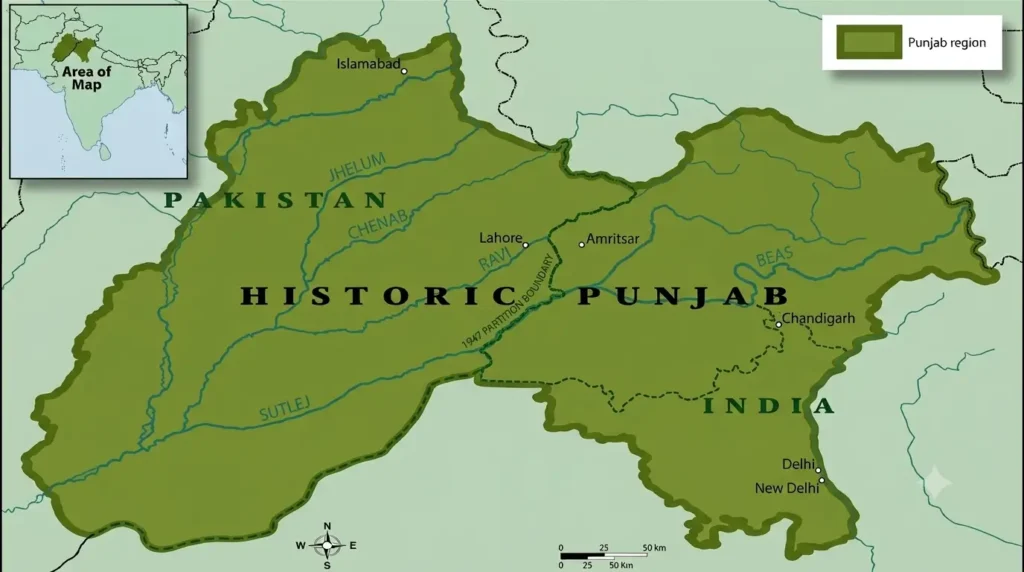
Punjab was cut in two by the Radcliffe Line in August 1947, and the province saw some of the worst violence of the Partition: killings, forced conversions, abductions and rapes, and one of the largest mass migrations in history. Estimates of the number displaced across the subcontinent vary widely, and figures between ten and twenty million are commonly cited. Nirupama Dutt notes that Pritam’s own anguish focused on the massacres and, above all, on the violence against women.
The name Punjab itself matters to the poem: it means the land of five waters, and the five rivers are the poem’s main image of a shared homeland that was poisoned and divided.
Who was Waris Shah, and why Heer Ranjha?
Waris Shah (1722–1798, though some sources give an earlier birth year of 1706) was a Punjabi Sufi poet of the Chishti order from Jandiala Sher Khan, in present-day Pakistan. His Heer, completed in 1766, is the most celebrated telling of the Heer–Ranjha love story, a tale that older poets such as Damodar had also written. In Waris Shah’s version, Ranjha leaves home after a quarrel with his brothers and their wives, becomes a cowherd in Heer’s village, and wins her love through his flute. Heer’s uncle Kaido (spelt Qaidon in the DU translation) and her family expose them, and she is married off against her will to Saida Khera. The story ends in tragedy. Waris Shah himself hinted that the romance has a deeper spiritual meaning, the soul’s longing for God.
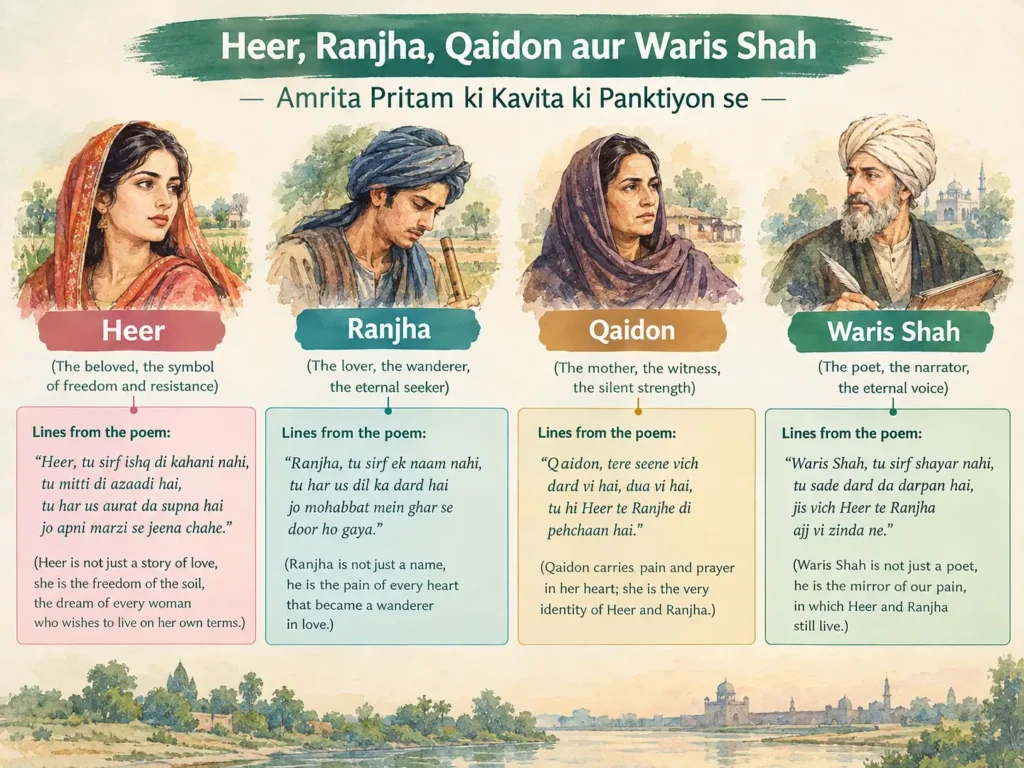
That is why he is such a powerful addressee. Waris Shah is a Muslim Sufi poet, writing about a love that crosses family and social barriers, and Pritam, born into a Sikh family, calls on him to speak to a Punjab that has begun killing along religious lines.
| Element in Heer | How Pritam uses it |
|---|---|
| Heer as the wronged “daughter of Punjab” | One daughter wept and Waris Shah wrote laments for her. A million daughters weep now, and no poet answers. |
| Ranjha’s flute | The flute of love is lost, and the poison-wind turns bamboo into snakes. |
| Ranjha’s brothers | They have forgotten Ranjha’s art and devotion. |
| Kaido (Qaidon), the villainous uncle | Everyone has turned into Qaidon, “thieves of love and beauty”. |
| Waris Shah as the poet of compassion | Pritam asks him to open the next page of the “book of love” (kitab-e-ishq). |
Key Facts
| Detail | Information |
|---|---|
| Poem | I Say unto Waris Shah (Punjabi: Ajj Aakhaan Waris Shah Nu) |
| Poet | Amrita Pritam (1919–2005) |
| Original language | Punjabi |
| DU translation | N.S. Tasneem, in Modern Indian Literature: An Anthology, ed. K.M. George, vol. 3 (Sahitya Akademi, 1992) |
| Composed | Late 1947, during a train journey after Partition |
| Addressee | Waris Shah (1722–1798), author of Heer (1766) |
| Genre | Lament / elegy (a dirge in some descriptions), addressed by apostrophe |
| Form of the original | Rhymed Punjabi couplets, with the opening couplet repeated at the end |
| Form of DU translation | Unrhymed English verse |
| Speaker | An unnamed woman speaker, close to the poet’s own voice |
| Setting | Punjab during and after Partition, 1947 |
| Central subject | Partition violence, cultural loss, women’s suffering, hope of healing through love |
| DU course | BA (Hons.) English, Semester 4, DSC-12, Unit III |
I Say unto Waris Shah Summary
Short summary
Amrita Pritam calls on the dead poet Waris Shah to speak from his grave and to open a new page in his book of love. When one daughter of Punjab (Heer) wept, he wrote many laments; now a million daughters are weeping and nobody writes for them. She asks him to look at Punjab today: corpses lie in the fields, the Chenab is red with blood, and someone has poisoned the five rivers. The poison has spread through the land, the people and the songs, until the flute of love is lost and everyone has become a Qaidon. The poem closes by repeating its opening plea and asking where another Waris Shah can be found.
Movement-by-movement summary
The poem is best studied in movements. Your prescribed translation may group the lines into stanzas differently, so check the divisions in your text.
- The invocation. The speaker asks Waris Shah to speak from the graves and turn the next leaf of the book of love. She reminds him that he once wrote laments (vain) for a single daughter of Punjab, while lakhs of daughters now beg for the same voice.
- The landscape of death. She tells him to get up, “friend of the sorrowing”, and see his Punjab: the riverside woodland is covered in bodies and the Chenab is full of blood.
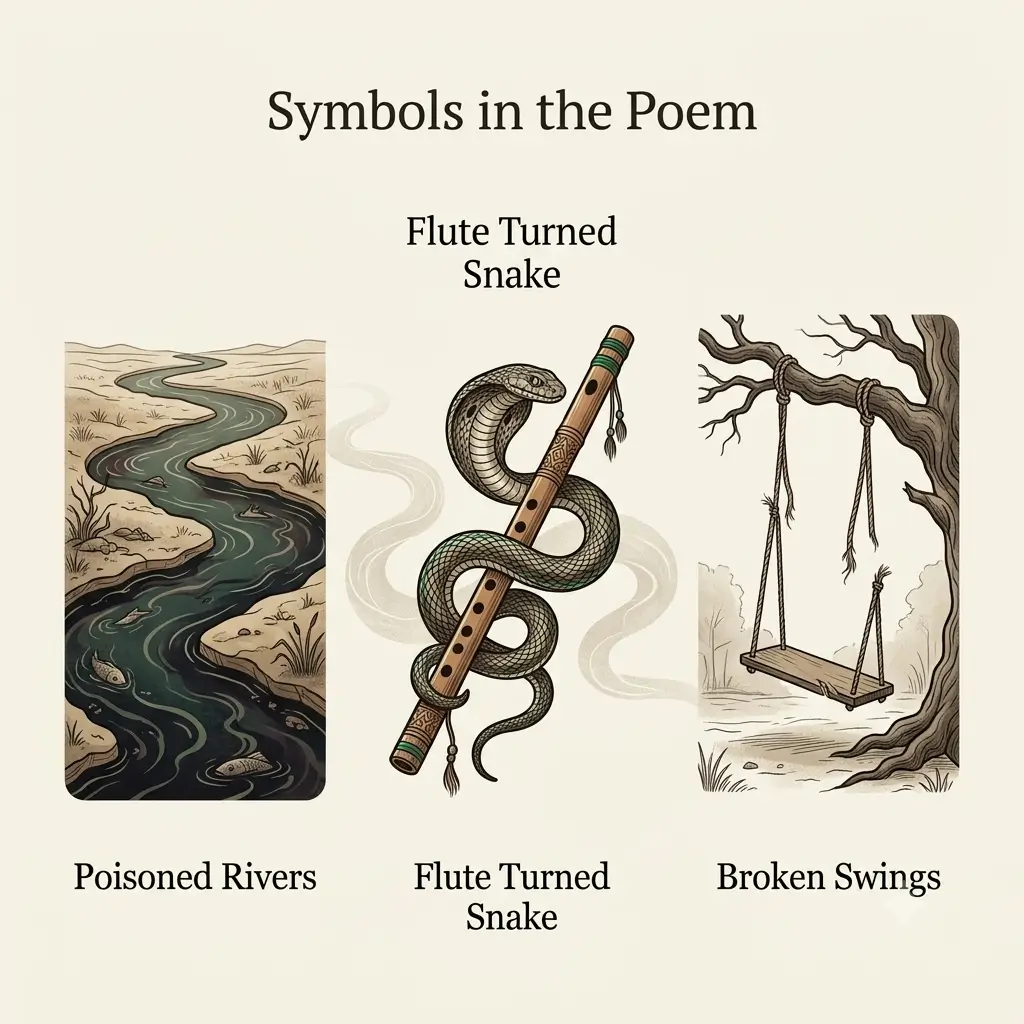
- Poison and contagion. Someone has mixed poison into the five rivers. The waters irrigated the fields, so the poison now comes out of every pore of the fertile land. A poisoned wind blows through every forest and turns each bamboo flute into a snake. The first bite makes the snake-charmers lose their mantras, the second spreads to everyone, and Punjab’s limbs turn blue.
- The end of everyday life. Songs break off in throats, the thread snaps on the spindle, the girls’ spinning circle scatters and the spinning wheels fall silent. Swings hanging from the peepul tree crash to the ground.
- Love’s craft is forgotten. The flute that carried love is lost. Ranjha’s brothers have forgotten his art and devotion. Blood rains on the earth and oozes from the graves, and the “princesses of love” weep in the shrines. Everyone has turned into Qaidon, and the poem asks where another Waris Shah can be found.
- Return of the refrain. The poet repeats her opening call, “you yourself speak from the graves and turn the next leaf of the book of love.” The circular structure shows that the plea is unanswered.
Key lines
The line most often quoted is the opening one: Ajj aakhaan Waris Shah nu, kitton qabraan vichon bol. It means “Today I say to Waris Shah: speak from the graves.” The second line asks him to turn a new page in the “book of love”.
Note for students: an earlier version of this page gave the opening line as “kiton kadiyan ve, Heeran dian, rovan te” and translated it as “where are the Heers who once wept”. This wording is not the poem’s line and has been corrected here. The poem says that one daughter of Punjab wept and Waris Shah wrote her laments, and that lakhs of daughters weep now.
Other lines worth remembering, in paraphrase:
- Someone has poured poison into the five rivers, and those rivers now water the land.
- Every bamboo flute has been turned into a snake.
- Everyone has become a Qaidon.
- The final question about finding another Waris Shah.
Explanation
The poem reads Partition through a story that Punjabis of every religion already knew. When Waris Shah wrote Heer, he took the private grief of one girl and made it the region’s grief. Pritam asks him to do it again, but the scale has changed from one daughter to a million, and the pain is no longer a family tragedy but a communal one. Because the story of Heer and Ranjha is loved by Hindus, Muslims and Sikhs alike, invoking it reminds every reader that Punjab once had a shared culture.
The poem also shows that this culture has been damaged, not just the bodies of people. Songs, spinning circles, swings and flutes are what disappear, so the poem is a lament for a way of life as well as for the dead.
Analysis of I Say unto Waris Shah
Characters and Voices in the Poem
The poem is not a narrative, but a set of figures gives it a story. Each one is worth a short paragraph in an answer.
- The speaker. She is a woman whose grief is personal and collective at the same time. It is usually safest to write “the speaker” or “the poet’s voice” rather than calling Amrita Pritam the “protagonist”, because a poem’s “I” is a created voice even when it is close to the author’s own. She speaks for the displaced and the violated and demands that a poet respond.
- Waris Shah. He is the addressee. Historically he was the author of Heer; in the poem he stands for Punjab’s cultural memory and for compassion expressed through art. He is asked to rise from the grave, which implies that the living cannot speak for themselves.
- Heer, the “daughter of Punjab”. She is the earlier sufferer whose tragedy Waris Shah wrote. She now becomes one of a million.
- Ranjha and his brothers. Ranjha’s flute is the emblem of love. His brothers, who drove him from home in the story, stand for a community that has forgotten his devotion.
- Qaidon (Kaido). The wicked uncle who destroys the lovers in Heer becomes the picture of the killers and looters of 1947, and of a whole society that turned on itself.
- “Someone”. The poem never says who poisoned the rivers. This silence is a deliberate choice and is discussed in the debates below.
Themes of I Say unto Waris Shah
- The pain of Partition. The poem’s main subject is the suffering of Punjab, the massacres and the scattering of families. It shows the wound in physical images: bodies, blood and poison.
- The suffering of women. It is women, the “daughters of Punjab”, who cry out to Waris Shah, and the images of the broken spinning circle and swings speak of women’s social world being destroyed. Dutt’s account of Pritam’s own anguish about rapes supports a reading of the poem as a lament for the violence done to women, although the poem itself expresses this through metaphor rather than describing events.
- Poison as communal hatred. The poison spreading from the rivers to the land to the people is the poem’s picture of how hatred travels. The image of the first and second snakebite suggests contagion: the whole community caught the disease.
- Longing for peace and healing. Pritam calls on Waris Shah to “turn a new page”, which asks for a different chapter to follow the horror. The poem ends with a question, not an answer, so the hope is real but uncertain.
- Loss of cultural heritage and memory. Waris Shah’s Heer is presented as a common inheritance that the rioters have forgotten. The poem mourns both the people and the culture they shared.
- The power and limits of poetry. The poem believes that art can name a catastrophe, yet it addresses a dead poet, which suggests that no living voice is adequate. It is a poem about the need for poetry.
Symbols in the Poem
| Symbol | What it stands for |
|---|---|
| Waris Shah | Punjab’s shared cultural memory; the poet of compassion who once turned one girl’s grief into a public language |
| Punjab / the five rivers | A homeland that was one and has been divided; its rivers carry the poison into the land |
| Blood | The violence of Partition, in the Chenab, in the fields and even oozing from graves |
| Tears | The grief of the “million daughters” who now cry to Waris Shah |
| Poison | Hatred and communal violence, spreading like an infection |
| The flute turned snake | Love and music corrupted into violence; Ranjha’s instrument lost |
| Spinning wheel, spindle and swings | The everyday rhythm of village women’s life, now broken |
| Qaidon | The betrayer of love; every person who has turned against a neighbour |
| The grave | Silence, death and the end of shared culture; the place from which the poem demands a voice |
Critical Analysis
Form: lament, refrain and ring composition
The poem belongs to the tradition of the lament. The Punjabi word vain (used in the poem for the laments Waris Shah wrote) refers to the mourning songs that women sing at death. In the original, the poem is made up of rhymed couplets, and the opening couplet returns at the end, so the poem circles back to its plea. A word of caution about earlier notes: the poem is not free verse in Punjabi. The English translation is unrhymed, which is why it looks like free verse. This is a good point to raise in a DSC-12 answer, because the paper is about reading literature in translation.
Literary techniques
- Apostrophe. The speaker addresses a person who is dead, and the address is the poem’s central device. It links the past of Heer to the present of 1947 and turns the reader into an eyewitness.
- Imagery. The images are drawn from Punjab’s landscape and folk life: rivers, woodland, bamboo flutes, spinning wheels, peepul swings, graves and shrines. Notes that mention only “blood”, “tears” and “broken hearts” miss most of this.
- Metaphor and personification. Poison flows in water, wind blows poison, flutes become snakes, and the land itself bleeds. Some commentators also read the “crimson” Chenab as metonymy, the effect (colour) standing for the cause (bloodshed).
- Intertextuality. The poem depends on the reader knowing Heer. Its allusions to Ranjha, his brothers and Qaidon do most of its emotional work.
- Irony. Qaidon, the enemy of the lovers, is now everyone. The poem’s cruelest irony is that the people who inherited Heer have become its villains.
- Rhetorical question. The poem ends by asking where another Waris Shah can be found, leaving the reader with an unanswered question.
Literary Style
- Narrative voice. The first-person voice is intimate and urgent; the poem begins with a command, not a description. The speaker is close to the reader as well as to Waris Shah.
- Language. In Punjabi, the diction is simple, musical and rooted in folk speech. That simplicity is exactly what makes the poem quotable across the border in both Punjabs.
- Imagery. See the techniques above and the symbol table.
Narrative Technique
- Structure. The poem moves from invocation to a picture of the dead land, then to the spread of poison, the breakdown of village life, the loss of love’s craft and the identification of everyone as Qaidon, before returning to its opening line.
- Pacing. The poem starts urgently, with an order to the dead poet, and builds through accumulating images of ruin. The repetition at the end is quieter and more helpless.
- Point of view. The speaker’s perspective is first-person, but the experience is collective. She speaks for the “million daughters”.
Translation matters: the DSC-12 angle
The paper asks you to think about Indian literature in translation. A few things are lost or changed in English:
- The rhyme and the sound of the Punjabi couplets.
- The word vain and what it means as a woman’s ritual lament.
- The resonance of names such as Waris Shah, Ranjha and Qaidon for a Punjabi ear.
- Small images that different translators handle differently (for example, the several English versions of the “flute turned snake” passage).
Because there are at least four English versions (Tasneem, Khushwant Singh, Nirupama Dutt, and Pritam’s own), quote from the translation your department prescribes and treat others as comparison.
Critical debates and reception
- Is the poem “about” Partition or about love? Some readers, such as the writer of an analysis on Matsyaa Lyfe, stress that Waris Shah stands for a love that ignores religion, so the poem is as much about love’s survival as about violence. Others treat it primarily as Partition literature. The two readings are compatible.
- The unnamed “someone”. The poem does not name a community or a political party as the poisoner. One reading is that this widens the blame to everyone who took part or stood by; another is that it avoids historical specificity. It is safer to say that the poem’s grief is ethical and cultural rather than political.
- Reception. According to Nirupama Dutt, the poem moved Punjabis on both sides of the border, but Pritam also faced criticism in India: her own community asked why the poem was not addressed to Guru Nanak, while some Left-wing writers said it should have been addressed to Lenin or Stalin. That shows the pressure on Partition writers to speak in the name of a religion or an ideology, and Pritam’s decision to call on a Sufi poet of Punjab refused both.
- A gendered reading. The poem’s focus on “daughters”, spinning circles and swings has led to readings that place it beside women-centred Partition history, such as Urvashi Butalia’s The Other Side of Silence. The poem, however, does not narrate assault directly; that reading is an interpretation.
Historical and contemporary perspective
In 1947 the poem gave many displaced Punjabis a language for grief, and it travelled across the border even before it was formally published in India. It later appeared in the Pakistani Punjabi film Kartar Singh (1959), sung by Inayat Hussain Bhatti, and it is widely described as one of the most read poems in modern Indian literature, with an echo in both Punjabs. Its relevance today is that it asks what it means to remember a shared culture after violence, which is why it continues to be taught and cited in discussions of conflict and displacement.
Limitations and criticisms
- The poem does not describe specific events, so students who need historical evidence must turn to other sources.
- Its address to a male poet as the only possible healer can be questioned: the “daughters” are given no voice of their own.
- In translation, much of its music is lost, so an English reader is judging a different poem from the Punjabi one.
Comparing the Poem with Other Partition Texts
| I Say unto Waris Shah | Pinjar (novel, 1950) | Andha Yug (verse play, 1954) | |
|---|---|---|---|
| Author | Amrita Pritam | Amrita Pritam | Dharamvir Bharati |
| Form | Lament / elegy | Novel | Verse play |
| How Partition appears | Directly, through Punjab’s land, rivers and folk life | Through the character Puro and violence against women | Indirectly, as an allegory in the Mahabharata’s last day |
| Emotional centre | Grief and a plea for healing | Loss of humanity and existential surrender | The moral blindness of war |
| Source of hope | Return of a poet of love | Personal endurance | Krishna’s wisdom, but limited |
Andha Yug is also part of DSC-12, and our notes on Andha Yug show how a very different text responds to the same historical shock.
Conclusion
I Say unto Waris Shah is short, but it carries a great deal: a woman poet’s grief for Punjab, a whole cultural tradition gathered around Heer, and a question that the poem leaves unanswered. It turns Waris Shah into an image for everything Punjabis lost when their land was divided and asks whether poetry can still call a wounded community back to itself. For DU students, the most useful things to remember are its 1947 setting, the way it uses Heer as an intertext, the poison and flute images, the form of the original, and the fact that you are reading it in translation.
Continue Reading
Continue Reading
University of Delhi Previous Year Questions
University of Delhi Previous Year Questions
Section A — Short Answer Questions
1 Who is Waris Shah, and why does Pritam address him? +
Hint: Waris Shah was the author of Heer, a major Punjabi poetic work, and is associated with the Sufi poetic tradition.
Suggested Answer Focus: Cultural memory, compassion, the tragedy of Partition, and the contrast between Heer as one daughter and the suffering of a million daughters of Punjab. Probable
2 What is the significance of the title I Say Unto Waris Shah? +
Hint: Consider the title as a direct address to Waris Shah and its connection with the opening invocation of the poem.
Suggested Answer Focus: Address to a dead poet, invocation, remembrance, and the use of Waris Shah’s cultural authority to express the suffering caused by Partition. Probable
3 Explain the symbol of the poisoned rivers in the poem. +
Hint: Focus on the imagery of Punjab’s five rivers and the transformation of life-giving water into poison.
Suggested Answer Focus: The poisoned rivers symbolize the spread of hatred and violence across Punjab and the destruction of the region’s shared cultural and human landscape. Probable
4 Who is Qaidon, and what does he stand for in the poem? +
Hint: Recall Kaido, Heer’s uncle in the Heer tradition.
Suggested Answer Focus: Betrayal of love, destructive social forces, and the transformation of the individual villain Qaidon into a wider metaphor for people who become perpetrators of violence. Probable
5 Comment on the use of apostrophe in the poem. +
Hint: Examine Pritam’s direct address to the dead poet Waris Shah.
Suggested Answer Focus: The apostrophe creates a bridge between past and present, connects Partition with the cultural memory of Heer, and turns the poem into an act of witnessing and mourning. Probable
6 How does the poem use folk life, such as the spinning wheel and swings, to show loss? +
Hint: Consider the significance of women’s everyday social and cultural life in Punjab.
Suggested Answer Focus: The spinning wheel, swings, and other elements of folk life represent a destroyed cultural world, showing that Partition caused both human suffering and the loss of everyday community life. Probable
Section B — Long Answer Questions
1 Discuss I Say Unto Waris Shah as a Partition poem. +
Hint: Situate the poem in the context of the 1947 Partition of India and Punjab.
Suggested Answer Focus: Historical context, Punjab and the Radcliffe Line, violence and displacement, gendered violence, imagery of destruction, cultural memory, and the poem’s reception and translation. Probable
2 Analyse the poem’s relationship with Waris Shah’s Heer. +
Hint: Discuss Heer, Ranjha, and Qaidon as important elements of the poem’s intertextual framework.
Suggested Answer Focus: Intertextuality, irony, the cultural memory of Heer, the Sufi background of Waris Shah, and Pritam’s transformation of an individual love tragedy into a collective tragedy of Punjab. Probable
3 Examine the poem as a lament with reference to its form, refrain, and imagery. +
Hint: Consider the poem’s lamenting voice, recurring expressions, and the significance of terms such as vain.
Suggested Answer Focus: Lament form, repetition, ring-like structural movement, apostrophe, imagery, and the difference between the rhymed Punjabi original and its unrhymed English translations. Probable
4 Read the poem in terms of gender and violence. +
Hint: Focus on the image of the “daughters of Punjab” and the movement from Heer to a million daughters.
Suggested Answer Focus: Gendered violence, the transformation of Heer’s individual tragedy into collective suffering, broken swings and spinning wheels, and the cultural destruction experienced by women during Partition. Probable
5 What difficulties does translation pose for I Say Unto Waris Shah? +
Hint: Consider different English translations, including versions associated with Tasneem, Singh, and Dutt.
Suggested Answer Focus: Rhyme, rhythm, culturally specific names and references, words such as vain, emotional intensity, and the difficulty of preserving the cultural and historical resonance of the Punjabi original. Probable
6 Compare Pritam’s response to Partition with another text in DSC-12. +
Hint: A possible comparison may be made with Andha Yug or The Shroud, depending on the prescribed syllabus.
Suggested Answer Focus: Direct lament versus allegory, representations of violence and suffering, individual and collective trauma, cultural memory, and different sources or possibilities of hope. Probable
Section C — Exam Writing Tip
Frequently Asked Questions
Is “I Say unto Waris Shah” the same as “Ajj Aakhan Waris Shah Nu” and “To Waris Shah”?
Yes. Ajj Aakhaan Waris Shah Nu is the Punjabi title. “I Say unto Waris Shah”, “Today I Say unto Waris Shah”, “To Waris Shah” and “Ode to Waris Shah” are different English titles used for translations of the same poem.
Which translation does Delhi University prescribe?
The DSC-12 syllabus prescribes N.S. Tasneem’s translation, printed in Modern Indian Literature: An Anthology, ed. K.M. George, vol. 3 (Sahitya Akademi, 1992). Other translations (Khushwant Singh, Nirupama Dutt) are useful for comparison but should not be quoted as the prescribed text.
When was the poem written: 1947, 1948 or 1949?
It was composed in late 1947, on the train journey Pritam described in her autobiography. Sources differ on the year of first publication, giving 1948 or 1949, so the safest answer is “composed in 1947, soon after Partition”.
Who is Qaidon, and why does the poem mention him?
Qaidon (Kaido) is Heer’s villainous uncle in the Heer–Ranjha story, who helps to destroy the lovers. Saying that everyone has turned into Qaidon means that the violence has made neighbours into betrayers of love.
Why does Pritam address Waris Shah and not a political leader or a religious figure?
Waris Shah is loved across religious lines and wrote about a love that crossed social barriers. According to Nirupama Dutt, Pritam faced criticism from some Sikh readers who wanted a call to Guru Nanak and from some Left-wing writers who wanted a call to Lenin or Stalin. Her choice of Waris Shah kept the poem cultural, not sectarian.
Is the poem only about Punjab, or about the whole of India?
It speaks of Punjab, its rivers and its folk life, because Punjab was cut in half and suffered heavily. But its questions about hatred, women’s suffering and cultural memory apply more widely, which is why it is read as a general Partition poem.
Who is the “someone” who poisoned the five rivers?
The poem does not say. The poison is a metaphor for hatred and communal violence, and the anonymity means that the poem holds a whole society accountable, not one group. You should present this as an interpretation, not as a fact.
Is the poem written in free verse?
Not in Punjabi. The original is in rhymed couplets, and its opening couplet returns at the end. The English translation is unrhymed, which is why it looks like free verse.
Is Amrita Pritam the “protagonist” of the poem?
It is more accurate to call her the speaker. The voice is close to her own, and her autobiography ties the poem to her journey, but a poem’s speaker is still a constructed voice.
What should I quote or remember for the exam?
Remember the opening couplet, the “one daughter / million daughters” contrast, the poison in the five rivers, the flute turned into a snake, and the line about everyone becoming a Qaidon. Check the exact words in your prescribed translation before quoting.
References and Further Reading
References and Further Reading
Subscribe to keep reading
You've used your free notes for now. Get Delhi Pathshala Premium for unlimited access.
Subscribe — ₹29/30 days