
Contents
- About Thangjam Ibopishak Singh
- About the Poems
- Main Themes:
- Key Facts
- Summary and Explanation
- Poem 1: ‘Dali, Hussain, or Odour of Dream, Colour of Wind’ Summary
- Poem 2: ‘The Land of the Half-Humans’ Summary
- Simple Analysis
- Character Analysis: The Poet as a Key Figure
- Themes: Identity, Cultural Displacement, Surrealism, Political Critique
- Symbols: Dreams, Half-Humans, Wind, Colour
- Simple Critical Analysis
- Literary Techniques: Surrealism, Allegory, Rich Imagery
- Social Commentary: Reflection on Cultural and Political Issues in Northeast India
- Reception: Historical and Contemporary Perspectives
- All Characters
- The Poet
- Mythical and Literary Figures
- Important Comparisons
- The two poems side by side
- Ibopishak and Amrita Pritam (Unit III)
- Critical Debates and Reading Notes
- Translation Matters: The DSC-12 Angle
- Criticism and Limitations
- Contemporary Relevance
- Conclusion
- Continue Reading
- University of Delhi Previous Year Questions
- Frequently Asked Questions
- References and Further Reading
Quick answers (for students in a hurry)
What is ‘Dali, Hussain, or Odour of Dream, Colour of Wind’ about? It is a five-part, dream-like poem by Thangjam Ibopishak Singh in which a speaker drifts from questions about paddy and poems, to a cashier who eats rotten banknotes, to a man who hides behind dark glasses, and finally to his wife turning into a peepal tree. Read it as a dark, associative satire on money, silence, religion, violence and the strangeness of everyday life.
What is ‘The Land of the Half-Humans’ about? It is a satirical prose poem about an imagined land where people spend six months as a head with no body and six months as a body with no head. The head only talks and eats; the body only labours. The land still claims to be a perfect democracy, run by nameless representatives for nameless citizens.
In this post you will find notes on Unit 3b: ‘Dali, Hussain, or Odour of Dream, Colour of Wind’ and ‘The Land of the Half-Humans’ by Thangjam Ibopishak Singh from DSC-12: Indian Writing in English Translation (BA (Hons.) English, Semester 4). You get the poet’s background, a section-by-section summary of both poems, characters and voices, themes, symbols, literary techniques, the debates between critics, translation issues, practice questions and FAQs.
A note on labelling: the University of Delhi’s Semester IV syllabus lists these poems as item 8 of Unit III, along with Amrita Pritam’s ‘I Say unto Waris Shah’ and Joseph Macwan’s The Stepchild. Our notes call them 3a, 3b and 3c to keep the three texts apart. The prescribed text is Robin S. Ngangom’s English translation, printed in Anthology of Contemporary Poetry from the Northeast (NEHU, Shillong, 2003), as given in the University of Delhi’s DSC-12 syllabus.
A caution before you start: this page paraphrases the poems instead of reproducing them. Read the full prescribed translation first (both are also available on the Poetry International website, linked at the end), because examiners expect you to refer to the text, not to a summary of it.
About Thangjam Ibopishak Singh
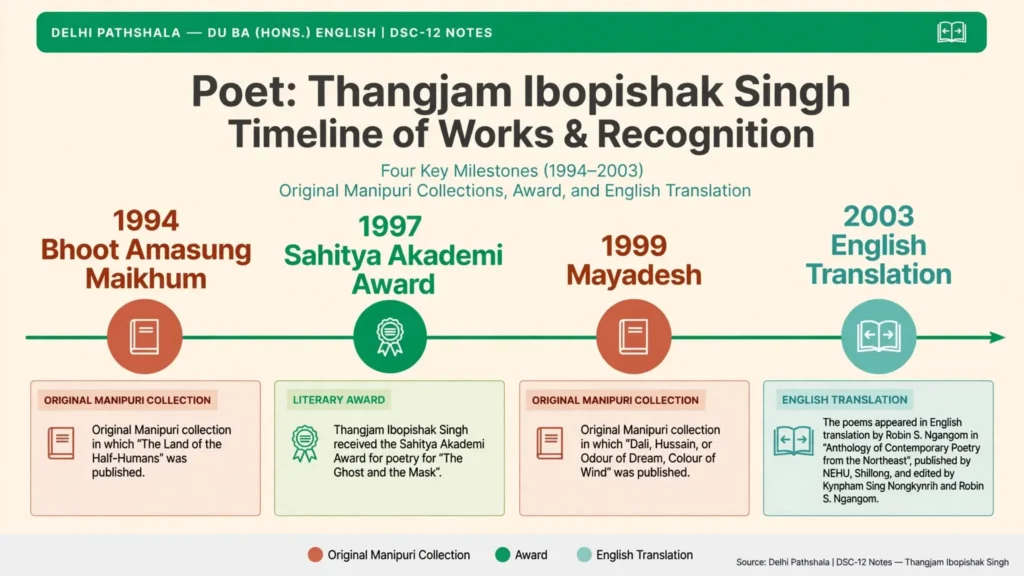
- Biography: Thangjam Ibopishak Singh was born on 15 February 1948 in Manipur, in north-eastern India. He writes in Manipuri (Meiteilon), the language of the Meitei community, and is based in Imphal. By his own account, his career as a poet began when he was fourteen. He has also said that his childhood and adolescence were unhappy and troubled by his family’s money problems, and that readers will find this phase reflected in his early poems.
- Literary Contributions: His first collection, Apaiba Thawai (The Hovering Soul), appeared in 1969. Later collections include Norok Patal Prithivi (This Earth Is Hell, 1985), Bhoot Amasung Maikhum (The Ghost and the Mask, 1994), Mayadesh (The Land of Maya, 1999) and Manam (The Human Scent, 2003). English readers can now find a larger selection in The Smell of Man (Red River, 2021), translated by Robin S. Ngangom.
- Awards: He won the Sahitya Akademi Award for poetry in 1997 for The Ghost and the Mask, the collection that contains ‘The Land of the Half-Humans’. His other honours include the Manipur State Kala Akademi Award (1986), the Jamini Sunder Guha Gold Medal (1989), the Ashangbam Minaketan Memorial Award (2005) and the Manipur State Award for Literature (2009).
- Importance in Indian Literature: Ibopishak is one of the leading and most widely read poets of the Northeast. His poetry blends private feeling with public anger, and its best-known mode is a dark, savage satire. Poetry International’s profile of the poet (credited to Arundhathi Subramaniam) describes his satire as savage, in the manner of Swift, and his poems as dense, with images that keep yielding new meanings on re-reading. In a separate Poetry International essay on Northeast poetry, Subramaniam calls ‘The Land of the Half-Humans’ unsentimental and cuttingly satirical.
- In his own words: In a 2006 conversation with the poet Kynpham Sing Nongkynrih, Ibopishak said that the socio-political problems of Manipur are his main source of inspiration. He named corruption, insurgency and its repercussions, ethnic killings, fanaticism and terrorism among his recurring themes. He also said he writes about nature and death, and that he does not believe in God or any religion. Keep this last remark in mind when you read the religious jokes in ‘Dali, Hussain, or Odour of Dream, Colour of Wind’. It tells you about the poet’s outlook, though it does not settle how any single line should be read.
About the Poems
- Titles: The two poems are ‘Dali, Hussain, or Odour of Dream, Colour of Wind’ and ‘The Land of the Half-Humans’. Both are satirical, and both use fantasy to talk about real social and political life.
- Original publication: Note the dates. The poems were not first published in 2003, which is only the year of the English translation. ‘Dali, Hussain, or Odour of Dream, Colour of Wind’ comes from the Manipuri collection Mayadesh (Writer’s Forum, Imphal, 1999). ‘The Land of the Half-Humans’ comes from Bhoot Amasung Maikhum (Writer’s Forum, Imphal, 1994).
- English translation: Both poems were translated into English by the poet Robin S. Ngangom and printed in Anthology of Contemporary Poetry from the Northeast, edited by Kynpham Sing Nongkynrih and Robin S. Ngangom (North-Eastern Hill University, Shillong, 2003). The anthology’s foreword is by Jayanta Mahapatra, and its editors argue that writers who live with the menace of the gun must “master the art of witness”.
- Setting: ‘Dali, Hussain…’ moves between a village question about the paddy harvest, a cashier’s counter, a rich man’s tall building in Imphal and an unnamed bathroom, all stitched together by dream logic. ‘The Land of the Half-Humans’ is set in an invented country that the speaker insists is real: he says it is not a folktale and that he has been there.
- Form: ‘Dali, Hussain…’ is a free-verse poem in five numbered sections, written in a stream-of-consciousness mode. ‘The Land of the Half-Humans’ is printed as a prose poem in long lines.
Main Themes:
- Identity: Both poems ask who or what a person is. In the first poem the speaker insists that the “you” other people describe is never “me”. In the second, the citizens are so divided that nobody can decide whether the human name belongs to the head or the body, and so they have no names at all.
- Cultural and Social Displacement: Both poems show people who do not belong comfortably in the society they live in: a poet whose poems are weighed like grain, and a nation of citizens split in two. Critics link this feeling to the Northeast’s history of conflict and its sense of being under-represented.
- Surrealism and Dream Logic: The first poem is built on associative, dream-like leaps. The second uses a grotesque fantasy to make an everyday political point.
- Political Critique: Both poems attack corruption, empty democracy, violence and silence. The critique is oblique in the first poem and openly allegorical in the second.
Key Facts
| Detail | Information |
|---|---|
| Poet | Thangjam Ibopishak Singh (born 15 February 1948, Manipur) |
| Original language | Manipuri (Meiteilon) |
| Translator | Robin S. Ngangom |
| DU text | Anthology of Contemporary Poetry from the Northeast, NEHU, Shillong, 2003 (ed. Kynpham Sing Nongkynrih and Robin S. Ngangom) |
| Original publication, poem 1 | Mayadesh, Writer’s Forum, Imphal, 1999 |
| Original publication, poem 2 | Bhoot Amasung Maikhum, Writer’s Forum, Imphal, 1994 |
| Genre | Contemporary Manipuri poetry in English translation; satire |
| Form, poem 1 | Free verse in five numbered sections; dream sequence; stream of consciousness |
| Form, poem 2 | Prose poem; allegory; dystopian satire |
| Speaker / protagonist | In poem 1, an “I” who is half-participant, half-observer of his own dream. In poem 2, a narrator who claims to have visited the land he describes |
| Social context | Manipur and the wider Northeast: insurgency, state power, corruption and ethnic conflict (the poet’s own account, 2006) |
| DU course | BA (Hons.) English, Semester 4, DSC-12, Unit III |
Summary and Explanation
Poem 1: ‘Dali, Hussain, or Odour of Dream, Colour of Wind’ Summary
- Short summary: The poem is a dream sequence in five numbered parts. It begins with two everyday questions, one about the paddy a farmer has stored and one about how many kilograms of poems a poet has written. It then lurches through a cashier who counts rotten notes and eats them, a speaker who hides his mind behind dark glasses and shut eyes, a debate about what the “you” and the “I” really are, a comparison of gunfire and flowers, a long list of random objects, and finally a bathroom in which the speaker finds his wife half-transformed into a peepal tree.
- The title: The poem never mentions Dalí or Hussain in its text. They appear only in the title. Salvador Dalí (1904–1989) was the Spanish painter most closely associated with Surrealism and dream imagery. M.F. Husain (died 2011) was a leading member of the Progressive Artists’ Group of Bombay, formed in 1947, and a central figure of Indian modernism. Many readers take the pairing as a signal that the poem will work like a painting in the Surrealist or modernist tradition: images arrive without logical connection, and the senses are mixed up in impossible ways. The second half of the title (the odour of a dream, the colour of the wind) does the same thing in language. This is a reasonable reading of the title, but the poem does not explain it, and we have not found any source in which the poet comments on it. State it in an exam as your interpretation.
- Key lines: The title phrases “odour of dream” and “colour of wind” are not repeated in the body of the poem. The poem’s own version of the same impossible mixing of senses is the line “Blind men see colours on voices.” The other passages worth remembering are paraphrased below.
- Explanation: Read the poem section by section, because each part has its own target.
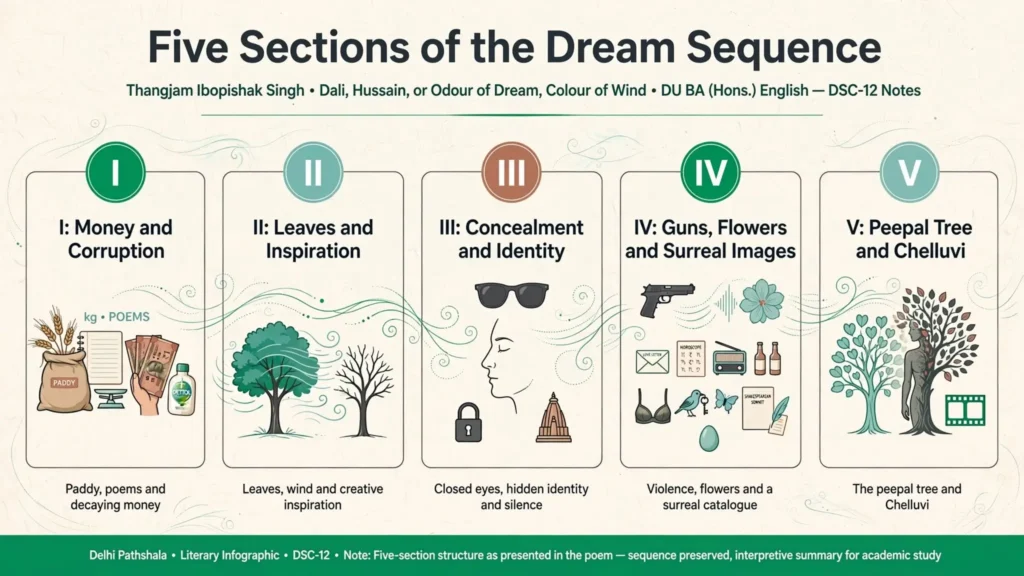
Section I: farmers, poets and a cashier. The speaker’s uncle from Wangu asks how many bushels of paddy he has stored this season. The speaker then asks his friend Kesho how many kilograms of poems he has written this month. The joke is that poetry, like grain, is measured by quantity. The next image is the poem’s first dream: someone writes and tears up, and a cashier counts a mouldy bundle of one-rupee notes, taking over an hour. The numbers fall (a thousand, seven hundred, eleven) as he counts. When he finishes he washes his hands with Dettol and eats the notes one by one. One reading is that money has become a rotting obsession that consumes the person who handles it. Another is that the passage is a joke about corruption, where public money simply disappears. The two readings do not contradict each other.
Section II: an epigram about inspiration. The speaker agrees with the poet that leaves do not move without a passing wind. Then he adds that leaves cannot move at all if there are no leaves on the tree. A common reading, offered by the Poem Analysis commentary, treats the leaves as poems and the wind as inspiration: a poet cannot write if there is nothing left to write with. The bare tree can then stand for a society or a mind that has run dry. This is an interpretation, but it fits the poem’s opening joke about poems measured in kilograms.
Section III: hiding, and the idea of a self. The speaker says that a person’s thoughts can be read from their speech, and that a silent person’s thoughts can be read from the eyes. So he puts on dark glasses to hide his mind, and then shuts his eyes so that even the glasses cannot read it. In brackets he adds that men with closed eyes are found either in a lockup or in a sacred temple. The bracketed aside puts prisoners and worshippers on the same level. The second half of the section moves to claims about truth. The speaker says he has never seen fish flying in the sky but has often seen ducks float on water. Someone tells him he is wrong, and he agrees that he is wrong. He then says the Vedas claim that zero lies in Brahma. The poem does not say where this “quotation” comes from, and we have not been able to verify it as an actual Vedic text, so treat it as a mock-citation: a joke at the expense of religious certainty. The section ends with the two speakers agreeing that what others call “you” is never “me”. This is the poem’s strongest statement about identity: other people’s labels do not match the person inside.
Section IV: guns, flowers and a list. The speaker asks whether the report of guns or the scent of flowers is more fragrant. He says the sound of guns sits on the nose, while the odour of flowers sits only on the tips of the flowers. Then comes the line about blind men seeing colours in voices. The first image sets violence against beauty, and the second turns the senses upside down. The rest of the section is a long list of unrelated things: a love letter, the speaker’s grandfather’s horoscope, his mother’s radio, his son’s tweezers, ten bottles of rum floating in the air, his grandmother’s brassiere, a pair of lingams, a bird with a bunch of keys in its beak, a whistle, two butterflies, a cake of soap, a Shakespearean sonnet and a pair of clogs tied with women’s hair. He then invites the reader to add more items of their own. The list ends with an egg that slowly sinks into his sleeping teenage daughter’s hairless head, and her ears move lazily. The list can be read as a picture of the mind in dream, with family history, sex, religion, European literature and domestic objects all jumbled together. The egg image is deliberately disturbing: something enters the sleeping girl’s head without pain or protest.
Section V: the peepal tree and the wife. The speaker says that one day he wanted to own a peepal tree. He climbs onto a rich man’s tall building and goes into his bathroom to find one. In brackets he says he likes peepal trees very much and would like every citizen of Imphal to walk about with a small peepal growing on their head. In the bathroom he finds his wife half-turned into a peepal tree above the waist and naked below it. He says he was not surprised, not worried and did not cry. Then he turns to the filmmaker Girish Karnad and says that his wife has become Karnad’s Chelluvi. Chelluvi is the title character of a Kannada film based on a Karnataka folk tale; she is a flower girl who turns into a flowering tree. The poem ends with the speaker asking how he can now claim to like peepal trees. The scene can be read as a joke about being too accepting of the strange, or as an image of a woman turned into an object, or as a collapse of the speaker’s own pretended certainties. The closing question does not settle the matter.
How the five parts hang together: The sections move from money and poetry (I, II) to concealment and religion (III) to violence, memory and the family (IV), and then to private life and the body (V). Critics disagree about how much coherence the poem has. Poem Analysis calls it a dream sequence in which “only meanings” remain, without coherence, but it also argues that connections run between the images. Subramaniam’s description (a playful mix of the lyrical, the fantastic and the deliriously associative, with an undertone of black humour) is probably the safest summary for an exam answer.
Poem 2: ‘The Land of the Half-Humans’ Summary
- Summary: The narrator asks whether anyone has seen a land whose people are only a head for six months and only a body for the next six. Then he says that he has not only seen it but been there, and that it is not a folktale. In the six months when they are heads, the people talk, eat and drink; the poem compares this to a millstone grinding. In the six months when they are bodies, they work, labour and sweat; the poem compares the head’s gorging to Bhima and the body’s misery to Shakuni. Women and children are described in the same way. The women are big and well-built and have long hair, and their clothing hangs below the waist, because the law of the land does not allow the body to be covered. They give birth through their mouths and have no teeth. The head can fly by spreading its fan-like ears, speaks the language of men and is understood. The headless body’s voice comes from an orifice, is unrecognisable and carries an odour. The land is said to be famous and much talked about. It has no poverty, and some men are richer than Kuber, the god of wealth. But the head eats up everything that the body earns by its sweat. The land has political rights, a government and elections every five years, and the poem claims that democracy works flawlessly. Nobody in the land has a name. The nameless representatives govern the nameless citizens, because no one can decide whether the head or the body should receive the human name.
- Key lines: The passages that students most often discuss are the narrator’s claim that the land is real and not a folktale; the Bhima and Shakuni comparison; the head’s consumption of the body’s earnings; the democracy that is said to work flawlessly; and the final problem of naming. The line “Democracy functions with total success” is the single most important ironic line in the poem.
- Explanation: The poem builds a fantasy and then describes it in the flat, plausible tone of a news report. That contrast is the source of its satire.
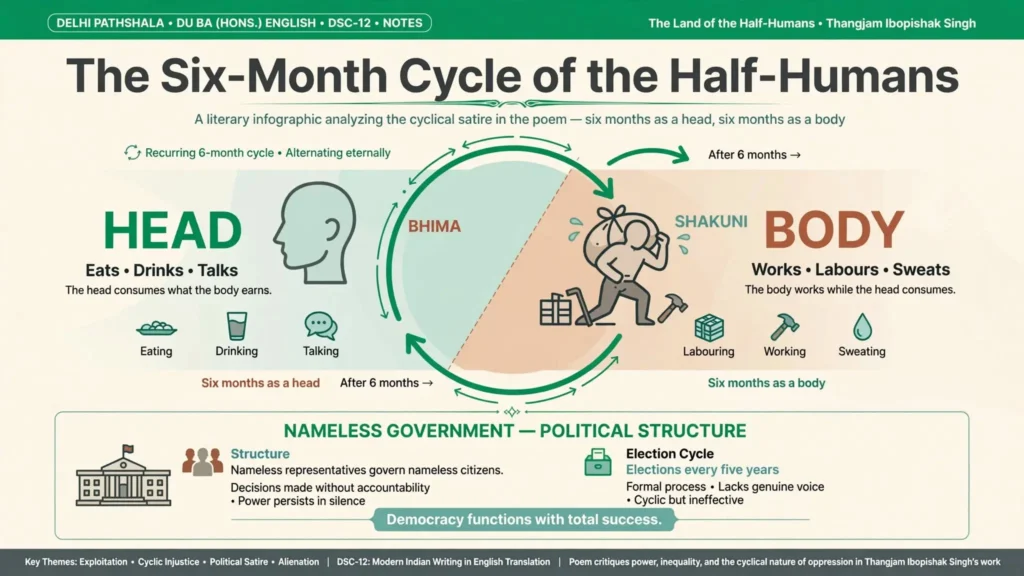
The first level of meaning is about labour and consumption. One half of the self does all the work; the other half does all the eating. Bhima, in the Mahabharata tradition, is known for his huge appetite, and Shakuni is the cunning Kaurava uncle associated with the dice game. By attaching Bhima to the head and Shakuni to the body, the poem borrows two epic figures to show greed on one side and suffering on the other. The poem does not explain the Shakuni comparison, so be ready to offer it as your reading and not as a fact.
The second level is about speech and silence. The head is heard and understood. The body has a voice, but nobody recognises it. Because only one half can speak, the other half has no public existence at all.
The third level is about democracy and names. Elections are held regularly, rights exist on paper and the government is functioning, and yet nobody in the land has a name. The poem’s final problem, that nobody can decide who deserves the human name, suggests that a political system can run perfectly well on forms and procedures while it has lost track of what a person is.
Finally, there is the Manipur reading. Because Ibopishak has himself said that the socio-political problems of Manipur are his main source of inspiration, many critics read the land as Manipur or the wider Northeast, a place defined by insurgency, state force and corruption, and constantly in the news. That reading is widely accepted, but it is an interpretation of an allegory: the poem never names Manipur.
Simple Analysis
Character Analysis: The Poet as a Key Figure
Neither poem has characters in the usual sense, but each has a strongly marked speaking voice.
- In ‘Dali, Hussain…’, the speaker is an ordinary citizen of Imphal who is also a poet and a family man. He asks and answers questions, jokes, hides behind dark glasses and, in the last section, discovers his wife half-turned into a tree. His attitude is not that of a confident spokesman. He conceals his mind, agrees that he is wrong and says he is neither surprised nor worried. It would be too strong to call him an activist in this poem: his main strategy is evasion and irony, not open protest.
- In ‘The Land of the Half-Humans’, the narrator is a reporter-like witness who claims first-hand knowledge. He sounds calm and informative, and the calm is what makes the satire cutting. He never states his own judgment; he lets the details condemn the land.
- The poet and the speaker are not the same. As with any poem, treat “the speaker” as a created voice, even though the poems draw on Ibopishak’s own life and concerns.
Other figures in the first poem include the uncle from Wangu, the friend Kesho, the cashier, the speaker’s wife, his sleeping daughter and the addressed filmmaker Girish Karnad. They are best described as the poem’s cast of voices and images, not as characters with developed stories.
Themes: Identity, Cultural Displacement, Surrealism, Political Critique
- Identity: In ‘Dali, Hussain…’ identity is a matter of concealment and refusal. The speaker hides his mind and denies that other people’s “you” is his “me”. In ‘The Land of the Half-Humans’, identity has been split in two, and the people have no names because no one can decide where the human name should go. Both poems reject the idea that identity is simple.
- Cultural and Social Displacement: The first poem’s poet is out of step with a world that counts everything, even poems, in kilograms. The second poem’s citizens live in a country that is celebrated and discussed everywhere yet cannot say who its people are. Critics link this to the Northeast’s long experience of conflict and its feeling of being spoken about and not listened to.
- Surrealism and Dream Logic: In the first poem, the dream logic is the structure. In the second, the surreal premise is a device: it lets the poet describe an unfair order as if it were ordinary.
- Political Critique: Both poems attack empty institutions. In the first, money rots and is eaten, religion is a punchline and the sound of guns hangs in the air. In the second, a democracy with elections and rights has turned its citizens into heads and bodies. The critique is quiet in the first poem and openly allegorical in the second.
- Money, labour and consumption: This theme runs through both poems: the paddy and poems counted by weight and the cashier eating banknotes in the first, and the head eating the body’s earnings in the second.
- Silence and concealment: The speaker’s dark glasses and shut eyes in the first poem, and the unrecognised voice of the body in the second, make silence a central problem.
Symbols: Dreams, Half-Humans, Wind, Colour
| Symbol | Poem | What it may stand for |
|---|---|---|
| Paddy and kilograms of poems | 1 | Art treated as a product; the pressure to produce and count |
| Rotten one-rupee notes, the cashier, Dettol | 1 | Money as decay and obsession; corruption that consumes itself |
| Leaves, wind and the bare tree | 1 | Poems, inspiration and a barren society, on one common reading |
| Dark glasses and shut eyes | 1 | Concealment and self-protection; fear of being read |
| Lockup and sacred temple | 1 | Imprisonment and worship set side by side, as a sceptical joke |
| The claim, attributed to the Vedas, that zero lies in Brahma | 1 | A mock-citation that mocks religious certainty (origin not verified) |
| Guns and flowers; colours on voices | 1 | Violence against beauty; senses thrown into confusion |
| The long list of objects | 1 | The jumbled contents of a dreaming mind |
| The egg and the daughter | 1 | An unsettling dream image of something entering the head without pain |
| The peepal tree and Chelluvi | 1 | A sacred tree and a folk heroine; a woman changed into something else |
| Head and body | 2 | The talker and the worker; consumption and labour; a divided person or society |
| Bhima and Shakuni | 2 | Gluttony on one side, suffering on the other, in epic language |
| The body’s unrecognised voice | 2 | Those who work but are not heard |
| Women’s mouths giving birth | 2 | Women’s bodies distorted by the land’s odd rules; exploitation |
| Nameless citizens and representatives | 2 | Democracy reduced to form; people without recognised identity |
A caution on the title words: “wind” appears in the body of the first poem only in the epigram about leaves, and “colour” only in the line about the blind men. Readings that make wind a symbol of time, or colour a symbol of many influences on identity, go beyond what the poem itself states, so offer them only as your own interpretation.
Simple Critical Analysis
Literary Techniques: Surrealism, Allegory, Rich Imagery
- Surrealism and dream logic: Images are linked by association, not by plot. The poem’s final scene echoes the logic of a dream in which a strange event raises no alarm.
- Satire and irony: Both poems say one thing and mean another. The loudest example is the claim that democracy works flawlessly in a land where nobody has a name.
- Allegory: ‘The Land of the Half-Humans’ works as an allegory, with an invented land standing for a real one. Poem 1 is not a continuous allegory, though some of its images (the cashier, the lockup and temple, the rich man’s building) invite symbolic reading.
- Dark humour and the grotesque: The cashier’s snack, the brassiere beside the lingams, the mouths that give birth and the headless body’s odour are all deliberately shocking. Poetry International’s profile of the poet describes his satire as savage and in the manner of Swift, a useful phrase to remember.
- Epigram and aside: Poem 1 uses short, aphoristic statements (the leaves) and bracketed asides (the men with closed eyes; the wish for every citizen of Imphal to wear a peepal tree). These give the dream a second, commenting voice.
- Catalogue or list: The list of objects in section IV is a catalogue that breaks the poem’s rhythm and invites the reader to join in.
- Intertextual and mythological allusion: The poems refer to the Mahabharata (Bhima, Shakuni), Kuber, the Vedas (as the speaker claims), Shakespeare and Girish Karnad’s film Chelluvi.
- Deadpan reportage: In poem 2 the long, flat sentences and the question-and-answer exchanges (for example, whether women live in the land at all) imitate a travel report or a news item.
- Synaesthesia: The title and the line about blind men seeing colours in voices both cross the boundaries of the senses.
Social Commentary: Reflection on Cultural and Political Issues in Northeast India
Ibopishak’s own account of his themes (corruption, insurgency, ethnic killings, fanaticism and the misery of ordinary people under a “rotten system”) is the best starting point for any answer on social commentary. The anthology in which these poems appear was edited by two poets from the Northeast who argue that poets living with the menace of the gun must master the art of witness. The editors also speak of the “banality of corruption and the banality of terror”. That phrase fits both poems: in the first, a cashier eats the notes and nobody remarks on it; in the second, a perfectly functioning democracy has forgotten the names of its people.
In ‘The Land of the Half-Humans’, the commentary is open: a land that is always in the news and loudly celebrated is shown to be divided against itself. In ‘Dali, Hussain…’, it is indirect: the gunfire and the lockup appear within a dream, and the speaker’s only reply is to close his eyes.
A note on the Dalí–Hussain title in this context: the surreal manner of the poem is a way of speaking about a reality that cannot be described straight. The poem does not say this, but the practice of treating the surreal as the only honest reaction to an absurd situation is a common move in political satire.
Reception: Historical and Contemporary Perspectives
The documented reception of the poems is as follows.
- Ibopishak won the Sahitya Akademi Award for poetry in 1997, for The Ghost and the Mask, the same book that contains ‘The Land of the Half-Humans’.
- Poetry International presents him as one of the leading and most popular poets of the Northeast. Subramaniam calls the satire of ‘The Land of the Half-Humans’ lacerating and identifies satire as a dominant mode in contemporary writing from the Northeast. She also describes ‘Dali, Hussain…’ as a playful and memorable mix of the lyrical, the fantastic and the deliriously associative, with a familiar undertone of black humour.
- In a peer-reviewed article in the Rupkatha Journal (2019), Ridhima Tewari and Pragnya Parimita Chayani read ‘The Land of the Half-Humans’ as an alternative myth that exposes and ridicules hierarchy, and place it alongside other Northeast poems written against a background of military violence.
- DU colleges teach the poems in the DSC-12 paper. A Delhi University college internal test for this paper (2023–24) asked students to discuss Ibopishak’s poems as commentary on post-Independence Indian society (see the practice questions below).
All Characters
The Poet
The poet-speaker is the unifying voice of both poems. In the first, he is an observer and participant in his own dream, evasive and ironic. In the second, he is a witness who reports on a land he claims to have seen. In neither poem is he a leader or a prophet. His power comes from his tone.
Mythical and Literary Figures
- Bhima and Shakuni (poem 2): epic figures from the Mahabharata used as comparisons for the head’s gorging and the body’s suffering.
- Kuber (poem 2): the Hindu god of wealth, mentioned to show how rich some men in the land are.
- Brahma and the Vedas (poem 1): invoked in a mock-citation about zero.
- Chelluvi (poem 1): the flower girl who becomes a flowering tree, in Girish Karnad’s Kannada film based on a folk tale.
- The half-humans themselves (poem 2) are not mythical creatures taken from existing legend. They are the poet’s own invention, so avoid calling them “mythical creatures” in an exam.
Important Comparisons
The two poems side by side
| Point | ‘Dali, Hussain, or Odour of Dream, Colour of Wind’ | ‘The Land of the Half-Humans’ |
|---|---|---|
| Original collection | Mayadesh (1999) | Bhoot Amasung Maikhum (1994) |
| Form | Free verse; five numbered sections | Prose poem in long lines |
| Mode | Dream sequence; stream of consciousness | Allegory; deadpan reportage |
| Main target | Money, silence, religious certainty, violence, the self | Hierarchy of consumption and labour; hollow democracy; loss of names |
| Speaker’s stance | Evasive, ironic, half-asleep | Calm, informative, authoritative |
| Reference points | Girish Karnad’s Chelluvi, the Vedas, Shakespeare, Imphal | Mahabharata (Bhima, Shakuni), Kuber |
| Role of the body | A wife half-transformed; a sleeping daughter | Head without body; body without head |
| Link to Manipur | Implicit (Imphal, guns, lockup) | Widely read as allegorical |
Ibopishak and Amrita Pritam (Unit III)
Pritam’s poem and Ibopishak’s poems both respond to violence, but in opposite ways. Pritam’s ‘I Say unto Waris Shah’ is a direct lament that calls on an older poet to speak. Ibopishak’s poems do not lament. They joke, exaggerate and hide. If your examiner asks you to compare the two, a useful frame is lament versus satire: Pritam mourns, Ibopishak mocks.
Critical Debates and Reading Notes
Where scholars and teachers disagree, say so in your answer. These are the main debates.
- Is ‘The Land of the Half-Humans’ about Manipur or about something more general? Most commentary reads the land as Manipur or the wider Northeast, in line with the poet’s own statements about his themes. Some student guides read it as a general satire on a society where an elite consumes and workers labour. Tewari and Chayani read it as an alternative myth that ridicules hierarchy. The Poetry International profile of the poet describes it as a bleak portrait of a damaged society that produces beings unable to reconcile mind and body. These readings overlap, and a good answer can use all of them.
- Are the head and body two classes, or one divided being? Some readers take the head and the body as an elite and its workers. Others, following the profile’s mind-and-body language, see a split inside a single being. Because the same people alternate between being a head and a body, the poem supports both readings and does not settle the question.
- How coherent is ‘Dali, Hussain…’? Some commentators treat it as a free-floating dream with little coherence; others argue that threads of money, silence, religion and violence connect the sections. A safe answer is that the poem is associative, but not random.
- What does the title do? The poem does not mention the painters in its body, and we have not found published commentary that explains the title. The Surrealist and modernist reading in these notes is an interpretation of the pairing of names. You can say plainly in an exam that the poem does not explain its title, and then offer your reading.
- Does the poet’s non-belief decide how to read the religious jokes? Ibopishak has said he does not believe in any religion, and the poem’s jokes about the Vedas, lingams and sacred temples fit that stance. But a poem can mean more than its author says about himself, so use the statement as supporting evidence and not as proof.
Translation Matters: The DSC-12 Angle
This paper is about Indian writing in translation, so examiners may expect you to say something about it. Both poems were written in Manipuri and reach you through Robin S. Ngangom’s English translation. Some questions to keep in mind:
- Ngangom is a bilingual poet who writes in English and Manipuri, and he co-edited the anthology. His translation makes the poems accessible, but a translation always makes choices about tone, idiom and names.
- Some of the humour depends on small cultural details: the uncle from Wangu and the friend Kesho are local references; Imphal is a particular city; the peepal tree has specific associations; Chelluvi comes from Kannada cinema, which is an unexpected reference in a Manipuri poem. A translator has to decide how much to explain.
- The long-line, prose-like form of ‘The Land of the Half-Humans’ in English may or may not match the Manipuri original. We could not verify the original’s line structure, so do not make claims about it in an exam.
- Poetry International notes that Kuber is the god of wealth and that Chelluvi is a Kannada film. These are translator’s or editor’s notes, which tells you that the English poem is partly glossed for readers outside the culture.
Criticism and Limitations
- The satire in ‘The Land of the Half-Humans’ is aimed at a system, not at individuals, so it can seem abstract. It does not show any resistance or alternative; the final image is of a land that cannot name its people.
- ‘Dali, Hussain…’ relies on shock and on a fairly crude set of images (the brassiere, the lingams, the egg in the daughter’s head). Some readers may feel the female characters in both poems (the wife, the daughter, the women of the half-human land) are treated as bodies and not as people. A reader who wants the poem to take women’s experience seriously may find this a limitation. Others argue that the poems expose this treatment instead of endorsing it. This is a debate, not a settled question.
- Because the poems are so open to interpretation, student answers often over-read them. Always tie a claim to a detail in the text.
Contemporary Relevance
Both poems are still read as examples of how a society can look orderly while failing its people. Questions about who is represented, who is heard and who is named have not gone away. Critics also use the poems in discussions of literature and human rights: the Tewari and Chayani article places ‘The Land of the Half-Humans’ in a conversation about the dehumanising effects of violence in the Northeast. For a DU student, the practical value is that both poems show how satire can criticise institutions without naming them.
Conclusion
Ibopishak’s two poems look very different on the page: one is a five-part dream sequence, the other a deadpan account of an imaginary country. But both use fantasy to say something plain. In ‘Dali, Hussain, or Odour of Dream, Colour of Wind’, a dreaming speaker hides, jokes and watches money, religion and violence parade through his head. In ‘The Land of the Half-Humans’, a calm narrator describes a land where one half of a person eats and the other half works, and no one has a name. Neither poem lets the reader feel comfortable.
For your exam, remember the following: the poems come from Mayadesh (1999) and Bhoot Amasung Maikhum (1994) and reach you through Robin S. Ngangom’s 2003 translation; the first poem does not mention Dalí or Hussain in its body; the second poem’s most important irony is its claim that democracy works perfectly; and the Manipur reading is strong but remains an interpretation.
Continue Reading
- ‘I Say unto Waris Shah’ by Amrita Pritam (Unit 3a): the first text in Unit III and a good contrast, since it is a lament where Ibopishak’s poems are satires.
- The Stepchild by Joseph Macwan (Unit 3c): the third and last text in Unit III.
- ‘The Void’ and ‘So Very Far’ by G.M. Muktibodh: modern Hindi poetry in translation from the same paper, useful for comparing how different poets handle anxiety and fragmentation.
- Andha Yug by Dharamvir Bharati: a verse play that uses the Mahabharata as an allegory. It is a helpful comparison for Ibopishak’s use of Bhima and Shakuni.
University of Delhi Previous Year Questions
DU Previous Year Questions
Important questions for DU DSC-12: Indian Writing in English Translation (BA Hons English, Semester 4), Unit 3(b), based on available DU college internal tests, question banks and exam-oriented practice questions. Tap a question to view a quick-answer guide.
1 Why does Ibopishak talk about the “colour of wind” in “Dali, Hussain, or Odour of Dream, Colour of Wind”? +
2 Discuss the significance of the title “Dali, Hussain, or Odour of Dream, Colour of Wind”. Why does the poet bring together Salvador Dalí and M.F. Hussain? +
3 How does surrealism function in “Dali, Hussain, or Odour of Dream, Colour of Wind”? Comment on images such as “odour of dream” and “colour of wind”. +
4 The poem “Dali, Hussain, or Odour of Dream, Colour of Wind” is described as a dream sequence. How does the poet use the dream to explore identity and artistic influences? +
5 Which two epic characters does Ibopishak mention in his poem “The Land of the Half-Humans”? +
6 What does Ibopishak mean by “half-humans” in “The Land of the Half-Humans”? Discuss how the poem portrays a damaged society unable to reconcile mind and body. +
7 Critically comment on Ibopishak’s depiction of Manipur as “a heap of darkness” and “a land of half-humans”. +
8 Who is the poet of “The Land of the Half-Humans”? +
9 Examine the use of satire and the prose-poem-like quality in “The Land of the Half-Humans”. +
10 Discuss the poems by Thangjam Ibopishak Singh as commentary on post-Independence Indian society. +
11 Do you agree that Ibopishak in “Dali, Hussain, or Odour of Dream, Colour of Wind” presents a world of many-layered complexities of human relationships? Support your answer with reference to the poem. +
12 Compare “Dali, Hussain, or Odour of Dream, Colour of Wind” and “The Land of the Half-Humans” in their representation of identity crisis, cultural displacement and political unrest in Northeast India. +
13 Discuss how Thangjam Ibopishak Singh uses mythical and surreal imagery in both poems to comment on the contemporary socio-political reality of Manipur. +
Frequently Asked Questions
Does ‘Dali, Hussain, or Odour of Dream, Colour of Wind’ actually mention Dalí and Hussain?
Not in the body of the poem. The two painters appear only in the title. Their names suggest Surrealist and modernist painting, but the poem does not explain this, so treat any link as your own interpretation.
Who translated the poems, and where were they published?
Robin S. Ngangom translated both. The translations were printed in Anthology of Contemporary Poetry from the Northeast, edited by Kynpham Sing Nongkynrih and Robin S. Ngangom (NEHU, Shillong, 2003). This is the text prescribed in the DU syllabus.
When were the original poems first published?
Not in 2003, which is the year of the English translation. ‘Dali, Hussain…’ comes from the Manipuri collection Mayadesh (1999) and ‘The Land of the Half-Humans’ from Bhoot Amasung Maikhum (1994).
What is the poem ‘Dali, Hussain, or Odour of Dream, Colour of Wind’ really about?
It follows a dreaming speaker through five scenes: poems and paddy measured by weight, a cashier who eats rotten notes, a man hiding his mind behind dark glasses, guns and flowers followed by a long list of random objects, and a wife turning into a peepal tree. Critics read it as a dark satire on money, silence, religion and violence.
Why does the speaker wear dark glasses and then close his eyes?
Because he thinks a person’s mind can be read from speech and, if the person is silent, from the eyes. He hides behind glasses, and then shuts his eyes so that even the glasses cannot read him. A common reading is that this shows the pressure on a writer or citizen to conceal what he thinks.
What is Chelluvi, and why does Ibopishak mention Girish Karnad?
Chelluvi is the flower girl in a Kannada film directed by Girish Karnad, based on a Karnataka folk tale; she turns into a flowering tree. When the speaker finds his wife half-turned into a peepal tree, he says she has become Karnad’s Chelluvi.
What do Bhima and Shakuni represent in ‘The Land of the Half-Humans’?
The poem sets Bhima’s gorging against Shakuni’s suffering, to describe the two phases of the half-humans’ year. Bhima is traditionally associated with a huge appetite. The Shakuni comparison is less clear, so present it as your reading.
Is ‘The Land of the Half-Humans’ about Manipur?
It is widely read that way, and the poet has said that the socio-political problems of Manipur are his main source of inspiration. But the poem never names Manipur, and other readers see a general satire on hierarchy and hollow democracy. A good answer mentions both.
Why is the line about democracy ironic?
Because the poem says democracy works perfectly, with elections and political rights, in a land where citizens have no names and one half of each person eats the earnings of the other half.
Did Ibopishak win the Sahitya Akademi Award?
Yes. He won the Sahitya Akademi Award for poetry in 1997 for Bhoot Amasung Maikhum (The Ghost and the Mask), the collection that includes ‘The Land of the Half-Humans’.
Does the poet’s lack of religious belief affect how we read the poems?
Ibopishak has said he does not believe in God or any religion, which fits the jokes about the Vedas, lingams and temples in the first poem. It helps as supporting evidence, but your answer should still rest on the text.
Is the same poem used in other DU courses?
‘Dali, Hussain, or Odour of Dream, Colour of Wind’ also appears in the University of Delhi’s VAC course on Ecology and Literature, where it is listed with a different anthology (Dancing Earth). If you are studying that course, check the text and translation prescribed there.
References and Further Reading
- University of Delhi: Semester IV syllabus, BA (Hons.) English, DSC-12 (DoFollow): the official source for the prescribed text and translator.
- Poetry International: ‘Dali, Hussain, or Odour of Dream, Colour of Wind’, translated by Robin S. Ngangom (DoFollow): full text of the poem, with the note on Chelluvi.
- Poetry International: ‘The Land of the Half-Humans’, translated by Robin S. Ngangom (DoFollow): full text of the poem, with the note on Kuber.
- Poetry International: Thangjam Ibopishak Singh, biography and bibliography (DoFollow): career, collections and Arundhathi Subramaniam’s introduction.
- Poetry International: “From the Land of ‘Half-Humans’ and ‘Nameless Citizens’”, a conversation between Kynpham Sing Nongkynrih and Thangjam Ibopishak Singh, 2006 (DoFollow): the poet’s own account of his themes and beliefs.
- Arundhathi Subramaniam: “The Poet as Chronicler: An Overview of Contemporary Poetry in Northeast India” (DoFollow): context on the anthology and Northeast poetry.
- Ridhima Tewari and Pragnya Parimita Chayani, “Relationality, Resistance and Mimicry: Towards an Alternate Discourse of Violence and Victimhood from the North East of India”, Rupkatha Journal 11(1), 2019 (DoFollow): a peer-reviewed reading of ‘The Land of the Half-Humans’.
- Encyclopaedia Britannica: M.F. Husain (DoFollow): background on the painter named in the title.
Subscribe to keep reading
You've used your free notes for now. Get Delhi Pathshala Premium for unlimited access.
Subscribe — ₹29/30 days