
Contents
- What “Traditional Approach” Means in This Unit
- Unit II at a Glance
- Background: Why Administration Needed a Theory
- Scientific Management Theory (F.W. Taylor)
- History of Scientific Management Theory
- Basic Principles of Scientific Management Theory
- The “Mental Revolution”
- Scientific Management Theory’s Effect on Public Administration
- Criticism of Scientific Management
- Relevance Today
- Ideal-Type Bureaucracy Theory (Max Weber)
- What “Ideal Type” Means
- Weber’s Three Types of Authority
- Characteristics of Bureaucracy Theory
- Advantages and Criticisms of Bureaucracy Theory
- Bureaucracy Theory Relevance to Modern Public Administration
- Human Relations Theory (Elton Mayo)
- Hawthorne Studies
- The “Hawthorne Effect”: What Is Settled and What Is Not
- Key Concepts in Human Relations Theory
- Impact on Management Practices
- Criticism of Human Relations Theory
- Rational Decision-Making Theory (Herbert Simon)
- Simon’s Challenge to the Classical Principles
- What is Bounded Rationality?
- Decision-Making Process in Rational Decision-Making
- Critiques and Contributions
- Ecological Approach (Fred Riggs)
- Concept of Ecology in Administration
- Prismatic Sala Model of Riggs
- Ecological Approach Relevance to Comparative Public Administration
- Criticism of Riggs’s Model
- Important Comparisons
- Taylor and Weber
- Taylor and Mayo
- Economic Man and Administrative Man (Simon)
- Weber’s Bureaucracy and Riggs’s Sala
- Why These Theories Still Matter
- Conclusion
- Continue Reading
- University of Delhi Previous Year Questions
- FAQs
- Sources and Further Reading
What “Traditional Approach” Means in This Unit
Two different things hide behind the phrase traditional approach of public administration. In most textbooks it means the earliest model of running government: administration as a neutral, rule-bound, hierarchical machine that carries out decisions taken by politicians. That model grew out of Woodrow Wilson’s essay “The Study of Administration” (1887), Frederick Taylor’s work on efficiency, and Max Weber’s analysis of bureaucracy. One research article describes the traditional approach as having managerial, political and legal strands, with the managerial strand treating government work much like the business of a large corporation (Zia and Khan, 2014).
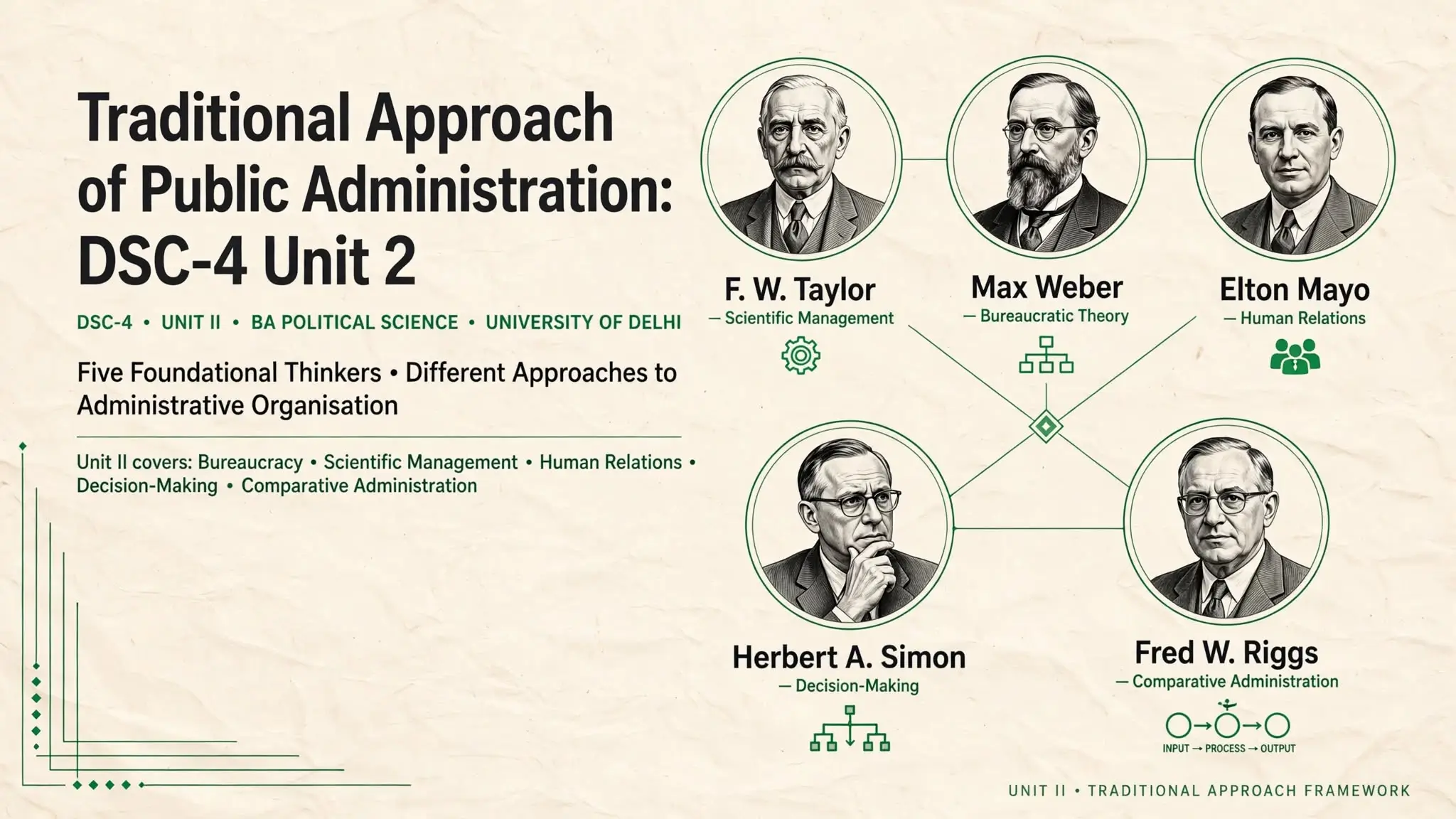
In the University of Delhi syllabus the label is wider. Unit II of DSC-4 (Perspectives on Public Administration) is titled “Mainstream/ Traditional Theoretical Perspectives” and lists five theories, which together are meant to take 15 teaching hours:
- Scientific management: F.W. Taylor
- Ideal-type bureaucracy: Max Weber
- Human relations theory: Elton Mayo
- Rational decision-making: Herbert Simon
- Ecological approach: Fred Riggs
Strictly speaking, only the first two belong to the classical “traditional” model. Mayo is usually placed in the neo-classical or human relations school, Simon in the behavioural or decision-making school, and Riggs in comparative and ecological studies. The syllabus groups all five because they form the standard theoretical canon of the discipline before the contemporary perspectives of Unit III (New Public Management, New Public Service and governance). That grouping is our reading of the syllabus, not a statement the syllabus makes in words, so in an exam answer it is safest to use the heading exactly as DU does and explain each thinker’s school separately.
Definition for exam answers: The traditional approach to public administration refers to the early mainstream theories that explain how public organisations should be structured and managed. They stress efficiency, hierarchy, rules, trained officials and, later, the human, decision-making and environmental factors that classical thinkers had ignored.
These notes cover all five theories in the order of the syllabus. For each one you will find the background, the main ideas, the important criticisms with names attached, and a pointer to how it connects to the rest of the paper. At the end there are comparison tables, a revision glossary, DU previous year questions and FAQs.
The official DU syllabus lists these readings for Unit II. It is worth knowing the names because examiners set questions from them: F.W. Taylor, “Scientific Management” in Shafritz and Hyde (eds.), Classics of Public Administration; P. Mouzelis, “The Ideal Type of Bureaucracy”; Max Weber, “Bureaucracy” in Gerth and Mills, From Max Weber: Essays in Sociology (1946); Warren Bennis, Beyond Bureaucracy (1973); D. Ravindra Prasad and others (eds.), Administrative Thinkers (2010); R. Arora, “Riggs’ Administrative Ecology”; Fred Riggs, Administration in Developing Countries: The Theory of Prismatic Society (1964); and D. Gvishiani, Organisation and Management (1972). You can check the list in the DU Political Science syllabus PDF.
This is Unit II of Perspectives on Public Administration. If you are still revising the basics of the discipline, start with Unit I: Evolution of Public Administration as a Discipline.
In political science the word “traditional” also appears in another debate, the contrast between old and new institutionalism, where the old approach meant the formal-legal study of constitutions, cabinets and bureaucracies. We have a separate note on old and new institutionalism if you want that comparison, but it is not part of this unit.
Unit II at a Glance
| Theory | Thinker | Key work | Core idea in one line | School |
|---|---|---|---|---|
| Scientific management | Frederick Winslow Taylor (1856–1915) | The Principles of Scientific Management (1911) | Replace rule-of-thumb work with methods found by scientific study | Classical |
| Ideal-type bureaucracy | Max Weber (1864–1920) | Wirtschaft und Gesellschaft (Economy and Society), published after his death; “Bureaucracy” in Gerth and Mills (1946) | Legal-rational authority exercised through a hierarchy of trained, rule-bound officials | Classical |
| Human relations | Elton Mayo (born Adelaide, 1880) | The Human Problems of an Industrial Civilization (1933) | Social relations and informal groups strongly shape work behaviour | Neo-classical |
| Rational decision-making | Herbert A. Simon (1916–2001) | Administrative Behavior (1947) | Decision-making is the heart of administration, and human rationality is bounded | Behavioural / decision-making |
| Ecological approach | Fred W. Riggs | Administration in Developing Countries (1964) | Administration is shaped by the society around it; the fused–prismatic–diffracted model | Ecological / comparative |
Background: Why Administration Needed a Theory
Before the 1880s, governments in the West ran largely on patronage and habit. Several developments pushed people to ask how administration should be organised, and the five theories in this unit are answers to different parts of that question.
| Year | Development | Why it matters for this unit |
|---|---|---|
| 1883 | Pendleton Act in the United States creates the first federal civil service system based on merit | Merit-based entry to government comes from civil service reform, which is older than Taylor’s book |
| 1887 | Woodrow Wilson publishes “The Study of Administration” | Argues for a separate science of administration, standing apart from party politics |
| 1906 | New York Bureau of Municipal Research (founded as the Bureau of City Betterment in 1905; some sources date it 1907) | Applies scientific methods and efficiency thinking to city government |
| 1910–1913 | President Taft’s Commission on Economy and Efficiency | A national effort to study how government business is conducted |
| 1911 | Taylor publishes The Principles of Scientific Management | Efficiency becomes a systematic doctrine |
| 1921–22 | Weber’s Economy and Society appears after his death in 1920 | Describes bureaucracy as an ideal type |
| 1924–1932 | Hawthorne studies at Western Electric | Shifts attention to the social side of work |
| 1937 | Gulick and Urwick’s Papers on the Science of Administration (POSDCORB) | Peak of the “principles of administration” tradition |
| 1946–47 | Simon’s “The Proverbs of Administration” and Administrative Behavior | Attacks the principles and puts decision-making at the centre |
| 1961–1964 | Riggs’s The Ecology of Public Administration and Administration in Developing Countries | Brings comparison and environment into the discipline |
For the National Archives’ account of the Taft Commission see Glenn’s article listed under Sources. The point to remember is the sequence: first came efficiency and rules (Taylor, Weber), then criticism from the human side (Mayo), then criticism of the principles themselves (Simon), and finally the question of whether any of these ideas travel across societies (Riggs).
Scientific Management Theory (F.W. Taylor)
History of Scientific Management Theory
Scientific Management was created by Frederick Winslow Taylor, an American mechanical engineer, in the late 1800s and early 1900s during the industrial revolution, a time of fast technology growth and mass production. Old management methods could not meet the needs of large factories, causing waste and uneven work results. Taylor noticed these problems while working in industrial plants and suggested that scientific methods could greatly improve productivity.
One problem troubled him in particular. Workers often held back effort deliberately, a habit Taylor called “soldiering”, partly because they feared that higher output would cut jobs or pay. Under the old system each worker used his own rule-of-thumb methods, and managers usually left the details of the work to him. Taylor’s answer was to move the knowledge of how work should be done from the worker’s habit to management’s study. He set out his views in a paper read to engineers and then in the book The Principles of Scientific Management (1911), which you can read free in the Project Gutenberg edition. In its introduction Taylor says the same principles can be applied to government departments, among many other kinds of organisation.
Basic Principles of Scientific Management Theory
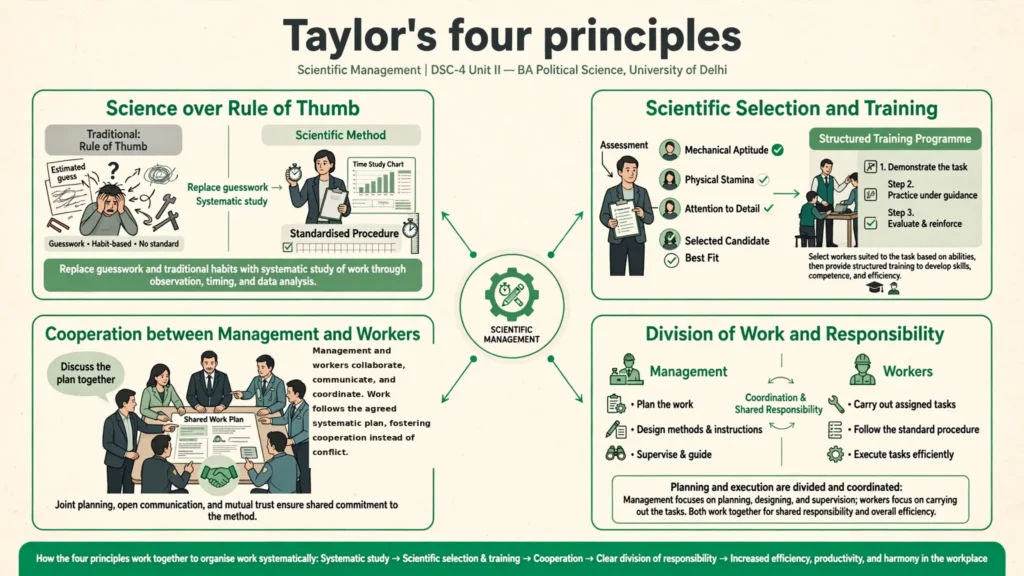
Taylor’s four principles. In Chapter 2 of the 1911 book Taylor describes scientific management as resting on four duties of management:
- Replace rule of thumb with science. Study each element of a job scientifically and develop the best method for doing it.
- Select, train and develop workers scientifically. Instead of letting workers choose their own tasks and train themselves, match people to jobs and teach them the method.
- Cooperate with the workers. Management should make sure the work is actually done in the scientifically developed way.
- Divide work and responsibility almost equally between management and workers. Management takes over the planning and preparation for which it is better suited, and workers carry out the tasks.
How Taylor put these principles into practice. The three points below are the ones most notes mention, and they all follow from the four principles.
- Time and Motion Studies Taylor started using time studies, which meant watching workers closely, timing how long tasks took, and finding the best ways to do them. Motion study, the detailed analysis of the movements involved, was developed further by Frank and Lillian Gilbreth and is usually discussed alongside Taylor’s work. The aim was to cut out unnecessary movements and find the “best way” to do a job, which could then be taught to all workers.
- Standardizing Work Taylor thought that once the best way to do a job was found, everyone should do it the same way. This meant creating clear instructions and using the same tools so all workers could be consistent and produce better results.
- Choosing and Training Workers Another important idea was to choose workers based on their ability for a specific job instead of just assigning anyone to any task. After choosing workers, they would get proper training to learn the best methods, which would help them work better and make fewer mistakes.
- Pay linked to output Taylor believed that workers who met the standard should earn clearly more than those who did not. He argued that higher pay for higher output would benefit both sides, an idea that sits behind his differential piece-rate system.
- Planning separated from doing, and functional foremanship Because planning moved to management, Taylor proposed a planning department and replaced the single all-round foreman with specialist supervisors, each responsible for one aspect of the work. This is called functional foremanship.
The “Mental Revolution”
Taylor insisted that scientific management was not just a set of techniques. He said it required a complete change in attitude on both sides: workers and managers had to stop quarrelling over how to divide the surplus and cooperate to increase it. This idea is known as the mental revolution. It is a favourite exam theme, because it shows that Taylor believed the interests of employers and workers were ultimately the same, which is exactly what his critics doubted.
Scientific Management Theory’s Effect on Public Administration
The ideas of scientific management changed not just businesses but also how government worked. It brought a focus on being efficient and accountable in government tasks. Care is needed here, because several effects that are loosely credited to Taylor have other roots as well.
Key effects on public administration include:
- The efficiency movement in government. Reform bodies such as the New York Bureau of Municipal Research took up scientific methods, and one account notes that the Bureau was influenced by Taylor’s recommendations. The national Taft Commission on Economy and Efficiency (1910–1913) shows the same mood at the federal level.
- Standard procedures and work planning. Written procedures, work standards and planning of tasks in government offices reflect Taylor’s influence. Note that the broader idea of a rule-based, hierarchical bureaucracy is more closely associated with Weber than with Taylor, so keep the two separate in your answer.
- Merit-based hiring (a shared influence). The focus on choosing workers for their skills fitted comfortably with civil service reform. But merit systems in government, such as the Pendleton Act of 1883 in the United States, were already being built before Taylor published his book, so scientific selection reinforced the merit idea rather than creating it.
- Measuring performance. Using time and motion studies led to a focus on checking how well employees were doing their jobs, which improved management in public administration. Early performance measurement in municipal government drew on this tradition.
Historians of the field also note a tension that never fully went away: leaders of public administration were constantly trying to reconcile efficiency with democracy, since a government cannot be judged only by how cheaply it works.
Criticism of Scientific Management
Although some criticized Taylor’s ideas for being too rigid and not considering people’s needs, his work helped modernize management practices in both businesses and government. The main criticisms are these.
- A narrow view of motivation. Taylor treated the worker mainly as a rational, money-seeking person. Later schools, beginning with the human relations movement (see below), showed that belonging, recognition and group norms also drive behaviour.
- Separating thinking from doing. Giving all planning to management reduces workers’ skill, initiative and say in their own work.
- “One best way” is too rigid. It assumes that tasks can be standardised in a stable, predictable setting. Public services, which deal with varied citizens and changing situations, rarely fit that description.
- Distrust from workers and unions. Many workers felt that scientific management was a method of speeding up work. Taylor’s claim that employers’ and workers’ interests are the same was disputed in his own time.
- Little attention to politics and values. Efficiency answers “how”, not “for whom” or “why”, a gap that matters more in government than in a factory.
Relevance Today
Service standards, standard operating procedures, citizen’s charters with time limits and performance targets all carry traces of Taylor’s thinking. The lesson is to use standardisation where tasks are routine, and not where judgment and empathy are the real work.
Ideal-Type Bureaucracy Theory (Max Weber)

Max Weber, a German sociologist and scholar of law and economics, described the “ideal-type bureaucracy” in his writings on economy and society. He worked on the descriptive parts of this book from about 1910, and most chapters were written before 1914, but Wirtschaft und Gesellschaft (Economy and Society) was published only after his death, in 1921–22. English readers got the bureaucracy chapter in full through Gerth and Mills’s From Max Weber (1946), which is the DU reading.
What “Ideal Type” Means
An ideal type is a mental model built by emphasising the main features of a social phenomenon. “Ideal” here does not mean “best” or “desirable”. It means a pure, logically consistent construct against which real organisations can be compared. No real office matches it exactly. Weber did not give a one-line definition of bureaucracy; he listed the features of this type. Weber considered bureaucracy technically the most efficient form of large-scale administration, but he was also uneasy about it. He worried that a society run mainly by officials could become a kind of “iron cage”, and that the officials’ power would be hard to check.
Weber’s Three Types of Authority
Weber linked bureaucracy to a particular source of legitimacy. He distinguished three types of authority:
| Type of authority | Why people obey | Example |
|---|---|---|
| Traditional | Belief in the sanctity of long-standing customs and the ruler’s inherited status | A hereditary monarch |
| Charismatic | Devotion to the exceptional personal qualities of a leader | A religious or revolutionary leader |
| Legal-rational | Belief in the legality of enacted rules and in the right of those holding office under those rules to command | A modern civil service |
Bureaucracy is the administrative form of legal-rational authority: officials are obeyed because of the office and the rules, not because of who they are.
Characteristics of Bureaucracy Theory
- Hierarchical Structure Bureaucracies have a clear structure with different levels of authority. Each level has specific roles and responsibilities, ensuring that decisions come from the top down and that everyone is accountable. Managers oversee workers, and every job has a defined role. Weber also stressed that lower officials have a regulated way of appealing decisions to a higher office.
- Rules and Regulations Bureaucracies follow formal, written rules that guide all activities. These rules help maintain consistency and fairness, as they apply to everyone equally. This prevents random decision-making and creates a standard way to do work.
- Impersonality In Weber’s ideal bureaucracy, personal feelings and relationships do not affect decisions. This helps ensure that choices are made based on facts and rules, promoting fairness and professionalism.
- Merit-based Advancement Weber believed that jobs and promotions should be earned based on abilities and performance, not personal connections. This means that employees are hired and promoted for their skills and achievements. In his description, officials are appointed by superior authority rather than elected, receive a fixed salary and have a secure career with orderly advancement.
- Fixed Areas of Jurisdiction and Division of Labour Each office has its own defined area of competence, fixed by rules, laws or administrative regulations. Duties are divided so that each official becomes a specialist in a particular kind of work.
- Written Records Administration is managed on the basis of written documents (“the files”) that are preserved. The officials, along with the files and equipment, make up a “bureau”. This gives continuity and a basis for accountability.
- Expert Training Office management normally presupposes thorough, specialised training, so a bureaucratic official is a trained expert and not a gifted amateur.
- Separation of Office from the Person Official activity is kept separate from the official’s private life and property. The post belongs to the organisation, not to the person who holds it, and holding office is treated as a full-time vocation demanding the official’s full working capacity.
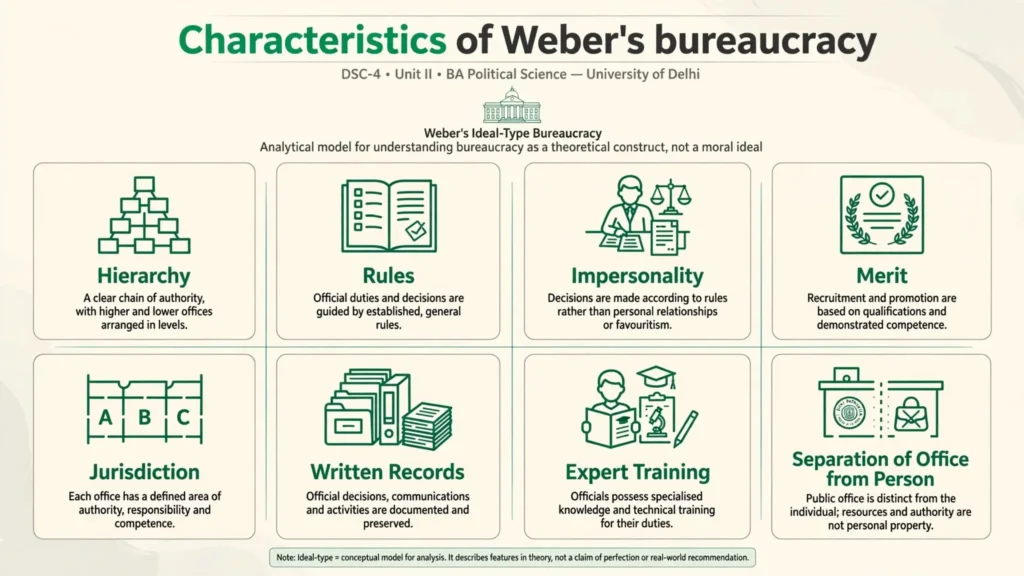
A common mistake is to list only three or four of these points. In a long answer, give at least the first seven.
Advantages and Criticisms of Bureaucracy Theory
Advantages of Bureaucracy Theory:
- Efficiency: Clear rules and roles help tasks be done quickly and effectively.
- Consistency: Standard rules make decisions predictable, ensuring reliable public services.
- Accountability: A clear chain of command helps clarify responsibilities and improves oversight.
- Professionalism: Hiring based on merit creates a skilled workforce.
- Continuity: Written records and permanent offices keep administration going when individual officials change.
Criticisms of Bureaucracy Theory:
- Rigidity: Strict rules can make bureaucracies slow to change, leading to problems in fast-moving situations.
- Red Tape: Bureaucracies can become overly complicated, causing delays and making simple tasks harder.
- Impersonality: While objectivity is good, too much impersonality can make organizations unresponsive to individual needs.
- Goal Displacement: Focusing too much on rules may cause bureaucrats to lose sight of the organization’s main goals. The American sociologist Robert K. Merton developed a related argument in the 1940s, that training in rule-following can turn into a “trained incapacity” to respond to new situations.
- Neglect of informal organisation: Real offices run on friendships, loyalties and unwritten norms, which the ideal type leaves out. This is the point at which the Hawthorne studies, discussed next, challenged the classical model.
- Not suited to rapid change: Warren Bennis, whose Beyond Bureaucracy is on the DU reading list, is a prominent voice in the argument that rigid bureaucratic forms fit stable conditions better than fast-changing ones.
- Weber’s own ambivalence: Weber thought bureaucratic management was both inevitable and a danger, because officials can become a powerful class unless politicians and parliament keep them in check.
Bureaucracy Theory Relevance to Modern Public Administration
Weber’s ideal-type bureaucracy is still important in today’s public administration, as many government organizations are based on these principles. However, new management ideas now emphasize flexibility and responsiveness, which challenge some traditional bureaucratic features. These new ideas, especially New Public Management, are covered in New Public Management and New Public Service.
- Accountability and rule-based decision-making remain vital for fairness in public administration.
- Merit-based recruitment is still important in civil service systems worldwide. In India, recruitment to the higher civil services through competitive examinations is a familiar example.
- Flexibility: Modern public administration aims to combine Weber’s ideas with the need for more adaptability and innovation to meet today’s complex governance challenges.
- Openness: Weber’s world of files and officials’ discretion has been pushed towards transparency through measures such as the Right to Information Act, 2005, in India.
Despite its criticisms, Weber’s bureaucracy model helps us understand how large organizations work, especially in the public sector. Many public administration reforms build on his ideas while trying to fix the issues he pointed out. You can read Weber’s own text of the bureaucracy chapter in an open university course reader.
Human Relations Theory (Elton Mayo)
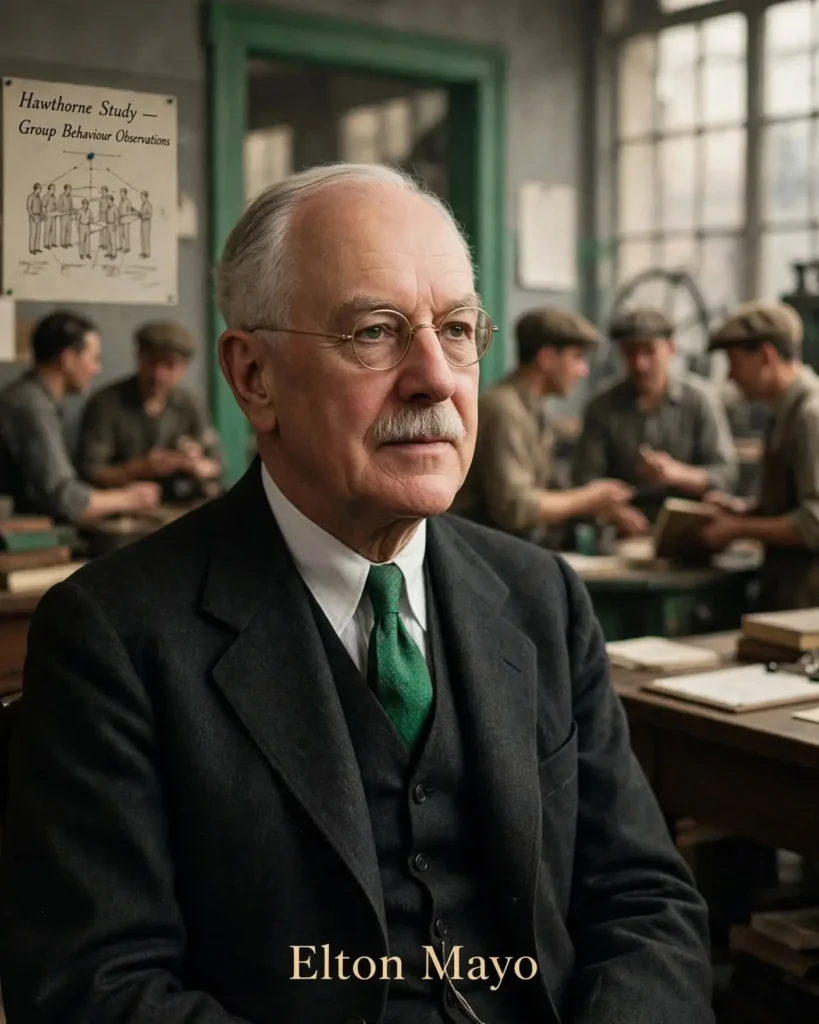
Elton Mayo was born in Adelaide, Australia, in 1880 and became a professor at Harvard Business School, where he led research on industrial life. He is described variously as a psychologist, sociologist or industrial researcher. He is famous for the Human Relations Theory, which took shape in the late 1920s and 1930s. This theory focuses on human behavior, social interactions, and the well-being of employees at work. His main statement of it is The Human Problems of an Industrial Civilization (1933), and the fullest account of the Hawthorne research itself is Roethlisberger and Dickson’s Management and the Worker (1939).
One historical point is worth keeping in mind. The Hawthorne research was not started by Mayo. The first experiments began in 1924 under the National Research Council, and Mayo’s Harvard team joined around 1928, after the early lighting tests had produced puzzling results. Western Electric was also an early adopter of scientific management, so the Hawthorne studies began inside a workplace shaped by Taylor-style thinking.
Hawthorne Studies
The Hawthorne Studies were done at the Western Electric Hawthorne Works in Cicero, Illinois, a town next to Chicago, between 1924 and 1932. These studies looked at how different work conditions, like lighting and hours, affected how well workers performed. They found surprising results that highlighted the importance of social and mental factors.
| Phase | Period | What was done | What was reported |
|---|---|---|---|
| Illumination experiments | 1924–1927 | Researchers varied the lighting in departments and compared output | Output did not follow the lighting in a simple way, which puzzled the researchers and led to further study |
| Relay Assembly Test Room | 1927–1932 | A small group of women (accounts mention five or six operators) assembling telephone relays was observed while rest breaks, hours and pay were changed | Output rose over the years; Mayo’s team stressed morale and supervision |
| Mass interviewing programme | 1928–1930 | More than 21,000 employees were interviewed about their work and supervisors | Attention turned from physical conditions to attitudes and relations with management |
| Bank Wiring Observation Room | 1931–1932 | Fourteen men were observed under unchanged conditions | No increase in output; workers followed an informal understanding of a “fair day’s work” |
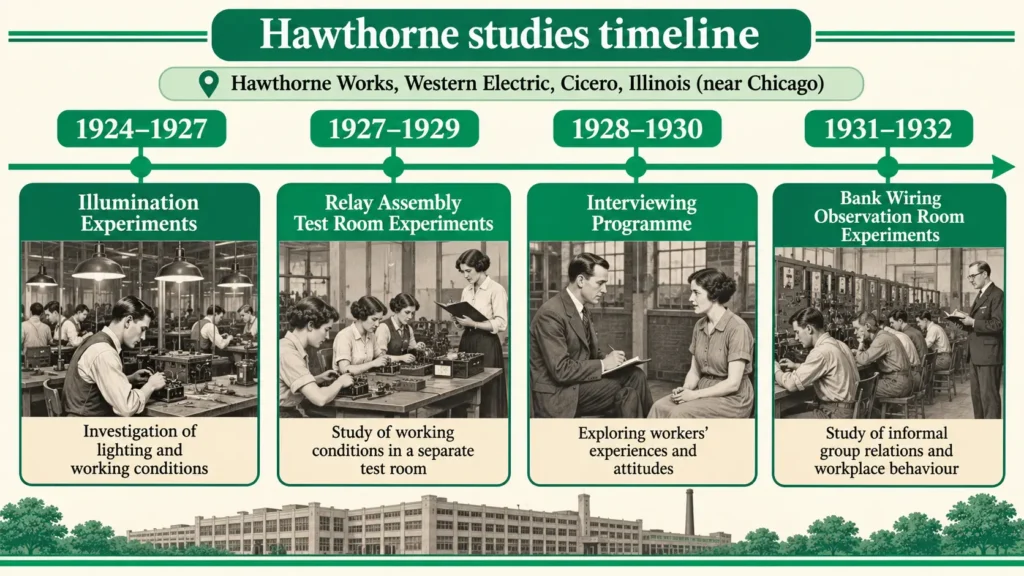
Experiments and Findings of Hawthorne Studies:
- Illumination Experiments: The first tests looked at how changes in lighting affected worker productivity. The classic textbook account says that productivity went up whether the lights were brighter or dimmer. This made researchers rethink how much physical conditions mattered for efficiency. (Later research has questioned this account; see the debate below.)
- Relay Assembly Test Room Experiments: In this phase, a small group of women was monitored while hours, breaks and rewards were changed. Mayo’s team concluded that productivity increased not just because of these changes but because workers felt noticed, included and part of a team, with a more relaxed supervision than they were used to.
- Mass Interviewing Programme: Company interviewers heard employees’ views about work, which showed how much relations with supervisors and co-workers mattered to satisfaction.
- Bank Wiring Observation Room: This experiment studied informal groups and showed that social relationships, peer pressure, and unwritten rules greatly affected how workers behaved and performed. The group restrained its own output to what its members thought fair, so the informal organisation mattered more than the official pay incentive.
Findings of the Hawthorne Studies (as drawn by Mayo and his colleagues):
- Relationships among workers mattered more than previously believed, and informal group dynamics often influenced productivity more than official rules.
- Attention to workers’ needs, their sense of being listened to and the social environment is important for performance.
The “Hawthorne Effect”: What Is Settled and What Is Not
Many notes say that “just being watched” made workers more productive and call this the Hawthorne Effect. Treat that statement with caution, for three reasons that scholars have raised.
- The name came later. The term “Hawthorne effect” was popularised by Henry Landsberger in his 1958 book reviewing the research, about a quarter-century after the studies ended. Neither Mayo (1933) nor Roethlisberger and Dickson (1939) used it in its modern sense; their argument was about social relations and supervision.
- The data have been re-examined. In 1992 Stephen Jones re-studied the relay-room records and argued that changes in the incentive pay scheme and ordinary learning effects could explain much of the rise in output. In 2011 the economists Steven Levitt and John List recovered the original illumination data, long thought lost, and reported that the dramatic “any change raises output” pattern described in textbooks does not appear in them, though they found weaker signs of possible effects (NBER working paper).
- One experiment did not show it. In the bank wiring room, where conditions were left alone, productivity did not rise (Harvard Business School, Baker Library).
A balanced exam answer therefore says: the Hawthorne studies are the founding evidence for the human relations school, but the “Hawthorne effect” in its popular form is a later, contested interpretation, and critics such as Alex Carey (1967) have questioned the methods and conclusions of the studies.
Key Concepts in Human Relations Theory
- Importance of Social Relations Mayo’s work showed that workers are not just machines but social beings with feelings and relationships. Friendships and interactions at work are important for worker satisfaction and performance. Human Relations Theory shifted focus from just tasks to understanding human behavior in organizations.
- Employee Motivation and Morale Mayo found that workers are motivated not only by money or work conditions but also by feeling valued, having a sense of belonging, and building good relationships with coworkers. Employee morale is closely tied to productivity, so management should create a supportive and inclusive environment to boost performance.
- Informal Organisation and Group Norms Alongside the formal organisation chart there is an informal organisation of friendships and shared norms. Work groups can set their own pace, as in the bank wiring room, and managers who ignore this will misjudge why people behave as they do.
- Social Skills of Managers Mayo argued that managers need skill in communication and in securing cooperation, in addition to technical skill. Supervisors who listen, and who are seen to care, change the atmosphere of work.
Impact on Management Practices
Human Relations Theory changed how management viewed worker engagement and teamwork. Some key impacts include:
- Shift to Employee-Centered Management: Management went from treating workers like machines to recognizing their emotional needs and the importance of communication and support. This led to programs for employee engagement and team-building activities.
- Development of Human Resources Management: This theory helped shape modern Human Resources (HR) practices, focusing on training, support, and employee motivation.
- Better Workplace Communication: The importance of open communication between managers and workers became a key management principle, making managers more approachable and encouraging workers to share their thoughts.
- Emphasis on Leadership Styles: The theory also prompted the exploration of leadership styles that value empathy and teamwork, moving away from strict, top-down approaches.
Later behavioural scholars such as Douglas McGregor, with his Theory X and Theory Y, and Abraham Maslow carried this line of thinking further. They are not part of the DU Unit II list, so use them only as a short extension in a long answer.
Criticism of Human Relations Theory
- Weak evidence. The studies were not controlled experiments in the strict sense, and the results have been re-read in different ways (see the debate above).
- Possible managerial bias. Critics argue that the approach can treat good feeling as a tool for raising output, and that it pays little attention to conflict, trade unions, wages and unequal power in organisations.
- Neglect of the formal structure and of the larger environment. Human relations looks closely at the small work group and says little about how the organisation fits into society, which the ecological approach later addressed.
- Overstates harmony. A satisfied worker is not always a more productive worker, and the studies themselves do not establish that simple link.
Overall, Mayo’s Human Relations Theory changed how organizations think about worker productivity by highlighting the importance of social factors, well-being, and relationships in the workplace, even though some of its original claims are now treated with care. For the earlier view that Mayo reacted against, see Taylor’s scientific management above.
Rational Decision-Making Theory (Herbert Simon)

Herbert Simon was an American social scientist who worked across political science, economics, psychology and computer science. He is known for studying how decisions are made in organizations. He received the Turing Award (with Allen Newell) in 1975 and the Nobel Memorial Prize in Economic Sciences in 1978 for pioneering research on decision-making inside economic organisations (see the INFORMS biography). His first major book, Administrative Behavior (1947), grew out of his doctoral dissertation. He questioned the traditional idea that people make fully informed decisions, suggesting instead the idea of bounded rationality. This concept acknowledges that people have limits in their thinking and face real-life challenges when making choices.
Simon’s Challenge to the Classical Principles
Simon entered the discipline with an attack. In his 1946 article “The Proverbs of Administration” (Public Administration Review, 6(1), pp. 53–67), he argued that the so-called principles of administration, the favourites of the Gulick and Urwick tradition, behave like proverbs: for almost every principle there is an equally plausible principle that points the other way. A standard example is the conflict between keeping the span of control narrow (for close supervision) and keeping chains of command short. Because the principles contradict each other, they cannot decide real organisational questions.
His alternative was to take the decision, and not the principle, as the unit of study. In Administrative Behavior he argued that administration is, at its core, decision-making, and that a theory of administration is therefore a theory of human choice. He also separated the factual and value parts of a decision. Science can test factual statements, but it cannot by itself settle questions of values, so only part of administration can be made scientific. Dwight Waldo and other critics argued that this fact–value split was too neat for public administration, where values are always involved.
What is Bounded Rationality?
Bounded rationality means that people are not completely rational because they cannot process all information, often lack complete facts, and have limited time. Unlike the traditional model, which assumes people can think through all options and results, Simon believed that people work within a limited scope. This leads them to make decisions that are satisficing, choosing an option that is good enough instead of the best one since they can’t consider every possibility. Simon developed the idea of satisficing in the 1950s (for example in “Rational Choice and the Structure of the Environment”, Psychological Review, 1956), and the term “bounded rationality” is closely tied to his book Models of Man (1957).
Bounded rationality highlights three main limits:
- Cognitive limits: People can’t handle endless information because of mental limits.
- Incomplete information: Decision-makers often don’t have all the details needed for the best choice.
- Time limits: People do not have endless time to look at all possible outcomes.
Economic Man and Administrative Man. Simon contrasted the “economic man” of classical economics, who has complete information and always maximises, with the “administrative man”, who has limited information and ability, searches until he finds an acceptable option, and relies on routines and rules of thumb.
Decision-Making Process in Rational Decision-Making
Simon suggested that decision-making involves several steps to help people deal with their limited rationality. The three-phase scheme below comes from his later book The New Science of Management Decision (1960).
- Intelligence Phase In this first step, the decision-maker finds the problem or need for a decision. They gather information and look for potential issues or chances. Here, they define the problem clearly and understand the situation.
- Design Phase In this step, possible solutions are created. Decision-makers think of different options to solve the identified problem and consider the effects of each choice while keeping in mind their limits in resources, time, and information.
- Choice Phase In the last step, the decision-maker picks the best option from those created in the design phase. The choice is made based on evaluating alternatives, often going for a good enough decision rather than the best one, given their limitations. After a decision is made, it is put into action and reviewed later.
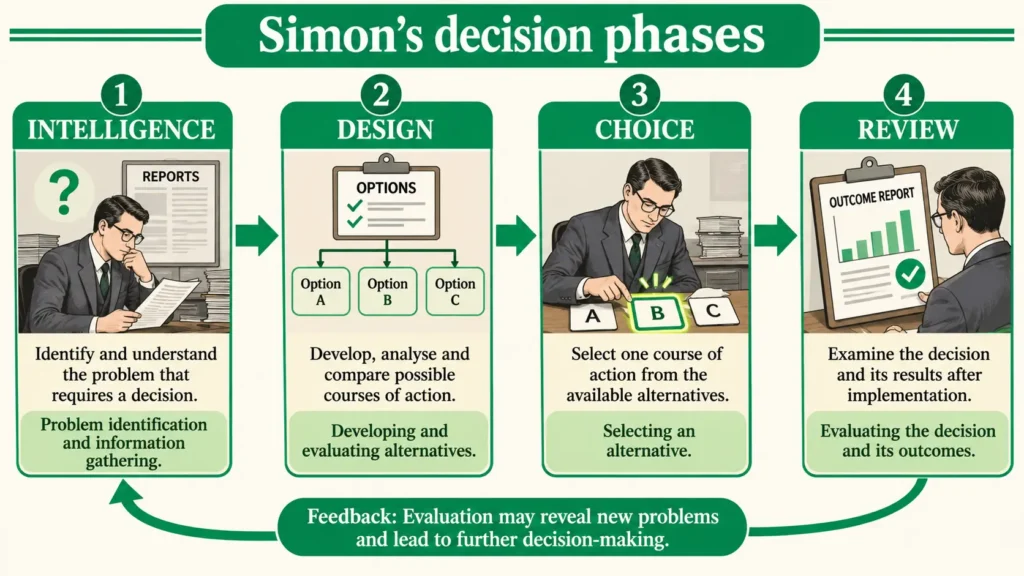
Many textbooks add a fourth step, review, which checks the results of the decision, so you may see the model written as intelligence–design–choice–review. If your notes show a six-step “rational decision process” (identify, list alternatives, evaluate, decide, implement, review), that is a general textbook model and not Simon’s own scheme.
Programmed and non-programmed decisions. In the same 1960 book Simon separated routine, repetitive decisions handled by set procedures (programmed) from new, unstructured ones that call for judgment (non-programmed). Public offices deal with both: issuing a ration card follows a procedure, while responding to a flood needs fresh judgment.
Critiques and Contributions
Contributions:
- Realism in Decision-Making Models: Simon’s bounded rationality model shows a more realistic view of how decisions are made, recognizing that people are not always perfectly rational.
- Framework for Complex Decisions: His phases of decision-making help break down complicated decisions into easier steps for managers and policymakers.
- Introduction of Satisficing: Simon introduced the idea of satisficing, showing that people often look for solutions that are “good enough” rather than perfect. This idea is widely accepted in management and economics.
- Interdisciplinary Influence: Simon’s work has impacted many fields, including economics, psychology, management, political science, and artificial intelligence, especially in decision-support systems.
- Breaking the hold of the “principles”: His critique of the proverbs of administration moved the discipline towards empirical study of behaviour.
Critiques:
- Overemphasis on Cognitive Limitations: Some critics believe that Simon focuses too much on cognitive limits and underestimates people’s ability to learn and make decisions in uncertain situations.
- Simplistic Framework: The steps of decision-making (intelligence, design, choice) may be too simple and might not always reflect the complexities of decision-making in large organizations.
- Focus on Individual Decision-Making: While Simon’s model looks at individual decision-making, it does not fully capture how group dynamics and social interactions affect decisions. Later behavioural work by Simon and James March on organisations tried to address this.
- Politics and power are underplayed. Charles Lindblom’s article “The Science of Muddling Through” (1959) argued that real policy-makers do not compare all options but make small, incremental changes, and that politics, bargaining and power shape decisions. This is the standard alternative to the rational model.
- Fact–value distinction. As noted above, critics such as Waldo doubted that a value-free science of administration is possible.
Overall, Herbert Simon’s work on rational decision-making and the concept of bounded rationality has greatly influenced how we understand decision-making in complex situations. It challenged the traditional view of rationality and provided a more realistic way to study how decisions are made in organizations and everyday life.
Ecological Approach (Fred Riggs)
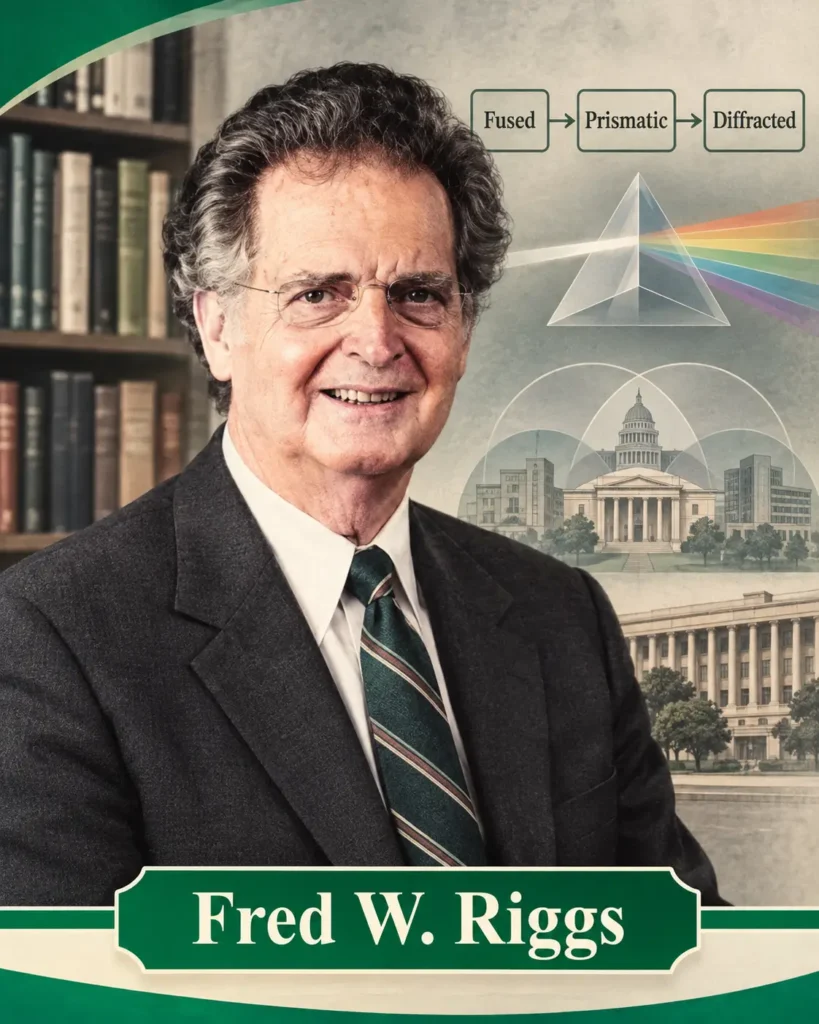
Fred W. Riggs was an American political scientist and an important expert in comparing public administration, and his ecological approach helps us understand how public administration works in different settings. He pointed out that administrative systems are greatly affected by the social, economic, cultural, and political conditions (ecology) around them. His work helps analyze how administration interacts with its environment, especially in developing countries. His main books on the subject are The Ecology of Public Administration (1961), Administration in Developing Countries: The Theory of Prismatic Society (1964), Thailand: The Modernization of a Bureaucratic Polity (1966) and Prismatic Society Revisited (1973).
Who first used the ecological idea? Riggs did not invent the idea that administration must be studied in its setting. Study notes trace the ecological view in American administration to earlier writers such as John M. Gaus, and credit Dwight Waldo with suggesting in the 1950s that structural-functional analysis could be used in public administration. Riggs’s contribution was to build this into a systematic framework for comparing administrative systems across countries. A careful answer should say that he developed and popularised the approach, and not that he created it from nothing.
Concept of Ecology in Administration
The ecological approach sees public administration as part of a larger social system, where factors like the economy, culture, and politics shape how administration works. Riggs believed that the success and features of any administrative system depend on the specific context it is in, influenced by the society it serves. He borrowed the structural-functional method from sociology: look at the structures (patterns of behaviour and institutions) and the functions they perform.
Key points of the ecological approach include:
- Interdependence: Public administration works with other social systems (political, economic, cultural) and is affected by them.
- Adaptation: Administrative systems must adjust to their surroundings, leading to different structures and processes in various societies.
- Context-Sensitivity: What works well in one place may not work in another due to differences in social, cultural, and economic conditions.
Prismatic Sala Model of Riggs
To explain the complexity of administrative systems in developing societies, Riggs created the Prismatic-Sala Model. This model shows how societies change from traditional structures to modern ones, moving through a phase where both traditional and modern elements exist together. It grew out of his earlier agrarian–industrial typology (the “Agraria–Industria” idea of the 1950s).
The prism metaphor. Riggs compared societies to light. In a fused society, like white light, one structure performs many functions. When light passes through a prism it splits into colours; the prismatic society is the stage in which functions are separating but not yet cleanly. In the diffracted society the colours are fully separated and each structure does one specialised job.
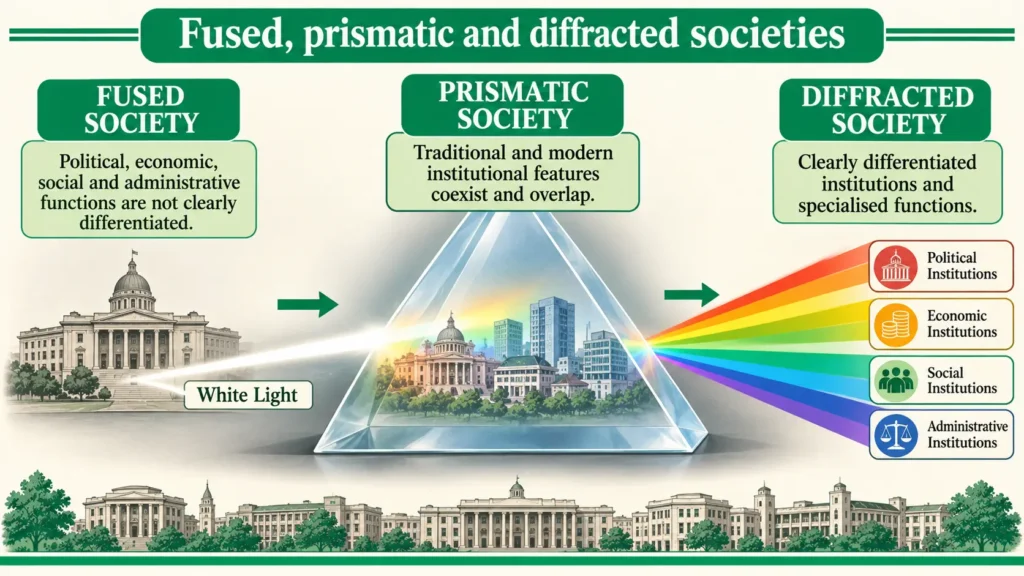
| Fused society | Prismatic society | Diffracted society | |
|---|---|---|---|
| Structures | One structure performs many functions | Modern and traditional structures side by side | Specialised structures, each with its own function |
| Typical setting | Traditional, agrarian | Transitional, developing | Modern, industrial |
| Administrative sub-system | Chamber | Sala | Bureau |
| Norms | Customary, shared | No agreed norms (polynormativism) | Universal, rule-based |
The word sala is a Spanish word for a hall or office. Riggs used it for the administrative sub-system of a prismatic society, which mixes features of the fused “chamber” and the diffracted “bureau” (the Weberian-type office). Riggs described these three as ideal types, so no real country fits exactly.
Characteristics of Prismatic Societies:
Riggs’s three main features are heterogeneity, formalism and overlapping. Notes also list further features such as polynormativism, poly-communalism, nepotism, the bazaar-canteen economy and the authority–control differential.
- Heterogeneity: These societies have a mix of old and new systems, practices and viewpoints existing at the same time, which can create confusion. For example, modern laws may exist alongside traditional customs.
- Formalism: There can be a big difference between official rules and how things actually work. A society may have modern systems in place, but they might not be followed properly due to cultural practices. Formalism is Riggs’s most quoted concept.
- Overlapping: Formally differentiated, modern structures, such as legislatures, courts or departments, exist alongside older undifferentiated structures, and the behaviour of the modern ones is still shaped by family, caste, community or other traditional loyalties. A simple version, that one department handles many tasks because specialisation is lacking, captures only part of the idea. What Riggs stressed is that formal structures and informal behaviour overlap.
- Poly-normativism: Different rules may apply to people based on their social, ethnic, or geographic backgrounds, leading to inconsistent administration. There is no single agreed standard of conduct.
- Poly-communalism and Nepotism: Different communal groups keep distinct identities, and appointments and favours can follow group or kin ties. In the sala, Riggs treated this as a structural feature of the system and not as a random lapse.
- Bazaar-Canteen Model: In the economic sphere, prices are indeterminate and bargaining is common. Riggs combined the bazaar (open bargaining) and the canteen (a protected, subsidised price system for a privileged few).
- Authority–Control Differential: In politics, there is a gap between the formal authority of officials and the real control they exercise.
Administrative Implications (as drawn by Riggs and later scholars):
- Corruption: The gap between official rules and real practices often leads to corruption, as officials may exploit these gaps for personal gain. Riggs explained such practices as products of the setting, which is different from saying that people in these societies are less honest.
- Inefficiency: The blend of old and new systems can cause delays and mismanagement in administrative processes.
- Dual Accountability: Administrators may face pressure from both formal institutions and informal social networks, making it unclear who they are accountable to.
Ecological Approach Relevance to Comparative Public Administration
Fred Riggs’ ecological approach and Prismatic-Sala Model greatly influence the study of Comparative Public Administration (CPA), which looks at how different administrative systems operate in various contexts. Riggs’ work is important for several reasons:
- Understanding Diversity in Administration: Riggs highlighted that we can’t understand administrative systems without considering their environments. This is especially important for studying developing countries, where outside models may not work due to unique societal conditions.
- Focus on Transitional Societies: Riggs’ model helps explain the difficulties faced by countries moving from traditional to modern systems and why some reforms succeed or fail.
- Framework for Comparative Analysis: His work offers a way to compare public administration systems across different societies, recognizing that what works in one place may not work in another.
- Guidance for Reform: Riggs’ approach is useful for creating administrative reforms in developing countries, emphasizing the need for reforms to fit the specific social, political, and economic conditions of each country.
Many Indian students use the model to think about the gap between a rule on paper and its implementation on the ground, which is a useful way to apply formalism, as long as you present it as an application of Riggs’s idea and not as his finding about India.
Criticism of Riggs’s Model
- Too abstract and full of new terms. Riggs borrowed language from physics and sociology, and critics say this makes the model hard to test or measure. Terms like “formalism” and “overlapping” lack precise operational definitions.
- Static. The three-stage scheme says little about how and why a society moves from one stage to the next, which limits its use for studying change and development.
- Overgeneralisation. It places many very different countries under one “prismatic” label.
- Western yardstick. The diffracted, Western-style society is treated as the end point, a view that scholars of other regions question.
- One-way influence. The model shows how society shapes administration, but gives less attention to how administration shapes society.
In summary, Riggs’ ecological approach helps us understand how administrative systems are shaped by their environments and provides helpful insights for studying public administration across different contexts. DU students can read Riggs’s own Administration in Developing Countries (1964) and R. Arora’s “Riggs’ Administrative Ecology”, both on the syllabus.
Important Comparisons
Taylor and Weber
| Point | F.W. Taylor (scientific management) | Max Weber (ideal-type bureaucracy) |
|---|---|---|
| Main focus | The work process on the shop floor | The structure of the whole organisation |
| Question asked | What is the best way to do this task? | How should an organisation be arranged so that it works on rules and not on personal will? |
| Method | Time study, experiment and standardisation | Building an ideal type from historical and sociological analysis |
| Source of authority | Management’s scientific knowledge | Legal-rational authority of rules and offices |
| View of the worker or official | Mainly motivated by pay and suited to a task by selection and training | A trained, salaried expert in a defined office |
| Key concepts | Time study, standard method, mental revolution, functional foremanship | Hierarchy, rules, written files, impersonality, expert training |
| Common criticism | Dehumanising, ignores social needs | Rigid, red tape, ignores informal organisation |
| What they share | Belief in rationality, standardisation and expert-led efficiency |
Taylor and Mayo
| Point | Taylor | Mayo |
|---|---|---|
| View of the worker | Rational, money-seeking individual | Social being who seeks belonging and recognition |
| Motivation | Pay linked to output | Morale, group membership, supervision style |
| Focus | Individual task and method | Work group and informal organisation |
| Role of management | Plan and control the work scientifically | Listen, communicate and sustain cooperation |
| Evidence | Time and motion studies | Hawthorne studies (1924–1932) |
| Weakness | Overlooks social factors | Evidence contested; may underrate pay, conflict and power |
Economic Man and Administrative Man (Simon)
| Point | Economic man | Administrative man |
|---|---|---|
| Information | Complete | Limited |
| Aim | Maximise: choose the best option | Satisfice: choose a good-enough option |
| Process | Examines all alternatives | Searches until an acceptable alternative is found |
| Behaviour | Fully rational | Boundedly rational; uses rules of thumb and routines |
Weber’s Bureaucracy and Riggs’s Sala
| Point | Bureau (diffracted society, Weberian type) | Sala (prismatic society) |
|---|---|---|
| Recruitment | Merit, rules | Merit on paper, with kin and community influence in practice |
| Rules | Followed | Often exist formally but are not followed in practice (formalism) |
| Authority | Matches control | Gap between authority and control |
| Norms | Universal | Several competing norms |
Why These Theories Still Matter
The theories of Unit II are not museum pieces. Unit III of the paper, New Public Management, was a reaction against the rule-bound, hierarchical administration that Weber described, and New Public Service reacted in turn against the efficiency-and-market emphasis of NPM. Reading Taylor, Weber, Mayo, Simon and Riggs first makes that argument easy to follow. Read it next in New Public Management and New Public Service.
- Taylor is still visible wherever government sets service standards, time limits and performance targets.
- Weber underlies merit-based civil services, written rules and files, and the demand for impersonal, fair treatment of citizens.
- Mayo is behind attention to staff morale, teamwork and supervision in public offices.
- Simon reminds policy-makers that decisions are made with limited information and time, which is why pilot programmes and phased reforms are often more realistic than grand plans.
- Riggs warns that a reform copied from another country may not work unless it fits local social conditions.
Conclusion
The five theories of Unit II answer five different questions. Taylor asks how work should be done, Weber how an organisation should be arranged, Mayo what people bring to work beyond pay, Simon how decisions are really made, and Riggs how the surrounding society shapes administration. Each corrects an earlier blind spot. Taylor and Weber give efficiency and rules but overlook the human and political side. Mayo and Simon bring in people and decisions, but have their own limits in evidence and in their treatment of power. Riggs widens the view to whole societies, but at the cost of abstraction.
For exams, the safest pattern is the same for every thinker: background and context, main ideas with correct terms, criticism with names attached, and a line on relevance today. Keep the contested points (the Hawthorne effect, who first used the ecological idea, what “ideal” means in Weber) in your answers as debates, since examiners reward that kind of maturity.
Continue Reading
Continue Reading: more from Perspectives on Public Administration (DSC-4)
- Evolution of Public Administration as a Discipline: Unit I, covering ancient roots, the theoretical journey and principles of administration (POSDCORB).
- New Public Management and New Public Service: Unit III, the reaction to the traditional model.
- Good Governance, Collaborative Governance, Network Governance and Digital Governance: Unit III, the governance perspectives.
- Gender Perspectives on Public Administration: Unit IV.
- All DSC-4 notes in one place: the full category page for this paper.
University of Delhi Previous Year Questions
DU Previous Year Questions
Frequently asked questions from DU exam papers on DSC-4: Perspectives on Public Administration, Unit II – Mainstream / Traditional Theoretical Perspectives. Tap a question to view a quick-answer guide.
1 Elaborate on Human Relations theory. How is it an improvement over the Scientific Management theory? Explain. +
2 Critically examine the Rational Decision-Making theory by Herbert Simon. +
3 “One size does not fit all.” In light of this statement critically examine Max Weber’s “theory” of bureaucracy. +
4 Riggs’ ecological approach has made a substantial contribution to the understanding of Public Administration. Elaborate. +
5 Critically examine the scientific management theory as propounded by F.W. Taylor. +
6 Examine the decision-making theory of Herbert Simon with special reference to “bounded rationality”. +
7 Explain human relations theory with special reference to Hawthorne experiments. +
8 Discuss Max Weber’s legal-rational approach to bureaucracy. +
9 Critically examine the Fused-Prismatic-Diffracted model given by Fred Riggs. Explain its relevance for understanding developing societies. +
10 Write a short note on Scientific Management Approach. +
11 Critically examine Herbert Simon’s rational Decision-making theory. +
12 Critically examine Herbert Simon’s rational Decisionmaking theory. +
13 How is Human Relations Theory an improvement upon the theory of Scientific Management? +
14 Discuss the contribution of Max Weber’s theory of ideal-type bureaucracy. +
15 Examine Herbert Simon’s Rational Decision-making theory. +
16 Critically examine F.W. Taylor’s Scientific Management Approach in Public Administration. +
17 Explain Max Weber’s Ideal type of Bureaucracy. +
18 Explain Rational Decision Making Theory by Herbert Simon. +
19 Analyse Ecological Approach in Public Administration as propounded by Fred Riggs. +
20 Explain the principles of Scientific Management as proposed by Frederick Taylor. How is it different from traditional management practices? +
21 Describe Max Weber’s concept of bureaucracy. What are its main features and how does it ensure efficiency in public administration? +
22 Evaluate the contribution of the ecological model of Fred Riggs. +
23 “True Scientific Management requires a mental revolution on the part of both the management and workers.” Examine the statement in the light of the principles of Scientific Management enunciated by F.W. Taylor. +
24 The “Rational Decision-Making Model” of Herbert A. Simon is a major component of administrative theory. Comment. +
25 Critically evaluate the contribution of Fred Riggs’ Ecological Model to Public Administration. +
26 Write a short note on Hawthorne Experiments. +
27 Write a short note on Herbert Simon’s concept of bounded rationality. +
For more papers, visit the DU previous year question papers page and the DU BA Political Science PYQ category.
FAQs
Why does DU call Mayo, Simon and Riggs “traditional” when they came after Taylor and Weber?
The syllabus title is “Mainstream/ Traditional Theoretical Perspectives”, and it does not explain the grouping. In textbooks only Taylor and Weber are classical or traditional; Mayo is neo-classical, Simon is behavioural and Riggs is ecological. They are grouped as the “mainstream” canon that comes before the contemporary perspectives of Unit III. In an exam, use DU’s heading and name each thinker’s school.
Does “ideal type” in Weber’s theory mean the best type of organisation?
No. An ideal type is a pure, simplified model used to compare real organisations. Weber thought bureaucracy was technically very efficient, but he also feared its power, so “ideal” does not mean “desirable”.
Is the Hawthorne effect real?
The studies are real and important for the history of management, but the popular idea that “being watched raises productivity” is contested. The term was popularised in 1958, and later re-analyses (Jones, 1992; Levitt and List, 2011) questioned the textbook account of the lighting experiments. Present it as a debate.
Where exactly were the Hawthorne studies done?
At the Hawthorne Works of the Western Electric Company in Cicero, Illinois, near Chicago, between 1924 and 1932.
What is the difference between bounded rationality and satisficing?
Bounded rationality is the condition: people have limited information, ability and time. Satisficing is the behaviour that follows: choosing the first option that is good enough rather than searching for the best.
Did Mayo reject Taylor’s ideas?
Mayo’s school shifted attention from the task to the worker and the group, so it is often presented as a reaction to scientific management. It is better described as a correction and a widening of focus than a complete rejection, and the Hawthorne plant itself had been influenced by scientific management.
What are the three main features of a prismatic society?
Heterogeneity (old and new systems side by side), formalism (a gap between formal rules and actual behaviour) and overlapping (formally differentiated structures still shaped by older undifferentiated ones). Polynormativism, poly-communalism and the bazaar-canteen economy are further features in many notes.
What does “sala” mean?
It is a Spanish word for a hall or office. Riggs used it for the administrative sub-system of a prismatic society, a mixture of the fused society’s “chamber” and the diffracted society’s “bureau”.
Are Fayol, Gulick and POSDCORB part of Unit II?
Not in the Unit II list of the current DSC-4 syllabus, which names five theories only. Principles of administration and POSDCORB come under Unit I (“Principles of Public Administration”), which is covered in Evolution of Public Administration as a Discipline. Older syllabi did list “Administrative Management (Gulick, Urwick and Fayol)”, so check that your own college uses the current one.
Which text of Weber should I read for DU?
The syllabus lists Max Weber, “Bureaucracy”, in Gerth and Mills, From Max Weber: Essays in Sociology (1946). Weber’s main work was published after his death, in 1921–22.
Can I write the exam answer in Hindi?
The DU question papers say that answers may be written in English or Hindi, but the same medium must be used throughout the paper.
How should I structure a 15-mark answer on any of these theories?
Start with a one-line definition and the context, then give the main ideas with correct terms, then criticism with names, then relevance today, and end with a short conclusion. Use a table only for comparisons.
Sources and Further Reading
Primary and official
- University of Delhi, Department of Political Science, Semester II syllabus (DSC-4).
- F.W. Taylor, The Principles of Scientific Management (1911), Project Gutenberg.
- Max Weber, “Bureaucracy”, in Gerth and Mills (eds.), From Max Weber (1946); an open-access excerpt of the text.
- Herbert A. Simon, “The Proverbs of Administration”, Public Administration Review 6(1), 1946, pp. 53–67; Administrative Behavior (1947); Models of Man (1957); The New Science of Management Decision (1960).
- Fred W. Riggs, The Ecology of Public Administration (1961); Administration in Developing Countries: The Theory of Prismatic Society (1964); Prismatic Society Revisited (1973).
Scholarly and archival
- Harvard Business School, Baker Library, Hawthorne studies exhibit.
- UGC-INFLIBNET e-PG Pathshala, module on the Hawthorne experiments.
- S. Levitt and J. List, “Was There Really a Hawthorne Effect at the Hawthorne Plant?”, American Economic Journal: Applied Economics 3(1), 2011.
- E. Mayo, The Human Problems of an Industrial Civilization (1933); F. Roethlisberger and W. Dickson, Management and the Worker (1939); H. Landsberger, Hawthorne Revisited (1958); A. Carey, “The Hawthorne Studies: A Radical Criticism”, American Sociological Review (1967); S. R. G. Jones, American Journal of Sociology (1992).
- Bess Glenn, “The Taft Commission and the Government’s Record Practices”, The American Archivist, National Archives.
- INFORMS, biographical profile of Herbert A. Simon.
Subscribe to keep reading
You've used your free notes for now. Get Delhi Pathshala Premium for unlimited access.
Subscribe — ₹29/30 days
Thanks very much for the literature ,it is really well articulated and clear to understand. I am looking forward for further reading materials