

Contents
- Quick Summary (TL;DR)
- Old Institutionalism vs New Institutionalism: Key Differences
- Old Institutionalism (Traditional Institutionalism)
- 1. Historical Institutionalism
- Definition and Key Concepts
- Evolution of Historical Institutionalism
- Major Theorists and Contributions
- Case Studies and Applications
- Strengths and Limitations
- New Institutionalism (Neo-Institutionalism)
- 2. Rational Choice Theory
- Definition and Key Concepts
- Evolution of Rational Choice Theory
- Major Theorists and Contributions
- Case Studies and Applications
- Strengths and Limitations
- 3. Sociological Institutionalism
- Definition and Key Concepts
- Evolution of Sociological Institutionalism
- Major Theorists and Contributions
- Case Studies and Applications
- Strengths and Limitations
- Frequently Asked Questions (FAQ)
- Related Notes (DSC-5, Unit 3 & Beyond)
- External References (for further reading)
In this post, notes of “Unit 3: Approaches to Studying Comparative Politics: Traditional and Neo-Institutionalisms” from “DSC – 5: Methods and Approaches in Comparative Political Analysis” are given, which are helpful for BA (Hons.) Political Science students preparing for their DU exams this year.
If you’re also studying the foundational framework before this topic, check out our notes on Approaches to Studying Comparative Politics first — it sets up the context for why New Institutionalism emerged.
Quick Summary (TL;DR)
- Old (Traditional) Institutionalism focused only on formal-legal structures — constitutions, parliaments, courts — and was descriptive, not comparative.
- New Institutionalism (Neo-Institutionalism) broadened the scope to include informal norms, culture, and individual behavior, and is analytical, empirical, and comparative.
- New Institutionalism has three main strands: Historical Institutionalism, Rational Choice Institutionalism, and Sociological Institutionalism.
- Key thinkers: Peter Hall & Rosemary Taylor (who classified the “three new institutionalisms”), Paul Pierson, Theda Skocpol, Elinor Ostrom, John Meyer.
Old Institutionalism vs New Institutionalism: Key Differences
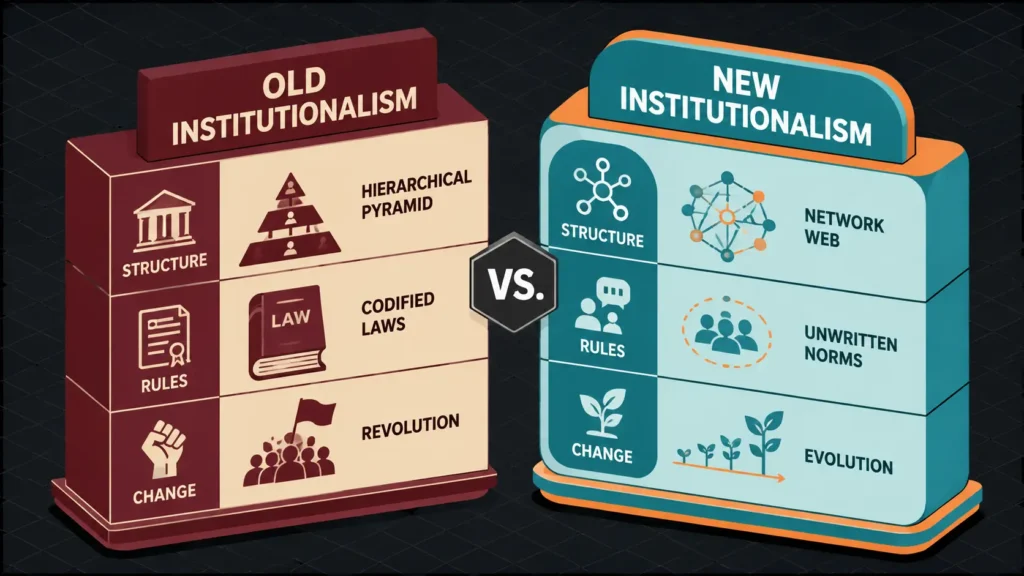
| Basis | Old (Traditional) Institutionalism | New Institutionalism |
|---|---|---|
| Focus | Formal-legal structures (constitutions, laws) | Formal + informal institutions, norms, culture |
| Approach | Descriptive, narrative-based | Analytical, empirical, theory-driven |
| Method | Inductive reasoning | Deductive + inductive reasoning |
| Scope | Single-country, non-comparative | Comparative, cross-country analysis |
| View of institutions | Static, unchanging | Dynamic, evolving over time |
| Key concern | “Good government” / normative ideals | Explaining political outcomes, behavior |
| Associated scholars | Woodrow Wilson, early legal-formalists | Peter Hall, Rosemary Taylor, Paul Pierson, Elinor Ostrom |
| Major critique it responds to | N/A (foundational approach) | Reaction to Behaviouralism’s neglect of institutions |
(Source basis: Thelen & Steinmo’s classic distinction between Old and New Institutionalism)
For a deeper look at how this shift happened historically, see the Wikipedia entry on New Institutionalism.
Old Institutionalism (Traditional Institutionalism)
Old Institutionalism was the dominant approach in political science until the mid-20th century. It concentrated almost entirely on formal government structures — constitutions, legal frameworks, and administrative arrangements — assuming these rules were actually followed and were the primary basis for political action. It was largely descriptive and non-comparative, which limited its usefulness for explanatory theory-building.
1. Historical Institutionalism
Definition and Key Concepts
- Historical Institutionalism studies how institutions affect political and social behavior over time. It shows that history and past events influence how institutions develop, including their rules and policies.
- Important ideas include path dependency (once institutions are set up, they tend to stay the same and resist change), critical junctures (important moments that change the direction of institutions), and increasing returns (the idea that the benefits of an institution grow over time).

Evolution of Historical Institutionalism
Historical institutionalism started in the 1970s and 1980s as a response to other theories. It focuses on how long-term historical events shape institutions. It gained popularity because it addressed weaknesses in behavioral studies that ignored history, using detailed case studies to understand institutional effects over time.
Major Theorists and Contributions
- Paul Pierson studied path dependency and increasing returns, showing how institutions resist change.
- Theda Skocpol looked at social revolutions and how state structures affect political outcomes.
- Kathleen Thelen examined how institutions change slowly, introducing ideas like institutional layering and drift.
Case Studies and Applications
Historical institutionalism is used in areas like welfare state development, labor market policies, and international relations. For instance:
- U.S. welfare state: It studies how New Deal policies have influenced later welfare policies.
- European Union integration: Researchers look at how early treaties have impacted later European cooperation.
Strengths and Limitations
Advantages:
- Provides a long-term view of how institutions change and stay the same.
- Helps explain why some policies last and why changing institutions can be hard.
Disadvantages:
- Sometimes focuses too much on stability, missing chances for change.
- It can be hard to measure historical events and show cause and effect due to the complexity of many factors over time.
Historical institutionalism is an important method in political science, helping to understand how institutions develop in relation to history.
New Institutionalism (Neo-Institutionalism)
New Institutionalism emerged in the 1980s as a corrective — it brought institutions back to the centre of comparative analysis while keeping the analytical rigour introduced by the behaviouralists. Instead of insisting on one correct way to study institutions, it accommodates structural analysis, strategic modelling, and cultural interpretation under one broad umbrella — split mainly into three schools: Historical, Rational Choice, and Sociological Institutionalism.
2. Rational Choice Theory

Definition and Key Concepts
- Rational Choice Theory (RCT) is an idea in neo-institutionalism that explains how institutions work by assuming that people act in ways that are best for themselves. It suggests that rules and norms in institutions appear as solutions to problems that affect groups, helping people get better results than if they acted alone.
- Important ideas include individual rationality (people make choices that fit their needs), utility maximization (seeking the best result based on personal choices), strategic interaction (thinking about what others might do), and institutional equilibrium (a stable situation where everyone’s interests match within the rules of the institution).
Evolution of Rational Choice Theory
RCT grew in popularity in the late 20th century as researchers began to use economic ideas about rational behavior to study political and social institutions. It is different from older views because it focuses on the actions of individuals and uses math to predict how rules and norms come about from people’s decisions.
Major Theorists and Contributions
- James Buchanan and Gordon Tullock are key figures, especially for their work on public choice theory, which looks at how political decisions are made.
- Mancur Olson introduced the idea of collective action problems, explaining why people might not work together for shared goals without institutional help.
- Elinor Ostrom showed how groups can manage shared resources effectively by working together, applying RCT to common resources.
- Kenneth Shepsle applied RCT to how lawmakers behave, suggesting that rules are created to solve common problems and make decision-making smoother.
Case Studies and Applications
RCT is used in many areas, including:
- Voting behavior: It explains why people choose to vote or not by looking at the costs and benefits.
- Legislative behavior: It helps understand how lawmakers form alliances and negotiate laws.
- Public goods and resource management: Ostrom’s work shows how communities manage shared resources without a central authority, highlighting rational choices that keep institutions stable.
Strengths and Limitations
Strengths:
- Provides a clear way to analyze how people make decisions within institutional rules.
- Helpful for creating models that explain and predict behavior in competitive situations.
Limitations:
- Often criticized for being too simple by assuming everyone is purely rational, overlooking emotions and social influences.
- Has trouble explaining how institutions change over time, as it assumes that rules and incentives stay the same.
- Faces challenges in proving what people really want and what drives their choices.
Rational Choice Theory is still important in studying institutions, especially where strategic decision-making is key. Its use is changing as critiques push for more realistic views of human behavior and how institutions work.
3. Sociological Institutionalism
Definition and Key Concepts
- Sociological Institutionalism studies how culture, social structures, and common beliefs shape institutions and behavior. It shows that institutions are influenced by cultural and social contexts, not just by logic and reason.
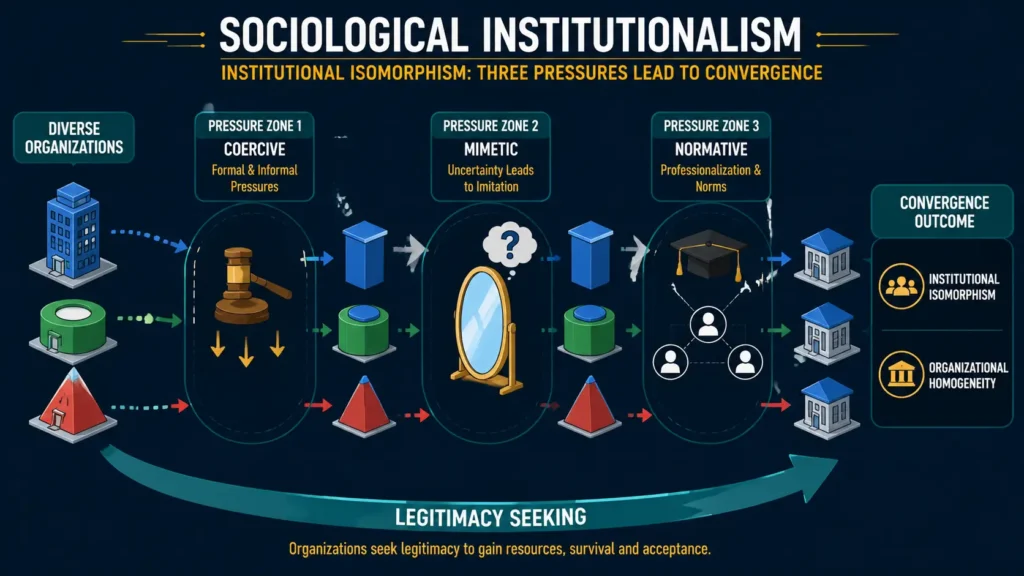
- Important ideas include cultural scripts (shared ideas about how to behave in institutions), institutional isomorphism (the tendency for institutions to become similar to gain acceptance), and legitimacy (the approval of an institution based on how well it matches social values, not just its efficiency).
Evolution of Sociological Institutionalism
Sociological Institutionalism started in the late 1900s, offering a different view from Rational Choice Theory. It focuses on how institutions grow based on shared values and norms, rather than just on what is most useful. It looks at institutions as things created by society that reflect deeper cultural ideas.
Major Theorists and Contributions
- John W. Meyer and Brian Rowan are key figures known for their work on institutional isomorphism, showing how institutions become similar to fit social norms and gain legitimacy.
- Paul DiMaggio and Walter Powell expanded these ideas, identifying three types of isomorphism: coercive (influences from rules or pressures), mimetic (copying successful organizations), and normative (influences from shared professional standards).
- Richard Scott made important contributions by categorizing institutional pillars (regulative, normative, and cultural-cognitive) and explaining how they affect how institutions work.
Case Studies and Applications
Sociological Institutionalism is used in areas where culture and legitimacy are important:
- Education systems: Meyer’s research shows that schools worldwide adopt similar structures to align with modern social norms, not just because they are needed.
- Organizational structure: DiMaggio and Powell found that companies often have similar management styles to seem legitimate, even if these styles don’t always improve efficiency.
- Healthcare systems: Studies show that healthcare institutions adopt certain policies to follow professional standards or rules, creating similar patterns across different countries or regions.
Strengths and Limitations
Strengths of Sociological Institutionalism:
- It helps us understand how culture and norms shape how institutions develop and last.
- It shows the importance of legitimacy, explaining why institutions may continue to exist even when they are not efficient, as they reflect accepted social practices.
Limitations of Sociological Institutionalism:
- It is sometimes seen as downplaying individual actions and focusing too much on social norms as the main influence on behavior.
- It has trouble explaining how institutions change in situations where norms and culture are very strong.
- There can be confusion about what causes institutional changes—whether they come from cultural influences or from practical responses to outside pressures.
Sociological Institutionalism has greatly helped us understand the cultural and social aspects of institutions, adding to other theories by highlighting the importance of shared meanings and legitimacy. Its focus on norms and isomorphism offers valuable insights, especially in fields that are closely regulated or culturally important.
Frequently Asked Questions (FAQ)
What is the main difference between old and new institutionalism?
Old institutionalism focused narrowly on formal-legal structures like constitutions and laws, using a descriptive, non-comparative approach. New institutionalism expands this to include informal norms, culture, and individual behavior, using an analytical and comparative approach.
Who founded/popularized New Institutionalism?
New Institutionalism is most associated with Peter Hall and Rosemary Taylor, who classified it into three schools — Historical, Rational Choice, and Sociological Institutionalism — along with contributors like James March and Johan Olsen, who coined the phrase “bringing institutions back in.”
What are the three types of New Institutionalism?
The three main types are: (1) Historical Institutionalism, (2) Rational Choice Institutionalism, and (3) Sociological Institutionalism.
Why did New Institutionalism emerge?
It emerged in the 1980s as a reaction to Behaviouralism, which had pushed institutions aside to focus purely on individual behavior. Scholars realized behaviouralism alone couldn’t explain why political systems differed so much across countries, so institutions were brought back into focus — but with more analytical rigor than Old Institutionalism had.
Is Rational Choice Institutionalism part of Old or New Institutionalism?
Rational Choice Institutionalism is one of the three strands of New Institutionalism, not Old Institutionalism.
What is path dependency in institutionalism?
Path dependency is a concept from Historical Institutionalism stating that once an institution is established, it tends to persist and resist change, even if it becomes inefficient, because of the high cost of switching to alternatives.
Related Notes (DSC-5, Unit 3 & Beyond)
- Approaches to Studying Comparative Politics
- Types of Political Culture in Comparative Politics
- New Public Management vs New Public Service Comparison
- BA (Hons.) Political Science Notes — Full Syllabus
External References (for further reading)
- Wikipedia: New Institutionalism
- Hall, P. & Taylor, R. — “Political Science and the Three New Institutionalisms” (classic academic paper, searchable via Google Scholar)
Subscribe to keep reading
You've used your free notes for now. Get Delhi Pathshala Premium for unlimited access.
Subscribe — ₹29/30 days