
Contents
- Understanding Political Systems
- 1. The Institutional Approach (Traditional Approach)
- What is the Institutional Approach?
- Key Features
- Major Criticisms
- 2. The System Approach (David Easton’s Political System Approach)
- What is the System Approach?
- Easton’s Input-Output Model
- Why the System Approach Was Important
- Criticisms of the System Approach
- 3. The Structural-Functional Approach
- What is Structural Functionalism
- Origins and Key Theorists
- Basic Concepts: Structure, Function, and System
- Application in Comparative Politics
- Case Studies: Structural-Functionalism in Different Countries
- 1. United States
- 2. United Kingdom
- 3. China
- 4. Brazil
- Comparison Table: Institutional vs System vs Structural-Functional Approach
- Critiques and Limitations (of Structural Functionalism, applies broadly)
- Strengths
- Criticisms
- Alternative Approaches That Emerged in Response
- From Old to New Institutionalism
- External References (for further reading)
- DU Previous Year Questions (Typical Exam Pattern for This Unit)
- FAQs
In this post, notes of Unit 2: Approaches to Studying Comparative Politics from DSC-5: Methods and Approaches in Comparative Political Analysis are given — covering the three foundational approaches (Institutional, System, and Structural-Functional), their key theorists, real-country case studies, and critiques. These notes are structured exactly around the official DU syllabus so that BA (Hons.) Political Science students can revise Unit 2 quickly before their semester exam.
📌 Before this unit, make sure you’ve covered Unit 1: Nature and Scope of Comparative Politics, and after finishing this post, continue to Unit 3: New Institutionalism for the natural next step in the syllabus.
Understanding Political Systems
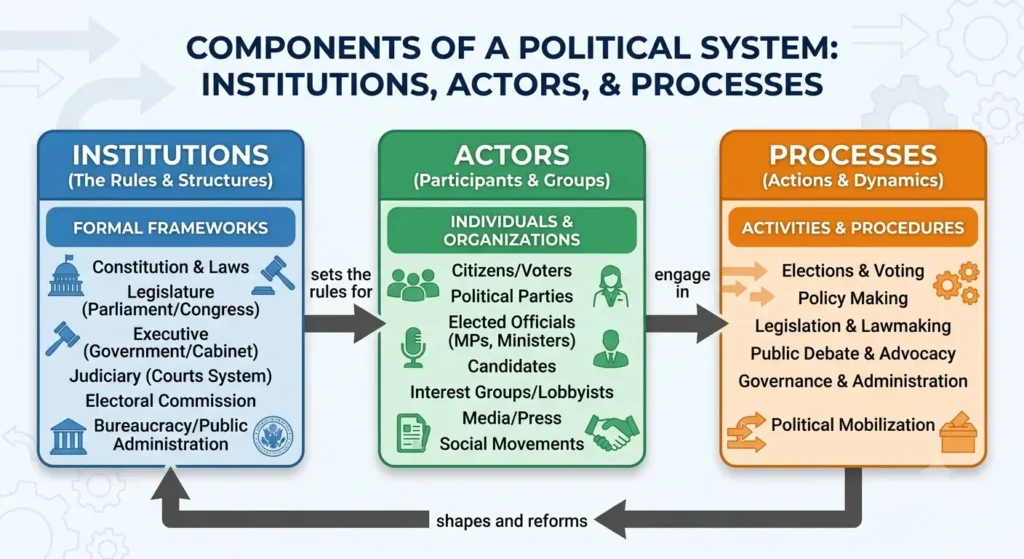
A political system refers to the structured and organized way in which a society manages its political affairs. It encompasses the institutions, actors, processes, and norms that govern political behaviour and decision-making within a state. Political systems vary widely across countries, reflecting different cultural, historical, and social contexts — which is exactly why comparative politics needs distinct approaches (tools of analysis) to study them systematically, rather than just describing what exists.
Before Approaches to Studying Comparative Politics became a defined sub-field, political scientists mostly just described institutions country by country. The three approaches below represent successive attempts to make that study more scientific, comparative, and theory-driven.
1. The Institutional Approach (Traditional Approach)
What is the Institutional Approach?
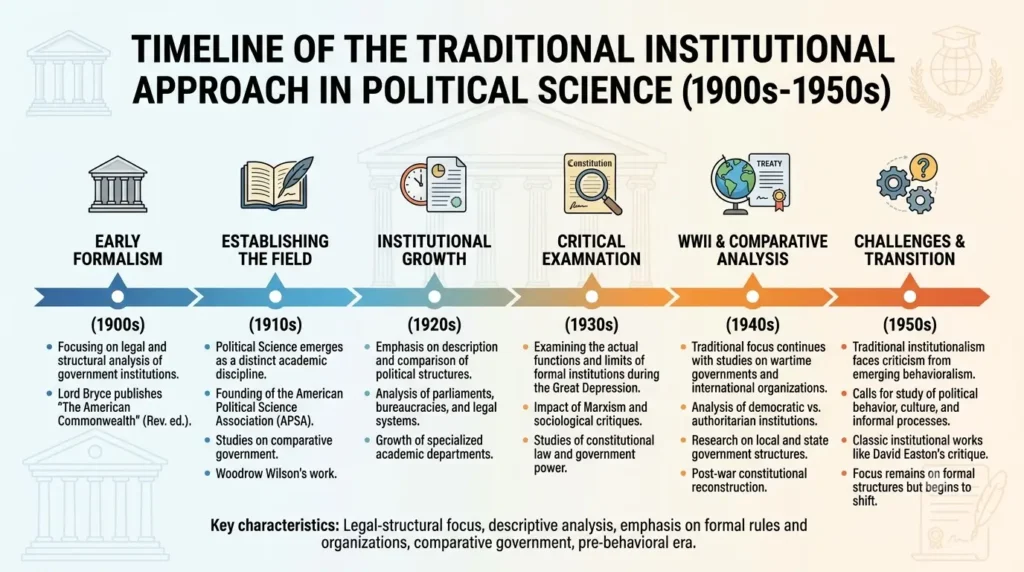
The Institutional Approach is the oldest and most traditional way of studying comparative politics. It focuses on the formal structures of government — constitutions, legislatures, executives, and judiciaries — and studies how these institutions are organised and how they function on paper.
This approach dominated the discipline roughly from the late 19th century until the 1950s, before the “behavioural revolution” pushed political science toward more scientific, data-driven methods.
Key Features
- – Focus on Formal Structures: Legislatures, executives, judiciary, and constitutional provisions are studied as the core unit of analysis.
- – Legal-Constitutional Method: Emphasis on written rules, laws, and constitutional design rather than actual political behaviour.
- – Descriptive, Not Analytical: Mostly describes “what exists” rather than explaining “why it works this way” or predicting outcomes.
- – Country-by-Country Study: Institutions of different nations were studied largely in isolation, with limited genuine comparison between them.
Major Criticisms
- – Parochial: Concentrated almost entirely on Western democracies (US, UK, France), largely ignoring the developing and non-Western world.
- – Non-comparative: Despite being called “comparative,” it rarely compared institutions across countries in a structured way — most studies were single-country accounts.
- – Static: Treated institutions as fixed, ignoring how they change, adapt, or are actually used in practice, which often differs sharply from formal rules.
- – Formal-Legalistic: Overemphasised written constitutional text while ignoring informal practices, political culture, and actual power dynamics.
These weaknesses are exactly why political scientists moved toward the System Approach in the 1950s-60s — a shift that mirrors the broader “behavioural revolution” in political science.
2. The System Approach (David Easton’s Political System Approach)
What is the System Approach?
The System Approach was pioneered by political scientist David Easton in the 1950s as a reaction to the narrow, formal-legalistic Institutional Approach. Instead of studying isolated institutions, Easton proposed treating the entire political system as a single, interconnected unit — similar to how biology treats a living organism as a system of interacting parts.
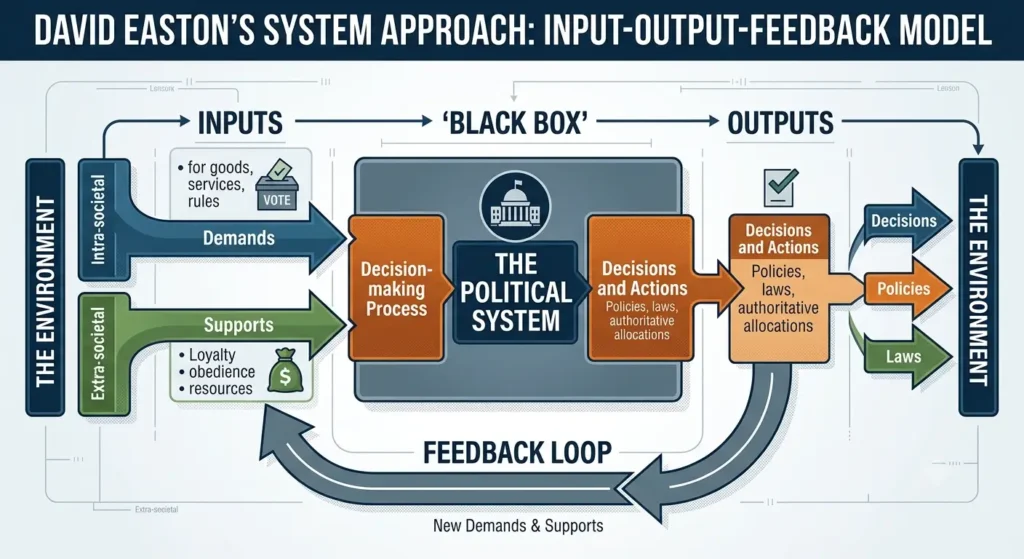
Easton’s Input-Output Model
Easton’s model explains how a political system processes societal pressures and converts them into policy outcomes, through four connected stages:
- – Inputs: Demands (e.g., citizens wanting better roads, jobs, or rights) and Support (loyalty, taxes, obedience to law) flow into the political system from society.
- – Conversion Process: The political system (parliament, bureaucracy, courts) processes these inputs — debating, negotiating, and turning demands into actual decisions.
- – Outputs: The system produces policies, laws, and decisions in response to the inputs it received.
- – Feedback: The effects of these outputs flow back into society, generating new demands and support, and the cycle repeats continuously.
Why the System Approach Was Important
- – Universally Applicable: Because it’s built around functions (inputs, outputs) rather than specific institutions, it can be applied to any political system — democratic, authoritarian, or traditional — solving the Institutional Approach’s Western bias problem.
- – Dynamic, Not Static: It treats politics as an ongoing, self-adjusting process rather than a fixed structure frozen in a constitution.
- – Genuinely Comparative: Since every political system, regardless of country, can be studied through the same input-output framework, real cross-country comparison finally became possible.
Criticisms of the System Approach
- Critics argue it is overly abstract and mechanical, treating political life like an engineering system and downplaying human agency, ideology, and conflict.
- It tends to assume systems naturally move toward stability and equilibrium, which underplays revolutions, sudden regime collapse, and radical political change.
3. The Structural-Functional Approach
What is Structural Functionalism
Structural functionalism is a way of looking at society as a system where different parts work together to keep things stable and orderly. It focuses on how social structures connect and the roles they play in keeping society together — extending Easton’s systems thinking with a deeper focus on functions.
Origins and Key Theorists
– Historical Background: Structural functionalism started in the early 1900s, during a period of major change driven by industrialisation and urbanisation. It aimed to understand how different parts of society help keep it stable.
– Main Thinkers:
- Émile Durkheim (1858–1917): Known as the father of sociology, Durkheim highlighted the importance of social facts and collective beliefs in maintaining order. His work on suicide showed how society shapes individual behaviour.
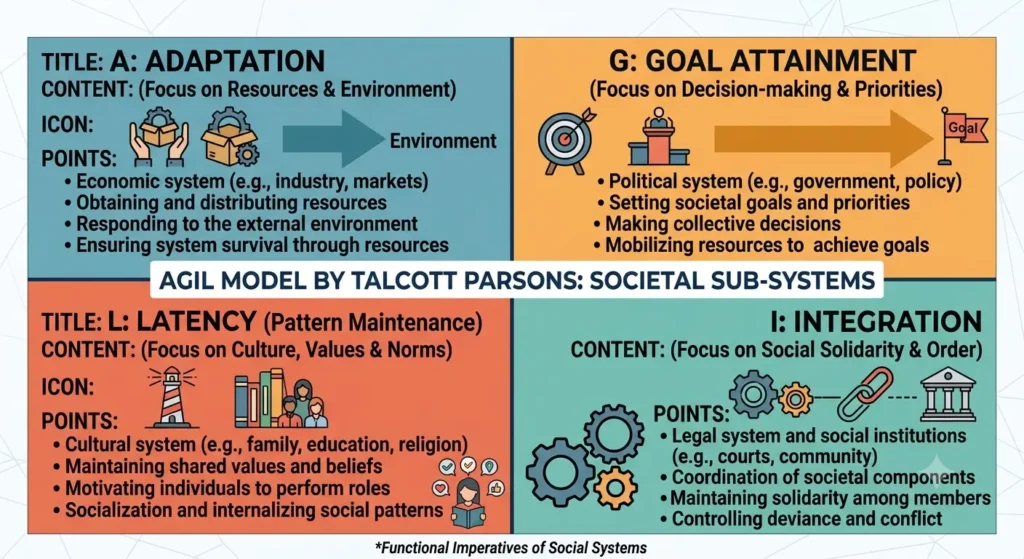
- Talcott Parsons (1902–1979): A key figure in American sociology, Parsons developed a detailed framework for structural functionalism, introducing the AGIL model (Adaptation, Goal attainment, Integration, Latency) to explain how social systems meet society’s needs.
- Robert K. Merton (1910–2003): Merton built on Durkheim’s and Parsons’ ideas by adding the concepts of manifest (clear, intended) and latent (hidden, unintended) functions, showing how social norms and values shape behaviour in ways not always obvious.
- Gabriel Almond: Applied structural-functionalism specifically to comparative politics, arguing that all political systems perform the same basic functions (interest articulation, interest aggregation, rule-making, rule application) regardless of which institutions perform them.
Basic Concepts: Structure, Function, and System
– Structure: The organised relationships and institutions in a society — family, education, government, economy, and religion. Each structure plays a specific role in keeping order.
– Function: The roles that social structures play in keeping society stable, whether manifest (clear) or latent (hidden). For example, the education system provides knowledge (manifest function) and also teaches cultural norms (latent function).
– System: How different structures and their functions connect. A change in one part can affect the whole system; stability depends on all parts working together.
Application in Comparative Politics
Structural functionalism studies political systems by examining the roles of different political institutions and how they work together to keep the system stable:
– Roles of Institutions: Each branch of government (executive, legislative, judicial) has specific jobs that help govern the country. For example, the legislature makes laws while the judiciary interprets them.
– Function and Stability: This approach looks at how well a political system performs its jobs — keeping peace, resolving problems, representing people. A stable system balances the jobs of its institutions.
– Balance and Change: If one part changes (like a new political party gaining power), it can upset the balance and cause instability. Understanding these shifts helps explain how political systems adjust and grow.
Case Studies: Structural-Functionalism in Different Countries
1. United States
– Political Structure: A federal system with three separate branches — executive, legislative, judicial. – Functionality: Congress makes laws, the President enforces them, and the Supreme Court interprets them. – Analysis: Structural functionalism helps explain how checks and balances maintain stability — for example, when Congress reaches gridlock, it reveals how the branches interact and depend on balance.
2. United Kingdom
– Political Structure: A parliamentary system with a constitutional monarchy. – Functionality: The Prime Minister leads the government while Parliament represents the people and holds it accountable. – Analysis: The relationship between the monarchy and Parliament shows a balance of tradition and modern governance, both contributing to stability and national identity.
3. China
– Political Structure: A one-party system led by the Communist Party, which controls political life. – Functionality: The party organises society and controls decision-making. – Analysis: Structural functionalism explains how China maintains stability through strict control — state media and education reinforce party ideology, showing how institutions help sustain the regime’s power.
4. Brazil
– Political Structure: A federal structure with a presidential democracy. – Functionality: Multiple political parties represent different interests, and institutions like the judiciary support democratic processes. – Analysis: Brazil shows how institutions bring together diverse social groups, but recurring corruption scandals reveal how political systems can lose balance and undergo change. (See also: Political System of Brazil, DSC-17 Unit 3 for a full country-specific breakdown.)
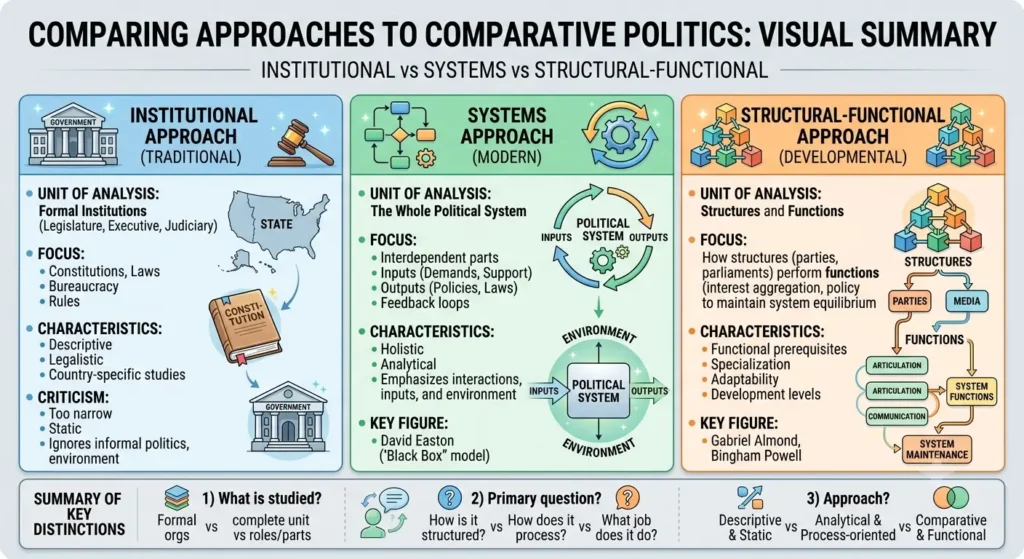
Comparison Table: Institutional vs System vs Structural-Functional Approach
| Aspect | Institutional Approach | System Approach | Structural-Functional Approach |
|---|---|---|---|
| Key Thinker(s) | Traditional/no single founder | David Easton | Parsons, Merton, Almond |
| Unit of Analysis | Formal government institutions | The political system as a whole | Structures + their functions |
| Nature | Descriptive, legal-constitutional | Dynamic, input-output process | Functional, stability-oriented |
| Scope | Mostly Western democracies | Universally applicable | Universally applicable |
| Main Strength | Detailed on formal structures | Genuinely comparative & dynamic | Explains hidden (latent) functions too |
| Main Weakness | Static, non-comparative, Eurocentric | Overly abstract/mechanical | Downplays conflict & change |
Critiques and Limitations (of Structural Functionalism, applies broadly)
Strengths
- Big Picture View: Shows how different parts of society and government work together to maintain stability, revealing how connected various institutions really are.
- Focus on Order and Stability: Explains how institutions help maintain social order — useful for analysing stable political systems.
- Looking at Functions: By studying both manifest and latent functions, this approach reveals the wider effects of institutions, including unexpected outcomes.
- Comparative Framework: Provides a method to compare different political systems and spot similarities/differences across settings.
Criticisms
- Too Much Focus on Stability: Critics argue it ignores conflict and change, often missing how power struggles and social movements disrupt systems.
- Ignoring Individual Action: May underweight how individual political actors actively shape events, presenting people as passive.
- Lack of Historical Context: Often fails to consider historical and cultural factors, leading to oversimplified analysis.
- Oversimplification: Can reduce complex social issues to basic functions and structures, overlooking ideology, culture, and history.
Alternative Approaches That Emerged in Response
- – Conflict Theory: Highlights power struggles, social inequality, and conflict in shaping political systems.
- – Post-Structuralism: Challenges structural functionalism’s assumptions, stressing the changing nature of meaning and how language shapes politics.
- – New Institutionalism: Looks at how institutions influence political behaviour and outcomes, focusing on rules and practices in political dynamics. Read the complete breakdown in Old vs New Institutionalism: Key Differences Explained.
From Old to New Institutionalism
The Institutional Approach didn’t disappear — it evolved. By the 1980s, scholars like James March and Johan Olsen revived institutional analysis but fixed its old weaknesses by treating institutions as dynamic rule-systems that shape behaviour, rather than just static legal structures. This “New Institutionalism” bridges the gap between the old Institutional Approach and the System/Structural-Functional approaches. For the full unit-3 breakdown, see New Institutionalism vs Old Institutionalism.
External References (for further reading)
- Britannica’s overview of comparative government and politics — for a broader academic framing of the discipline.
- David Easton’s systems theory is widely covered in political science coursework; see your university library’s political theory section for A Systems Analysis of Political Life (1965) for the original source.
DU Previous Year Questions (Typical Exam Pattern for This Unit)
(Based on recurring question patterns across DU semester exams for this unit — practice these for your paper.)
- Discuss the Institutional Approach to the study of comparative politics. What are its major limitations?
- Explain David Easton’s System Approach with the help of the input-output model.
- Critically examine the Structural-Functional Approach to comparative politics.
- Distinguish between the Institutional Approach and the System Approach.
- What is the AGIL model? Discuss its relevance to the study of political systems.
- “The Structural-Functional Approach overemphasises stability and ignores conflict.” Comment.
- How did the System Approach overcome the limitations of the Traditional Institutional Approach?
- Discuss any two case studies that illustrate the application of structural functionalism in comparative politics.
💡 Exam Tip: Questions 1, 3, and 4 repeat almost every year in slightly different wording — master the Institutional vs System vs Structural-Functional comparison table above, since most long-answer questions are built around distinguishing these three approaches.
FAQs
What are the three main approaches to studying comparative politics in DU’s DSC-5 syllabus?
The three main approaches are the Institutional Approach, the System Approach (David Easton), and the Structural-Functional Approach.
Who developed the System Approach in political science?
David Easton developed the System Approach in the 1950s, using an input-output-feedback model to explain how political systems work.
What is the main criticism of the Institutional Approach?
It is criticised for being non-comparative, parochial (Western-focused), static, and overly formal-legalistic, ignoring actual political behaviour.
What is the AGIL model in structural functionalism?
The AGIL model, developed by Talcott Parsons, stands for Adaptation, Goal attainment, Integration, and Latency — the four functional requirements every social system must fulfil to survive.
What is the difference between manifest and latent functions?
Manifest functions are the clear, intended roles of an institution (e.g., schools provide education), while latent functions are hidden, unintended effects (e.g., schools also transmit cultural norms).
How is the System Approach different from the Institutional Approach?
The System Approach studies the political system as a dynamic, interconnected whole using inputs and outputs, while the Institutional Approach studies fixed formal structures like constitutions and legislatures in isolation.
What replaced the Institutional Approach after its criticisms?
The System Approach and Structural-Functional Approach emerged in the 1950s-60s, followed later by New Institutionalism in the 1980s, which revived institutional analysis in a more dynamic form.
Why is structural functionalism criticised in comparative politics?
It is criticised for overemphasising stability and order while downplaying conflict, power struggles, individual agency, and historical/cultural context.
Subscribe to keep reading
You've used your free notes for now. Get Delhi Pathshala Premium for unlimited access.
Subscribe — ₹29/30 days