

Contents
- Introduction to Brazil’s Political System
- History of Brazil’s Political System
- Main Features of Brazil’s Federal System
- The Importance of the 1988 Constitution in Governance
- The Constitution of Brazil (1988)
- Features of the 1988 Constitution
- Federalism and Decentralization
- Separation of Powers and Checks and Balances
- Constitutional Amendments
- The Executive Branch in Brazil
- The President: Powers, Functions, and Limitations
- The Vice President: Role and Responsibilities
- The Cabinet and Executive Agencies: Structure and Functions
- The Legislature in Brazil
- Structure and Composition: National Congress
- Functions and Powers of the Legislature
- The Legislative Process in Brazil
- The Role of Committees in Shaping Legislation
- The Judiciary in Brazil
- Structure and Hierarchy of Courts in Brazil
- The Role of the Supreme Federal Court in Interpreting the Constitution
- Judicial Review and Its Implications
- The Appointment Process for Judges
- Political Parties and Elections in Brazil
- Major Political Parties and Their Ideologies
- Electoral System: Proportional Representation and Its Implications
- The Role of Political Parties in Shaping Public Policy
- Recent Trends in Brazilian Elections and Party Politics
- Social Dimension of Brazilian Politics
- Economic Dimension of Brazilian Politics
- Federalism and State Governance in Brazil
- What is Federalism in Brazil?
- Powers and Roles of State and Local Governments
- How Federal, State, and Local Governments Work Together
- How Federalism Affects Brazilian Politics and Governance
- Current Issues and Challenges in Brazil
- Social Movements and Their Influence on Politics
- Challenges to Federalism in a Diverse Society
- Discussions on Constitutional Reform
- Brazil’s Role in Regional and Global Politics
- Quick Comparison: Brazil vs USA vs India — Federal Systems at a Glance
- Conclusion — Quick Revision Summary
- Top DU Previous Year Questions (PYQs) — DSC-17 Unit 3
- Frequently Asked Questions (FAQs)
- External References
- Related Delhi Pathshala Notes
In this post, notes of “Unit 3: Introduction to Political System of Brazil” from “DSC 17: Comparative Political Systems“ are given, covering the constitutional history, federal structure, executive-legislative-judicial branches, party system, and current challenges — helpful for BA Hons Political Science Semester 6 students preparing for exams.
📌 Related notes: Political System of United States | Political System of Russia | Full DSC-17 Syllabus
Introduction to Brazil’s Political System
Brazil is the Federative Republic of Brazil, the largest country in South America and one of the world’s most diverse democracies. Understanding its political system is essential for comparative politics because Brazil represents a large, federal, presidential democracy shaped by a complex colonial and authoritarian past — offering useful contrasts with both the US presidential system and parliamentary federations like India.
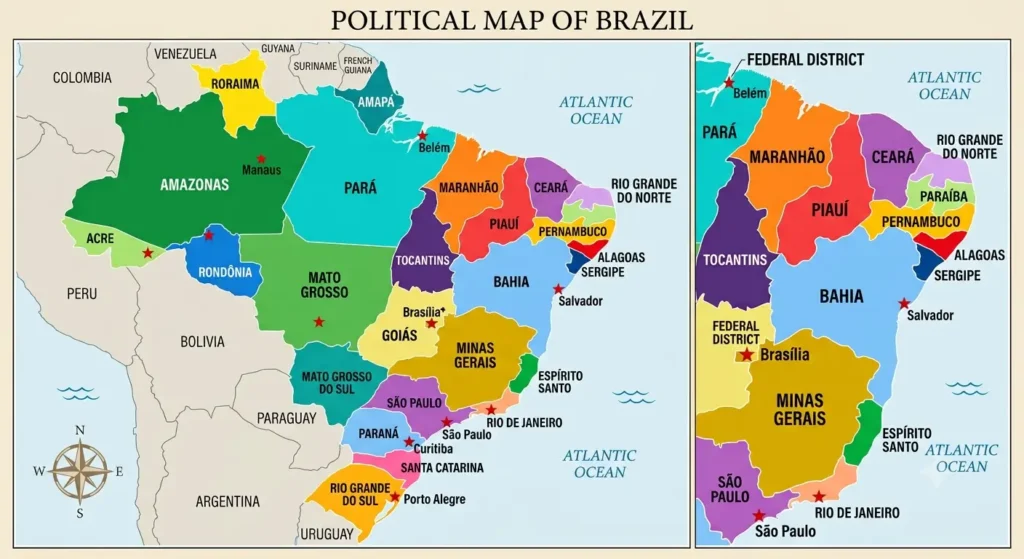
History of Brazil’s Political System
Brazil’s political system has evolved significantly since its colonial era. It began as a Portuguese colony (1500–1822), ruled by the Portuguese crown until independence in 1822.
The first emperor, Dom Pedro I, established the Empire of Brazil, which lasted until 1889, when a military coup ended the monarchy and proclaimed a republic.
The First Brazilian Republic (1889–1930) — often called the “Old Republic” — was politically unstable and dominated by regional oligarchies, particularly coffee-planter elites from São Paulo and Minas Gerais (the café com leite arrangement). In 1930, a revolution led by Getúlio Vargas ended this arrangement and centralized power under a stronger national government.
Vargas’s rule oscillated between semi-democratic governance and outright authoritarianism (the 1937–1945 Estado Novo), with heavy state involvement in the economy.
Brazil experienced repeated military coups and dictatorships through the mid-20th century. The most significant was the 1964 military coup, which installed a military government lasting until 1985. During this period, civil liberties were curtailed, opposition was suppressed, and press freedom was restricted.
Direct elections in 1985 marked the return to democracy, and the 1988 Constitution — discussed in detail below — established the democratic, rights-based framework Brazil operates under today.
For a broader historical account, see the Wikipedia entry on Politics of Brazil.
Main Features of Brazil’s Federal System
Brazil follows a federal system, where power is constitutionally divided between the national government and subnational units. The country comprises:
- 26 states
- 1 Federal District (home to the capital, Brasília)
- Over 5,000 municipalities
Key features of this federal arrangement include:
- Separation of Powers — Brazil has three constitutionally independent branches:
- Executive: The President leads the country and directs national policy and foreign relations.
- Legislative: The National Congress, comprising the Chamber of Deputies (lower house, representing the people) and the Federal Senate (upper house, representing the states).
- Judicial: An independent court system that ensures laws comply with the Constitution and protects individual rights.
- Federalism in Action — States maintain their own laws, governments, and budgets, but the Constitution defines exclusive federal domains such as defense and currency.
- Regional Differences — Economic and social development varies sharply: São Paulo and Rio de Janeiro are industrially developed, while parts of the Amazon region and the Northeast face persistent poverty and weaker infrastructure.
- Municipalities — Local governments have elected mayors and councils with authority over local matters, strengthening grassroots representation.
The Importance of the 1988 Constitution in Governance
The 1988 Constitution, known as the “Citizen Constitution” (Constituição Cidadã), marked Brazil’s transition from military dictatorship to a consolidated democracy. It remains the foundational legal document shaping governance today.
Key contributions of the 1988 Constitution:
- Democratic Governance — Guarantees free, direct elections for President, Governors, Mayors, and legislators.
- Human Rights and Social Justice — Strongly emphasizes freedoms of speech, religion, and assembly, along with labour rights and social welfare.
- Social and Economic Rights — Establishes a welfare-state framework covering public education and healthcare.
- Institutional Framework — Defines the federal system and creates checks and balances among the three branches, including concurrent powers shared between federal and state governments.
- Environmental Protections — Recognizes the importance of preserving natural resources, particularly the Amazon rainforest.
- Political Stability — Anchored democratic norms after decades of authoritarian rule, rebuilding institutional trust.
The Constitution of Brazil (1988)
Features of the 1988 Constitution
Key features of the 1988 Constitution include:
- Democratic Republic — Sovereignty derives from the people through elected representatives.
- Human Rights — Guarantees freedom of speech, assembly, religion, fair legal treatment, and anti-discrimination protections.
- Social Welfare — Provides for universal healthcare, education, social security, and the right to strike.
- Secular State — Complete separation of government from religious institutions.
- Environmental Protection — Rules for sustainable development and indigenous land rights.
- Federalism — Power-sharing across national, state, municipal, and Federal District levels.
- Social Justice — Programs targeting poverty reduction and equitable resource distribution.
Federalism and Decentralization
Federalism is central to the 1988 Constitution, distributing power across the federal government, states, municipalities, and the Federal District.
- Division of Powers — Separates taxation, lawmaking, defense, and public-service responsibilities across levels.
- State and Municipal Autonomy — States have their own constitutions; municipalities pass their own local laws.
- Concurrent Powers — Both federal and state governments handle areas like education and health; federal law prevails in conflicts.
- Federal Financial Transfers — Redistributes federal revenue to poorer states and municipalities to reduce regional gaps.
- Cooperation Among Governments — Encourages joint implementation of national policies in health, education, and infrastructure.
- Federative Pact — Treats states and municipalities as equal governance partners, preventing excessive federal centralization.
Separation of Powers and Checks and Balances
The three branches operate under a system of mutual checks:
- Executive — The President can propose laws, veto bills, and command the armed forces, but remains subject to legislative and judicial oversight.
- Legislative — The National Congress makes laws, approves budgets, and can initiate impeachment proceedings.
- Judicial — The judiciary, headed by the Supreme Federal Court (STF), can strike down unconstitutional laws.
- Checks and Balances:
- Presidential vetoes can be overridden by Congress.
- The judiciary can nullify unconstitutional laws.
- Congress can investigate and impeach the President for misconduct.
Constitutional Amendments
- Amendment Process — Requires approval from both chambers of Congress, with at least three-fifths support in each.
- Limits on Amendments — Core provisions, such as federal structure and fundamental rights, cannot be amended away (entrenched clauses).
- Responding to Change — Numerous amendments since 1988 have addressed electoral reform and environmental protection.
- Stability vs. Flexibility — Balances constitutional permanence with adaptability to Brazil’s evolving society.
The Executive Branch in Brazil
The President: Powers, Functions, and Limitations
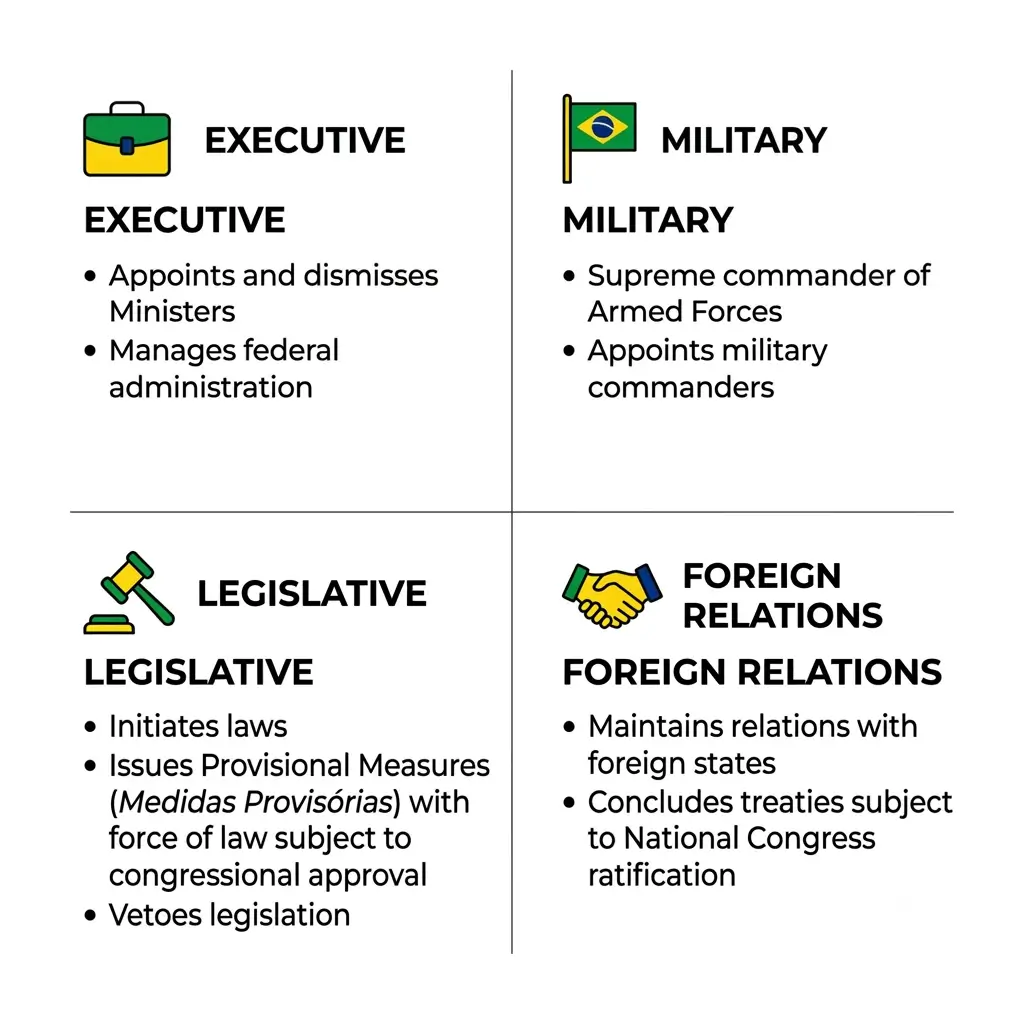
The President of Brazil serves as both head of state and head of government, wielding substantial authority under the 1988 Constitution.
- Executive Power — Implements laws, issues provisional measures, and oversees government departments.
- Military Power — Commands the Armed Forces and appoints the Minister of Defense and senior military leadership.
- Legislative Powers — Proposes budget and policy legislation, can veto bills (subject to congressional override), and can convene special sessions.
- Foreign Relations — Manages diplomacy, signs treaties, and appoints ambassadors.
- Appointments and Removals — Appoints ministers and judges (with Senate approval); can remove cabinet officials independently.
- Emergency Powers — Can declare emergencies, subject to congressional approval and constitutional limits.
- Limitations — Bound by constitutional limits, checked by the judiciary and Congress, and removable through impeachment for serious misconduct like corruption.
The Vice President: Role and Responsibilities
- Succession — Assumes the presidency if the President cannot serve.
- Representational Duties — Represents the President at events and meetings.
- Executive Roles — May be assigned specific government programs.
- Participation in Decision-Making — Can join Cabinet meetings and key discussions.
The Cabinet and Executive Agencies: Structure and Functions
- Cabinet Structure — Led by the Chief of Staff, with ministers overseeing sectors like Health and Education.
- Functions — Policy implementation, advisory support to the President, legislative proposals, and inter-ministerial coordination.
- Executive Agencies — Regulatory bodies and state-owned enterprises handling specialized public functions, reporting to the President.
The Legislature in Brazil
Structure and Composition: National Congress
- Chamber of Deputies — The lower house, with 513 deputies elected for four-year terms via open-list proportional representation; seats allocated by state population.
- Federal Senate — The upper house, with 81 senators (3 per state) serving eight-year terms, with staggered elections.
Compare this with the US Congress structure to understand how bicameralism functions differently across presidential systems.
Functions and Powers of the Legislature
- Legislation — Passes laws, including the budget; both houses must generally agree.
- Oversight — Monitors the executive branch, holds hearings, and investigates misconduct.
- Impeachment — Initiated in the Chamber of Deputies; tried in the Senate.
- Constitutional Amendments — Requires three-fifths approval in both houses.
The Legislative Process in Brazil
- Proposal — Bills introduced by the President, Congress members, or committees.
- Debate and Approval — Debated first in the Chamber of Deputies, then the Senate.
- Veto or Approval — Presidential veto can be overridden by majority vote.
- Publication — Signed bills are published and become law.
The Role of Committees in Shaping Legislation
- Specialized Committees — Focus on areas like finance and education.
- Public Hearings and Expert Testimony — Gather input before recommendations.
- Amendments — Committees can propose changes before full-chamber debate.
The Judiciary in Brazil
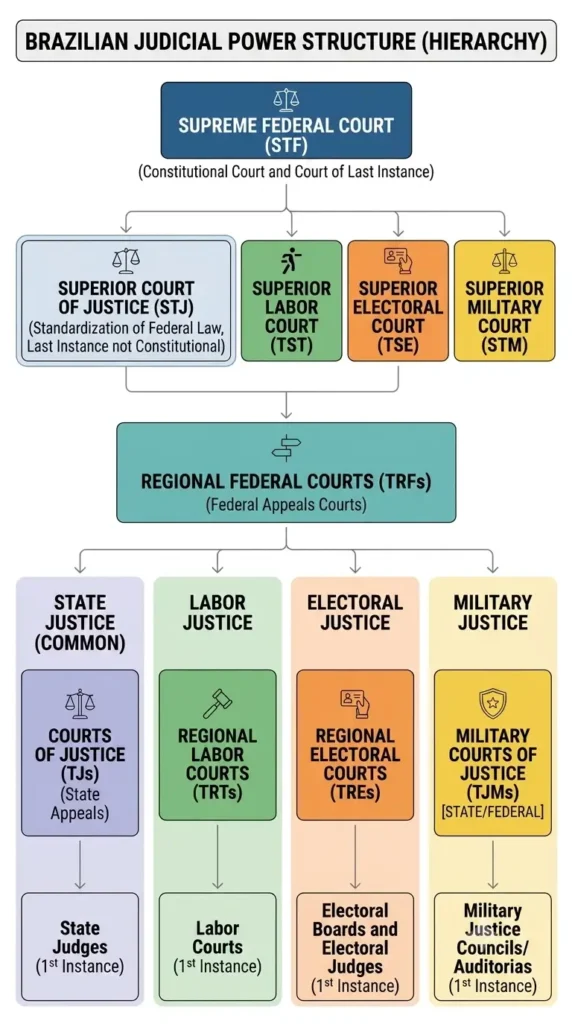
Structure and Hierarchy of Courts in Brazil
- Supreme Federal Court (STF) — Highest court; 11 justices, appointed by the President and approved by the Senate; serve for life.
- Superior Court of Justice (STJ) — Handles federal law consistency; 33 justices.
- Regional Federal Courts (TRFs) — Five regional appeal courts for federal cases.
- State Courts — Each of the 26 states and the Federal District has its own court system.
- Labor Courts — Handle employer-employee disputes.
- Electoral Courts — Oversee elections, headed by the Superior Electoral Court (TSE).
- Military Courts — Address cases involving military personnel.
The Role of the Supreme Federal Court in Interpreting the Constitution
- Constitutional Interpretation — Determines constitutionality of laws and actions.
- Guardian of Fundamental Rights — Rules on rights violations, including freedom of speech and equality.
- Judicial Activism — Has expanded protections in areas like LGBTQ+ rights.
- Conflict Resolution — Settles disputes between government branches and federal/state authorities.
- Final Arbiter — STF rulings are binding on all courts.
Judicial Review and Its Implications
- Constitutional Supremacy — Unconstitutional laws are struck down.
- Protection of Rights — Judiciary intervenes when rights are violated.
- Checks on Executive Power — STF can cancel unconstitutional presidential actions.
- Stability and Predictability — Reinforces rule of law.
- Politicization and Controversy — Critics argue the STF sometimes makes politically charged rulings.
The Appointment Process for Judges
- STF Justices — Nominated by the President, confirmed by the Senate; serve for life or until age 75.
- Other Courts — STJ judges follow a similar process; state court judges are selected via competitive exams.
- Independence and Objectivity — Senate confirmation adds scrutiny to reduce political influence.
Political Parties and Elections in Brazil
Major Political Parties and Their Ideologies
- Workers’ Party (PT) — Left-wing; power 2003–2016; focus on socialism and anti-poverty programs.
- Brazilian Social Democracy Party (PSDB) — Center-right; advocates economic reform and privatization.
- Brazilian Democratic Movement (MDB) — Centrist; coalition-builder across ideologies.
- Social Liberal Party (PSL) — Right-wing; rose with Jair Bolsonaro’s 2018 election.
- Democratic Labor Party (PDT) — Center-left; emphasizes labor rights and social justice.
- Other Parties — Numerous smaller parties spanning far-left to far-right.
Electoral System: Proportional Representation and Its Implications
- Chamber of Deputies — Open-list proportional representation.
- Senate — Majoritarian system favoring larger parties.
- Implications — Encourages coalition governments but risks party fragmentation.
For the technical electoral mechanics, see Wikipedia’s Electoral System of Brazil.
The Role of Political Parties in Shaping Public Policy
- Electoral Mobilization — Parties represent voter interests.
- Policy Advocacy — Promote agendas once in power.
- Coalition Building — Compromise policies emerge from alliances.
Recent Trends in Brazilian Elections and Party Politics
- Polarization — Rising left-right divide in recent elections.
- Rise of Populism — Leaders like Bolsonaro shifted politics toward conservative themes.
- Political Instability — Shifting alliances and leadership crises affect governance.
Social Dimension of Brazilian Politics
Brazil’s social structure has been historically shaped by Portuguese colonialism, which introduced deep racial and class hierarchies that still influence politics today.
- Diverse Population — Brazil’s population includes white, Black, Indigenous, and mixed-race communities, with wealth and privilege historically concentrated among white elites.
- Racial and Economic Stratification — Black and mixed-race communities disproportionately face poverty, limited access to education, and discrimination.
- Regional Disparities — Urban centers like São Paulo and Rio de Janeiro enjoy relative prosperity, while rural regions — especially in the North and Northeast — struggle with underdevelopment.
- Social Movements:
- Landless Workers’ Movement (MST) — Advocates land reform for rural poor.
- Indigenous Rights Movements — Defend land and cultural rights, especially against agricultural and mining interests.
- LGBTQ+ Rights Movement — Achieved same-sex marriage legalization in 2013; continues fighting discrimination.
- Urban Movements — Address housing and public services in favelas (urban slums).
- Constitutional Guarantees vs. Ground Reality — While the 1988 Constitution guarantees social and economic rights, implementation gaps and resource inequality limit their practical realization.
Economic Dimension of Brazilian Politics
- Historical Roots — Economic inequality traces back to colonial-era land and wealth concentration among elite families.
- Nature of Inequality — Multidimensional: income gaps, unequal access to healthcare/education, and regional disparities.
- Impact on Political Structure — Wealthier classes tend to back market-oriented policies; marginalized groups push for redistributive policies — fueling political conflict.
- Government Responses — Land reform, education investment, and welfare schemes exist but face corruption and weak implementation.
- Import Substitution Industrialization (ISI) — Brazil’s ISI strategy boosted local industry initially but contributed to imbalances and the 1980s economic crisis.
- Way Forward — Policy transparency, effective redistribution, and institutional accountability remain key reform priorities.
Federalism and State Governance in Brazil
What is Federalism in Brazil?
Federalism under the 1988 Constitution shares power between federal, state, and local governments, balancing national unity with local autonomy.
- Division of Powers — Constitutionally defined roles for each level of government.
- Independence of States and Local Governments — Each of the 26 states has its own constitution, legislature, and government.
- Representation — States participate in national politics through elected representatives and intergovernmental discussions.
Powers and Roles of State and Local Governments
- State Governments — Legislate on education, health, police, and infrastructure; elect Governors for 4-year terms; maintain separate court systems.
- Local Governments — Councils pass laws on zoning and public services; Mayors serve 4-year terms; collect local taxes and receive federal funds.
How Federal, State, and Local Governments Work Together
- Cooperative Federalism — Joint management in health (e.g., Unified Health System — SUS), education, and infrastructure.
- Fiscal Federalism — Federal revenue-sharing addresses regional inequalities.
- Conflicts — Disputes over resource distribution often escalate to the Supreme Federal Court.
- National vs. Local Focus — Tensions arise when national policy conflicts with local priorities like crime prevention.
How Federalism Affects Brazilian Politics and Governance
- Political Diversity — Supports a multiparty system representing local interests.
- Decentralization of Power — Enables governance tailored to local needs.
- Regional Inequalities — Federalism highlights, rather than resolves, disparities between richer and poorer regions.
Current Issues and Challenges in Brazil
Social Movements and Their Influence on Politics
- Landless Workers Movement (MST) — Pressures governments on land reform.
- Indigenous Rights Movements — Intensifying debates over land amid agricultural/mining interests.
- LGBTQ+ Rights Movement — Legal milestones alongside continued social stigma.
- Urban Movements — Address housing and services in favelas.
- Impact on Policy — Programs like Bolsa Família trace directly to social movement pressure.
Challenges to Federalism in a Diverse Society
- Regional Inequality — Demands for fairer resource distribution.
- Ethnic and Racial Diversity — Calls for better political representation for Afro-Brazilians and Indigenous peoples.
- Federal-State Conflicts — Wealthier states resist federal policies on environment and taxation.
Discussions on Constitutional Reform
- Decentralization — Proposals to grant states more economic and social policy power.
- Political System Changes — Debates over reducing party fragmentation via electoral thresholds.
- Social Security Changes — Reform pressure as the population ages.
Brazil’s Role in Regional and Global Politics
- Regional Leadership — Key member of Mercosur and UNASUR.
- Global Influence — Active in the UN and WTO, advocating for greater voice for developing nations.
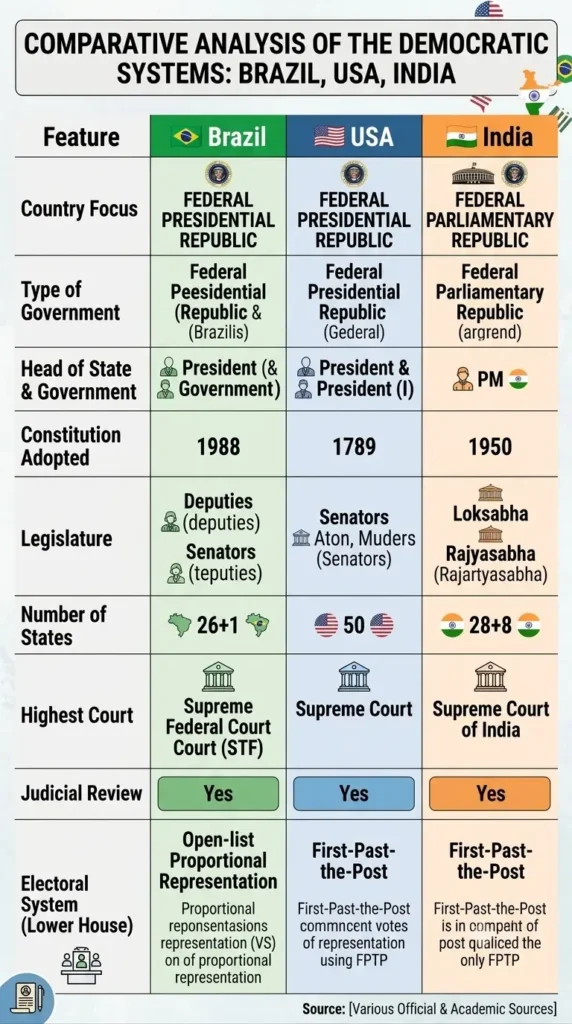
Quick Comparison: Brazil vs USA vs India — Federal Systems at a Glance
| Feature | Brazil | USA | India |
|---|---|---|---|
| Type of Government | Federal Presidential Republic | Federal Presidential Republic | Federal Parliamentary Republic |
| Head of State & Government | President (same person) | President (same person) | President (nominal) & PM (real executive) |
| Constitution Adopted | 1988 | 1789 | 1950 |
| Legislature | Bicameral (Chamber of Deputies + Senate) | Bicameral (House + Senate) | Bicameral (Lok Sabha + Rajya Sabha) |
| Number of States | 26 states + 1 Federal District | 50 states | 28 states + 8 UTs |
| Highest Court | Supreme Federal Court (STF) | Supreme Court | Supreme Court of India |
| Judicial Review | Yes | Yes | Yes |
| Electoral System (Lower House) | Open-list Proportional Representation | First-Past-the-Post | First-Past-the-Post |
Conclusion — Quick Revision Summary
- Brazil transitioned from a Portuguese colony → Empire → Old Republic → Vargas era → military dictatorship → democracy (1988 Constitution).
- The 1988 “Citizen Constitution” guarantees democratic rights, federalism, and social justice.
- Power is divided among Executive (President), Legislative (bicameral National Congress), and Judicial (STF-led court system) branches.
- Brazil is a federal republic with 26 states, a Federal District, and over 5,000 municipalities.
- The party system is highly fragmented, requiring coalition governments.
- Social and economic inequality — rooted in colonial history — remains a defining political challenge.
- Brazil plays an active regional (Mercosur) and global (UN, WTO) role.
Top DU Previous Year Questions (PYQs) — DSC-17 Unit 3
- Discuss the salient features of the 1988 Constitution of Brazil. (Focus on: Citizen Constitution, democratic governance, federalism, human rights, environmental protections.)
- Examine the federal system of Brazil. How is power divided between the union, states, and municipalities? (Focus on: division of powers, concurrent powers, fiscal federalism, federative pact.)
- Explain the powers and functions of the President of Brazil. (Focus on: executive, military, legislative, foreign relations powers, and limitations.)
- Discuss the composition and functions of the National Congress of Brazil. (Focus on: Chamber of Deputies, Federal Senate, legislative process, committees.)
- What is judicial review? Discuss its role in Brazil’s political system. (Focus on: STF’s role, constitutional supremacy, checks on executive power.)
- Analyze the party system and electoral process in Brazil. (Focus on: proportional representation, coalition politics, party fragmentation.)
- Discuss the social and economic challenges facing Brazil’s federal democracy. (Focus on: regional inequality, racial disparities, social movements like MST.)
- Write a note on the role of social movements in shaping Brazilian politics. (Focus on: MST, Indigenous rights, LGBTQ+ movement, Bolsa Família.)
Tip: Practice these with our DSC-17 Comparative Political Systems category page for unit-wise revision.
Frequently Asked Questions (FAQs)
What type of government does Brazil have?
Brazil has a federal presidential republic, where the President serves as both head of state and head of government, and power is constitutionally divided between the federal government, 26 states, and municipalities.
How many states does Brazil have?
Brazil has 26 states plus one Federal District (Brasília), the national capital.
Who is the head of state in Brazil?
The President of Brazil is both the head of state and head of government, elected directly by the people for a four-year term.
What is the significance of the 1988 Constitution of Brazil?
Known as the “Citizen Constitution,” the 1988 Constitution ended military rule and established Brazil’s current democratic, federal, and rights-based system of governance.
Is Brazil a federal or unitary state?
Brazil is a federal state, with power shared between the national government, 26 states, the Federal District, and over 5,000 municipalities.
What is the structure of Brazil’s National Congress?
Brazil’s National Congress is bicameral, consisting of the Chamber of Deputies (513 members, lower house) and the Federal Senate (81 members, upper house).
What is the role of the Supreme Federal Court (STF) in Brazil?
The STF is Brazil’s highest court and final interpreter of the Constitution, with the power to strike down unconstitutional laws and government actions through judicial review.
External References
Related Delhi Pathshala Notes
Subscribe to keep reading
You've used your free notes for now. Get Delhi Pathshala Premium for unlimited access.
Subscribe — ₹29/30 days