
Contents
- Quick Answer Box
- Key Facts Table
- Detailed Summary – Part Wise
- Part I (Stanza 1-4) – The Island and The Tower
- Part II (Stanza 5-9) – The Curse and The Mirror
- Part III (Stanza 10-14) – Sir Lancelot
- Part IV (Stanza 15-19) – The Final Journey
- Full Poem Text (1842 Version)
- Central Idea
- Themes and Motifs – Detailed
- 1. Isolation and Confinement
- 2. Art and the Artist’s Struggle
- 3. The Consequences of Desire and Transgression
- 4. Role of Fate and Curse
- 5. Death and Mortality
- 6. Idealization of Camelot
- Use of Symbolism and Imagery – Detailed
- Poetic Structure and Form
- Line-by-Line Explanation – 5 Most Important Lines for Exams
- Social and Historical Context
- Victorian Ideals and Artistic Movements
- The Role of Women in Victorian Literature
- Critical Perspectives
- Romantic and Victorian Literary Traditions
- Gender and Identity in Tennyson’s Poetry
- Alfred Tennyson – Short Biography
- DU Previous Year Questions with Hints
- FAQs – Add FAQ Schema in RankMath
- Continue Reading
Quick Answer Box
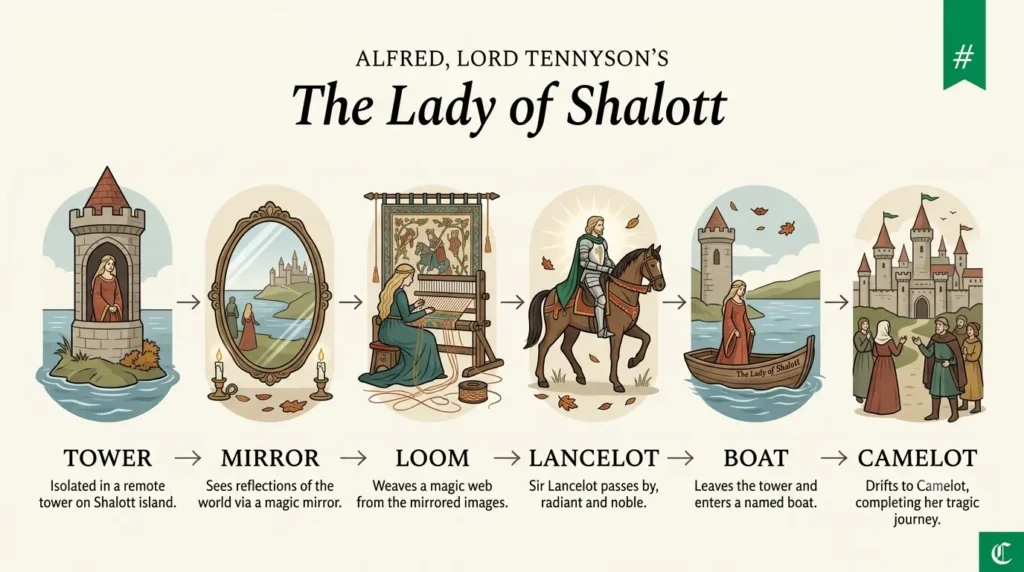
The Lady of Shalott is a Victorian ballad by Alfred Tennyson about a mysterious woman cursed to live alone in a tower on the island of Shalott, near Camelot. She must weave constantly and can only see the outside world in a magic mirror. When she looks directly at Sir Lancelot, the mirror cracks, the curse falls, and she dies floating down the river to Camelot.
Key Facts Table
| Detail | Info |
|---|---|
| Poet | Alfred, Lord Tennyson (1809-1892) |
| Written | 1831-32, Revised 1842 |
| Published | 1832 (20 stanzas), 1842 (19 stanzas) – 1842 version is standard |
| Form | Narrative Ballad, 19 stanzas x 9 lines = 171 lines |
| Rhyme Scheme | aaaabcccb |
| Meter | Mix of tetrameter and trimeter, musical ballad rhythm |
| Setting | Island of Shalott, River to Camelot |
| Source | Italian Novella Donna di Scalotta & Elaine of Astolat in Thomas Malory’s Le Morte d’Arthur |
| Main Characters | The Lady of Shalott, Sir Lancelot, Reapers, Camelot knights |
Detailed Summary – Part Wise
Part I (Stanza 1-4) – The Island and The Tower
On either side of the river lie long fields of barley and rye that clothe the wold and meet the sky. Through these fields runs the road to many-towered Camelot. People go up and down gazing where lilies blow round an island – the island of Shalott.
Willows whiten, aspens quiver, breezes shiver through the wave that flows to Camelot. Four gray walls and four gray towers overlook flowers and imbowers The Lady of Shalott. Heavy barges trailed by slow horses and silken-sailed shallops skim to Camelot. But who hath seen her wave her hand? Only early reapers hear a song echoing cheerly down to Camelot and whisper at night – ‘Tis the fairy Lady of Shalott.
Part II (Stanza 5-9) – The Curse and The Mirror
There she weaves by night and day a magic web with colours gay. She has heard a whisper say, a curse is on her if she stays to look down to Camelot. She knows not what the curse may be, so she weaveth steadily.
Moving through a mirror clear that hangs before her all year, shadows of the world appear. She sees highway winding to Camelot, river eddy whirls, surly village-churls, red cloaks of market girls passing onward from Shalott. Sometimes troop of damsels glad, abbot on ambling pad, curly shepherd-lad, long-haired page in crimson clad go by to Camelot. Sometimes knights riding two and two, but she hath no loyal knight and true.
But in her web she still delights to weave mirror’s magic sights. Often through silent nights a funeral with plumes and lights and music went to Camelot, or two young lovers lately wed. Then comes the most important line: “I am half sick of shadows,” said The Lady of Shalott.
Part III (Stanza 10-14) – Sir Lancelot
A bow-shot from her bower-eaves, bold Sir Lancelot rode between barley-sheaves. Sun dazzled through leaves and flamed on brazen greaves. A red-cross knight kneeled to a lady in his shield, sparkling on yellow field beside remote Shalott.
Gemmy bridle glittered like branch of stars in golden Galaxy. Bridle bells rang merrily, silver bugle hung from blazoned baldric, armour rung beside remote Shalott. Thick-jewelled saddle-leather shone, helmet and helmet-feather burned like one burning flame as he rode to Camelot. Like bearded meteor trailing light over still Shalott, his broad clear brow glowed, burnished hooves trode, coal-black curls flowed.
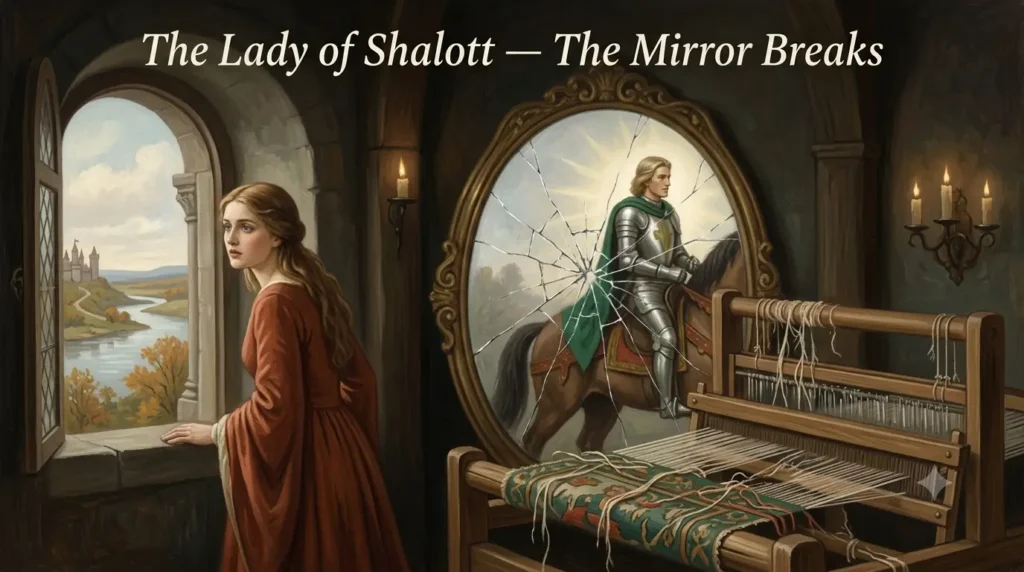
From bank and river he flashed into crystal mirror, singing “Tirra lirra” by the river – Sang Sir Lancelot.
She left the web, she left the loom, made three paces through the room, saw water-lily bloom, helmet and plume, and looked down to Camelot. Out flew web and floated wide, mirror cracked from side to side. “The curse is come upon me,” cried The Lady of Shalott.
Part IV (Stanza 15-19) – The Final Journey
In stormy east-wind straining, pale yellow woods waning, broad stream complaining, low sky raining over towered Camelot. Down she came and found a boat beneath willow left afloat, and round about prow she wrote The Lady of Shalott.
Down river’s dim expanse like bold seer in trance with glassy countenance she looked to Camelot. At closing of day she loosed chain and down she lay, broad stream bore her far away.
Lying robed in snowy white that loosely flew left and right, leaves upon her falling light, through noises of night she floated down to Camelot. As boat-head wound along willowy hills, they heard her singing her last song.
Heard a carol mournful, holy, chanted loudly, chanted lowly, till blood was frozen slowly, eyes darkened wholly turned to towered Camelot. For ere she reached first house by waterside, singing in her song she died, The Lady of Shalott.
Under tower and balcony, garden-wall and gallery, gleaming shape she floated by, dead-pale between houses high, silent into Camelot. Out upon wharfs came knight and burgher, lord and dame, and round prow they read her name. Who is this? What is here? In lighted palace near died sound of royal cheer, they crossed themselves for fear, all knights at Camelot. But Lancelot mused a little space, said, “She has a lovely face; God in his mercy lend her grace, The Lady of Shalott.”
Full Poem Text (1842 Version)
📜 Click to Read Full Poem Text – The Lady of Shalott (1842) – 171 Lines
Source: Public Domain (1842). Original by Alfred, Lord Tennyson via Wikisource. No copyright.
Central Idea
The central idea of The Lady of Shalott is the conflict between art and life, isolation and connection. Tennyson shows that an artist cannot create authentic art if she lives only through shadows/reflections. The desire to live directly in the real world, even at the cost of death, is more powerful than safe, sterile isolation. It is also a critique of how Victorian society confined women to domestic towers.
Themes and Motifs – Detailed
1. Isolation and Confinement
The Lady is physically (four gray walls, four gray towers) and emotionally trapped. Tower = domestic sphere where Victorian women were kept. Her curse shows limits placed by society and internalized fear.
2. Art and the Artist’s Struggle
Lady’s tapestry = art. Mirror = how artist sees world indirectly. Her passive creativity contrasts with active world. Question: Can art be true if not lived? Tennyson, as poet laureate, felt same conflict.
3. The Consequences of Desire and Transgression
Her choice to look for Sir Lancelot shows risks of desire. Lancelot does not even know her impact – one-sided desire. Shows Romantic idealism can be fatal if not grounded.
4. Role of Fate and Curse
Curse = fate, patriarchy, social norms. Lady cannot choose path. Tragic end reminds that breaking rules has price, especially for women in Victorian times.
5. Death and Mortality
Death ends isolation but also shows loss of potential. Floating to Camelot dead = art only recognized after artist’s suffering/death.
6. Idealization of Camelot
Camelot = perfect patriarchal world filled with knights. Lady sees only reflection, dies before truly belonging. Suggests outside world is not as perfect as imagined – irony of idealism.
Use of Symbolism and Imagery – Detailed
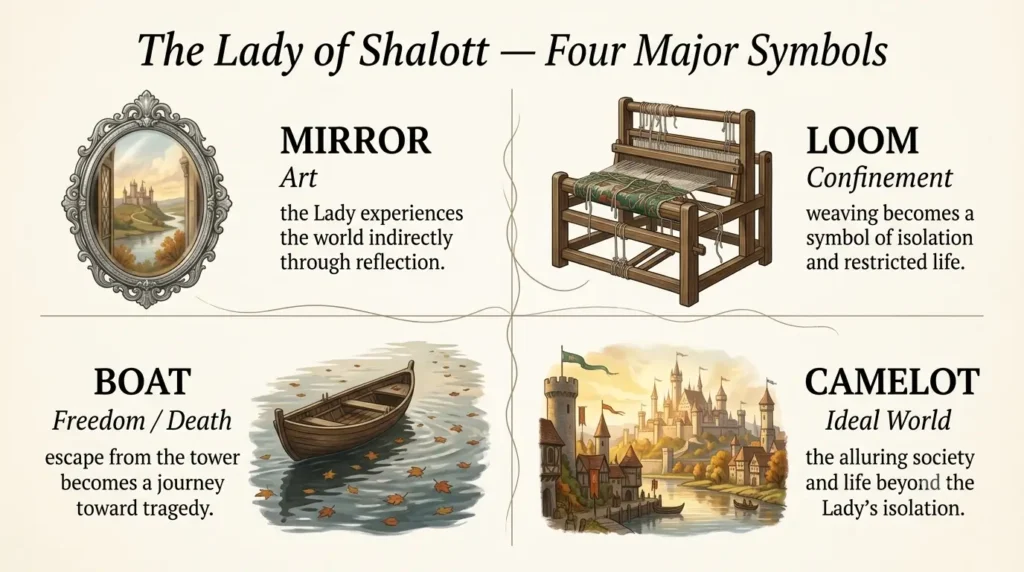
The Mirror: How Lady views world from distance. Represents art, illusion, female gaze that is allowed only indirect. When it cracks, illusion breaks, reality kills.
The Loom and Tapestry: Represents work, isolation, female domestic creativity. Beautiful but separate from lively world. Gap between imagination and reality.
The Boat: Final journey from life to death, freedom and end. Writing name on prow = claiming identity for first time. White robes = bridal and funeral both.
Camelot: Ideal world she wishes to be part of but can never truly reach. Dead arrival shows disappointment of chasing unattainable dreams.
Poetic Structure and Form
- Ballad Form: Narrative ballad telling tragic story in rhythmic style.
- Stanzas: 19 stanzas, each 9 lines (Total 171 lines) – NOT 4 lines. Each stanza ends with refrain “The Lady of Shalott” or “Camelot/Shalott”.
- Rhyme Scheme: AAAABCCCB – first 4 lines share rhyme, then shift.
- Meter: Primarily iambic tetrameter with variations creating musical, dreamy flow that contrasts tragic ending.
- Refrain: Repetition of “The Lady of Shalott” reminds of loneliness and identity.
- Alliteration: “Willows whiten, aspens quiver”, “Long fields of barley and of rye”, “Four gray walls” – creates music.
- Onomatopoeia: “Tirra Lirra” – Lancelot’s song.
Line-by-Line Explanation – 5 Most Important Lines for Exams
- “I am half sick of shadows” (Line 71-72): Turning point. Shadows = mirror reflections, indirect life. She craves real connection, companionship, not just art. Marks shift from passive artist to active woman.
- “Tirra lirra, by the river / Sang Sir Lancelot“: Joyful, carefree masculine song contrasted with Lady’s silent weaving. Shows male freedom vs female confinement.
- “She left the web, she left the loom“: Repetition emphasizes deliberate choice, abandonment of art/safety for life. Active verbs vs earlier passive weaving.
- “The mirror crack’d from side to side; The curse is come upon me“: Breaking of art, breaking of social contract. Mirror cracking = loss of artistic distance, also loss of virginity/innocence metaphor in Victorian reading.
- “She has a lovely face; God in his mercy lend her grace“: Lancelot’s final line. Ironic – he only sees surface beauty, not her art, struggle, or name. Male gaze reduces her to lovely face even in death.
Social and Historical Context
Victorian Ideals and Artistic Movements
1. Romanticism’s Influence: Early Victorian period influenced by Romantic movement focusing on feeling, imagination, nature (Wordsworth, Keats). Lady’s wish to connect shows Romantic yearning for real experience.
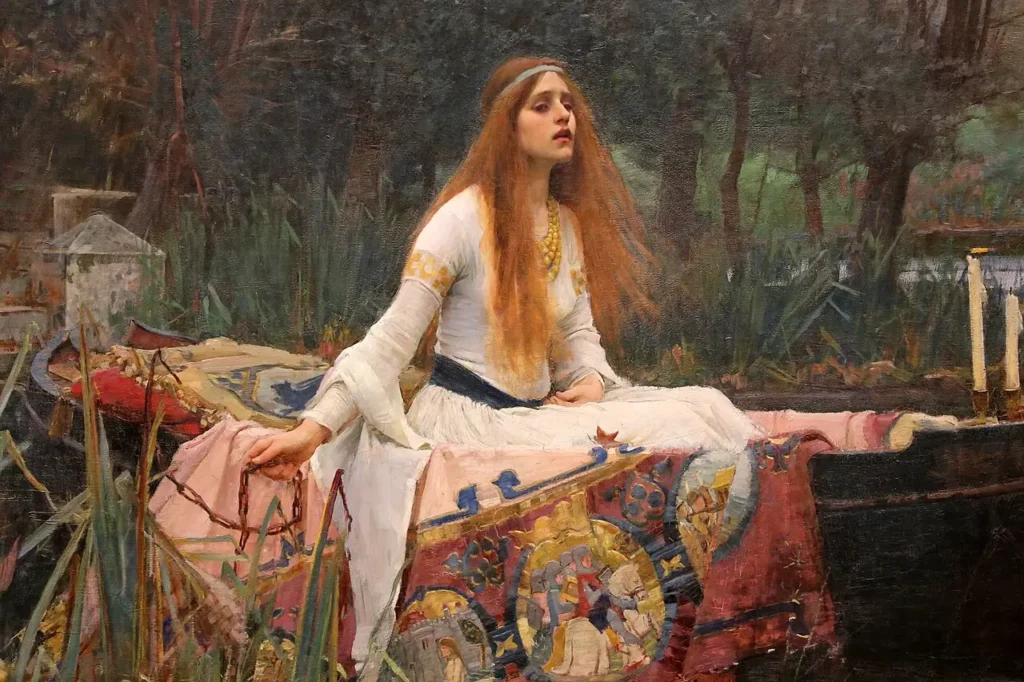
2. Pre-Raphaelite Brotherhood: Poem linked to Pre-Raphaelite Brotherhood (founded 1848, after poem). They loved medieval themes, bright colors, tragic beautiful women. Waterhouse painted Lady 3 times (1888, 1894, 1915). This painting tradition made poem famous.
3. Art and Beauty vs Industrialization: Victorian era struggled between art and industrialization. Lady creates art but cannot live life = symbol of artist alienated from industrial reality. Conflict between dreams and harsh realities.
The Role of Women in Victorian Literature
1. Women as Angels or Victims: Victorian stories saw women as either Angel in the House (pure, domestic) or fallen woman. Lady fits both – innocent but faces tragedy when she looks out, representing dangers of breaking societal rules.
2. Victim of Control: Tower represents how women expected to stay home, avoid outside world. Curse = metaphor for limitations on freedom and creativity.
3. Desire for Freedom: Looking out = wish to escape confinement and live freely. Tragic end highlights risks women faced when seeking independence.
4. Women as Art and Muse: Lady is both artist (creating tapestries) and source of beauty (captured by Lancelot’s gaze). Shows how women seen as beautiful objects but lacked power to create art themselves.
Critical Perspectives
Romantic and Victorian Literary Traditions
Romanticism and Idealism: Focus on personal feelings, beauty in nature, struggle between desire and society. Lady represents lonely artist seeking beauty away from society. Sad ending different from happy Romantic poems – shows chasing ideal can lead to disappointment if ignores real life.
Victorian Influence and Social Norms: Shows Victorian focus on social order, gender roles. When she looks out window, challenges idea women should be passive and domestic. Death highlights limited choices for women. Medieval chivalry with Sir Lancelot connects to Victorian interest in medieval past, but Lady’s tragic ending shows even idealized Camelot out of reach for women stuck in societal roles.
Gender and Identity in Tennyson’s Poetry
Feminine Roles: Isolation symbolizes social isolation women faced. Mirror represents passive role – see world but not engage.
Dual Identity: Ideal Victorian woman focused on craft but also symbol of unfulfilled desire. Lancelot = romantic ideal Victorian women told to aspire to, but unattainable.
Victimhood and Empowerment: Fate can be seen as both commentary on women’s victimization in male-dominated society and sign of empowerment. Defiance shows desire for personal freedom. Death symbolizes high price of challenging norms.
Alfred Tennyson – Short Biography
Alfred, Lord Tennyson (1809-1892) was Poet Laureate of Great Britain for over 40 years, major Victorian poet. Born Aug 6, 1809 in Somersby, Lincolnshire. Father Dr. George Tennyson, Anglican priest with mental illness. Went to Trinity College, Cambridge, befriended Arthur Henry Hallam whose death in 1833 inspired In Memoriam. Named Poet Laureate in 1850, became Lord Tennyson in 1884. Famous works include Poems, Chiefly Lyrical (1830) with Mariana, In Memoriam (1850), The Lady of Shalott (1832, revised 1842), Idylls of the King (1859-1885), and The Charge of the Light Brigade. Died Oct 6, 1892. Known for exploring personal feelings and social issues.
DU Previous Year Questions with Hints
DU Previous Year Questions — The Lady of Shalott
Important DU and DU SOL Previous Year Questions on Alfred, Lord Tennyson’s The Lady of Shalott. Tap a question to view a quick-answer guide.
1 What is the curse on the Lady of Shalott? Discuss its symbolic significance. (DU 2022, 10 Marks) +
2 Explain the line “I am half sick of shadows” in context. (DU 2021, 5 Marks) +
3 How does Tennyson use the mirror and the loom as symbols? (DU 2020, 10 Marks) +
4 Discuss The Lady of Shalott as a poem about the conflict between art and life. (DU 2019, 15 Marks) +
5 Why does the Lady decide to leave the tower despite knowing about the curse? (DU 2023, 5 Marks) +
6 Comment on the ending with reference to Lancelot’s remark “She has a lovely face”. (DU SOL 2021, 5 Marks) +
7 What is the significance of Camelot in the poem? (DU 2018, 5 Marks) +
FAQs – Add FAQ Schema in RankMath
What is the summary of The Lady of Shalott in simple words?
Lady lives cursed on island tower near Camelot, weaves what she sees in magic mirror. When she sees Sir Lancelot, she looks directly out, mirror breaks, curse falls. She sails in boat to Camelot singing last song and dies before reaching. Lancelot says she has lovely face.
What is the curse of the Lady of Shalott?
Poem never fully explains. Whisper says if she stays to look down to Camelot, curse will fall. Symbolically represents societal rules that keep women and artists isolated, Victorian gender norms, and fate.
What does the mirror symbolize in The Lady of Shalott?
Mirror symbolizes art, indirect experience of life, illusion. She sees world only through reflections, not directly, showing alienation of artist who creates without living.
Is The Lady of Shalott based on a true story?
No. Based on Italian novella Donna di Scalotta and character Elaine of Astolat from Thomas Malory’s Le Morte d’Arthur (Arthurian legend). Tennyson adapted it.
What is the difference between 1832 and 1842 versions?
1832 version had 20 stanzas and more fairy-tale tone. 1842 revised version has 19 stanzas, more refined language, deeper focus on art vs life theme. 1842 version is standard taught in universities.
Why does the Lady die at the end?
She breaks curse by looking directly at Camelot/Lancelot. Mirror cracks, tapestry flies. Leaves tower to experience real world. Journey down river in storm represents transition from life to death. Death is both punishment for transgression and liberation from isolation.
Why is The Lady of Shalott important for DU exams?
It covers key DU BA English topics: Victorian Woman Question, conflict between art and life, ballad form and musicality, Pre-Raphaelite influence, symbolism, and medievalism. Frequently asked in 5 and 10 marks.
What does “Tirra Lirra” mean?
Onomatopoeic representation of Lancelot’s joyful whistling/singing, showing carefree masculine freedom contrasted with Lady’s silent confinement. Some critics link to lark’s song.
Continue Reading
Continue Reading — The Lady of Shalott
Subscribe to keep reading
You've used your free notes for now. Get Delhi Pathshala Premium for unlimited access.
Subscribe — ₹29/30 days