

Contents
- Quick Answer: What Is My Last Duchess About?
- Key Facts at a Glance
- Background: Robert Browning and the Poem
- Biography and historical context
- Overview of his literary works
- My Last Duchess in context
- The True Story Behind the Poem
- Full Text of the Poem (with Line Numbers)
- Summary of My Last Duchess
- The poem in short
- Stage-by-stage summary
- Line-by-Line Explanation of My Last Duchess
- Characters in My Last Duchess
- Key Themes in My Last Duchess
- Dramatic Monologue and Its Significance
- How My Last Duchess meets the requirements of a dramatic monologue
- Key points about the monologue
- Literary Analysis: Form, Language and Symbols
- Poetic structure and form
- Use of symbolism and imagery
- The Big Question: What Did “I Gave Commands” Mean?
- Social and Historical Context
- Renaissance setting: art, rank and marriage
- Victorian ideals and artistic movements
- Representation of women in Victorian literature
- Critical Perspectives
- Psychological analysis of the Duke’s character
- Power dynamics and language
- Feminist readings
- The reader’s response: sympathy and judgement
- Important Comparisons
- The Duke and the Duchess
- My Last Duchess and The Lady of Shalott (both Victorian poems in your paper)
- Within Browning
- Key Quotations from My Last Duchess
- Contemporary Relevance
- Conclusion
- Quick Revision Table
- How to write the exam answer
- Continue Reading
- University of Delhi Previous Year Questions
- Frequently Asked Questions
- Sources and Further Reading
DU course context: BA (Hons.) English, Semester 3, DSC 8: Victorian Literature, Unit 2b (Unit 2 pairs Dickens’s Great Expectations with this poem; see the DU English syllabus and the official University of Delhi Semester 3 syllabus PDF).
In this post you will find a quick summary, the full poem with line numbers, a line-by-line explanation, the historical story behind the poem, characters, themes, form, symbols, critical readings, key quotations, University of Delhi previous year questions, and FAQs. It is written to match the Victorian Literature paper that also covers Great Expectations and The Lady of Shalott.
Quick Answer: What Is My Last Duchess About?
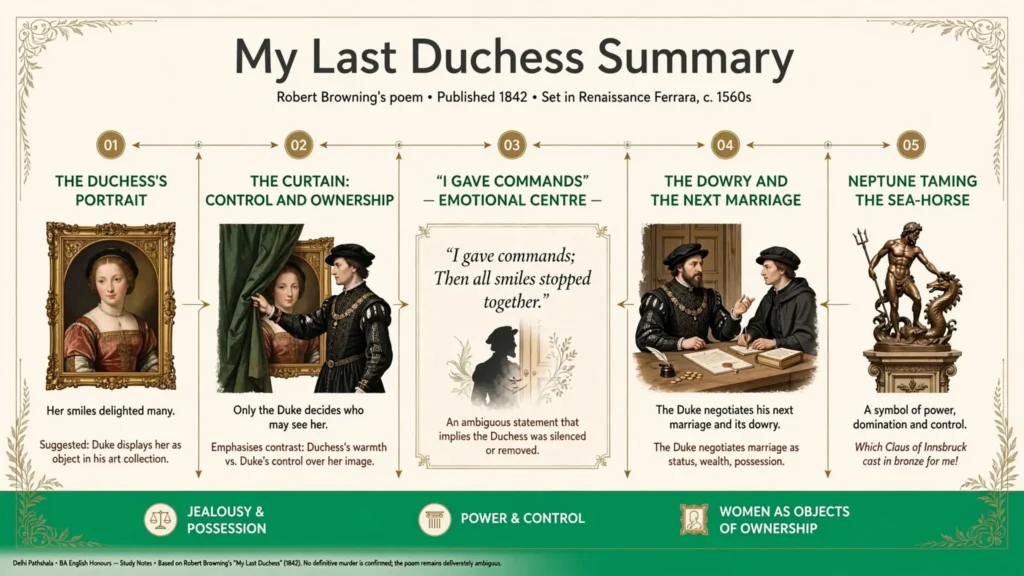
My Last Duchess (1842) is a dramatic monologue by Robert Browning. The Duke of Ferrara shows a visiting envoy a portrait of his dead wife and, while praising the painting, reveals that her friendly, easily pleased nature wounded his pride. He says he “gave commands” and “all smiles stopped together,” and then moves on to negotiate a marriage with the daughter of another nobleman. The poem is a study of power, possession and self-exposure: the Duke is trying to impress his listener, yet every word shows us who he is.
Key Facts at a Glance
| Detail | Information |
|---|---|
| Poet | Robert Browning (1812–1889) |
| First published | 1842, in Dramatic Lyrics (Bells and Pomegranates, No. III) |
| Original title | “Italy” (printed as “Italy and France. I. Italy”, paired with “Count Gismond”); renamed My Last Duchess in 1849 |
| Form | Dramatic monologue in rhyming couplets (56 lines, iambic pentameter) |
| Speaker | The Duke of Ferrara |
| Listener | A silent envoy (messenger) of a Count, whose daughter the Duke wishes to marry |
| Setting | Ferrara, northern Italy, Renaissance period (sixteenth century) |
| Historical basis | Alfonso II d’Este, Duke of Ferrara, and his first wife Lucrezia de’ Medici (see below) |
| DU paper | DSC 8: Victorian Literature, Unit 2b |
| Central ideas | Power, possession, jealousy, pride of rank, objectification of women, art and control |
Background: Robert Browning and the Poem
Biography and historical context
Robert Browning (1812–1889) was an English poet and playwright, best known for his dramatic monologues. In these poems a single speaker talks, usually to a silent listener, and ends up revealing far more about himself than he intends. Browning was born on 7 May 1812 in Camberwell, south London. His father, also named Robert Browning, was a clerk at the Bank of England, and his mother, Sarah Anna Wiedemann, was of mixed Scottish and German background. He was a bank clerk with a very large private library.
That library, of around 6,000 volumes, gave the young Browning access to old and new literature, history and stories from many languages. He went to school as a weekly boarder in Peckham and briefly attended classes at London University, but he was mostly educated at home and read widely on his own, including in the classical languages.
His first published poem, Pauline: A Fragment of a Confession, appeared anonymously in 1833, paid for by a relative. Early work such as Paracelsus (1835) was noticed, but Sordello (1840) was widely seen as too obscure, and Browning’s reputation dipped for a while before it recovered. In 1846 he secretly married the poet Elizabeth Barrett; the couple settled in Florence. Their relationship is the best-known literary love story of the period, and it also connected Browning with important writers and thinkers. Elizabeth died in 1861. Browning himself died in Venice on 12 December 1889 and is buried in Westminster Abbey. If you are studying her work as well, see our notes on Elizabeth Barrett Browning’s How Do I Love Thee.
Browning lived through the Victorian age, a time of industrial growth, social questions and doubts about science and religion. His poetry keeps returning to individuality, power, faith and doubt, and the strange workings of the human mind. He often looks at the darker side of people, and sometimes tests the social habits and moral assumptions of his own time, though, as you will see below, he often does this by looking at other countries and centuries.
Overview of his literary works
Browning first tried to find a suitable form, writing long poems and then plays. He became famous for the dramatic monologue, where speakers reveal their inner thoughts, often in surprising ways.
Some of his most important works are:
- Pauline (1833) – His first published work, issued anonymously.
- Paracelsus (1835) and Sordello (1840) – Long poems; Sordello was widely seen as difficult and obscure.
- Bells and Pomegranates (1841–1846) – A series of eight inexpensive pamphlets, originally meant mainly for his plays but also including shorter poems. No. III is Dramatic Lyrics (1842), the volume in which My Last Duchess first appeared. The same volume also contains “Porphyria’s Lover” and the children’s poem The Pied Piper of Hamelin.
- Men and Women (1855) – A collection of dramatic poems about love, art, faith and character, including monologues on Italian Renaissance artists such as “Fra Lippo Lippi” and “Andrea del Sarto”.
- Dramatis Personae (1864) – Another collection of dramatic monologues on faith, doubt and human character.
- The Ring and the Book (1868–69) – A very long poem that retells a murder trial from many different viewpoints, exploring justice, morality and the nature of truth.
- Balaustion’s Adventure (1871) and The Agamemnon of Aeschylus (1877) – Works that show his interest in Greek tragedy.
- Asolando (1889) – His last collection.
Browning’s style is known for its complex rhymes, varied rhythms, colloquial speech and strong emotions. His poems often mix poetry and drama, giving detailed character studies in the form of a speech. Themes of power, control, obsession, human weakness and moral uncertainty appear in many of them, and they are seen sharply in My Last Duchess.
My Last Duchess in context
My Last Duchess first appeared in November 1842 in Dramatic Lyrics. In that first edition it was printed under the heading “Italy and France”, as “I. Italy”, and it was followed by “Count Gismond” as “II. France”. Browning gave it its present title only in 1849, when it was reprinted in Dramatic Romances and Lyrics. The change is worth noting for exams: the title now stresses the word last, because the end of the poem shows that the Duke is already negotiating for a next duchess.
The poem is set in the Italian Renaissance, but it was written in early Victorian England. Browning had visited Italy in 1838 and was fascinated by Renaissance history and art. The poem is therefore a meeting point of two of his great interests: the Italian Renaissance and the visual arts. Through the Duke’s words Browning explores jealousy, power and control, and the treatment of a woman as a possession.
The True Story Behind the Poem
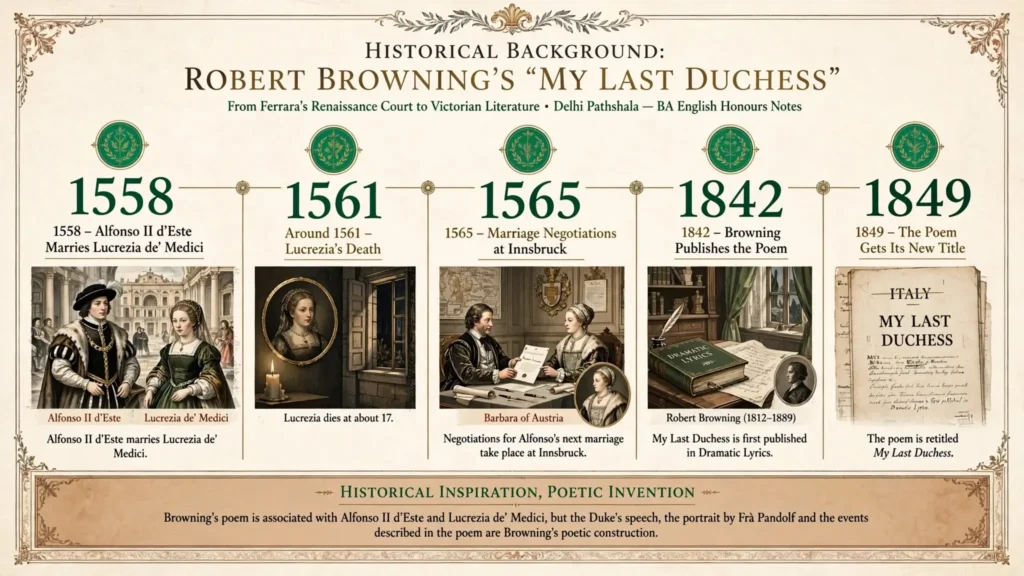
Browning’s Duke is based on a real person, but the poem’s version of events is Browning’s own invention. The usual scholarly view, set out by the critic Louis S. Friedland in a 1936 article, is that Browning most likely had Alfonso II d’Este (1533–1598), the fifth Duke of Ferrara, in mind. The notes in the University of Toronto’s Representative Poetry Online summarise the evidence like this.
| Detail | In history | In Browning’s poem |
|---|---|---|
| The Duke | Alfonso II d’Este, fifth Duke of Ferrara, last of the Este line | Unnamed; only “Ferrara” appears as a heading |
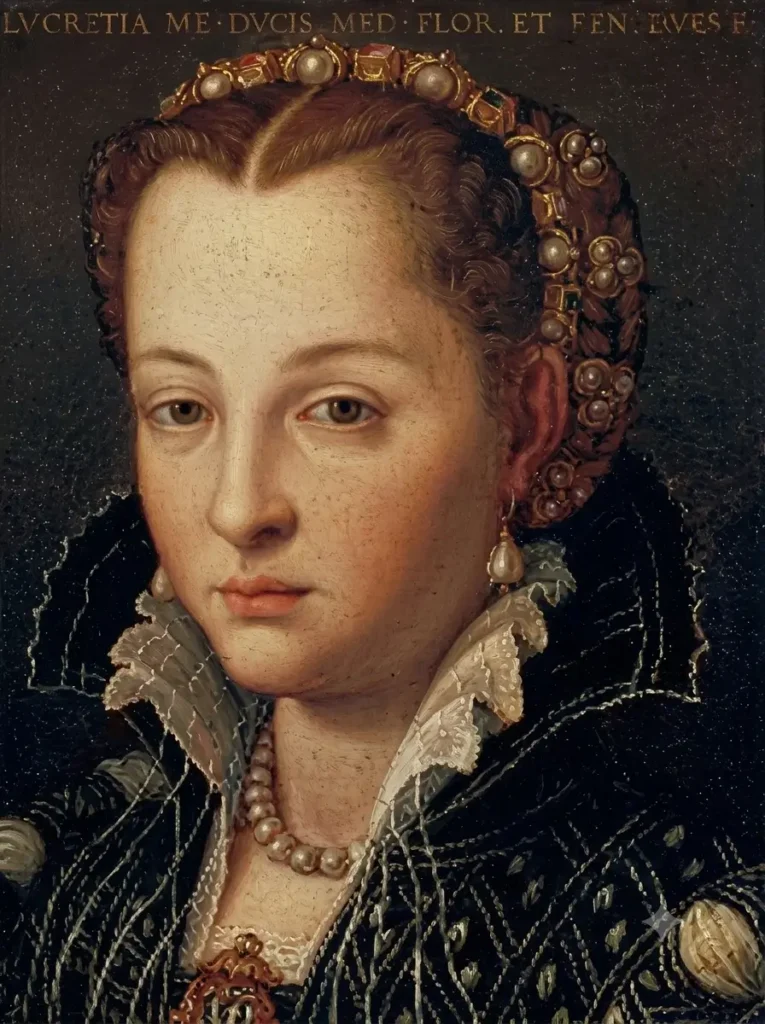
| The first wife | Lucrezia, daughter of Cosimo I de’ Medici; married in 1558 when she was about 14; died aged about 17 in circumstances some thought suspicious | “My last Duchess,” never named |
| After the wedding | Alfonso left her three days after the wedding for around two years | Not mentioned |
| The second marriage | Alfonso negotiated to marry Barbara of Austria; in 1565 he met her party in Innsbruck | The Duke is negotiating the marriage of “the Count’s fair daughter” |
| The envoy | Nikolaus Mardruz, who acted for Ferdinand II, Count of Tyrol | An unnamed “sir” |
| Fra Pandolf (painter), Claus of Innsbruck (sculptor) | No known historical record; no known painting is linked to the poem | Invented artists |
| How she died | Cause not settled in the poem’s sources | Left deliberately unclear: “I gave commands” |
Why this matters for answers. In an exam you can say that the poem is “based on history but not a historical record.” Browning chose real names and places to give the monologue a Renaissance atmosphere, then used the gaps to imagine a psychology. Note too that the Este family’s lineage was much shorter than “nine hundred years” (the notes put it at about 650), so the Duke’s boast is also an exaggeration, which tells us something about his pride.
Full Text of the Poem (with Line Numbers)
My Last Duchess (Ferrara) by Robert Browning, from Dramatic Lyrics (1842). The poem is in the public domain. Line numbers follow the University of Toronto Representative Poetry Online edition; small spelling and punctuation differences exist between editions.
FERRARA

 1  That's my last Duchess painted on the wall,
 2  Looking as if she were alive. I call
 3  That piece a wonder, now: Frà Pandolf's hands
 4  Worked busily a day, and there she stands.
 5  Will 't please you sit and look at her? I said
 6  "Frà Pandolf" by design, for never read
 7  Strangers like you that pictured countenance,
 8  The depth and passion of its earnest glance,
 9  But to myself they turned (since none puts by
10  The curtain I have drawn for you, but I)
11  And seemed as they would ask me, if they durst,
12  How such a glance came there; so, not the first
13  Are you to turn and ask thus. Sir, 'twas not
14  Her husband's presence only, called that spot
15  Of joy into the Duchess' cheek: perhaps
16  Frà Pandolf chanced to say, "Her mantle laps
17  Over my Lady's wrist too much," or "Paint
18  Must never hope to reproduce the faint
19  Half-flush that dies along her throat": such stuff
20  Was courtesy, she thought, and cause enough
21  For calling up that spot of joy. She had
22  A heart—how shall I say?—too soon made glad,
23  Too easily impressed; she liked whate'er
24  She looked on, and her looks went everywhere.
25  Sir, 'twas all one! My favour at her breast,
26  The dropping of the daylight in the West,
27  The bough of cherries some officious fool
28  Broke in the orchard for her, the white mule
29  She rode with round the terrace—all and each
30  Would draw from her alike the approving speech,
31  Or blush, at least. She thanked men,—good! but thanked
32  Somehow—I know not how—as if she ranked
33  My gift of a nine-hundred-years-old name
34  With anybody's gift. Who'd stoop to blame
35  This sort of trifling? Even had you skill
36  In speech—(which I have not)—to make your will
37  Quite clear to such an one, and say, "Just this
38  Or that in you disgusts me; here you miss,
39  Or there exceed the mark"—and if she let
40  Herself be lessoned so, nor plainly set
41  Her wits to yours, forsooth, and made excuse,
42  —E'en then would be some stooping; and I choose
43  Never to stoop. Oh sir, she smiled, no doubt,
44  Whene'er I passed her; but who passed without
45  Much the same smile? This grew; I gave commands;
46  Then all smiles stopped together. There she stands
47  As if alive. Will 't please you rise? We'll meet
48  The company below, then. I repeat,
49  The Count your master's known munificence
50  Is ample warrant that no just pretence
51  Of mine for dowry will be disallowed;
52  Though his fair daughter's self, as I avowed
53  At starting, is my object. Nay, we'll go
54  Together down, sir. Notice Neptune, though,
55  Taming a sea-horse, thought a rarity,
56  Which Claus of Innsbruck cast in bronze for me!
Glossary. Frà = Brother (a friar or member of a religious order); by design = deliberately; countenance = face and expression; durst = dared; mantle = a loose, sleeveless cloak; favour = a love-gift such as a ribbon; officious = over-eager to please; munificence = great generosity; dowry = money or property a bride’s family gives; avowed = openly declared; pretence (line 50) = claim.
Summary of My Last Duchess
The poem in short
The Duke of Ferrara is showing a visitor around his palace. He stops before a portrait of his late wife, painted on the wall behind a curtain that only he is allowed to draw. He praises the painter, Frà Pandolf, and explains why the portrait’s expression—a deep, warm glance—makes visitors want to ask what caused it. He claims that her blushes were not meant for him alone. She was, he says, pleased by everything in the same way: his gift of a ribbon, a sunset, a branch of cherries, a ride on a white mule. Worst of all, in his eyes, she gave the same thanks to others that she gave to him, as if his “nine-hundred-years-old name” were no better than “anybody’s gift.”
The Duke says he could never lower himself (“stoop”) to explain this to her. Instead, he says, “I gave commands; / Then all smiles stopped together.” He then turns to the real purpose of the visit: he is arranging a new marriage with the daughter of a Count, and he assures the envoy that the Count’s generosity will make the dowry no problem. As they go down to meet the other guests, he points out a bronze statue of Neptune taming a sea-horse, made for him by Claus of Innsbruck.
Stage-by-stage summary
- The portrait (lines 1–13). The Duke introduces his “last Duchess” as a work of art, praises the painter, and shows he alone controls who may see her.
- The “spot of joy” (lines 13–24). He says her blush was not only for her husband and sneers at the compliments of the painter as “stuff.” He calls her heart “too soon made glad.”
- The list of pleasures (lines 25–34). Her husband’s gift, a sunset, cherries and a mule all gave her the same delight, and she thanked men as though his name were equal to anybody’s gift.
- The refusal to “stoop” (lines 34–43). He insists that speaking to her about her faults would have lowered him, and he refuses to do so.
- The commands (lines 43–47). She smiled at him, but at everybody else too. “I gave commands; / Then all smiles stopped together.” The poem returns to the portrait: “There she stands / As if alive.”
- The next marriage and Neptune (lines 47–56). He moves to the dowry, asserts that the Count’s daughter herself is his true aim, and ends by pointing out another work of art he owns.
Line-by-Line Explanation of My Last Duchess
Use this table for questions that ask you to “explain” or “comment on” a passage.
| Lines | What the Duke says | What it shows |
|---|---|---|
| 1–4 | “That’s my last Duchess painted on the wall, / Looking as if she were alive.” He calls the portrait a “wonder” and says Frà Pandolf painted it in a single busy day. | The Duke introduces his wife as an object (“that piece”), not by name. “My” shows ownership; “last” hints that duchesses can be replaced. “There she stands” blurs the portrait and the woman. |
| 5–13 | He invites the envoy to sit and look. He says he named Frà Pandolf on purpose, because strangers always turn to him to ask how the “depth and passion” of that glance arose; only he draws the curtain. | The curtain is control. He decides who sees her face. (When asked about “by design”, Browning replied that it gave the Duke an occasion for telling the story.) |
| 13–21 | He says the blush on her cheek was not caused by her husband’s presence alone. Perhaps the painter praised her cloak or her “half-flush”; such “stuff” she took as courtesy. | The Duke belittles compliments and subtly suggests another man’s attention pleased her. His jealousy appears even towards a friar-painter. |
| 21–25 | “A heart—how shall I say?—too soon made glad, / Too easily impressed.” He says “her looks went everywhere.” | The pause in “how shall I say?” is staged, as if he is searching for words; he is actually accusing her. “Looks” can mean both her glances and her appearance. |
| 25–31 | His love-gift, the sunset, a branch of cherries from an “officious fool,” the white mule: all received the same approving speech or blush. | He sees her equal warmth as a fault. The list sets his gift beside trivial pleasures, which is exactly what offends him. |
| 31–34 | She thanked men, but “as if she ranked / My gift of a nine-hundred-years-old name / With anybody’s gift.” | His real wound is pride of rank. His lineage matters more to him than her feelings. The number is an exaggeration. |
| 34–43 | Even if he had the “skill / In speech” (which he says he lacks), correcting her would be “stooping,” and “I choose / Never to stoop.” | A key irony: the Duke is highly articulate, so “I have no skill in speech” is false modesty. His pride prevents any communication with his wife. |
| 43–47 | She smiled at him, “but who passed without / Much the same smile? This grew; I gave commands; / Then all smiles stopped together.” | The central, ambiguous moment. The short, hard sentences replace the earlier flow. See the debate section below. |
| 47–53 | He ends the tour: “Will ‘t please you rise?” He mentions the Count’s generosity, the dowry, and that the Count’s “fair daughter’s self” is his real “object.” | The Duke moves from the dead wife to business. “Object” can mean both “aim” and “thing,” a sharp double meaning. |
| 53–56 | “Notice Neptune, though, / Taming a sea-horse.” The bronze was cast “by Claus of Innsbruck… for me.” | Another prized artwork. The god taming an animal echoes the Duke’s treatment of his wife. The poem ends on possession (“for me”). |
Characters in My Last Duchess
The Duke of Ferrara. The only speaker. He is cultured (an art collector, a patron of artists, fluent and polite) and also proud, jealous and cold. His courtesy hides his cruelty. He never says her name.
The Last Duchess. She never speaks, and we meet her only through the Duke’s biased description. She appears warm, cheerful, polite and easily delighted. Browning, asked about her, indicated that she had unwittingly wounded the Duke’s pride by failing to recognise his superiority in even small matters; she did not commit any offence in the usual sense.
The envoy (the silent listener). A messenger from the Count, the father of the Duke’s intended bride. He is addressed as “sir” and never replies; his silence lets the Duke dominate the conversation. (In history, he corresponds to Nikolaus Mardruz, according to the sources above.)
Frà Pandolf. The painter of the portrait. An invented artist and a “Frà,” a member of a religious order, which makes it unlikely, as the poem suggests, that he was the Duchess’s lover; the Duke’s suspicion is therefore mostly his own jealousy.
Claus of Innsbruck. An invented sculptor who cast the Neptune bronze. His name connects the closing lines to Innsbruck, where the historical Alfonso negotiated his second marriage.
The Count’s daughter. Never present, never named. She is the next possible “duchess,” and the end of the poem asks whether she will share her predecessor’s fate.
Key Themes in My Last Duchess
1. Jealousy and possession. The Duke is deeply jealous and wants total control over the Duchess. He sees her as something he owns, not as a person with feelings of her own. Her pleasure in a sunset or a branch of cherries threatens him, because it shows that his attention is not the centre of her joy.
2. Power and control. The Duke wants to control everything: who sees the portrait, who speaks, what is said and how the story of the marriage is told. The portrait behind the curtain, which only he may open, is the clearest sign of his need to dominate.
3. Objectification of women. The Duke sees the Duchess as a beautiful object for his enjoyment. He values her looks and what she brings to his status, not her personality. Her portrait ends up more obedient than she was.
4. Moral corruption and arrogance. The Duke shows no guilt about her fate. He speaks casually, and he moves smoothly to the next marriage. His charm and artistic taste do not make him good; Browning shows that refinement and cruelty can sit side by side.
5. Inequality and patriarchy. The Duke’s authority over his wife reflects a society in which women had little power and marriages were arranged for rank and money. The poem shows a marriage as a deal between men (the Duke and the Count) over a dowry.
6. Pride of lineage and rank. The “nine-hundred-years-old name” is the Duke’s most precious possession. The poem makes his pride in family and status a root cause of his anger.
7. Art as ownership. The Duke collects works of art (a portrait, a bronze) and treats the Duchess as one of them. Art here is not a form of love but a way to fix and keep things under control.
8. Silence and voice. The Duchess is silent and the envoy is silent. Only the Duke speaks. This forces readers to read between the lines and to supply the voice the poem withholds.
Dramatic Monologue and Its Significance
A dramatic monologue is a poem in which one speaker, clearly different from the poet, talks to a listener in a particular situation. As the speaker talks, we learn about his character, often including what he does not mean to reveal. Browning himself described the poems of Dramatic Lyrics as “so many utterances of so many imaginary persons, not mine.”
How My Last Duchess meets the requirements of a dramatic monologue
| Requirement | In the poem |
|---|---|
| A speaker who is not the poet | The Duke of Ferrara; Browning does not speak directly |
| A silent listener | The envoy, addressed as “sir” and “you” |
| A definite occasion | A tour of the palace during negotiations for a second marriage |
| Speech that sounds natural | Conversational rhythm, pauses (“how shall I say?”), enjambment, interruptions |
| Self-revelation | The Duke exposes his pride, jealousy and cruelty without intending to |
| Dramatic irony | We understand more than the Duke realises about what his words mean |
Key points about the monologue
1. Character revelation. The Duke reveals his character through his own speech, showing his arrogance and insecurity. No narrator is needed to tell us.
2. Unreliable narrator. The Duke’s view is biased and he only hints at what he did; he does not describe his own actions openly. We should treat his account of the Duchess as his version, not the truth. (See the debate below: he is candid about his feelings but vague about his deeds.)
3. Intimacy and manipulation. He speaks warmly and confidentially to the envoy, as if to a friend, while giving a quiet warning about what happens to a wife who displeases him. The poem is both a self-portrait and a message to the next family.
4. Psychological insight. The poem gives a deep look into the Duke’s mind. His voice moves from calm admiration to cold complaint to brisk business, showing how easily he turns from his wife’s death to a new match.
5. Power through language. The Duke uses words to control the conversation, the story of the marriage and the way others see him. He tells the envoy where to sit, when to rise, and what to look at.
In conclusion, My Last Duchess uses the dramatic monologue to explore power, control, jealousy and the objectification of women. The Duke’s speech shows a man whose ego and moral failure lead him to a terrible act, and the poem examines both the individual and the social order that allows him to act.
Literary Analysis: Form, Language and Symbols
Poetic structure and form
1. Dramatic monologue. One speaker (the Duke) talks to a silent listener (the envoy). This lets him reveal his thoughts without realising how much he gives away. Browning grouped the poem in a volume of “dramatic lyrics.”
2. Rhyme and metre. The poem has 56 lines of rhyming couplets (rhyme pattern AABBCC…) in iambic pentameter, which is why it is often called a poem in “heroic couplets.” The rhyme pairs run wall/call, hands/stands, said/read, countenance/glance, by/I, durst/first, not/spot, and so on, so each couplet closes before the next begins.
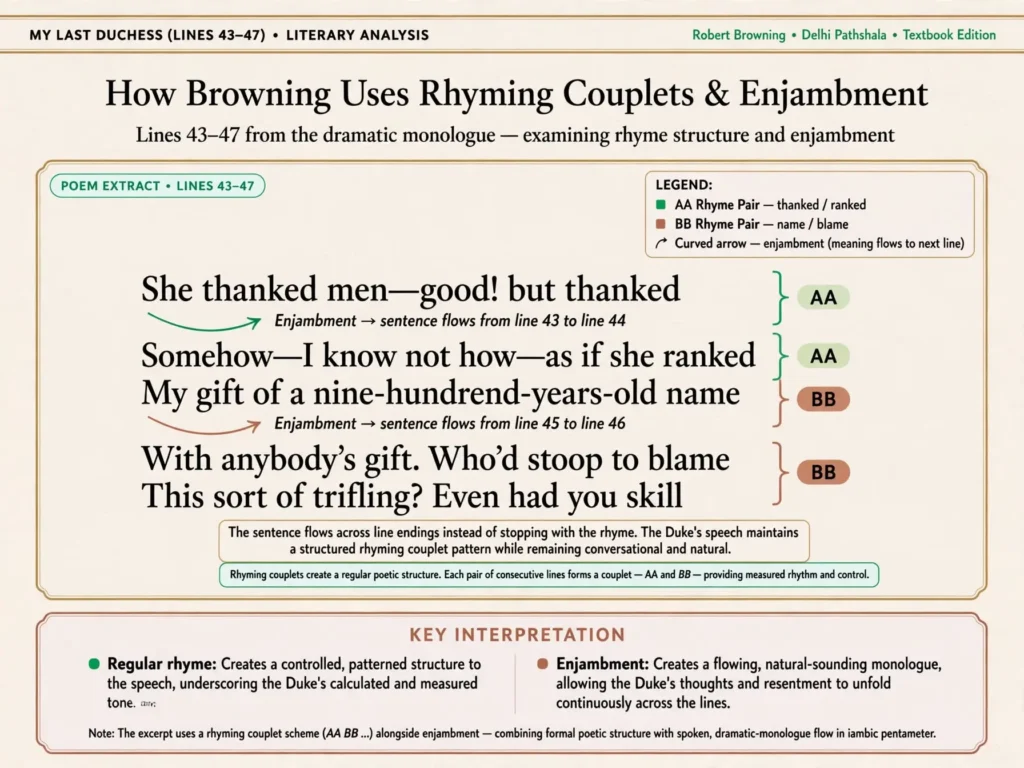
3. Enjambment and conversational flow. The sentences run across line endings so often that the couplet rhymes are muted, and the verse sounds like natural speech, not formal poetry. A line like “Sir, ’twas not / Her husband’s presence only” carries the sense forward, and the Duke seems to control the conversation without pause. Breaks in the metre, dashes and pauses (“A heart—how shall I say?—too soon made glad”) suggest an act: he is choosing his words carefully.
4. Repetition. The Duke repeats certain phrases: “as if… alive” (lines 2 and 47), “there she stands” (lines 4 and 46), “stoop” (34, 42–43), “smile” (43–46). Ian Lancashire’s commentary in Representative Poetry Online reads these repetitions as the habits of a mind that circles back to the same obsessions.
5. Circular structure. The poem begins with an artwork (the portrait) and ends with another (the bronze Neptune). The shift from a dead wife to the next marriage, with another object in view, suggests that the pattern will repeat.
Use of symbolism and imagery
1. The portrait. The portrait is the central symbol. It shows the Duke’s wish to control how the Duchess is seen and remembered, freezing her in time. The painted face has the “depth and passion” of the living one but can no longer smile at anyone else.
2. The curtain. Only the Duke draws the curtain. It is a clear symbol of control over access to her image, and of the control he once tried to have over her glances and smiles.
3. The Duke’s art collection. The art collection shows how he sees people, especially women: as possessions to display and use to confirm status. His comments on art suggest that relationships are, for him, things to manage and own.
4. The Duchess’s smile and blush (“spot of joy”). The smile and blush express a warmth he cannot manage. He wants her smile for himself alone, but it was given freely to a sunset, a mule, and men who brought small gifts.
5. Cherries, the white mule and the sunset. Ordinary pleasures in nature and simple kindness. In the Duke’s list they are the “rivals” of his name and gift, which shows how petty his jealousy is.
6. The “nine-hundred-years-old name.” The name is his most valued possession and, in his own mind, his greatest “gift.” It stands for rank and family pride.
7. Neptune taming a sea-horse. The god of the sea controls a wild creature. This final image echoes the Duke’s treatment of his wife: the aim of marriage, for him, is mastery. It also hints at what may await the new bride.
The Big Question: What Did “I Gave Commands” Mean?
The most-discussed line in the poem is lines 45–46: “This grew; I gave commands; / Then all smiles stopped together.” The poem never says exactly what the Duke ordered. Here is how this is usually discussed, with the evidence for each reading.
| Reading | Evidence | Who holds it / notes |
|---|---|---|
| He ordered her death. | The phrase “all smiles stopped together,” the return to “There she stands / As if alive,” and the Duke’s cold calm. | The usual reading. The Encyclopaedia Britannica says it becomes clear at last that he brought about her death. Ian Lancashire argues that nothing short of death could stop smiles that spread “everywhere.” |
| He might have sent her away (for example, to a convent). | The text names no murder. Browning was reported to have said, when asked, “I meant that the commands were that she should be put to death,” and then, as if the thought had just come to him, added that the Duke might instead have had her shut up in a convent (reported in Hiram Corson’s 1899 book, quoted in the Representative Poetry Online notes). | Shows that even Browning treated the line as open. Even on this reading, Lancashire notes, the Duke has killed her joy. |
| The ambiguity is deliberate. | The line is brief, bare and followed at once by “There she stands.” The poem lets readers feel the horror without a confession. | Teachers often use this reading to link the poem’s form with its theme: the Duke controls the story even here. |
What to write in an exam. Do not state as a plain fact that the Duke “admitted” killing her. Say instead that he implies he had her removed, most readers understand this as an order for her death, and that Browning’s own comments left room for other possibilities. This shows that you know both the text and the debate.
Social and Historical Context
My Last Duchess was written in 1842, in the early Victorian period, but it is set in sixteenth-century Renaissance Italy. Good answers keep both in view. The poem is about a Renaissance duke, yet readers have long seen it as speaking to Victorian questions of gender, class and power. Critics disagree on how directly Browning is “criticising” his own society, so it is safer to say the poem invites readers to think about those questions.
Renaissance setting: art, rank and marriage
In the Italian courts of the sixteenth century, noble marriages were political and financial alliances. A bride’s family paid a dowry, and her husband’s family gave status and alliances in return. The Duke’s conversation with the Count’s envoy is exactly such a negotiation, and the poem exposes how a wife could be treated as part of a business arrangement. Art patronage was also a sign of power: rulers commissioned portraits and statues to show wealth and taste. Browning links these two things through the Duke, who treats both art and wife as signs of his own status.
Victorian ideals and artistic movements
1. The Victorian era (1837–1901). The period is named after Queen Victoria. It saw big changes in industry, science and social life, along with strict ideas of respectability and clear roles for men and women. Men were expected to work and head families, and women were expected to be wives and mothers in the home.
2. Social class and power. Victorian society was divided into classes. In the poem the Duke belongs to the highest rank and treats his possessions, including his wife, as his own to manage. Browning shows what pride of rank can do to a person. Because the Duke is from another country and century, Victorian readers could see the problems of class and male authority from a distance.
3. Victorian art and literature. Victorian literature grew out of the Romantic movement, which valued individual feeling and nature, but by the mid-Victorian period many writers were turning to realism and social issues; novelists like Dickens and George Eliot wrote about class and human nature. Browning’s dramatic monologues fit the Victorian interest in psychology and the inner life.
A note on dates: the Pre-Raphaelite Brotherhood, a group of painters and poets who loved medieval themes and detailed, expressive art, was founded in 1848, six years after My Last Duchess was published. So they cannot have influenced the poem, but their paintings and poems, which often showed beautiful women as images to be looked at, belong to the same wider Victorian interest in art and the female figure. If you mention them in an exam, say “parallel” or “related” and not “influenced.”
4. Religion and morality. The Victorian age was strongly shaped by Christianity and a public language of duty and respectability, though scientific discoveries led many to doubt traditional beliefs. In the poem the Duke has none of the moral concern that his refined manners suggest. His pride and jealousy are shown beneath a surface of politeness, so the poem asks readers to look through polished behaviour to the moral truth beneath it.
Representation of women in Victorian literature
1. The idealised woman. Victorian writing often imagined an ideal woman: gentle, pure and devoted to her family, sometimes called “the angel in the house” (a phrase from a later Victorian poem by Coventry Patmore). The Duchess is warm and cheerful, which would suit this ideal in many ways, yet the Duke finds her warmth too generous and not directed to him alone. The poem therefore shows that even a “perfect” woman could be judged and controlled by her husband’s wishes.
2. Objectification and possession. In My Last Duchess the Duke’s possessiveness shows how women were treated as belongings. He keeps the portrait like a trophy. This reflects patriarchal attitudes and the view of women as beautiful objects that increase a husband’s status.
3. Agency and silence. The Duchess does not speak. Whatever resistance or independence she has appears only as the Duke reports it, and Browning does not give her a voice of her own. The Duke’s later phrase “she smiled, no doubt, / Whene’er I passed her; but who passed without / Much the same smile?” suggests a fixed habit of kindness, not a rebellion. Browning’s own comments suggest she hurt the Duke’s pride unwittingly, so any sense of defiance is the Duke’s reading and not the poem’s fact.
4. Is the Duchess a “fallen woman”? No. The “fallen woman” in Victorian literature was a woman who had broken sexual rules and was punished by society. The Duke never accuses the Duchess of adultery; his complaint is that her pleasure was too equal and too widely given. This distinction is useful in exams: the poem is about jealousy and control, not about a sinful wife.
In conclusion, the poem does not show a Victorian wife but a Renaissance one, yet through the Duke’s attitude Browning raises questions about male power, social rank and the treatment of women that mattered to his own age, and still do.
Critical Perspectives
My Last Duchess can be read in several ways. The four below are the ones most useful for DU answers. Remember to present them as ways of reading and not as the only truth.
Psychological analysis of the Duke’s character
1. Self-importance and wounded pride. The Duke is self-centred and needs to feel that he is superior to everybody. He cannot tolerate any sign that his status is not the centre of someone’s attention. Browning’s own comment, as reported in the Representative Poetry Online notes, was that the Duke acted mainly out of vanity wounded by the Duchess’s failure to recognise his superiority in small things.
2. Need for control. He tries to control the Duchess’s glances, her smile and her pleasures; he now controls her portrait by keeping it behind a curtain. His solution to his fear of losing control is to remove the source of the problem.
3. Lack of remorse. He shows no regret. He speaks of the Duchess’s end in the same smooth tone he uses for his art collection. Some readers use modern terms such as narcissism or psychopathy for this coldness. These labels are anachronistic for a sixteenth-century duke and risk simplifying a complex poem, so in an exam it is safer to speak of pride, vanity, entitlement and a lack of empathy.
Power dynamics and language
1. Power and control. The poem shows how those in power manipulate others. The Duke controls not only his wife’s fate but also the way the story is told to the envoy.
2. Control through language. The Duke decides what the listener learns. He portrays his wife as too easily pleased and disrespectful, shaping how she will be remembered. Browning lets the reader see through this performance.
3. Gender and power. The marriage negotiation is between two men over a woman’s dowry. Women are the subject of the conversation but never take part in it.
Feminist readings
1. Women as objects. A feminist reading shows how the Duke sees the Duchess as an object to be displayed and controlled, valued for how she benefits him.
2. Critique of male entitlement. The Duke believes he has the right to control his wife’s feelings and her life, and his calm discussion of her fate suggests that he considers her replaceable. The poem lets readers see this as a flaw to be criticised.
3. The Duchess’s silence. The Duchess does not speak. The Duke’s monologue shows how a woman can be silenced, her image kept and her voice removed. As Lancashire observes, the more the Duke talks, the more he endears the Duchess to the reader.
The reader’s response: sympathy and judgement
Browning makes the Duke fluent, confident and charming, so a reader may find himself listening with interest before realising what he is hearing. Some critics argue that this is the poem’s real power: it makes us notice how easily polished speech can disguise cruelty. Others stress that the poem makes sure we judge the Duke even as we understand him. In an exam you can use this to explain why the poem is not simply a “story of a murder” but a study of how we respond to a persuasive speaker.
In conclusion, a psychological view reveals a man of pride and fear of losing control; a power-and-language view shows how speech itself can control others; a feminist view highlights how women are silenced and treated as property; and a reader-response view shows how Browning tests our own judgement.
Important Comparisons
The Duke and the Duchess
| Aspect | The Duke | The Duchess |
|---|---|---|
| Voice | The only speaker | Silent; reported through him |
| Attitude to pleasure | Wants exclusive attention | Delights in everything equally |
| View of rank | “Nine-hundred-years-old name” is his greatest gift | Does not rank his gift above others’ |
| Relation to art | Collector and owner | Now a painted image |
| Fate | Continues to a new marriage | Silenced; remembered as a portrait |
My Last Duchess and The Lady of Shalott (both Victorian poems in your paper)
| Aspect | My Last Duchess (Browning, 1842) | The Lady of Shalott (Tennyson) |
|---|---|---|
| Woman’s voice | Silent; seen through a man’s words | Silent until her song at the end; seen mostly through a narrator |
| Woman and art | She becomes a portrait owned by the Duke | She is herself an artist, weaving what she sees in a mirror |
| Setting | Renaissance Italy | Arthurian Camelot |
| Male figure | The Duke controls and speaks | Sir Lancelot, who is unaware of her and only remarks on her face |
| Theme to compare | Possession, control, objectification | Confinement, art vs life, the male gaze |
You can use this table for the Part B question on “the portrayal of women in the works of any two Victorian poets in your course,” where My Last Duchess and The Lady of Shalott are an easy pairing.
Within Browning
My Last Duchess is often read together with “Porphyria’s Lover,” which appeared in the same 1842 volume. In both poems a male speaker reveals a possessive attitude towards a woman. “Porphyria’s Lover” is not on the DU Semester 3 list for this unit, so use it only as a short comparison.
Key Quotations from My Last Duchess
| Quotation (line) | What it shows |
|---|---|
| “That’s my last Duchess painted on the wall” (1) | Ownership (“my”), replacement (“last”), and treatment of a woman as an object on a wall |
| “Looking as if she were alive” (2); “As if alive” (46–47) | The portrait stands in for the woman; the repetition after “all smiles stopped” is chilling |
| “none puts by / The curtain I have drawn for you, but I” (9–10) | The Duke controls access to her image |
| “that spot / Of joy into the Duchess’ cheek” (14–15) | The Duchess’s natural warmth, which the Duke treats as a fault |
| “too soon made glad” (22) | His accusation that she was too easily pleased |
| “her looks went everywhere” (24) | His resentment of her wide attention |
| “a nine-hundred-years-old name” (33) | Pride of rank; the Duke’s idea of his greatest gift |
| “I choose / Never to stoop” (42–43) | Pride; he will not speak to her about her faults |
| “This grew; I gave commands; / Then all smiles stopped together” (45–46) | The ambiguous turning point |
| “Notice Neptune, though, / Taming a sea-horse” (54–55) | Another object; the Duke’s idea of mastery |
Contemporary Relevance
The poem is still widely read because its central situation is not tied to one century. It shows how possessive and controlling behaviour can hide behind good manners, charm and “love,” and how a person’s own account of a relationship can be shaped to justify harm. It also asks readers to think about who gets to speak and who is silenced, and about how art, money and rank can turn people into things. For students, it is a useful model for reading any narrator critically.
Conclusion
In My Last Duchess, Robert Browning uses the dramatic monologue to show a duke whose pride, jealousy and need for control are revealed through his own graceful, persuasive speech. The poem is built on a real Renaissance story, but Browning invents the psychology, and the ambiguity of “I gave commands” lets him show a crime without describing it. Its form (rhyming couplets broken by enjambment), its symbols (the portrait, the curtain, Neptune) and its silent listener all work together to make the Duke condemn himself. By the end, the Duchess is a painted image, the next wife is already “the object,” and readers are left to judge. Read in its context, the poem also raises larger questions about power, rank and the treatment of women that matter in the Victorian period and beyond.
Quick Revision Table
| Term | Meaning in the poem |
|---|---|
| Dramatic monologue | One speaker addressing a silent listener and revealing his own character |
| Dramatic irony | We understand more than the Duke realises |
| Heroic couplet | Rhyming pair of iambic pentameter lines |
| Enjambment | A sentence running over the end of a line, making speech sound natural |
| Caesura / dash | A pause in the line, used for the Duke’s staged hesitation |
| Persona | The Duke, a speaker distinct from Browning |
| Envoy | The silent messenger of the Count |
| Dowry | Money or property a bride’s family gives |
| “Stoop” | To lower oneself; the Duke refuses to |
| Neptune and sea-horse | An image of mastery over a wild creature |
How to write the exam answer
- 5-mark short note (about 100 words): one clear definition or context, two quotations, one point on technique.
- 10-mark passage comment (about 250 words): identify (poem, poet, speaker, listener), contextualise (what has just happened in the poem), then comment on language, tone, irony and theme, using two or three words from the passage.
- 20-mark essay (about 600–800 words): a short introduction with a clear argument, three or four well-supported points (for example: form, characterisation, theme, context) with line references, one critical perspective, and a conclusion.
Continue Reading
Same unit (Unit 2): Great Expectations by Charles Dickens – Summary, Themes and Analysis
Unit 1 poem, useful for comparison: The Lady of Shalott by Alfred Tennyson – Summary and Line-by-Line Explanation
Unit 3 poem by Browning’s wife: How Do I Love Thee by Elizabeth Barrett Browning – Summary and Analysis
Unit 3 novel: The Mill on the Floss by George Eliot – Summary
Unit 1 novel: Jane Eyre by Charlotte Brontë – Summary
More from this paper: All Victorian Literature notes
University of Delhi Previous Year Questions
DU Previous Year Questions
Frequently asked questions from DU exam papers on this topic. Tap a question to view a quick-answer guide.
1 Discuss the salient features of the poem “My Last Duchess” as a dramatic monologue. (SGND Khalsa QB, DSC-8) +
2 How does Browning use the dramatic monologue form to expose patriarchal power and the objectification of women in My Last Duchess? (DSC-8, Dec 2023) +
3 The Duke’s monologue reveals more about himself than about the Duchess. Elaborate. / Discuss the character of the Duke. +
4 Comment on the use of ekphrasis and art objects in My Last Duchess. What is the significance of the painting and the Neptune statue? +
Frequently Asked Questions
What is My Last Duchess about in simple words?
A Duke shows a visitor a portrait of his dead wife and explains why her friendliness annoyed him. He hints that he “gave commands” that ended her smiles, then turns to arranging a new marriage. The poem is really about his pride, jealousy and need for control.
Who is the speaker, and who is the listener?
The speaker is the Duke of Ferrara. The listener is a silent envoy sent by a Count, whose daughter the Duke wants to marry. The listener never replies in the poem.
Did the Duke kill the Duchess? What does “I gave commands” mean?
The poem never says. Most readers understand that he ordered her death, and the Encyclopaedia Britannica describes it that way. Browning, asked about the line, was reported to have first said that he meant she was put to death, then that the Duke might instead have shut her up in a convent. In exams, say that the Duke implies he had her silenced and that the ambiguity is part of the poem’s effect.
Is My Last Duchess based on a real person?
It is probably based on Alfonso II d’Este, Duke of Ferrara, and his young first wife Lucrezia de’ Medici, who died at about 17. The painter Frà Pandolf and the sculptor Claus of Innsbruck are invented, and Browning’s version of events is his own.
Why is the poem called My Last Duchess?
The word “last” means “most recent,” and it suggests that she is only one in a series of duchesses. The poem ends with the Duke negotiating for the next one. Its first title in 1842 was “Italy,” and Browning changed it to My Last Duchess in 1849.
What is the rhyme scheme and metre of the poem?
It is written in rhyming couplets (AABBCC…) in iambic pentameter, a form called heroic couplets. Many sentences run across line endings (enjambment), so the poem sounds like speech.
Why is it called a dramatic monologue?
Because a single character who is not the poet speaks to a silent listener in a particular situation and, in doing so, reveals his own character. We learn about the Duke from his words, not from a narrator.
Who are Frà Pandolf and Claus of Innsbruck?
Frà Pandolf is the painter of the Duchess’s portrait; “Frà” means “Brother,” showing he belongs to a religious order. Claus of Innsbruck is the sculptor of the Neptune bronze. Both appear to be invented by Browning.
Why does the poem end with Neptune taming a sea-horse?
It shows another prized object in the Duke’s collection and echoes his idea of mastery: a god taming a creature. It also hints at how he may treat his next wife, and it ends the poem on the phrase “for me.”
What is the central theme of My Last Duchess?
The central themes are power and possession: the Duke’s attempt to control a woman’s feelings and image. Linked ideas include jealousy, pride of rank, the objectification of women and the way art can become a means of ownership.
Is My Last Duchess a Victorian poem or a Renaissance poem?
Both, in different ways. It was written and published by a Victorian poet in 1842, but it is set in Renaissance Italy. Its Victorian relevance lies in what it suggests about gender, class and power, not in a Victorian setting.
Where does the poem come in the DU Victorian Literature syllabus?
It is in Unit 2 of DSC 8: Victorian Literature (BA Hons English, Semester 3), alongside Charles Dickens’s Great Expectations. The University’s syllabus lists Unit I as Jane Eyre and “The Lady of Shalott,” Unit II as Great Expectations and “My Last Duchess,” and Unit III as The Mill on the Floss and Elizabeth Barrett Browning’s “How Do I Love Thee? Let me Count the Ways.”
Sources and Further Reading
- Browning’s poem and notes: Representative Poetry Online, University of Toronto (poem text, historical notes, Ian Lancashire’s commentary).
- Poetry Foundation – My Last Duchess and Poetry Foundation – Robert Browning.
- Encyclopaedia Britannica – My Last Duchess.
- The Victorian Web – My Last Duchess.
- University of Delhi – Semester 3 English syllabus (PDF).
- University of Delhi question paper, Victorian Literature DSC, Semester III: Ramanujan College library copy (PDF).
- More DU question papers: DU previous year question papers on Delhi Pathshala and DU BA English previous years’ questions.
Subscribe to keep reading
You've used your free notes for now. Get Delhi Pathshala Premium for unlimited access.
Subscribe — ₹29/30 days