
Contents
- 1. About Joseph Macwan
- 2. About Angaliyat and The Stepchild
- 3. Historical and Literary Context
- 4. What Does “Angaliyat” Mean? The Title Explained
- 5. Summary of The Stepchild
- The opening: two friends and a village
- The incident that starts everything
- The cost of standing up
- Manipulators and conscience-keepers
- Deaths, a marriage that is not a marriage, and a school plaque
- Quick plot timeline (for revision)
- 6. Character Analysis
- Teeha (Teeharam, Teeho)
- Valji
- Methi
- Kanku
- Bhavaankaka and Master
- Ranchhod Dehlawala
- Ramlo, Vali, Dana and Goka
- The Patels and Thakors
- 7. Themes
- Caste oppression from two directions
- Friendship, loyalty and sacrifice
- Dalit assertion and identity
- Gender, purity and remarriage
- Unity, disunity and political awakening
- Freedom and its limits (Swaraj)
- Education and memory
- 8. Symbols and Motifs
- 9. Style, Language and Narrative Technique
- 10. Critical Debates and Limitations
- 11. Reception and Significance
- 12. The Stepchild with Other DSC-12 Texts
- 13. Conclusion
- 14. Continue Reading
- 15. University of Delhi Previous Year Questions
- 16. FAQs
- 17. References and Further Reading
Quick facts for revision
| Item | Detail |
|---|---|
| Course | BA (Hons.) English, Semester 4, DSC-12: Indian Writing in English Translation |
| Unit | Unit III, item 9 (this page = Unit 3C) |
| Text | Joseph Macwan, The Stepchild, trans. Rita Kothari, Oxford University Press, New Delhi, 2004 (the edition named in the DU Semester IV syllabus) |
| Original | Angaliyat, Gujarati novel, first published 1986 (some sources say 1987) |
| Community | The Vankars, a weaver community now classed as a Scheduled Caste in Gujarat |
| Setting | Two neighbouring villages, Ratnapaar and Shilapaar, in the Charotar region of central Gujarat; the story is set in the 1930s and runs into the years around Independence |
| Central figures | Teeha, Valji, Methi, Kanku, with Bhavaankaka, Master, Dana and the Patel and Thakor power-holders |
| Recognition | Sahitya Akademi Award in Gujarati (listed under 1989) |
Many students open this page looking for a quick summary of The Stepchild, so here is the first thing to get right: the novel does not follow a single young woman’s marriage. Its core is a friendship between two Vankar weavers, Teeha and Valji, and what happens to them, their families and their whole community after Teeha stands up for a Vankar girl named Methi in the neighbouring village of Shilapaar. Methi and Valji’s wife Kanku matter enormously to the book, and DU examiners have asked about both of them, but the plot is driven by a conflict between the Vankars and the dominant Patel (Patidar) and Thakor castes. This post covers the author, the title, a full plot summary, characters, themes, style, critical debates and exam preparation for BA (Hons) English, DSC-12 (Indian Writing in English Translation), Unit 3C.
A note on sources: the plot summary below is built from the publisher’s description, a review by Shanta Gokhale in The Hindu, and peer-reviewed or journal articles listed at the end. Character names are transliterated differently across editions and notes (Teeha/Teeho, Dana/Dano, Goka/Gokal), so use the spellings in your own copy of the Oxford edition in the exam.
1. About Joseph Macwan
Joseph Macwan was a Gujarati novelist, short-story writer and essayist from Gujarat who wrote about the lives of Dalit communities in the Charotar region. Wikipedia gives his birth as 9 October 1936 in Tranol, in Anand district, and his death as 28 March 2010 in Nadiad. Publishers such as Oxford University Press and Penguin print his dates as 1935–2010, so you will see both years; if you need a single safe formulation in an answer, write “born in the mid-1930s, died 2010”. (Our earlier version of this page gave 1930, which none of these sources support.)
Some facts about his life, as given in Wikipedia’s biography of him:
- He worked as a teacher of Hindi at St. Xavier’s School in Anand from 1957 and earned an MA in Hindi while teaching.
- He is described as a Dalit writer; one journal article on the novel calls him a Dalit convert to Christianity.
- His major works include Vyathana Vitak (1985), Angaliyat (1986) and Mari Parnetar (1988), among others.
- He received the Sahitya Akademi Award for Angaliyat (listed under 1989) and the Dhanji Kanji Gandhi Suvarna Chandrak (1990).
Rita Kothari, the translator, says in an interview that a member of staff at St. Xavier’s College put the book in her hands and that she stayed in Macwan’s village on and off while translating it. Rita Kothari is also the author of Translating India: The Cultural Politics of English, which is useful background if your class discusses translation politics.
2. About Angaliyat and The Stepchild
Angaliyat was Macwan’s first major novel in Gujarati (1986), and it is widely described as a landmark of Dalit writing in Gujarat. The English translation by Rita Kothari, titled The Stepchild, was published by Oxford University Press in 2004; a revised paperback appeared later with an updated introduction and a new preface, and a Penguin edition carries a prologue by Dr. Gogu Shyamala. For DU, remember that the syllabus lists the 2004 OUP edition.
The publisher’s description presents the novel as the first Dalit novel set in rural Gujarat of the 1930s, a work that offers a “history from below” of the Vankar weavers, who are oppressed from outside by the Patels and from within by the compromises of their own leaders. Shanta Gokhale goes further and argues that it may be the first Dalit novel written in any language. That is a critic’s claim and, as with most “first” claims in literary history, you should attribute it rather than state it as settled fact.
3. Historical and Literary Context
Three layers of context help you answer almost any question on this text.
The Gujarat of the 1980s. The novel appeared after the anti-reservation agitations of 1981 and 1985, in which Dalits were among the main targets. Critics such as Dr. Amandeep note that this period pushed educated Dalits towards exploring their own history and produced a new body of Dalit writing, including the first anthology of Dalit short stories in 1987.
The Gujarat of the 1930s. The story itself looks back to the final decades of British rule, when nationalist politics (Dehlawala is a Congressman) was reaching the village and a new local political class was emerging. This is why Gokhale reads the novel as a document of the politics of the years before and after Independence, seen from below, and why it holds two ideologies in tension: the Gandhian and the Ambedkarite.
A new language for the Gujarati novel. Rita Kothari explains in her introduction that Macwan used the spoken dialect of Charotar rather than the Sanskritised language of “serious” Gujarati literature. Gokhale notes that the translation keeps the proverbs and sayings, though English cannot fully reproduce the dialect.
If your class has read Dalit theory, you can connect the novel to the DU suggested reading in this paper: B. R. Ambedkar’s Annihilation of Caste (chapters 4, 6 and 14 are listed in the syllabus).
4. What Does “Angaliyat” Mean? The Title Explained
In Gujarati, angaliyat (from angali, “finger”) is a kinship term for a child who follows his mother, holding her finger, into the house of her second husband. The child belongs to the mother but not fully to the new family; he lives on its edge. The publisher’s note uses exactly this image and applies it to the Vankars, who are inside the village but never admitted to its centre.
The title works at several levels, and good answers name more than one:
- A kinship fact. Remarriage (natru) among “backward” communities is a real practice, and there are literal stepchildren in the book. Goka, Methi’s son, grows up in Teeha’s house and is called an angaliyat.
- A social metaphor. The Dalit stands to the village as the stepchild stands to the stepfather’s family: fed and used, never accepted.
- A weapon of insult. Near the end, Ramlo, a Vankar who sides with the Patels and has bought Teeha’s house, snaps at Gokal, who pleads for the ancestral house, with the abuse “you bloody angaliyat” (as quoted in Dr. Amandeep’s study). The word that names a social wound is used to humiliate.
- A reversal. Gokhale points out that Goka, the stepson, proves a truer son to Teeha than Teeha’s own sons, who abandon his home and loom.
A scholar working from the same material (Dr. Amandeep) reads the title as carrying the age-old divide between centre and periphery in family and society.
5. Summary of The Stepchild
What follows is a faithful but condensed summary based on the sources named above. Read the novel itself before the exam; examiners reward references to particular scenes and speeches.
The opening: two friends and a village
The novel begins in Ratnapaar, a Vankar village. Teeha and Valji are neighbours and inseparable friends, both weavers. Teeha is the finest weaver in the district and a man of great physical courage; Valji is steadier and more cautious, and the friends are opposites in temperament. Valji’s wife Kanku and Valji himself would like to see Teeha married. They do not know that Teeha already loves Methi, who lives in the neighbouring village of Shilapaar. Loyalties of village and region sometimes override loyalties of caste, so a marriage between the two is not simple.
The incident that starts everything
Teeha persuades Valji to come with him to Shilapaar to auction their cloth. Methi walks by with a pot of water on her head, and an upper-caste young man, Nanio Patel, aims a stone at the pot and drenches her. Teeha springs to her defence and humiliates him so thoroughly in front of others that Nanio swears revenge. The Patels, the dominant landowning caste of Shilapaar, cannot accept that a Vankar has humbled one of their own. (Notes differ on small details here; the core, a Dalit man defending a Dalit girl’s dignity against a Patel youth, is common to all the sources.)
The cost of standing up
What follows is not a clean victory. Teeha learns quickly that no one stands with him. Neither the Vankars of Shilapaar nor many in his own village wish to be drawn into a conflict with the Patels. In a passage quoted by Dr. Amandeep, Macwan notes that if all eighty Vankar houses stood together, the twenty-five Patel families would be powerless, but the Vankars cannot even imagine such unity. The money is with the Patels, the police are in their hands, and even the Thakors depend on them.
Manipulators and conscience-keepers
As the quarrel spreads, a whole cast gathers around it. Ranchhod Dehlawala, a shrewd Congressman from Teeha’s own village who will later become a Minister, is the key manipulator: he uses the quarrel for his own advancement and relies on Dalit disunity. On the opposite side stand Bhavaankaka, the spiritual elder, and Master, an educated, reform-minded figure who tries to raise the community’s consciousness so that it can unite. Both fail to turn events. Within the Vankars, a man like Ramlo sides with the oppressors and gains from it.
Deaths, a marriage that is not a marriage, and a school plaque
Valji is killed in the struggle, and Teeha is ultimately killed by men associated with Dehlawala. After Valji’s death, Kanku marries Dana, a younger male relative of Valji (Dr. Amandeep calls him her younger brother-in-law; some notes call him a cousin), mainly to stop people from reading something impure into her closeness to the household. Marriage, in Gokhale’s phrase, gives the two the freedom not to be husband and wife.
Methi, meanwhile, has left an alcoholic and abusive husband and has been saved by Teeha at a moment of despair. She lives in Teeha’s house but not as his wife, since she is still married to another man; Teeha cares for her son Goka as his own. Under social pressure Teeha too is persuaded to marry, and his marriage to Vali, a relative of Kanku, brings its own tensions. (Notes differ in how they narrate Vali’s hostility to Methi; the sources agree that this marriage is troubled.)
The ending is defiant rather than comforting. When Dehlawala inaugurates the first school in Ratnapaar and invites donations for a marble plaque, Goka steps forward and donates Rs. 7,000 in the name of “Teehabhai Gopalbhai Parmar”. The stepchild becomes the keeper of Teeha’s name. At the same time, Teeha’s house passes to Ramlo, who tells the family that he bought it only to hold it over them. Many critics read the book as a tragedy in which the heroes are defeated but are not forgotten, and in which the novel “turns the periphery into the core” (the publisher’s phrase).
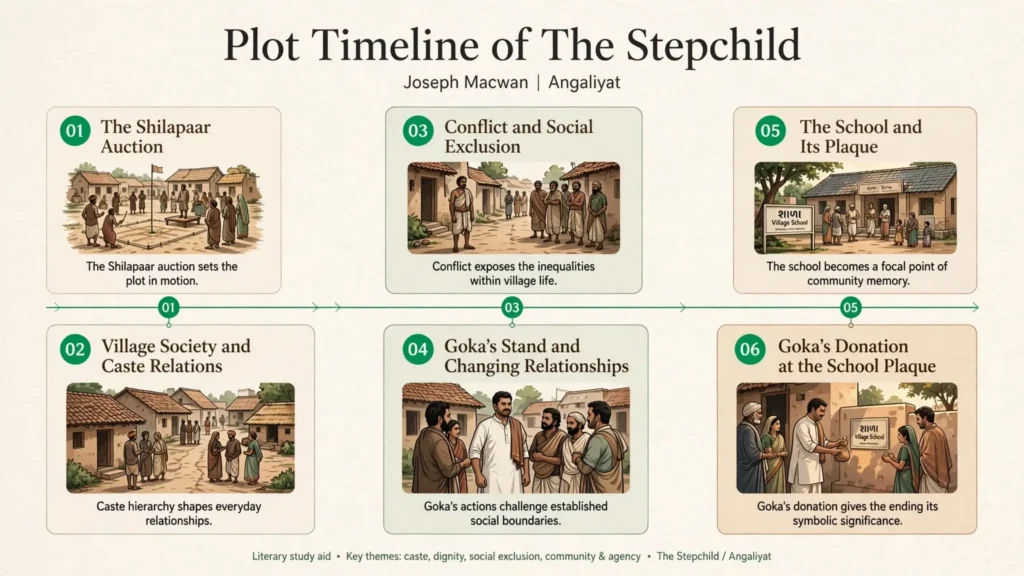
Quick plot timeline (for revision)
| Stage | What happens |
|---|---|
| 1 | Teeha and Valji, Vankar weavers of Ratnapaar, are close friends; Teeha secretly loves Methi of Shilapaar |
| 2 | At the cloth auction in Shilapaar, Nanio Patel drenches Methi; Teeha humiliates him and creates a lasting enemy |
| 3 | The Vankars hesitate to support Teeha; Dehlawala and other power-brokers exploit the dispute |
| 4 | Bhavaankaka and Master try to unite or advise the community and fail |
| 5 | Valji and then Teeha are killed; Kanku’s remarriage and Methi’s situation raise questions of “purity” and reputation |
| 6 | Goka, Teeha’s stepson, carries on his name at the school plaque; Ramlo takes Teeha’s house |
6. Character Analysis
Teeha (Teeharam, Teeho)
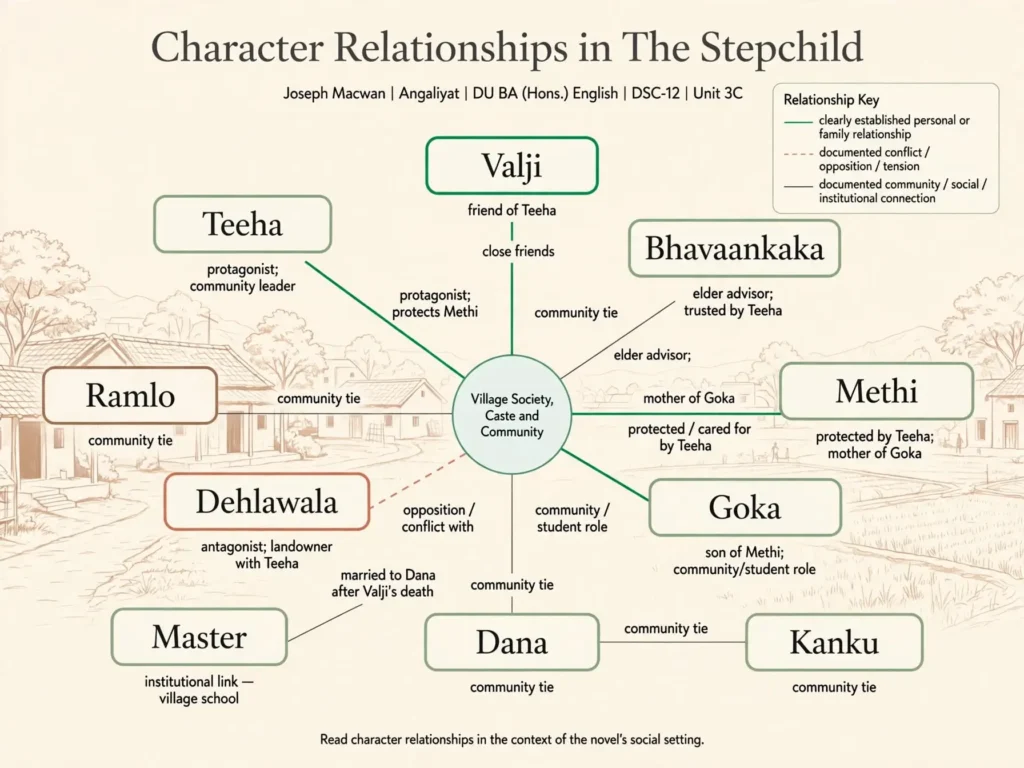
Teeha is the centre of the novel. He is the best weaver in the district, physically brave, proud and unwilling to swallow humiliation. Critics read him as one of the first “enlightened” Vankars who is prepared to confront the Patels openly (S. Bharathiraja’s article). He believes that silence is not safety: when Methi’s brother Moti says one cannot live in water and quarrel with the crocodile, Teeha answers that his people will either disappear or take the water from the crocodile, and he adds that once Independence arrives, “our days will be numbered” (as given in Gokhale’s review and in a journal article that quotes the novel at p. 23 of the OUP text). That remark shows his political realism: he suspects that the end of British rule will strengthen the local dominant castes. Bharathiraja’s paper frames the protagonists’ story as a tragedy (its title is “Caste as Tragic Flaw of Dalit Protagonists”); you can argue that the courage that makes Teeha admirable is also what brings him to his death.
Valji
Valji is Teeha’s friend, neighbour and foil. Dr. Amandeep notes that Valji has always believed that one lives where one is born, endures suffering without complaint and stays loyal to the village, whereas Teeha thinks differently. Gokhale puts it simply: Teeha is the leader and Valji is the led. Valji’s steadiness, though, is a form of courage too: in the end he, like Teeha, pays with his life and refuses to submit.
Methi
Methi, the girl whose dignity starts the conflict, is more than the occasion of a quarrel. After leaving a husband who drinks and beats her, she is saved by Teeha at a point of despair (a sensitive episode; be factual and brief in an exam answer), moves into his household without being his wife, and raises her son Goka there. The OUP description says her portrayal, together with Kanku’s, challenges the higher-caste contempt for remarriage among “backward” communities. A 2024-25 DU paper asked precisely how Methi and Kanku emerge “not just as victims” but as powerful figures.
Kanku
Kanku is Valji’s wife and, in Bharathiraja’s phrase, “the tender Kanku”. After Valji’s death she remarries Dana, mainly so that no one can slander her closeness to the family; the marriage protects both and, as Gokhale observes with some irony, leaves them free not to behave as husband and wife. Gokhale sees Kanku and Methi as almost twins, both beautiful and both pure. Keep this phrase in mind for the “purity” debate in Section 10.
Bhavaankaka and Master
Bhavaankaka is the community’s philosophical, spiritual elder. Master is an educated, reform-minded figure who wants Dalits to unite. Both try to tip the balance towards Teeha, and both fail, according to Gokhale. After Teeha’s death, Master remarks bitterly that this is the Swaraj and Ramrajya they were promised (Dr. Amandeep quotes the passage, p. 229 of the OUP text), and Bhavaankaka answers that the fault lies in the human heart: the kingdom of Rama will remain a dream until Ram lives in people’s hearts, and many more Valjis and Teehas may have to die before eyes open. Read together, the two voices give you the political and moral argument of the novel.
Ranchhod Dehlawala
Dehlawala is the clever Congressman of Teeha’s village who later becomes a Minister. He is not a crude villain; he is a political manipulator who profits from Dalit disunity. In Gokhale’s paraphrase, his strength lies precisely in the community’s lack of self-awareness, and he knows that the day Dalits recognise themselves, his side loses. He is useful in an exam answer when you want to show that the novel criticises not only “high-caste Hindus” but also the way a nationalist party can use a Dalit village.
Ramlo, Vali, Dana and Goka
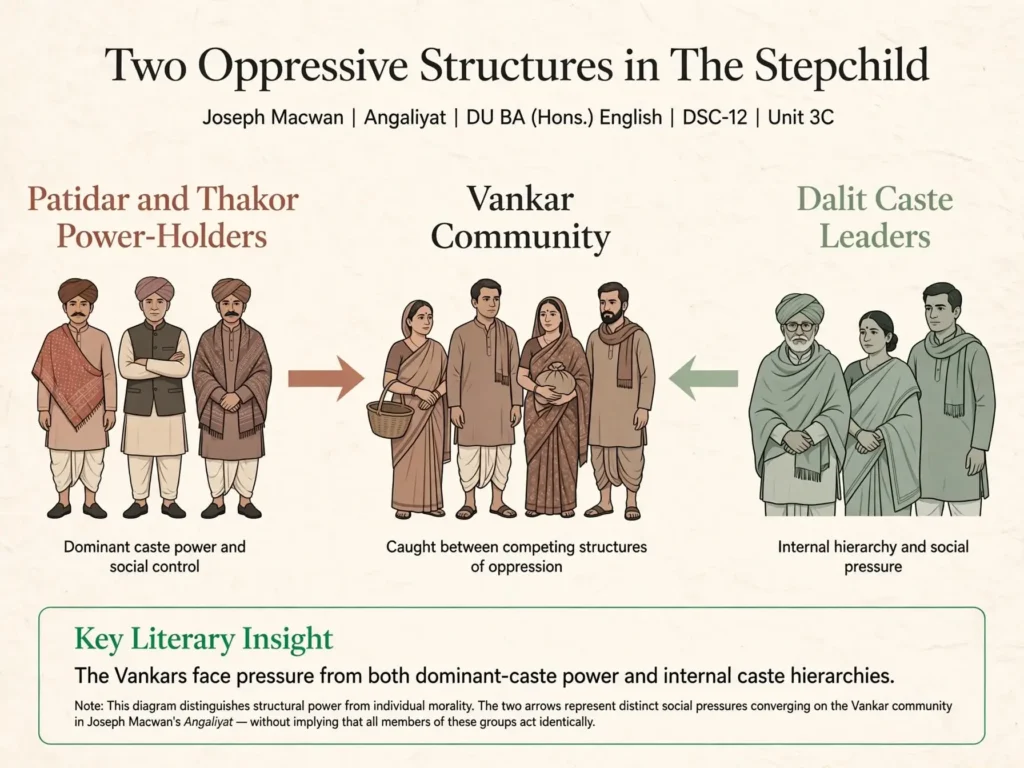
- Ramlo is the Vankar who sides with the oppressors. The OUP blurb speaks of two oppressive structures, the Patidar and Thakor power-holders and “greedy and manipulative Dalit caste leaders”; Ramlo and his like belong to the second.
- Vali is Teeha’s wife, a relative of Kanku, whose marriage to Teeha is marked by friction with Methi in the notes we consulted.
- Dana is the gentle man who marries Kanku after Valji’s death.
- Goka, Methi’s son, is the angaliyat who carries Teeha’s name forward at the end.
The Patels and Thakors
Nanio Patel, whose stone starts the conflict, and the Patel and Thakor leaders of Shilapaar represent the dominant, landowning side. Macwan shows how they control money, police and public speech, while the Thakors in turn depend on the Patels.
7. Themes
Caste oppression from two directions
The first theme is the obvious one: the Vankars are made to live under the power of the Patidar landowners. The more original point is that the novel shows a second structure, “greedy and manipulative Dalit caste leaders”, that overlaps with the first at many levels. Teeha and Methi, and Valji and Kanku, have to fight both. If you want a strong thesis, say that the book describes oppression as both external and internal.
Friendship, loyalty and sacrifice
The friendship between Teeha and Valji carries moral weight. Bharathiraja describes it as not ordinary: each, in different ways, gives up his life and joys for the other. Dalit solidarity begins here, in a friendship, long before it becomes a movement.
Dalit assertion and identity
Teeha’s refusal to bow is an act of assertion, and the novel keeps asking what kind of assertion can last. Dr. Amandeep argues that Macwan reasserts the Dalit quest for identity and dignity through the resistance of Teeha and Valji, even at the cost of their lives.
Gender, purity and remarriage
Women in this novel bear caste and gender pressure together. Methi leaves a violent marriage; Kanku remarries; both live under constant gossip about their “purity”. The publisher’s view is that by presenting them as pure women, the novel challenges the higher-caste contempt for remarriage (natru). Critics (Section 10) ask whether the novel challenges patriarchal norms or reproduces them.
Unity, disunity and political awakening
A famous passage notes that if all the Vankars in the locality stood together, the Patels would be powerless. They do not. The theme of disunity is also the theme of political awareness: Master’s failure, Dehlawala’s success.
Freedom and its limits (Swaraj)
Gokhale reads the book as a document of the pre- and post-Independence years seen from below, torn between Gandhian and Ambedkarite ideologies. Teeha’s suspicion of Independence, and Master’s bitter remark at his death, make The Stepchild a critique of how national freedom looked from a Dalit village. Compare this with the moral disillusion of post-independence India in Andha Yug if your teacher links the two.
Education and memory
The school plaque at the end is easy to miss. Goka’s donation puts Teeha’s name on the school that Dehlawala has built, and the gesture links education, money and memory: the stepchild claims a place in the village’s public record.
8. Symbols and Motifs
Macwan is not a heavily symbolic writer; his strength is dialogue and social detail. The following readings are interpretations that students and critics have offered, not statements by the author, so present them with phrases like “can be read as”.
- The finger (angali). The title image. A child holding a mother’s finger is dependent, trusting and on the edge of another man’s house.
- The pot of water. The incident that sets the plot in motion begins with a pot of water. In a caste society, access to water, and the right to carry it without being polluted or harassed, is a marker of dignity. The attack on Methi’s pot is an attack on that dignity.
- The loom and weaving. Weaving is the Vankars’ traditional occupation. Teeha’s excellence at it gives him economic independence and pride. When his sons abandon the loom and the house, they also abandon the tradition.
- The ancestral house. At the end, Ramlo’s purchase of Teeha’s house, which he admits he bought to lord it over the family, turns property into a symbol of defeat and a further humiliation.
- Swaraj / Ramrajya. Master’s remark and Bhavaankaka’s reply make “the kingdom of Rama” a symbol of an ideal that does not come when hearts do not change.
9. Style, Language and Narrative Technique
Dialect and dialogue. Rita Kothari’s introduction stresses that Macwan wrote in the spoken Charotari dialect of the region, a departure from the Sanskritised register that dominated serious Gujarati prose. Gokhale observes that dialogue, full of proverbs and sayings, reveals character with great energy; English cannot fully reproduce the dialectal registers.
Realism and “history from below”. The publisher’s description calls the novel a view of “history from below”. It documents farm and weaving life, village politics and local power in detail.
Memoir-like texture. The writer Achyut Yagnik, in his foreword quoted in a journal article, reads the novel as something like a memoir without an intrusive self, a celebration of Macwan’s land, past and community. This is a useful nuance: the book is a novel, but it carries traces of a world Macwan knew from childhood.
Four levels. Gokhale’s review offers a handy way to structure an answer: the novel is (1) a tale of love, heroism, humiliation, revenge and death; (2) a picture of two neighbouring villages in the Charotar region; (3) a document of pre- and post-Independence politics from below; and (4) the account of one Dalit community’s struggle, driven by Gandhian and Ambedkarite ideas.
The narrator. The narration follows several households, which lets the reader see the Vankar side, the Patel side and the brokers in between. If your teacher has discussed point of view, tie your points to particular chapters in your own copy; earlier notes on this page mentioned flashbacks and a third-person narrator, but we could not confirm these from scholarly sources, so we have not repeated them.
10. Critical Debates and Limitations
Good DU answers treat these as debates, with attribution.
Debate 1: Does the novel reproduce the order it critiques? Dr. Amandeep argues that in the novel the assertion of Dalit identity takes place through physical valour in men and “purity” in women, and that adopting these upper-caste categories unwittingly pushes the novel into a symbolic Brahminic order. The publisher’s description takes a different line: presenting Methi and Kanku as pure women challenges the higher-caste contempt for remarriage. Both claims can be true at once, and a 2023-24 DU question asked this very thing (see PYQs). A balanced answer names both and then judges.
Debate 2: Victory or defeat? The publisher’s note says the novel transforms the vanquished into the victor and turns the periphery into the core, yet it also says that the Vankar protagonists are ultimately defeated by the dominant castes. Bharathiraja’s reading of caste as a “tragic flaw” stresses the cost of resistance, while Dr. Amandeep sees Teeha’s death as motivating others to continue the struggle. You can argue that the novel is tragic in plot but affirmative in impact.
Debate 3: Gender. Gokhale notes that while Macwan clears an independent linguistic space for his characters, he locates the women in the psycho-emotional spaces traditionally assigned to women in mainstream novels. A reader focused on gender will ask whether Kanku and Methi are agents or ideals; the 2024-25 DU question (“victims, but also powerful figures”) invites a both/and argument.
Debate 4: “First Dalit novel”? The OUP description calls it the first Dalit novel set in rural Gujarat of the 1930s; Dr. Amandeep and others call Macwan the first Dalit novelist in Gujarati; Gokhale says “arguably the first Dalit novel to be written in any language”. These claims have different scopes, and we have not found an independent source that settles the broader claim, so attribute it.
Limitations to mention in an answer. Translation loses dialect; the plot depends on a heroic masculine ideal; and the novel’s villains are sometimes drawn broadly, though Dehlawala’s political shrewdness gives the book depth.
11. Reception and Significance
- Awards. Macwan received the Sahitya Akademi Award in Gujarati for Angaliyat. The Akademi-derived lists on Wikipedia place it in 1989, as do Dr. Amandeep’s article and Wikipedia’s biography; the OUP description says 1988. Use 1989 and be prepared to note the discrepancy if asked. He also received the Dhanji Kanji Gandhi Suvarna Chandrak in 1990.
- Dalit literature in Gujarat. Critics link the novel to the wave of Dalit writing that followed the 1981 and 1985 anti-reservation agitations, and Dr. Amandeep identifies it as a significant beginning, one that bridges the spoken and the written word.
- Translation and afterlife. When the English translation appeared, Gokhale lamented that the novel had not been translated into other Indian languages. Wikipedia’s lists of Sahitya Akademi translation prizes since then record translations of Angaliyat into Rajasthani (2008), Urdu (2016), Maithili (2017) and Dogri (2017).
- Why DU teaches it. It sits in Unit III of DSC-12 beside Amrita Pritam’s poem and Ibopishak’s poems, bringing caste and the Dalit viewpoint into a course about regional literatures in English.
12. The Stepchild with Other DSC-12 Texts
DU questions often ask for connections across texts (the 2023-24 paper, for example, asked students to discuss how caste and patriarchy are critiqued in any two short stories). Use the table to prepare, and check each point against your own readings.
| Angle | The Stepchild | Other DSC-12 texts that connect |
|---|---|---|
| Caste and class | Vankar weavers vs Patidar and Thakor power-holders; Dalit collaborators | Premchand’s “The Shroud” (poverty and exploitation) |
| Gender | Methi, Kanku, remarriage and “purity” | Ismat Chughtai’s “The Quilt” (women and sexuality); Senapati’s “Rebati” (women’s empowerment, rural life) |
| Politics after freedom | Teeha’s doubts about Independence; Master’s remark on Swaraj | Dharamvir Bharati’s Andha Yug (moral erosion after Independence, a theme asked in DU papers) |
| Violence and community | Revenge, killings and divided villages | Amrita Pritam’s “I say unto Waris Shah” (partition violence and ordinary humanity) |
13. Conclusion
The Stepchild is not the story of one woman’s marriage but the story of how a community of weavers is pushed to the edge of a village, defends itself, and finds that its own divisions are almost as dangerous as its oppressors’ power. Teeha and Valji’s friendship, Methi and Kanku’s endurance, Master’s and Bhavaankaka’s unanswered appeals, and Goka’s final act together build a case for solidarity and for memory. For the DU exam, hold on to three habits: name the characters and episodes precisely, treat the purity and valour question as a debate, and always link the word “angaliyat” to the novel’s politics.
14. Continue Reading
Keep going with DSC-12, Unit 3 and the rest of the paper:
- ‘Dali, Hussain, or Odour of Dream, Colour of Wind’ & ‘The Land of the Half-Humans’ by Thangjam Ibopishak Singh (Unit 3B): the poems that precede The Stepchild in the same unit.
- ‘I Say unto Waris Shah’ by Amrita Pritam (Unit 3A): another text on violence, community and the voice of the wronged.
- Rebati by Fakir Mohan Senapati (Unit 1C): rural life and women’s agency, useful for gender comparisons.
- Lihaaf (The Quilt) by Ismat Chughtai (Unit 1B): another text on gender and power, often paired with caste questions in exams.
- Andha Yug by Dharamvir Bharati (Unit 2A): moral disillusion after Independence, a useful comparison with Master’s remark on Swaraj.
All DSC-12 notes are collected in the Indian Writing in English Translation category.
15. University of Delhi Previous Year Questions
DU Previous Year Questions
Previous year questions on Joseph Macwan’s The Stepchild (Angaliyat) from DU DSC-12: Indian Writing in English Translation. Tap a question to view a quick-answer guide.
1 Critically assess Joseph Macwan’s depiction of caste, class, and gender in his novel The Stepchild. +
Paper reference: DU paper, Sr. No. 5214 H, Paper Code 20321024403, Indian Writing in English Translation, Semester IV.
2 Joseph Macwan’s narrative emphasis on male physical strength and female sexual purity runs the risk of pushing his novel The Stepchild into a symbolic order that it tries to critique. Do you agree? +
Paper reference: DU paper, Sr. No. 5214 H, Paper Code 20321024403, Indian Writing in English Translation, Semester IV.
3 Methi and Kanku in The Stepchild by Joseph Macwan emerge not just as victims of societal constraints, but also as powerful figures in the narrative. Explain. +
Paper reference: DU paper, Sr. No. 6125, Paper Code 2032102403, listed in the 2024–25 question-paper folder.
4 How does Joseph Macwan in his novel The Stepchild depict the resistance of the Dalits and an assertion of their identities while at the same time challenging the dominant upper-caste point of view? +
Paper reference: DU paper, Sr. No. 6125, Paper Code 2032102403, listed in the 2024–25 question-paper folder.
5 Discuss the significance of the title Angaliyat (The Stepchild). Why is the metaphor of the stepchild central to the Dalit experience? +
6 Analyse the portrayal of Methi and Kanku as ‘pure women’. How does it challenge upper-caste notions of purity and remarriage? +
7 How does Angaliyat transform the periphery into the core? Discuss with reference to Dalit aesthetics. +
8 Critically examine the themes of oppression, exclusion, and revenge in The Stepchild. +
16. FAQs
Who is the main character of The Stepchild?
Teeha, a Vankar weaver, is the central figure, and his friend Valji is almost equally important. Methi and Kanku are major characters, but the plot is not about Kanku alone, as some online notes suggest.
What does “Angaliyat” mean, and why is it the title?
It is a Gujarati kinship word for a child who follows his remarried mother, holding her finger, into her new husband’s house. The novel uses it for the Vankars, who live within the village without belonging to its centre, and for Goka, who is a stepson to Teeha.
Who are the Vankars?
A weaver community of Gujarat. Gokhale notes that the Vankars are a Scheduled Caste in Gujarat. In the novel they are Dalits living under the dominance of Patidar (Patel) and Thakor landholders.
When is the novel set?
Publishers describe it as set in rural Gujarat of the 1930s. Critics add that it also deals with politics before and after Independence, and the character of Master and Teeha’s doubts about Swaraj reflect that.
Which edition and translation does DU prescribe?
The DU syllabus lists The Stepchild, translated by Rita Kothari, Oxford University Press, New Delhi, 2004.
Is the novel autobiographical?
It is a work of fiction. Achyut Yagnik reads it as something like a memoir of Macwan’s land, past and community without an intrusive self, and Wikipedia says his writing was inspired by real-life experience. In an answer, call it a novel rooted in lived experience rather than an autobiography.
Why do critics argue about “purity” and physical strength?
Because Dalit identity in the book is asserted through male bravery and female sexual purity, which are also upper-caste ideals. Some critics see this as an unintended return to the order the novel challenges; others see it as a strategy to reclaim dignity. A DU question has asked students to take a position.
How should I answer a 20-mark question on caste, class and gender?
Use a three-part structure with one scene for each: caste (the auction at Shilapaar), class (Dehlawala’s control of money and office), gender (Methi’s and Kanku’s choices). Close by showing how the three overlap.
Did The Stepchild win an award?
Yes, the Sahitya Akademi Award in Gujarati, listed under 1989 in Akademi-based lists (the publisher’s page says 1988). Macwan also won the Dhanji Kanji Gandhi Suvarna Chandrak in 1990.
Can I rely on a summary alone for the exam?
Not for a 20-mark answer. DU questions ask about specific depictions and arguments, so you need scene-level evidence from the novel. Use this page to organise your reading and to avoid factual slips (such as the main character or the setting).
17. References and Further Reading
- DU Department of English, Semester IV syllabus, DSC-12 Indian Writing in English Translation.
- Oxford University Press, The Stepchild (OIP): Angaliyat, product page.
- Shanta Gokhale, “Saga of Struggle”, first published in The Hindu, 3 October 2003.
- Dr. Amandeep, “The Stepchild: Angaliyat by Joseph Macwan: A Dalit Novel”, The Criterion, Vol. 8, Issue II, April 2017.
- S. Bharathiraja, “Macwan’s The Stepchild: Caste as Tragic Flaw of Dalit Protagonists”, 2014.
- Rita Kothari interview, “South Asian Literature in Translation: The Stepchild”, Global Literature in Libraries Initiative.
- Joseph Macwan and List of Sahitya Akademi Award winners for Gujarati, Wikipedia (secondary sources; check before citing in an assignment).
- Vikram Singh, “A Study of Redemption in Joseph Macwan’s The Stepchild” (journal article; check its quality before citing).
- “Locating the Stepchild: The Powerful Centre and the Resisting Periphery” (quotes Achyut Yagnik’s foreword).
- Ambedkar’s Annihilation of Caste, chapters 4, 6 and 14, as suggested in the DU syllabus.
Subscribe to keep reading
You've used your free notes for now. Get Delhi Pathshala Premium for unlimited access.
Subscribe — ₹29/30 days
A remarkable novel translated beautifully by Ritu Kothari that exposes different layers of social discrimination. The consummate desire to fight back is also exhibited by the victims of the caste hierarchy. The satirical prose ought to remind the readers that all of us are socially responsible for the indignities prevalent in our social system.