
Contents
- Introduction
- Quick facts
- About Ismat Chughtai
- Context of “The Quilt”
- Historical and Cultural Background
- India in the Early 20th Century
- Literary Movements
- Lihaaf (The Quilt) by Ismat Chughtai Summary
- Setting of the Story
- Narrative Arc
- Character Analysis
- Begum Jaan
- Nawab Sahib
- Rabbu
- The Young Narrator
- Supporting Characters
- Themes and Motifs
- Loneliness and Isolation
- Gender Roles and Expectations
- Repression and Desire
- Social Hypocrisy
- Class and Caste
- Power, Consent and the Child
- Symbolism of the Quilt
- Literary Techniques
- Narrative Style
- Imagery and Symbolism
- Irony and Satire
- Language and Translation
- Critical Reception
- Initial Controversy
- Literary Critics’ Views
- Legacy and Influence
- Comparative Analysis
- With Other Works by Chughtai
- Within Indian Feminist Literature
- Contemporary Relevance
- Key Terms for Quick Revision
- How to Answer a 20-Mark Question on The Quilt
- Conclusion
- Overall Significance
- Reflective Thoughts
- Continue Reading
- University of Delhi Previous Year Questions
- FAQs
- Resources
Introduction
Lihaaf (“The Quilt”) is a short story in Urdu by Ismat Chughtai, first published in the Lahore journal Adab-i-Latif in 1942. A grown woman recalls a week from her childhood, when she was left with Begum Jaan, a neglected wife in a Nawab’s household. The child’s puzzled, frightened observations of Begum Jaan, her masseuse Rabbu, and the swaying shape under the quilt let the story speak about desire and neglect without ever naming them. It brought Chughtai an obscenity trial in Lahore, which she won.
These notes cover Unit I (B) of DSC-12: Indian Writing in English Translation, BA (Hons.) English, Semester 4, University of Delhi. According to the DU syllabus, the prescribed text is “The Quilt” in Lifting the Veil: Selected Writings of Ismat Chugtai, translated by M. Asaduddin (Penguin, 2009). Character names below follow that translation (Begum Jaan, Rabbu). Other translations spell them differently, for example Begum Jan or Rubbu, so always check the spelling in your own copy before the exam.
A note on method. The plot below was checked against the Asaduddin translation (published online with his permission) and against another English translation by Surjit Singh Dulai and Carlo Coppola (1972). Where scholars disagree, the disagreement is shown with the critic’s name. We have kept direct quotation to a minimum. In the exam, quote from the page numbers of your own Penguin copy.
Quick facts
| Point | Detail |
|---|---|
| Author | Ismat Chughtai (Urdu fiction writer, screenwriter, filmmaker) |
| Original title | Lihaaf (Urdu for “quilt”) |
| First publication | Adab-i-Latif, Lahore, 1942 (a few sources give 1941) |
| Form | Short story, first-person, retrospective narration |
| Narrator | An adult woman remembering herself as a small girl |
| Main characters | Begum Jaan, Rabbu, Nawab Sahib, the child narrator |
| Central image | The quilt whose shadow sways “like an elephant” |
| Major themes | Neglect and loneliness, desire and repression, hypocrisy, class and caste, power over a child |
| Legal history | Obscenity case in a Lahore court; Chughtai refused to apologise and was not penalised |
| DU paper | DSC-12 Indian Writing in English Translation, Unit I |
| Same unit | Premchand, “The Shroud”; Fakir Mohan Senapati, “Rebati” |
About Ismat Chughtai
Early life and education. Ismat Chughtai was born in Badayun (Budaun), Uttar Pradesh, on 21 August. The year is contested: Wikipedia and the 2018 Google Doodle (her “107th birthday”) point to 1911, while Rekhta and many publisher biographies give 1915. She died in Bombay on 24 October 1991. She was the ninth of ten children, and her father was a civil servant, so the family moved between towns such as Jodhpur, Agra and Aligarh. She had her early schooling at the Women’s College, Aligarh Muslim University. She took a BA at Isabella Thoburn College, Lucknow, in 1940, and a B.Ed at Aligarh Muslim University the next year. Some publisher biographies call her the first Muslim woman in India to earn both degrees; treat that as a marketing claim we could not verify independently.
Literary contributions. Chughtai wrote short stories, novels, plays and film scripts. She wrote about middle-class respectability, class conflict, and women’s bodies and desires, often with a realist and Marxist-leaning eye. In a 1972 interview with Mahfil, she said she wrote the way she speaks, in plain everyday language. Her major works include the novel Terhi Lakeer (The Crooked Line, 1943), the novella Ziddi (translated as The Wild One or Wild at Heart), the novel Dil ki Duniya (The Heart Breaks Free), the novel Ajeeb Aadmi (A Very Strange Man), and stories such as “Gainda”, “Chhui Mui” and “Lihaaf”. She was awarded the Padma Shri in 1976.
Role in the Progressive Writers’ Movement. Chughtai attended her first Progressive Writers’ meeting in 1936, where she met Rashid Jahan, one of the women writers of Angaarey. Jahan is often credited as an early inspiration. Chughtai’s relationship with the movement was supportive but not always warm. In her memoir Kaghazi Hai Pairahan (translated by Asaduddin as A Life in Words), she says the Progressives neither praised nor condemned her over “Lihaaf”.
Context of “The Quilt”
Publication history. “Lihaaf” appeared in Adab-i-Latif in 1942 and was soon included in a collection of her stories published by Shahid Ahmad Dehlavi. According to her own account, the criminal case was brought against that published book, not against the journal. The story is said to be inspired by the rumoured relationship between a begum and her masseuse in Aligarh (this comes from the biographical literature, not from the text itself). Chughtai also recalled that the real woman later told her the story had changed her life.
Significance in Indian literature. The story is widely regarded as a landmark for its early treatment of female sexuality and same-sex desire in Indian fiction. A caution for exam answers: “the first story ever to…” is hard to prove. Safer phrasing is “one of the earliest and most famous.” The story is also read today as a study of a neglected wife in a feudal household, and, in some critical readings, of sexual abuse of a child.
Relevance to contemporary society. The story still connects with conversations about women’s autonomy, sexual freedom and censorship, and with debates about consent and silence inside families. This is explained further in the section on contemporary relevance below.
Historical and Cultural Background
India in the Early 20th Century
Social structure and the zenana. Chughtai’s world was the late-colonial north Indian Muslim household, with its zenana (women’s quarters) and mardana (men’s space). A woman’s respectability (sharafat) was measured by her seclusion and silence. In a household like the Nawab’s, wealth could still mean confinement: Begum Jaan is surrounded by things but not allowed out, and the narrator describes her as a prisoner in her own home.
Women and education. Aligarh was also a centre of new ideas about women’s schooling. Chughtai’s own story is a reminder that reform and orthodoxy lived side by side. She went to college and then to teacher training while her family and social circle resisted.
Colonial rule. Colonial rule shaped the setting indirectly. The Nawab is a figure of a declining feudal elite, and the obscenity case that followed was heard in a colonial court, under colonial law, on a complaint pushed by respectable Indian opinion. It is better not to claim that Lihaaf is mainly an anti-colonial story. Its target is the domestic order of the zenana. The colonial context matters mostly for how the story was received and prosecuted.
Literary Movements
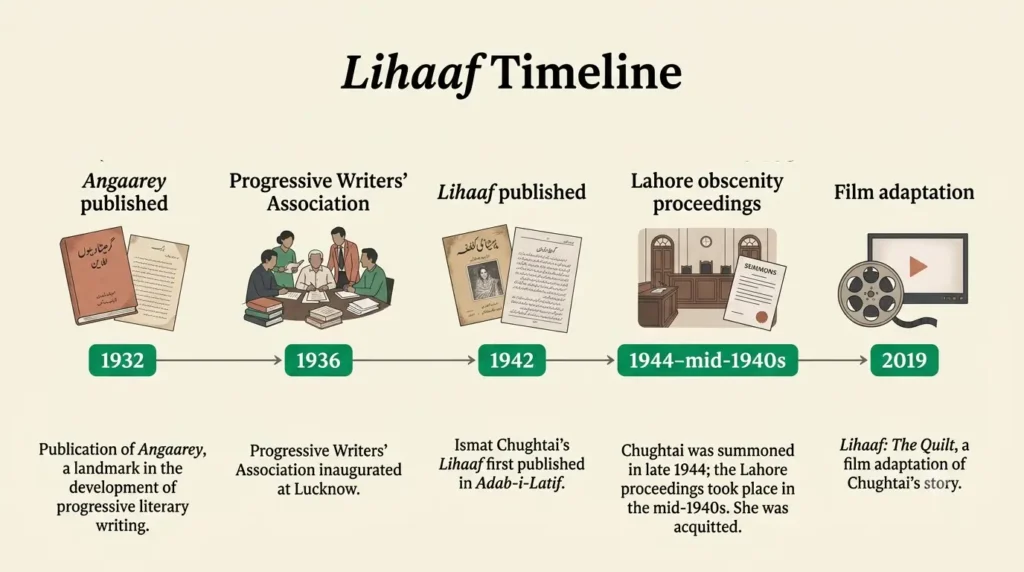
Progressive Writers’ Association (PWA). The story that made Chughtai famous grew out of this movement. The 1932 Urdu collection Angaarey, by Sajjad Zaheer, Ahmed Ali, Rashid Jahan and Mahmud-uz-Zafar, shocked conservative opinion and was banned in March 1933. Out of that controversy the All-India Progressive Writers’ Association took shape: it was conceived in London in 1934–35 and formally inaugurated at Lucknow on 9–10 April 1936, with Premchand presiding. Its aim was a literature of social realism that would question feudalism, colonialism and patriarchy. Chughtai belonged to this circle, as did Manto, her contemporary and fellow defendant in Lahore. (Manto is often misdescribed as someone she inspired. In fact he was born in 1912 and was her contemporary, and the two were tried together.)
Feminist writing in Urdu and Indian literature. Chughtai wrote after, and alongside, women such as Rashid Jahan and Hijab Imtiaz Ali. What set her apart was a candid, colloquial prose that took the everyday talk of women, sometimes called begumati zaban, seriously as literature.
Lihaaf (The Quilt) by Ismat Chughtai Summary
Setting of the Story
The story is set in the household of a Nawab, in an unnamed town. The narrator’s mother travels to Agra and leaves her small daughter for about a week with Begum Jaan, whom the narrator calls her mother’s “adopted sister”. The setting is not described as an empty palace. The key details are inward: the girl’s bed is placed beside Begum Jaan’s in her bedroom, the winter cold, the closed doors during Begum Jaan’s long massages, the maids gossiping outside, and the constant presence of the quilt. The confinement is social and emotional as much as physical.
Narrative Arc
A short summary in order of events
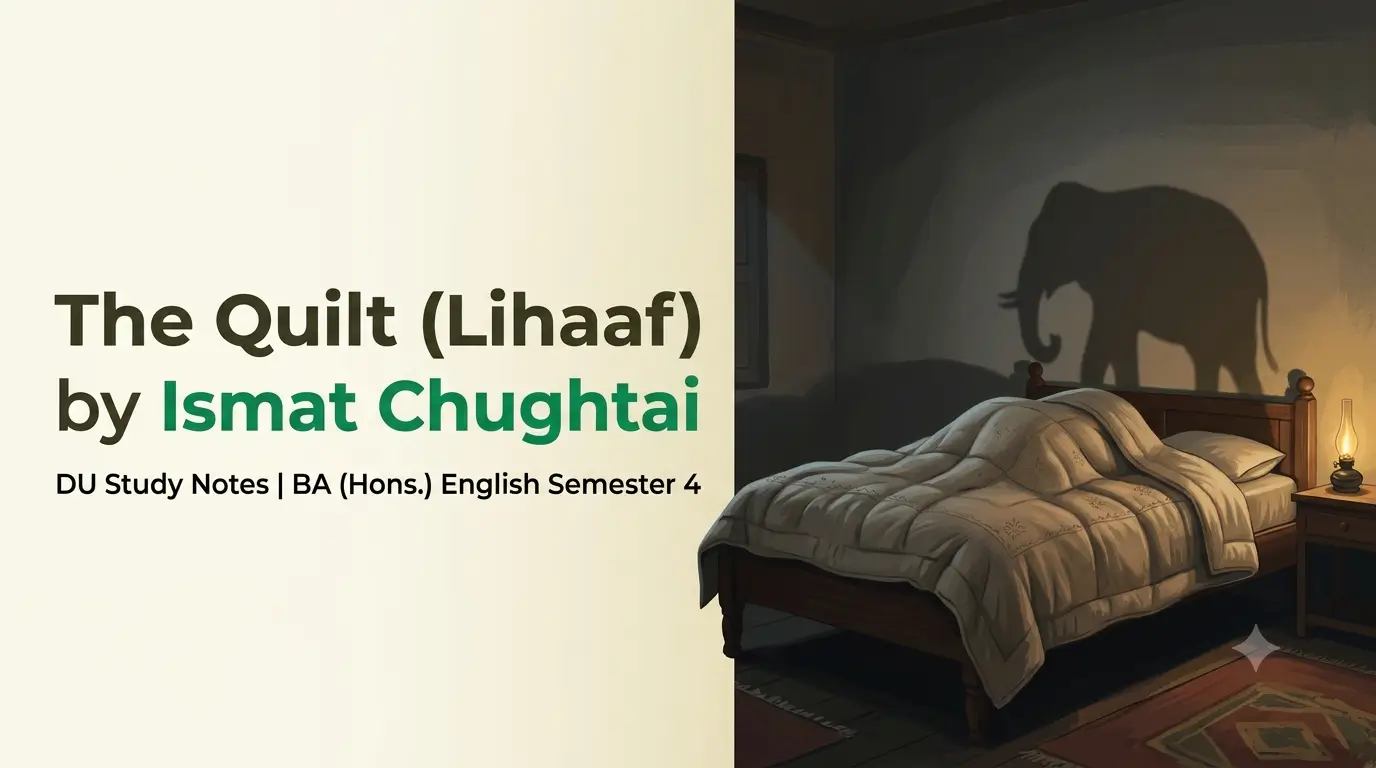
- The frame. An adult narrator says that in winter, the shadow of her quilt on the wall seems to sway like an elephant, and it sends her back to her childhood. She warns the reader that this will not be a romantic story.
- Why she was there. As a quarrelsome child, she is “punished” by being left with Begum Jaan while her mother goes to Agra, because nothing ever happens in that quiet house.
- Begum Jaan’s marriage. Her poor parents accepted the much older Nawab because he was pious and no courtesans visited his house. But his “strange hobby” was housing and funding young, slim, fair students. He neglected his wife. Begum Jaan tried amulets, prayers and books, but found no relief.
- Rabbu. The turning point in Begum Jaan’s life is Rabbu, a maidservant who massages her for hours. Begum Jaan regains her health and glow. She also suffers from a persistent itch that no doctor can explain, and Rabbu always remains near her. The other maids are jealous and gossip.
- Night one. The child wakes in the dark and sees the quilt shaking as if an elephant were inside. She is told to go back to sleep and to recite a verse from the Quran. She hears whispering and then sleeps.
- Night two. She hears Begum Jaan and Rabbu quarrel in low voices, hears Rabbu cry, and hears a sound like a cat licking a plate.
- Rabbu leaves. Rabbu goes to see her estranged son. Begum Jaan becomes restless and unwell. The child offers to rub her back.
- The scene with the child. Begum Jaan begins to make promises of gifts to the child, draws her close, counts her ribs, and holds her tightly while she struggles. The narrator describes her own fear and nausea, and later believes Begum Jaan may be dying. She runs out of the room. Many critics read this scene as sexual abuse of a child.
- Rabbu returns; fear and jealousy. The child now fears Begum Jaan and stays with the servants. After another quarrel, Begum Jaan showers affection on the child, who only repeats that she wants to go home. Rabbu’s jealous remark leads to a fit of rage in which Begum Jaan tears her ornaments and scarf.
- The final night. The quilt sways again in the dark. The child resolves to switch on the light. When she does, the “elephant” somersaults and the quilt falls flat, and its corner rises by about a foot. She gasps and dives back into bed. The story ends there. What she saw is never stated.
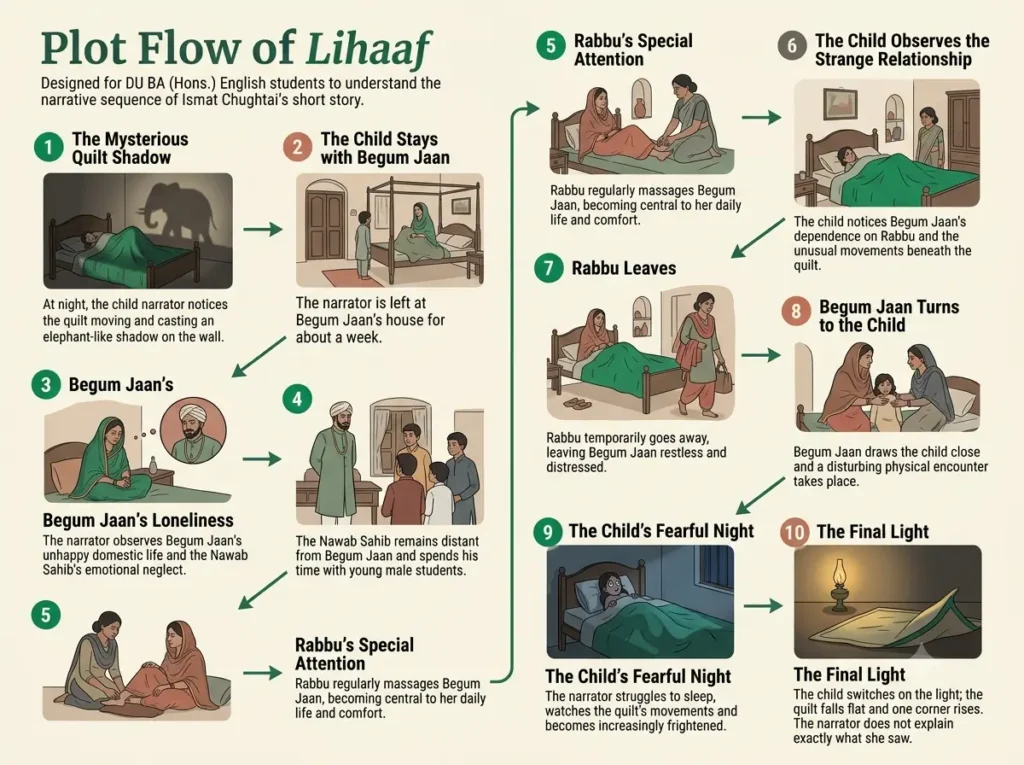
Key turning points. The key turning points are the first night (the elephant), the child’s own encounter with Begum Jaan in Rabbu’s absence, and the last night, when the light goes on. The ending is deliberately open. The narrator never explains, and the reader fills the gap.
Corrections to a common misreading. Some summaries say the narrator “sees a private moment” and “reveals” the quilt. The text does not support this. She never describes what she sees, and she does not uncover anything: the reader is left with only her shock.
| Stage | What happens | What it shows |
|---|---|---|
| Frame | Elephant shadow, memory begins | The past still haunts the narrator |
| Background | Marriage, Nawab’s hobby | Neglect and a hidden male-male world |
| Rabbu arrives | Massage, “itch” | Care, desire and class together |
| Nights 1–2 | Elephant, whispers, licking sound | Child’s limited understanding |
| Rabbu away | Begum Jaan and the narrator | Power and abuse; fear |
| Quarrel | Fit of rage, torn ornaments | Jealousy; desire without legitimacy |
| Last night | Light on; the quilt falls; corner rises | Truth glimpsed and left unsaid |
Character Analysis
Begum Jaan
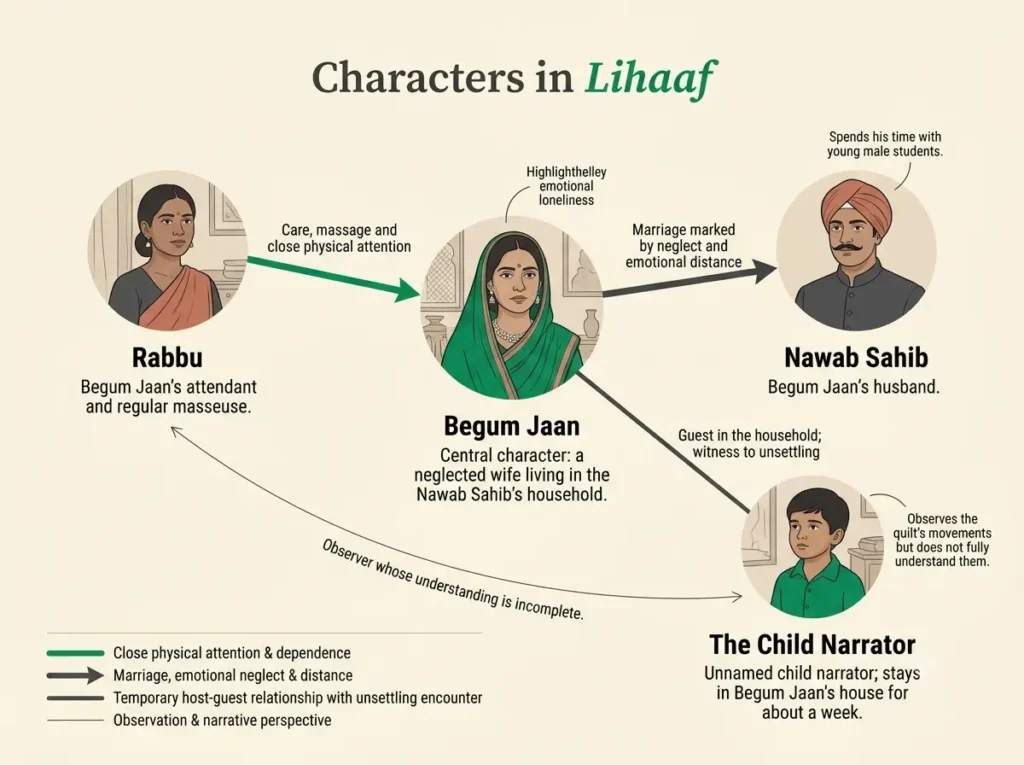
Background and social standing. Begum Jaan is a high-status woman married as a young woman to a much older Nawab. The narrator first sees her at about forty, a handsome and commanding figure on her couch, like a queen receiving courtiers. Her husband gave her a home, wealth and a title, but no companionship.
Emotional struggles. The story’s opening account of her life shows an active attempt to hold on to her husband, through amulets, charms and religious readings, followed by despair. She then reads novels and poetry, which only make her more depressed. The narrator’s description is full of images of waste and starvation. She is not a passive victim. She “lived” in the end, the story says, because she found Rabbu.
Quest for companionship. Her relationship with Rabbu answers a need for touch and attention. The story is careful here. It shows tenderness and appetite, but through the child’s eyes. It also shows Begum Jaan as capable of harming a child when she is deprived and alone. A fair answer must hold both sides: she is a victim of neglect and an adult who abuses her power over a child.
Nawab Sahib
His absence and indifference. The Nawab is respected as a pilgrim (a haji) and a man of virtue. No “nautch girls” or prostitutes visit his house. He rarely appears in person; he is present as a pattern of neglect.
Secret life and priorities. His hobby is to keep young male students at his own expense. The story implies his interest in young men but does not state it as fact, and the text leaves it as suggestion. This is the story’s irony: the man whose public virtue is that no women enter his house is the one who leaves his wife starving for touch. (Note: older summaries that say “likely infidelity” or “distractions” are too vague. The text is specific about the students.)
Rabbu
Role as a servant and confidante. Rabbu is a household servant whose only duty seems to be massaging Begum Jaan. The narrator describes her as dark, pock-marked, stocky and strongly scented, and calls her names. She is not only a “friend”: she is a dependent, and the relationship is shaped by class. A caste reading (see below) adds that the child’s contempt is voiced through a caste slur that the English translation softens.
Her influence on Begum Jaan. Rabbu restores Begum Jaan’s body and spirits, keeps others away, and is jealous of the child. She is shown with her own life: a son she cannot reach, and a quarrelsome relationship with Begum Jaan. She is a servant who also controls the situation. Spelling note: it is Rabbu, not “Rabbo” (as an earlier version of these notes wrongly had it).
The Young Narrator
Perspective and innocence. The narrator is a small girl, in the story’s present, but she is also the adult who tells the story. Her curiosity and fear drive the plot. She is attracted to Begum Jaan’s beauty and fond of her at first; she is repelled by Rabbu and by the massages; she is terrified by the elephant; and she is hurt, confused and ashamed after the scene in Rabbu’s absence.
Observations and interpretations. She misreads what she sees (“Rabbu must be eating”), which creates both humour and dread. The adult narrator, however, knows more than the child did. The gap between the two voices is where the story’s irony, and some of its pain, live.
Supporting Characters
The maids, who are jealous of Rabbu and spread gossip, show how the household watches and judges. The narrator’s mother (Amma), who believes in strict segregation of women, is part of the story’s picture of control. The male students, seen only through the dining-room screen, are the unseen reason for Begum Jaan’s loneliness. Rabbu’s irascible son, whom Begum Jaan helped, shows how Rabbu’s ties to the household are complicated.
| Character | Position | What the story uses them for |
|---|---|---|
| Begum Jaan | Wife of a Nawab | Neglect, desire, and the abuse of power |
| Nawab Sahib | Respected husband | Hypocrisy; male indifference |
| Rabbu | Maidservant/masseuse | Care, class and caste; the household’s inside |
| Narrator | Child (and adult remembering) | Limited knowledge, fear, silence |
| Maids | Other servants | Gossip as social surveillance |
Themes and Motifs
Loneliness and Isolation
Emotional neglect in marriage. Begum Jaan is married to a man who gives her a house and a title but no attention. The story’s long opening account of her life presents this as a kind of slow starvation, and the narrator’s comment that her existence was centred on herself and her itch (the translation’s own words) sums up a woman shut inside her body.
Search for emotional fulfilment. Her turn to Rabbu answers a basic need for touch and company. The story neither celebrates this nor condemns it; it shows what neglect does.
Gender Roles and Expectations
Traditional expectations of women. A wife in a respectable household is expected to be patient, modest and silent. The narrator’s own mother wants to keep girls “secluded” and warns against playing with boys, yet it is in the women’s quarters that the narrator is harmed.
Subversion of gender norms. Begum Jaan’s bond with Rabbu steps outside the roles prescribed for women. Chughtai makes that visible while keeping the language “innocent”.
Repression and Desire
Suppression of personal desires. Begum Jaan’s desires are denied by her husband and by social rules. The itch is read by many critics as a bodily symptom of that repression.
Consequences of repression. Suppressed desire does not disappear. It becomes illness, jealousy, fits of rage and, in the scene with the child, a harmful act. This is why a one-sided “liberation” reading is incomplete.
Social Hypocrisy
Facade of respectability. The Nawab is respected because no courtesans enter his house. The story shows how this outward virtue hides his neglect of his wife and his own pursuits.
Double standards. The gossip about Begum Jaan and Rabbu is mocking and moral, while the Nawab’s own preferences are tolerated. The same double standard appeared in the real world: in the trial, the prosecution could not point to an obscene word, and the final complaint, as scholars report it, was that an educated woman from a respectable family should not write such things.
Class and Caste
Why this theme matters. Rabbu is a servant, and the story’s power structure is not only about gender. In a 2024 Queerbeat essay, Dhiren Borisa and Akhil Katyal argue that the story is about caste respectability, and that English translations quietly remove caste slurs from the Urdu text. They give two examples: a remark about red cloth like that of chamars, and the narrator’s name-calling of Rabbu with the word bhangan, which Asaduddin renders as “Ugly woman!”. For DU students using the Asaduddin edition, this is a useful critical point: it shows how translation choices change a reading. It is one critic’s argument, not settled consensus.
Power, Consent and the Child
The scene students must not skip. In Rabbu’s absence, Begum Jaan holds the child, counts her ribs, and pulls her close while she struggles. The narrator’s fear and nausea are explicit. Earlier celebrations of the story as a “lesbian” text often passed over this scene. Later readings, including a narratological study in South Asian History and Culture (vol. 14, no. 4), argue that feminist and queer-positive readings can underplay the molestation of the child and the tension between the adult and child narrating voices. We discuss these debates under Critical Reception.
Symbolism of the Quilt
Layers and hidden truths. The quilt (lihaaf) is both a physical cover and a screen. It hides what happens in the bed, and its changing shapes (an elephant, a huge frog) stand in for what cannot be said. The story’s last image is the quilt’s corner rising and falling flat: truth glimpsed, then covered again.
Metaphor for concealed emotions. The quilt also stands for the covering of desire, the “respectable” surface of the household, and the child’s fear. Note that the quilt does not “reveal” anything in the story: it hints. That restraint is the source of its power.
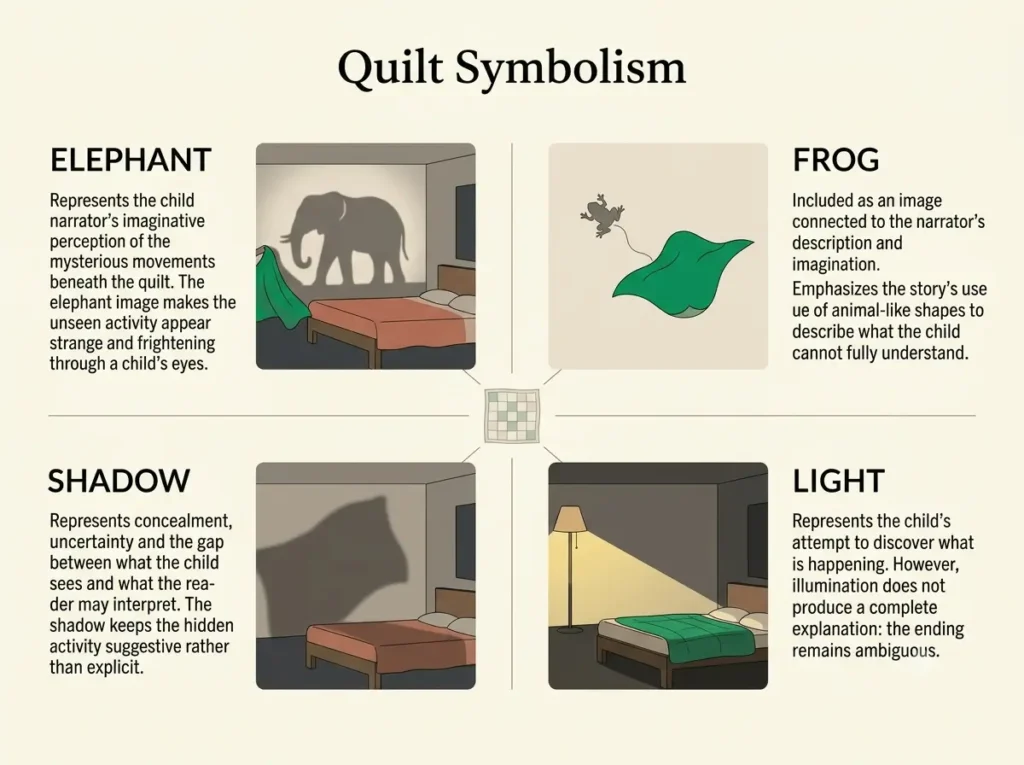
| Quilt image | Possible meaning |
|---|---|
| Elephant swaying | The unseen presence; something large that cannot be named |
| Frog about to leap | The child’s fear; the unknown as threat |
| Shadow on the wall | What society sees (a shape) versus what happens |
| Light switched on | Knowledge; the end of innocence |
| Quilt “looks innocent” in the morning | Respectable appearance in daylight |
Literary Techniques
Narrative Style
First-person, retrospective narration. The story is told by an adult recalling a childhood week. This is not simply a child’s voice: the adult frames the story at the start and speaks across the years. The child’s limited understanding creates suspense and lets the reader see more than the child can. The adult’s presence, with its occasional jokes and warnings, also adds a second layer.
The child’s perspective. A child narrator allowed Chughtai to write about sexuality while keeping the language “innocent”. In her own memoir’s account of the trial, the prosecution’s witnesses struggled to identify any obscene word. A critic can note the opposite side as well: because the child cannot explain, the story also leaves the abuse she experiences without an adult’s moral clarity. (This is exactly the question DU papers have asked; see the PYQ section.)
Imagery and Symbolism
Descriptive language. Sensory detail dominates: oil, attar, sandalwood, henna, the sound of a cat licking a plate, the swaying quilt, a long description of Begum Jaan’s body. The sensory language does the work that explicit statement would otherwise do.
Symbolic elements. The quilt is the major symbol, supported by the itch (suppressed desire), the massage (care and appetite), the light switch (knowledge) and the elephant (the unnamed).
Irony and Satire
Critique of social norms. The irony is that the “virtuous” Nawab is the cause of the household’s disorder, and that the respectable gossip of the maids is crueller than anything Begum Jaan does. The narrator’s misreading (Rabbu must be enjoying a meal) is comic and chilling at once.
Subtle humour and wit. Chughtai’s humour is part of her style. She jokes about the narrator’s quarrelsome nature and her own “punishment” at the start. The humour makes the later dread sharper. One reviewer who re-read the story before teaching it called it dark and funny; that mix is part of how it works.
Language and Translation
Urdu expressions and begumati zaban. The original is written in the colloquial Urdu of women’s speech. Chughtai said she wrote as she spoke. Idiom, proverb and abuse carry social meaning that is hard to carry over.
Challenges of translation. The English Lihaaf you read is a translation, and translations differ. The table below shows the main ones.
| Translation | Translator(s) | Where | Note |
|---|---|---|---|
| “The Quilt (Lihaf)” | Surjit Singh Dulai and Carlo Coppola | Mahfil 8, 2–3 (1972) | Early English version; spells “Begam Jan”, “Rubbu” |
| The Quilt and Other Stories | Tahira Naqvi and Syeda S. Hameed | Kali for Women, 1990 | Widely used; character spellings not checked here |
| “The Quilt” | M. Asaduddin | Lifting the Veil (Penguin, 2009); other Penguin collections | DU-prescribed; spells “Begum Jaan” |
Borisa and Katyal argue that all English translations soften caste language in the Urdu. If you cite this in an exam, attribute it to them.
Critical Reception
Initial Controversy
Accusations of obscenity. “Lihaaf” drew angry letters and articles. Chughtai was pressed to apologise and refused. Her own memoir describes an atmosphere of abusive mail and public pressure.
Legal battle and outcome. According to her memoir (excerpted in Asaduddin’s translation), the summons reached her in Bombay in December 1944, under the title “Ismat Chughtai vs The Crown”, and she travelled to Lahore. Manto was tried at the same time for his story “Bu”. The sources differ on dates: Wikipedia places the trial in 1945, while other sources say 1944, and her memoir mentions a first hearing in January (presumably 1945) and a second in November 1946. Our safe statement for the exam is: summoned in late 1944; heard at Lahore in the mid-1940s; acquitted. The prosecution’s witnesses could not point to a clearly obscene word, and her lawyer argued that the story was suggestive and told from a child’s point of view. The Lahore judge, she recalled, told her privately that the story was not obscene. Later she wrote that the story became a “stick” with which she was beaten, so that it overshadowed her other work.
| Date (as sources give it) | Event |
|---|---|
| 1932 | Angaarey published; banned in March 1933 |
| 1936 | Progressive Writers’ Association inaugurated at Lucknow |
| 1942 | “Lihaaf” published in Adab-i-Latif |
| Dec 1944 | Summons issued (per Chughtai’s memoir) |
| 1945–46 | Hearings in Lahore; case ends without penalty |
| 1990–91 | English translations bring her to wider audiences |
Literary Critics’ Views
Praise for boldness and honesty. Priyamvada Gopal has described the story as among the most suggestive and sensual representations of homoeroticism in modern Indian fiction. Gayatri Gopinath also reads it within a framework of queer desire in South Asia. Many critics have praised the economy of the story.
Contemporary scholarship: a debate. Modern criticism does not agree on how to read Lihaaf. A fair DU answer should show the debate with names, not state one view as fact.
| Reading | Main claim | Attribution (as far as we have verified) |
|---|---|---|
| Feminist / queer-affirming | A neglected woman finds companionship; the story is a landmark of homoerotic representation | Priyamvada Gopal; Gayatri Gopinath (via secondary summaries) |
| Child-centred / abuse-attentive | Celebratory readings can overlook the molestation scene and the tension between adult and child narrators | A narratological study in South Asian History and Culture, vol. 14, no. 4 (author not verified here) |
| Caste-sensitive | The story is built on caste respectability; translations erase caste slurs | Dhiren Borisa and Akhil Katyal, Queerbeat, 2024 |
| Authorial self-view | Chughtai felt the story’s notoriety overshadowed her wider work | Chughtai’s memoir Kaghazi Hai Pairahan, in Asaduddin’s translation |
None of these readings cancels the others. A strong answer uses two or three, and ties each to the text.
Legacy and Influence
Impact. The story is widely anthologised and taught. Chughtai’s memoir recalls that a critic once advised her to make the heroine of her later novel a lesbian, like the one in “Lihaaf”. She was furious. This shows how the story’s fame shaped expectations of her.
Adaptations. Deepa Mehta’s film Fire (1996) is described as loosely based on it. Dedh Ishqiya (2014) is loosely based on it and refers to it. Lihaaf: The Quilt (2019), directed by Rahat Kazmi, is based on the story and also depicts her trial. These are adaptations, not the text; do not use them as evidence of what the story says.
Role in feminist literature. The story is a reference point in South Asian women’s writing and in queer readings, though, as the debates above show, its status has been reassessed over time.
Comparative Analysis
With Other Works by Chughtai
Themes of rebellion and identity. Women who step outside the rules of their households are central in Chughtai’s fiction. Terhi Lakeer (The Crooked Line) follows a girl’s education and growing independence. Ziddi (The Wild One) tells of a servant girl and her employer’s son. Dil ki Duniya (The Heart Breaks Free) looks at women in a conservative Muslim household. “Gainda” is a story of a lower-caste woman and an upper-caste man. Ajeeb Aadmi (A Very Strange Man) is about a film star’s affair.
Stylistic similarities and differences. Plain, spoken-sounding prose and a sharp eye on domestic life run through all of these. What is special about “Lihaaf” is its short, compressed, open-ended form and its use of suggestion.
Correction. An earlier version of these notes listed Toba Tek Singh as a story by Chughtai. It is by Saadat Hasan Manto, a partition story. It belongs in a comparison with Manto, not in a list of her works. Chughtai and Manto were friends and fellow defendants at Lahore, and Manto’s “Bu” was prosecuted in the same period.
Within Indian Feminist Literature
Comparison with Mahasweta Devi and Kamala Das. Kamala Das’s memoir My Story speaks frankly about a woman’s desire, but in a first-person confessional mode, while Chughtai works through fiction and a child’s eyes. Mahasweta Devi’s “Draupadi” and “The Breast-Giver” look at tribal and marginalised women’s bodies in a political and economic frame. Chughtai’s focus is a respectable household, but, as the caste reading suggests, class and caste are not absent.
Within Unit I of DSC-12. Comparing the three prescribed stories is a common exam strategy.
| Story | Author | Setting | Main concern | Technique |
|---|---|---|---|---|
| “The Shroud” | Premchand | Rural poverty | Poverty and moral numbness | Realist, ironic |
| “The Quilt” | Ismat Chughtai | Zenana household | Gender, desire, power, respectability | Child narrator, suggestion |
| “Rebati” | Fakir Mohan Senapati | Rural Odisha | Women’s agency and education; rural life | Satirical, social realism |
Evolution of feminist thought. Early reform-minded writing focused on education and marriage, while writing like Chughtai’s put women’s bodies and desires at the centre. Later writers brought in caste, class and intersectionality, which is why the caste reading of Lihaaf belongs to a more recent critical moment. (An earlier version of these notes grouped Shashi Tharoor here; he is not usually discussed as a feminist writer, so the reference has been dropped.)
Contemporary Relevance
The questions the story raises remain current: who gets to speak about women’s desire, what counts as obscenity, and how families keep silent about harm. The story’s own history, a woman writer tried for a short story, makes it part of the history of free expression in South Asia. At the same time, current readers are more alert to the child’s experience in the story than earlier readers were, which is a good example of how interpretation changes with time.
Key Terms for Quick Revision
| Term | Meaning in the context of the story |
|---|---|
| Lihaaf | Urdu for quilt; the central symbol |
| Zenana | Women’s quarters of a household |
| Sharafat | Respectability, especially of “decent” families |
| Begumati zaban | Women’s colloquial Urdu, which Chughtai used |
| Frame narrative | The adult’s opening that sets up the memory |
| Retrospective narration | Telling from a later point in life |
| Child narrator | A narrator whose limited knowledge shapes what the reader learns |
| Open ending | The story stops without explaining what the child saw |
| Obscenity trial | The Lahore proceedings against Chughtai |
How to Answer a 20-Mark Question on The Quilt
- Open with the story, author, year and place of publication, and the one idea your answer argues.
- Build two or three paragraphs, each tied to a moment in the text: the first night, the scene in Rabbu’s absence, the final light.
- Use a critic with attribution (Gopal, Borisa and Katyal, and so on), and say “one critic argues”, not “everyone agrees”.
- Close by returning to the question. For example, if the question is about the child narrator, end by saying what the child’s limits let the story do and what they conceal.
Conclusion
Overall Significance
Lihaaf is short, but it carries a lot. It shows how a respectable household can starve a woman of attention, how she seeks care, and how neglect can turn into harm. It also shows, in Chughtai’s handling, how a child’s voice can say what an adult voice cannot. Its trial is part of its history, and its later readings, feminist, queer, child-centred and caste-sensitive, show that it is still being read in new ways.
Reflective Thoughts
Reading the story today, one is struck by how much it refuses to state. The child cannot name what she sees, the adult narrator will not name it for her, and the reader supplies the rest. This silence can be read as a protection, a limit, or both. It asks us to think about who is allowed to speak in a household, and about what silence protects. The best exam answers keep that question open instead of closing it too quickly.
Continue Reading
- The Shroud by Premchand: Summary, Analysis, PYQs & FAQs: the first story of the same unit, and a useful comparison on poverty and morality.
- Rebati by Fakir Mohan Senapati: Summary: the third story of Unit I, which also deals with women and social expectations.
- The Stepchild by Joseph Macwan: Summary, Characters, Themes and DU Notes: a later text in the same paper, useful for caste and gender questions.
- I Say unto Waris Shah by Amrita Pritam: Summary: a woman writer’s voice in the same DSC-12 paper.
- Indian Writing in English Translation: all DSC-12 notes
University of Delhi Previous Year Questions
DU Previous Year Questions
Frequently asked questions from DU exam papers on Ismat Chughtai’s “Lihaaf” (“The Quilt”), prescribed in Unit I (B) of DSC-12: Indian Writing in English Translation (UPC 2032102403). Tap a question to view a quick-answer guide.
1 Discuss the significance of the title of the short story “The Quilt” by Ismat Chughtai. +
Explain the symbolic significance of the quilt (Lihaaf) as the central image of the story. Discuss how it conceals Begum Jaan and Rabbu’s intimate relationship while simultaneously revealing what society refuses to acknowledge. Examine the moving shadow beneath the quilt, the contrast between outward respectability and hidden desire, and the child’s inability to fully understand what she witnesses. Conclude by showing how the quilt becomes a symbol of secrecy, repression, female desire and social hypocrisy. Short Note
2 Do you agree with the statement that “The Quilt” by Ismat Chughtai is a story about homoerotic sympathies among women? Give arguments in support of your viewpoint. +
Develop a critical argument about female homoerotic desire and intimacy through the relationship between Begum Jaan and Rabbu. Discuss the Nawab’s neglect of his wife, Begum Jaan’s emotional and physical isolation, Rabbu’s role in fulfilling her needs, and the suggestive imagery of the quilt. Consider how Chughtai exposes the restrictions imposed on women’s sexuality within a patriarchal household. Support your viewpoint with textual references rather than merely narrating the plot. Long Answer
3 How does Ismat Chughtai explore the world of sexuality through the narrative of a child in “The Quilt”? +
Paper session: 2023–2024 folder (session not independently confirmed).
Analyse how the child narrator’s limited understanding allows Chughtai to address adult sexuality indirectly. Discuss the child’s observations of Begum Jaan, Rabbu’s massages, the mysterious movements beneath the quilt and the events of the first and last nights. Explain the contrast between what the child sees and what she can comprehend. Also examine how innocence, irony, ambiguity and suggestion enable the author to expose the hidden sexual realities of a patriarchal household. Long Answer
4 Critically comment on the deployment of a child narrator in Ismat Chugtai’s “The Quilt”. +
Critically examine the literary purpose and limitations of the child narrator. Discuss the contrast between childhood innocence and adult realities, the narrator’s inability to interpret Begum Jaan and Rabbu’s relationship, and the irony created by the gap between observation and understanding. Consider the adult framing voice, the narrator’s experiences during the trial and the disturbing final encounter. Explain how this narrative technique makes the story powerful while leaving important aspects of sexuality and abuse implicit. Long Answer
5 Using any two texts from the course, examine the themes of patriarchy, feminism, and desire. +
This is an open comparative question in which “The Quilt” can be selected as one of the two prescribed texts. Discuss Begum Jaan’s position within a patriarchal marriage, the Nawab’s neglect, the relationship between Begum Jaan and Rabbu, and the expression of female desire. Examine how Chughtai challenges conventional expectations of women’s sexuality and exposes the limitations imposed by patriarchal social structures. Support the discussion with a second text from the course. Long Answer
6 Themes of social divide in the form of caste and class politics are pivotal in many texts in this paper. Discuss the work of at least two such authors. +
This is an open comparative question, not a question exclusively about “The Quilt”. If selecting Chughtai’s story, examine the class hierarchy and gendered power relations within the Nawab’s household. Discuss the contrast between Begum Jaan’s privileged social position and Rabbu’s dependent status as a domestic attendant. Analyse how class, gender and unequal power shape their relationship. A second suitable course text and author must also be discussed to address the question fully. Long Answer
FAQs
What does “Lihaaf” mean?
Lihaaf is the Urdu word for a quilt or padded winter cover. In Hindi it is also written लिहाफ़ and is close to रज़ाई. The English title of the story is “The Quilt”.
Which translation of “The Quilt” does DU prescribe?
The DU DSC-12 syllabus lists “The Quilt” in Lifting the Veil: Selected Writings of Ismat Chugtai, translated by M. Asaduddin (Penguin, 2009). If a search shows a book titled The Quilt and Other Stories, that is a different collection, with a different translation.
Is it Rabbu or Rabbo, Begum Jan or Begum Jaan?
The Asaduddin text uses Begum Jaan and Rabbu. Other versions use Begum Jan, Begam Jan, and Rubbu. Use the spelling in your own prescribed copy.
Who is the narrator, and how old is she?
The narrator is an unnamed adult woman remembering a week of her childhood. In the memory she is a small girl. The text we checked does not give an exact age (some publisher blurbs say nine; we could not confirm that from the story).
What happens at the end of “The Quilt”?
On the last night, the narrator switches on a light while the quilt sways. The quilt falls flat and its corner rises about a foot. She gasps and dives back into bed. The story ends there and never says what she saw.
Is “The Quilt” a lesbian story?
Many readers see it as a story of same-sex desire, and it is widely read that way. Others stress the abuse of the child, and others the caste and class structure. The text never names the relationship. A good exam answer presents the debate and says which reading you find best supported.
Was the Nawab homosexual?
The story says he keeps young male students at his own expense and neglects his wife, and its tone suggests an erotic interest in them. It does not state this plainly, so say “the story suggests”, not “the story states”.
Why did Ismat Chughtai use a child narrator?
It allowed her to describe a charged situation in a seemingly innocent voice, which helped when the story was tried for obscenity. It also produces suspense and irony, because the reader understands more than the child. Critics also point out that it makes the abuse in the story harder to name. This is a frequent DU question.
Was “Lihaaf” banned?
It was tried for obscenity and she was not penalised. Some sources say her work was banned in parts of South Asia, but we could not verify a formal ban of this story, so we do not claim one.
Is “The Quilt” in the book Lifting the Veil?
Yes, according to the DU syllabus, which prescribes it from Lifting the Veil in Asaduddin’s translation. Students sometimes search for “Lifting the Veil summary” when they mean this story.
What films are based on “Lihaaf”?
Lihaaf: The Quilt (2019, directed by Rahat Kazmi) is based on the story. Fire (1996, Deepa Mehta) and Dedh Ishqiya (2014) are described as loosely based on it. The films add and change things, so do not use them in place of the text.
How should I revise “The Quilt” quickly?
Learn the ten-step event list, the quilt table, the four readings table, and one quotation from your own copy for each of the three nights. Then practise the two actual PYQs above.
Resources
- DU Semester 4 English syllabus – Prescribed text and translation
- Asaduddin’s translation of “The Quilt” (The Beacon, published with his permission) – Read the story text
- Chughtai’s account of the Lahore trial (The Beacon, memoir excerpt, trans. Asaduddin) – Primary account of the trial
- “Caste under the quilt” (Queerbeat) – The caste-reading debate
- “No one heard me!”: sexual self-fashioning and the child in “Lihāf” (South Asian History and Culture)Open University, Progressive Writers’ Association – Child-centred critique
Subscribe to keep reading
You've used your free notes for now. Get Delhi Pathshala Premium for unlimited access.
Subscribe — ₹29/30 days
Rabbo❌Rabbu✅
Dear Usha,
Thank you so much for pointing out the mistake in our notes on *Lihaaf*.
You’re absolutely right — it’s Rabbu, not Rabbo. This one slipped past us, and we’re really grateful to you for catching it.
We’ve corrected it right away. Really means a lot that you took the time to write to us.
Keep your feedback coming — and thank you for being so kind and careful.
Warmly,
Team Delhi Pathshala