
Contents
- Introduction to the Gilded Age
- What Was the Gilded Age?
- Why the Period Matters
- Defining Features of the Gilded Age Economy
- Big Business and Industrialisation
- Growth of Major Industries
- Key Figures
- Technology’s Role
- Competition and Consolidation
- Competitive Tactics
- Vertical and Horizontal Integration
- Trusts and Monopolies
- Consequences for Businesses and Consumers
- Monopolism and Regulation
- Effects of Monopolistic Practice
- Antitrust Legislation
- Regulatory Agencies
- The Populist Challenge: Agrarian Crisis and Discontent
- Roots of Agrarian Crisis
- Farmer Organisation
- The Omaha Platform (1892)
- Key Figures
- Legacy
- The Politics of Progressivism
- Origins and Principles
- Social, Political and Economic Goals
- Theodore Roosevelt vs Woodrow Wilson: Comparing Progressive Reforms
- Legacy of Progressivism
- Key Takeaways
- Previous Year Questions (PYQs) — DSC-3 The Gilded Age
- FAQs
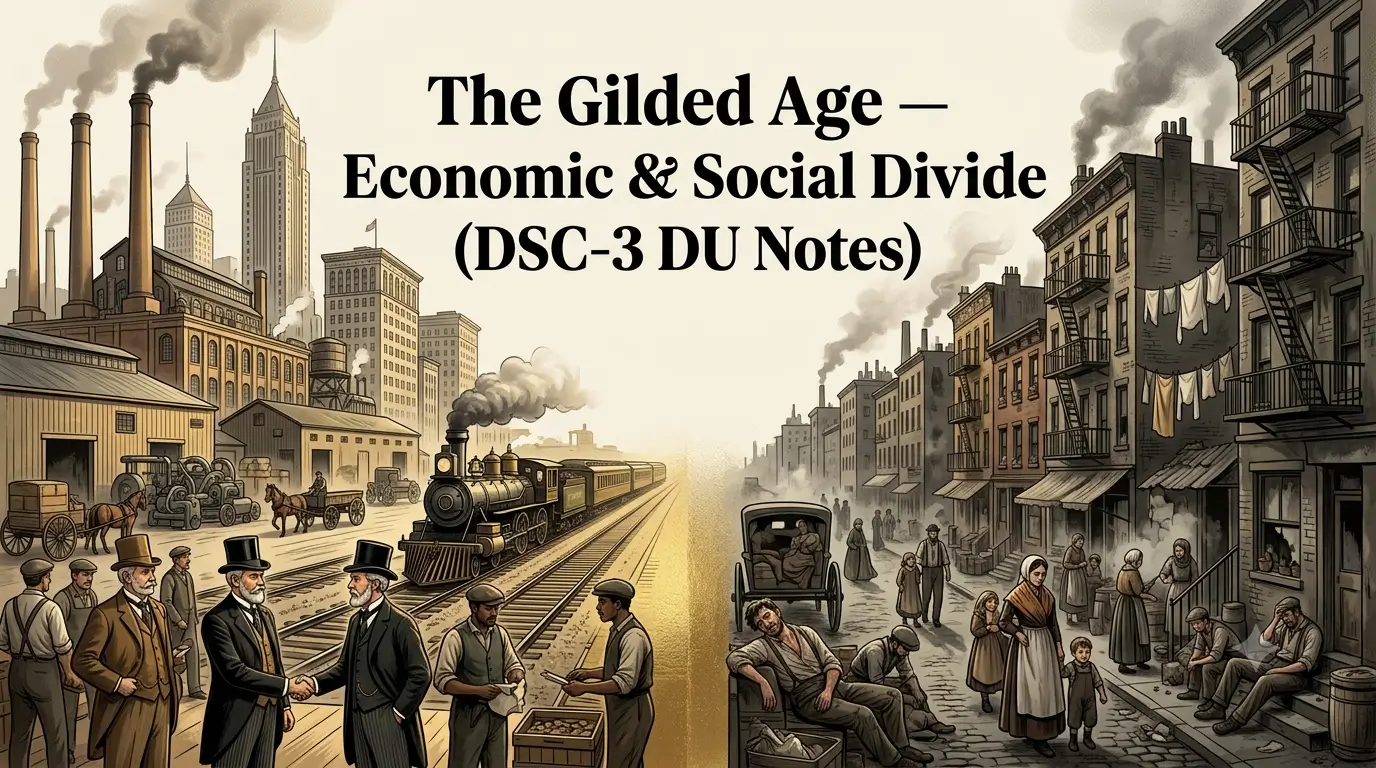
This post covers complete notes on Unit 2: The Gilded Age — Economic, Social Divide, and Reform, part of DSC-3: History of the USA — Reconstruction to New Age Politics, B.A. (Hons.) History, Delhi University. It includes the growth of big business and monopolies, the Populist movement, and Progressive-era reforms under Roosevelt and Wilson — followed by PYQs and an FAQ section for revision.
Introduction to the Gilded Age
What Was the Gilded Age?
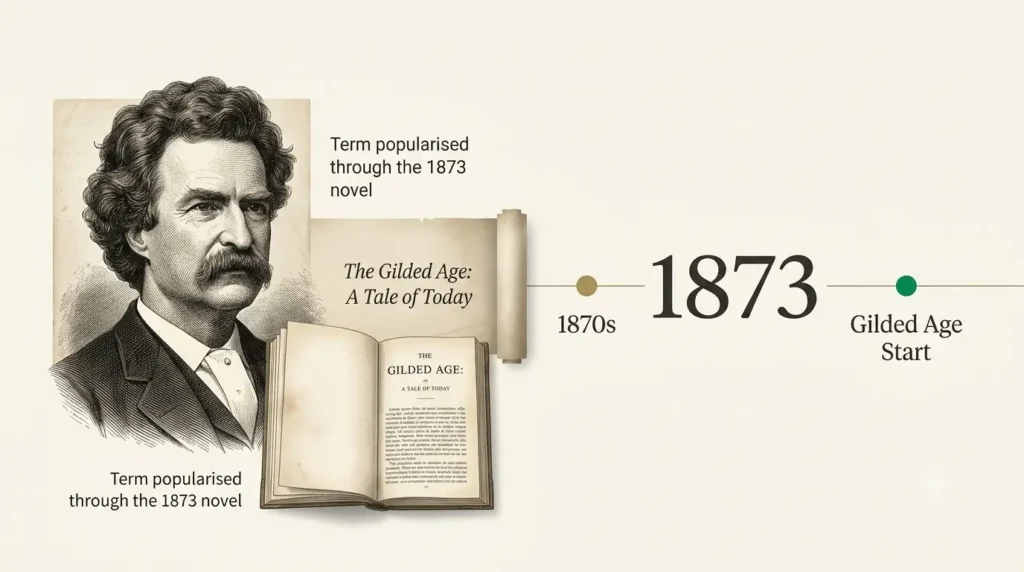
The Gilded Age refers to the period in American history roughly spanning 1870 to 1900, marked by explosive industrial growth alongside deep social and political fault lines. The name comes from Mark Twain and Charles Dudley Warner’s 1873 satirical novel The Gilded Age: A Tale of Today, whose title plays on the idea of a thin layer of gold coating something far less valuable underneath — a sharp jab at an era that looked prosperous on the surface while masking corruption and inequality beneath it.
For further historical context, see the Gilder Lehrman Institute.
Why the Period Matters
The Gilded Age is a pivotal unit for DSC-3 because it explains how the United States transformed from a largely agrarian economy into the world’s leading industrial power — and how that transformation generated the very tensions (labour unrest, monopolistic control, political corruption) that the Progressive Era would later attempt to resolve. Understanding this cause-and-effect chain is central to answering long-form DU exam questions on this unit.
Defining Features of the Gilded Age Economy
- Rapid industrial growth — steel, oil, and railroads expanded at unprecedented speed, aided by innovations such as the Bessemer steel-making process and the spread of electrification.
- Concentration of corporate power — a small group of industrialists (often labelled “robber barons”) came to dominate entire sectors through trusts and monopolies.
- Railroad expansion — the completion of the transcontinental railroad network knit the country into a single national market and accelerated westward settlement.
- Urbanisation — factory jobs pulled millions from rural areas into fast-growing, often overcrowded cities.
- Technological change — inventions such as the telephone, the light bulb, and the elevator reshaped daily life and business practice.
- Widening inequality and labour unrest — strikes such as the Homestead Strike and the Pullman Strike reflected growing friction between capital and labour.
- Political corruption — urban political machines such as Tammany Hall wielded outsized influence through patronage and bribery.
Big Business and Industrialisation
Growth of Major Industries
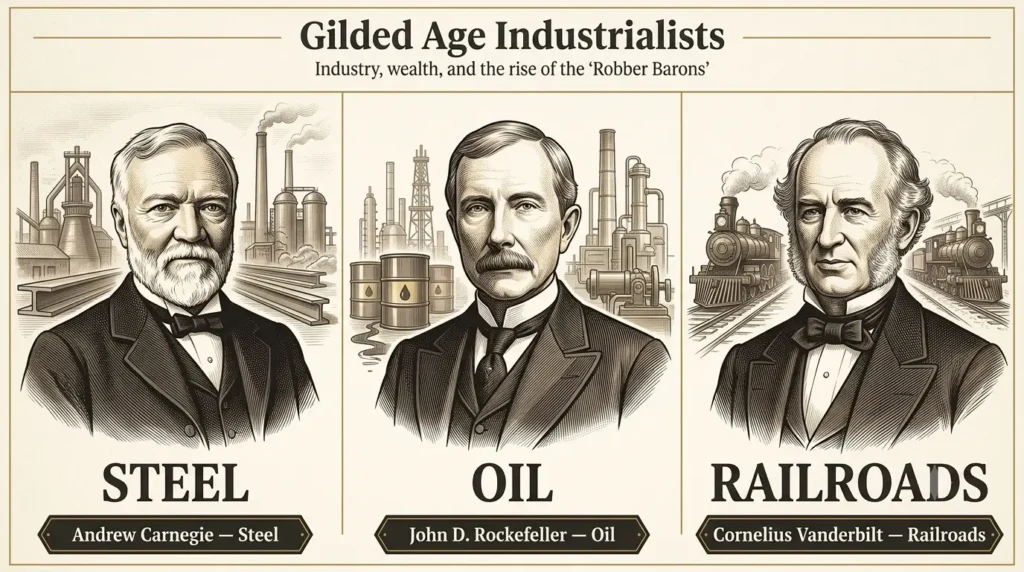
Steel: The Bessemer process made steel dramatically cheaper to produce, fuelling railroad and skyscraper construction. Andrew Carnegie built Carnegie Steel into the industry’s dominant player before selling it to J.P. Morgan in 1901, forming U.S. Steel — the first billion-dollar corporation.
Railroads: The transcontinental railroad, completed in 1869, connected the East and West coasts and catalysed growth in coal, steel, and agriculture. Cornelius Vanderbilt consolidated numerous smaller lines into a dominant eastern rail network.
Oil: Following the 1859 discovery of oil in Titusville, Pennsylvania, John D. Rockefeller founded Standard Oil in 1870 and, through aggressive tactics, controlled roughly 90% of American oil refining by the 1880s.
Key Figures
- Andrew Carnegie — steel magnate, later a major philanthropist who articulated the “Gospel of Wealth.”
- John D. Rockefeller — built Standard Oil into history’s most dominant single-industry monopoly.
- J.P. Morgan — the era’s most powerful financier, orchestrating major industrial mergers.
- Cornelius Vanderbilt — consolidated the railroad industry in the northeastern United States.
Technology’s Role
The Bessemer process, electrification (driven by Edison’s work on the light bulb and power generation), the telegraph and telephone, and continual improvements in railroad engineering together underpinned this era’s industrial expansion.
Competition and Consolidation
Competitive Tactics
- Price wars: Firms slashed prices to drive out rivals, then raised them once competition was eliminated.
- Rebates and kickbacks: Railroads offered preferential rates to large shippers, disadvantaging smaller businesses.
- Predatory pricing: Selling below cost temporarily to bankrupt competitors before restoring higher prices.
Vertical and Horizontal Integration
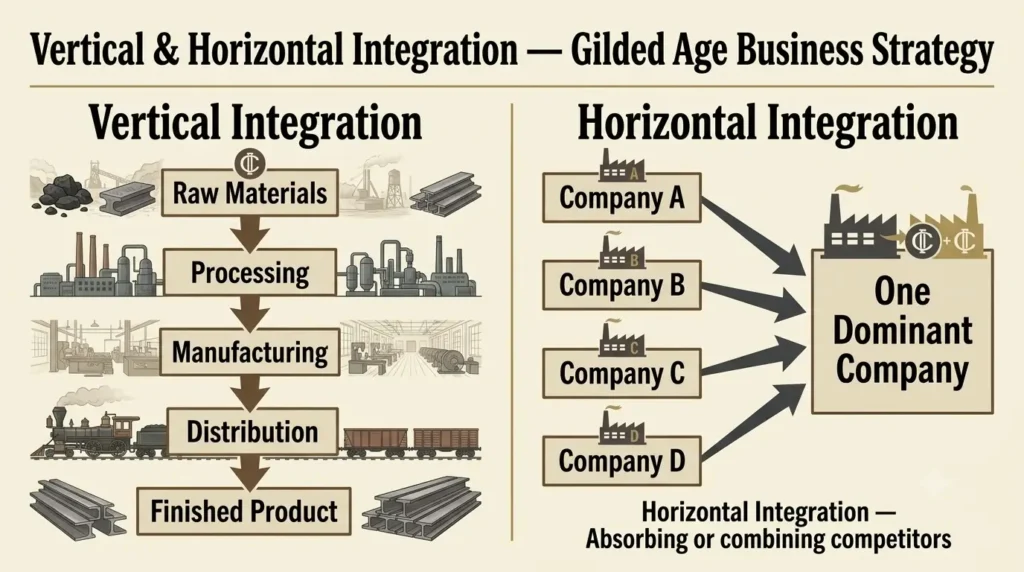
Carnegie pioneered vertical integration — controlling every stage of production from raw material to finished product. Rockefeller pursued horizontal integration — absorbing competitors within the same industry to dominate market share.
Trusts and Monopolies
Business trusts allowed a small group of trustees to control an entire industry without technically owning every firm within it — the Standard Oil Trust being the most prominent example. By the century’s end, monopolies such as Standard Oil and U.S. Steel controlled overwhelming shares of their respective markets, concentrating economic power narrowly.
Consequences for Businesses and Consumers
Smaller firms were frequently bought out or driven under. Consumers initially benefited from competitive pricing, but once rivals were eliminated, monopolies could raise prices, reduce the incentive to innovate, and deepen the era’s wealth gap — developments that eventually provoked public demand for government intervention.
Monopolism and Regulation
Effects of Monopolistic Practice
Monopolies could fix prices, suppress competitors, and depress wages and working conditions in the absence of competitive pressure — outcomes that steadily built public and political opposition.
Antitrust Legislation
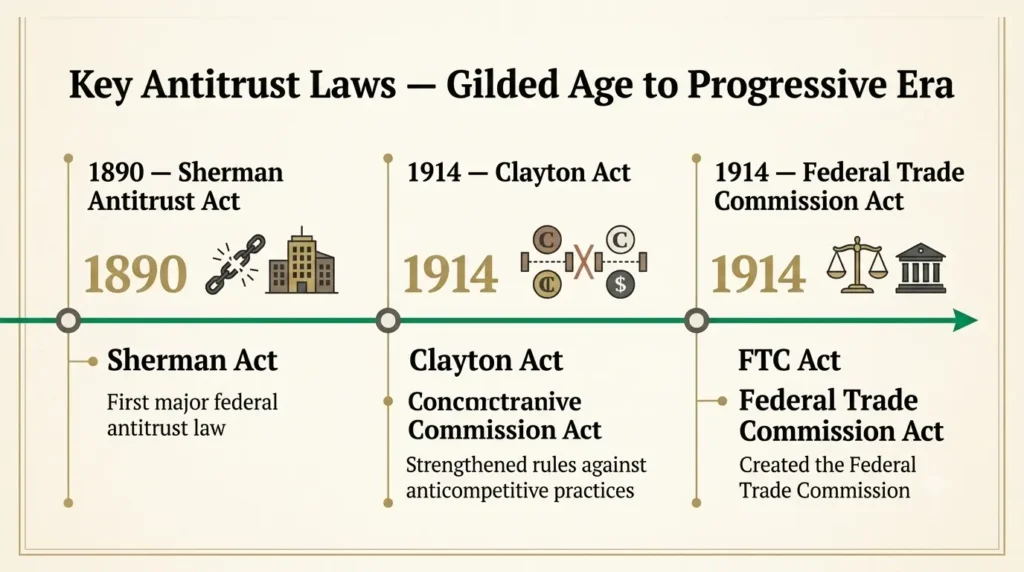
- Sherman Antitrust Act (1890): The first major federal law against monopolistic practices; initially weakly enforced due to vague drafting.
- Clayton Antitrust Act (1914): Strengthened the Sherman Act by explicitly defining unfair practices such as price discrimination, and exempted labour unions from antitrust prosecution.
- Federal Trade Commission Act (1914): Established the FTC to investigate and act against unfair business practices.
Regulatory Agencies
- Federal Trade Commission (FTC): Enforced the Clayton Act and continues to operate today.
- Interstate Commerce Commission (ICC): Established in 1887 to regulate railroad pricing.
- Trust-busting under Theodore Roosevelt: Roosevelt’s administration pursued legal action against major trusts, most notably Standard Oil, to restore competitive markets.
The Populist Challenge: Agrarian Crisis and Discontent
Roots of Agrarian Crisis
Farmers expanded onto new land under the Homestead Act of 1862, but mechanisation (the McCormick reaper, steel ploughs) contributed to chronic overproduction, pushing crop prices down even as farmers’ debts rose. Railroads’ high freight rates and control over grain storage further squeezed farm incomes.
Farmer Organisation
- The Grange (1867): An early organisation advocating railroad-rate regulation and farmer cooperation.
- The Farmers’ Alliance (1870s–80s): Built cooperatives to reduce costs and pushed for monetary reform, including “free silver.”
- The Populist Party (1890s): Formed from these earlier movements to demand systemic reform.
The Omaha Platform (1892)
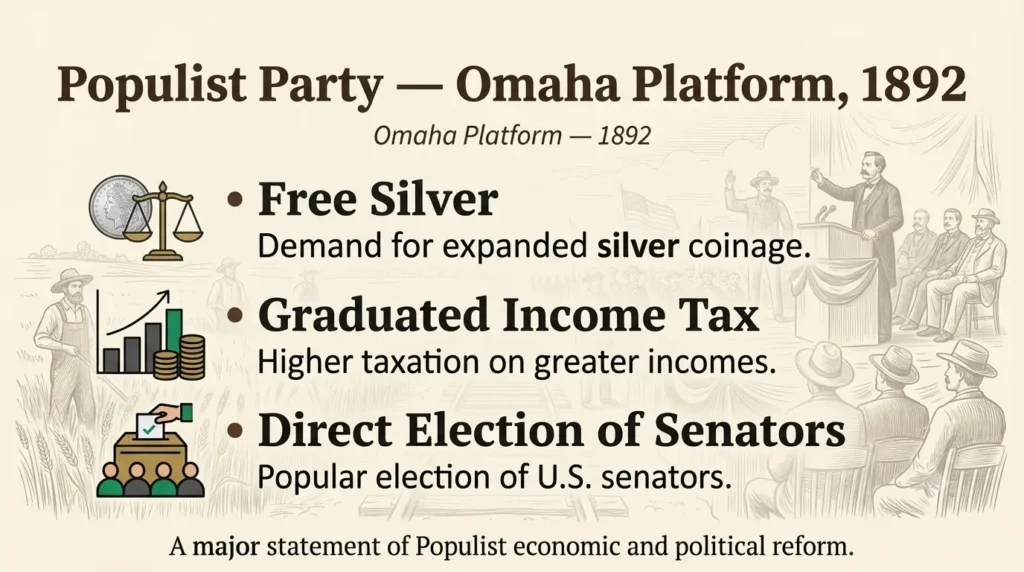
The Populist Party’s founding platform demanded: free coinage of silver, government regulation (or ownership) of railroads, a graduated income tax, direct election of Senators, and the Subtreasury Plan for farm credit.
Key Figures
- William Jennings Bryan — delivered the famous “Cross of Gold” speech at the 1896 Democratic National Convention, championing free silver.
- James B. Weaver — the Populist Party’s 1892 presidential candidate.
- Mary Elizabeth Lease — a prominent Populist orator known for urging farmers toward political action.
- Tom Watson — a leading Southern Populist who initially sought interracial farmer solidarity.
Legacy
Though the Populist Party never won the presidency, many of its demands were eventually enacted: the direct election of Senators (17th Amendment, 1913), the graduated income tax (16th Amendment, 1913), and stronger railroad regulation — largely absorbed into the subsequent Progressive movement.
The Politics of Progressivism
Origins and Principles
The Progressive Movement, gathering strength through the 1890s–1920s, sought to address the social costs of industrialisation — worker exploitation, urban squalor, corporate political influence — through government intervention, political reform, and application of expert/scientific methods to public policy.
Social, Political and Economic Goals
- Social: Improved urban sanitation and housing; women’s suffrage (achieved via the 19th Amendment, 1920); child labour restrictions.
- Political: Direct election of Senators (17th Amendment); direct democracy tools such as initiative, referendum, and recall; curbing corporate influence over elections.
- Economic: Trust-busting; labour protections; food and drug safety regulation (Pure Food and Drug Act, Meat Inspection Act); a graduated income tax (16th Amendment).
Theodore Roosevelt vs Woodrow Wilson: Comparing Progressive Reforms
| Feature | Theodore Roosevelt (1901–09) | Woodrow Wilson (1913–21) |
|---|---|---|
| Approach to trusts | Distinguished “good” vs “bad” trusts; regulated rather than eliminated | Strengthened antitrust law via the Clayton Act; created the FTC |
| Signature economic reform | Enforced the Sherman Antitrust Act more actively (“Trust-Buster”) | Federal Reserve Act (1913) — created the central banking system |
| Labour relations | Mediated the 1902 Coal Strike; supported an eight-hour workday for federal workers | Signed the Adamson Act (eight-hour day for railroad workers) |
| Consumer protection | Pure Food and Drug Act, Meat Inspection Act (1906) | Federal Trade Commission Act (1914) |
| Conservation | Expanded national parks/forests; created the U.S. Forest Service | Limited focus — conservation was not a central Wilson priority |
| Social justice record | Progressive on labour, limited on race | Criticised for resegregating federal offices; slower on women’s suffrage |
| Major disruption | Political pushback from big business and Congress | World War I diverted focus toward wartime economic control |
Legacy of Progressivism
Progressive-era reforms expanded the federal government’s regulatory role — laying groundwork for later 20th-century institutions such as the FDA and, eventually, the EPA. Programmes and ideas from this era fed directly into Franklin D. Roosevelt’s New Deal in the 1930s and, decades later, into the civil rights and Great Society reforms of the 1960s. The era’s central tension — between economic growth and the government’s role in checking corporate power — remains directly relevant to present-day debates about regulation and inequality.
Key Takeaways
The Gilded Age (1870–1900) transformed America into an industrial power while deepening inequality between industrialists and workers. This tension produced the Populist movement’s agrarian revolt in the 1890s and, subsequently, the Progressive Era’s push for regulation, labour rights, and political reform under Roosevelt and Wilson. For DSC-3 exam preparation, focus on: the mechanics of trusts/monopolies, the Omaha Platform’s demands, and a clear comparison of Roosevelt’s and Wilson’s reform approaches.
Continue Reading — DSC-3 (History of USA: Reconstruction to New Age Politics)
Previous Year Questions (PYQs) — DSC-3 The Gilded Age
DU Previous Year Questions
Frequently asked questions from DU exam papers on this topic. Tap a question to view a quick-answer guide.
1 Discuss the growth of monopolies during the Gilded Age and the government’s response through antitrust legislation. +
2 Examine the causes of agrarian discontent in the late 19th-century United States. +
3 What was the Omaha Platform? List its major demands. +
4 Compare the Progressive reforms of Theodore Roosevelt and Woodrow Wilson. +
5 Write a short note on vertical and horizontal integration, with examples. +
6 Discuss the significance of the Sherman Antitrust Act (1890). +
7 How did Populism influence the later Progressive Movement? +
8 Assess Theodore Roosevelt’s contribution to the conservation movement. +
FAQs
What is the Gilded Age?
A period in American history, roughly 1870–1900, marked by rapid industrial growth alongside sharp social and economic inequality.
Who coined the term “Gilded Age”?
Mark Twain, along with Charles Dudley Warner, in their 1873 satirical novel The Gilded Age: A Tale of Today.
What caused the rise of monopolies during this period?
Aggressive competitive tactics (price wars, rebates) combined with vertical and horizontal integration allowed a small number of firms — Standard Oil and U.S. Steel among them — to dominate entire industries.
What was the Populist Party and what did it want?
A political party formed in 1891–92 by farmers and workers demanding free silver, railroad regulation, a graduated income tax, and direct election of Senators, as outlined in the 1892 Omaha Platform.
How did Theodore Roosevelt and Woodrow Wilson differ in their reform approach?
Roosevelt focused on regulating rather than eliminating trusts and emphasised conservation, while Wilson pursued broader structural reform through the Federal Reserve, the Clayton Antitrust Act, and the FTC.
Is this topic part of the DU BA History syllabus?
Yes — it forms Unit 2 of DSC-3: History of the USA — Reconstruction to New Age Politics, Semester 2, B.A. (Hons.) History.
What was the long-term legacy of the Progressive Era?
It expanded the federal government’s regulatory role, influencing later reforms such as the New Deal in the 1930s and the Great Society programmes of the 1960s.
Subscribe to keep reading
You've used your free notes for now. Get Delhi Pathshala Premium for unlimited access.
Subscribe — ₹29/30 days
Really Healpful and Awsom website