
Contents
- GE-4 Unit 1 Syllabus (University of Delhi)
- What is International Relations?
- Definition and Scope of International Relations (IR)
- Where, When and What is IR? Blaney’s Challenge
- Evolution and Development of International Relations (IR)
- Is 1648 really the beginning? The Westphalia debate
- Major Themes and Issues in International Relations (IR)
- Understanding Space: How Do We Sense Our Planet
- Concept and Significance of Space
- Space as planet: what changes if we stop taking nature for granted?
- Globe versus planet: Chakrabarty
- Space beyond the planet: outer space as a shared area
- Spatial Dimensions of International Relations (IR)
- Territorial and Non-Territorial Spaces
- Territorial spaces
- Non-territorial spaces
- How the law divides the sea
- Interconnections and challenges
- Ways of Knowing and Being: Peoples, Histories and Civilisations
- Concept and Significance of Knowledge
- Sources and Types of Knowledge
- Knowledge and Power in International Relations (IR)
- Concept and Significance of Culture
- Sources and Types of Culture
- Culture and Identity in International Relations (IR)
- How Do We Begin to Think About the World? Pin-Fat
- Relational IR: Starting from Relations Rather than Units
- Peoples, Histories and Civilisations: Putting It Together
- Important Comparisons
- Criticism and Limitations
- Contemporary Relevance
- Quick Revision: Key Terms for GE-4 Unit 1
- Conclusion
- Continue Reading
- University of Delhi Previous Year Questions (DU-Pattern and Probable Questions)
- Frequently Asked Questions (FAQs)
- References and Further Reading
Unit 1 of GE-4 (Understanding International Relations) asks you to do something unusual for a first unit: before studying states, wars or institutions, it asks how we come to see “the world” in the first place. Is IR only about countries dealing with each other? Where does “the international” begin and end? Is the planet just the stage on which politics happens, or part of the story? And whose ways of knowing and being count when we talk about peoples, histories and civilisations?
The University of Delhi divides this 7-hour unit into three parts: 1.1 What is International Relations?, 1.2 Understanding Space: How do we sense our planet and 1.3 Ways of knowing and being: Peoples, Histories and Civilisations. These notes follow that order. They keep the standard textbook explanations of IR (actors, levels of analysis, theories, themes, culture and identity) because students need them for answers, and they add the specific arguments of the readings DU prescribes: David Blaney, Simon Dalby, Dipesh Chakrabarty, Véronique Pin-Fat and the relational-IR scholars.
If you are studying the rest of the paper, the next units are States, Nations and Markets, Inequalities, Sites of Conflict and Forms of Violence and Knowing Our Virtual and Creative World.
GE-4 Unit 1 Syllabus (University of Delhi)
The table below follows the official DU syllabus for B.A. (Hons.) Political Science, GE-4: Understanding International Relations (DU syllabus PDF). Syllabuses are revised from time to time, so always check the latest version on the DU website.
| Part | Topic | Prescribed reading (as listed in the syllabus) | Section in these notes |
|---|---|---|---|
| 1.1 | What is International Relations? | David Blaney, “Where, When and What is IR?” in Tickner and Smith (eds.), International Relations from the Global South: Worlds of Difference (Routledge, 2020), pp. 38–55 | What is International Relations? |
| 1.2 | Understanding Space: How do we sense our planet | Simon Dalby, “What happens if we don’t take nature for granted?” in Edkins and Zehfuss (eds.), Global Politics: A New Introduction (Routledge), pp. 39–60; Dipesh Chakrabarty, The Climate of History in a Planetary Age (University of Chicago Press, 2021), pp. 1–20 | Understanding Space |
| 1.3 | Ways of knowing and being: Peoples, Histories and Civilisations | Véronique Pin-Fat, “How do we begin to think about the world?” (Edkins and Zehfuss, pp. 20–38); Trownsell et al., “Recrafting International Relations through Relationality” (E-International Relations, 2019); Trownsell et al., “Differing about Difference: Relational IR from around the World” (International Studies Perspectives, 22:1, 2021); Giorgio Shani, “IR as inter-cosmological relations?” (International Politics Review, 9, 2021). Additional: Milja Kurki (2020); Arturo Escobar (2020); Kothari et al. (eds.), Pluriverse (2019) | Ways of Knowing and Being |
According to the syllabus’s learning outcomes, you should be able to explain how our world is shaped in both territorial and non-territorial forms, how human and non-human relations fit into a planetary understanding, and how interactions between peoples, histories and civilisations can be mapped. Keep those three outcomes in mind while reading; most Unit 1 questions are variations on them.
What is International Relations?
Definition and Scope of International Relations (IR)
International Relations (IR) is the study of how countries interact with one another and with actors that are not countries, and of the political, economic, social and cultural forces that shape those interactions. It covers diplomacy, conflict resolution, economic cooperation, global rules and the effects of global forces on everyday life. Put differently, it is the attempt at making sense of the world beyond the borders of a single state.
Eight features describe the scope of the discipline. Most textbook definitions can be rebuilt from these.
1. State-centric focus. For a long time IR treated states as the main (sometimes the only) actors. This view asks why states act as they do, what they do, and how they deal with each other. It is strongest in realism, which you will meet in the next section, and it still shapes how many people understand news about “India’s position” or “China’s response”.
2. Transnational actors. Today IR also looks at actors that are not states: international organisations such as the United Nations, non-governmental organisations (NGOs), multinational companies and other groups that influence global issues. Researchers have also studied advocacy networks, for example Keck and Sikkink’s study of transnational activist networks in Activists Beyond Borders (1998).
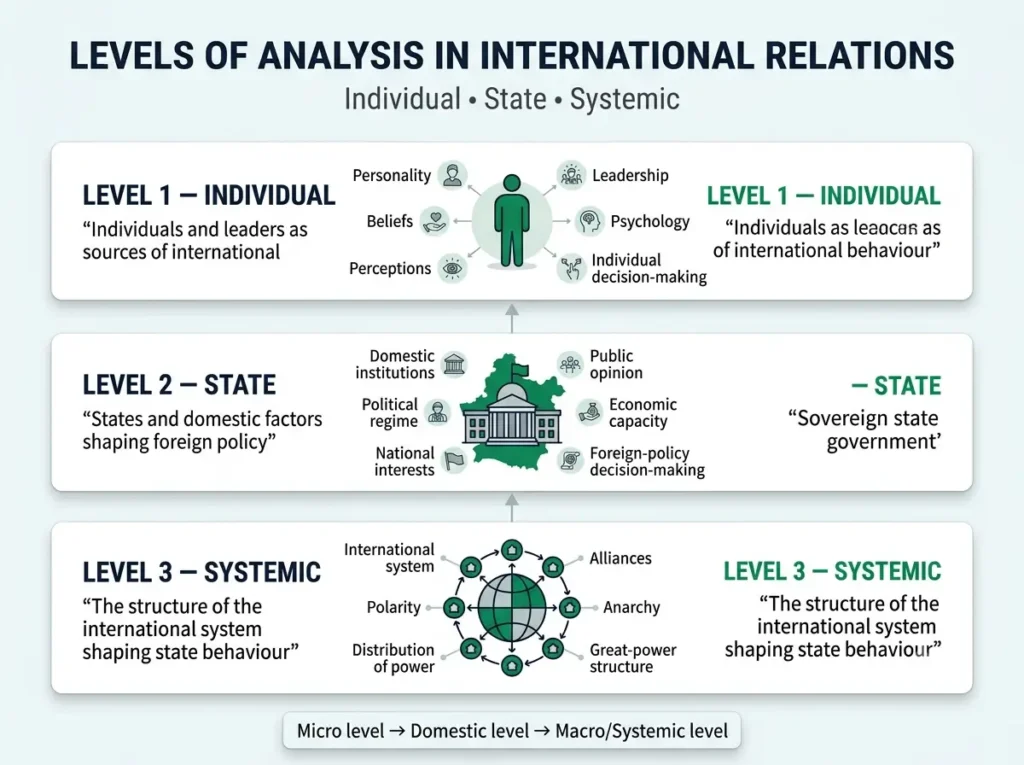
3. Levels of analysis. IR explains events at different levels. At the individual level we look at leaders and decision-makers; at the state level, at how countries behave and make decisions; at the systemic level, at the structure of the international system as a whole. Kenneth Waltz’s Man, the State and War (1959) organised explanations of war around three such “images”, and students still use this framework to ask a simple question: where is the cause of this event located?
4. Interdisciplinary nature. IR borrows from political science, economics, history, sociology and law. A trade dispute, for instance, needs economics to understand tariffs, history to understand grievances, and law to understand what rules apply.
5. Global issues. IR studies problems that do not stop at borders: climate change, terrorism, migration, public health and human rights abuses. The discipline asks how these problems affect the world and how the international community responds.
6. Theoretical perspectives. Different theories explain global events in different ways. The major ones are realism, liberalism, constructivism and critical theories (summarised later in this unit). Each theory tells you what to look at as well as how to explain it.
7. Power and security. Military strength, alliances, conflict and the maintenance of peace and stability remain central topics, whichever theory you prefer.
8. Globalisation. Technology, communication, trade and cultural exchange have made countries and societies more connected and more dependent on each other. Globalisation is not only a theme in IR; it is part of the reason the discipline had to widen its focus beyond states.
The field keeps changing as global conditions change, which is why IR cannot be learnt as a fixed list of facts.
A note on names. You will see “international relations”, “world politics” and “global politics” used for much the same field. The syllabus itself draws on Global Politics: A New Introduction, whose title signals a deliberate choice: rather than assuming that “international” means “between states”, it asks students to question what counts as “global” and what counts as “politics”. Keep this in mind when you reach the Blaney reading below.
Where, When and What is IR? Blaney’s Challenge
The first prescribed reading, David Blaney’s chapter in International Relations from the Global South, asks three deceptively simple questions: where is IR, when did it begin, and what is it?
A useful way to organise your answer is as follows. (This framing is a study aid; consult the chapter, pp. 38–55, for Blaney’s own wording.)
- Where? Standard accounts imagine IR as the story of Europe and later North America. Blaney’s chapter, as reviewed in E-International Relations, reads the discipline through the Amerindian homelands of North America, using what the review calls a “contrapuntal” reading. The term comes from Edward Said, who used it to describe reading the histories of colonisers and the colonised together, like two melodies played at once.
- When? According to that review, Blaney highlights the connectivity, trade and diplomacy among Amerindian peoples and argues that fixing a single point in time when international relations or diplomacy “begins” does not hold up.
- What? Past and present coexist in a society made up of many overlapping sovereignties, so the “international” is made of overlapping and complex relations rather than of neat boundaries between self-contained states.
The wider book, edited by Arlene Tickner and Karen Smith, uses “global South” not just as a geographical label but as a political position and an ethical stance. It is part of a larger critique of Western-centrism or Eurocentrism in IR; some authors, including Steve Smith, also speak of the American-centrism that has shaped the field.
Why does this matter for exams? Because the typical question “What is IR?” has two good answers. One is the textbook definition above. The other is the critical answer: IR itself is a historically and geographically situated way of seeing. Strong answers give both.
Evolution and Development of International Relations (IR)
IR has changed over time, and the history of the discipline can be read through both events and ideas. The table traces the traditional historical overview, with corrections noted.
| Period | What happened | Why it matters for IR |
|---|---|---|
| Ancient and medieval periods | Diplomacy between ancient civilisations; treaties and alliances managed relations between political communities. | Shows that cross-border relations are far older than the modern state. |
| 1648 | The Peace of Westphalia ended the Thirty Years’ War (1618–1648). Traditionally treated as the start of the modern state system and state sovereignty. | A foundational story in IR textbooks, but contested (see the debate below). |
| 19th century | Nationalism and industrialisation changed global politics. The Congress of Vienna (1814–1815) tried to bring stability to Europe after the Napoleonic Wars. | Source of the balance-of-power and “concert” ideas. |
| After World War I | The League of Nations was created to prevent future wars; it struggled and could not stop World War II. The United States never joined. | Shaped early liberal (often called “idealist”) thinking and the discipline’s own beginnings after the war. |
| After World War II | The United Nations was formed in 1945 to promote peace and cooperation. The Cold War between the US and the Soviet Union (roughly 1947–1991) dominated global politics. | Pushed realism and strategic studies to the centre of the field. |
| After the Cold War | Globalisation, new technologies and non-state actors came to the fore; liberal ideas gained ground. | Widened the agenda to economy, environment, identity and rights. |
Note that 1648 belongs to the early modern period, not the medieval one, which is why it has its own row.
Intellectual traditions. Four broad traditions are usually taught.
| Tradition | Core idea | Key names / works | Typical example |
|---|---|---|---|
| Realism | States pursue power and national interest in an anarchic system. Popular in the mid-20th century. | Hans Morgenthau, Politics Among Nations (1948); Kenneth Waltz, Theory of International Politics (1979) | Arms races, alliances |
| Liberalism | Cooperation, international institutions, democracy and human rights can reduce conflict. Gained ground after the Cold War. | Immanuel Kant (peace ideas); Robert Keohane and Joseph Nye, Power and Interdependence (1977) | The European Union |
| Constructivism | Ideas, identities and norms shape what states want and do; challenges simple views of state behaviour. Gained popularity in the late 20th century. | Alexander Wendt, “Anarchy Is What States Make of It” (1992) | Why some rivals become friends |
| Critical theories | Question traditional power structures and reveal hidden inequalities, for example through Marxist, feminist and critical-theory approaches. | Robert Cox (1981); Cynthia Enloe, Bananas, Beaches and Bases (1989) | Gendered and unequal global economies |
Detailed notes on these theories are part of other papers; for this unit you mainly need to know that each tradition answers the question “what is IR about?” differently.
Emergence of non-state actors. Do not call the IMF, the World Bank or the WTO “non-state actors”, as many notes do. These are intergovernmental organisations created by states. (The IMF and World Bank came out of the Bretton Woods conference of 1944; the WTO was established in 1995.) They matter because they are institutions of global governance. Genuine non-state actors include NGOs, multinational corporations (MNCs), advocacy networks, diaspora communities and, in some analyses, armed groups and transnational movements.
Contemporary challenges. Globalisation, technology and climate change create interconnected problems that no state can solve alone. They call for new strategies from both states and non-state actors, and they connect directly to the “planetary” arguments in section 1.2.
Is 1648 really the beginning? The Westphalia debate
Many IR textbooks tell students that the Peace of Westphalia created a system of sovereign, legally equal states. That story is now contested.
- The traditional view treats 1648 as the starting point of the “Westphalian system”. Historians of the idea trace much of its popularity to Leo Gross’s 1948 essay “The Peace of Westphalia, 1648–1948”.
- Andreas Osiander (in International Organization, 2001) argues that IR judges today’s trends against a past that is largely imaginary, shaped by a later fixation on sovereignty, and he re-examines the treaties and the Holy Roman Empire that followed.
- Benno Teschke (The Myth of 1648, 2003) argues that 1648 is a false turning point and that domestic property relations and dynastic politics shaped international relations well beyond that date.
- Global and decolonial critics, such as John Hobson (The Eurocentric Conception of World Politics, 2012) and Amitav Acharya and Barry Buzan (The Making of Global International Relations, 2019), widen the critique: a story that starts in Europe in 1648 leaves out much of the world.
So an exam-ready position is: Westphalia is a convenient shorthand for the emergence of the territorial state system in Europe, but scholars disagree on whether 1648 was a real turning point.
Major Themes and Issues in International Relations (IR)
IR covers many topics that show how countries, groups and global forces interact. These themes help you see the important parts of the international system.
| Theme | What it examines |
|---|---|
| 1. Power and security | Balance of power: how power is distributed among states to stop any one from becoming too strong. National security: how states protect their territory and people. |
| 2. Global governance | International organisations such as the UN and World Bank, which help states cooperate on global problems. Regional organisations such as the European Union, which work on security and economic issues in specific regions. |
| 3. Globalisation | Economic globalisation: linked economies through trade and investment. Cultural globalisation: how ideas and cultures spread, and the challenges that follow. |
| 4. Conflict and cooperation | Interstate conflict: why wars happen and what they do. Diplomacy and cooperation: how states work together to solve problems and keep peace. |
| 5. Human rights and international law | How human rights, including protection from discrimination, are defended globally; how law between states helps resolve conflicts and holds states accountable. |
| 6. Environmental issues | Climate change and its effects on the planet and people; sustainable development, or growing economies while protecting the environment. |
| 7. Transnational actors | The influence of multinational corporations on global trade; how NGOs advocate for rights and justice. |
| 8. Technology and cybersecurity | Threats from cyber attacks, the use of technology in conflict, and how innovation affects global security. |
| 9. Migration and refugees | Forced migration caused by war or disaster; refugee protection and the challenges of providing it. |
| 10. Identity and nationalism | How national pride shapes state behaviour and conflict; how culture and religion shape international relations (discussed in section 1.3). |
| 11. Health diplomacy | How states respond to health crises such as pandemics and how they cooperate to protect global health. The World Health Organization is a central institution here. |
Some of these themes return in later units: the state and markets in Unit 2, global inequalities and climate change in Unit 3, and conflict in Unit 4.
Understanding Space: How Do We Sense Our Planet
The word “space” in this part of the syllabus can be read in three connected ways. First, space as the planet we live on: the Earth, nature and the environment, not just a backdrop for politics but something that politics changes (the Dalby and Chakrabarty readings). Second, space as territory: how political authority is organised over land, sea and borders. Third, space beyond the planet: outer space as an area of cooperation and competition. The prescribed readings emphasise the first two meanings, but all three appear in exam questions, so each is covered below.
Concept and Significance of Space
Space as planet: what changes if we stop taking nature for granted?
Simon Dalby is a scholar of geopolitics, environment and security who has focused in recent years on climate change and the Anthropocene. His chapter title in Global Politics: A New Introduction is itself the question: what happens if we don’t take nature for granted? Most IR begins with a world of states and treats the natural environment as a given background, something that supplies resources or sets limits. Dalby’s wider work argues that this assumption no longer holds. In his book Anthropocene Geopolitics, for example, he argues that traditional notions of sovereignty do not fit a rapidly changing geophysical situation and that planning can no longer assume fixed environmental conditions as its starting point.
Reading note: the points above come from Dalby’s wider published work. For the exact structure and examples of the prescribed chapter (pp. 39–60), read the chapter itself when preparing long answers.
Globe versus planet: Chakrabarty
Dipesh Chakrabarty, a historian at the University of Chicago, makes the most important conceptual move in this part of the syllabus in The Climate of History in a Planetary Age (2021).
- Climate change, he argues, upends long-standing ideas of history, modernity and globalisation.
- He distinguishes the globe from the planet. The globe is a human-centred construction: the world of human connections, trade, empires and globalisation. The planet (the “Earth system”) decentres the human and treats humans as one force among many.
- Earth-system scientists argue that since roughly the 1950s a “Great Acceleration” in human numbers, consumption and technology has made humans a geological force, pushing the planet beyond the Holocene, the epoch that began about 11,700 years ago after the last Ice Age. They propose calling this new epoch the Anthropocene.
- Chakrabarty’s claim is that we now have to look at human history from both perspectives at once. Labels such as “modern” or “global” have to be thought together with the much longer time-scales of geological history.
| Globe | Planet | |
|---|---|---|
| Centre of attention | Human beings, their connections and institutions | The Earth system, in which humans are one force among many |
| Typical subjects | Empires, trade, globalisation, states | Climate, geology, biodiversity, the biosphere |
| Time-scale | Human history | Geological time |
| Relation to IR | Familiar: states, markets, global governance | Newer: climate change and limits that no state controls |
A debate worth knowing. The word “Anthropocene” is itself contested. In March 2024 the International Union of Geological Sciences confirmed a vote by its stratigraphy subcommission (12 votes against, 4 in favour) rejecting a proposal to make the Anthropocene a formal epoch of the Geological Time Scale. The IUGS added that the term will continue to be used by earth and environmental scientists, social scientists, politicians, economists and the public as a descriptor of human impact on the Earth system. So: not a formal geological epoch, but a widely used concept. Scholars also criticise Chakrabarty directly. One published review argues that his notions of “the globe” and “the planetary” are themselves somewhat ahistorical, which is a useful line for the criticism section of an answer.
How this connects to the syllabus. The learning objectives of GE-4 speak of going beyond the Westphalian conception of territoriality. The planetary argument is the most direct case: carbon dioxide, warming oceans and species loss do not recognise borders. This reading prepares you for climate change and the global commons in Unit 3.
Space beyond the planet: outer space as a shared area
This is the most familiar meaning of “space”, and it is a good example of a non-territorial space.
Outer space as shared space. Outer space is seen as a shared area that no single country can claim, to be used for the benefit of all countries. Article II of the Outer Space Treaty (1967) says that outer space, including the Moon and other celestial bodies, is not subject to national appropriation by claim of sovereignty, by use or occupation, or by any other means.
Space as a key strategic area. With satellites, outer space has become important for communication, navigation, weather tracking and military purposes.
Laws governing space. The Outer Space Treaty (opened for signature on 27 January 1967; in force from 10 October 1967) is the main legal framework. A precise reading matters here, because the treaty is often summarised as banning nuclear weapons and weapons of mass destruction in space. Article IV is narrower: states undertake not to place in orbit around the Earth any objects carrying nuclear weapons or other weapons of mass destruction, not to install them on celestial bodies, and not to station them in outer space in any other manner. The Moon and other celestial bodies must be used exclusively for peaceful purposes, and military bases, weapons tests and manoeuvres there are forbidden. But the treaty does not ban all military activity in space: military personnel may be used for peaceful scientific work, and arms-control analysts point out that it does not prohibit conventional weapons in orbit. This gap is exactly why “weaponisation of space” remains a live debate.
Why space matters in IR.
| Dimension | Explanation |
|---|---|
| Communication | Satellites connect people around the world, which matters for business, diplomacy and information-sharing. |
| National safety | Space tools support surveillance and early-warning systems; the military use of space raises fears of arms races. |
| Economic growth | Better weather forecasts, farming support and navigation help transport and trade. |
| Scientific research | Joint projects such as the International Space Station advance science and build a shared understanding of space. |
| Environmental tracking | Satellites monitor climate change and disasters, which feeds global environmental efforts. |
| GPS and navigation | GPS is crucial for transport and logistics, and its global use shows interdependence. Several states run their own systems (for example Russia’s GLONASS, the EU’s Galileo, China’s BeiDou and India’s NavIC), which also shows the wish to avoid dependence on others. |
| Respecting treaties | Keeping space agreements is important for good relations; cooperation is needed to use space responsibly and prevent conflict. |
| Space diplomacy | States negotiate and cooperate on joint missions and sharing satellite data, partly to avoid weaponising space. |
| Challenges and competition | Growing reliance creates vulnerabilities: debris, cyber threats and the risk of military use. |
New challenges and opportunities.
- Space debris. The growing amount of debris threatens safe space activity, and guidelines for managing it need international cooperation.
- Cybersecurity. Linking space technology with ground systems brings cyber risks; protecting space assets needs global collaboration.
- Commercial space. Private space companies are new players. States must cooperate to regulate them and to ensure fair access. Under Article VI of the treaty, states bear international responsibility for national activities in space, including those of private companies, and non-governmental activity requires authorisation and continuing supervision by the relevant state.
- Resource exploration. Extracting resources from the Moon or asteroids raises questions of property rights and competition. In 2015 the United States passed a law allowing US citizens to own resources extracted from asteroids; critics argue this tests the non-appropriation principle of Article II.
Using and exploring space therefore involves cooperation, strategy, economics and the environment together, and it shows how interconnected the world has become.
Spatial Dimensions of International Relations (IR)
The spatial dimensions of IR look at how geography and physical factors affect how states and other groups interact. Location and borders matter.
1. Geopolitics and geography. The location of a country affects its importance. Control of key waterways, such as the Strait of Malacca or the Strait of Hormuz, can strengthen a state’s position. Natural features such as mountains and rivers can separate or connect countries, and many borders follow them.
2. Globalisation and connectivity. Better transport and communication have made distance matter less. Air and sea routes move goods and people across borders and shape trade and cultural exchange. The internet and digital technology have created a virtual space that connects people and states in new ways, a theme developed in Unit 5.
3. Territorial sovereignty and boundaries. A state’s control over its territory is basic to the state system. Changes in borders, whether through conflict or agreement, can alter international relations deeply. Border disputes affect neighbours, migration and the sharing of resources. Borders are also political creations: the Radcliffe Line drawn at the time of India’s Partition in 1947 is a familiar South Asian example of a boundary whose consequences have lasted for decades.
4. Regionalism and supranational entities. Regional groups such as the European Union and the African Union promote cooperation among neighbouring states that share geography and interests. Bodies like the EU hold some powers over members, changing how states interact.
5. Environmental and resource dimensions. Environmental problems such as climate change need joint action because they affect many areas at once. The location of natural resources can shape economies and create competition.
6. Conflict zones and security. Regions with histories of conflict can become hotspots of geopolitical tension. Military bases and security alliances influence global safety and defence.
7. Human geography and demographics. Migration and refugee movements, driven by conflict or economic need, change the make-up of populations and international relations. The spread of languages, religions and cultures also influences how states cooperate.
Understanding these spatial aspects shows how states are connected and how geography shapes diplomatic, economic and security issues.
Territorial and Non-Territorial Spaces
Territorial and non-territorial spaces are important in political science, IR and law. The syllabus’s own wording is that our world is shaped in both forms.
Territorial spaces
| Aspect | Explanation |
|---|---|
| Definition | Territory is a specific area of land that a state controls. |
| Sovereignty | States have the right to govern within their borders. |
| Legal framework | International law supports the idea that states respect each other’s borders. |
| Maritime zones | Coastal states also hold rights over certain sea areas (see the table below). Note that these are rights over resources and activities, which is not the same as full territorial sovereignty. |
| Political implications | Borders help shape national identity and mark where a state’s authority ends. |
| Security | States secure their borders; territorial disputes can lead to conflict. |
| Examples | Land borders (lines on a map between states); maritime boundaries (ocean areas that belong to specific states). |
Non-territorial spaces
| Aspect | Explanation |
|---|---|
| Definition | Areas without fixed state borders that involve shared governance or international cooperation. |
| Shared governance | Several states cooperate on common issues without claiming exclusive control. |
| Global commons | Some non-territorial spaces are shared for everyone’s benefit. |
| Political implications | Issues such as climate change and space exploration demand international cooperation. |
| Security | Security is collaborative, for example in responding to cyber threats. |
| Examples | Outer space (treated as a shared area under international agreements); the high seas (ocean beyond national control where navigation is free); Antarctica, where the Antarctic Treaty of 1959 set the continent aside for peaceful purposes and froze territorial claims. |
How the law divides the sea
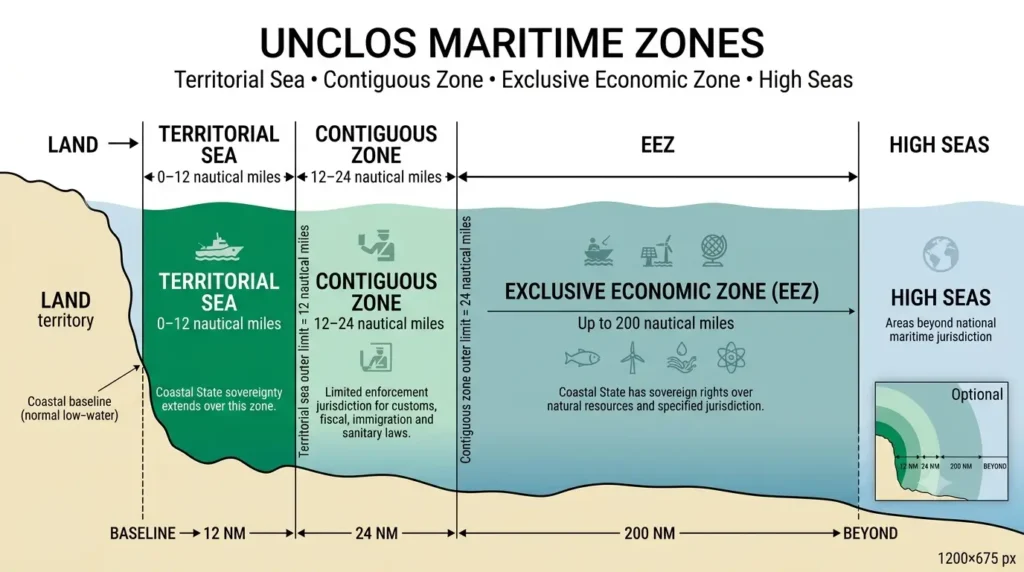
The UN Convention on the Law of the Sea (UNCLOS, 1982) shows how law turns a continuous ocean into zones with different degrees of state authority.
| Zone | Extent (measured from baselines) | Rights |
|---|---|---|
| Territorial sea | Up to 12 nautical miles | The coastal state exercises sovereignty; foreign vessels have “innocent passage”. |
| Contiguous zone | Up to 24 nautical miles | Limited control powers, such as customs and immigration. |
| Exclusive Economic Zone (EEZ) | Up to 200 nautical miles | Sovereign rights over natural resources and certain economic activities; jurisdiction over marine research and environmental protection. |
| Continental shelf | At least 200 nautical miles, more under specified conditions | Sovereign rights over seabed exploration and exploitation. |
| High seas | Beyond national jurisdiction | Freedoms of navigation, overflight, fishing and scientific research, subject to the Convention. |
Interconnections and challenges
Transitional and mixed spaces. Notes often describe “international waters” as both territorial and non-territorial, which is confusing. A clearer way to put it is that the sea is layered: the territorial sea is territory, the EEZ and continental shelf are zones of limited, resource-focused state rights, and the high seas are a commons. That layering is what makes maritime disputes complicated.
Overlap and conflict. Some regions face disputed claims, such as the Arctic and the South China Sea, where overlapping claims test the legal framework.
Global governance. Managing non-territorial spaces needs effective international cooperation, which is hard to achieve when states have different interests and capacities. This is the point at which “space” in the sense of territory meets “space” in the sense of planet: the atmosphere, oceans and climate are commons that no border can contain.
Ways of Knowing and Being: Peoples, Histories and Civilisations
The third part of the unit shifts from what we study to how we know it, and from who exists in IR to how they exist. Two technical words help. Ways of knowing (epistemology) are the methods, sources and assumptions by which we claim to know something. Ways of being (ontology) are our assumptions about what exists and how things relate: whether the world is made of separate units, such as states, that then interact, or of relations that come first and make the units possible.
The prescribed readings (Pin-Fat, Trownsell and colleagues, Shani) deal with this second, deeper layer. This article first keeps the broader, textbook discussion of knowledge, power, culture and identity in IR, and then turns to the relational arguments.
Concept and Significance of Knowledge
Knowledge is central to IR. It helps us understand global issues and guides decisions in diplomacy and cooperation.
What knowledge means in IR.
| Meaning | Explanation |
|---|---|
| Information and awareness | Understanding global affairs: information about the politics, economies, societies and cultures of different countries, important for diplomats and policymakers. Awareness of global issues: knowing about climate change, human rights and conflicts shapes diplomatic action. |
| Theoretical perspectives | Theoretical knowledge: theories such as realism and liberalism help explain events. Interdisciplinary knowledge: ideas from political science, economics and other fields help study how states interact. |
| Intelligence and diplomacy | Strategic knowledge: states gather information on others’ plans and strengths for diplomatic and security decisions. Diplomatic knowledge: diplomats need to know international law and cultures to negotiate well. |
Why knowledge matters in IR.
| Area | Why knowledge matters |
|---|---|
| Informed decision-making | Policy formulation: policymakers need accurate information about global trends. Crisis management: in emergencies, quick and accurate information helps organise relief. |
| International cooperation | Building trust: sharing information and interests makes cooperation likelier. Global governance: organisations such as the World Health Organization use health data to respond to global health crises. |
| Conflict resolution | Understanding root causes: history and culture help explain disputes. Mediation and negotiation: mediators must know the backgrounds and issues of the parties. |
| Human rights and justice | Advancing human rights: knowledge of abuses helps organisations hold states accountable. International justice: legal knowledge is key to pursuing justice for serious crimes. |
| Global public opinion | Media and information-sharing: media shapes how people view global events. Soft power: states that share their culture and education gain influence. |
Sources and Types of Knowledge
Knowledge about IR comes from many places and in many forms.
Sources of knowledge.
| Source | What it offers |
|---|---|
| Academic research | Scholarly journals provide studies and theories that shape the field; books offer detailed treatments of topics and events. |
| International organisations | Reports (for example from the UN and World Bank) share information on global problems; databases hold statistics for researchers and policymakers. |
| Government sources | Official documents show strategies and foreign policy; embassy reports give insight into international events and relationships. |
| Think tanks | Policy papers influence government decisions; experts comment on current events and trends. |
| Media | News offers real-time information; opinion pieces present different views on global issues. |
Types of knowledge.
| Type | Examples |
|---|---|
| Theoretical | Frameworks such as realism and liberalism explain state behaviour; critical theories challenge traditional views and highlight overlooked perspectives. |
| Empirical | Historical studies explain how the past shapes the present; case studies give real-life examples. |
| Legal | Understanding international law and analysing treaties clarifies how states act and what they have committed to. |
| Cultural and social | Studies of culture and sociological insights show social influences on state interactions. |
| Economic | Economic theories explain trade and development; economic data helps assess the global financial situation. |
| Scientific and technological | Technological advances matter for international security; scientific research on climate change informs global responses. |
| Public opinion | Surveys reveal how people view international events and policies; media coverage shapes public understanding. |
A point worth adding to your answers: the list of sources above is itself a choice. Notice that it is made up almost entirely of institutions in the global North (journals, think tanks, international organisations). The relational and global-South readings later in this section ask what is left out when only such sources count as “knowledge”.
Knowledge and Power in International Relations (IR)
The link between knowledge and power shows that those who have and control information often have great influence in world affairs.
1. Types of power in IR.
| Type of power | Meaning |
|---|---|
| Military power (hard power) | Armies and weapons that help states influence others. |
| Economic power | A strong economy lets a state affect global trade and finance, using tools such as trade rules or sanctions. |
| Soft power | Influence through attraction rather than force (a term associated with Joseph Nye): culture, values, education, diplomacy and films. |
| Informational power | Control of information lets actors shape opinion and the news. |
2. The role of knowledge in IR.
- Information as a resource: states gather and use information to make choices and gain advantage.
- Diplomacy and negotiation: knowing the history and interests of others helps diplomats negotiate.
- Global governance: states share information to tackle climate change and health crises.
- International law and norms: understanding law allows states to use it to support their goals or challenge others.
- Public opinion and influence: media-shared knowledge shapes what people think, and states that control stories influence global views.
- Technology and innovation: states leading in areas such as cybersecurity and military technology are stronger.
3. Knowledge as a form of power.
| Form | Explanation |
|---|---|
| Access to information | Informational asymmetry: states with more information have better decision-making power, creating imbalance in negotiations. |
| Control of narratives | Controlling how stories are told gives soft power and helps shape global opinion. |
| Knowledge monopolies | States with exclusive knowledge, especially technological, have significant control. |
| Educational and cultural hegemony | Strong education systems can spread worldviews and create cultural dominance. |
Susan Strange, whose work is on the syllabus for Unit 2, made a related point by treating knowledge as one of four “structures” of power in the world economy alongside security, production and finance (see States, Nations and Markets).
4. Challenges and ethical considerations. Disinformation and propaganda: false information can be used to gain an edge. Knowledge inequality: gaps in access to education and technology create power imbalances. Responsibility and accountability: powerful states must use knowledge responsibly because their decisions have serious effects.
5. Emerging trends. Cyber power: cybersecurity and information warfare are becoming key sources of power. Global knowledge networks: the internet creates networks that make information more accessible and can challenge old power structures. (These ideas return in Unit 5.)
Concept and Significance of Culture
Culture affects how states and people see and connect with one another.
What is culture in IR?
| Idea | Explanation |
|---|---|
| Definition | The shared beliefs, values, customs and lifestyles of a group, seen in language, art and traditions. |
| Cultural identity | Countries and regions have cultural identities that affect how they interact globally and present themselves. |
| Soft power | Influence through attraction; cultural diplomacy uses a state’s cultural strengths to create positive views and encourage cooperation. |
| Diversity and multiculturalism | Under globalisation, understanding and respecting cultures promotes tolerance and peaceful co-existence. |
| Cultural hegemony | Strong states may have more cultural influence, affecting global norms and policies (an idea associated with Antonio Gramsci). |
| Cultural norms in diplomacy | Cultural practices shape diplomatic interaction, so understanding customs matters. |
Why culture matters in IR.
- Communication and understanding. Culture shapes how states talk to each other; different styles can cause misunderstanding.
- Cultural identity and nationalism. Cultural identity is tied to national identity; strong feelings can lead to conflict, and understanding them is key to resolving issues.
- Soft power and public diplomacy. Films, music and other cultural goods boost a state’s influence; states promote their culture to build relationships.
- Global governance and norms. Cultural values help shape global rules, and discussions on human rights or environmental care involve varied cultural views.
- International cooperation. Cultural exchange programmes build trust and goodwill.
- Identity politics. Cultural and religious identities, and national pride, influence how states act.
- Globalisation challenges. Dominant cultures can overshadow local ones, and some societies resist by protecting their identities.
Sources and Types of Culture
Sources of culture in IR.
| Source | How it shapes a society’s place in IR |
|---|---|
| Historical roots | The past shapes how a society sees itself and others. |
| Religion and beliefs | Religion influences cultural values, foreign policy and relationships; how religions interact matters. |
| Language and communication | Language reflects culture and affects negotiation. |
| Arts and media | Art, literature, music and film express a nation’s culture and affect how others see it; media spreads cultural messages. |
| Cultural institutions | Museums and schools show a country’s history and culture and shape how future generations see the nation. |
| Social norms | Customs and traditions shape interaction; understanding gender roles is important for women’s rights and equality in international matters. |
| National symbols | Flags and anthems represent identity and are used in diplomacy to show pride. |
Types of culture in IR.
| Type | Explanation |
|---|---|
| National culture | The shared identity of a nation (values, symbols), promoted abroad to improve relations. |
| Religious culture | Shared beliefs and practices within religious communities, which affect how groups view each other. |
| Popular culture | Music, movies and fashion reflect society and influence global trends; strong popular culture improves a state’s image. |
| Organisational culture | International organisations have their own cultures; knowing them helps in working together. |
| Cultural diplomacy | Promoting a state’s image through exchanges and programmes, both official and grassroots. |
| Subcultures | Ethnic and minority groups add to cultural diversity and must be recognised. |
| Virtual culture | Digital interaction creates new online cultures that influence global views. |
Culture and Identity in International Relations (IR)
Culture and identity affect how people interact at home and abroad.
Culture in IR.
| Theme | Explanation |
|---|---|
| National culture and behaviour | A country’s shared values, traditions and history shape its cultural identity and so its foreign policy. |
| Cultural soft power | States use art and music to attract others; a positive cultural image helps relations. |
| Cultural diplomacy | Sharing culture abroad through exchanges and art shows builds understanding; festivals and exhibitions create chances for dialogue. |
| Culture, identity and conflict | Ethnic and religious identities can lead to cooperation or conflict; differences can cause tension or bring states together. Nationalism draws on cultural symbols and history. |
| Cultural norms in diplomacy | Diplomatic etiquette depends on cultural practice; cultural sensitivity prevents misunderstanding and helps diplomatic success. |
Identity in IR.
| Theme | Explanation |
|---|---|
| National identity | States build national narratives about shared history. A state’s identity affects its foreign-policy choices and alliances. |
| Identity in international organisations | Bodies such as the UN have organisational identities based on shared goals and values; identity politics can influence decision-making and effectiveness. |
| Ethnic and cultural identity | Minorities and diasporas add diversity to international relations. Understanding identities is important in resolving ethnic or cultural conflicts. |
| Identity and globalisation | Globalisation spreads ideas and creates mixed identities; it also challenges societies dealing with outside influences on their traditions. |
| Identity and human rights | Cultural relativism asks how to balance universal principles (such as those in the Universal Declaration of Human Rights, 1948) with respect for different cultural practices. Rights movements, including those on gender and LGBTQ+ rights, work with international groups to promote fairness. |
| Identity-based conflict and reconciliation | Many conflicts stem from ethnic or religious differences; after conflict, addressing identity and promoting inclusion is important for lasting peace. |
Challenges and considerations.
- Cultural diversity: respecting differences is important for fairness, and global decision-making should include a range of cultural perspectives (pluralism in global governance).
- Identity politics: states juggle multiple identities, which can complicate cooperation; shared identities can produce alliances that affect regional and global dynamics.
- Ethical considerations: states should promote their culture without misusing or exploiting it, and promoting human rights while respecting cultural practice requires careful judgment.
How Do We Begin to Think About the World? Pin-Fat
Véronique Pin-Fat’s chapter is the prescribed reading on thinking itself. According to the book’s contents, the chapter moves through thinking and language, works with the “ticking bomb” torture scenario as an illustrative example, compares two responses to the ethics of such cases, and ends with a reflection on “thinking about thinking”.
What you can carry into an exam answer is the underlying point: the way we begin to frame a question already shapes what answers seem possible. If we begin by asking what a state should do, we have already assumed that states are the right units. For the exact argument and examples, work from pp. 20–38 of the chapter.
Relational IR: Starting from Relations Rather than Units
The most distinctive reading in this part of the syllabus is the group of relational-IR pieces.
What “relational” means. In “Recrafting International Relations through Relationality” (E-International Relations, January 2019), Tamara Trownsell, Amaya Querejazu, Giorgio Shani, Navnita Chadha Behera, Jarrad Reddekop and Arlene Tickner write that relationality ontologically begins by assuming interconnection as prior to the existence of entities. In plain words, relations come first; “units” such as states, individuals and “nature” are made by relations rather than existing separately beforehand.
Their critique of IR. The authors argue that the “critical turn” has made IR a more plural discipline by opening space to examine different types of relations, but that these critical approaches are still founded on modern, Western ontological assumptions. This undercuts their ability to learn from other, more thoroughly relational ways of existing. The discipline, they say, has yet to take relational ways of knowing and being seriously. When we study cosmologies that start from interconnection through lenses that assume separate units, we use what they call “ontologically incommensurate filters”. The essay therefore asks IR to develop skills of “ontological translation”.
Difference. The follow-up forum, “Differing about Difference: Relational IR from around the World” (International Studies Perspectives, 22:1, 2021, pp. 25–64), argues that difference, a central concern of IR, has not had its ontological foundations adequately disrupted. Its six contributions draw on cosmological commitments from the Andes, South Asia, East Asia and the Middle East to explore how existential assumptions affect the way we deal with difference as theorists, researchers and teachers.
Cosmologies and the pluriverse. Giorgio Shani’s article “IR as inter-cosmological relations?” (International Politics Review, 2021) introduces the concept of cosmologies. As summarised in his own seminar abstracts, cosmologies challenge dominant ways of treating geo-cultural difference by questioning the relationship between territory, culture and difference, between the “religious” and the “secular”, and between humans and the environment. He suggests that a “post-western IR” should focus on inter-cosmological relations in a pluriverse: a world of many worlds, each with its own understanding of universality and particularity. He also criticises attempts to accommodate difference through “Global IR” (the project associated with Acharya and Buzan) because it keeps a single idea of universality in place.
An Indian connection. Navnita Chadha Behera, a co-author of the 2019 and 2021 pieces, is a scholar at the University of Delhi. With Shani she has also published “Provincialising International Relations through a Reading of Dharma” in the Review of International Studies, which is useful if you want an example of relational thinking drawn from South Asian traditions.
Additional readings. The syllabus also lists Milja Kurki’s International Relations in a Relational Universe (Oxford University Press, 2020), Arturo Escobar’s Pluriversal Politics (Duke University Press, 2020) and Kothari and colleagues’ Pluriverse: A Post-Development Dictionary (Tulika Books, 2019). “Pluriverse” is the idea that there is not one “universe” with one set of rules but many worlds that deserve recognition; it is often summed up in the phrase “a world where many worlds fit”.
Peoples, Histories and Civilisations: Putting It Together
The title of 1.3 names three things that conventional IR tends to flatten. A useful way to use the readings together:
- Peoples. IR often speaks of “states” or “nations”. Blaney’s Amerindian homelands and the relational authors’ cosmologies bring in peoples whose political life does not fit the sovereign-state template.
- Histories. The Westphalia debate, Blaney’s argument about “when”, and Chakrabarty’s geological time-scales all show that how we tell history decides what counts as “international”.
- Civilisations. One influential way of talking about civilisations is Samuel Huntington’s “clash of civilizations” thesis, which treats civilisations as fairly separate blocs. The relational approach does the opposite: it stresses that peoples and traditions are connected, so “inter-civilisational” relations are about entanglement as much as difference. (This comparison is a common exam angle but is our framing, not one stated in a single prescribed reading.) Scholars of Indian thought often point to Kautilya’s Arthashastra and its mandala theory of neighbouring states as an example of a non-Western way of thinking about interstate relations; how best to read it in IR is itself debated.
Important Comparisons
Mainstream (state-centric) IR versus relational IR.
| State-centric IR | Relational IR | |
|---|---|---|
| Starting point | Separate units (states) that then interact | Relations that make the units |
| Typical question | What do states do, and why? | How are beings and worlds connected, and how do we relate across difference? |
| View of knowledge | Universal theories | Plural knowledges; “ontological translation” between cosmologies |
| Treatment of nature | Background or resource | Part of the relations |
| Main critics’ point | Eurocentric, ignores other worlds | Hard to operationalise; can seem abstract (see below) |
Territorial versus non-territorial space.
| Territorial space | Non-territorial space | |
|---|---|---|
| Authority | State sovereignty | Shared governance or none |
| Examples | Land borders, territorial sea | Outer space, high seas, Antarctica |
| Main risk | Border disputes | Under-protection, “tragedy of the commons” |
| Legal basis (examples) | UNCLOS territorial sea provisions | Outer Space Treaty (1967); high-seas regime under UNCLOS |
Hard power, economic power, soft power and informational power are compared in the “Knowledge and Power” section above.
Criticism and Limitations
- Of the traditional IR story. Critics (Blaney, Hobson, Acharya and Buzan, Tickner and Smith) say IR’s usual starting points, such as 1648 and the sovereign state, reflect Western and American experience.
- Of the global-South framing. The editors of International Relations from the Global South themselves note that no single book can represent the full range of Southern experiences, and they use “global South” as a position as much as a place.
- Of Chakrabarty. One review argues that the categories “globe” and “planet” are ahistorical, and that a highly abstract argument leaves open how a climate-changed planet will affect human affairs in practice. The Anthropocene is also not an accepted formal epoch (IUGS, 2024).
- Of relational IR and “Global IR”. Shani argues that Global IR keeps a single idea of universality; defenders of Global IR would reply that some shared framework is needed for a common discipline. Students should present this as an open debate, not a settled result.
- Of the older space discussion. The Outer Space Treaty leaves gaps (conventional weapons in orbit, resource rights), as noted above.
Contemporary Relevance
- Climate and the planet. Global warming, sea-level rise and biodiversity loss are the everyday evidence for the planetary perspective, and prepare you for the “global commons” debate in Unit 3.
- Space governance. Commercial space activity, satellite constellations, debris and resource extraction are testing a 1967 treaty written for a handful of state actors.
- Information and narratives. Knowledge-as-power is visible in disinformation, cyber operations and competition over technology, which connects to Unit 5.
- Plural worldviews. Debates on decolonising the curriculum and on “Global IR” show that the question “whose IR?” is live inside universities, including in India.
Quick Revision: Key Terms for GE-4 Unit 1
| Term | One-line meaning |
|---|---|
| International Relations | Study of interactions among states and other actors across borders and the forces shaping them |
| Levels of analysis | Individual, state and systemic levels of explanation |
| Westphalian system | Traditional label for the state system associated with 1648 (contested) |
| Intergovernmental organisation | Organisation created by states (UN, IMF, WTO) |
| Non-state actor | Actor that is not a state (NGOs, MNCs, advocacy networks) |
| Soft power | Influence through attraction rather than coercion |
| Global South | Used as a political position and ethical stance, not only a location |
| Contrapuntal reading | Reading histories of coloniser and colonised together |
| Globe / Planet | Human-centred world versus the Earth system (Chakrabarty) |
| Anthropocene | Proposed name for the period of human-driven planetary change; not a formal geological epoch |
| Global commons | Areas beyond national jurisdiction, such as the high seas and outer space |
| EEZ | Zone up to 200 nautical miles where a coastal state has sovereign rights over resources |
| Relationality | Assumption that relations are prior to the entities they connect |
| Cosmology | A way of understanding the world and one’s place in it |
| Pluriverse | A world of many worlds |
| Ontology / epistemology | Assumptions about what exists / about how we know |
Conclusion
Unit 1 invites you to treat “the world” as something we make sense of, not something we simply find. Part 1.1 shows that IR is both a field with standard definitions and a historically situated way of seeing, whose usual starting points (Westphalia, the sovereign state) are open to challenge. Part 1.2 widens space from borders on a map to the planet itself and to the shared areas beyond national control. Part 1.3 asks whose knowledge counts, and offers relational approaches that begin from connection rather than separation. Learn the standard concepts for the short answers, and use the critical arguments to lift your long answers.
Continue Reading
- (GE-4) Unit 2: States, Nations and Markets: the next unit; picks up the state, sovereignty and the state-market relationship.
- (GE-4) Unit 3: Inequalities: politico-military and economic inequalities, and climate change and the global commons.
- (GE-4) Unit 4: Sites of Conflict and Forms of Violence: changing landscape of conflict and forms of violence.
- (GE-4) Unit 5: Knowing Our Virtual and Creative World: the internet, museums and cinema, extending the “virtual space” discussed above.
University of Delhi Previous Year Questions (DU-Pattern and Probable Questions)
University of Delhi Previous Year Questions | DU Previous Year Questions
Official Unit Structure: 1.1 What is IR? 1.2 Understanding Space: How do we sense our planet 1.3 Ways of knowing and being: Peoples, Histories and Civilisations
Exam Pattern: 90 Marks | 3 Hours | Attempt any four questions | All questions carry equal marks.
Note: The questions below are organized according to the supplied DU PYQ/question-bank material and the three prescribed Unit-I themes. Questions identified as real/repeated PYQs are labelled accordingly; pattern-based preparation questions are not presented as independently verified DU PYQs.
1.1 What is IR? | International Relations
1. What is International Relations? Discuss the levels of analysis approach in understanding global politics. +
Year / Paper: DU question-bank / CBCS examination pattern
Hint: Definition of IR + levels of analysis.
Suggested Answer Focus: International Relations की परिभाषा देते हुए individual, state और international/systemic levels of analysis तथा global politics को समझने में उनकी उपयोगिता स्पष्ट करें।
Direct PYQ Long Answer
2. Give a definition of International Relations. +
Year / Paper: DU question-bank / examination pattern
Hint: Meaning and basic definition of IR.
Suggested Answer Focus: International Relations को states, non-state actors और उनके बीच political, economic, social तथा strategic interactions के अध्ययन के रूप में परिभाषित करें।
Direct PYQ Short Answer
3. Define International Relations. Discuss its scope and relevance. +
Year / Paper: DU question-bank / CBCS examination pattern
Hint: Definition, scope and contemporary relevance.
Suggested Answer Focus: IR की परिभाषा के साथ states, international institutions, globalisation, security, economy, environment और transnational issues तक इसके विस्तृत scope को समझाएँ।
Direct PYQ Long Answer
4. Discuss the expanding scope of International Relations. +
Year / Paper: DU question-bank / examination pattern
Hint: From traditional state-centric IR to global and transnational issues.
Suggested Answer Focus: Traditional diplomacy, war and security से आगे बढ़कर economy, environment, climate change, global institutions, peoples and transnational actors तक IR के expanding scope को स्पष्ट करें।
Direct PYQ Long Answer
5. Where, When and What is IR? Discuss with reference to David Blaney. +
Year / Paper: Based on prescribed reading: David Blaney, “Where, When and What is IR?”
Hint: Question the conventional boundaries and assumptions of International Relations.
Suggested Answer Focus: David Blaney की reading के आधार पर IR के conventional geographical, historical और disciplinary boundaries की आलोचनात्मक समझ विकसित करें।
Exam Pattern Practice
6. Explain the evolution of the international state system. How did the Peace of Westphalia shape modern IR? +
Year / Paper: DU/CBCS examination pattern
Hint: Westphalia, sovereignty, territorial state and modern international system.
Suggested Answer Focus: International state system के विकास तथा Westphalian sovereignty, territoriality और state-centric international order के निर्माण में Peace of Westphalia की भूमिका समझाएँ।
Direct PYQ Long Answer
7. Trace the evolution of International State System from the Treaty of Westphalia to the 1950s. +
Year / Paper: DU examination pattern
Hint: Westphalia → sovereign states → nationalism → World Wars → post-1945 order → 1950s.
Suggested Answer Focus: Treaty of Westphalia से modern sovereign state system, nationalism, imperialism, World Wars और post-1945 international order तक की प्रमुख ऐतिहासिक stages को क्रमबद्ध रूप से समझाएँ।
Direct PYQ Long Answer
1.2 Understanding Space: How do we sense our planet
8. What do you mean by ‘Understanding Space’ in IR? How do we sense our planet beyond Westphalian territoriality? +
Year / Paper: DU examination pattern
Hint: Territorial space, Westphalian order and planetary understanding of space.
Suggested Answer Focus: Westphalian territoriality से आगे space को planetary, ecological और interconnected phenomenon के रूप में समझने की आवश्यकता स्पष्ट करें।
Direct PYQ Long Answer
9. What happens if we don’t take nature for granted? Discuss Dalby’s argument on geography and nature in Global Politics. +
Year / Paper: Based on 2022/2023 DU examination pattern
Hint: Simon Dalby — geography, nature and global politics.
Suggested Answer Focus: Dalby के argument को geography और nature की conventional understanding से जोड़ते हुए यह स्पष्ट करें कि environmental/planetary conditions international politics की understanding को कैसे बदलती हैं।
Direct PYQ Long Answer
10. Explain the concept of Planetary Age. How does Chakrabarty link climate history to IR? +
Year / Paper: Based on 2022/2023 DU examination pattern
Hint: Dipesh Chakrabarty — planetary age, climate history and global politics.
Suggested Answer Focus: Planetary Age की अवधारणा को climate history और मानव इतिहास के संबंध से जोड़ते हुए समझाएँ कि planetary processes traditional IR categories को किस प्रकार चुनौती देती हैं।
Direct PYQ Long Answer
11. Differentiate between territorial space and planetary space. Is outer space a shared space? +
Year / Paper: DU examination pattern
Hint: Territoriality, planetary space, common/shared spaces.
Suggested Answer Focus: Territorial space की state-centred understanding और planetary/shared space की interconnected understanding में अंतर स्पष्ट करें तथा outer space को shared space के रूप में विचार करें।
Direct PYQ Long Answer
1.3 Ways of Knowing and Being: Peoples, Histories and Civilisations
12. How do we begin to think about the world? Discuss Pin-Fat’s approach to ways of knowing in IR. +
Year / Paper: Based on prescribed reading: Veronique Pin-Fat, “How do we begin to think about the world”
Hint: Ways of knowing, assumptions and alternative understandings of the world.
Suggested Answer Focus: Pin-Fat की approach के आधार पर यह समझाएँ कि world को जानने और समझने के तरीके किस प्रकार हमारी IR की अवधारणाओं और categories को प्रभावित करते हैं।
Direct PYQ Long Answer
13. What is Relational IR? Discuss Trownsell et al.’s idea of ‘Recrafting IR through Relationality’. +
Year / Paper: Based on prescribed reading: Trownsell et al., “Recrafting International Relations through Relationality”
Hint: Relationality and alternative approaches to IR.
Suggested Answer Focus: Relational IR की मूल अवधारणा तथा actors और entities को isolated units के बजाय relationships के माध्यम से समझने की Trownsell et al. की approach स्पष्ट करें।
Direct PYQ Long Answer
14. Critically examine the Global IR debate – why does the ‘blondeness’ of knowledge production matter? +
Year / Paper: DU Unit-I examination pattern
Hint: Eurocentrism, knowledge production and Global IR.
Suggested Answer Focus: IR knowledge production में Eurocentric dominance की आलोचना करते हुए यह समझाएँ कि whose knowledge counts, whose histories are included और किस perspective को universal माना जाता है — ये Global IR debate में क्यों महत्वपूर्ण हैं।
Direct PYQ Long Answer
15. Explain ‘Peoples, Histories and Civilisations’ as alternative ways of knowing and being beyond Eurocentrism. +
Year / Paper: DU Unit-I examination pattern
Hint: Peoples, histories, civilisations and non-Eurocentric knowledge.
Suggested Answer Focus: Peoples, plural histories और diverse civilisations को IR के वैकल्पिक sources of knowledge के रूप में समझाएँ और Eurocentric तथा exclusively Western narratives की सीमाएँ स्पष्ट करें।
Direct PYQ Long Answer
16. How do plural histories and civilisations challenge the traditional state-centric narrative of IR? +
Year / Paper: DU Unit-I examination pattern
Hint: State-centrism, plural histories and alternative civilisational perspectives.
Suggested Answer Focus: Traditional state-centric IR के बाहर peoples, histories और civilisations को शामिल करने से international politics की understanding किस प्रकार व्यापक और plural होती है, इसे समझाएँ।
Direct PYQ Long Answer
Very Short Answer | अति लघु उत्तर | 2 Marks
17. Define International Relations. +
Year / Paper: DU Unit-I pattern
Hint: Basic meaning of IR.
Suggested Answer Focus: IR की संक्षिप्त परिभाषा दें और international actors के बीच relations/interactions का उल्लेख करें।
Direct PYQ 2 Marks
18. Define sovereignty in the context of Westphalia. +
Year / Paper: DU Unit-I pattern
Hint: Sovereignty, territoriality and the Westphalian state.
Suggested Answer Focus: Westphalian framework में state की territorial authority, political independence और external interference से autonomy को संक्षेप में समझाएँ।
Direct PYQ 2 Marks
19. What is meant by levels of analysis in International Relations? +
Year / Paper: DU Unit-I pattern
Hint: Individual, state and systemic levels.
Suggested Answer Focus: IR phenomena को अलग-अलग analytical levels पर समझाने की पद्धति को परिभाषित करें और प्रमुख levels का संक्षिप्त उल्लेख करें।
Direct PYQ 2 Marks
DU Exam Pattern | परीक्षा पैटर्न
20. Unit 1 में 1.1, 1.2 और 1.3 से किस प्रकार के प्रश्न तैयार करने चाहिए? +
Year / Paper: DU GE-4 pattern, 2021–2024
Hint: 1.1 What is IR? | 1.2 Understanding Space | 1.3 Ways of knowing and being
Suggested Answer Focus: Unit 1 के तीनों हिस्सों को अलग-अलग तैयार करें। 1.1 से definition, levels of analysis और Westphalian state system; 1.2 से territorial/planetary space, Dalby और Chakrabarty; तथा 1.3 से Pin-Fat, Relational IR, Global IR और plural histories/civilisations पर long-answer तैयारी रखें।
Exam Pattern High Priority
Frequently Asked Questions (FAQs)
What is covered in GE-4 Unit 1 of the DU Understanding International Relations paper?
Unit 1, “Making Sense of the World” (7 hours), has three parts: what IR is, understanding space and our planet, and ways of knowing and being across peoples, histories and civilisations.
Which readings are prescribed for Unit 1?
Blaney for 1.1; Dalby and Chakrabarty for 1.2; Pin-Fat, the relational-IR articles by Trownsell and colleagues, and Shani for 1.3. The full list is in the syllabus table above.
Is “space” in this unit about outer space?
Not mainly. The prescribed readings focus on nature, the planet and the Anthropocene. Outer space is one example of a non-territorial space, which is why it is covered here too.
Is the Peace of Westphalia the beginning of IR?
It is the traditional starting point for the modern state system, but scholars such as Osiander and Teschke argue that this story is a myth or a false turning point.
Are the IMF, World Bank and WTO non-state actors?
No. They are intergovernmental organisations created by states. NGOs, multinational corporations and advocacy networks are non-state actors.
Does the Outer Space Treaty ban all weapons in space?
No. Article IV bans nuclear weapons and other WMD in orbit, on celestial bodies and elsewhere in space, and requires the Moon and other celestial bodies to be used for peaceful purposes. It does not ban all military activity or conventional weapons in orbit.
What is the difference between a state’s territorial sea and its EEZ?
In the territorial sea (up to 12 nautical miles) the coastal state exercises sovereignty. In the EEZ (up to 200 nautical miles) it has sovereign rights over resources and certain economic activities, but the area is not its territory.
Is the Anthropocene an official geological epoch?
No. In 2024 the IUGS approved the rejection of the proposal to make it a formal epoch, though the term remains widely used.
How should I write about relational IR if I find it abstract?
Start with the plain definition (relations come before entities), give the critique of Western ontological assumptions, mention cosmologies and the pluriverse, and end with one limitation.
Can I use textbook theories like realism and liberalism in Unit 1 answers?
Yes, briefly, to show the traditional views of IR, but the unit rewards answers that also engage the critical readings.
Where can I find the official DU syllabus?
On the University of Delhi academic affairs website; the link is given in the syllabus section above.
Where do the next topics in this paper continue?
References and Further Reading
- University of Delhi, B.A. (Hons.) Political Science, GE-4 syllabus (PDF)
- Trownsell et al., Recrafting International Relations through Relationality, E-International Relations (2019)
- Differing about Difference: Relational IR from around the World (publication record)
- Giorgio Shani, IR as inter-cosmological relations? (DOI)
- Review of International Relations from the Global South, E-International Relations
- Andreas Osiander, “Sovereignty, International Relations, and the Westphalian Myth” (abstract record)
- Outer Space Treaty, UN Treaty Series, vol. 610
- UNCLOS at 30 (UN pamphlet)
- IUGS/ICS statement on the Anthropocene vote, 20 March 2024
Subscribe to keep reading
You've used your free notes for now. Get Delhi Pathshala Premium for unlimited access.
Subscribe — ₹29/30 days