

Contents
- State and Diffusion of authority/power
- Concept and significance of state
- Evolution and development of state
- Types and features of state
- Challenges and limitations of state
- Is the state declining? The globalisation debate
- Nations and Nationalism
- Concept and significance of nation
- Evolution and development of nation
- Types and features of nation
- Challenges and limitations of nation
- State vs Nation vs Nation-State
- States and Markets
- Concept and significance of market
- Three classical perspectives on states and markets
- Susan Strange’s structural power framework
- Evolution and development of market
- Types and features of market
- Challenges and limitations of market
- Key Takeaways
- Continue Reading
- University of Delhi Previous Year Questions
- FAQs
Unit 2 of GE-4: Understanding International Relations asks a deceptively simple question: who actually runs the world — states, nations, or markets?
This unit builds the conceptual vocabulary you will use for the rest of the paper: what a state is and how it differs from a nation; how the two combine (or fail to combine) into the nation-state; and how markets — as both an economic space and a source of political power — constrain, empower, and sometimes outlast the states that create them.
These notes cover the full DU syllabus for all three sub-units (2.1 State and Diffusion of Authority/Power, 2.2 Nations and Nationalism, 2.3 States and Markets), correct common oversimplifications found in most online notes (especially around the Treaty of Westphalia and the “state vs nation” distinction), and integrate the key thinkers from the official DU reading list — Max Weber, Susan Strange, Robert Gilpin, Benedict Anderson, Ernest Gellner, Stephen Krasner, Shibashish Chatterjee, David Held, Andrew Heywood, Michael J. Shapiro, Elena Barabantseva, Sanjay Chaturvedi, Matthew Watson, and Lavanya Rajamani — whose arguments DU examiners routinely test.
State and Diffusion of authority/power
Concept and significance of state

The concept of the state is a fundamental building block of International Relations (IR). The state is a political and legal entity that possesses a defined territory, a permanent population, a government, and the capacity to enter into relations with other states. Understanding the concept of the state is crucial in analysing and comprehending the dynamics of international relations.
The classical definition students must know: the German sociologist Max Weber, in his 1919 lecture Politics as a Vocation, defined the state as the human community that (successfully) claims the monopoly of the legitimate use of physical force within a given territory.
This is the single most frequently tested one-line definition in DU political science exams — note the two conditions Weber attaches to it: the force must be legitimate (accepted as rightful, not merely coercive) and the claim must hold within a defined territory.
A state that has lost this monopoly — where private militias, criminal gangs, or rebel groups control the use of force — is what political scientists later termed a “failed state” (discussed below).
A contested concept, not a settled one: it is worth noting — as Shibashish Chatterjee does in his essay ‘Reconsidering the State’ — that the Weberian, legal-territorial picture of the state is itself a starting point for debate rather than the final word.
Scholars have long argued about whether the state should be understood primarily as a coercive apparatus (Weber), as a class instrument serving dominant economic interests (Marxist readings), or as a more diffuse, socially-embedded set of institutions and practices that extend well beyond government buildings and armies.
Carrying this “contested concept” framing into your answer — rather than treating the four-elements definition as beyond question — is what distinguishes a strong DU answer from an average one.
Here are the key components and significance of the state in the context of IR:
1. Sovereignty: – The state is often considered the highest authority within its territory, possessing sovereignty. Sovereignty implies that a state has the supreme and exclusive power to govern itself without interference from external sources.
2. Defined Territory: – The state is geographically defined with clearly demarcated borders. The concept of territory is essential in delineating the spatial limits of state authority.
3. Permanent Population: – States consist of a population that resides within their defined territory. The relationship between the state and its citizens is a critical aspect of political and legal systems.
4. Government: – The state is characterized by a government that exercises authority and implements policies. The government can take various forms, including democracies, monarchies, or authoritarian regimes.
5. International Recognition: – States interact with each other on the international stage. Recognition by other states is a crucial factor in establishing a new state’s legitimacy and participation in international affairs.
6. International Legal Personality: – States are recognized as legal persons in international law. They can enter into treaties, engage in diplomatic relations, and be held accountable for their actions under international law.
7. International Organizations: – States are the primary actors in international organizations such as the United Nations, where they participate in discussions, negotiations, and decision-making processes on global issues.
8. Security and Defense: – States are responsible for the security and defense of their territory and citizens. The ability to defend against external threats is a core function of the state.
9. National Interest: – States pursue their national interests in the international arena. These interests may include economic prosperity, security, cultural preservation, and the promotion of values and ideologies.
10. Diplomacy and Foreign Policy: – States engage in diplomatic relations and formulate foreign policies to safeguard their interests and promote cooperation with other states. Diplomacy is a key instrument in managing international relations.
The significance of the state in international relations lies in its role as the primary actor in the global system. States shape the course of international events, negotiate treaties, resolve conflicts, and contribute to the development of international norms and institutions. Understanding the concept of the state is essential for analyzing the dynamics, interactions, and power relations within the international system.
Evolution and development of state
The evolution and development of the state in the context of International Relations (IR) is a complex and multifaceted process that spans centuries. The concept of the state has evolved over time, influenced by historical, political, economic, and social factors. Here is an overview of the evolution and development of the state in the context of IR:
1. Ancient and Medieval Periods:
– In ancient civilizations, such as Mesopotamia, Egypt, Greece, and Rome, early forms of political organization emerged. City-states and empires were common, and political authority often centered around monarchies or oligarchies.
– Feudalism characterized the medieval period, with power dispersed among local lords and monarchs. Centralized states began to take shape in Europe, leading to the emergence of sovereign entities.
2. Rise of the Modern State:
– The Peace of Westphalia (1648), which ended the Thirty Years’ War in Europe, is conventionally cited as the founding moment of the modern state system. It is popularly credited with establishing the principles of state sovereignty, non-intervention in the internal affairs of other states, and the legal equality of territorial states.
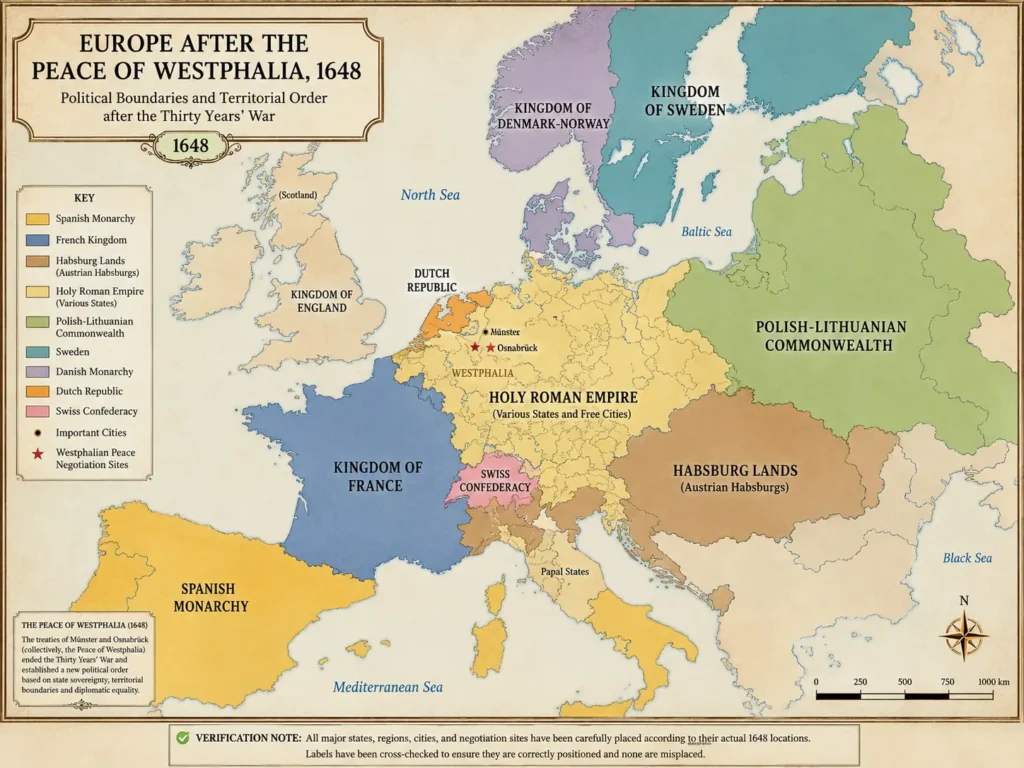
– Important nuance for DU exams: many IR scholars now treat “1648 as Year Zero” as an oversimplification. Stephen Krasner, in his influential work on sovereignty, calls Westphalian sovereignty a form of “organized hypocrisy” — a norm that states have invoked consistently while violating it just as consistently (through intervention, colonial conquest, and great-power politics). Examiners increasingly reward answers that mention this critique rather than presenting 1648 as an uncomplicated historical fact.
– The modern state system gained prominence in the 18th and 19th centuries with the rise of nationalism. Nationalistic movements sought to unite people based on common language, culture, and history, leading to the formation of nation-states.
3. Industrialization and Modernization:
– The Industrial Revolution in the 19th century brought about significant economic and social changes. As societies modernized, there was an increasing need for centralized governance to manage complex economies and social structures.
– States began to play a more active role in economic affairs, regulating industries, implementing social policies, and providing public services.
4. Colonialism and Imperialism: – Colonial expansion by European powers introduced the state system to various regions around the world. Colonial territories often had imposed borders that did not necessarily align with pre-existing social or ethnic divisions, contributing to later geopolitical challenges — a point directly relevant to the “artificial borders” debates you will study in the Nations section below. Sanjay Chaturvedi’s work on the colonial legacy of the nation-state develops this point further: he argues that many post-colonial states inherited borders drawn for the administrative and strategic convenience of the colonial power, not for the communities living within them — a mismatch between political boundary and social community that continues to generate conflict long after independence (Partition of India in 1947 being the clearest South Asian example, discussed further in the Nations section below).
5. World Wars and the Establishment of International Organizations: – The two World Wars in the 20th century had a profound impact on the state system. The devastation of the wars led to the establishment of the United Nations (UN) and other international organizations aimed at preventing conflicts and promoting cooperation among states.
6. Decolonization and Emergence of New States: – The mid-20th century witnessed the decolonization process, as former colonies gained independence. This led to the emergence of new states, often grappling with challenges related to nation-building, identity, and governance.
7. Cold War and Bipolarity: – The Cold War era (1947–1991) shaped international relations with the ideological rivalry between the United States and the Soviet Union. The bipolar world order influenced state alliances, conflicts, and the development of nuclear deterrence strategies.
8. Post-Cold War Era: – The end of the Cold War marked a shift in the global balance of power. The collapse of the Soviet Union and the emergence of new actors highlighted the fluid nature of the state system. – Globalization and advancements in technology further interconnected states, impacting economic, cultural, and political dynamics.
9. Challenges to State Sovereignty: – Contemporary challenges include issues such as transnational terrorism, climate change, and global pandemics, which test the ability of states to address shared concerns and cooperate on a global scale.
10. Evolution of State Functions: – States have evolved in terms of their functions, expanding beyond traditional roles in security and diplomacy to include economic management, welfare provision, and participation in international institutions.
The evolution and development of the state in the context of IR reflect the dynamic nature of international politics. Changes in the global landscape, technological advancements, and shifting geopolitical realities continue to shape the role of states in the international system. Understanding this historical context is essential for analyzing contemporary international relations and anticipating future developments.
Types and features of state
In the context of International Relations (IR), states are the primary actors that interact with each other in the international system. States vary in terms of their political structures, forms of government, and internal organization. Here are different types of states, along with their features, in the context of IR:
1. Nation-State: – Features:
– Nation-states are characterized by a congruence between the political entity (state) and a specific cultural or ethnic community (nation).
– The concept is based on the idea that each nation should have its own sovereign state, and citizens share a common identity, language, history, and culture.
– Nation-states often strive for national unity and may promote policies to strengthen a common national identity.
2. City-State: – Features:
– Historically, city-states were independent political entities centered around a city. Examples include ancient Athens, Rome, and medieval Italian city-states like Florence and Venice.
– City-states often had a high degree of autonomy, and their governance structures varied, ranging from democracies to oligarchies.
3. Federal State: – Features:
– Federal states, like the United States, Germany, and Canada, consist of multiple subnational entities (such as states or provinces) with a significant degree of autonomy.
– These subnational entities retain certain powers while delegating others to a central government, allowing for a division of authority between levels of government.
4. Unitary State: – Features:
– In a unitary state, political power is concentrated at the national level, and subnational entities have limited autonomy.
– The central government holds authority over all administrative divisions, and there is a uniform legal system throughout the country.
5. Authoritarian State: – Features:
– Authoritarian states are characterized by a concentration of political power in the hands of a single leader or a small group.
– Individual freedoms and political opposition may be restricted, and the government often exercises control over media, civil society, and political institutions.
6. Democratic State: – Features:
– Democratic states are characterized by representative government, where leaders are elected through periodic, free, and fair elections.
– Citizens typically enjoy political freedoms, and there are checks and balances to prevent the abuse of power. Democratic principles may vary, and there are different models of democracy.
7. Totalitarian State: – Features:
– Totalitarian states have a highly centralized government that exercises extensive control over all aspects of public and private life.
– The state seeks to regulate and control political, economic, social, and cultural spheres, often suppressing dissent and opposition.
8. Failed State: – Features:
– Failed states are characterized by a breakdown of governmental structures and institutions, leading to an inability to provide basic services, maintain order, or protect citizens.
– Factors contributing to state failure may include political instability, economic collapse, and social unrest.
– Exam tip: connect this back to the Weber definition above — a failed state is, in Weberian terms, a state that has lost its monopoly on the legitimate use of force. Political scientist Stephen Krasner (whose work also appears in the GE-4 reading list) has written specifically on institutional responses to state failure, proposing arrangements such as shared or “de facto trusteeship” sovereignty for collapsed states.
9. Transitional State: – Features:
– Transitional states are in a period of political transition, often following conflict or regime change.
– During this phase, the state may undergo significant institutional reforms, draft new constitutions, and work toward establishing stable governance.
10. Globalized State: – Features:
– Globalized states are characterized by extensive international engagement in economic, political, and cultural spheres.
– These states are active participants in the global economy, form alliances and partnerships with other states, and contribute to international institutions.
Understanding the different types of states and their features is essential for analyzing the dynamics of international relations. The variation in political systems and structures contributes to the diversity of interactions and relationships among states on the global stage.
Challenges and limitations of state
States, as key actors in International Relations (IR), face numerous challenges and limitations that shape their behavior and influence global dynamics. Understanding these challenges is crucial for analyzing the complexities of international relations. Here are detailed explanations of some of the major challenges and limitations faced by states in the context of IR:
Challenges:
1. Globalization: – Challenge: Globalization has interconnected states economically, culturally, and politically. While this creates opportunities for cooperation, it also poses challenges such as economic interdependence, the spread of transnational issues (e.g., terrorism, pandemics), and the erosion of state sovereignty.
2. Security Threats: – Challenge: States contend with a range of security threats, including terrorism, cyber attacks, and the proliferation of weapons of mass destruction. These challenges often require international cooperation to address effectively.
3. Human Rights and Humanitarian Crises: – Challenge: States may face scrutiny and pressure from the international community when there are human rights abuses or humanitarian crises within their borders. Balancing national sovereignty with global expectations can be challenging.
4. Climate Change: – Challenge: Climate change is a global issue that transcends national borders. States must collaborate to mitigate its effects, but differing national interests and priorities can impede collective action.
Lavanya Rajamani’s work on the principle of Common but Differentiated Responsibilities (CBDR) is directly relevant here: since industrialised states are historically responsible for the bulk of greenhouse gas emissions while developing states are still industrialising, international climate agreements (from the UNFCCC onward) assign differentiated obligations rather than treating all states identically — richer states are expected to cut emissions faster and finance mitigation/adaptation in poorer ones.
This principle is itself a live source of diplomatic tension, since developed and developing states frequently disagree over how the “differentiation” should be calculated and enforced.
5. Economic Inequality: – Challenge: Disparities in economic development and wealth distribution create tensions between states. Addressing global economic inequality requires cooperation but can be hindered by conflicting interests.
6. Nationalism and Populism: – Challenge: The rise of nationalism and populism in some states can lead to protectionist policies, strained international relations, and a reluctance to engage in multilateral cooperation.
7. Migration and Refugee Crises: – Challenge: The movement of people across borders due to conflict, economic hardship, or environmental issues poses challenges for states. It can lead to social, economic, and political tensions, both domestically and internationally.
8. Ethnic and Religious Conflicts: – Challenge: States may grapple with internal or regional conflicts based on ethnic or religious differences. These conflicts can have implications for state stability and international peace.
Limitations:
1. State Sovereignty: – Limitation: While sovereignty is a fundamental principle of the state system, it can limit the ability of states to address global challenges that require collective action. States may be hesitant to cede authority to international institutions.
2. Power Imbalances: – Limitation: Global power imbalances, whether economic, military, or technological, can influence the ability of states to assert their interests on the international stage. Smaller or less powerful states may face challenges in having their voices heard.
3. Complex Interdependence: – Limitation: The interdependence created by globalization can lead to complex relationships among states. This interdependence can limit the autonomy of states and make them vulnerable to external economic shocks or crises.
4. Institutional Constraints: – Limitation: International institutions, while essential for cooperation, may face limitations such as inadequate enforcement mechanisms, unequal representation, or inefficiencies that hinder their ability to address global challenges effectively.
5. Historical and Cultural Context: – Limitation: Historical and cultural factors shape states’ perceptions and actions in international relations. Deep-seated historical grievances and cultural differences can impede cooperation and contribute to conflicts.
6. Internal Divisions: – Limitation: Internal divisions, such as political polarization, ethnic tensions, or economic inequality within a state, can weaken its ability to engage effectively in international relations.
7. Legal and Normative Constraints: – Limitation: States are bound by international law and norms, but compliance is not always guaranteed. Some states may act in violation of established norms, leading to challenges in enforcing international standards.
8. Limited Resources: – Limitation: States may face limitations in terms of financial resources, manpower, and technological capabilities, affecting their ability to address global challenges adequately.
Understanding these challenges and limitations is essential for policymakers, scholars, and analysts in navigating the complexities of international relations. States must grapple with these issues while seeking cooperative solutions in a rapidly changing world.
Is the state declining? The globalisation debate
A major theoretical debate in this unit is whether globalisation has weakened the state as the central actor in world politics.
The “retreat of the state” thesis: Susan Strange, in her influential 1996 book The Retreat of the State, argued that authority has been diffusing away from states toward markets, multinational corporations, and non-state actors. States, in her view, increasingly compete with each other to attract mobile capital and investment, which shifts real bargaining power to firms and financial markets rather than governments. She described this as a movement from a “diplomacy among states” to a “diplomacy among states and firms.”
The realist/statist counter-argument: Scholars in the realist tradition contest this view, arguing that:
- States remain the only actors capable of legitimate coercive force (tying back to Weber’s definition).
- Even “globalized” markets depend on states to enforce property rights, contracts, and currency stability — there is no truly “stateless” market.
- Powerful states (especially the US, China, and the EU) actively shape the rules of globalisation rather than being passively eroded by it — regulating trade, sanctioning rivals, and setting technology standards.
A third, “transformationalist” position — David Held: Rather than picking a side, David Held (whose essay ‘The Territorial State and Global Politics’ is part of the syllabus reading list) argues that sovereignty is not simply being lost to markets, as the retreat-of-the-state thesis suggests, nor is it unchanged, as strict realists claim — it is being reconfigured and pooled. Held identifies three concrete shifts:
(i) a state’s regulatory and protective capacity is being reshaped by expanding economic and political networks it does not fully control;
(ii) decisions taken outside a country’s borders (in international institutions or by other governments) increasingly affect domestic life, narrowing citizens’ control over their own government; and
(iii) globalisation reshapes political identities, so that regional and local groups begin to question whether the central state still represents them. Crucially, Held stresses that states often choose to pool sovereignty — joining a climate treaty or a trade bloc means giving up some freedom of action in exchange for the capacity to solve problems no single state could manage alone.
A balanced exam answer should present all three positions — Strange’s retreat-of-the-state, the realist rebuttal, and Held’s transformationalist “pooled sovereignty” — rather than treating the debate as a simple either/or. The consensus among most contemporary IR scholars is closer to Held’s position: states are not disappearing, but they are increasingly sharing regulatory and economic space with markets and international institutions, a theme this unit returns to in the Part III sections below.
Nations and Nationalism
Concept and significance of nation
In the context of International Relations (IR), the concept of a nation is closely related to the broader concept of the nation-state. Here, we’ll delve into the concept of a nation and its significance in the field of International Relations:
Concept of a Nation:
1. Definition: – A nation can be broadly defined as a group of people who share a common identity, often characterized by factors such as language, culture, history, and sometimes religion. It is a subjective feeling of belonging and shared consciousness among a group of individuals.
Two influential academic definitions worth remembering for exams:
- Benedict Anderson (Imagined Communities, 1983) defines the nation as an “imagined political community” — imagined because most members of even the smallest nation will never meet most of their fellow-members, yet each carries a mental image of their communion; and a community because, regardless of internal inequality, the nation is conceived as a deep, horizontal comradeship.
- Ernest Gellner, taking a “modernist” position, argued that nationalism does not awaken nations to self-consciousness; it invents nations where they do not exist — i.e., nations are a product of modern industrial society and mass education systems, not ancient, natural facts. This “modernist” view is usually contrasted in DU answers with the “primordialist” view, which treats national identity as rooted in ancient, quasi-natural ethnic ties.
- Andrew Heywood, in his textbook treatment of nations and nationalism, similarly stresses that a nation is fundamentally a psychological-cultural community — bound by subjective self-identification — and is therefore distinct from an ethnic group (based on shared descent) or a race (based on shared physical traits), even though the three are often confused in everyday usage. Heywood’s typology of nationalism (cultural nationalism vs political nationalism, and liberal vs conservative vs expansionist forms) is useful for the “types of nationalism” part of exam answers.
How do people actually come to identify with a nation? Elena Barabantseva’s work on national identification pushes the “imagined community” idea further into practical terms: national belonging is not automatic but actively produced and reproduced through everyday symbols and routines — a shared language and print culture (as Anderson also emphasised), national flags and anthems, school textbooks and history curricula, public holidays and commemorations, and media narratives that repeatedly draw the line between “us” (the nation) and “them” (outsiders). This is a useful, concrete answer to the frequently-asked question of how imagined communities are built and sustained in practice, not just what they are in theory.
Is the nation-state itself a natural or a constructed category? Michael J. Shapiro’s essay ‘Does the Nation-State Work?’ takes the constructivist critique furthest. He argues that transnational flows of people, trade, and ideas historically pre-date the nation-state, and that the process of nation-state formation was, in important ways, a project of drawing hard lines between a “national” inside and an “international” outside where none had naturally existed before — a process that required forgetting or suppressing the transnational connections that came before it. In this reading, the nation-state’s apparent naturalness is itself the product of a historical and, at times, coercive sorting process, rather than the starting point of world politics. This gives DU students a stronger critical angle for questions asking whether the nation-state “works” in a globalised, transnational world.
2. Nation vs. State: – While the terms “nation” and “state” are often used interchangeably, they have distinct meanings. A nation is a cultural, ethnic, or linguistic community with a shared identity, while a state is a political entity with defined borders, a government, and sovereignty.
3. Nationalism: – Nationalism is the political ideology that emphasizes the importance of the nation and its right to self-determination. It often seeks to promote and protect the interests, culture, and identity of the nation.
4. Multinational States: – In some cases, a state may contain multiple nations. These are called multinational states, where different national groups coexist within the same political entity. Managing diversity within such states can be a challenge.
5. Nation-Building: – Nation-building refers to the process of constructing or enhancing a national identity, often within the context of state-building. It involves fostering a sense of unity among diverse populations within a state.
Significance of the Nation in International Relations:
1. Identity and Self-Determination: – Nations play a crucial role in shaping the identity of individuals and communities. The principle of self-determination, the right of a nation to govern itself, is a key aspect of international relations.
2. National Interests: – States often base their foreign policies on the perceived interests of the nation. These interests can include security, economic well-being, and the promotion of the nation’s values and influence in the international arena.
3. National Security: – Ensuring the security of the nation is a primary concern for states. National security policies are formulated to protect the state and its citizens from external threats, contributing to the broader field of international security studies.
4. Nationalism in International Relations: – Nationalism influences the behavior of states in the international system. It can manifest as patriotism, national pride, or, in extreme cases, as aggressive and expansionist policies.
5. International Alliances: – Nations often form alliances and partnerships with other states based on shared interests or common values. These alliances can have significant implications for international relations and geopolitical dynamics.
6. Diasporas and Transnationalism: – The concept of the nation extends beyond borders, especially in the era of globalization. Diaspora communities maintain connections with their homeland, contributing to transnational networks and influencing international relations.
7. Conflict and Cooperation: – National identities can be a source of both conflict and cooperation. Ethnic or national tensions may lead to disputes, while shared national interests can foster cooperation among states.
8. Cultural Diplomacy: – Nations use cultural diplomacy to promote their image abroad and strengthen international relations. This includes activities such as cultural exchanges, language promotion, and the export of cultural products.
9. Global Governance and Multilateralism: – Nations participate in international organizations and institutions to address global challenges collectively. Multilateralism relies on states working together to find solutions to issues such as climate change, public health, and economic development.
Understanding the significance of the nation in the context of International Relations helps shed light on the motivations and behaviors of states in the global arena. The complex interplay between national identity, state interests, and international dynamics shapes the landscape of international relations.
Evolution and development of nation
The evolution and development of a nation in the context of International Relations (IR) is a complex and multifaceted process that involves political, economic, social, and cultural dimensions. Understanding how nations evolve and develop in the international arena requires examining historical, theoretical, and practical perspectives. Below is an overview of key aspects related to the evolution and development of nations in the context of IR:
1. Historical Context: – Colonialism and Independence: Many nations have a history shaped by colonialism, with European powers establishing empires across Africa, Asia, and the Americas. The struggle for independence marked a significant phase in the evolution of nations, as they sought to assert their sovereignty and identity.
– Post-World War II Reconstruction: The aftermath of World War II led to the reconstruction of many nations and the establishment of international organizations such as the United Nations (UN). The Cold War rivalry between the United States and the Soviet Union also influenced the development of nations as they aligned with one of the superpowers.
2. Political Development: – State-Building: The process of forming a nation-state involves establishing political institutions, defining borders, and creating a sense of national identity. Nation-building is a complex process that often includes consolidating diverse ethnic, religious, and cultural groups.
– Political Systems: The type of political system adopted by a nation, such as democracy, authoritarianism, or socialism, influences its development and interactions in the international arena.
3. Economic Development: – Industrialization and Globalization: Economic development plays a crucial role in a nation’s standing in international relations. Industrialization and globalization have transformed economies, impacting trade, investment, and the distribution of wealth.
– Development Policies: Nations often pursue various economic policies, such as import substitution, export-oriented growth, or neoliberal reforms, to stimulate economic development and competitiveness in the global market.
4. Social and Cultural Dimensions: – Cultural Diplomacy: Soft power and cultural diplomacy play a role in a nation’s image and influence abroad. Cultural exchanges, education programs, and media influence contribute to a nation’s cultural presence on the global stage.
– Identity and Nationalism: National identity and nationalism shape a nation’s foreign policy and interactions with other countries. Ethnic, religious, or linguistic factors can influence a nation’s sense of unity and belonging.
5. International Relations Theories: – Realism, Liberalism, and Constructivism: These are some of the major IR theories that offer different perspectives on how nations interact. Realism emphasizes power politics, liberalism focuses on international institutions and cooperation, while constructivism highlights the role of ideas and identity.
– Global Governance: Nations participate in various international organizations and agreements to address global challenges, such as climate change, economic inequality, and security issues. The evolution of global governance structures reflects changing dynamics in international relations.
In summary, the evolution and development of nations in the context of International Relations are shaped by historical legacies, political choices, economic strategies, social factors, and international interactions. The study of IR involves analyzing how nations navigate the complexities of the global system and engage with other actors to pursue their interests and contribute to global stability and cooperation.
Types and features of nation
In the context of International Relations (IR), the concept of a nation refers to a politically organized body of people under a single government or authority. Nations are key actors in the international system, and they interact with each other to pursue their interests, address common challenges, and engage in diplomatic, economic, and security relations. Below are types and features of nations in the context of IR:
Types of Nations:
1. Nation-State:
– Definition: A nation-state is a sovereign state inhabited by a population with a common national identity, language, and culture.
– Features: Nation-states have defined borders, a central government, and a citizenry that shares a sense of national identity. Examples include France, Japan, and Germany.
2. Multinational State:
– Definition: A multinational state is a sovereign state that includes multiple nations within its borders, each with its distinct identity.
– Features: These states often face challenges related to managing diversity and may adopt federal systems or autonomy arrangements. Examples include Canada and India.
3. Supranational Organizations:
– Definition: Supranational organizations involve multiple nations pooling sovereignty to achieve common goals.
– Features: The European Union (EU) is an example, where member states delegate certain powers to supranational institutions to promote economic and political integration.
4. Transnational Nations:
– Definition: Transnational nations refer to communities or groups that span multiple states and may not have a territorial base.
– Features: Diaspora communities, global religious organizations, and multinational corporations are examples of transnational entities that influence international relations.
Features of Nations in the Context of IR:
1. Sovereignty: – Nations in IR are considered sovereign entities, meaning they have the supreme authority within their borders and are recognized as such by other states.
2. National Interest: – Nations pursue their national interest in the international arena, which can include economic prosperity, security, territorial integrity, and the promotion of ideological values.
3. Foreign Policy: – Each nation develops a foreign policy to guide its interactions with other states. This includes diplomatic, economic, and military strategies to advance national interests.
4. Identity and Culture: – National identity, culture, and language play a significant role in shaping a nation’s perception of itself and its interactions with other nations. Cultural diplomacy is often employed to build bridges and strengthen international relations.
5. Diplomacy and International Organizations: – Nations engage in diplomatic relations and participate in international organizations to address common challenges, negotiate agreements, and promote cooperation on issues such as trade, human rights, and security.
6. Military Power: – Military capabilities are crucial in the realm of IR, influencing a nation’s ability to defend itself, deter potential adversaries, and contribute to collective security efforts.
7. Economic Strength: – Economic power and influence are essential in international relations. Nations with robust economies often have greater leverage in diplomatic negotiations and can shape global economic trends.
8. Global Governance Participation: – Nations participate in global governance structures, such as the United Nations, to contribute to international decision-making, address global challenges, and uphold international law.
Understanding the types and features of nations in the context of IR is essential for analyzing the dynamics of international relations, as it provides insights into how states interact, cooperate, and compete in the global system.
Challenges and limitations of nation
Nations face various challenges and limitations that shape their interactions with other states and actors on the global stage. These challenges can arise from political, economic, social, and environmental factors. Understanding these challenges is crucial for policymakers, scholars, and analysts involved in the study of IR. Here are detailed explanations of some key challenges and limitations:
Challenges:
1. Security Challenges:
– Military Conflicts: Nations often face the challenge of resolving or managing conflicts, whether regional or global, which can threaten security and stability.
– Terrorism: Transnational threats such as terrorism pose challenges to national security and require international cooperation to address effectively.
2. Economic Challenges:
– Global Economic Uncertainty: Economic challenges, including recessions, trade disputes, and financial crises, can impact a nation’s economic stability and growth.
– Inequality: Economic disparities within and among nations can lead to social unrest and strain international relations.
3. Political Challenges:
– Authoritarianism vs. Democracy: The tension between states with different political systems can lead to ideological conflicts and challenges in diplomatic relations.
– Failed States: Weak governance and state failure can create security vacuums and contribute to regional instability.
4. Humanitarian Challenges:
– Refugee Crises: Mass migration and refugee flows can strain relations between nations and pose humanitarian challenges.
– Human Rights Violations: Nations may face criticism and sanctions for human rights abuses, impacting their international standing.
5. Environmental Challenges:
– Climate Change: Environmental issues, such as climate change, can lead to resource conflicts, displacement, and challenges in global cooperation.
– Natural Disasters: Nations may need international assistance to cope with the aftermath of natural disasters.
6. Global Health Challenges:
– Pandemics: Global health crises, such as pandemics, require international collaboration in disease control, vaccine distribution, and healthcare infrastructure.
7. Cybersecurity Challenges:
– Cyber Threats: Nations face challenges in securing their critical infrastructure from cyber threats and navigating the complexities of cyber warfare.
Limitations:
1. Sovereignty: – Limitations on Action: Nations, in pursuit of their interests, are constrained by the principles of sovereignty, which may limit their ability to intervene in the affairs of other states.
2. International Law: – Enforcement Challenges: While international law exists, enforcement mechanisms are often limited, and compliance depends on the willingness of states to adhere to legal norms.
3. Economic Interdependence: – Vulnerability to Economic Shocks: The interconnectedness of global economies means that economic challenges in one nation can have ripple effects on others, limiting their ability to insulate themselves from external shocks.
4. Diplomatic Constraints: – Alliances and Commitments: Nations may face limitations in their foreign policy due to commitments to alliances, treaties, and international organizations.
5. Cultural and Linguistic Barriers: – Communication Challenges: Differences in culture and language can lead to misunderstandings and hinder effective communication in international relations.
6. Power Asymmetry: – Power Imbalances: Power imbalances among nations can create challenges in negotiations and contribute to inequalities in the international system.
7. Nationalism and Identity: – Nationalistic Constraints: Nationalistic sentiments may limit a nation’s willingness to cooperate on certain issues or to make concessions in negotiations.
8. Resource Constraints: – Limited Resources: Nations may face limitations in terms of resources, both human and financial, affecting their capacity to address various challenges effectively.
Understanding these challenges and limitations is essential for policymakers and diplomats to navigate the complex landscape of international relations. Addressing these issues often requires multilateral cooperation, diplomatic skill, and a nuanced understanding of the global context.
State vs Nation vs Nation-State
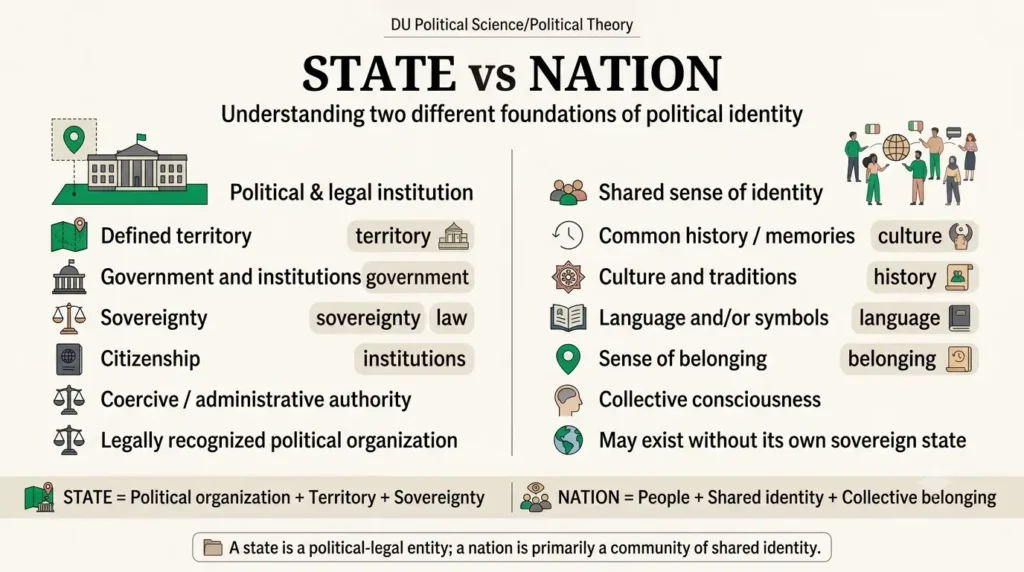
| Aspect | State | Nation | Nation-State |
|---|---|---|---|
| Nature | Political and legal entity | Cultural/psychological community | Fusion of political and cultural entity |
| Basis | Territory, government, sovereignty | Shared language, history, culture, “imagined” solidarity (Anderson) | State boundaries coincide with a national community |
| Recognition | Recognised by international law and other states | Not necessarily recognised in law; may exist without a state (e.g., a stateless nation) | Recognised as both a legal and cultural unit |
| Can exist without the other? | Yes — a state can contain many nations (multinational state, e.g., India) | Yes — a nation can exist without its own state (e.g., the Kurds) | By definition, no — requires congruence of both |
| Key thinker | Max Weber (monopoly of legitimate force) | Benedict Anderson (imagined community); Ernest Gellner (modernist invention) | — |
States and Markets
Concept and significance of market
The concept of the market in the context of international relations (IR) refers to the economic interactions and exchanges that take place between different nations. The significance of the market in IR is rooted in the idea that economic factors play a crucial role in shaping the relationships between countries, influencing diplomatic, political, and social dynamics. Here are some key aspects to consider:
A crucial caution before we define it — is “the market” even a single thing? Political economist Matthew Watson, in his work on understanding the state and the market, warns against treating “the market” as a natural, self-acting force with its own will — what he calls the “thingification” of the market. In everyday and even policy language, we speak of “market forces” punishing a currency or “the market” demanding austerity, as though the market were an autonomous actor separate from politics.
Watson’s point is that markets are always politically and socially constructed — built, regulated, and sustained by legal rules, property rights, and institutions that states and societies create — so “the market versus the state” is a misleading framing if it implies the market exists independently of political choices in the first place. Keep this caution in mind as you read the “types,” “evolution,” and “challenges” sections below.
Concept of Market in International Relations:
1. Economic Interdependence: – Nations engage in trade and investment to meet their economic needs. The market represents the arena where goods, services, and capital flow across borders, creating interdependence among countries.
2. Globalization: – The market is a key driver of globalization, the process by which economies and societies become more interconnected. Globalization intensifies economic ties and influences international relations by breaking down barriers to trade and communication.
3. Trade Relations: – The market involves the exchange of goods and services between countries. Bilateral and multilateral trade agreements are negotiated to facilitate and regulate these exchanges, impacting diplomatic relations.
4. Economic Power: – Economic strength enhances a nation’s standing in international relations. Countries with robust and diverse markets often have greater influence in shaping global policies and norms.
5. Soft Power: – The market can contribute to a nation’s soft power, influencing others through culture, economic success, and attractiveness. Economic prosperity can enhance a country’s global image and influence.
Significance of Market in International Relations:
1. Conflict Prevention: – Interconnected economies create incentives for peaceful relations. Countries that are economically dependent on each other have a vested interest in avoiding conflicts that could disrupt trade and economic stability.
2. Diplomatic Relations: – Economic issues often dominate diplomatic agendas. Trade negotiations, economic sanctions, and financial cooperation are integral parts of international diplomacy.
3. Influence on Global Governance: – Economic power translates into influence in international institutions. Countries with significant market strength can shape global economic policies, regulations, and standards. (For a detailed look at how these institutions function, see our GE-7 Unit-4 notes on the World Bank, IMF, WTO and G-20.)
4. Technological Transfer: – Markets facilitate the exchange of technology and knowledge across borders, contributing to the development and progress of nations. This can impact a country’s competitiveness and innovation capacity.
5. Social and Cultural Exchange: – The market fosters cross-cultural interactions as people from different nations engage in trade and business. This can lead to greater understanding and cooperation on social and cultural levels.
6. Development and Prosperity: – Access to international markets can stimulate economic growth and development. Developing nations often seek to integrate into the global market to improve living standards and promote prosperity.
Understanding the concept of the market in international relations is crucial for policymakers, diplomats, and analysts, as it provides insights into the complex interplay between economic forces and geopolitical considerations. It highlights the interconnected nature of the global community and the importance of cooperation and negotiation in addressing shared challenges.
Three classical perspectives on states and markets
Political economist Robert Gilpin (in The Political Economy of International Relations, 1987, and Global Political Economy, 2001) identified three classical schools of thought on how states and markets relate to each other:
| Perspective | Core claim | View of the state | View of the market |
|---|---|---|---|
| Mercantilism / Economic Nationalism | Economics should serve the political and security interests of the state | State is dominant; economy is a tool of state power | Market should be regulated/subordinated to national interest (tariffs, protectionism) |
| Liberalism | Politics and economics are separable; free markets benefit all parties through mutual gains | State should have a limited role — mainly enforcing contracts and property rights | Free, self-regulating market is the most efficient allocator of resources |
| Marxism / Structuralism | Economic class relations determine political outcomes; capitalism is inherently exploitative | State serves the interests of the dominant capitalist class | Market generates structural inequality between core and periphery economies (dependency theory) |
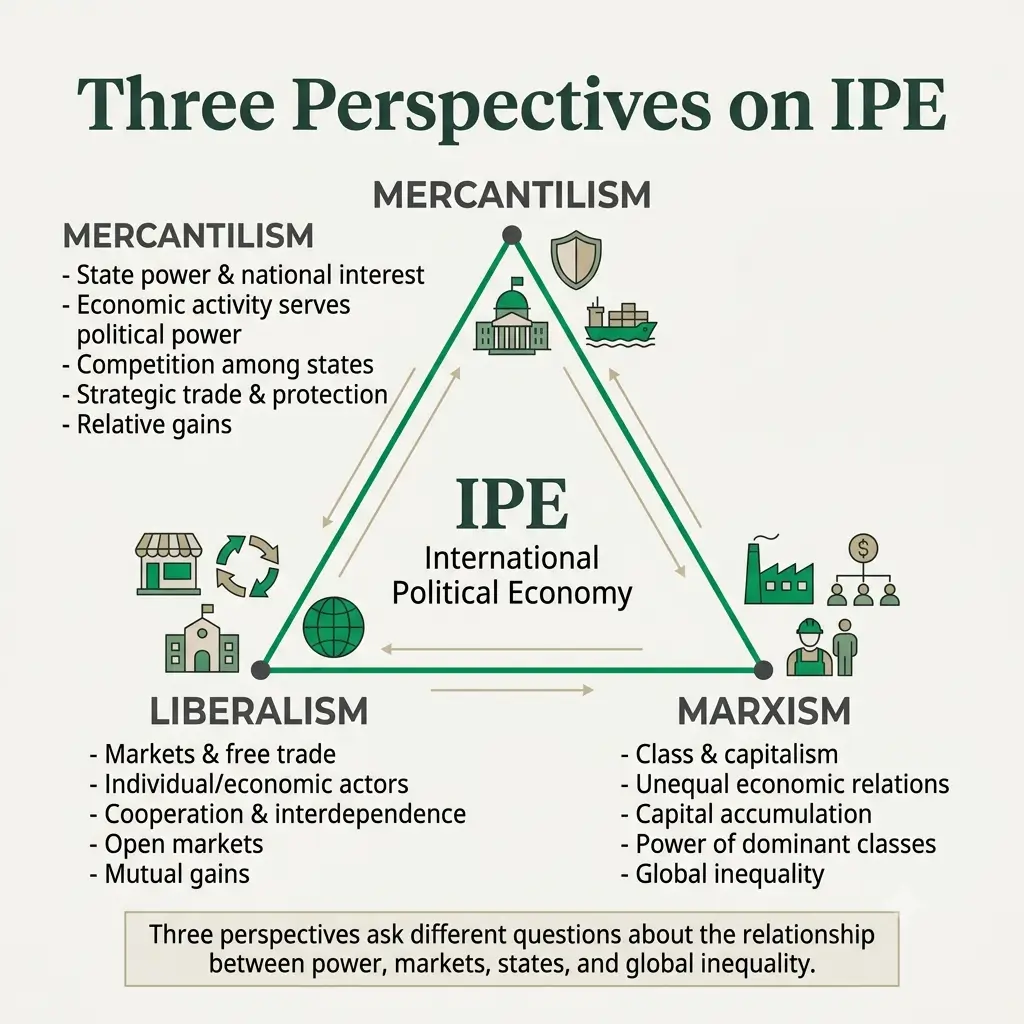
Gilpin’s framework is important because it shows that “states vs markets” is not a single debate — it is at least three different debates, depending on whether you start from a security-first (mercantilist), efficiency-first (liberal), or class-first (Marxist) assumption.
Susan Strange’s structural power framework
In her seminal 1988 book States and Markets, Susan Strange — widely regarded as a founder of the field of International Political Economy (IPE) — offered an alternative to simply asking “who has more power, states or markets?” She argued that power in the world economy operates through four interlocking structures:

- Security structure — control over the provision (or denial) of protection from violence.
- Production structure — control over what is produced, by whom, and under what conditions.
- Financial structure — control over the supply and access to credit and capital.
- Knowledge structure — control over what knowledge is discovered, stored, communicated, and believed (including technology and information).
Strange’s key insight is that a state or a firm does not need to dominate all four structures to be powerful — different actors can hold structural power in different domains simultaneously, and states and markets are constantly bargaining across all four at once. This is a more sophisticated way of answering “does the state or the market dominate IR?” than a simple either/or answer, and DU examiners specifically reward students who cite this framework by name.
Evolution and development of market
The evolution and development of markets in the context of international relations (IR) have undergone significant changes over the centuries. The interaction of states and their economic activities has evolved in response to geopolitical shifts, technological advancements, and changes in economic theories. Here’s a detailed overview of the evolution and development of markets in the context of international relations:
1. Pre-Modern Era:
– Barter System: In ancient times, the barter system prevailed, where goods and services were exchanged directly without a common medium of exchange. International trade was limited and often occurred through caravan routes and maritime trade.
2. Mercantilism (16th to 18th centuries):
– National Wealth: Mercantilist economic policies focused on accumulating gold and silver reserves to increase national wealth. States played a dominant role in economic affairs, seeking to maintain a positive balance of trade.
– Colonialism: European powers established colonies to secure resources and markets, shaping the early dynamics of international trade.
3. Industrial Revolution (18th to 19th centuries):
– Technological Advancements: The Industrial Revolution brought about significant technological advancements, leading to increased production and the rise of factories. This fueled demand for raw materials and new markets, driving international trade.
– Imperialism: European powers expanded their empires to secure access to resources and markets, further integrating economies on a global scale.
4. Classical Liberalism (19th century):
– Laissez-Faire Economics: The rise of classical liberalism emphasized free markets and limited government intervention. The idea of comparative advantage, proposed by economist David Ricardo, became influential in shaping trade policies.
5. Interwar Period and Bretton Woods (20th century):
– Protectionism and Economic Nationalism: The interwar period saw a rise in protectionist measures and economic nationalism, contributing to the Great Depression. After World War II, the Bretton Woods Conference (1944) established institutions like the IMF and World Bank to facilitate international economic cooperation and stability.
6. Post-Cold War Era (Late 20th century):
– Globalization: The latter half of the 20th century witnessed increased globalization, marked by the liberalization of markets, advancements in technology, and the dismantling of trade barriers. (See our detailed GE-7 notes on Conceptualising Globalisation for the three theoretical perspectives — hyperglobalist, sceptic, and transformationalist — that are often cross-referenced with this unit.)
– Rise of Transnational Corporations: Multinational corporations played an increasingly prominent role, shaping global markets and influencing state policies.
7. Contemporary Era (21st century):
– Information Technology: The digital revolution and advancements in information technology have further accelerated globalization, facilitating instant communication and online transactions.
– Trade Agreements: The proliferation of regional and bilateral trade agreements, as well as the World Trade Organization (WTO), has continued to shape the rules and norms governing international trade.
8. Challenges and Tensions:
– Trade Wars and Protectionism: Recent years have seen a resurgence of protectionist measures and trade tensions between major economies.
– Global Supply Chains: The complexity of global supply chains has highlighted vulnerabilities, especially in times of geopolitical tensions or health crises.
Future Trends:
– Sustainable Development: There is a growing emphasis on sustainable and responsible business practices, reflecting concerns about environmental and social impacts.
– Digital Economy: The rise of the digital economy and e-commerce is transforming traditional market structures, presenting new challenges and opportunities in international relations.
The evolution of markets in the context of international relations reflects a dynamic interplay of economic theories, geopolitical forces, and technological advancements. The ongoing development of markets continues to shape the landscape of international relations, presenting both opportunities for cooperation and challenges that require diplomatic and policy responses.
Types and features of market
In the context of international relations, markets can take various forms, each with distinct features that influence the dynamics of economic interactions between nations. Here are some types of markets and their features in the context of international relations:
1. Global Market:
– Scope: Encompasses the entire world and involves the exchange of goods, services, and capital on a global scale.
– Features: – Global markets are characterized by high levels of interconnectedness and interdependence among nations.
– Trade in the global market often involves major players, including multinational corporations and powerful economies.
– Market participants are influenced by global economic trends, geopolitical events, and international institutions.
2. Regional Markets:
– Scope: Limited to a specific geographic region or group of countries that share common economic interests.
– Features: – Regional markets promote economic integration and cooperation among neighboring countries.
– Examples include the European Union’s single market and the Association of Southeast Asian Nations (ASEAN) economic community.
– Regional markets often involve the negotiation of trade agreements and the removal of trade barriers among member states.
3. Bilateral and Multilateral Trade:
– Scope: Involves trade agreements between two countries (bilateral) or multiple countries (multilateral).
– Features: – Bilateral trade agreements focus on the economic relationship between two specific nations, addressing issues such as tariffs and market access.
– Multilateral trade agreements involve multiple countries and are often negotiated through international organizations like the World Trade Organization (WTO).
– Trade agreements aim to create a framework for fair and mutually beneficial economic interactions.
4. Emerging Markets:
– Scope: Refers to economies that are in the process of rapid industrialization and experiencing high levels of growth.
– Features: – Emerging markets often present opportunities for foreign investment and trade due to their expanding economies. – These markets may have unique challenges, such as regulatory uncertainties, but also offer potential rewards for businesses and investors.
5. Commodity Markets:
– Scope: Focuses on the buying and selling of commodities such as oil, metals, agricultural products, etc.
– Features: – Commodity markets are influenced by global supply and demand dynamics, geopolitical events, and weather conditions. – Fluctuations in commodity prices can have significant impacts on the economies of both exporting and importing nations.
6. Digital Markets:
– Scope: Involves online platforms and e-commerce where goods and services are bought and sold electronically.
– Features: – Digital markets transcend national borders, allowing for instantaneous transactions and global connectivity. – E-commerce platforms enable small and medium-sized enterprises (SMEs) to participate in international trade. – Issues related to data protection, cybersecurity, and digital trade regulations are crucial in digital markets.
7. Financial Markets:
– Scope: Involves the trading of financial instruments such as currencies, stocks, and bonds.
– Features: – Financial markets play a critical role in facilitating international capital flows and investments. – Exchange rates, interest rates, and financial regulations impact the behavior of financial markets. – The stability of financial markets is essential for maintaining confidence in the global economy.
8. Sustainable and Ethical Markets:
– Scope: Focuses on environmentally friendly and socially responsible business practices.
– Features: – Sustainable markets emphasize long-term environmental and social considerations in economic activities. – Certification systems and standards (e.g., fair trade) help ensure ethical practices in global supply chains. – The demand for sustainable products and corporate responsibility influences international business strategies.
Understanding the types and features of markets in the context of international relations is essential for policymakers, businesses, and analysts. Different markets contribute to the complexity of economic interactions between nations, and their features shape the landscape of international trade, investment, and cooperation.
Challenges and limitations of market
While markets in the context of international relations bring about numerous benefits, they also face challenges and limitations that impact global economic interactions. Understanding these challenges is crucial for policymakers, businesses, and analysts. Here are the key challenges and limitations of markets in the context of international relations:
1. Inequality:
– Challenge: Global markets can exacerbate income and wealth inequality both within and between nations.
– Limitation: Unequal distribution of resources and benefits can lead to social and political tensions, both domestically and internationally.
2. Market Failures:
– Challenge: Markets may fail to allocate resources efficiently or produce socially desirable outcomes.
– Limitation: Issues such as externalities, public goods, and asymmetric information can result in market failures, necessitating government intervention.
3. Dependency and Vulnerability:
– Challenge: Developing nations may become dependent on a few key exports, making them vulnerable to fluctuations in global commodity prices.
– Limitation: Economic dependence can expose countries to external shocks and limit their ability to diversify and develop sustainable economies.
4. Financial Crises:
– Challenge: Global financial markets are susceptible to crises, such as currency devaluations, banking collapses, and debt crises.
– Limitation: Financial instability can have widespread and severe consequences, affecting economies around the world and necessitating coordinated international responses.
5. Trade Imbalances:
– Challenge: Persistent trade imbalances can lead to tensions between surplus and deficit countries. – Limitation: Trade imbalances may result in protectionist measures, currency conflicts, and strains on international economic relations.
6. Environmental Concerns:
– Challenge: Unregulated markets may contribute to environmental degradation and resource depletion.
– Limitation: Market-driven activities that disregard environmental sustainability can lead to long-term consequences, affecting ecosystems and climate.
7. Labor Exploitation:
– Challenge: Global markets may contribute to labor exploitation, particularly in industries with weak labor standards.
– Limitation: Exploitative labor practices can lead to social unrest, damage reputations, and pose ethical challenges for companies involved in international trade.
8. Regulatory Arbitrage:
– Challenge: Differences in regulatory frameworks between countries can lead to regulatory arbitrage, where businesses exploit loopholes for competitive advantage.
– Limitation: Regulatory gaps and inconsistencies may hinder efforts to establish a level playing field and ensure fair competition in the global market.
9. Nationalism and Protectionism:
– Challenge: Rising nationalism and protectionist policies can disrupt global supply chains and hinder international cooperation.
– Limitation: Protectionist measures, trade wars, and geopolitical tensions can undermine the principles of free trade and economic cooperation.
10. Technological Displacement:
– Challenge: Rapid technological advancements may lead to job displacement and economic dislocation in certain industries and regions.
– Limitation: The uneven distribution of the benefits of technology can contribute to social and economic disparities, both within and between nations.
11. Cultural Resistance:
– Challenge: Cultural differences may create resistance to globalized markets, particularly in regions where there is a strong emphasis on cultural identity.
– Limitation: Cultural resistance can impede the integration of markets and hinder cross-cultural understanding and cooperation.
Addressing the challenges and limitations of markets in the context of international relations requires a comprehensive and collaborative approach. Policymakers, international organizations, and businesses need to work together to establish fair and sustainable economic systems that promote global prosperity while addressing social, environmental, and ethical concerns.
Key Takeaways
- The state is a political-legal entity defined by territory, population, government, and sovereignty; Max Weber’s definition — the monopoly of the legitimate use of force within a territory — is the anchor definition for DU exams.
- The 1648 Peace of Westphalia is the conventional origin story for state sovereignty, but scholars like Stephen Krasner treat it as “organized hypocrisy,” since sovereignty has always been violated as much as it has been respected.
- A nation is a cultural/psychological community (Anderson’s “imagined community”); it does not require its own state, and a state can contain more than one nation (multinational state).
- The relationship between states and markets can be read through three classical lenses — mercantilism, liberalism, and Marxism (Gilpin) — or through Susan Strange’s four structures of power: security, production, finance, and knowledge.
- Whether the state is “retreating” in the face of markets (Strange) or remains the dominant actor (realists) is one of the unit’s central live debates — a balanced answer should engage with both sides rather than picking one uncritically.
Continue Reading
Continue Reading — States and Markets
University of Delhi Previous Year Questions
The questions below are compiled from DU’s official college Question Banks (SGND Khalsa College), GE/CC-4 papers (2022, 2023), and the sub-topic reading lists prescribed for Unit-2 (2.1 State and Diffusion of Authority/Power, 2.2 Nations and Nationalism, 2.3 States and Markets). This unit is asked every year in both the 10-mark and 15-mark formats.
DU Previous Year Questions — Unit 2: States, Nations and Markets
Important DU questions arranged section-wise according to Unit 2. Each question includes its marks, source/paper where available, and a quick-answer guide.
1 Explain the evolution of the international state system. How did the Peace of Westphalia shape modern IR? +
Hint: Structure chronologically, then focus on 1648 and the conventional contributions of the Peace of Westphalia — sovereignty, non-intervention and legal equality of states. For higher marks, add the Krasner critique of “organized hypocrisy.” 15 Marks
2 Analyze the concept of state sovereignty. Is it eroding in the contemporary globalized world? +
Hint: Define sovereignty, then contrast Susan Strange’s “retreat of the state” thesis with the realist argument that states continue to possess coercive, legal and regulatory authority. 15 Marks
3 Discuss the role of nations and nationalism in international relations. How do they challenge state authority? +
Hint: Define nation and nationalism, explain self-determination, and show how nationalist claims can challenge existing state borders through demands for autonomy or statehood. 15 Marks
4 Examine the relationship between states and markets. What is the significance of economic globalization? +
Hint: Use Gilpin’s three perspectives — mercantilism, liberalism and Marxism — as the theoretical framework. Add Susan Strange’s four structures of power and examples such as WTO, IMF and MNCs. 15 Marks
5 Distinguish between State and Nation. Is India a Nation-State or Multinational State? +
Hint: Begin with the State–Nation–Nation-State distinction. Then discuss India’s linguistic, religious and regional diversity while acknowledging the counter-view of a shared constitutional-civic Indian nationhood. 15 Marks
6 Discuss the diffusion of power / “Retreat of the State” based on Susan Strange. +
Hint: Explain Strange’s argument from The Retreat of the State (1996), showing how authority diffuses toward markets, firms and non-state actors. Contrast this with the realist rebuttal and conclude with the idea of shared rather than completely replaced authority. 15 Marks
7 What is the State? Explain its four essential elements — sovereignty, territory, population and government. +
Hint: Define each of the four elements with a brief example. Add Max Weber’s definition of the state as possessing a “monopoly of legitimate force” for extra analytical depth. 10 Marks
8 What is a Failed State / Collapsed State? Discuss Stephen Krasner’s idea of “Sharing Sovereignty” for failed states. +
Hint: Define failed and collapsed states through the loss of effective authority, then explain Krasner’s proposal of shared or externally assisted sovereignty as an institutional response to state collapse. 15 Marks
9 Explain Susan Strange’s argument — has state power retreated due to markets? +
Hint: Explain the retreat thesis, give an example such as mobile capital or MNC bargaining power, and then present the realist counter-point that states continue to regulate markets and shape globalisation. 10 Marks
10 What is Nation and Nationalism? Explain its types. +
Hint: Define both terms and cover major forms such as civic and ethnic nationalism. Also distinguish nation-state, multinational state and transnational nations. 10 Marks
11 How do people come to identify with nations? Discuss symbols, language, culture and imagined communities. +
Hint: Explain imagined communities, then discuss flags and national symbols, language, print culture, education and shared historical memory as mechanisms of national identification. 10 Marks
12 Does the nation-state work in a globalized world? Critically examine. +
Hint: Present arguments supporting the continuing relevance of citizenship, borders and welfare provision against pressures from migration, transnational identities and supranational bodies such as the EU. 15 Marks
13 Discuss Indian Geopolitics: Nation-State and the Colonial Legacy with reference to Partition. +
Hint: Explain colonial boundary-making and its relationship with existing social and religious divisions. Connect this directly with the 1947 Partition and contested nation-state formation. 15 Marks
14 Discuss the debate between State and Market — Laissez-faire vs Welfare State vs Neoliberal State. +
Hint: Place the three models on a spectrum of state involvement: minimal state/free market, welfare-oriented state provision, and market-oriented neoliberal reform. Relate these to Gilpin’s perspectives. 15 Marks
15 What is Economic Globalization? How has it challenged state sovereignty and control over the domestic economy? +
Hint: Define economic globalization and explain trade dependency, capital mobility, regulatory arbitrage and MNC bargaining power as major pressures on purely domestic economic control. 15 Marks
16 Explain Corporate Power and Global Production Networks. Do MNCs diffuse state authority? +
Hint: Define global production networks as dispersed manufacturing and supply chains across states. Discuss both sides — MNC bargaining power through investment and tax competition versus continued state regulatory and legal authority. 15 Marks
17 When was the Treaty of Westphalia signed? +
Answer Focus: 1648. If space allows, add that it ended the Thirty Years’ War in Europe. 1 Mark
18 What is the concept of sovereignty? +
Answer Focus: Sovereignty is the supreme and exclusive authority of a state to govern itself without external interference. Briefly distinguish internal sovereignty from external sovereignty. 1 Mark
DU Exam Pattern Tip: The 1-mark compulsory question (Q1) almost always draws two sub-questions from Unit-2 — commonly the Treaty of Westphalia date, Brexit, or “define nation-state.” The 10-mark (100-word) question is usually a Neo-Realist view of the state or the role of nations. The 15-mark (500-word) question is asked from 2.3 States and Markets in most years — specifically the “relationship between states and markets” — so prepare a full 500-word answer in advance covering WTO, IMF, MNCs, and Susan Strange’s four structures of power.
FAQs
What is the difference between a state and a nation in simple words?
A state is a political unit with a government, defined borders, and sovereignty. A nation is a group of people who feel they belong together because of shared language, culture, or history — it doesn’t need its own government or borders to exist.
Is India a nation-state?
India is more accurately described as a multinational state — a single sovereign state containing multiple linguistic, ethnic, and religious nations/communities united under one constitutional and political framework, rather than a state built around one single, homogeneous cultural nation.
What did the Peace of Westphalia actually establish, and why is it debated?
It is conventionally credited with establishing the principle that states are sovereign and equal, and should not interfere in each other’s internal affairs. It is debated because, historically, this principle has been violated repeatedly (through colonialism and great-power intervention) even as states continued to invoke it — a contradiction Stephen Krasner calls “organized hypocrisy.”
What are the four structures in Susan Strange’s power framework?
Security, Production, Finance, and Knowledge. Strange argued that power in the world economy is distributed across these four structures rather than residing purely with states or purely with markets.
Are markets replacing states as the main actor in world politics?
Not entirely. Susan Strange’s “retreat of the state” thesis argues authority is shifting toward markets and firms, but realist scholars point out that states still hold the sole legitimate authority to use force and continue to set the legal and regulatory rules within which markets operate — so most scholars see this as a shared rather than a replaced authority.
What is the difference between mercantilism, liberalism, and Marxism in the context of states and markets?
Mercantilism holds that markets should serve state power; liberalism holds that states and markets are separate and free markets benefit everyone; Marxism holds that markets reflect and reproduce class-based exploitation, with the state serving dominant economic interests.
Subscribe to keep reading
You've used your free notes for now. Get Delhi Pathshala Premium for unlimited access.
Subscribe — ₹29/30 days
1 thought on “(GE-4) Unit-2: States, Nations and Markets — Notes for DU BA Political Science”