
Contents
- 1. Introduction: State and Regime Types
- What is a State?
- What is a Regime?
- Why is this Important?
- State vs Regime vs Government vs Nation
- Regime Types at a Glance
- How the Four State Types Fit Together
- 2. Capitalist State
- Background
- Key Moments
- Main Features
- Theoretical Views
- Classical liberalism
- Neoliberalism
- Marxist views of the capitalist state
- Varieties of capitalism and the developmental state
- Examples
- Criticisms and Issues
- In Summary
- 3. Welfare State
- Background and Growth
- Main Features and Characteristics
- Theoretical Views
- Social democracy
- Keynesian economics
- Esping-Andersen’s “three worlds” of welfare capitalism
- Examples
- Challenges and Criticisms
- Contemporary Relevance
- In Summary
- 4. Populist State
- Definition and Characteristics
- How Scholars Define Populism: Four Approaches
- Historical and Contemporary Examples
- Why Has Populism Grown? Factors Behind Neo-Right Populism in Europe
- Dynamics and Impacts
- Populism and Democracy
- Criticisms and Debates
- In Summary
- 5. Security State
- Definition and Key Features
- Historical Context
- Case Studies
- Theoretical Perspectives
- Contemporary Issues and Criticisms
- In Summary
- 6. Comparative Analysis of State Types
- 1. Capitalist State
- 2. Welfare State
- 3. Populist State
- 4. Security State
- Comparative Summary
- Key Terms for Quick Revision
- Timeline for Revision
- 7. Criticism and Limitations of the Typology Itself
- 8. Contemporary Relevance
- 9. Conclusion
- Continue Reading
- University of Delhi Previous Year Questions (PYQs)
- Frequently Asked Questions (FAQs)
- References and Further Reading
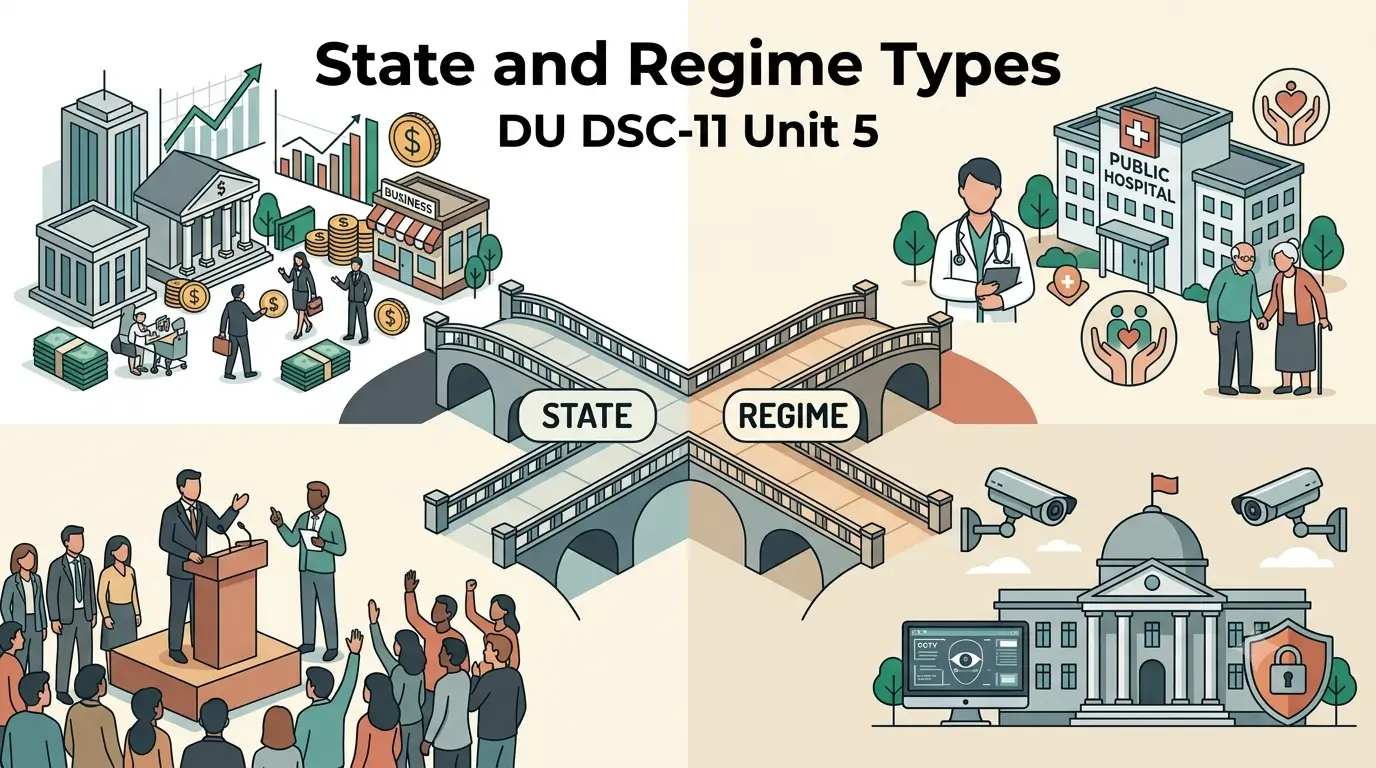
In this post, you will find notes on Unit 5: State and Regime Types from DSC 11: Concepts in Comparative Political Analysis for B.A. (Hons.) Political Science, Semester 4, University of Delhi.
The unit title looks simple, but students often get confused by it. The syllabus lists four things: the capitalist, welfare, populist and security state. Yet the unit is called “State and Regime Types”, and DU’s own study material for this lesson also discusses democratic, authoritarian and totalitarian regimes. So a good answer needs to do two jobs: separate the ideas of state and regime clearly, and then explain the four state types with thinkers, examples and criticism.
That is how this article is organised. Section 1 settles the basic vocabulary (state, regime, government, nation) and gives a quick map of regime types. Sections 2 to 5 take the four state types one by one. Section 6 compares them, section 7 shows where the typology itself runs into trouble, and the PYQ and FAQ sections at the end help you turn all of this into exam answers.
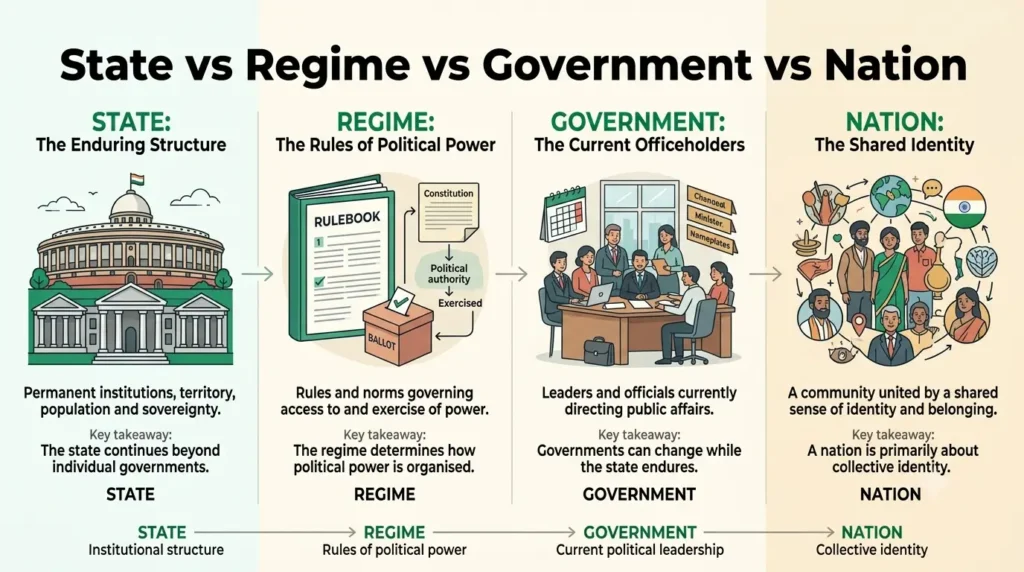
Quick answer — state vs regime: A state is the continuing political organisation that holds sovereignty over a territory and a population, with a monopoly of legitimate force. A regime is the set of rules, norms and institutions that decide who gets power and how it is exercised. Governments come and go, regimes can change, and the state can carry on through both.
1. Introduction: State and Regime Types
What is a State?
A state is a political community that has control over a specific territory and has institutions (such as government, the military, the bureaucracy and the legal system) that make and enforce laws. The state keeps order, provides services, protects its territory and represents its people in the world.
A well-known way of putting it is Max Weber’s: the state is the body that successfully claims a monopoly of the legitimate use of physical force within a given territory. In political studies, the state is analysed through its power, its institutions, and the way it deals with the market, society and citizens. States differ widely in how power is shared, how the government is organised and how authority is used.
What is a Regime?
A regime is the system of rules and practices that shows how political power works in a state. It covers how leaders are chosen, how far people can participate in politics, and how power is shared among groups and institutions.
The concept comes into comparative politics from David Easton, who separated the regime from the political community (the country). His point was that a country can go through fundamental changes of regime while the political community stays basically the same. Over a long period a single stable state may therefore have many governments and several regime types.
Regimes are usually classified by how democratic or authoritarian they are, or as a mix of the two. The state is the organised structure of power; the regime is the political system that decides how that structure is used.
Why is this Important?
Knowing the difference between state and regime types matters for comparing political systems because:
- Different political systems: Countries differ in both state structure and regime, and this affects how power is used and how people are governed.
- Political change: Studying how states and regimes change helps us understand stability, shifts in power, democratisation and authoritarian turns.
- Policy effects: States and regimes shape how policies are made and carried out. Understanding them helps explain outcomes in economy, welfare and security policy.
- Power and governance: Looking at state structures and regimes helps explain how authority is built and kept, and why citizens trust, tolerate or resist it.
State vs Regime vs Government vs Nation
| Term | What it means | Changes how? | Example |
|---|---|---|---|
| State | Permanent political organisation with territory, population, sovereignty and a monopoly of legitimate force | Very slowly; it can survive many regimes | India as a sovereign state |
| Regime | The basic rules and norms for gaining and using political power | Through revolution, coup, constitutional overhaul or democratisation | Democratic or authoritarian regime |
| Government | The people currently holding office and running the state | Through elections, resignations, coalition changes | A particular Prime Minister’s cabinet |
| Nation | A community with a sense of shared identity (language, culture, history, memory) | Gradually; often contested | The “Indian nation” or “Polish nation” |
In one line: the state is the structure, the regime is the rulebook for using it, and the government is the current set of officeholders.
Regime Types at a Glance
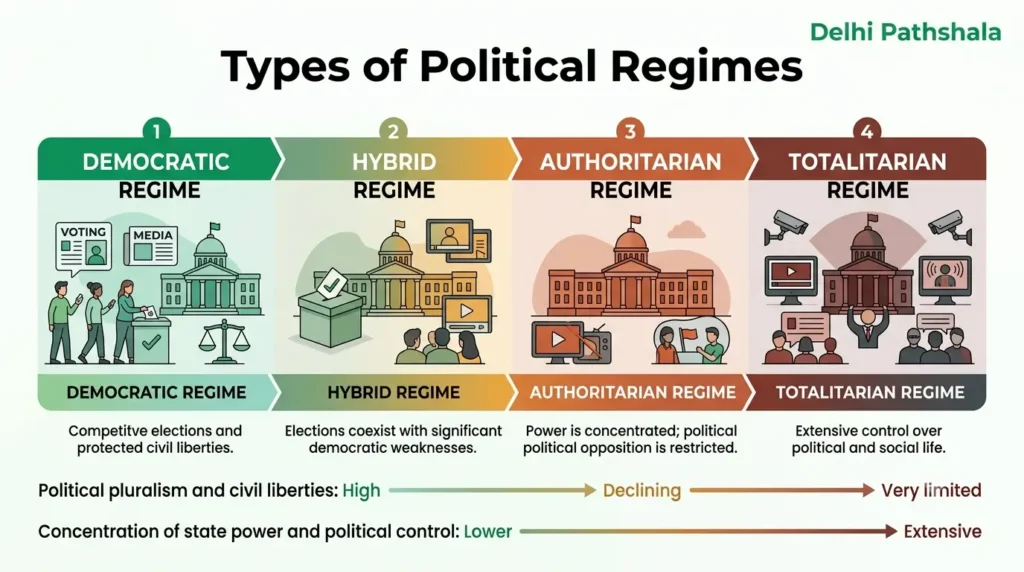
Before the four state types, it helps to know the broad regime categories that DU’s study material also uses. Regimes can be classified by the number of rulers and the nature of authority exercised.
| Regime type | Basic idea | Key features | Core thinkers / references |
|---|---|---|---|
| Democratic | Rulers are chosen by, and answerable to, citizens | Competitive elections, rights and liberties, rule of law, free press | Robert Dahl’s idea of polyarchy (standard textbook reference) |
| Authoritarian | Power is concentrated, political competition is limited, but society is not totally controlled | Restricted opposition, controlled media, limited pluralism | Lindstaedt (2020), Authoritarian Regimes — listed in the DU DSC-11 reading list |
| Totalitarian | The state or party tries to control almost every part of public and private life | Single ruling ideology, mass mobilisation, terror, party-state fusion | Hannah Arendt; Carl Friedrich and Zbigniew Brzezinski (standard textbook references) |
| Hybrid / “grey zone” | Elections exist, but fairness, rights or checks are weak | Regular voting alongside executive dominance | Debated in the democratisation literature |
A related and exam-useful point: populism is sometimes grouped with regimes in DU’s study material, but scholars disagree on whether it is a regime, an ideology, a style or a strategy. We return to this in section 4.
How the Four State Types Fit Together
This is the single most useful idea for scoring well in comparative answers. The four types in the syllabus are not four boxes on the same scale. They answer different questions:
| Type | The question it answers | What it is mainly about |
|---|---|---|
| Capitalist state | How is the economy organised, and what role does the state play in it? | State–market relation |
| Welfare state | What does the state do for the social protection of its citizens? | Social rights and redistribution |
| Populist state | How is political support mobilised, and who claims to speak for “the people”? | Political style or logic of representation |
| Security state | How far does the state prioritise security and control over liberty? | Purpose and powers of the state |
Because they measure different things, they overlap. The same country can sit in several categories at once.
| Example | Capitalist? | Welfare? | Populist? | Security? |
|---|---|---|---|---|
| Sweden | Yes (market economy) | Strongly (social-democratic model) | Not usually classed so | Not mainly |
| United States | Yes | Partial (liberal model) | Populism appears in specific movements and leaders (contested) | Strong after 2001 |
| Hungary under Orbán (2010–2026) | Yes | Selective | Widely described as populist | Debated |
| China | Market-oriented under party control | Expanding but uneven | Not the standard label | Frequently described this way |
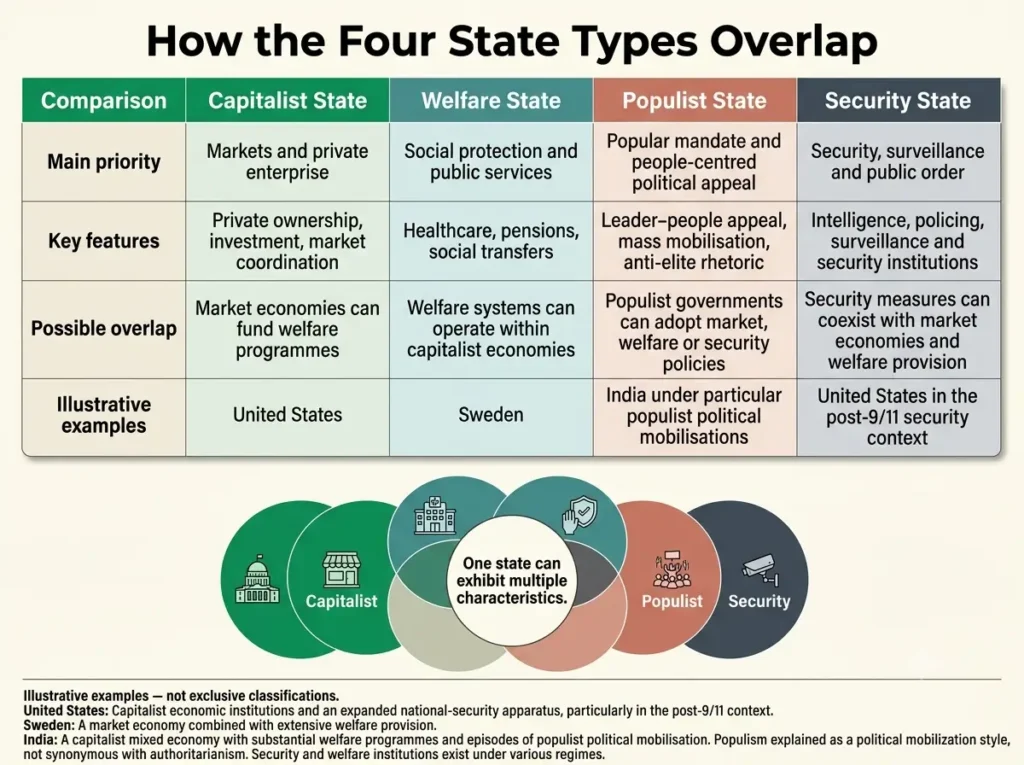
(The table is an analytical summary written for revision; the classification of any country is open to scholarly debate, so use it as a starting point and name your source in exams.)
2. Capitalist State
Background
The idea of a capitalist state grew with the rise of capitalism, from about the 16th century as trade and industry expanded in Europe. The shift from feudalism to capitalism accompanied the rise of modern nation-states, especially during the Industrial Revolution. New economic arrangements developed around private ownership, profit-making and the exchange of goods and services.
By the 19th and 20th centuries capitalism had become the dominant economic system in Western countries. The state’s role was mainly to enforce laws, protect property rights and keep markets running smoothly.
Historians disagree about when capitalism begins. Some link it to merchant trade and money-making from very early periods, while others (including Marxist historians such as Maurice Dobb and Ellen Meiksins Wood, both on the DU reading list for Unit 1) emphasise the specific social relations — wage labour, enclosures, the agrarian transformation — that make capitalism a distinctive modern system. For the state’s role, what matters is that the state helped create the conditions for markets: property law, currency, contracts, policing and, in many cases, colonial expansion.
Key Moments
- 16th–17th century: Mercantilism and expanding global trade set the stage for capitalism.
- 18th century: Adam Smith’s The Wealth of Nations (1776) gives the classic liberal case for market economies.
- 19th century: The Industrial Revolution in Western Europe (especially Britain, later the U.S.) speeds up capitalist growth. Marx and Engels publish the Communist Manifesto (1848) and criticise the system.
- 20th century: Capitalism spreads worldwide in different forms. Some capitalist states build large welfare systems; others keep the market central.
- From the 1980s: Neoliberal policies gain influence under leaders such as Ronald Reagan (U.S.) and Margaret Thatcher (U.K.).
Main Features
- Market economy: Goods and services are produced and traded in competitive markets, and supply and demand determine what is produced and at what price.
- Competition: Firms try to produce at low cost and maximise profit; supporters argue this drives innovation and growth.
- Profit motive: Individuals and firms aim at profit, which encourages enterprise and wealth creation.
- Private property: Individuals and businesses can own and control land, factories and capital. Protecting property rights is central, so people can invest without fear of losing what they own.
- Ownership rights: Property can be bought, sold and inherited.
- Capital accumulation: Owners can reinvest profits to earn more.
- Limited government involvement: The state enforces laws and protects property rights but, in the classical view, does not interfere much in economic transactions, on the belief that free markets allocate resources efficiently.
- Minimal regulation: Some rules exist to prevent market failures, but the focus is on letting markets work.
- Individualism: Strong emphasis on individual responsibility and economic freedom.
Theoretical Views
Classical liberalism
Classical liberalism, which developed in the 17th and 18th centuries, gave the philosophical base for the capitalist state. John Locke argued for natural rights, including property. Adam Smith and, in the early 19th century, David Ricardo are the key names of classical political economy; they argued that economic freedom and individual rights lead to prosperity.
- Laissez-faire: They favoured minimal government interference. Smith’s image of the “invisible hand” suggests that people pursuing their own interest can end up benefiting society. A correction worth remembering for exams: Smith is often reduced to “no state at all”. In fact his writing leaves the state with real duties (defence, justice, and certain public works), and DU’s own study material notes that classical liberal thought allows state action that keeps markets competitive, such as checks on monopolies. The “night-watchman state” is the shorthand for this limited role: protect life and property, keep order, enforce contracts.
- Rule of law: Classical liberalism stressed protecting individual rights, especially property rights, and laws that make markets fair and predictable.
Neoliberalism
Neoliberalism revives many classical liberal ideas for the modern world. Its intellectual roots go back to the mid-20th century (Friedrich Hayek and Milton Friedman are the thinkers usually named), but it became a governing programme in the 1980s under Reagan and Thatcher. It calls for free markets, privatisation, deregulation and reduced state spending, and supports free trade and open markets worldwide.
DU’s Unit 1 covers neoliberalism in more detail; see our notes on Socio-Economic Structures.
Marxist views of the capitalist state
You cannot write a balanced answer on the capitalist state without the Marxist critique.
- In the Communist Manifesto, Marx and Engels describe the executive of the modern state as a committee managing the common affairs of the whole bourgeoisie. In this view the state is not neutral; it protects the interests of the owning class.
- Instrumentalist readings (associated with Ralph Miliband) stress that the state is staffed and influenced by the economic elite.
- Structuralist readings (associated with Nicos Poulantzas) argue that the state serves capital through the way the system works, even when state officials are not personally linked to business, and that the state has relative autonomy to manage conflicts between classes.
These two positions are a standard debate in state theory. Use them to show that the capitalist state is a contested concept, not a settled description.
Varieties of capitalism and the developmental state
Not all capitalist states look alike. A common contrast is between liberal market economies (such as the U.S. and U.K.) and coordinated market economies (such as Germany), a distinction developed by Peter Hall and David Soskice. East Asian cases like post-war Japan are often discussed under the developmental state idea (associated with Chalmers Johnson’s study of Japan’s industrial policy), where the state guides investment and industry.
Examples
- United States: Often treated as a typical capitalist state. It has a mixed economy in which private property rights are protected and the government regulates some areas (for example antitrust law).
- Entrepreneurship and private ownership are encouraged, though the country has a welfare system; it remains largely market-driven.
- Since the 1980s, policy has emphasised deregulation, privatisation and tax cuts for businesses and high earners.
- United Kingdom: A long history of capitalism, with the Industrial Revolution as a key moment. The U.K. developed a welfare state while keeping a capitalist market.
- Thatcher era: Under Margaret Thatcher the U.K. carried out significant neoliberal changes, including privatising state-owned industries and reducing union power.
- Japan: Capitalist, but with close government–business partnership. After World War II the state guided industrial growth through industrial policy.
- Japan has private property and market competition, but the state has played a larger role in steering the economy than in more laissez-faire systems. This is why Japan is a standard example in the developmental state debate.
Criticisms and Issues
- Inequality: Wealth tends to concentrate among those who own capital, producing gaps between rich and poor.
- Exploitation: Marxist and other critics argue that workers are paid less than the value they produce, with the surplus going to owners.
- Environmental damage: The pursuit of profit can lead to short-term decisions at the cost of sustainability; critics link capitalism with overconsumption and waste.
- Financial crises: Weak regulation, especially in finance, can lead to crises. The 2008 global financial crisis is the standard example of the risks of deregulation and poor lending practices.
- Corporate power: Large firms can gain too much influence over markets and politics, harming competition and small businesses.
- Tension with democracy: Critics ask whether formal political equality can survive large economic inequality, since money can buy political influence.
Supporters’ reply (for balance): Defenders argue that market economies have produced large gains in output and living standards, that competition rewards innovation, and that regulation and taxation can correct many of the problems listed above without abandoning markets.
In Summary
The capitalist state is marked by a market-driven economy, protection of private property and (in theory) limited state involvement. Classical liberalism and neoliberalism support free-market ideas; Marxist theory treats the state as tied to class power; and cases like the U.S., U.K. and Japan show that capitalism takes different institutional forms. Inequality, exploitation, environmental damage and crisis-proneness remain central to the debate on its fairness and sustainability.
3. Welfare State
Background and Growth
The welfare state arose in response to the social and economic problems of industrial growth and city life in the late 19th and early 20th centuries. As economies grew, gaps between rich and poor widened and family-based support weakened, leaving many people exposed to poverty, job loss and illness.
The earliest welfare programmes appeared in Germany in the late 19th century, when Chancellor Otto von Bismarck introduced health and social insurance for workers. In the UK, the Beveridge Report (1942) and the creation of the National Health Service (1948) became landmarks of the post-war settlement. After World War II, governments across Europe built larger welfare systems, aiming at a basic standard of living and access to essentials such as health care and education.
The welfare state is often linked with social democracy, which supports combining capitalist economies with social policies that reduce inequality. The sociologist T. H. Marshall gave it a citizenship basis: after civil and political rights, he argued, social rights (a minimum of welfare and security) complete full citizenship.
Important moments:
- Late 19th century: Bismarck’s social insurance in Germany.
- After World War II: The UK and the Nordic countries build strong welfare systems for recovery and social stability.
- 1960s–1970s: Many Western countries expand welfare programmes to include unemployment benefits, health care and pensions.
- From the 1980s: Neoliberal ideas challenge the welfare state, calling for lower government spending and more market-based solutions.
Main Features and Characteristics
- Social security: Systems that give financial support in times of need — job loss, illness, disability or old age — usually funded through taxes and contributions by workers and employers.
- Universal coverage: Aims to cover all citizens regardless of income or job status.
- Pension schemes: Income in retirement.
- Public welfare programmes: Provision of basic needs such as housing, food, health care and education for those who cannot afford them, to reduce poverty and ensure a minimum standard of living.
- Universal healthcare: Access to medical services regardless of income (in many welfare states).
- Unemployment benefits: Temporary income support while people look for new work.
- Housing and childcare: Help with costs in some welfare states.
- Government role in the economy: The state manages the economy to support social welfare, using taxes, subsidies and regulation to reduce inequality.
- Progressive taxation: Higher earners contribute a larger share.
- Economic stabilisation: In downturns, governments may raise spending to boost demand and reduce unemployment.
Theoretical Views
Social democracy
Social democracy supports a mixed economy in which both government and market matter. It focuses on redistributing wealth to reduce inequality and on ensuring access to basic services, while valuing individual rights and democratic governance.
- Inclusive growth: Economic growth that benefits everyone, not only the wealthy.
- Balancing welfare and market: A market regulated by the state to ensure fairness and meet social needs.
Keynesian economics
John Maynard Keynes argued (in the context of the Great Depression and his General Theory, 1936) that in downturns governments should actively raise demand, reduce unemployment and support social programmes.
- Demand-side economics: Overall spending drives growth; when the economy is weak, public spending can help restore demand.
- Full employment: Government investment can create jobs when the private sector does not.
Esping-Andersen’s “three worlds” of welfare capitalism
One of the most useful frameworks for DU answers. Gøsta Esping-Andersen (1990) argued that we should compare welfare-state regimes, not just spending levels. Building on earlier work by Richard Titmuss, he identified three types, with decommodification (how far people can maintain a livelihood without depending on the market) as the central idea.
| Regime | Core logic | Typical examples (as commonly classified) | Key feature |
|---|---|---|---|
| Social democratic | Universal, generous benefits as a right of citizenship | Sweden, Denmark | High decommodification; strong state role |
| Conservative / corporatist | Insurance-based benefits tied to employment and status | Germany | Bismarckian social insurance model |
| Liberal | Means-tested, modest benefits; market is primary | United States, United Kingdom (often) | Low decommodification; market-based solutions |
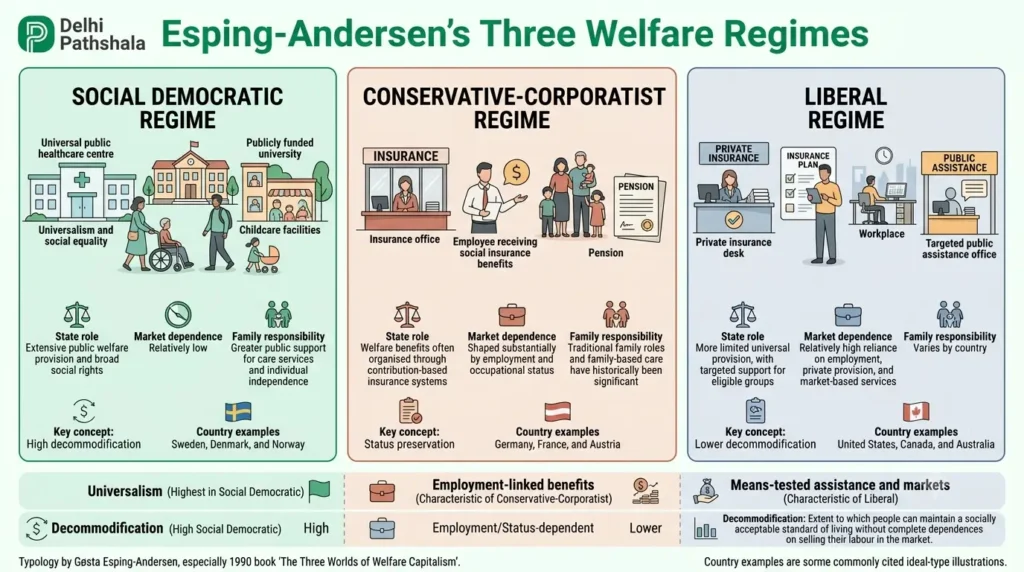
Esping-Andersen argued that strong unions and social democratic parties used the welfare state to change the character of advanced capitalism. Critics have since added more types (for example, Southern European and East Asian models) and questioned whether a three-fold classification fits countries outside the rich world. Wood and Gough, for instance, proposed a wider comparison of regimes (welfare state, informal security and insecurity regimes) for poorer, partly capitalised societies, where people often rely on informal and clientelist ties rather than state provision.
DU’s reading list for this unit includes David Garland’s The Welfare State: A Very Short Introduction (OUP, 2016), which is a good starting point for the history and politics of the welfare state.
Examples
- Sweden: Often seen as the ideal case, with strong public services funded by high taxes: universal healthcare, generous parental leave, free education and comprehensive social security.
- A progressive tax system supports many social services.
- Sweden is a social democracy, with strong unions and a high level of public trust in government.
- Denmark: A similar welfare state, focusing on social security and free public services. Its “flexicurity” model combines labour-market flexibility with strong social support.
- Universal healthcare, free education and generous unemployment benefits; high taxes fund these programmes.
- Germany: Relies on social insurance, with workers and employers contributing to insurance programmes. This is the Bismarckian model, named after the German chancellor of the late 19th century.
- Health care, unemployment benefits, pensions and family support are provided, with insurance contributions at the centre and state guarantees on coverage.
- India (for DU students — a debated case): India’s Constitution contains the Directive Principles of State Policy (Part IV), which set welfare-oriented goals for the state, and the National Food Security Act, 2013 created a legal entitlement to subsidised foodgrains. Whether India is a “welfare state” in the Western sense is contested: scholars point to the large informal economy and limited social-insurance coverage. Use this example carefully and name a source in your answer.
Challenges and Criticisms
- Sustainability: Ageing populations and falling birth rates raise health and pension costs; maintaining benefits means higher taxes or service cuts. Countries like Sweden, Denmark and Germany face this pressure.
- Equity vs efficiency: Welfare states aim at fairness through redistribution, but critics say high taxes and generous benefits can discourage work and investment.
- Work disincentives: Some argue generous benefits reduce the motivation to find work. (Evidence on this is mixed; the flexicurity model is often cited as an attempt to combine support with active job-seeking.)
- Fiscal responsibility: High spending requires careful financial management.
- Globalisation and competition: Firms can move to countries with lower taxes and fewer obligations, putting pressure on welfare states.
- “Race to the bottom”: The argument that countries may cut social spending to attract investment. Scholars debate how far this has actually happened.
Contemporary Relevance
The debate has not gone away. Supporters of the welfare state argue that social protection reduces poverty, supports demand during downturns, and invests in health and education. Critics ask how to fund it under demographic pressure. For DU exams, the question “how indispensable is the welfare state today?” asks you to weigh both sides with examples (see the PYQ section).
In Summary
The welfare state is a system in which government actively provides social services such as health care, education, pensions and unemployment benefits, aiming to reduce poverty and inequality. Social democracy, Keynesian economics and Esping-Andersen’s regime typology help explain its variety. Sustainability, the fairness-versus-efficiency debate and pressure from globalisation keep reshaping discussions of welfare states.
4. Populist State
Definition and Characteristics
First, a caution that improves answers: populism is not a universally accepted “type of state” in the way “welfare state” is. Scholars mostly treat it as an ideology, a political style, a strategy or a logic of mobilisation. The syllabus lists the “populist state”, so you should explain what it means in practice: a political system in which power is exercised by a leader or movement that claims to represent “the people” against a “corrupt elite”. Populism often appears in difficult economic times or when people are disillusioned with traditional politicians.
- Leader-centric politics: Movements often revolve around a powerful leader who claims to speak for ordinary people and contrasts themselves with the elite.
- Charismatic authority: Leaders create an emotional bond with supporters.
- Centralisation of power: Populist leaders may concentrate power in the executive and bypass traditional democratic checks.
- Anti-elitism: Deep distrust of elites in politics, economics or culture.
- Anti-corruption rhetoric: Promises to fight elites and protect the people’s interests.
- “Us vs them”: A moral divide between the good “people” and the bad “elite”.
- Nationalism and sovereignty: Many (not all) populist movements stress national pride and identity.
- Cultural nationalism: Appeals to traditional values.
- Sovereignty and borders: Priority to national interest over global cooperation.
How Scholars Define Populism: Four Approaches
| Approach | Main thinker(s) | Populism is… |
|---|---|---|
| Ideational | Cas Mudde (2004) | A “thin-centred” ideology separating society into “the pure people” and “the corrupt elite”, which argues that politics should express the general will of the people |
| Discursive / logic of politics | Ernesto Laclau (and Chantal Mouffe) | A way of constructing a political identity by uniting different demands into “the people” against an “other” |
| Strategic | Kurt Weyland | A strategy by which a personalistic leader seeks power with direct, unmediated support from followers |
| Stylistic | Benjamin Moffitt | A repertoire of performance and communication |
On Mudde, precisely: In The Populist Zeitgeist (Government and Opposition, 2004), Mudde defines populism as an ideology that sees society as divided into two homogeneous and antagonistic groups, “the pure people” versus “the corrupt elite”, and argues that politics should express the volonté générale (general will). He calls it a thin-centred ideology: it has a restricted core and can attach itself to very different full ideologies such as nationalism, socialism or ecologism. That is why populism appears on both the left and the right. (The Cambridge Core article is linked in the references.)
Jan-Werner Müller adds that populists typically claim that they alone represent the whole people, which makes populism anti-pluralist.
Left vs right, inclusionary vs exclusionary: Mudde and Rovira Kaltwasser distinguish inclusionary populism (common in Latin America, aiming to include marginalised groups materially and politically) from exclusionary populism (common in Europe, excluding groups such as immigrants or minorities).
Historical and Contemporary Examples
- Latin America: Populism has a long history here, where leaders promised to reduce inequality and challenge elites. Juan Perón in Argentina is a classic historical case. Venezuela under Hugo Chávez (president 1999–2013) is the most-cited recent example.
- Hugo Chávez: Appealed to the poor, nationalised industries and promised wealth redistribution; critics saw growing authoritarian tendencies. Venezuela’s politics changed again in January 2026 after the capture of Nicolás Maduro by U.S. forces, and the situation is still unfolding, so check recent sources before using it as a “current” example.
- Other leaders: Evo Morales (Bolivia) and Lula da Silva (Brazil) are sometimes described as left populists, but this label is contested: many scholars would not classify them as populist, or only in some phases. Present it as a debate.
- Eastern and Central Europe:
- Hungary under Viktor Orbán (2010–2026): Orbán promoted nationalism and “Christian democracy”, centralised power through legal changes, limited media freedom and criticised the European Union. In 2014 he described his model as an “illiberal state”. Important update: Hungary is no longer a “current” example of Orbán in power. In the parliamentary election of 12 April 2026 the opposition Tisza party under Péter Magyar won a two-thirds majority, and Orbán conceded defeat, ending 16 years of Fidesz rule. For exams, this is now an important teaching case: it shows that elections can still remove a populist-illiberal government.
- Poland: The Law and Justice (PiS) party governed from 2015 to 2023, using populist rhetoric and national-conservative themes. Its judicial reforms were widely criticised as undermining judicial independence. A coalition government under Donald Tusk took office in December 2023.
- Western Europe and beyond: Radical-right parties have grown in many European countries; the PYQ on “neo-right populism in Europe” (see below) draws on this.
Why Has Populism Grown? Factors Behind Neo-Right Populism in Europe
DU has asked students to enumerate the factors behind the growth of neo-right populism in Europe (see PYQs). A structured answer can group explanations into four clusters and note that scholars disagree about which matters most:
- Economic explanations: Job insecurity, deindustrialisation, the 2008 financial crisis and eurozone austerity left “globalisation’s losers” feeling ignored.
- Cultural explanations: Backlash against rapid social change and immigration; concern about national identity. Norris and Inglehart’s Cultural Backlash (2019) is a standard reference for this view.
- Political explanations: Declining trust in traditional parties and institutions, weaker party loyalties, and the perception that mainstream parties offer similar policies. The EU is also blamed for distant decision-making.
- Media and communication: Mudde links the “populist zeitgeist” partly to the media environment, where sensational reporting and, later, social media amplify populist messages.
The debate: economic-grievance accounts and cultural-backlash accounts compete. Many scholars see a mix, which is a safe line for an exam answer, as long as you attribute each side.
Dynamics and Impacts
- Economic policies: Populist governments often adopt policies meant to help the working class, such as greater public spending or nationalisation.
- State intervention: Leaders may take control of industries to protect workers.
- Economic inefficiency: Critics say such policies can bring inefficiency and reduced investment, as is argued in the Venezuelan case.
- Social and political impacts:
- Empowerment of disenfranchised groups: Populists can give a voice to people who feel ignored and highlight inequality.
- Polarisation and division: Opponents may be treated as enemies of “the people”.
- Erosion of democratic norms: Populist leaders may weaken checks and balances over time.
Populism and Democracy
This is the heart of the long-answer debate.
- Critical view: Populism claims to represent the true will of the people but can undermine democracy by attacking courts, media and opposition. Some link populism to “illiberal democracy”, a phrase popularised by Fareed Zakaria in 1997, meaning systems that hold elections but limit liberal rights.
- Defenders’ view: Laclau and Mouffe argue that populism can revive democracy by giving voice to excluded groups and challenging elite consensus; the problem is not populism as such but its exclusionary forms.
- The 2026 Hungarian result is a reminder that populist regimes are not automatically permanent: where elections remain competitive enough, they can be lost.
Criticisms and Debates
- Authoritarianism: Critics argue that populist leaders may become authoritarian, concentrating power and attacking the opposition.
- Economic consequences: Policies that promise equality can backfire, causing shortages and inefficiency.
- Democratic legitimacy: By rejecting democratic norms, populist leaders can undermine the democracy they claim to represent.
- Exclusionary politics: Blaming immigrants or minorities for national problems can create xenophobia and social tension.
- Conceptual critique: The word “populism” is used for very different leaders and movements, so critics say it explains little. This is why the four-approach table above matters.
In Summary
A populist state is one where a leader or movement claims to speak for ordinary people against a corrupt elite. Mudde sees it as a thin-centred ideology; Laclau as a logic of building popular identity; Weyland as a strategy. Populism can give voice to the neglected but often raises concerns about authoritarianism, economic mismanagement and weaker democratic norms. Latin America and Europe supply the standard cases — and the 2026 Hungarian election means the “current example” must now be taught with care.
5. Security State
Definition and Key Features
A security state is a state in which national security and public order become the main organising priority of government, often ahead of individual freedoms. The government uses tools such as surveillance, intelligence agencies, emergency powers and military force to prevent threats. Security concerns are then used to justify limits on freedoms, monitoring of citizens and a strong presence of the state in everyday life.
A note on terms: the literature uses several related labels — national security state, surveillance state, garrison state (Harold Lasswell’s 1941 idea of societies dominated by the military) and, in popular usage, police state. They overlap but are not identical, and the DU reading list for this unit includes Andreas Busch (2015), The Changing Architecture of the National Security State, and a lecture by Paul Rosenzweig titled Security, Liberty, or Neither. The title is a reminder that scholars question whether security and liberty must always be traded against each other.
- High level of state control: Power is centralised to manage the population and state functions, including information, public discussion and rights.
- Centralisation of power: Courts and legislatures may offer little check, which can weaken democratic institutions.
- Emergency powers: Governments may act quickly without normal democratic procedures during threats.
- Focus on national security: Both external threats (terrorism, military attack) and internal ones (protest, political opposition) are treated as security matters.
- Security over liberty: Actions such as spying on citizens and censoring information are justified as necessary for safety.
- National security policies: Laws strengthen military and law-enforcement powers.
- Extensive surveillance: Technology and agencies monitor citizens to track threats.
- Mass surveillance: Phone calls, emails and social media can be monitored.
- Intelligence agencies: Agencies such as the CIA and FBI in the U.S. gather information; how far they are accountable is itself debated, since U.S. agencies work under congressional and court oversight, but critics argue that this oversight is limited by secrecy.
Historical Context
- Cold War era (1947–1991): Security states grew in the U.S. and the Soviet Union amid fears of nuclear war and espionage. (The U.S. National Security Act of 1947 created much of the institutional machinery.)
- Soviet Union: The KGB watched and suppressed dissent, keeping the Communist Party in power.
- United States: Security measures were used to investigate suspected communists, and the FBI surveilled activists and leaders.
- Post-9/11 world: The September 11 attacks (2001) led to a big increase in security measures, especially in the U.S., and to more surveillance and military action against terrorism worldwide.
- USA PATRIOT Act (2001): Expanded surveillance and detention powers.
- Department of Homeland Security (2002) was created, and intelligence agencies gained new powers.
- War on Terror: Operations in Afghanistan and Iraq were accompanied by tougher domestic security measures.
- NSA surveillance debate: Disclosures in 2013 about NSA monitoring of communications led to a major debate on privacy.
Case Studies
- China: Commonly described as a state that prioritises security and stability, with the Chinese Communist Party using surveillance and censorship; technologies such as facial recognition and internet monitoring are widely reported. The government presents these measures as necessary for stability. Note that scholars may call China an authoritarian party-state (a regime label) as well as a security state (a function label) — a useful reminder that the two terms measure different things.
- Russia: Under Vladimir Putin, intelligence services such as the FSB play a major role, and strict internet and protest laws limit opposition. Political opponents and journalists have faced imprisonment or violence.
- United States (post-9/11): Shows that a liberal democracy can also expand its security state, creating DHS, widening intelligence powers and debating privacy. This case is crucial for the PYQ on whether security states fail to protect democratic values.
- Estonia (cybersecurity): After the large-scale cyber-attacks of 2007, Estonia became known for its cyber-defence work, and NATO’s Cooperative Cyber Defence Centre of Excellence is based in Tallinn. It is a common example when answering how security states operate in the globalised era.
Theoretical Perspectives
- Realism: States must ensure their own survival in an anarchic international system. This leads them to focus on defence and internal control.
- Security dilemma (a term associated with John Herz): When one state strengthens its security, others feel threatened and do the same, increasing tension.
- Authoritarianism and the state of exception: Security rhetoric can justify extraordinary powers. The idea of the “state of exception” (associated with Carl Schmitt and later Giorgio Agamben) is often used to discuss how emergencies suspend normal legal limits.
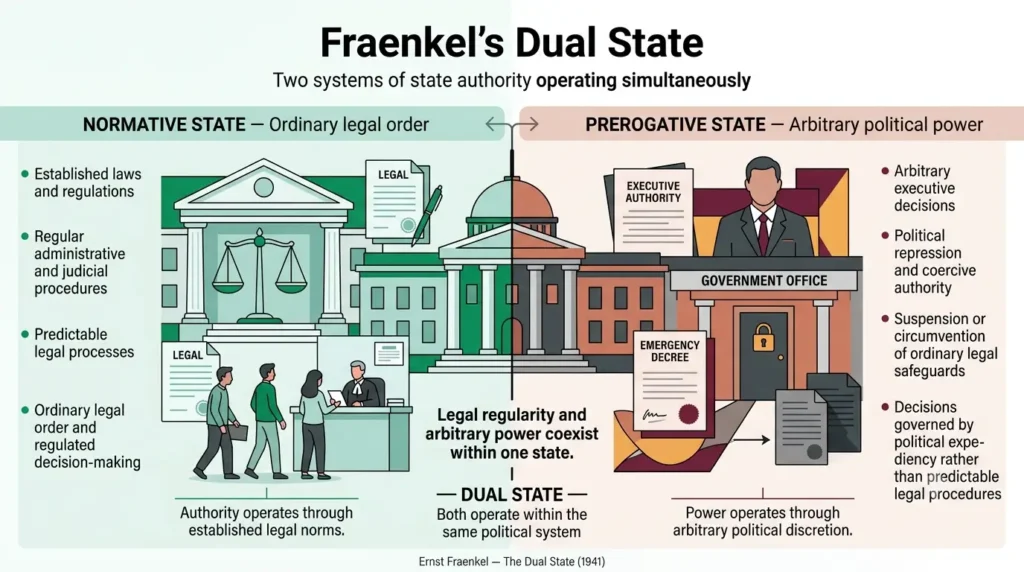
- Fraenkel’s dual state: In The Dual State (1941), Ernst Fraenkel analysed Nazi Germany as two coexisting states: a normative state, which protected the legal order expressed in statutes, court decisions and administrative acts, and a prerogative state, governed by the party and unrestrained by legal guarantees. The concept is widely used to think about how law and arbitrary power can coexist in security-heavy regimes. (Students searching “normative state vs prerogative state” are looking for this.)
Contemporary Issues and Criticisms
- Privacy concerns: Mass surveillance and data collection raise worries about a “surveillance society”.
- Erosion of privacy and free speech: Monitoring can chill dissent and discussion.
- Balance between security and freedom: Governments say security measures protect citizens; critics say they can undermine the freedoms that make democracy meaningful.
- Overreach: Powers granted for emergencies may stay and expand.
- Civil liberties: The challenge is to protect the public while keeping rights, courts and free media intact.
- Is the trade-off real? Some argue that security and liberty are not simple opposites, because arbitrary security powers can themselves create insecurity and distrust.
Supporters’ view (for balance): Defenders argue that effective intelligence, border control and counter-terrorism are core duties of any state, that citizens in many democracies support tougher measures after attacks, and that legal oversight can keep such powers accountable.
In Summary
The security state places national security above many personal freedoms and uses surveillance, emergency powers and force to control threats. It is visible in the Cold War, after 9/11 and in states like China and Russia. Realism, the security dilemma, the state of exception and Fraenkel’s dual state help explain it, while privacy and civil liberties remain the core criticisms.
6. Comparative Analysis of State Types
Comparing the four types shows how each balances freedom, economic success, social protection and security. The pros and cons below summarise what supporters and critics argue; treat them as arguments, not proven rules, and give examples in your answers.
1. Capitalist State
Supporters argue:
- Economic growth and innovation: Market competition rewards new ideas and efficiency.
- Individual freedom: People can start businesses, trade and build wealth.
- Technological progress: The pursuit of profit has driven advances in technology, medicine and communication.
Critics argue:
- Income inequality: Large gaps between rich and poor.
- Exploitation: Without rules, workers can be taken advantage of, especially in jobs without protection.
- Market failures: Markets may under-provide essentials like health care and education.
Impact on citizens and society: Economic differences create social classes, and the rich often have better access to services. Competition can weaken community bonds. Social mobility exists but many face barriers, especially disadvantaged groups.
2. Welfare State
Supporters argue:
- Social safety nets: Programmes in health, education and income support reduce poverty.
- Greater equality: Redistribution through taxes and services narrows income gaps.
- Social stability: Meeting basic needs reduces conflict.
Critics argue:
- High taxes: Funding burdens individuals and businesses.
- Dependency: Some believe benefits can reduce incentives to work (the evidence is debated).
- Sustainability: Ageing populations strain budgets.
Impact on citizens and society: Better access to services, and public trust can grow when people see their taxes supporting the community. Financial pressure from ageing societies is the main long-term challenge.
3. Populist State
Supporters argue:
- Representation of the marginalised: Gives voice to people who feel ignored by elites.
- Challenging the status quo: Can force reforms.
- National identity: Promotes unity around shared values.
Critics argue:
- Authoritarianism: Power may be centralised and institutions weakened.
- Polarisation: Society is divided into “people” and “enemies”.
- Economic mismanagement: Popular policies may be unsustainable.
Impact on citizens and society: A sense of empowerment for some groups, but deeper social divides, particularly against minorities. Political instability is possible if democratic norms are weakened, though outcomes differ by country.
4. Security State
Supporters argue:
- National security: Protects against terrorism, attack and espionage.
- Social order: Strong control can reduce crime and unrest.
- Rapid crisis response: Centralised authority can respond quickly.
Critics argue:
- Erosion of civil liberties: Privacy and free speech may be limited.
- Weak checks on power: Authority can grow without accountability.
- Constant monitoring: Surveillance can produce mistrust and fear.
Impact on citizens and society: Citizens may feel watched; dissent may be suppressed; participation can shrink. Economic effects are not uniform: some security-heavy states have grown quickly (China is a frequent example), while others have faced investor concerns where the rule of law is weak. So avoid saying “security states always have unstable economies”.
Comparative Summary
| State type | Core logic | Key thinkers / concepts | Typical examples | Main strength (per supporters) | Main weakness (per critics) | Relation to democracy |
|---|---|---|---|---|---|---|
| Capitalist | Market allocation and private property | Smith, Locke, Hayek; Marx (critic); Miliband, Poulantzas | U.S., U.K., Japan | Growth, innovation, individual freedom | Inequality, exploitation, crises | Can coexist with democracy; tension over money and power |
| Welfare | Social rights and redistribution | Keynes, Marshall, Esping-Andersen | Sweden, Denmark, Germany | Reduces poverty, supports stability | Fiscal pressure, work-incentive debate | Usually democratic in origin and practice |
| Populist | “The people” vs “the elite” | Mudde, Laclau & Mouffe, Weyland, Müller | Venezuela (Chávez), Hungary (Orbán, until 2026), Poland (PiS, 2015–23) | Voice for the ignored | Centralisation, polarisation | Ambiguous: can revive or erode democracy |
| Security | Security and order first | Lasswell, Fraenkel, Herz, Schmitt/Agamben | U.S. post-9/11, China, Russia (as commonly described) | Protection from threats, rapid response | Surveillance, curbs on liberty | Can exist inside democracies but strains them |
Key Terms for Quick Revision
| Term | One-line meaning |
|---|---|
| Regime | Rules and norms governing access to and use of political power |
| Laissez-faire | Minimal state interference in the economy |
| Night-watchman state | State limited to protection of life, property and contracts |
| Neoliberalism | Market-centred programme: privatisation, deregulation, free trade |
| Decommodification | Ability to maintain a livelihood without depending on the market (Esping-Andersen) |
| Flexicurity | Danish model combining flexible labour markets with strong social support |
| Thin-centred ideology | Mudde’s description of populism’s limited core ideas |
| Illiberal democracy | Elections without full liberal rights and checks |
| Security dilemma | One state’s security measures make others feel insecure |
| Dual state | Fraenkel’s coexistence of a normative and a prerogative state |
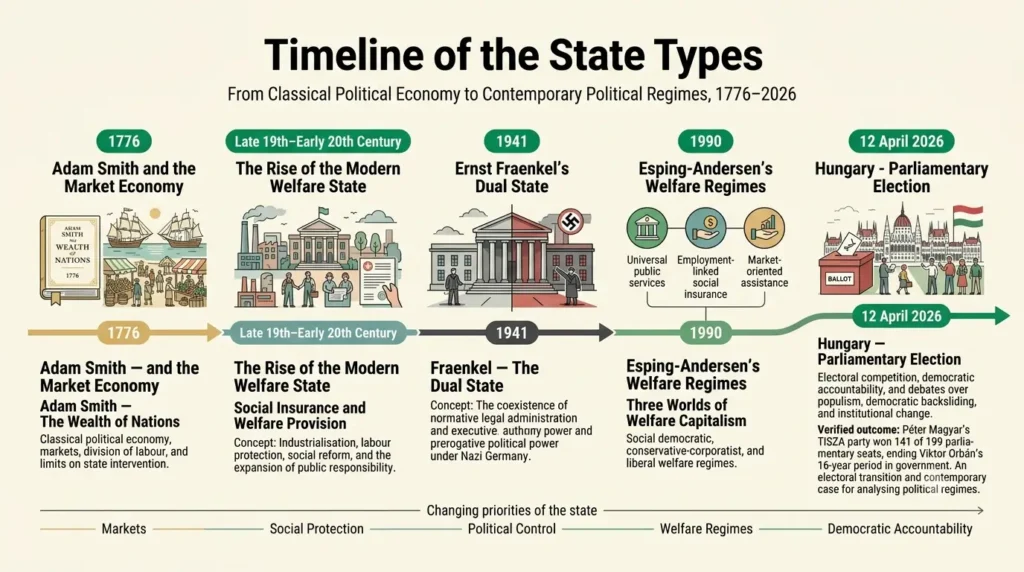
Timeline for Revision
| Year | Event | Why it matters |
|---|---|---|
| 1776 | Adam Smith, The Wealth of Nations | Classic liberal case for markets |
| 1848 | Communist Manifesto | Marxist critique of the capitalist state |
| 1880s | Bismarck’s social insurance in Germany | Origin of the welfare-state idea |
| 1936 | Keynes, General Theory | Intellectual base for state demand management |
| 1941 | Fraenkel, The Dual State | Normative vs prerogative state |
| 1942 / 1948 | Beveridge Report / NHS (UK) | Post-war welfare state |
| 1947 | U.S. National Security Act | Institutional base of the national security state |
| 1990 | Esping-Andersen’s welfare regimes | Typology of welfare capitalism |
| 2001–2002 | USA PATRIOT Act; Department of Homeland Security | Post-9/11 security state |
| 2004 | Mudde, The Populist Zeitgeist | Ideational definition of populism |
| 2008 | Global financial crisis | Fuels debates on capitalism and populism |
| 2013 | NSA surveillance disclosures | Privacy and security debate |
| 2015–2023 | PiS government in Poland | Populism and judicial independence |
| April 2026 | Hungarian election: Tisza wins two-thirds majority | End of Orbán’s 16 years in power |
7. Criticism and Limitations of the Typology Itself
A strong answer does not only describe the four types; it also questions the typology.
- The categories overlap. As the table in section 1 shows, a single state can be capitalist, welfare-providing and security-conscious at once. They are not parallel categories.
- “Populist state” and “security state” are less standard than “welfare state”. Many scholars would describe populism as an ideology or style, and many would call China or Russia authoritarian regimes first and security states second.
- Western bias. Much of the literature draws on Europe and North America. Post-colonial and developmental states in Asia, Africa and Latin America often do not fit neatly. (Wood and Gough’s regime typology for poorer countries is an attempt to widen the frame.)
- Labels can hide change. The same country can move between categories over time; Hungary and Poland show how quickly a case can change.
- Normative loading. Terms such as “populist” and “security state” are sometimes used as political insults, so scholars try to use them analytically and with definitions.
8. Contemporary Relevance
- Elections and populism: Hungary’s April 2026 election (a two-thirds majority for the opposition after 16 years of Orbán) and Poland’s 2023 change of government show that populist-illiberal governments can be removed through elections, though rebuilding institutions afterwards is difficult.
- Welfare debates: Ageing populations and fiscal pressure keep the future of welfare systems at the centre of politics across the world.
- Digital security: Biometric ID, facial recognition, data retention and cybersecurity make the old privacy-versus-security debate more urgent.
- Globalisation: Capital mobility and trade rules shape what capitalist and welfare states can do.
9. Conclusion
Each type of state strikes a different balance between freedom, economic success, social welfare and security. Capitalist states promote growth but can generate inequality; welfare states aim at equality and social protection but face fiscal and demographic pressure; populist states can give voice to citizens who feel ignored but risk becoming authoritarian; and security states prioritise safety, sometimes at the cost of personal freedom.
Two ideas tie the unit together. First, state and regime are different: the state is the enduring structure, the regime is the rulebook for using it, and regimes can change while the state remains. Second, the four syllabus types overlap, because they measure different things — economic organisation, social protection, political mobilisation and security priority. How well any state manages its goals depends on its institutions, its regime and the quality of its democratic checks.
Continue Reading
Keep going with the rest of DSC 11: Concepts in Comparative Political Analysis:
- Socio-Economic Structures (Unit 1) — capitalism, socialism, colonialism and neoliberalism, the background for the capitalist state.
- What is Federalism (Unit 4) — the previous unit, on territorial division of power.
- Electoral Systems (Unit 6) — the next unit: FPTP, proportional representation and mixed systems.
- Party System (Unit 7) — how parties and party systems shape political competition.
University of Delhi Previous Year Questions (PYQs)
DU Previous Year Questions
Frequently asked questions from DU exam papers on this topic. Tap a question to view a quick-answer guide.
1 Define populism. Enumerate major factors behind the growth of neo-right populism in Europe. +
How to approach: Define with Mudde, then group causes.
Structure: Mudde’s definition (thin-centered ideology: pure people vs corrupt elite); Economic – 2008 crisis, austerity; Cultural – immigration, identity backlash; Political – trust deficit, cartel party; Media – social media amplification. Examples: Hungary (Orban) and Poland (PiS). Mention exclusionary vs inclusionary distinction.
Long Answer | 10-15 Marks
2 Discuss the significant features of security state. Do you agree that security state has failed to protect democratic values? Comment. +
How to approach: Features first, then a two-sided argument.
Structure: Features: surveillance (NSA), emergency powers, intelligence agencies, post-9/11 US (Patriot Act, 【entity-DHS¦canonical_name=DHS】). Fraenkel’s dual state concept. Supporters: necessity for security. Critics: privacy violation, racial profiling, Guantanamo, erosion of rule of law. Conclude with balanced view on security-liberty trade-off.
Long Answer | 12-15 Marks
3 Define security state. Explain the role and importance of security state in the era of globalisation with suitable examples. +
How to approach: Link globalisation to cross-border threats.
Structure: Define security state (Busch, Mabee). Role: counter-terrorism (Al-Qaeda, ISIS), cybersecurity – Estonia 2007 attack & NATO Cooperative Cyber Defence Centre, border security – Frontex in EU, international cooperation – 【entity-INTERPOL¦canonical_name=INTERPOL】, NATO. Examples: USA post-9/11, China surveillance, Estonia. Mention civil liberties cost.
Long Answer | DU 2024 Reported
4 Describe welfare state. Comment on the indispensability of welfare state in contemporary times. +
How to approach: Definition, features, then “indispensable?” debate.
Structure: Origins: Bismarck (Germany), Beveridge Report (UK), T.H. Marshall social citizenship. Esping-Andersen’s three worlds. Features: social security, state intervention. Why indispensable: poverty, inequality, market failure, COVID-19. Challenges: fiscal crisis, ageing, globalization limits. Conclude: reinvented not redundant.
Long Answer | 10 Marks
5 Write short notes on any two of the following: (a) Welfare State, (b) Constitutionalism, (c) Socialism, (d) Colonialism. +
How to write (150-200 words per note):
For (a) Welfare State: Define – state committed to social and economic well-being. Two features – 1) institutionalized social security, 2) intervention in economy. One example – Nordic model / Beveridge model. One criticism – fiscal burden, dependency argument. If writing two notes, pick one from Unit 5 and one other for best coverage.
Short Note | 5 Marks
6 Populist State (short note) +
How to write: Definition – Mudde: thin ideology – pure people vs corrupt elite. Features: leader-centric, anti-elite, direct appeal via plebiscite/social media, moralistic. Types: Inclusionary (Latin America) vs Exclusionary (Europe – Hungary, Poland). Debate: Is populism threat or corrective to democracy?
Short Note | 5 Marks
7 Compare democratic and authoritarian regimes in terms of citizen freedom and state control. [DU 2023-24, Comparative Govt & Politics – 2322202401] +
Democratic Regime: Free & fair elections, rule of law, protection of civil liberties, political pluralism, accountability. E.g. India, Germany.
Authoritarian Regime: Power concentrated in single leader/elite, limited pluralism, repression, restricted freedoms, weak accountability. Sub-types: totalitarian (North Korea), authoritarian (China, Russia).
Comparison Table: Freedom (High vs Low), Control (Limited vs Extensive), Legitimacy (Popular mandate vs Coercion/Performance).
Link to Unit 5: Welfare and Security states can exist in both regime types. DU 2023-24 – Long Answer
8 What is a capitalist state? Discuss Ralph Miliband’s analysis of the state in capitalist society. [DU Syllabus Unit 5 – Core Reading Miliband 1973] +
Miliband (Instrumentalist View): State serves interests of dominant capitalist class because: 1) Interpersonal ties between state elite and capitalist class (same schooling, socialization), 2) Economic power of capital constrains state policies. State is not neutral.
Vs Poulantzas (Structuralist): State structure itself is capitalist regardless of who holds office.
Functions: Maintains law & order for property, manages crises, legitimizes capitalism via welfare concessions.
Examples: USA, UK neoliberal state post-1980s. Important for Unit 5 – Capitalist State
9 What is populism? Can we consider populism as a regime type? Discuss with reference to Cas Mudde. [DU Syllabus Unit 5 – Mudde & Kaltwasser Reading] +
Populist State Features: 1) Anti-establishment leader, 2) Direct unmediated link with people (bypassing institutions), 3) Majoritarianism, 4) Erosion of liberal checks (judiciary, media).
Debate – Is it a regime type? No, it’s a political strategy/style that can exist within democracy (【entity-Modi¦canonical_name=Narendra Modi】, 【entity-Trump¦canonical_name=Donald Trump】, 【entity-Bolsonaro¦canonical_name=Bolsonaro】) or authoritarianism. But some scholars call ‘populist regime’ when populism becomes state logic.
Examples: Left populism (Venezuela-Chavez), Right populism (Hungary-Orban).
Link to welfare & security: Populist often combines welfare promises with security rhetoric. Trending – Populist State
10 Define welfare state. Discuss its evolution and crisis in the era of globalization. [DU Syllabus Unit 5 – Garland & Kersbergen Reading] +
Evolution: Post-WWII Keynesian consensus, Marshall’s social citizenship, Esping-Andersen’s three worlds (Liberal, Conservative, Social Democratic).
Functions: Social security, health, education, full employment (Newton & Deth Ch 17).
Crisis: 1) Fiscal crisis – O’Connor, 2) Neoliberal attack – privatization, retrenchment, 3) Globalization – capital mobility reduces tax base, 4) New Social Risks.
Transformation: From Welfare to Workfare / Social Investment State. Examples: Sweden, Germany, India (welfare schemes but neoliberal economy). Most Expected – Welfare State
Frequently Asked Questions (FAQs)
Is the state the same as the government?
No. The state is the continuing political organisation with sovereignty over territory and population. The government is the group of people running the state at a given time. Governments change after elections; the state continues.
Can a regime change while the state stays the same?
Yes. Easton’s point is exactly this. For example, Spain moved from a dictatorship to democracy after 1975 while remaining the same Spanish state. Revolutions and coups can change regimes; the state’s borders and sovereignty may remain.
Are capitalist, welfare, populist and security states separate categories?
Not really. They answer different questions (economy, social protection, political mobilisation, security priority), so one country can fit several. Sweden is capitalist and a welfare state; the post-9/11 U.S. is capitalist and a security-heavy state.
Is populism a left-wing or a right-wing idea?
Either. Mudde calls populism a “thin-centred” ideology that attaches to other ideologies: left-wing and right-wing versions exist. Inclusionary and exclusionary forms are another useful distinction.
Does populism always end in authoritarianism?
Scholars disagree. Critics point to the weakening of courts and media in cases such as Venezuela and Hungary; defenders say populism can give voice to the excluded. Hungary’s April 2026 election, where the governing populist party lost to an opposition party with a two-thirds majority, shows that outcomes are not predetermined.
What is the difference between a security state and a police state?
Usage varies by author. “Police state” usually suggests arbitrary, unchecked control, whereas “security state” can also describe states, including democracies, that expand security powers while keeping some legal checks. In exams, define the term you use and name the source.
Is India a welfare state?
It is debated. The Directive Principles in Part IV of the Constitution set welfare-oriented goals, and laws like the National Food Security Act, 2013 create entitlements, but scholars point to the limited reach of formal social insurance in a large informal economy. Present both views.
Why is Hungary no longer a “current” example of Orbán’s populist state?
Because Viktor Orbán lost the parliamentary election on 12 April 2026 to Péter Magyar’s Tisza party, which won a two-thirds majority after Fidesz had governed for 16 years. You can still use Hungary 2010–2026 as a case study, but write it in the past tense.
Which thinkers should I quote in a long answer?
For the capitalist state: Smith, Locke, Hayek, Marx, Miliband, Poulantzas. For welfare: Keynes, Marshall, Esping-Andersen. For populism: Mudde, Laclau and Mouffe, Weyland, Müller. For security: Lasswell, Fraenkel, Herz. Use two or three per answer, with one line on what each argues.
How should I structure a long answer in the DU paper?
The paper I could verify asks for any five questions with equal marks (90 marks, so about 18 each). A workable structure is: a 3–4 line definition, 3–4 key features or arguments with thinkers, one or two examples, a short criticism/counter-argument, and a two-line conclusion. Check the instructions on your own paper, since patterns can change.
Does the welfare state exist only in rich countries?
Mainly in rich countries in its classic form, but scholars such as Wood and Gough argue for wider typologies that include informal-security and insecurity regimes in poorer countries, where families and patron–client ties often substitute for state provision.
Which readings does DU suggest for this unit?
According to a copy of the DSC-11 syllabus, the readings include Lindstaedt (2020), Authoritarian Regimes (in Caramani’s Comparative Politics, OUP) and Busch (2015) on the national security state. DU’s programme syllabus for a closely related paper lists Garland (2016) on the welfare state and Rosenzweig’s lectures on security and liberty. Always confirm the current list on the official DU syllabus.
References and Further Reading
References and Further Reading — External Resources
Subscribe to keep reading
You've used your free notes for now. Get Delhi Pathshala Premium for unlimited access.
Subscribe — ₹29/30 days