

Contents
- Part 1: Evolution of the Polis in Ancient Greece
- 1.1 Introduction to the Polis
- 1.2 Athens: Politics, Democracy and Reform
- 1.3 Sparta: Political and Social Structure
- 1.4 Athens vs Sparta — Comparison
- Part 2: Rome — From Republic to Principate (c. 500 BCE–27 BCE)
- 2.1 The Roman Republic: Institutions and Society
- 2.2 Conflict of the Orders
- 2.3 Expansion of the Roman Empire
- 2.4 Transition to the Principate
- Part 3: Slavery in Ancient Greece and Rome
- 3.1 Slavery in Ancient Greece
- 3.2 Slavery in Ancient Rome
- 3.3 Resistance and Slave Revolts
- Part 4: Crisis of the Roman Empire
- 4.1 Economic and Social Problems
- 4.2 Political and Military Crisis
- 4.3 Religious and Cultural Change
- 4.4 Fall of the Western Roman Empire
- Previous Year Questions
- FAQs
- Further Reading
Notes for Unit 1: Ancient Greece and Rome, from DSC-2: Social Formations and Cultural Patterns of the Medieval World – II, B.A. (Hons.) History, Semester 2, University of Delhi.
Quick Summary (30-second read): This unit covers four themes — (1) the rise of the Greek polis and the contrasting political systems of Athens and Sparta, (2) Rome’s journey from Republic to Principate, (3) slavery as an institution in both civilizations, and (4) the political, economic, and religious crisis that led to the fall of the Western Roman Empire in 476 CE. Jump to PYQs · Jump to FAQs
Part 1: Evolution of the Polis in Ancient Greece
1.1 Introduction to the Polis
The polis (plural: poleis) was the defining political unit of ancient Greece — a self-governing city-state with its own laws, military, and citizenship rules. It combined an urban centre with surrounding villages and farmland, and it shaped Greek identity for centuries.
Definition and Features
- Independence: Each polis governed itself; alliances formed but full mergers were rare.
- Citizenship: Only free, native-born men held rights like voting and military service.
- City centre: Built around the agora (marketplace) and acropolis (religious high point).
- Local economy: Farming, trade and crafts — Athens leaned commercial, Sparta stayed self-sufficient and militarised.
- Unique culture: Each polis had its own customs, religion and civic identity.
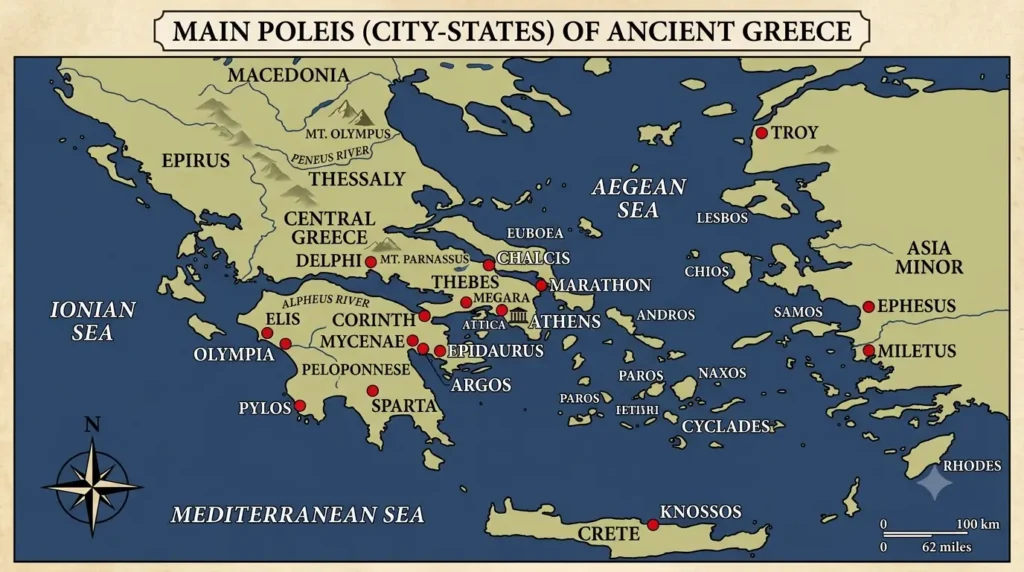
Historical background: The idea of the polis emerged around the 8th century BCE, after the collapse of Mycenaean civilization. By the 6th–5th centuries BCE, Athens, Sparta, Corinth and Thebes had become the leading poleis. The system introduced early democratic participation, fuelled philosophy, drama and art (Socrates, Plato), and depended militarily on hoplite citizen-soldiers. Its influence on citizenship and city-planning outlasted the poleis themselves. For a deeper primary-source grounding, see the Encyclopaedia Britannica entry on the polis.
1.2 Athens: Politics, Democracy and Reform
Development of Athenian government
- Monarchy → Aristocracy: Early kings gave way, by the 8th century BCE, to rule by wealthy landowning nobles.
- Rise of Tyranny (7th century BCE): Social unrest brought tyrants to power with popular backing. Peisistratus (r. 561–527 BCE) stabilised Athens through land redistribution, though he ruled alone.
- Start of democracy: After his sons lost power, Athens began building direct democratic institutions.
Key democratic institutions
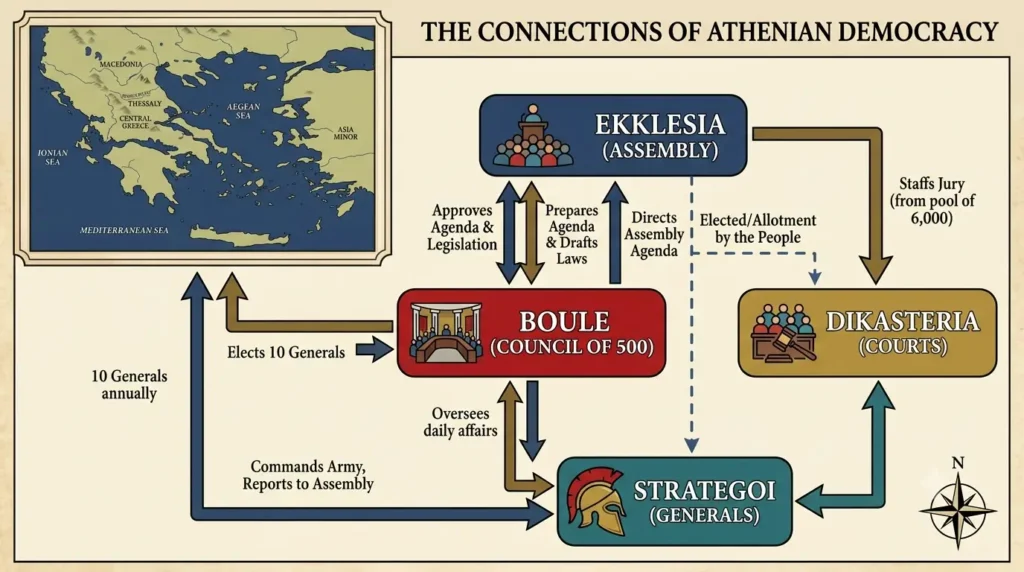
- Ekklesia (Assembly): Met ~40 times a year; all male citizens over 18 could speak and vote; decisions by majority.
- Boule (Council of 500): 500 citizens chosen by lottery (50 per tribe, one-year terms) set the Assembly’s agenda and ran daily administration.
- Dikasteria (Courts): Large citizen juries (201–1,501 members, always odd) could overturn Assembly decisions.
- Strategoi (Generals): Ten elected military-political leaders, one per tribe.
Reforms that built democracy
| Reformer | Date | Key change |
|---|---|---|
| Solon | 594 BCE | Cancelled debts, ended debt-slavery, created a wealth-based class system, made laws public |
| Cleisthenes | 508 BCE | Reorganised citizens into 10 location-based tribes, expanded the Boule to 500, introduced ostracism |
| Pericles | 461–429 BCE | Paid public officials (letting poorer citizens serve), expanded the Delian League, funded the Parthenon |
These reforms increased political participation, introduced lottery-based office selection to curb corruption, and made Athens a lasting symbol of democratic and cultural achievement.
1.3 Sparta: Political and Social Structure
Sparta mixed monarchy, oligarchy and limited democracy, organised entirely around military discipline.
- Dual kingship: Two kings, largely ceremonial, led the army.
- Gerousia (Council of Elders): 28 elders + 2 kings (30 total), elected for life, proposed laws.
- Ephors: Five elected officials who supervised the kings and could veto decisions.
- Apella (Assembly): All male Spartiates over 30 voted on proposals but couldn’t originate laws.
Social hierarchy: Spartiates (full citizens, professional soldiers) → Perioikoi (free non-citizens handling trade/crafts) → Helots (state-owned slaves from conquered Messenia who farmed the land and were treated harshly).
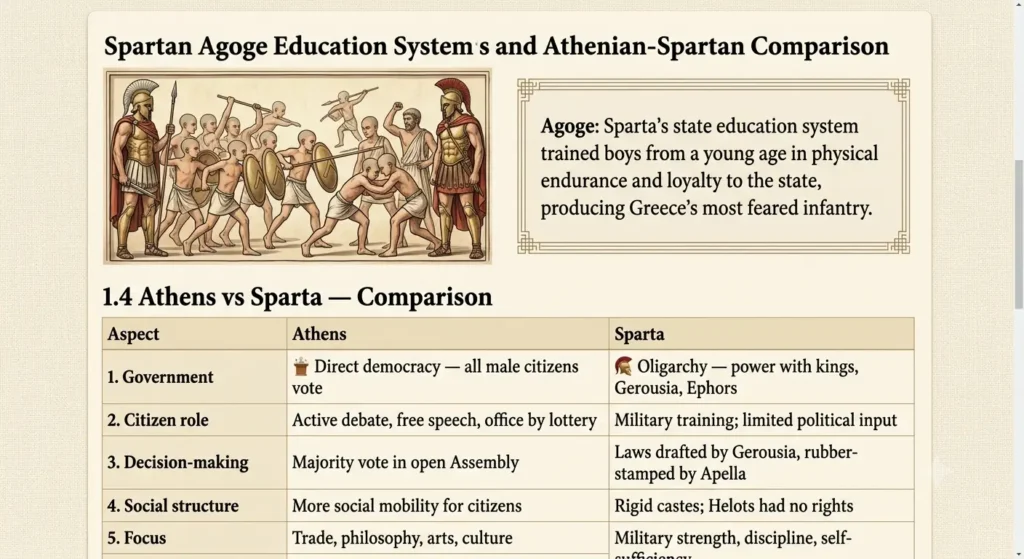
Agoge: Sparta’s state education system trained boys from a young age in physical endurance and loyalty to the state, producing Greece’s most feared infantry.
1.4 Athens vs Sparta — Comparison
| Aspect | Athens | Sparta |
|---|---|---|
| Government | Direct democracy — all male citizens vote | Oligarchy — power with kings, Gerousia, Ephors |
| Citizen role | Active debate, free speech, office by lottery | Military training; limited political input |
| Decision-making | Majority vote in open Assembly | Laws drafted by Gerousia, rubber-stamped by Apella |
| Social structure | More social mobility for citizens | Rigid castes; Helots had no rights |
| Focus | Trade, philosophy, arts, culture | Military strength, discipline, self-sufficiency |
Part 1 in brief: Athens and Sparta represent two opposite answers to the same question — how should a polis be governed? Athens chose participation and culture; Sparta chose discipline and control. Both left permanent marks on Western political thought. (For related Political Science context on early democratic theory, see Approaches to Political Theory on Delhi Pathshala.)
Part 2: Rome — From Republic to Principate (c. 500 BCE–27 BCE)
2.1 The Roman Republic: Institutions and Society
The Republic began in 509 BCE when the last king, Tarquinius Superbus, was overthrown, replacing one-man rule with elected officials.
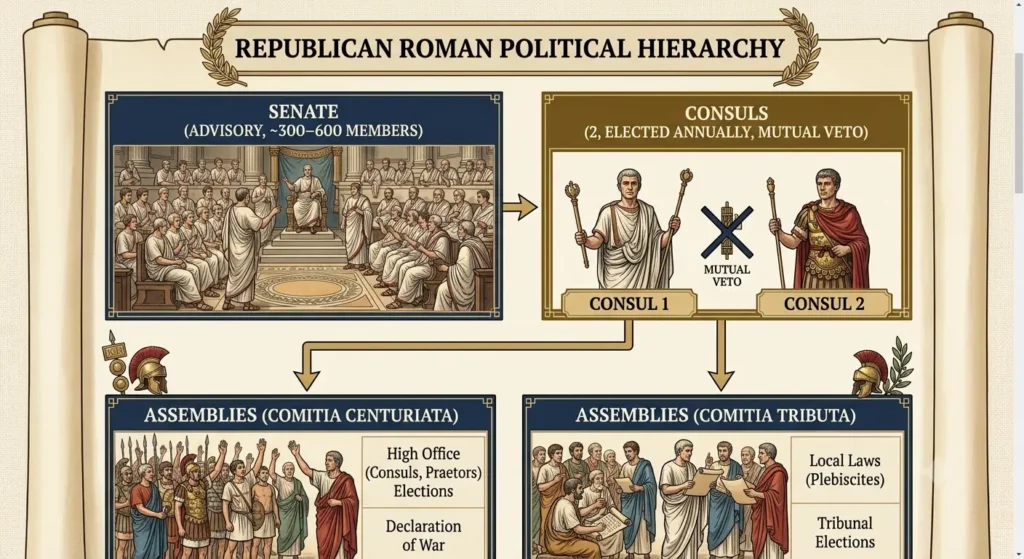
- Senate: ~300 members (grew to ~600 after Sulla’s reforms), advisory but highly influential.
- Consuls: Two elected annually, shared power, could veto each other.
- Comitia Centuriata: 193 voting “centuries,” wealth-weighted, elected top officials.
- Comitia Tributa: 35 tribes (4 urban, 31 rural), handled local laws and lower offices.
Social classes: Patricians (hereditary elite, held high office) · Plebeians (commoners, gradually won rights via elected tribunes) · Equites (wealthy merchant class, economic but not political power) · Slaves (no rights, though manumission was possible).
2.2 Conflict of the Orders
A near-two-century struggle (509–287 BCE) between patricians and plebeians over political rights, driven by political exclusion, economic inequality, unwritten laws favouring elites, and heavy but unrewarded military service.
| Reform | Year | Impact |
|---|---|---|
| The Twelve Tables | 451–450 BCE | First written Roman laws — reduced (but didn’t end) patrician manipulation |
| Tribune of the Plebs | 494 BCE | Elected plebeian officials with veto power |
| Lex Licinia Sextia | 367 BCE | Guaranteed one plebeian consul each year |
| Lex Hortensia | 287 BCE | Made plebeian assembly decisions binding on all Romans — ended the conflict |
2.3 Expansion of the Roman Empire
Rome’s growth from city-state to Mediterranean power rested chiefly on the Punic Wars (264–146 BCE) against Carthage.
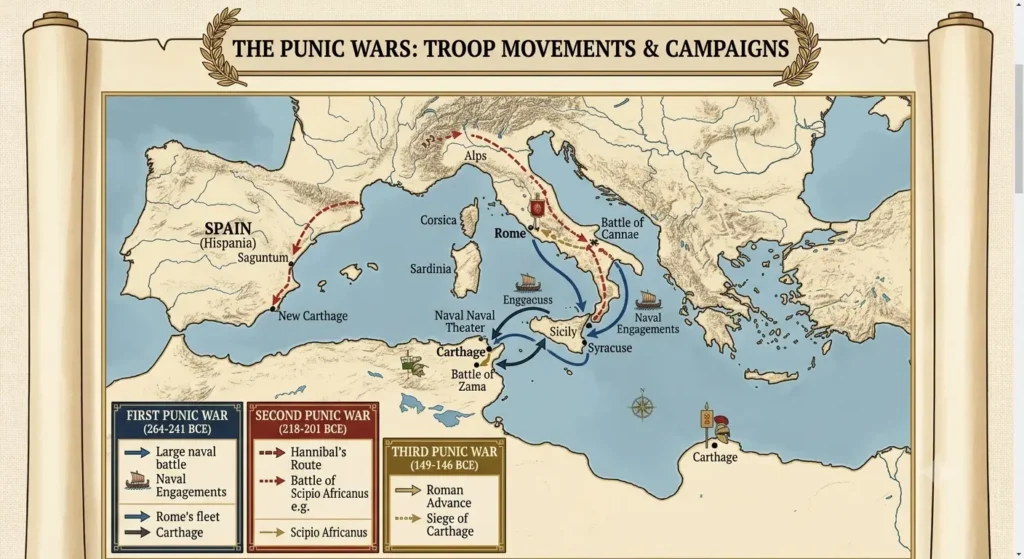
- First Punic War (264–241 BCE): Fought over Sicily; Rome won, gained its first overseas territory and became a sea power.
- Second Punic War (218–201 BCE): Hannibal crossed the Alps and won early victories (e.g. Cannae), but Scipio Africanus turned the tide; Carthage lost Spain.
- Third Punic War (149–146 BCE): Carthage was destroyed and annexed as a Roman province.
Rome then absorbed Macedonia and Greece (214–148 BCE), defeated the Seleucid Empire (192–188 BCE), annexed Egypt (30 BCE), and — under Julius Caesar — conquered Gaul (58–50 BCE).
Effects: Massive wealth and slave labour flowed in, but small farmers were squeezed out, wealth inequality widened, and armies grew loyal to generals rather than the Senate — planting the seeds of the Republic’s collapse.
2.4 Transition to the Principate
Political corruption, the Optimates-vs-Populares split, and generals like Julius Caesar gaining outsized power destabilised the Republic. Caesar’s crossing of the Rubicon (49 BCE), his dictatorship, assassination (44 BCE), and the ensuing civil wars ended at the Battle of Actium (31 BCE), where Octavian defeated Antony and Cleopatra.
In 27 BCE, Octavian took the title Augustus, publicly “restoring” the Republic while retaining real control over the army, provinces and legislation — inaugurating the Principate. He created the title Princeps (“first citizen”), held the office of Pontifex Maximus, split provinces into imperial and senatorial categories, and passed moral and family-focused legislation. The Senate survived in form but lost real power — governance now centred on the emperor.
Part 3: Slavery in Ancient Greece and Rome
3.1 Slavery in Ancient Greece
Slavery shaped the Greek economy, culture and social order from the Mycenaean period onward, formalising during the Archaic (800–480 BCE) and Classical (480–323 BCE) periods. People became slaves through war capture, debt, birth, or piracy/trade — not through race.
- Athens: Domestic slaves (often women), skilled labourers (some could buy freedom), public slaves (record-keeping, legal protections), and farm labour.
- Sparta: Helots — state-owned, harshly controlled, feared enough that Spartans used covert policing against them.
- Corinth & Thebes: Slaves worked pottery/luxury-goods production and general household/farm labour.
Slavery let free citizens focus on politics and culture (Aristotle defended it as “natural”; Socrates and Plato questioned its ethics without rejecting it outright), while helot revolts — especially during the Messenian Wars — showed the system’s fragility.
3.2 Slavery in Ancient Rome
Roman slavery expanded alongside conquest, especially after the Punic Wars, drawing captives from North Africa, Spain, Greece and Asia Minor.
- Agricultural slaves: The largest group; long hours, harsh supervision on large estates.
- Household slaves: Comparatively better treated but still without freedom.
- Mine slaves: Brutal conditions, low life expectancy.
- Skilled/public-works slaves: Construction, administration; some could earn and buy freedom (manumission).
Legally, slaves were property with no rights, though some laws restricted extreme abuse and freed slaves (freedmen) gained limited legal standing.
3.3 Resistance and Slave Revolts
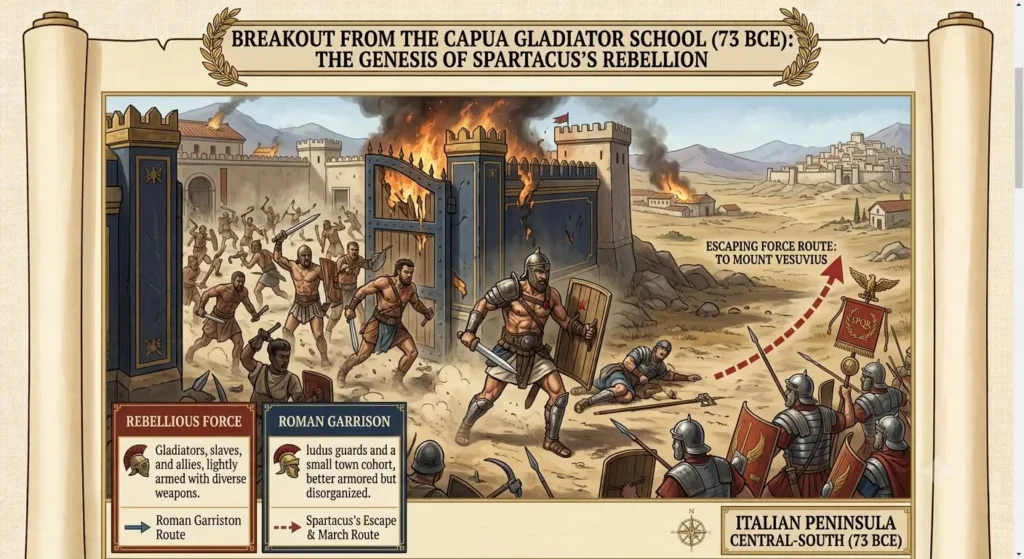
- Spartacus Revolt (73–71 BCE): The most famous slave uprising; escaped gladiators grew into an army that defeated several Roman forces before Crassus and Pompey crushed it — about 6,000 followers were executed as a warning.
- First Servile War (135–132 BCE) and Second Servile War (104–100 BCE): Both centred in Sicily, led by Eunus and Salvius respectively.
Impact: Tighter surveillance and harsher slave laws followed, alongside growing (though largely ineffective) philosophical debate about slavery’s ethics — a debate later reinforced by early Christian ideas of equality.
Part 4: Crisis of the Roman Empire
4.1 Economic and Social Problems
Trade declined as 3rd-century CE invasions (Goths, Vandals) disrupted routes, while debased coinage triggered inflation. Slave-dependent farming became less productive as the supply of new slaves fell, and repeated wars and climate disruptions (droughts, floods) hit food production. Cities shrank as people fled to self-sufficient rural estates, deepening the wealth gap between elites and the urban poor who depended on state grain doles.
4.2 Political and Military Crisis
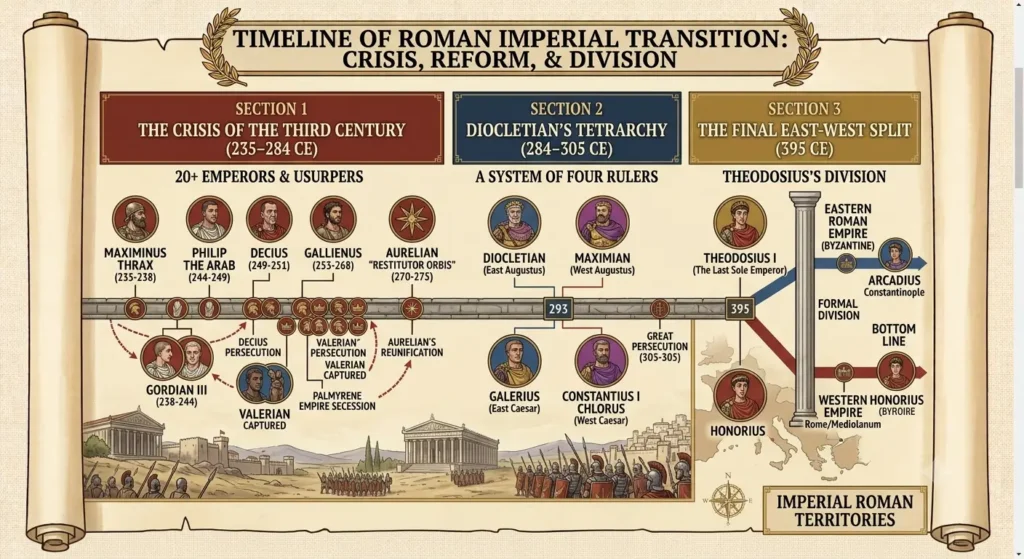
- Crisis of the Third Century (235–284 CE): Over 20 emperors in 50 years, frequent assassinations by soldiers, breakaway regions (Gallic Empire, Palmyrene Empire).
- Diocletian’s Tetrarchy (284–305 CE): Split the empire into four co-ruled parts — stabilised things briefly, then triggered new succession struggles.
- 395 CE split: After Theodosius I’s death, the empire divided into Western and Eastern (Byzantine) halves, leaving the West without Eastern resources.
- External invasions: Visigoths sacked Rome (410 CE), Vandals took Carthage (439 CE) and sacked Rome again (455 CE), and the Huns under Attila devastated Europe until stopped at the Battle of the Catalaunian Plains (451 CE).
4.3 Religious and Cultural Change
Christianity, born in 1st-century CE Judea, spread despite persecution (notably under Nero and Diocletian) because of its message of hope and equality. Constantine’s conversion and the Edict of Milan (313 CE) legalised it; the Council of Nicaea (325 CE) unified Christian doctrine; and Theodosius I made it the empire’s official religion in 380 CE, banning pagan practice. This reshaped Roman identity, social welfare (hospitals, care for the poor), and ultimately the political relationship between Church and state.
4.4 Fall of the Western Roman Empire
- Sack of Rome (410 CE): Visigoths under Alaric looted the city for three days — a psychological turning point.
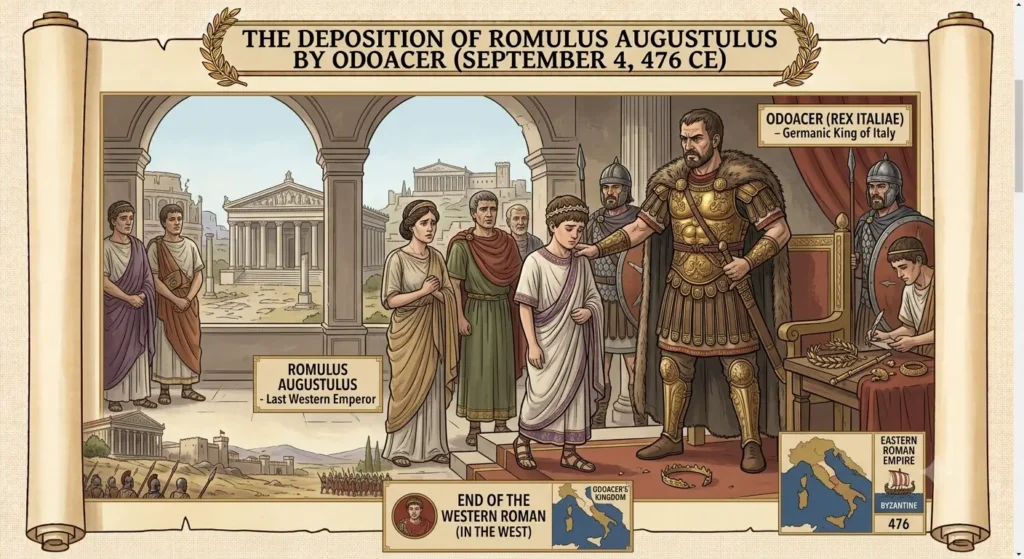
- 476 CE: Romulus Augustulus, the last Western emperor, was deposed by the Germanic leader Odoacer, who became King of Italy — conventionally marking the empire’s end in the West.
- Aftermath: The Byzantine (Eastern Roman) Empire survived another millennium; barbarian kingdoms (Visigoths in Spain, Vandals in North Africa, Franks in Gaul) emerged; trade networks and city life declined, giving rise to feudalism and the early Middle Ages.
For a broader look at what came next in Europe, see our notes on Feudal Societies in Medieval Europe. To understand how religious transformation played out elsewhere in this period, see History of Religion and Cultural Developments in India. For a primary-source-backed overview of the fall of Rome, the UNESCO World Heritage background on the Roman Forum and Perseus Digital Library’s Roman History collection are excellent further reading.
Previous Year Questions
Based on actual DU B.A. (Hons.) History Semester 2 examination pattern for this paper (Unique Paper Code 231202/2312101202):
- Account for the expansion and stability of the Roman Empire from 27 BCE to 180 CE.
- Examine the main characteristics of slavery in Ancient Rome.
- What were the factors responsible for the decline of the Roman Empire?
- Discuss the nature of the polis and its significance in Ancient Greek political life.
- Compare the political systems of Athens and Sparta.
- Write a short note on the Conflict of the Orders in the Roman Republic.
- Analyse the transition from Republic to Principate under Augustus.
(Tip for students: these are frequently asked as 20-mark long-answer or short-note questions — practice writing 200–300 word answers for each.)
FAQs
What is a polis in ancient Greek history?
A polis was a self-governing Greek city-state with its own laws, army, and citizenship — combining an urban centre with surrounding farmland and villages.
What is the main difference between Athens and Sparta?
Athens was a direct democracy focused on trade, culture and citizen participation; Sparta was a militarised oligarchy focused on discipline and social order, with real power held by Helots-controlling elites.
Who were the Helots in Spartan society?
Helots were state-owned slaves, mostly from conquered Messenia, who farmed the land for Spartan citizens and were treated harshly to prevent rebellion.
What caused the Conflict of the Orders in Rome?
Political exclusion of plebeians from high office, unwritten laws favouring patricians, economic inequality, and unrewarded military service caused nearly two centuries of struggle, resolved by the Lex Hortensia in 287 BCE.
Who was the first Roman emperor?
Augustus (formerly Octavian) became Rome’s first emperor in 27 BCE, founding the Principate after defeating Antony and Cleopatra at the Battle of Actium.
What were the main causes of the fall of the Western Roman Empire?
A combination of economic decline, political instability (20+ emperors in 50 years during the Crisis of the Third Century), external invasions by Goths, Vandals and Huns, and the 395 CE East-West split.
What was the Spartacus Revolt?
A major slave uprising (73–71 BCE) led by the gladiator Spartacus, which defeated several Roman armies before being crushed by Crassus and Pompey.
How did slavery differ between Ancient Greece and Ancient Rome?
Greek slavery (especially Athenian) included more paths to skilled work and occasional manumission, while Spartan Helotry was uniquely harsh and state-controlled; Roman slavery was larger in scale, driven by conquest, and spanned agriculture, mining, households and public works.
Further Reading
Subscribe to keep reading
You've used your free notes for now. Get Delhi Pathshala Premium for unlimited access.
Subscribe — ₹29/30 days
The notes are great but I think some of the numbering are wrong which creates a little confusion