
Contents
- 1. Introduction
- What Are Emerging Powers in Global Politics?
- India’s Path: From a New Nation to a Global Player
- Signs of India’s Growth
- 2. India in the Changing World
- Historical Background
- The Cold War and India’s Neutrality
- Changes After the Cold War
- India’s Role in the 21st Century
- Economic Growth and Influence
- Strategic Partnerships and Multipolarity
- India’s Role in Global Organizations
- Challenges in the Changing World
- Balancing Independence and Cooperation
- Rivalries with Other Major Powers
- 3. Soft Power Diplomacy
- Understanding Soft Power
- Definition and Importance in International Relations
- India’s Strengths in Soft Power
- Cultural Diplomacy
- Promotion of Indian Culture: Yoga, Food, Movies, and Heritage
- Global Impact of Indian Media and Entertainment
- Educational and Technological Diplomacy
- Academic Exchanges and International Student Programs
- Technology as a Tool for Influence
- Developmental Diplomacy
- Humanitarian Aid and Development Partnerships
- Global Health Initiatives (Vaccine Diplomacy)
- Challenges to Soft Power Diplomacy
- Addressing Negative Views and Global Criticism
- Improving Soft Power Strategies
- 4. India’s Growth Compared to Other Countries
- Differences from Other Growing Countries
- India’s Special Path: Democracy and Strategy
- 5. Future Outlook
- Opportunities for India as a Global Leader
- Strategies to Boost India’s Power Status
- Vision for India’s Role in the Future World
- 6. Conclusion
- 📌 Previous Year Questions (DSC-18, Unit 5 / related units)
- ❓ Frequently Asked Questions
- 🔗 Important Links
In this post, you’ll find complete notes on Unit 5: India as an Emerging Power from DSC 18: India’s Foreign Policy: Challenges and Strategies, Semester 6, B.A. (Hons.) Political Science, Delhi University. These notes cover India’s economic rise, soft power diplomacy, and its comparative position among emerging economies — along with previous year questions and FAQs to help you revise faster before your exam.
1. Introduction
What Are Emerging Powers in Global Politics?
Emerging powers are countries that are growing economically, gaining influence in world affairs, and strengthening their military capacity. These nations are transitioning from regional importance to a global role, competing with established powers like the U.S. and China.
Key features of emerging powers:
- Strong and sustained economic growth
- Increasing diplomatic and military influence
- Active participation in global groups (UN, BRICS, G20, SCO)
- Advancements in technology, defense, and innovation
India’s Path: From a New Nation to a Global Player
After gaining independence in 1947, India faced a weak economy, poverty, and partition-related instability, but has since made significant progress toward becoming an emerging power.
Key developments:
- Economic Reforms (1991): Opened up the economy under the LPG model (Liberalization, Privatization, Globalization), leading to rapid growth.
- IT & Services Boom: Became a global leader in IT and outsourcing (TCS, Infosys, Wipro).
- Diplomatic Expansion: Strengthened ties with major global powers — U.S., Russia, Japan, ASEAN — partly discussed in our notes on India’s Foreign Policy as a Postcolonial State.
- Military Strengthening: Nuclear power since the 1998 Pokhran-II tests, advanced defense indigenization under Atmanirbhar Bharat, and space achievements through ISRO.
- Cultural Influence: Bollywood, yoga, and democratic values enhanced India’s global soft-power appeal.
Signs of India’s Growth
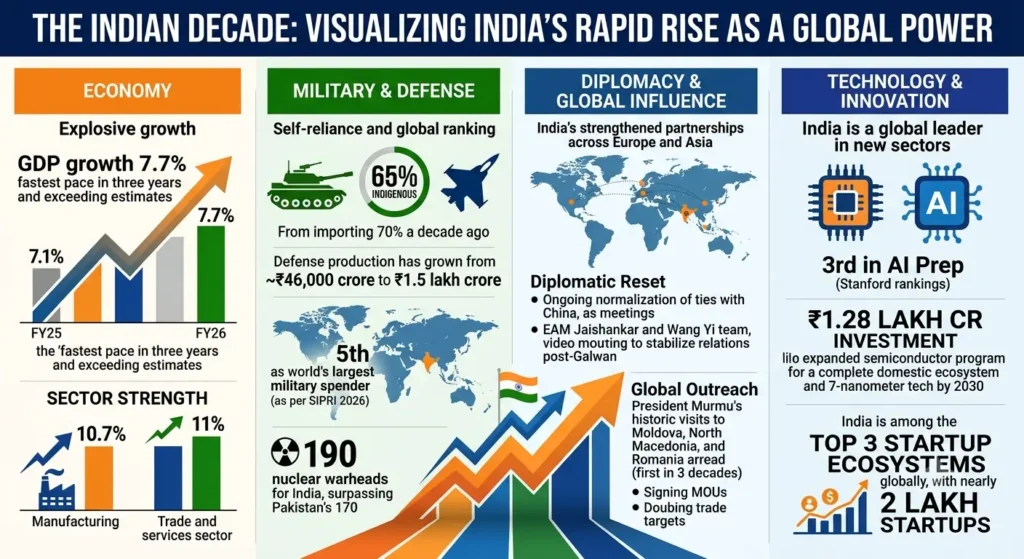
- Economic Success: Among the world’s largest economies by nominal GDP, with sustained growth projections through 2030 (see current figures on the IMF World Economic Outlook).
- Military Power: Ranked among the top militaries globally per the Global Firepower Index, with nuclear capability, advanced missile systems, and a growing navy.
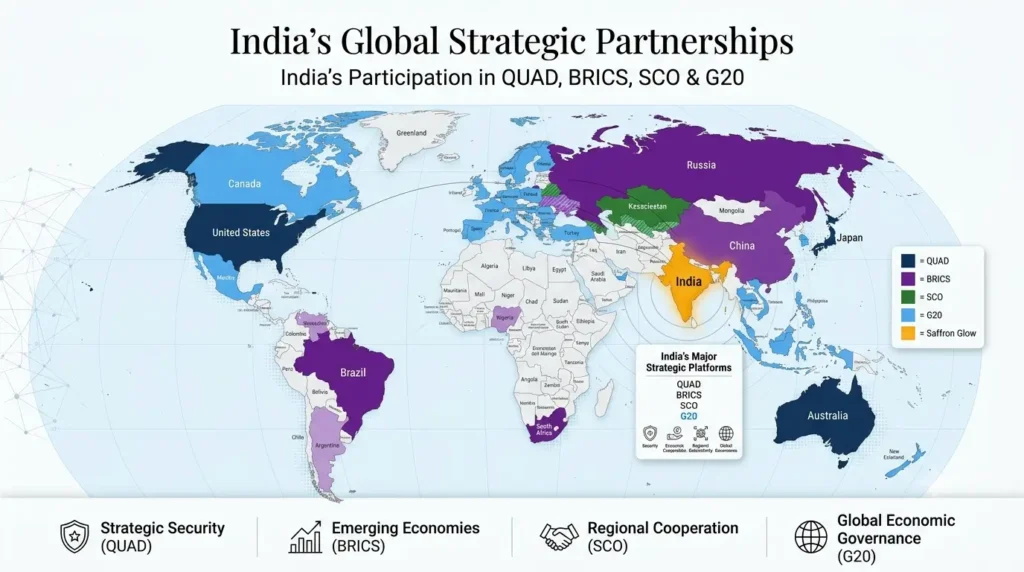
- Diplomatic Role: Key player in BRICS, G20, QUAD (U.S.-India-Japan-Australia), and SAARC.
- Technological Progress: Space missions (Chandrayaan, Mangalyaan, Gaganyaan), AI policy push, and the broader Digital India revolution.
- Young Workforce: A large, youthful population driving IT, innovation, and India’s startup ecosystem.
2. India in the Changing World
Historical Background
The Cold War and India’s Neutrality
During the Cold War (1947–1991), the world was divided between the U.S. and the Soviet Union. India, under Prime Minister Jawaharlal Nehru, chose a Non-Alignment Policy (NAM).
Key aspects of India’s foreign policy during this period:
- Maintained strategic independence while cooperating selectively with both blocs
- Supported decolonization movements and newly independent nations in Asia and Africa
- Promoted peace and multilateralism through the United Nations
- Built strong defense and economic ties with the Soviet Union while keeping working relations with the West
Changes After the Cold War
The collapse of the Soviet Union (1991) forced India to adjust to a U.S.-led unipolar order while simultaneously overcoming a domestic balance-of-payments crisis.
Key shifts in India’s approach:
- Economic Reforms (1991): Opened markets, boosting trade and FDI inflows
- Stronger U.S. Relations: Developed strategic and economic partnerships, culminating later in agreements like the India-U.S. Civil Nuclear Deal and iCET (Initiative on Critical and Emerging Technology)
- Joining Global and Regional Groups: Became active in ASEAN, BRICS, and G20
- Multipolar Strategy: Advocated for a world with multiple power centers to balance China’s rise
India’s Role in the 21st Century
Economic Growth and Influence
- One of the fastest-growing major economies, with projections placing it among the top three globally by 2030
- Key player in global supply chains, IT, pharmaceuticals (the “Pharmacy of the World”), and emerging technologies
- Enhancing energy security through partnerships with the Middle East and Africa
Strategic Partnerships and Multipolarity
- Supports a multipolar world order, avoiding dominance by any single power
- Strengthening ties with the U.S., Russia, Japan, and ASEAN while maintaining strategic autonomy
- Active in QUAD to address Indo-Pacific security, alongside regular joint drills such as the Malabar Exercise with the U.S., Japan, and Australia
- Expanding defense and economic relations with Europe, Africa, and Latin America
India’s Role in Global Organizations
- G20: Advocates for the Global South; hosted the 2023 G20 Summit in New Delhi, pushing the African Union’s inclusion as a permanent member
- United Nations: Seeks a permanent seat in the UN Security Council (UNSC) as part of broader reform demands
- World Trade Organization (WTO): Pushes for fair trade policies benefiting developing nations
- BRICS & SCO: Strengthens ties with Russia, China, and other emerging economies to build alternatives to Western-dominated financial institutions
Challenges in the Changing World
Balancing Independence and Cooperation
- Maintaining an independent foreign policy while deepening ties with both the U.S. and Russia simultaneously
- Managing tensions with China while continuing trade and diplomatic dialogue
- Aligning national priorities with global expectations on climate change, security, and trade
Rivalries with Other Major Powers
- China: Border standoffs in eastern Ladakh (Galwan, Doklam legacy), economic competition, and China’s expanding footprint in the Indian Ocean through Belt and Road Initiative (BRI)-linked infrastructure in Sri Lanka and Pakistan
- Pakistan: Ongoing tensions over Kashmir, cross-border terrorism, and diplomatic friction
- Russia vs. U.S.: Balancing historic defense ties with Russia while deepening trade and technology cooperation with the U.S.
- Western Regulations: Navigating EU and U.S. trade/technology policy shifts while promoting self-reliance under Atmanirbhar Bharat
To counter these maritime and regional security challenges, India promotes cooperative frameworks like the Indian Ocean Rim Association (IORA) and pushes renewable-energy diplomacy through the International Solar Alliance, reflecting a holistic approach that balances traditional and non-traditional security concerns.
India’s rise as a global power depends on its ability to balance economic growth, diplomatic strategy, and security challenges in a rapidly evolving world. For a deeper look at the obstacles India faces in executing this vision, see our notes on the Challenges of India’s Foreign Policy in the Global Domain.
3. Soft Power Diplomacy
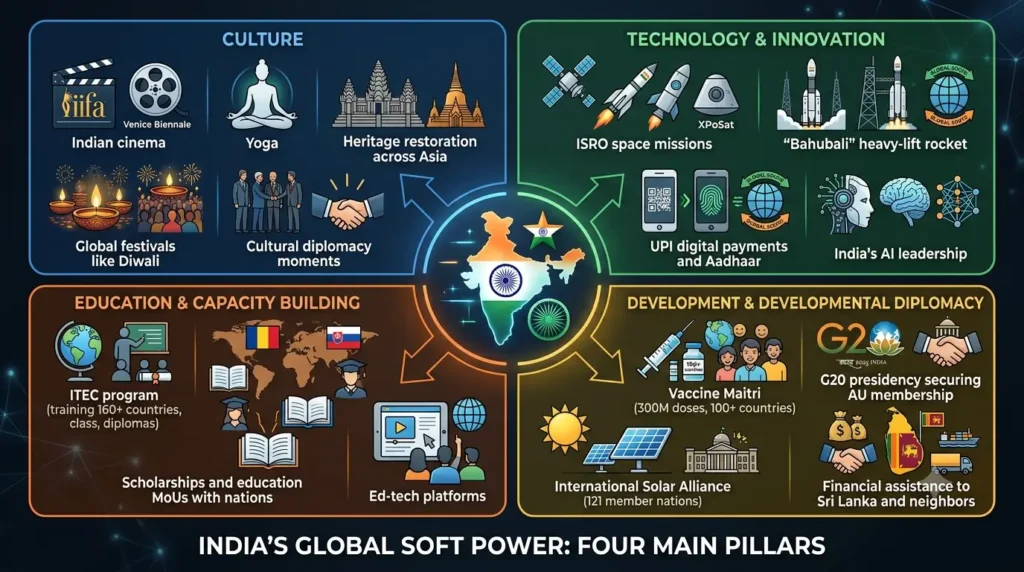
Soft power is when a country influences others through culture, values, and policy example instead of military or economic coercion. India, with its rich culture, democratic credentials, and technological advancement, has become a major soft power globally.
Understanding Soft Power
Definition and Importance in International Relations
- The term “soft power” was coined by political scientist Joseph Nye, describing influence gained through attraction and persuasion rather than force
- It helps countries form alliances, improve their global image, and build long-term goodwill
India’s Strengths in Soft Power
- Cultural Diversity: Numerous traditions, languages, religions, and festivals
- Democracy & Pluralism: India’s democratic model is admired across the developing world
- Historical Influence: Ancient philosophy, spirituality, and civilizational continuity attract global interest
- Technological Growth: India’s booming tech and startup sector — related to our notes on Technology and Public Administration in India
Cultural Diplomacy
Promotion of Indian Culture: Yoga, Food, Movies, and Heritage
- Yoga & Ayurveda: India’s advocacy led the UN to declare June 21 as International Yoga Day; Ayurveda is gaining global wellness recognition
- Indian Cuisine: Dishes like curry, biryani, and samosas have global popularity
- Bollywood & Cinema: Indian film, music, and dance have massive reach across South Asia, the Middle East, and Africa
Global Impact of Indian Media and Entertainment
- Indian films are increasingly visible on Hollywood platforms, Netflix, and international festivals
- Streaming platforms are expanding Indian-content libraries worldwide
- Cricket Diplomacy: The IPL attracts international players, strengthening people-to-people ties globally
Educational and Technological Diplomacy
Academic Exchanges and International Student Programs
- India hosts thousands of international students from Asia, Africa, and the Middle East
- Scholarship programs like ICCR (Indian Council for Cultural Relations) promote education and goodwill
- IITs and IIMs’ global reputation attracts international partnerships and research collaboration
Technology as a Tool for Influence
- IT & Software Leadership: Global leadership through companies like TCS, Infosys, Wipro
- Startups & AI Growth: Strong presence in fintech, edtech, and AI
- Digital Public Services: India’s UPI is being adopted or studied by Singapore, UAE, France, and other nations as a model for digital payments infrastructure
Developmental Diplomacy
Humanitarian Aid and Development Partnerships
- Neighbourhood First Policy: Infrastructure and trade support to Nepal, Bhutan, Bangladesh, and Sri Lanka
- Africa Outreach: Investment in healthcare, education, and infrastructure across the continent
- South-South Cooperation: Financial aid, trade partnerships, and skill-development programs
Global Health Initiatives (Vaccine Diplomacy)
- COVID-19 Vaccine Diplomacy: India supplied vaccines to 100+ countries under Vaccine Maitri
- Affordable Medicines: India’s role as the “Pharmacy of the World,” supplying low-cost generic drugs
- WHO Collaboration: Contributions to polio eradication and pandemic-response programs
Challenges to Soft Power Diplomacy
Addressing Negative Views and Global Criticism
- Concerns about religious tensions, press freedom, and human rights affect India’s global image in some assessments
- Diplomatic tensions with neighbors can weaken soft power outcomes
Improving Soft Power Strategies
- Strengthening institutions like ICCR, expanding cultural exchange, and engaging the Indian diaspora
- Leveraging social media, documentaries, and digital platforms to shape global perception
- Encouraging public-private partnerships in tourism, business, and entertainment
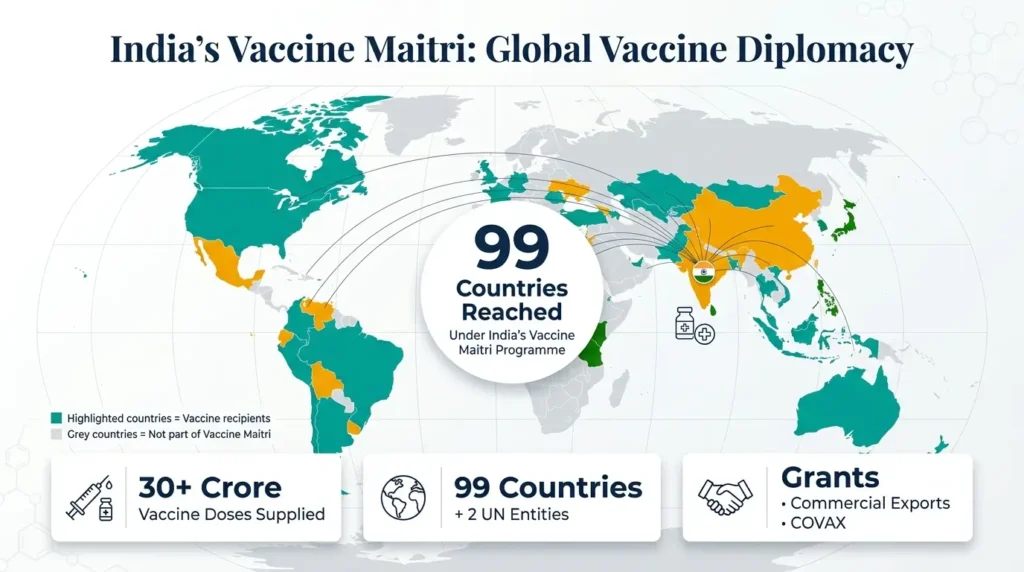
India’s soft power diplomacy plays a vital role in shaping its global influence. By leveraging culture, technology, and humanitarian outreach, India is consolidating its position as an emerging global power.
4. India’s Growth Compared to Other Countries
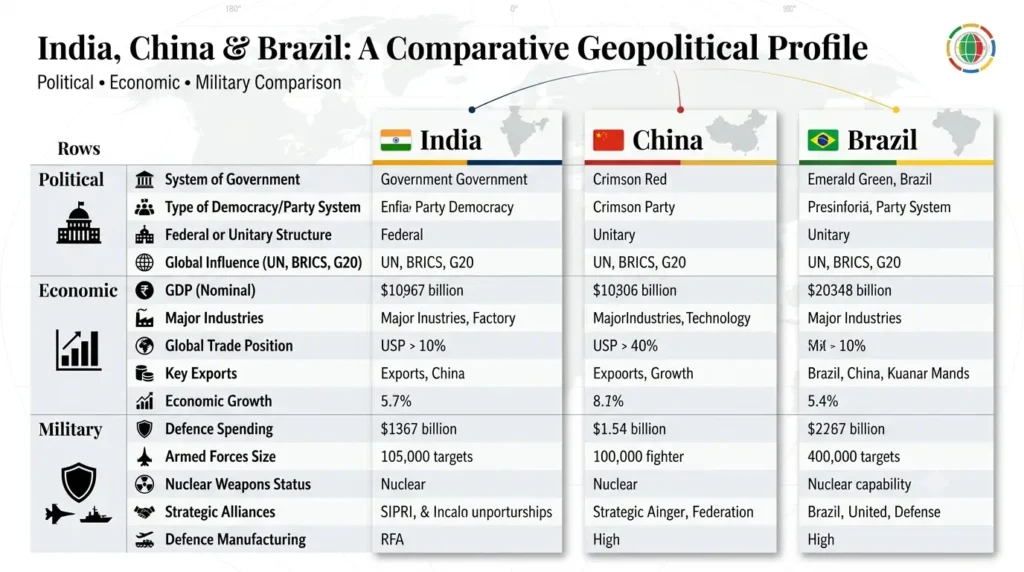
India is often compared with China and Brazil — fellow large, growing economies — but stands apart due to its democratic governance, independent decision-making, and heavy reliance on soft power in diplomacy.
Differences from Other Growing Countries
| Factor | India | China | Brazil |
|---|---|---|---|
| Political System | Democracy with multiple parties | One-party rule (Communist Party) | Presidential democracy |
| Economic Model | Mixed economy (strong in IT & services) | Government-led, manufacturing focus | Resource-based (commodities, agriculture) |
| Global Influence | Soft power & diplomacy | Military & economic dominance | Strong in Latin America, weaker globally |
| Military Strength | Among the top militaries globally, nuclear power, growing navy | Large military, advanced defense tech | Limited military, mostly regional influence |
| Technology & Innovation | IT hub, space tech (ISRO), strong startups | Leader in AI, 5G, industrial tech | Growing tech sector, not globally dominant |
| Trade & Economy | Strong services, rising manufacturing | Largest exporter, infrastructure focus | Dependent on commodity exports |
| Diplomatic Strategy | Balanced approach (QUAD, BRICS, G20) | Assertive (BRI, BRICS) | Regional focus in Latin America |
| Challenges | Infrastructure gaps, job creation, inequality | Aging population, U.S. tensions | Political instability, economic fluctuation |
India’s Special Path: Democracy and Strategy
1. Democracy as an Advantage
- Political stability, individual freedoms, and market-friendly policy continuity attract global investors
- Policy decisions rest on legal-institutional frameworks rather than single-party control
- Encourages innovation and entrepreneurship, making India a global startup hub
2. Growth through Services and Digital Development
- India’s economy is service-driven (IT, finance, digital economy), unlike China’s manufacturing-led model
- The Digital India initiative — related to our notes on Good Governance Initiatives in India — is expanding access to financial and government services
- Bengaluru and Hyderabad increasingly compete with global tech hubs
3. Strategic Vision: Working with Global Powers
- India follows a balanced foreign policy, engaging the U.S. (defense, trade, tech), Russia (energy, military), Europe (green energy, trade), and Asia-Africa (infrastructure, aid)
- Unlike China’s assertiveness in the South China Sea, India generally prioritizes diplomacy over coercion
4. Military Strength and Stability
- Growing domestic defense production under Atmanirbhar Bharat
- Strengthening naval presence in the Indo-Pacific to balance China’s influence
- Active in UN peacekeeping missions and defense partnerships with the U.S., France, and Israel
5. Soft Power in Global Influence
- India promotes cultural diplomacy (yoga, Bollywood, cuisine) rather than economic pressure
- A large global diaspora strengthens people-to-people and economic ties worldwide
Conclusion: India’s rise is unique because it balances economic power, democratic stability, soft power, and independent decision-making — positioning itself as a development- and diplomacy-first global actor rather than pursuing China’s assertiveness or Brazil’s regional focus.
5. Future Outlook
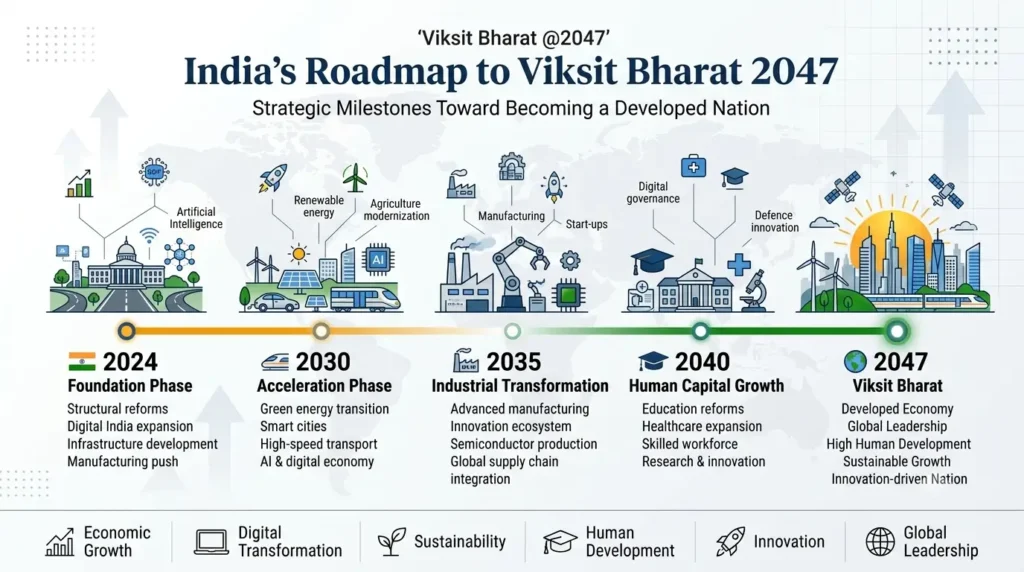
India is at a crucial stage in its journey toward global power status. With sustained economic growth, technological advancement, and strategic diplomacy, it has real potential to shape the future world order — provided it addresses key structural challenges.
Opportunities for India as a Global Leader
- Economic Growth & Innovation — driven by manufacturing (PLI schemes), digital services, and green energy; deepening trade ties with the EU, UK, and ASEAN through free trade agreements
- Geopolitical Strength — expanding leadership within G20, QUAD, BRICS, and the UN; increasing Indo-Pacific presence; strengthening Atmanirbhar Bharat defense self-reliance
- Young Workforce & Talent — leveraging India’s demographic dividend through investment in education, healthcare, and research
- Green Leadership — the Net Zero by 2070 commitment and leadership of the International Solar Alliance position India as a key climate-policy actor
Strategies to Boost India’s Power Status
- Economic reforms and infrastructure development to ease business and attract global investment
- Strengthening foreign relations with the U.S., EU, and ASEAN while maintaining working ties with Russia and China
- Investing in semiconductors, AI, cybersecurity, and space exploration
- Enhancing cultural and soft power outreach through education, diaspora engagement, and digital diplomacy (exporting UPI, Aadhaar-style digital public infrastructure)
Vision for India’s Role in the Future World
- Championing balanced, reformed global governance for developing nations
- Contributing to global peace via UN peacekeeping and counter-terrorism cooperation
- Leading sustainable growth through clean energy, smart cities, and climate resilience initiatives (ISA, Green Hydrogen Mission)
6. Conclusion
India’s transformation from a post-colonial nation to a rising global power rests on rapid economic growth, military modernization, and soft-power influence through culture, education, and humanitarian outreach. Despite challenges like infrastructure gaps and social inequality, India’s long-term trajectory as an emerging power remains strong.
Final Thought: India’s path to global leadership depends on clear vision, innovation, and inclusive development — positioning it as a leading force in democracy, development, and diplomacy through the 21st century.
📌 Previous Year Questions (DSC-18, Unit 5 / related units)
Compiled from DU BA (Hons.) Political Science, Semester 6, “India’s Foreign Policy: Challenges and Strategies” previous year and practice question patterns:
- Critically examine India’s transition from a postcolonial state to an aspiring global/emerging power.
- “India’s power is soft power.” Discuss with reference to cultural and diplomatic tools used by India.
- Evaluate India’s position and strategy in the contemporary multipolar world order.
- Discuss India’s role in the World Trade Organization (WTO) and multilateral economic institutions.
- Examine the areas of both conflict and cooperation in India-China relations against the backdrop of border disputes.
- Do you think India’s claim for a permanent seat at the UN Security Council is justified? Examine with arguments.
- Discuss the significance of soft power diplomacy — including yoga, Bollywood, and vaccine diplomacy — in shaping India’s global image.
- “Democracy is India’s biggest strategic asset in its rise as a global power.” Comment.
- Compare India’s model of emergence as a global power with that of China.
- What are the key challenges India faces in balancing strategic autonomy with deepening partnerships with major powers?
❓ Frequently Asked Questions
What does it mean when India is called an “emerging power”?
It means India is a country experiencing sustained economic growth, rising diplomatic and military influence, and increasing participation in global institutions like the UN, G20, and BRICS — transitioning from a regional to a global role.
What is India’s soft power, and why does it matter?
Soft power is influence gained through culture, values, and attraction rather than force. For India, this includes yoga, Bollywood, cuisine, democratic values, and vaccine diplomacy — tools that help build goodwill and alliances globally.
How is India different from China as an emerging power?
India is a pluralist democracy relying on soft power and balanced diplomacy, while China follows a one-party, state-led model relying more on economic and military assertiveness (e.g., the Belt and Road Initiative).
What are the main challenges to India’s rise as a global power?
Key challenges include infrastructure gaps, job creation, income inequality, border tensions with China and Pakistan, and balancing strategic autonomy while deepening ties with major powers like the U.S. and Russia.
Which groups/organizations reflect India’s growing global role?
India is an active member of the UN, G20, BRICS, QUAD, SCO, and SAARC, and seeks a permanent seat on the UN Security Council.
What is this unit’s weightage from an exam perspective?
Unit 5 (India as an Emerging Power) is a high-weightage, frequently examined unit in DSC-18 — expect at least one long-answer question on soft power diplomacy or India’s comparative global position.
🔗 Important Links
- India’s Foreign Policy as a Postcolonial State
- State and Democracy: Nehru, Deendayal Upadhyay, Lohia, Ambedkar
- Technology and Public Administration in India
- Good Governance Initiatives in India
- Challenges of India’s Foreign Policy in the Global Domain
- India and the Changing Global Power Equations
- DSC-18 category page
Subscribe to keep reading
You've used your free notes for now. Get Delhi Pathshala Premium for unlimited access.
Subscribe — ₹29/30 days