
Contents
- Introduction
- The main themes and issues of the unit
- The transition from classical to modern political philosophy
- The impact of historical and intellectual developments on political thought
- Chapter 1: Machiavelli (1469–1527)
- The life and works of Machiavelli
- The concept of power and the art of statecraft
- The distinction between virtù and fortuna
- The analysis of different forms of government and the ideal prince
- The critique of morality and religion in politics
- Chapter 2: Hobbes (1588–1679)
- The life and works of Hobbes
- The theory of human nature and the state of nature
- The concept of social contract and the sovereign
- The justification of absolutism and the right of resistance
- The relation between reason and passion and the role of law
- Chapter 3: Locke (1632–1704)
- The life and works of Locke
- The theory of natural rights and the state of nature
- The concept of social contract and the limited government
- The defense of liberalism and the right of revolution
- The notion of property and the role of consent
- Chapter 4: Rousseau (1712–1778)
- The life and works of Rousseau
- The theory of human nature and the state of nature
- The concept of social contract and the general will
- The critique of civilization and the ideal of democracy
- The notion of freedom and the role of education
- Chapter 5: John Stuart Mill (1806–1873)
- The life and works of Mill
- The Harm Principle and individual liberty
- Mill’s Utilitarianism and its political implications
- Representative government and political participation
- Chapter 6: Karl Marx (1818–1883)
- The life and works of Marx
- Historical materialism and the base-superstructure model
- Class struggle, alienation, and surplus value
- The state, revolution, and the communist society
- Marx’s critique of earlier political philosophers
- Key Takeaways: Comparing the Six Thinkers
- 1. Machiavelli
- 2. Thomas Hobbes
- 3. John Locke
- 4. Jean-Jacques Rousseau
- 5. John Stuart Mill
- 6. Karl Marx
- Overall Comparison
- A reflection on the legacy and impact of modern political philosophy on contemporary political thought
- DU Previous Year Questions (PYQs)
- FAQs
Quick Summary: This unit traces the shift from classical to modern political thought through six major thinkers — Machiavelli, Hobbes, Locke, Rousseau, Mill, and Marx. Below you’ll find complete explanations, DU previous year questions, and exam-ready FAQs.
Introduction
The unit on Renaissance and Modern Political Philosophy — part of the DU GE-6 Political Science syllabus — covers a broad range of intellectual developments that emerged during two significant periods in Western intellectual history: the Renaissance and the Modern era. As per the official GE-6 Unit-2 syllabus, this unit focuses on Machiavelli, Hobbes, Rousseau, Mill, and Marx; we’ve also included Locke as a bonus chapter since he’s frequently asked about in related papers and builds essential context for the social contract tradition.
This unit builds directly on (GE-6) Unit-1: Classical Political Philosophy — Plato & Aristotle, where the foundations of the polis and civic virtue were laid. Renaissance and modern thinkers reacted against — and built upon — these classical ideas.
The main themes and issues of the unit
The unit on Renaissance and Modern Political Philosophy covers a broad range of intellectual developments and ideas that emerged during two significant periods in Western intellectual history: the Renaissance and the Modern era. Here are some of the main themes and issues associated with this unit:
Renaissance Political Philosophy:
1. Humanism:
– Emphasis on human dignity, individualism, and the potential for human achievement.
– Rejection of medieval scholasticism in favor of a focus on classical texts (Greek and Roman).
2. Civic Humanism:
– Emphasis on active participation in civic life.
– The idea that individuals have a duty to contribute to the well-being of their communities.
3. Machiavellianism:
– Niccolò Machiavelli’s ideas on political realism and the relationship between power and morality.
– The Prince as a guide for rulers on the pragmatic use of power.
Modern Political Philosophy:
1. Social Contract:
– The emergence of the idea that individuals enter into a social contract to form a political society.
– Contract theorists like Thomas Hobbes, John Locke, and Jean-Jacques Rousseau.
2. State of Nature:
– Philosophical explorations of the hypothetical pre-political state of nature.
– Hobbes’ view of a state of war, Locke’s emphasis on natural rights, and Rousseau’s idea of the noble savage.
3. Liberalism:
– Development of liberal political thought emphasizing individual rights, freedom, and limited government.
– Enlightenment thinkers such as John Locke, Montesquieu, and John Stuart Mill.
4. Republicanism:
– Focus on the common good and civic virtue.
– Montesquieu’s separation of powers and Rousseau’s concept of the general will.
5. Enlightenment Ideals:
– Emphasis on reason, science, and progress as foundations for political and social improvement.
– Critiques of absolutism and advocacy for constitutional government.
6. Critique of Authority:
– Challenges to traditional authority, including religious and monarchical authority.
– Voltaire’s advocacy for religious tolerance and the separation of church and state.
7. Political Legitimacy:
– Questions about the source of political authority and legitimacy.
– Rousseau’s emphasis on popular sovereignty and the idea that government derives its authority from the consent of the governed.
8. Nationalism:
– Emergence of nationalist sentiments and the idea of a nation-state.
– Jean-Jacques Rousseau’s influence on the development of modern nationalism.
9. Feminist Critiques:
– Feminist perspectives on political philosophy emerge, challenging traditional gender roles and advocating for equal rights.
– Mary Wollstonecraft’s “A Vindication of the Rights of Woman” as a landmark text.
10. Responses to Industrialization:
– Philosophical reflections on the social and political implications of industrialization and capitalism.
– Karl Marx’s critique of capitalism and the call for a classless society.
These themes and issues represent a rich tapestry of ideas that have shaped political thought from the Renaissance through the Modern era, contributing to the development of Western political philosophy. The unit likely explores how these ideas influenced political institutions, revolutions, and the formation of modern states.
The transition from classical to modern political philosophy
The transition from classical to modern political philosophy represents a significant intellectual and historical shift in Western thought. This transition occurred during the Renaissance and the subsequent Modern era, marked by changes in political, social, economic, and cultural landscapes. Here’s an overview of the key elements and factors involved in this transition:
1. Renaissance Humanism:
– Classical Revival: The Renaissance witnessed a revival of interest in classical Greek and Roman texts. Humanists sought to reconnect with the wisdom of ancient philosophers and focused on the human experience.
– Shift to Human-Centered Values: The emphasis shifted from religious and otherworldly concerns to human-centered values, individualism, and the celebration of human potential.
2. Machiavellian Realism:
– Political Realism: Niccolò Machiavelli’s work, especially “The Prince,” marked a departure from classical political philosophy. Machiavelli focused on the practical aspects of politics, advocating for a realistic understanding of power and the ruthless pursuit of political goals.
– Morality in Politics: Machiavelli’s separation of political and moral considerations challenged the classical view that rulers should embody moral virtues.
3. Social Contract and State of Nature:
– Hobbes’s Leviathan (17th Century): Thomas Hobbes, in “Leviathan,” introduced the idea of a social contract and the state of nature. He argued that individuals, in their natural state, would create a social contract out of self-interest to escape the “war of all against all.”
– Locke’s Second Treatise (17th Century): John Locke’s work proposed a more optimistic view of the state of nature. He argued for natural rights, including life, liberty, and property, and posited that individuals form a social contract to protect these rights.
4. Enlightenment Ideals:
– Reason and Progress: Enlightenment thinkers, such as John Locke, Montesquieu, and Voltaire, emphasized reason as a guide for human affairs. They believed in the potential for progress through the application of reason, science, and education.
– Limited Government: Enlightenment philosophers questioned absolute authority and advocated for constitutional forms of government that limited the power of rulers. Montesquieu’s idea of the separation of powers influenced the framing of modern constitutions.
5. Rousseau’s Social Contract:
– General Will: Jean-Jacques Rousseau’s “The Social Contract” proposed a more communitarian vision. He argued for the concept of the general will, suggesting that legitimate political authority arises from the collective will of the people.
– Critique of Inequality: Rousseau’s critique of social inequality and private property challenged classical ideas about the naturalness of social hierarchies.
6. Challenges to Traditional Authority:
– Religious Tolerance: Enlightenment thinkers advocated for religious tolerance, challenging the traditional fusion of political and religious authority.
– Secularism: The transition saw a move towards secularism, separating political governance from religious doctrine. This shift is evident in the ideas of figures like Voltaire.
7. Responses to Economic Changes:
– Capitalism and Critiques: The rise of capitalism and the Industrial Revolution prompted philosophical reflections on the social and economic order. Karl Marx, for example, critiqued capitalism and called for a classless society.
8. Nationalism and Feminism:
– Emergence of Nationalism: Rousseau’s influence contributed to the rise of nationalist sentiments, with an emphasis on the nation-state.
– Feminist Critiques: The transition period also saw the emergence of feminist perspectives, challenging traditional gender roles and advocating for equal rights (e.g., Mary Wollstonecraft).
9. Scientific Revolution:
– Impact on Worldview: The Scientific Revolution challenged traditional views about the cosmos and human nature, influencing philosophical perspectives on governance and the role of reason.
10. Impact on Political Institutions:
– Constitutionalism: Modern political philosophy influenced the development of constitutional forms of government, with a focus on protecting individual rights and limiting the powers of rulers.
– Democracy: The transition laid the groundwork for the development of democratic ideals, where governance derived legitimacy from the consent of the governed.
In summary, the transition from classical to modern political philosophy involved a profound reevaluation of human nature, political authority, and the relationship between individuals and the state. It marked a shift from traditional, hierarchical, and religiously grounded views to more secular, individualistic, and rational approaches to understanding and organizing political life. This transition laid the foundation for the development of modern political thought and institutions.
The impact of historical and intellectual developments on political thought
Historical and intellectual developments have had a profound impact on political thought throughout different periods in history. The evolution of political thought is closely intertwined with the changing social, economic, and cultural contexts. Here’s an exploration of how various historical and intellectual developments have influenced political thought:
1. Ancient Greece and Rome:
– Intellectual Foundations: The political philosophy of ancient Greece, particularly the works of philosophers like Plato and Aristotle, laid the intellectual foundations for later political thought.
– City-State Model: The concept of the city-state (polis) and the exploration of political virtues and governance in works like “The Republic” and “Politics” shaped subsequent discussions on political organization.
2. Medieval Period:
– Integration of Religion and Politics: The medieval period saw the integration of religious and political authority. The works of thinkers like St. Augustine and St. Thomas Aquinas reflected on the relationship between earthly and divine authority.
– Scholasticism: Scholastic philosophy, characterized by a synthesis of Christian theology and Aristotelian philosophy, influenced discussions on political legitimacy and just governance.
3. Renaissance Humanism:
– Revival of Classical Thought: The rediscovery of classical Greek and Roman texts during the Renaissance led to a revival of humanism. The emphasis shifted towards individualism, secularism, and a focus on human potential.
– Machiavellian Realism: Niccolò Machiavelli’s pragmatic approach to politics in “The Prince” reflected the changing attitudes towards power and governance, emphasizing the pursuit of political goals over moral considerations.
4. Enlightenment:
– Scientific Revolution: The Scientific Revolution challenged traditional beliefs and contributed to an emphasis on reason, empiricism, and the scientific method. This influenced political thought by encouraging a more rational and empirical approach to understanding human affairs.
– Individual Rights: Enlightenment thinkers such as John Locke and Jean-Jacques Rousseau explored the concept of natural rights and the social contract, laying the groundwork for modern notions of individual rights and democratic governance.
– Separation of Powers: Montesquieu’s “The Spirit of the Laws” introduced the idea of the separation of powers, influencing the design of constitutional governments.
5. American and French Revolutions:
– Ideas of Democracy and Rights: The American Revolution and the French Revolution were informed by Enlightenment ideals. Documents like the U.S. Constitution and the Declaration of the Rights of Man and of the Citizen reflected a commitment to democratic governance and individual rights.
– Nationalism: The French Revolution, in particular, contributed to the rise of nationalism as people sought to define political communities based on shared values and identity.
6. Industrial Revolution:
– Critique of Capitalism: The social and economic changes brought about by the Industrial Revolution prompted critiques of capitalism. Thinkers like Karl Marx examined the impact of economic structures on political power and social relations.
7. 20th Century:
– Totalitarianism and Anti-Colonial Movements: The rise of totalitarian regimes in the 20th century, along with anti-colonial movements, prompted reflections on the nature of political power, the role of the state, and the quest for self-determination.
– Human Rights: The atrocities of World War II led to the development of international human rights frameworks, influencing discussions on the ethical responsibilities of states and the protection of individual rights.
8. Post-Cold War Era:
– Globalization: The post-Cold War era and the acceleration of globalization have led to discussions on the changing nature of sovereignty, the role of international institutions, and the challenges posed by interconnected global issues.
– Environmentalism: The recognition of environmental challenges has prompted discussions about the ethical responsibilities of political entities towards the planet and future generations.
9. Technology and Information Age:
– Digital Age Challenges: The Information Age and rapid technological advancements have raised questions about privacy, surveillance, and the impact of digital platforms on political discourse and participation.
10. Feminist and Postcolonial Perspectives:
– Gender and Identity: Feminist and postcolonial perspectives have enriched political thought by challenging traditional power structures, highlighting issues of gender, identity, and the impact of colonial legacies on political systems.
In summary, historical and intellectual developments continuously shape political thought by influencing the questions asked, the issues considered relevant, and the methods used to analyze political phenomena. The interplay between historical events and intellectual inquiries contributes to the dynamic and evolving nature of political philosophy. Political thinkers respond to the challenges and opportunities presented by their historical contexts, leaving a legacy that informs future generations.
Chapter 1: Machiavelli (1469–1527)
The life and works of Machiavelli
Niccolò Machiavelli (1469-1527) was an Italian diplomat, philosopher, historian, and politician who is best known for his political treatise, “The Prince.” Here are some key details about his life and works:
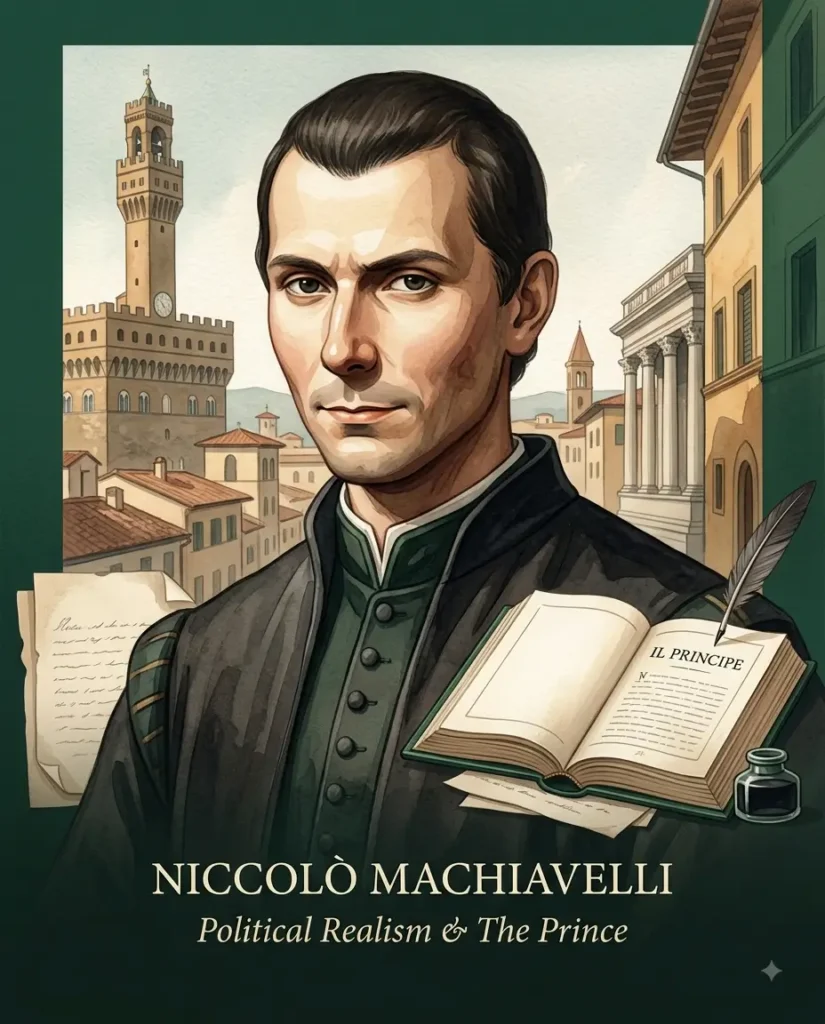
Life:
1. Early Life:
– Machiavelli was born on May 3, 1469, in Florence, Italy, during the Renaissance period.
– He received a humanist education and studied the classics, literature, and philosophy.
2. Political Career:
– Machiavelli entered public service in Florence in the early 16th century.
– He held various government positions, including serving as a diplomat and as the Secretary to the Second Chancery.
3. Diplomatic Missions:
– Machiavelli conducted diplomatic missions to various European courts, gaining insights into the politics of the time.
4. Fall from Power:
– After the Medici family returned to power in Florence in 1512, Machiavelli was dismissed from his political post and briefly imprisoned.
Works:
1. The Prince (Il Principe):
– Published in 1532, posthumously, “The Prince” is Machiavelli’s most famous work.
– It is a political treatise that explores the nature of power, leadership, and governance.
– Machiavelli’s pragmatic and realistic approach to politics is encapsulated in the famous phrase “the ends justify the means.”
2. The Discourses on Livy (Discorsi sopra la prima deca di Tito Livio):
– Written between 1517 and 1519, this work is a commentary on the history of Rome by Livy.
– It explores Machiavelli’s republican ideals and ideas about the best form of government.
3. Art of War (Dell’arte della guerra):
– A treatise on military strategy, written between 1519 and 1520.
– Machiavelli draws on his experiences in diplomacy and military affairs.
4. Historical Works:
– Machiavelli wrote several historical works, including “History of Florence” and “The Life of Castruccio Castracani.”
5. Plays and Poetry:
– Machiavelli also wrote plays and poetry, though they are less known than his political writings.
Legacy:
1. Controversy:
– Machiavelli’s ideas in “The Prince” have been widely debated and often criticized for their seemingly amoral and ruthless nature.
2. Impact on Political Thought:
– Machiavelli is considered a key figure in the development of modern political thought.
– His emphasis on practicality and realism in politics has had a lasting influence.
3. Machiavellianism:
– The term “Machiavellian” is often used to describe political cunning, deceit, and manipulation.
Despite being a complex and controversial figure, Machiavelli’s works continue to be studied and analyzed for their insights into politics and human nature.
The concept of power and the art of statecraft
Niccolò Machiavelli’s views on power and the art of statecraft are central themes in his works, particularly in “The Prince” and “The Discourses on Livy.” Here are key aspects of his ideas on these subjects:
1. The Nature of Power:
– Realism and Pragmatism: Machiavelli was a realist who believed in facing political realities as they were, rather than as one wished them to be. He argued that leaders must be pragmatic and adapt to the ever-changing circumstances of politics.
– Securing Power: Machiavelli emphasized the importance of acquiring and maintaining political power. He believed that a ruler’s primary concern should be the stability and security of the state.
– The Ends Justify the Means: Perhaps the most controversial aspect of Machiavelli’s philosophy is his assertion that the ends (achieving and maintaining power) justify the means. This pragmatism led to the famous phrase “the ends justify the means.”
2. The Art of Statecraft:
– Political Skill and Virtù: Machiavelli introduced the concept of “virtù,” which referred to a leader’s ability to adapt to changing circumstances and use political skill to achieve their goals. It involved a combination of intelligence, strength, and decisiveness.
– Fortuna (Fortune): Machiavelli recognized the role of luck or fortune in politics. A skilled leader needed to be able to navigate both fortunate and unfortunate circumstances with equal dexterity.
– Militarism and Diplomacy: Machiavelli, drawing on his experiences as a diplomat and military official, stressed the importance of both military strength and diplomatic finesse in statecraft. He considered a strong military as the foundation of a secure state.
3. The Prince:
– Advice to Rulers: In “The Prince,” Machiavelli offers practical advice to rulers on how to gain and maintain power. He explores topics such as leadership qualities, the use of force, alliances, and managing internal and external threats.
– Morality in Politics: Machiavelli departed from conventional moral considerations, arguing that a ruler should be willing to set aside traditional moral values if necessary for the greater good of the state.
4. The Discourses on Livy:
– Republican Ideas: In “The Discourses on Livy,” Machiavelli explores the idea of republicanism and the best form of government. He favors a mixed government that incorporates elements of monarchy, aristocracy, and democracy.
– Citizen Participation: Unlike “The Prince,” which is more focused on autocratic rule, “The Discourses” considers the role of citizens in the governance of a state. Machiavelli values active citizen participation for the stability of the republic.
Machiavelli’s theories on power and statecraft are often seen as a departure from conventional political thought of his time. His emphasis on realism, pragmatism, and the prioritization of state stability has sparked ongoing debates about the ethical implications of political actions and the role of morality in governance.
The distinction between virtù and fortuna
In Niccolò Machiavelli’s political philosophy, the concepts of “virtù” and “fortuna” are central to his understanding of leadership, power, and the art of statecraft. These concepts are prominently discussed in Machiavelli’s works, particularly in “The Prince” and “The Discourses on Livy.” Here’s a closer look at the distinction between virtù and fortuna:
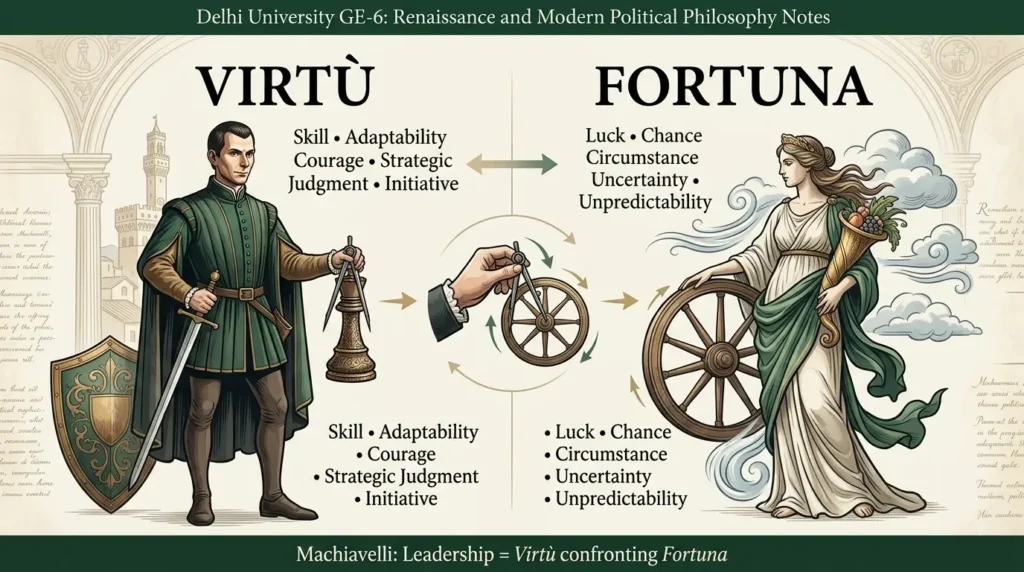
Virtù:
1. Definition:
– Virtù, in Machiavelli’s terms, does not directly correspond to our modern concept of virtue. It is more accurately translated as strength, prowess, or excellence.
– It represents the qualities and characteristics that a leader should possess to be effective in the political arena.
2. Leadership Qualities:
– Machiavelli identifies virtù as the combination of intelligence, strength, courage, and decisiveness. A leader with virtù is someone who is capable, resourceful, and able to adapt to changing circumstances.
3. Adaptability:
– Virtù involves the ability to navigate complex political situations with flexibility and creativity. It requires a leader to be both cunning and adaptable, making decisions based on the specific context rather than adhering strictly to a set of moral or ethical principles.
4. Pragmatism:
– Machiavelli’s concept of virtù is deeply pragmatic. Leaders should be willing to do whatever is necessary to achieve their goals and maintain power, even if it means acting in ways that might be considered unscrupulous or amoral.
5. Exemplified in “The Prince”:
– In “The Prince,” Machiavelli advises rulers on the practical application of virtù, suggesting that they should be willing to use force, deception, and other means to secure their position and maintain stability.
Fortuna:
1. Definition:
– Fortuna, or fortune, refers to the role of luck and external circumstances in politics.
– It represents the unpredictable and uncontrollable events that can shape the fate of individuals and states.
2. Unpredictability:
– Machiavelli acknowledges that fortune plays a significant role in political success or failure. Leaders must be prepared for unforeseen events that can either benefit or harm their objectives.
3. Navigating Fortuna:
– While virtù emphasizes a leader’s personal qualities and actions, fortuna emphasizes the external factors that can impact political outcomes. A skilled leader, according to Machiavelli, must be adept at navigating the uncertainties of fortuna.
4. Adaptive Leadership:
– Leaders must be able to respond effectively to changing circumstances and take advantage of favorable opportunities presented by fortuna while minimizing the impact of adverse events.
5. Exemplified in “The Prince”:
– Machiavelli’s advice in “The Prince” often includes strategies for dealing with the unpredictable nature of fortuna. Leaders should be ready to adjust their tactics and take advantage of favorable conditions while mitigating the impact of unfavorable ones.
In summary, virtù and fortuna represent two interconnected aspects of Machiavelli’s political philosophy. Virtù is the personal strength and qualities of a leader, emphasizing their ability to shape events, while fortuna represents the external forces that are beyond the leader’s control. Successful leadership, according to Machiavelli, requires a delicate balance of virtù and adaptability in the face of fortuna.
The analysis of different forms of government and the ideal prince
Niccolò Machiavelli’s analysis of different forms of government and his conception of the ideal prince are explored in his major works, primarily “The Prince” and “The Discourses on Livy.” Here’s a breakdown of his thoughts on these subjects:
Analysis of Different Forms of Government:
1. Monarchy:
– Advantages: Machiavelli recognized the stability that a well-established hereditary monarchy could bring. A strong and virtuous monarch, according to him, could provide effective and consistent governance.
– Disadvantages: However, Machiavelli warned against the dangers of hereditary rule without the qualities of virtù. A weak or incompetent monarch could lead to instability and the decline of the state.
2. Republic:
– Advantages: Machiavelli admired the stability and resilience of republics, especially those with active and engaged citizens. He believed that a well-ordered republic could withstand internal and external pressures.
– Disadvantages: Machiavelli acknowledged the challenges of maintaining a republic, particularly the potential for factionalism and conflicts among citizens. He also noted that republics could be slow to respond to emergencies.
3. Despotism/Tyranny:
– Advantages: Machiavelli recognized that a strong and centralized rule, often associated with despotic or tyrannical leadership, could bring about swift decisions and maintain order.
– Disadvantages: He cautioned against excessive cruelty and oppression by despots, as it could lead to rebellion and the downfall of the ruler. Machiavelli emphasized the importance of balancing authority with the support of the people.
The Ideal Prince:
1. Virtù and Pragmatism:
– The ideal prince, according to Machiavelli, is one who possesses virtù – a combination of intelligence, strength, and adaptability. This leader is pragmatic, making decisions based on the needs of the state rather than adhering strictly to moral or ethical principles.
2. Militaristic Qualities:
– Machiavelli emphasized the importance of military prowess for a prince. A strong military ensures the security of the state and deters external threats.
3. Adaptability and Flexibility:
– The ideal prince should be adaptable and flexible in responding to changing circumstances. Machiavelli urged leaders to be pragmatic and adjust their strategies based on the realities of the political landscape.
4. Dealing with Fortuna:
– The ideal prince should be skilled in dealing with the unpredictable nature of fortuna (fortune). This involves navigating through unexpected events, both positive and negative, to maintain stability and power.
5. The Ends Justify the Means:
– Machiavelli famously argued that the ends (achieving and maintaining power) justify the means. The ideal prince should be willing to take decisive and sometimes ruthless actions if it serves the greater good of the state.
6. Public Image:
– Machiavelli acknowledged the importance of perception. The ideal prince should be mindful of how they are perceived by the public, using both virtue and the appearance of virtue strategically to maintain support and stability.
Machiavelli’s concept of the ideal prince is grounded in the practicalities of governance and the realities of political power. His advice is often controversial, as it departs from traditional moral and ethical considerations in favor of a more pragmatic and results-oriented approach.
The critique of morality and religion in politics
Niccolò Machiavelli is well-known for his departure from traditional moral and religious considerations in politics, particularly in his work “The Prince.” Here are key aspects of Machiavelli’s critique of morality and religion in politics:
1. Separation of Morality and Politics:
– Machiavelli argued for a clear separation between morality and politics. While acknowledging the existence of ethical principles, he believed that political leaders should prioritize the effective governance and stability of the state over strict adherence to moral codes.
— power and material interest over moral idealism — resurfaces, in a very different form, in Marx’s later critique of ideology (see Chapter 6).
2. The Ends Justify the Means:
– One of Machiavelli’s most controversial ideas is encapsulated in the phrase “the ends justify the means.” He argued that leaders should be willing to employ any means necessary, even morally questionable or ruthless tactics, to achieve and maintain power for the greater good of the state.
3. Pragmatism over Idealism:
– Machiavelli was critical of idealistic political theories that prioritized moral virtue over practical considerations. He believed that leaders should be pragmatic and adaptable, making decisions based on the realpolitik of the situation rather than abstract ethical principles.
4. Deception and Manipulation:
– Machiavelli recognized the necessity of political leaders to be adept at deception and manipulation. He argued that leaders should be capable of using both honesty and deceit strategically to achieve their objectives and maintain stability.
5. Religion as a Tool:
– Machiavelli discussed the role of religion in politics, viewing it not as a moral guide for rulers but as a tool to maintain order and control. He suggested that leaders could use religion to manipulate the masses and strengthen their authority.
6. Fortuna (Fortune) and Virtù:
– Machiavelli’s focus on the practicalities of politics led him to emphasize the importance of virtù (a leader’s strength, intelligence, and adaptability) over moral virtue. He acknowledged the role of fortuna (fortune or luck) in political outcomes and urged leaders to be skilled in navigating unpredictable events.
7. Securing Power:
– Machiavelli’s central concern was the acquisition and maintenance of political power. He argued that leaders should prioritize actions that ensure the stability and security of the state, even if those actions might be considered morally dubious.
8. Critique of Classical Morality:
– Machiavelli departed from classical moral philosophy, which often emphasized virtuous behavior, justice, and the common good. His writings challenged the prevailing moral norms of his time, prompting a reevaluation of the relationship between morality and political leadership.
Machiavelli’s critique of morality and religion in politics reflects his pragmatic and realist approach to governance. While his ideas have been controversial and at times criticized for their apparent amorality, they have also sparked discussions about the practical challenges of political leadership and the complex interplay between ethics and the pursuit of power.
Chapter 2: Hobbes (1588–1679)
The life and works of Hobbes
Thomas Hobbes (1588-1679) was an English philosopher, political theorist, and historian who is best known for his influential works on political philosophy. Here is an overview of his life and key works:
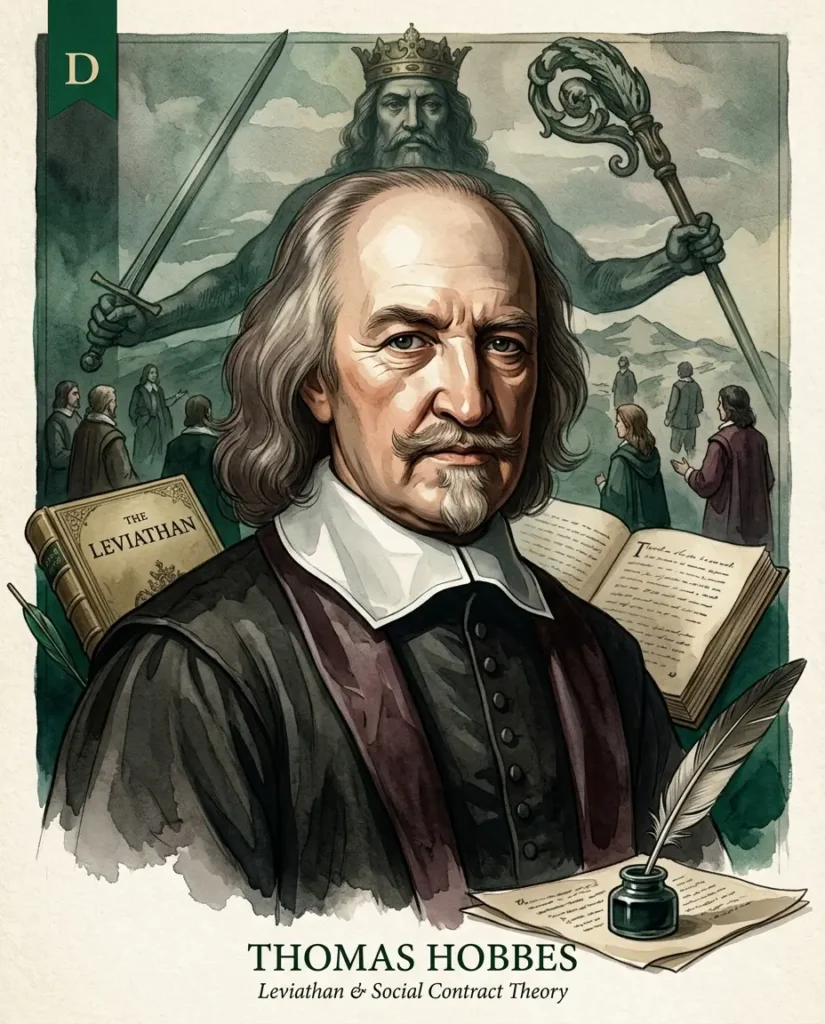
Life:
1. Early Life:
– Hobbes was born on April 5, 1588, in Westport, Wiltshire, England.
– He received his education at Oxford University, where he studied classics and developed a keen interest in the works of ancient philosophers.
2. Travel and Tutoring:
– After completing his university education, Hobbes traveled extensively throughout Europe, where he engaged with intellectual and political circles.
– He served as a tutor to the Cavendish family, accompanying them on their travels.
3. Intellectual Influences:
– Hobbes was influenced by the scientific revolution of his time, especially the works of Galileo and the emerging mathematical approach to understanding the natural world.
Works:
1. “Leviathan” (1651):
– Hobbes’s most famous work is “Leviathan,” published during the English Civil War. It is a comprehensive exploration of political philosophy, where he discusses the nature of human beings, the origin and purpose of government, and the social contract.
– Hobbes argues for a social contract theory in which individuals, out of rational self-interest, agree to create a sovereign authority to maintain order and prevent the chaos of the state of nature.
2. “De Cive” (1642) and “Elementa Philosophica” (1650):
– “De Cive” and “Elementa Philosophica” are earlier works that laid the groundwork for Hobbes’s ideas in “Leviathan.” They explore themes of political authority, the social contract, and the role of the individual in the state.
3. Political Philosophy:
– Hobbes is often considered one of the key figures in the development of social contract theory. He is known for his pessimistic view of human nature, asserting that in the state of nature, individuals are in a constant state of war and conflict.
4. Materialism:
– Hobbes was a materialist, arguing that everything in the world, including human thoughts and emotions, could be explained in terms of material phenomena. This materialistic perspective influenced his understanding of human behavior and political organization.
5. Absolute Sovereignty:
– Hobbes advocated for absolute sovereignty, arguing that a strong and centralized government, or Leviathan, was necessary to prevent the chaos that would arise in the absence of a powerful authority.
6. Religious Views:
– Hobbes’s views on religion were controversial. While he did not deny the existence of God, his emphasis on the sovereign’s authority led him to advocate for a state-controlled church to prevent religious divisions that could threaten political stability.
Legacy:
1. Influence on Political Thought:
– Hobbes’s ideas have had a lasting impact on political philosophy, particularly in discussions about the nature of government, the social contract, and the balance between individual rights and state authority.
2. Enlightenment and Modern Political Theory:
– His emphasis on reason, the social contract, and the need for a strong central authority influenced subsequent Enlightenment thinkers and modern political theorists.
3. Criticism and Debate:
– Hobbes’s theories have been both criticized and defended over the centuries. While some appreciate his contributions to political thought, others challenge his pessimistic view of human nature and argue for alternative approaches to political organization.
Thomas Hobbes’s work continues to be studied and debated, making him a significant figure in the history of political philosophy.
The theory of human nature and the state of nature
Thomas Hobbes’s theory of human nature and the state of nature is foundational to his political philosophy, particularly as outlined in his seminal work, “Leviathan.” Here are the key elements of Hobbes’s views on human nature and the state of nature:
1. State of Nature:
– Condition of Anarchy: Hobbes describes the state of nature as a hypothetical, pre-political condition in which individuals exist without a government or social contract. In this state, there is no established political authority, and individuals are not bound by laws.
– The State of War: Hobbes famously characterizes the state of nature as a condition of perpetual war. In the absence of a common authority to enforce laws and resolve disputes, individuals are in constant competition for limited resources, leading to a “war of every man against every man.”
– Life is “Solitary, Poor, Nasty, Brutish, and Short”: Hobbes famously describes life in the state of nature as harsh and violent, where the absence of political order results in a continual threat to individual survival.
2. Human Nature:
– Egoism and Self-Preservation: Hobbes’s theory of human nature is fundamentally egoistic. He argues that individuals are motivated by self-interest and a desire for self-preservation. In the state of nature, people act to satisfy their own needs and desires without regard for others.
– Equality and Scarcity: Hobbes asserts that in the state of nature, individuals are roughly equal in physical and mental abilities. However, the scarcity of resources and the fear of others create a competitive environment that leads to conflict.
– Lack of Inherent Morality: According to Hobbes, there is no inherent moral law or sense of justice in human nature. Morality, for Hobbes, is a product of social and political institutions.
3. The Social Contract:
– Contractual Agreement for Order: Hobbes argues that individuals, recognizing the dangers and hardships of the state of nature, enter into a social contract. This contract is an agreement among individuals to create a sovereign authority or Leviathan—a powerful government—to establish order and security.
– Transfer of Rights: In the social contract, individuals willingly transfer some of their natural rights, including the right to enforce the law, to the sovereign in exchange for protection and the establishment of civil society.
4. Role of Sovereign Authority:
– Absolute Sovereignty: Hobbes advocates for absolute sovereignty, a powerful and centralized government that holds authority over all aspects of public life. The sovereign’s role is to maintain order, prevent conflict, and ensure the security of individuals.
– Fear as a Governing Principle: Hobbes suggests that a well-ordered society is one in which individuals fear the consequences of violating the laws set by the sovereign. The sovereign’s authority is absolute, and obedience to the law is crucial for the prevention of chaos.
Hobbes’s theory of human nature and the state of nature lays the groundwork for his broader political philosophy. By presenting a stark and pessimistic view of human behavior in the absence of political order, Hobbes argues for the necessity of a strong and authoritative government to maintain social stability and prevent the inherent conflicts of the state of nature.
The concept of social contract and the sovereign
Thomas Hobbes’s concept of the social contract and the sovereign is a central theme in his political philosophy, particularly as outlined in his work “Leviathan.” Here’s an exploration of these concepts:
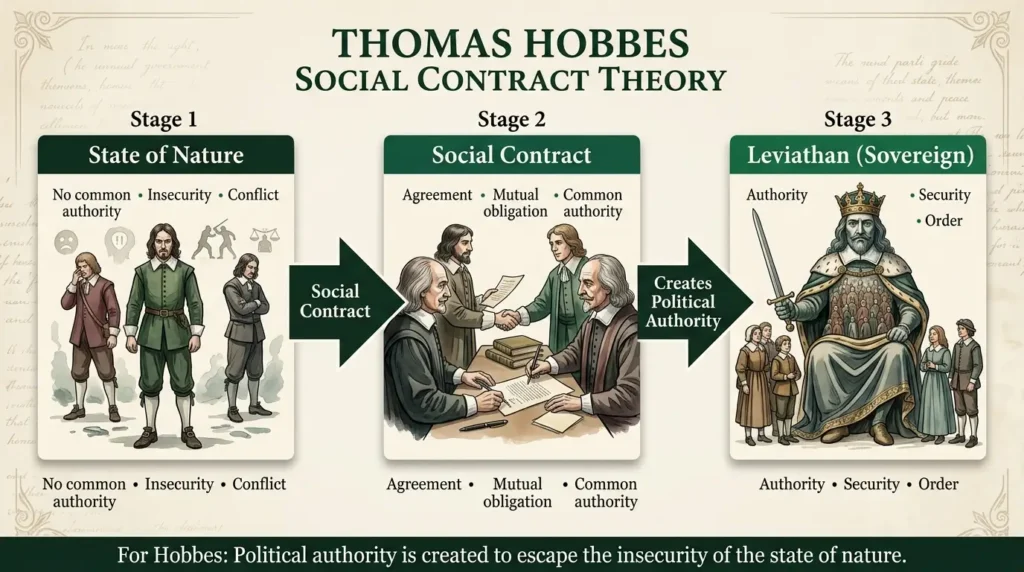
1. Social Contract:
– Formation of Civil Society: Hobbes argues that individuals in the state of nature recognize the inherent dangers and conflicts that arise from their egoistic and self-interested behavior. In order to escape the state of nature’s perpetual war, individuals enter into a social contract.
– Voluntary Agreement: The social contract is a hypothetical agreement among individuals where they voluntarily give up certain natural rights in exchange for the security and order provided by a common authority.
– Creation of Leviathan: The social contract results in the establishment of a sovereign authority, often referred to as the Leviathan. The Leviathan is a powerful and centralized government created to maintain order, prevent conflict, and protect individuals from the chaos of the state of nature.
– Mutual Transference of Rights: In the social contract, individuals transfer their natural rights to the sovereign. This includes the right to enforce the law and adjudicate disputes. The sovereign, in turn, is entrusted with the authority to ensure the well-being and security of the citizens.
2. Sovereign Authority (Leviathan):
– Absolute Sovereignty: Hobbes advocates for an absolute sovereign authority, a powerful and centralized government that holds undisputed authority over the entire society. The sovereign’s power is absolute and indivisible, encompassing all aspects of governance.
– Unity and Stability: The sovereign serves as a unifying force that brings order and stability to civil society. Without a strong sovereign, Hobbes believes that individuals would revert to the chaos and violence of the state of nature.
– Leviathan as a Metaphor: Hobbes uses the term “Leviathan” metaphorically to describe the all-encompassing and powerful nature of the sovereign authority. The Leviathan represents the collective power of the people unified under a single, authoritative ruler.
– Role of Fear in Governance: Hobbes suggests that the sovereign’s authority is maintained through the fear of consequences. Individuals obey the laws and authority of the sovereign not out of a sense of morality but out of fear of punishment and the desire for self-preservation.
3. Obligation and Obedience:
– Binding Nature of the Contract: Hobbes argues that once individuals have entered into the social contract and established a sovereign authority, they are morally and legally obligated to uphold their end of the agreement. This obligation includes obedience to the laws and authority of the sovereign.
– Breakdown of the Contract: Hobbes warns that if individuals violate the terms of the social contract or rebel against the sovereign, they risk returning to the state of nature and the chaos associated with it.
4. Individualism and Rationality:
– Egoistic Motivation: Hobbes’s concept of the social contract is rooted in a deeply individualistic and egoistic view of human nature. Individuals are motivated by self-interest and the desire for self-preservation.
– Rational Decision-Making: The decision to enter into the social contract is portrayed as a rational choice made by individuals seeking to escape the insecurity and conflict of the state of nature. It is a pragmatic response to the challenges of human nature.
Hobbes’s social contract theory and the concept of the sovereign laid the groundwork for subsequent discussions on political philosophy and the role of government. His emphasis on the need for a strong and centralized authority to prevent the chaos of the state of nature has influenced political thought for centuries.
The justification of absolutism and the right of resistance
Thomas Hobbes, in his political philosophy, justified absolutism and was critical of the right of resistance, as outlined in his major work, “Leviathan.” Hobbes’s insistence that individuals have no right to judge the sovereign stands in sharp contrast to Locke’s right of revolution — explored next in Chapter 3 — and to Rousseau’s popular-sovereignty model in Chapter 4.
Here are the key points regarding Hobbes’s views on absolutism and the right of resistance:
1. Justification of Absolutism:
– Need for Order and Security: Hobbes believed that the state of nature was a condition of perpetual war and chaos, where individuals were motivated by self-interest and there was no effective authority to maintain order. To escape this chaotic state, Hobbes argued for the necessity of a strong and absolute sovereign authority.
– Social Contract and Voluntary Submission: According to Hobbes, individuals voluntarily entered into a social contract to form civil society. They surrendered certain natural rights to the sovereign authority, creating a powerful Leviathan to ensure the security and well-being of the citizens.
– Fear as a Governing Principle: Hobbes emphasized the importance of fear in governing human behavior. The absolute sovereign, he argued, instills fear in individuals, deterring them from engaging in actions that would lead to conflict and disorder.
– Unity and Stability: Absolutism, in Hobbes’s view, was essential for maintaining the unity and stability of the state. The sovereign’s authority needed to be absolute and undivided to prevent internal strife and external threats.
– Leviathan as a Unifying Force: The Leviathan, representing the sovereign authority, served as a unifying force that kept the social contract intact and prevented the disintegration of civil society into the anarchy of the state of nature.
2. Critique of the Right of Resistance:
– State of Nature as a Deterrent: Hobbes argued that the state of nature, characterized by a war of all against all, was a powerful deterrent against the right of resistance. The natural condition of humanity, according to Hobbes, was so undesirable that individuals would voluntarily submit to absolute authority to avoid it.
– Inalienable Obligation: Once individuals entered into the social contract and formed a civil society, Hobbes contended that they had an inalienable obligation to obey the sovereign authority. Any attempt to resist or overthrow the sovereign would lead to a breakdown of the social contract and a return to the chaos of the state of nature.
– Preservation of Order: Hobbes argued that resistance to the sovereign would threaten the very foundation of civil society. The right of resistance, in his view, undermined the stability and security that the sovereign authority provided.
– No Right to Judge Sovereign’s Decisions: Hobbes maintained that individuals did not have the right to judge the decisions or actions of the sovereign. The sovereign’s authority was absolute, and challenging that authority would lead to disorder and conflict.
3. Legacy and Influence:
– Hobbes’s defense of absolutism and critique of the right of resistance had a significant impact on subsequent political thought. His ideas contributed to the development of theories of absolute monarchy and influenced debates on political authority and obedience.
– While Hobbes’s views were controversial and faced criticism, especially from later political theorists who advocated for limited government and the protection of individual rights, his work played a crucial role in shaping discussions about the relationship between the state and its citizens.
The relation between reason and passion and the role of law
Thomas Hobbes, in his political philosophy as presented in works like “Leviathan,” addresses the relationship between reason and passion, as well as the role of law in maintaining social order. Here are the key aspects of Hobbes’s views on these topics:
1. Reason and Passion:
– Reason as Self-Preservation: Hobbes acknowledges the role of reason in human behavior but emphasizes that it is ultimately motivated by the desire for self-preservation. According to Hobbes, individuals act rationally when seeking to fulfill their self-interest and avoid harm.
– Passion as Appetite and Aversion: Hobbes defines passion as “appetite” and “aversion” – the desire for what is good and the avoidance of what is harmful. Passions, for Hobbes, are the driving forces behind human actions, and reason is the tool individuals use to achieve their passionate goals.
– Dominance of Passion in the State of Nature: In the state of nature, where there is no established political authority, Hobbes contends that the dominance of passions leads to a perpetual war of all against all. Without a sovereign power to regulate behavior, individuals are prone to conflict driven by their passions.
– Rationality in Social Contract: The establishment of a social contract and the formation of civil society, according to Hobbes, is a rational response to the destructive nature of unchecked passions. Individuals, recognizing the dangers of the state of nature, use reason to create a common authority that can regulate and control their passions for the sake of self-preservation.
2. Role of Law:
– Laws as Civil Commands of the Sovereign: Hobbes sees laws as civil commands issued by the sovereign authority. These laws are necessary to maintain order and prevent the chaos of the state of nature. The sovereign has the power to legislate and enforce laws to ensure the security and well-being of the citizens.
– Fear of Punishment as a Deterrent: The effectiveness of laws, according to Hobbes, is based on the fear of punishment. Individuals, driven by their passions, are deterred from violating laws because they fear the consequences imposed by the sovereign. Fear of punishment is a crucial element in the social contract that binds individuals to obey the laws for their own self-preservation.
– Sovereign’s Authority Over Laws: Hobbes asserts that the sovereign’s authority is absolute and extends to the creation and interpretation of laws. The sovereign is the ultimate authority in determining what is just and unjust, and individuals are obligated to obey the laws issued by the sovereign.
– Absence of Natural Moral Law: Hobbes rejects the existence of a natural moral law that governs human behavior. Instead, he argues that morality is a product of societal conventions and the laws established by the sovereign.
3. Social Contract and Legal Obligation:
– Obligation to Obey Laws: Hobbes contends that individuals, by entering into the social contract, have an obligation to obey the laws established by the sovereign. This obligation is a result of the contractual agreement made for mutual self-preservation and the avoidance of the state of nature.
– Violation of Contract as Breach of Law: Hobbes views any attempt to violate or overthrow the sovereign as a breach of the social contract and a violation of the laws. Such attempts threaten the stability of civil society and risk a return to the state of nature.
Hobbes’s understanding of the relationship between reason and passion, along with his views on the role of law, is deeply embedded in his broader political philosophy, emphasizing the need for a strong sovereign authority to regulate human behavior and prevent the chaos inherent in the state of nature.
Chapter 3: Locke (1632–1704)
Note: While Locke is not formally listed in the GE-6 Unit-2 syllabus, his ideas are foundational to understanding Hobbes and Rousseau, and frequently appear in related DU papers — hence included here as bonus reading
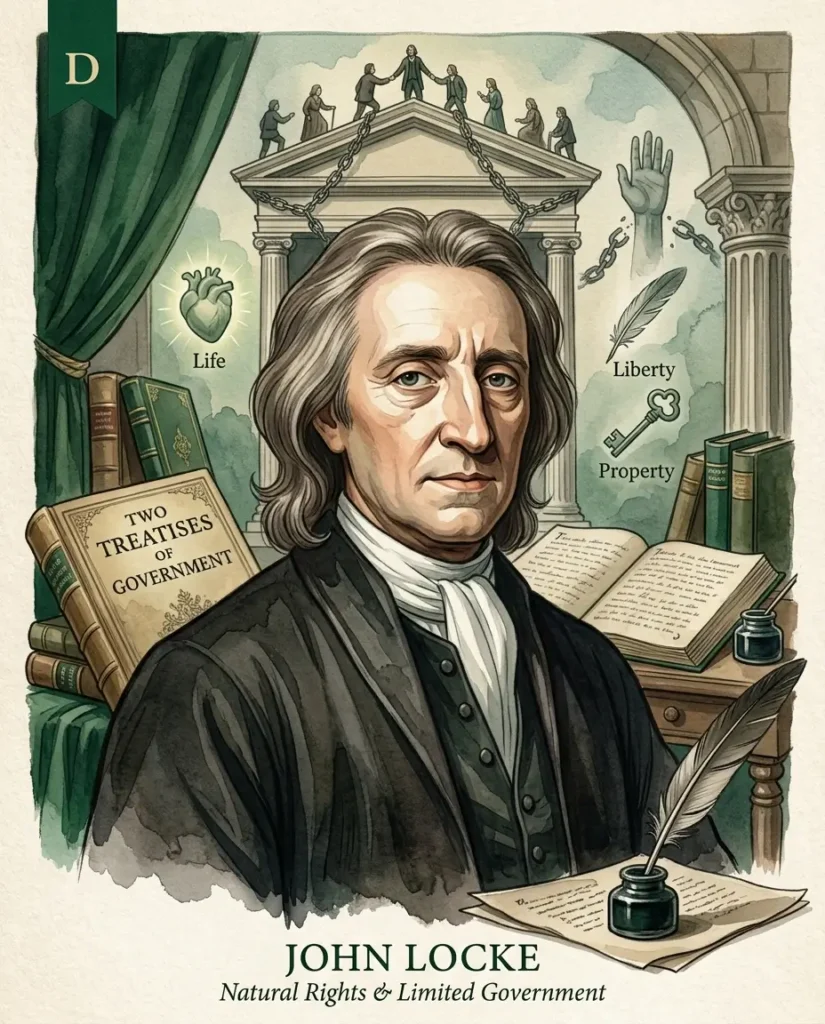
The life and works of Locke
John Locke (1632-1704) was an influential English philosopher, physician, and political theorist known for his significant contributions to the fields of epistemology, political philosophy, and liberalism. Here is an overview of his life and key works:
Life of John Locke:
1. Early Life: John Locke was born on August 29, 1632, in Wrington, Somerset, England. He was the son of a lawyer and small landowner.
2. Education: Locke received his education at Westminster School and later attended Christ Church, Oxford. He studied a wide range of subjects, including logic, metaphysics, and classical languages.
3. Association with the Scientific Revolution: Locke was greatly influenced by the scientific ideas of his time, particularly the works of Robert Boyle and Isaac Newton. He adopted a scientific and empirical approach to philosophy.
4. Medical Career: Locke studied medicine and worked as a physician. His medical knowledge influenced his philosophical views, especially his emphasis on empirical observation and the limits of human understanding.
Key Works:
1. “An Essay Concerning Human Understanding” (1690): This is one of Locke’s most significant works and is considered a foundational text in modern epistemology. In this essay, he explores the nature of human knowledge and argues that it is derived from experience and sensation. He introduces the idea of the mind as a “blank slate” (tabula rasa) upon which experience writes.
2. “Two Treatises of Government” (1690): In this work, Locke develops his political philosophy, which had a profound influence on the development of liberal thought. The first treatise criticizes the divine right of kings, while the second outlines the principles of a legitimate government based on the consent of the governed. Locke’s ideas on natural rights, property, and the social contract greatly influenced political thinkers such as Thomas Jefferson.
3. “A Letter Concerning Toleration” (1689): In this letter, Locke argues for religious tolerance and the separation of church and state. He contends that the state should not interfere with religious beliefs and practices as long as they do not threaten public order.
4. “Some Thoughts Concerning Education” (1693): Locke’s work on education discusses his views on the upbringing and education of children. He advocates a practical and individualized approach to education, emphasizing the development of reason and moral virtues.
Legacy:
John Locke’s ideas had a profound impact on the Enlightenment and the development of modern Western political thought. His emphasis on empiricism, the social contract, and individual rights laid the groundwork for liberal democratic principles and influenced key figures in the American Revolution, including Thomas Jefferson and the framers of the U.S. Constitution. Locke’s philosophical contributions continue to shape discussions on topics such as human rights, government legitimacy, and the nature of knowledge.
The theory of natural rights and the state of nature
John Locke’s theories of natural rights and the state of nature are central components of his political philosophy, particularly as articulated in his work “Two Treatises of Government” (1690). Let’s explore these concepts in more detail:
1. State of Nature:
Locke begins by postulating a hypothetical “state of nature” to explore the origins and justification of political authority. In this state:
– Equality: Locke posits that in the state of nature, all individuals are naturally free and equal. No one has inherent authority over others.
– Natural Law: Despite the absence of a political authority, Locke suggests the existence of natural law—moral principles that govern human behavior. Natural law is based on reason and prompts people to preserve themselves and others, as well as to respect property.
2. Natural Rights:
Central to Locke’s philosophy is the concept of natural rights, which individuals possess in the state of nature. These rights include:
– Life: The right to life is fundamental, and individuals have a natural inclination to preserve their lives.
– Liberty: Individuals have the right to freedom and autonomy to pursue their own interests within the bounds of natural law.
– Property: Locke considers the right to property as essential. He argues that individuals acquire property through their labor and that the government exists to protect these property rights.
3. Social Contract:
While the state of nature is characterized by freedom and equality, Locke acknowledges its potential shortcomings, such as the lack of a neutral judge to settle disputes. Hence, individuals enter into a social contract to establish civil society and government. Key elements of Locke’s social contract theory include:
– Consent: Government legitimacy is derived from the consent of the governed. Individuals agree to form a political society for their mutual benefit.
– Limited Government: Locke advocates for a limited government with specific responsibilities, primarily to protect natural rights. If a government oversteps its bounds or becomes tyrannical, citizens have the right to resist.
4. Right of Revolution:
Locke introduces the concept of the right of revolution as a safeguard against tyrannical rule. If a government violates its contract by infringing on natural rights, citizens have the right—and perhaps the duty—to resist and, if necessary, overthrow the government.
5. Influence on Modern Political Thought:
Locke’s theories laid the groundwork for modern democratic principles and influenced later political philosophers and revolutionaries. His emphasis on natural rights, the social contract, and the right of revolution played a crucial role in shaping the American and French revolutions, as well as the development of constitutional democracies.
In summary, John Locke’s theories of natural rights and the state of nature provide a theoretical framework for understanding the origins of political authority, the rights individuals possess, and the principles that should guide the establishment and operation of a just government.
The concept of social contract and the limited government
John Locke’s ideas about the social contract and the concept of limited government are key elements of his political philosophy, as outlined in his work “Two Treatises of Government” (1690). Let’s delve into these concepts:
1. Social Contract:
The social contract is a theoretical concept that attempts to explain the origin and legitimacy of political authority. According to Locke:
– Consent: Individuals, in the hypothetical state of nature, come together to form a political society through mutual agreement or consent. This agreement is the social contract.
– Purpose: The primary purpose of the social contract is to secure the natural rights of individuals—namely, life, liberty, and property. Individuals enter into civil society to better protect their rights and facilitate cooperation.
– Government as Trustee: The government, created through the social contract, is seen as a trustee or agent of the people. Its authority is derived from the consent of the governed, and its legitimacy is contingent upon its ability to protect the natural rights of its citizens.
2. Limited Government:
Locke advocated for the idea of a limited government, and he specified several key aspects of this concept:
– Protection of Natural Rights: The primary role of government, according to Locke, is to protect the natural rights of individuals—particularly life, liberty, and property.
– Rule of Law: Locke emphasized the importance of the rule of law. Even the government is subject to the law, and its actions should be in accordance with established laws that are known in advance.
– Separation of Powers: While Locke did not develop the idea as extensively as later thinkers like Montesquieu, he did argue for a separation of powers within government. He suggested that the legislative, executive, and federative powers should be separate to prevent the abuse of authority.
– Government by Consent: The authority of the government is limited by the terms of the social contract, and it exists with the consent of the governed. If a government oversteps its authority or violates the natural rights of citizens, individuals have the right to resist, and in extreme cases, to overthrow the government.
3. Right of Revolution:
Related to the concept of limited government, Locke introduced the idea of the right of revolution. If a government fails to protect natural rights and becomes tyrannical, individuals have the right to resist and, if necessary, to overthrow the government. This reflects the notion that political authority is conditional upon the government’s fulfillment of its obligations to the people.
4. Influence on Political Thought:
Locke’s ideas on the social contract and limited government had a profound impact on the development of liberal political thought and the formation of constitutional democracies. His emphasis on individual rights, the consent of the governed, and limitations on governmental power influenced subsequent political philosophers and the framers of the United States Constitution.
In summary, John Locke’s concept of the social contract underscores the idea that political authority is based on the consent of individuals who come together to form a government for the protection of their natural rights. The idea of limited government, as advocated by Locke, emphasizes that the authority of government is restricted by the terms of the social contract and that it should be exercised within defined and justifiable limits.
The defense of liberalism and the right of revolution
John Locke’s defense of liberalism and the right of revolution is articulated in his influential work “Two Treatises of Government” (1690). Let’s explore how Locke defends liberalism and the right of revolution:
1. Defense of Liberalism:
– Natural Rights: Locke’s liberalism is grounded in the concept of natural rights. He argues that individuals have inherent and inalienable rights, including the right to life, liberty, and property. These rights exist independently of government and are derived from human nature.
– Equality: Locke emphasizes the equality of individuals in the state of nature. He contends that no one has a natural right to rule over others, and political power should not be based on arbitrary factors such as birth.
– Limited Government: Locke advocates for a limited government that is established by the consent of the governed and exists to protect natural rights. The authority of the government is constrained by the social contract, and its legitimacy is contingent upon its ability to fulfill its obligations to the people.
– Rule of Law: Locke underscores the importance of the rule of law, asserting that both citizens and government are subject to a pre-established legal framework. This helps prevent arbitrary use of power and ensures that laws are known in advance, providing a degree of predictability and fairness.
2. Right of Revolution:
– Protection of Natural Rights: Locke argues that the primary purpose of government is to protect the natural rights of individuals. If a government fails in this duty, it loses its legitimacy.
– Right to Resist Tyranny: Locke introduces the right of revolution as a means for citizens to resist or overthrow a government that violates their natural rights. If a government becomes tyrannical—by infringing on individual rights, abusing power, or acting against the public interest—citizens have the right and, in some cases, the obligation to resist.
– Conditional Authority: Locke’s theory implies that political authority is conditional upon the government’s adherence to its obligations. If the government breaches the social contract and acts against the interests of the people, it forfeits its right to govern.
– Justification for Revolution: Locke argues that revolutions are not acts of lawlessness but are legitimate responses to a government’s failure to protect natural rights. The right of revolution serves as a check on potential government abuses and encourages rulers to govern justly.
3. Influence on Liberalism and Modern Political Thought:
– Locke’s defense of liberalism and the right of revolution laid the groundwork for modern liberal political philosophy. His ideas significantly influenced the development of liberal democracies and constitutional governments.
– Locke’s principles were particularly influential in shaping the political thought of the American Founding Fathers, including Thomas Jefferson, who drew upon Locke’s ideas in drafting the Declaration of Independence.
In summary, John Locke’s defense of liberalism revolves around the protection of natural rights, the establishment of a limited government based on consent, and the recognition of the right of revolution as a legitimate response to tyranny. These ideas have had a profound and enduring impact on the development of liberal democracies and the understanding of individual rights and political authority.
The notion of property and the role of consent
John Locke’s notions of property and the role of consent are integral parts of his political philosophy, particularly as presented in his “Two Treatises of Government” (1690). Let’s explore these concepts in detail:
1. Notion of Property:
– Labor and Property: Locke’s theory of property is closely tied to his views on labor. He argues that individuals have a natural right to the products of their labor. In the state of nature, as people mix their labor with resources from the common property, they acquire a property right in what they have produced. This labour-based justification of property was later fundamentally challenged by Marx’s critique of private property under capitalism — see Chapter 6: Karl Marx.
– Acquisition of Property: According to Locke, property is initially held in common, but individuals gain ownership through their labor. This labor-mixing principle justifies the appropriation of resources for personal use. Importantly, Locke contends that there should be enough and as good left in common for others, meaning that individuals should not waste or hoard resources to the detriment of others.
– Private Property and Social Harmony: Locke believes that the recognition and protection of private property are essential for social harmony and economic development. Secure property rights incentivize labor and the responsible use of resources, contributing to the overall well-being of society.
2. Role of Consent:
– Consent and Political Legitimacy: Locke’s political philosophy is built on the idea of the social contract, where individuals consent to form a government for the protection of their natural rights. Political authority is legitimate only when it is based on the consent of the governed.
– Government by Consent: Locke argues that individuals, in the state of nature, come together to form civil society and government through explicit or implicit consent. Consent is crucial for the establishment of political authority, and the government’s legitimacy is contingent upon ongoing consent.
– Limits on Government: Consent imposes limits on the authority of government. Locke advocates for a limited government with specific functions—chiefly the protection of life, liberty, and property. If a government exceeds its mandate or becomes tyrannical, it violates the terms of the social contract, and individuals have the right to withdraw their consent.
– Right of Revolution: Consent is also connected to Locke’s right of revolution. If a government fails to protect natural rights and loses the consent of the governed, individuals have the right to resist and, in extreme cases, to overthrow the government.
3. Influence on Modern Political Thought:
– Locke’s emphasis on the role of consent in political legitimacy and the protection of property rights has been highly influential in the development of liberal democratic principles.
– The ideas of individual rights, limited government, and the consent-based social contract found in Locke’s works influenced the framers of the United States Constitution and other liberal democracies.
In summary, John Locke’s notion of property is rooted in the labor-mixing principle, where individuals acquire property rights through their labor. The role of consent is fundamental in Locke’s political philosophy, as it establishes the legitimacy of political authority, imposes limits on government, and provides the basis for the right of revolution in the face of government tyranny. These ideas continue to shape discussions on property rights, governance, and individual freedoms in modern political thought.
Chapter 4: Rousseau (1712–1778)
The life and works of Rousseau
Jean-Jacques Rousseau (1712-1778) was an influential Genevan philosopher, writer, and political theorist whose works had a significant impact on the Enlightenment and later political and educational thought. Here’s an overview of his life and key works:
Life of Jean-Jacques Rousseau:
1. Early Life: Rousseau was born on June 28, 1712, in Geneva, which was then an independent republic. His mother died shortly after his birth, and his father left him to be raised by his maternal aunt and uncle.
2. Education: Rousseau had a relatively unconventional education. He left Geneva at the age of 16 and traveled through France and Italy, working various jobs and educating himself. He was largely self-taught in philosophy, literature, and music.
3. Return to Paris: Rousseau settled in Paris in the early 1740s, where he became involved with the intellectual circles of the Enlightenment. He befriended Denis Diderot and collaborated with him on the Encyclopédie.
4. Contributions to Music and Literature: In addition to his philosophical works, Rousseau made contributions to music and literature. He wrote operas and essays on music theory. His autobiographical works, especially “Confessions,” are considered pioneering works of modern autobiography.
Key Works:
1. “Discourse on the Sciences and Arts” (1750): Rousseau’s first major work, also known as the “First Discourse,” won an essay competition hosted by the Academy of Dijon. In it, he argued that the progress of the sciences and arts had not contributed to human virtue and happiness but had instead led to moral decline.
2. “Discourse on the Origin and Basis of Inequality Among Men” (1755): Also known as the “Second Discourse,” Rousseau explores the development of inequality and the impact of civilization on human nature. He famously declares that “Man is born free, and everywhere he is in chains.”
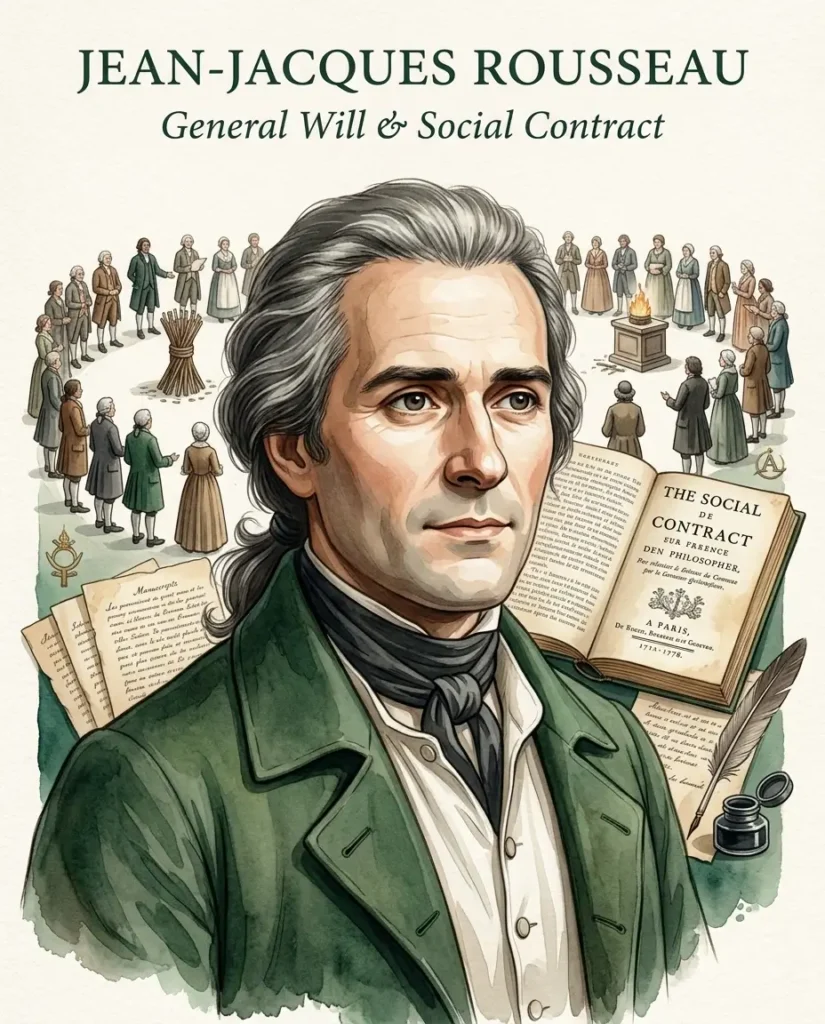
3. “The Social Contract” (1762): One of Rousseau’s most significant works, “The Social Contract” outlines his political philosophy. He argues for the idea of the general will and the creation of a government based on the consent of the governed. He proposes a form of direct democracy and explores the tension between individual freedom and the needs of the community.
4. “Emile, or On Education” (1762): In this work, Rousseau presents his views on education, emphasizing the natural development of the individual. He argues for an education that nurtures the child’s innate goodness and creativity, advocating a more child-centered approach.
5. “Confessions” (written between 1765 and 1770): Rousseau’s autobiographical work, “Confessions,” is considered one of the earliest and most significant examples of the modern autobiography. It provides insights into his personal life, thoughts, and experiences.
6. “The Reveries of the Solitary Walker” (1776-1778): Written near the end of his life, this work is a series of ten meditative essays in which Rousseau reflects on his life, society, and the nature of happiness.
Legacy:
– Rousseau’s ideas had a profound impact on political philosophy, particularly in the development of democratic and socialist thought. His emphasis on the general will and the importance of community influenced later thinkers, including Karl Marx.
– His views on education also had a lasting impact, contributing to the development of progressive education movements.
– Despite his influence, Rousseau’s ideas were controversial, and he faced criticism from his contemporaries. His works, however, continue to be studied and debated for their contributions to political theory, education, and literature.
The theory of human nature and the state of nature
Jean-Jacques Rousseau’s theories on human nature and the state of nature are foundational elements of his philosophical works, particularly outlined in his “Discourse on the Origin and Basis of Inequality Among Men” (1755) and “The Social Contract” (1762). Let’s delve into these concepts:
1. Theory of Human Nature:
– Innate Goodness: Unlike other Enlightenment thinkers who believed in the inherent rationality and goodness of man in the state of nature, Rousseau argued that humans are born naturally good and compassionate. He proposed that it is society and civilization that corrupt and distort this inherent goodness.
– Noble Savage: Rousseau’s concept of the “noble savage” suggests that in the state of nature, before the development of complex societies and institutions, humans lived in a relatively primitive but harmonious condition. He believed that the natural state was characterized by a simple, peaceful existence, where individuals lived in accordance with their instincts and natural inclinations.
– Influence of Society: Rousseau contended that the development of private property, inequality, and social hierarchies led to the corruption of human nature. He argued that the establishment of property and the rise of society introduced competition, envy, and a sense of superiority or inferiority among individuals.
2. State of Nature:
– Equality: In Rousseau’s state of nature, individuals are born equal, and there is no inherent hierarchy or domination. Natural inequalities, such as physical differences, are of little consequence in terms of social and political standing.
– Freedom: The state of nature is characterized by a sense of natural freedom. Unlike some other Enlightenment thinkers who believed that private property and social institutions were necessary for the protection of individual freedoms, Rousseau suggested that true freedom existed in the state of nature.
– Absence of Private Property: Rousseau argued that the concept of private property emerged with the development of agriculture and the establishment of settled communities. The introduction of private property led to inequality, competition, and conflicts over resources.
3. Transition to Civil Society:
– Rousseau recognized that the transition from the state of nature to civil society marked a crucial and transformative phase in human history. This transition, driven by the need for cooperation and survival, ultimately led to the establishment of property, laws, and social institutions.
– Rousseau’s account of this transition is critical of the emerging inequalities and social injustices that he believed were a consequence of the development of private property and the establishment of civil society.
4. “The Social Contract”:
– Rousseau’s “The Social Contract” presents his vision of an ideal political structure. He argues for a form of direct democracy based on the general will, where individuals come together to create a government that reflects the collective interests of the community.
– The general will, according to Rousseau, represents the common good and the shared interests of the citizens. Individuals must submit to the general will for the sake of the common good, and this submission ensures a just and free society.
In summary, Rousseau’s theories on human nature and the state of nature emphasize the innate goodness of individuals and the corrupting influence of society on that inherent goodness. His vision of the state of nature as a peaceful and egalitarian condition serves as the backdrop for his exploration of political philosophy in “The Social Contract.” Rousseau’s ideas have had a lasting impact on discussions about human nature, political authority, and the pursuit of a just society.
The concept of social contract and the general will
Jean-Jacques Rousseau’s ideas on the social contract and the general will are central to his political philosophy, as presented in his influential work “The Social Contract” (1762). Let’s explore these concepts in more detail:
1. Social Contract:
– Basis of Political Authority: Rousseau begins with the idea that individuals in the state of nature voluntarily come together to form a political society through a social contract. This contract is the foundation of legitimate political authority.
– Mutual Consent: The social contract is based on mutual consent, where individuals willingly give up some of their natural freedom in exchange for the benefits of political organization and protection of their natural rights.
– Creation of Sovereign Authority: Through the social contract, individuals create a sovereign authority, often referred to as the “general will,” which represents the collective will of the entire community. This sovereign authority is distinct from the government and is seen as an expression of the common interests and values of the people.
– Obligations and Rights: Individuals who are part of the social contract are both subjects and sovereigns. They are subject to the general will, which represents the common good, and they have the right to participate in the formation of laws and policies.
2. General Will:
– Definition: The concept of the general will is central to Rousseau’s political thought. It refers to the collective will or common interest of the entire community. The general will represents what is best for the community as a whole, aiming at the common good.
– Distinct from Individual Wills: Rousseau distinguishes the general will from the sum of individual wills. It is not a mere aggregation of individual preferences but rather a higher, rational, and moral will that considers the welfare of the entire community.
– Moral Authority: Rousseau posits that the general will has a moral authority that transcends individual desires. It represents the shared values and principles that contribute to the well-being and flourishing of the community.
– Obligation to Obey: Individuals who participate in the social contract are obligated to follow the general will. Rousseau argues that individuals are morally bound to obey the general will because it represents the common good and the collective interests of the community.
– Problem of Implementation: While Rousseau extols the concept of the general will, there is a challenge in determining what it actually is in practice. Interpreting and discerning the true general will can be complex and subject to manipulation.
3. Civic Virtue and Participation:
– Active Citizenship: Rousseau emphasizes the importance of active citizenship and political participation. He argues that individuals should participate directly in decision-making processes to ensure that laws and policies align with the general will.
– Civic Virtue: Rousseau believes that citizens should develop a sense of civic virtue, putting the common good above personal interests. This requires a commitment to the well-being of the community and a willingness to contribute to its welfare.
4. Influence on Political Thought:
– Rousseau’s ideas on the social contract and the general will had a profound impact on political thought and influenced later political philosophers, including Immanuel Kant and Karl Marx.
– His emphasis on the common good and the idea of a collective will played a role in the development of democratic principles and the concept of popular sovereignty.
In summary, Rousseau’s concept of the social contract underscores the idea that political authority is legitimate only when individuals come together voluntarily to create a sovereign authority that reflects the general will. The general will, representing the common good, serves as a moral guide for the community, and individuals are morally bound to obey it for the sake of the collective well-being.
The critique of civilization and the ideal of democracy
Jean-Jacques Rousseau had a complex and nuanced relationship with the concepts of civilization and democracy. While he contributed significantly to the development of democratic ideals, he also offered critiques of certain aspects of civilization. Let’s explore Rousseau’s critique of civilization and his ideal of democracy:
1. Critique of Civilization:
– Corruption of Human Nature: Rousseau believed that civilization, particularly the development of private property and social institutions, corrupted the innate goodness of human nature. In the state of nature, individuals lived peacefully, but with the advent of civilization, inequality, competition, and moral decay emerged.
– Private Property and Inequality: Rousseau argued that the introduction of private property led to social inequalities and conflicts. The establishment of property and the rise of social hierarchies marked a departure from the equality and simplicity of the state of nature.
– Rousseau’s critique of private property as the root of inequality directly foreshadows Karl Marx’s analysis of class and capitalism — covered in Chapter 6 — while his emphasis on individual liberty against the “general will” is precisely the tension J.S. Mill takes up in Chapter 5.
– Artificial Needs: Rousseau was critical of the artificial needs created by civilization. He believed that as societies became more complex, people became dependent on luxury and material possessions, leading to a loss of freedom and genuine human connections.
– Loss of Freedom: While civilization brought about certain benefits, Rousseau contended that it often resulted in the loss of natural freedom. Social structures, laws, and governments, he argued, could oppress individuals and curtail their freedom.
2. Ideal of Democracy:
– Direct Democracy: Rousseau’s ideal of democracy was closely tied to the concept of the general will. He advocated for a form of direct democracy where citizens actively participated in decision-making. In his vision, individuals would come together to deliberate on issues and collectively determine the laws that governed them.
– General Will: Rousseau believed that the general will, representing the common good, should guide the political decisions of the community. The general will is not a mere sum of individual wills but a higher, rational, and moral will that considers the well-being of the entire community.
– Popular Sovereignty: Rousseau’s democratic ideal emphasized the principle of popular sovereignty, where the ultimate authority rested with the people. The people, acting collectively through the general will, would determine the laws and policies of the state.
– Civic Virtue: For Rousseau, democracy required a sense of civic virtue among citizens. This involved a commitment to the common good, a willingness to participate actively in political life, and a moral duty to prioritize the welfare of the community over personal interests.
3. Limits of Rousseau’s Democracy:
– Limits on Individual Freedom: While Rousseau celebrated the collective will and democratic participation, his vision also imposed limits on individual freedom. Individuals were expected to conform to the general will, and dissent could be seen as a challenge to the common good.
– Homogeneity: Rousseau’s ideal of democracy leaned towards a homogenous society where citizens shared common values and interests. This may raise concerns about the treatment of minority viewpoints and the potential for conformity.
4. Influence on Political Thought:
– Rousseau’s ideas on democracy and the critique of civilization influenced later political thinkers, especially in the development of democratic theory and discussions on popular sovereignty.
– His emphasis on the common good and the importance of civic virtue played a role in shaping democratic principles and institutions.
In summary, Rousseau’s critique of civilization focused on the negative impact of social structures on human nature, while his ideal of democracy centered on the concept of the general will and direct democratic participation. Rousseau’s ideas contributed significantly to discussions on democracy, but his vision also raised questions about individual freedom and the potential challenges of achieving his ideal in diverse societies.
The notion of freedom and the role of education
Jean-Jacques Rousseau’s notions of freedom and the role of education are interlinked components of his philosophical thought. His views on these topics are particularly articulated in works such as “Emile, or On Education” (1762) and “The Social Contract” (1762). Let’s explore Rousseau’s ideas on freedom and education:
1. Notion of Freedom:
– Natural Freedom: Rousseau argued that in the state of nature, before the development of social institutions and private property, humans enjoyed a form of natural freedom. This was a state where individuals were free from the constraints and inequalities introduced by civilization.
– Civil Freedom: Rousseau acknowledged that as societies progressed and formed governments, a different form of freedom, called civil freedom, emerged. Civil freedom involved living under a system of laws that were determined by the general will. Citizens were expected to obey these laws, and in return, they collectively participated in the creation of those laws.
– Submission to the General Will: Rousseau believed that true freedom is found in the submission to the general will. Individuals, by participating in the political process and obeying laws that reflect the general will, are free because they are acting in accordance with their shared values and contributing to the common good.
– Freedom through Self-Government: Rousseau’s idea of freedom is not the absence of rules but the ability of individuals to govern themselves collectively. The general will, when properly expressed, reflects the shared rational and moral interests of the community.
– Limits on Individual Freedom: Rousseau’s concept of freedom is not absolute individual autonomy but is tempered by the constraints of the general will. Individuals are expected to surrender certain aspects of their natural freedom for the sake of the common good and the stability of society.
2. Role of Education:
– Natural Education: In “Emile, or On Education,” Rousseau presents his views on education. He argues for a form of natural education that allows the child, Emile, to develop in harmony with his natural inclinations. Rousseau proposes that education should respect the child’s individuality and encourage learning through experience and discovery.
– Emphasis on Nature: Rousseau’s educational philosophy is characterized by an emphasis on the natural development of the child. He advocates for an education that respects the child’s innate goodness and avoids the corrupting influences of society.
– Negative Education: Rousseau introduces the concept of “negative education,” suggesting that the educator’s role is to protect the child from the negative influences of society and allow their natural virtues to flourish. He believes that education should focus on avoiding the imposition of artificial needs and desires.
– Social Education: While Rousseau emphasizes the importance of individual development, he also acknowledges the need for social education. This involves preparing individuals to become responsible citizens who can participate in the political community and understand the implications of the general will.
– Civic Virtue: Education, according to Rousseau, should cultivate civic virtue. Individuals should learn to prioritize the common good and contribute to the well-being of the community. This aligns with his vision of a democratic society where citizens actively participate in the political process.
3. Influence on Modern Thought:
– Rousseau’s ideas on freedom and education have had a lasting impact on modern educational philosophy, contributing to the development of child-centered and experiential learning approaches.
– His emphasis on the submission to the general will and the collective determination of laws influenced democratic theory and discussions on political participation and citizenship.
In summary, Rousseau’s notions of freedom and education are interconnected within his philosophical framework. He envisions freedom as the result of individuals submitting to the general will and participating in self-governance. His educational philosophy emphasizes the natural development of the individual, cultivating civic virtue, and protecting against the corrupting influences of society. Rousseau’s ideas continue to shape discussions on the balance between individual freedom and the collective good, as well as educational practices that respect the natural inclinations of learners.
Chapter 5: John Stuart Mill (1806–1873)
The life and works of Mill
John Stuart Mill (1806–1873) was an English philosopher, political economist, and civil servant, widely regarded as one of the most influential thinkers of 19th-century liberalism. Raised under an intense educational regimen designed by his father James Mill (a close associate of Jeremy Bentham), Mill was reading Greek by age three and had studied logic, political economy, and classical texts before adolescence.
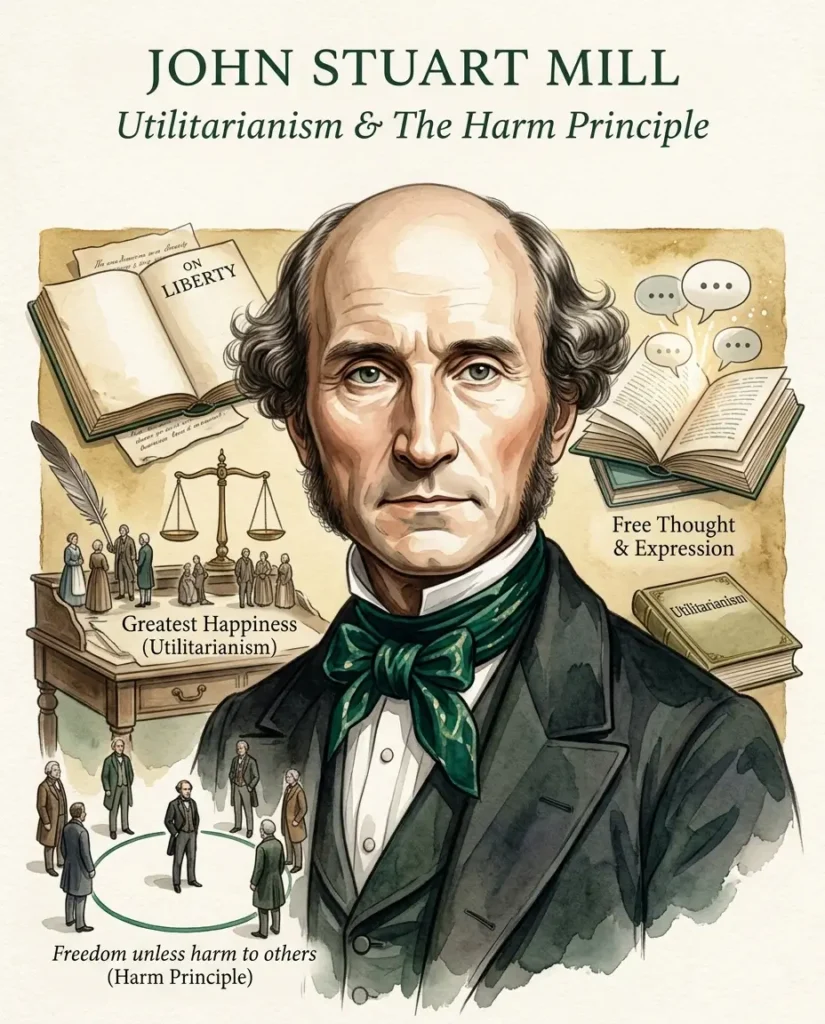
Life:
1. Early Life and Education: – Born on 20 May 1806 in London. His father James Mill personally supervised an extraordinarily rigorous education rooted in utilitarian philosophy. – At age 20, Mill suffered a “mental crisis,” which led him to reconsider the purely rationalist, calculative utilitarianism of his upbringing and to place greater value on emotion, poetry (especially Wordsworth), and individuality.
2. Career: – Worked for the British East India Company for over three decades, eventually becoming an examiner. – Served as a Member of Parliament (1865–1868), where he advocated for women’s suffrage — an unusually progressive position for his time.
3. Intellectual Partnership: – His close intellectual and personal partnership with Harriet Taylor Mill profoundly shaped his views on liberty, gender equality, and social reform; he credited her extensively in his own writings.
Key Works:
1. “On Liberty” (1859): – Mill’s most famous political work. It defends individual liberty against both state coercion and the “tyranny of the majority” — social conformity pressure in democratic societies.
2. “Utilitarianism” (1863): – Refines Bentham’s utilitarianism by distinguishing between higher (intellectual, moral) and lower (bodily) pleasures, arguing that quality of pleasure matters, not just quantity.
3. “Considerations on Representative Government” (1861): – Explores the design of representative democracy, proportional representation, and safeguards against majority tyranny.
4. “The Subjection of Women” (1869): – A landmark early feminist text arguing for legal and social equality between men and women.
The Harm Principle and individual liberty
Mill’s central contribution to political philosophy is the Harm Principle, articulated in On Liberty:
1. Core Idea: – The only legitimate reason for society or the state to interfere with an individual’s liberty of action is to prevent harm to others. A person’s own good — physical or moral — is not sufficient justification for interference.
2. Self-Regarding vs Other-Regarding Actions: – Mill distinguishes between actions that primarily affect only the individual (self-regarding) and those that affect others (other-regarding). Only the latter can legitimately be restricted by law or social pressure.
3. Freedom of Thought and Expression: – Mill argues passionately for freedom of speech, even for opinions we consider false, because: (a) the silenced opinion may be true, (b) even a false opinion may contain a portion of truth, and (c) truth that is not vigorously contested becomes “dead dogma” rather than a living conviction.
4. Tyranny of the Majority: – Mill warns that in democracies, the danger is not only despotic government but social conformity — the majority imposing its customs and prejudices on nonconforming individuals. This is as much a threat to liberty as legal coercion.
5. Individuality as a Component of Well-Being: – Mill sees the free development of individuality — “experiments in living” — as essential not just to personal happiness but to social progress; a society of conformists cannot generate the diversity of thought needed to advance.
Mill’s Utilitarianism and its political implications
1. Qualitative Utilitarianism: – Unlike Bentham’s purely quantitative “felicific calculus,” Mill argues some pleasures (intellectual, aesthetic, moral) are inherently higher in quality than others (purely physical pleasures) — captured in his famous line that it is “better to be a human being dissatisfied than a pig satisfied.”
2. Rule Utilitarianism Tendencies: – Mill leans toward general rules and rights (like liberty) that, followed consistently, tend to maximise long-term social utility — rather than judging each act in isolation.
3. Liberty and Utility Reconciled: – Mill grounds liberty itself in utility: a society that protects individual freedom and free discussion produces better outcomes (more truth, more progress, more happiness) over time than one that suppresses dissent.
Representative government and political participation
1. Representative Democracy: – Mill favoured representative government over direct democracy, believing it better balanced popular participation with competent governance.
2. Safeguards Against Majority Tyranny: – He proposed mechanisms like proportional representation and plural voting (weighted toward the educated) to prevent uneducated majorities from dominating minorities — a controversial but historically significant proposal.
3. Extension of the Franchise: – Mill supported extending voting rights to women, a genuinely radical position among 19th-century political philosophers, articulated fully in The Subjection of Women.
For a deeper reading on liberty, rights, and the scope-of-justice debate that Mill’s ideas later feed into, see our related notes on the Scope of Justice: National vs Global Justice Debate (DSC-7). For the original text and secondary scholarship on Mill’s political thought, see the Stanford Encyclopedia of Philosophy entry on Mill.
Chapter 6: Karl Marx (1818–1883)
The life and works of Marx
Karl Marx (1818–1883) was a German philosopher, economist, historian, sociologist, and revolutionary socialist whose ideas form the foundation of Marxism and had an unparalleled influence on 20th-century politics and economic thought.
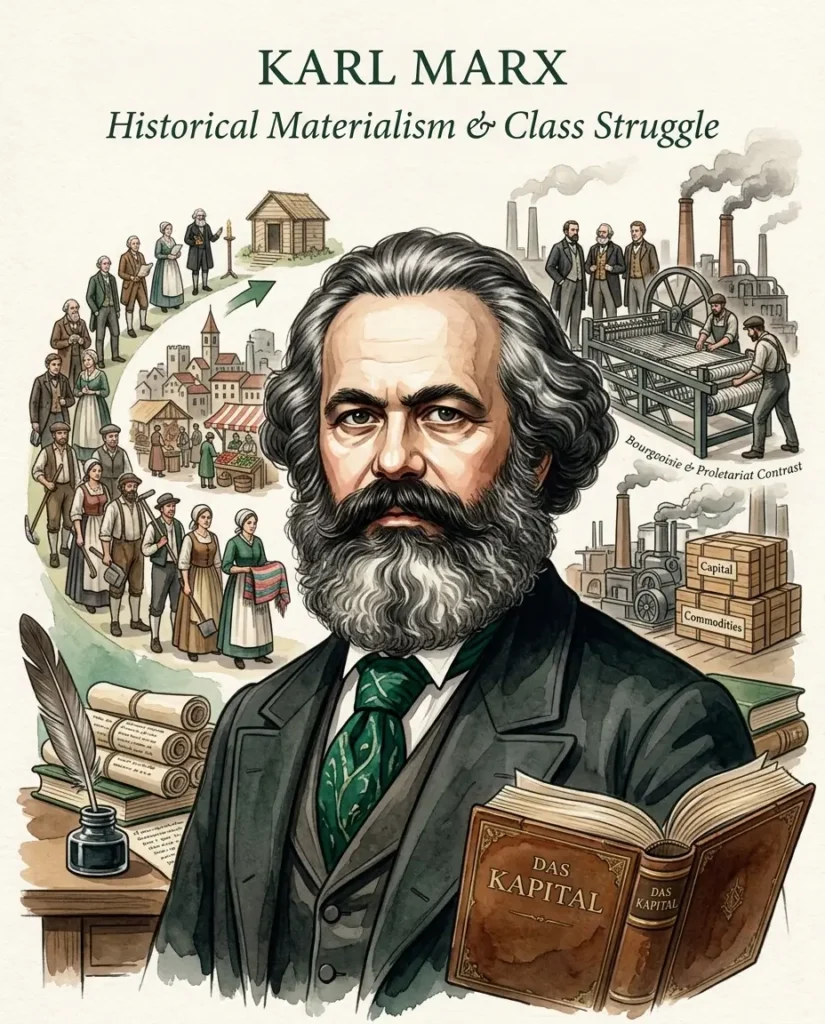
Life:
1. Early Life: – Born on 5 May 1818 in Trier, Prussia (present-day Germany), into a middle-class family. Studied law and later philosophy at the University of Berlin, where he was influenced by Hegelian philosophy.
2. Journalism and Exile: – Worked as a radical journalist; his political writings led to expulsion from Prussia, then France, then Belgium. He eventually settled in London in 1849, where he lived for the rest of his life, often in severe poverty.
3. Partnership with Friedrich Engels: – Marx’s lifelong collaboration with Friedrich Engels was central to his intellectual output and financial survival; Engels co-authored several works and financially supported Marx’s family.
Key Works:
1. “The Communist Manifesto” (1848, with Engels): – A concise, polemical statement of Marxist theory, famously opening with “The history of all hitherto existing society is the history of class struggles,” and calling for workers of the world to unite.
2. “Das Kapital” (Capital), Vol. 1 (1867): – Marx’s major theoretical work, a detailed critique of capitalist political economy — covering commodity production, surplus value, and the internal contradictions of capitalism. Volumes 2 and 3 were published posthumously by Engels.
3. “The German Ideology” (written 1846, published later): – Develops the theory of historical materialism in dialogue with (and critique of) Hegelian idealism and the “Young Hegelians.”
4. “Economic and Philosophic Manuscripts of 1844”: – Introduces Marx’s theory of alienation (estranged labour) under capitalist production.
Historical materialism and the base-superstructure model
1. Historical Materialism: – Marx’s method for analysing history and society: the material conditions of production (economic “base”) fundamentally shape a society’s political, legal, and cultural institutions (the “superstructure”) — including law, religion, and ideology.
2. Modes of Production: – Marx identifies successive historical stages (primitive communism, slave society, feudalism, capitalism, and eventually socialism/communism), each defined by its dominant mode of production and the class relations it generates.
3. Base and Superstructure: – The economic base (forces and relations of production) is, for Marx, the primary determinant of a society’s superstructure — its politics, ideology, and culture — though the relationship is dialectical rather than purely one-directional.
4. Dialectical Method: – Marx adapts Hegel’s dialectic (thesis-antithesis-synthesis) but “inverts” it — grounding historical change in material/economic contradictions rather than the movement of abstract ideas (“Spirit”).
Class struggle, alienation, and surplus value
1. Class Struggle: – Marx argues that history is driven by conflict between economically defined classes — under capitalism, primarily the bourgeoisie (owners of the means of production) and the proletariat (wage labourers who own only their labour power).
2. Surplus Value and Exploitation: – Central to Capital is the theory of surplus value: workers produce more value through their labour than they receive in wages; capitalists appropriate this difference as profit. This, for Marx, is the essential mechanism of exploitation under capitalism.
3. Alienation (Estranged Labour): – Marx describes four dimensions of alienation under capitalism: workers are alienated from (a) the product of their labour, (b) the process of labour itself, (c) their own human potential (“species-being”), and (d) other human beings.
4. Commodity Fetishism: – Marx argues that under capitalism, social relations between people appear as relations between things (commodities) — obscuring the human labour that actually creates value.
The state, revolution, and the communist society
1. The State as an Instrument of Class Rule: – For Marx, the state under capitalism primarily serves the interests of the ruling (bourgeois) class rather than being a neutral arbiter of the common good — a sharp contrast to Locke’s and Rousseau’s more consensual accounts of the state.
2. Revolution: – Marx predicted that capitalism’s internal contradictions (recurring crises, growing inequality, alienation) would eventually produce a proletarian revolution, overthrowing bourgeois state power.
3. Dictatorship of the Proletariat: – A transitional phase following revolution, in which the working class holds political power to dismantle capitalist relations of production.
4. Withering Away of the State: – In the final, classless communist stage, Marx envisioned that the state — as an instrument of class domination — would no longer be necessary and would “wither away,” giving way to a society organised on the principle “from each according to his ability, to each according to his need.”
Marx’s critique of earlier political philosophers
1. Critique of Locke and Property: – Where Locke justified private property as a natural right arising from labour, Marx argued that under capitalism, private ownership of the means of production allows capitalists to appropriate the surplus value created by workers’ labour — turning Locke’s labour-theory of property into a tool of exploitation rather than justice.
2. Critique of Hegel’s Idealism: – Marx “stood Hegel on his head,” replacing Hegel’s idealist dialectic of Spirit with a materialist dialectic grounded in economic relations and class conflict.
3. Critique of Utopian Socialism: – Marx distinguished his “scientific socialism” from earlier utopian socialists, arguing his analysis was grounded in rigorous economic and historical analysis rather than moral appeals alone.
Marx’s critique of capitalism continues to influence contemporary movements — see our related notes on Social Movements: Peasants, Tribals, Workers, Women and Anti-Caste Movements. For primary-source context and scholarly interpretation, see the Stanford Encyclopedia of Philosophy entry on Marx.
Key Takeaways: Comparing the Six Thinkers
1. Machiavelli
Similarities:
- Political Order: Like Hobbes, Machiavelli emphasizes the importance of political order and a strong authority capable of maintaining stability.
- Realistic View of Politics: Like Marx, he recognizes that political life is shaped by conflicts of interest and struggles for power.
- Role of Conflict: Machiavelli sees conflict between social groups as a recurring feature of political life.
Differences:
- Human Nature: Machiavelli presents humans as ambitious, self-interested and unreliable, whereas Locke places greater emphasis on rationality and natural rights.
- Purpose of Government: Machiavelli focuses on political stability, security and the preservation of the state rather than the protection of natural rights.
- Morality and Politics: Unlike Mill and Locke, Machiavelli is willing to separate political necessity from conventional morality when the survival of the state is at stake.
Key Concept: Virtù and Fortuna — effective political leadership requires the ability (virtù) to respond successfully to changing circumstances (fortuna).
2. Thomas Hobbes
Similarities:
- Social Contract: Like Locke and Rousseau, Hobbes explains political authority through a social contract.
- State of Nature: Hobbes, Locke and Rousseau all use the state of nature as a theoretical starting point for explaining political society.
- Importance of Security: Like Machiavelli, Hobbes gives great importance to order, stability and security.
Differences:
- Human Nature: Hobbes has a much more pessimistic view of the state of nature than Locke. He argues that insecurity and fear make life without a common authority dangerous.
- Sovereignty: Hobbes supports a very strong, effectively absolute sovereign, whereas Locke supports limited government and Rousseau emphasizes popular sovereignty.
- Rights: Hobbes gives priority to security and peace, while Locke places natural rights such as life, liberty and property at the centre of political society.
Key Concept: Leviathan — individuals surrender extensive freedom to a sovereign in order to escape insecurity and establish peace.
3. John Locke
Similarities:
- Social Contract: Locke, Hobbes and Rousseau all explain the origin of legitimate political authority through consent or social contract.
- Natural Rights: Locke strongly emphasizes life, liberty and property as rights individuals possess prior to government.
- Limited Government: Like Mill, Locke supports restrictions on arbitrary political power.
Differences:
- Human Nature: Locke is more optimistic about human rationality than Hobbes and places greater emphasis on peaceful cooperation.
- Government: Locke supports a limited government whose legitimacy depends upon consent and protection of rights.
- Property: Unlike Rousseau and Marx, Locke provides a philosophical justification for private property through individual labour.
Key Concept: Right of Resistance — when government violates the rights of the people, citizens have the right to resist or replace it.
4. Jean-Jacques Rousseau
Similarities:
- Social Contract: Like Hobbes and Locke, Rousseau uses the social contract to explain legitimate political authority.
- Equality: Rousseau and Marx both strongly criticize social and economic inequality.
- Popular Sovereignty: Rousseau, unlike Hobbes, places sovereignty ultimately in the people.
Differences:
- Nature of the Social Contract: Locke emphasizes protection of individual rights, whereas Rousseau emphasizes collective political freedom through the General Will.
- Private Property: Rousseau is critical of property as a major source of social inequality, while Locke treats property as a fundamental right.
- Freedom: Rousseau argues that genuine freedom is achieved through participation in making the laws by which citizens are governed.
Key Concept: General Will — the collective will directed toward the common good rather than the sum of individual private interests.
5. John Stuart Mill
Similarities:
- Individual Liberty: Like Locke, Mill considers individual liberty fundamental to a legitimate political order.
- Representative Government: Both Mill and Locke support constitutional limitations on political authority.
- Progress: Like Marx, Mill recognizes that social and economic institutions can produce inequality and require reform.
Differences:
- Human Nature: Mill emphasizes human individuality, rational development and the importance of diversity of lifestyles.
- Role of the State: Mill supports democratic government but strongly warns against both state oppression and the tyranny of the majority.
- Property and Economy: Unlike Marx, Mill does not seek the abolition of private property. However, he was open to significant economic reforms and cooperative forms of production.
- Method of Change: Mill generally favors gradual democratic and social reform rather than Marx’s revolutionary transformation.
Key Concept: Harm Principle — individuals should generally be free to act as they wish unless their actions cause harm to others.
6. Karl Marx
Similarities:
- Critique of Inequality: Marx shares Rousseau’s concern with inequality and the social consequences of private property.
- Conflict: Like Machiavelli, Marx sees conflict as central to political life, although Marx interprets it primarily through class relations.
- Historical Change: Marx, Rousseau and other modern thinkers recognize that political institutions develop historically rather than existing outside social conditions.
Differences:
- Economic Structure: Marx places economic relations and the mode of production at the centre of his explanation of society.
- Class Struggle: Marx identifies class struggle—particularly between the bourgeoisie and proletariat—as the major driving force of modern history.
- State: Marx views the state as connected to class domination. In a future classless society, the coercive political state would ultimately cease to be necessary.
- Private Property: Marx distinguishes ordinary personal possessions from capitalist private property in the means of production, which he seeks to abolish.
Key Concept: Historical Materialism and Class Struggle — social development is closely connected to material production and conflicts between social classes.
Overall Comparison
The six thinkers can be broadly understood through their different answers to power, freedom, equality and the state:
- Machiavelli → Power and political stability
- Hobbes → Security and sovereign authority
- Locke → Natural rights and limited government
- Rousseau → Popular sovereignty and equality
- Mill → Individual liberty and democratic progress
- Marx → Class struggle and emancipation from exploitation
Thus, the intellectual movement is not simply linear, but it reveals an important shift: Machiavelli emphasizes political power and realism; Hobbes explains the need for sovereign authority; Locke develops liberal rights and limited government; Rousseau radicalizes popular sovereignty and equality; Mill develops liberalism around individual autonomy and democratic participation; and Marx fundamentally challenges the capitalist social and economic order through class analysis.
| Thinker | View of Human Nature | State of Nature | Role of Government | View on Property |
|---|---|---|---|---|
| Machiavelli | Self-interested, driven by power | Not formally theorised | Instrument of the ruler’s virtù | Secondary to power/stability |
| Hobbes | Egoistic, war-prone | “War of all against all” | Absolute sovereign to ensure order | Subordinate to sovereign’s authority |
| Locke | Rational, capable of self-government | Peaceful but insecure | Limited, protects natural rights | Natural right via labour |
| Rousseau | Naturally good, corrupted by society | Peaceful, free, equal | Expression of the general will | Root cause of inequality |
| Mill | Capable of self-development | Not central to his theory | Protects liberty, prevents harm | Compatible with liberty if regulated |
| Marx | Shaped by economic/class conditions | Not applicable — historical materialism | Instrument of ruling-class interest (pre-revolution) | Root of exploitation under capitalism |
A reflection on the legacy and impact of modern political philosophy on contemporary political thought
Modern political philosophy, with its diverse range of thinkers and ideas, has left a profound and enduring impact on contemporary political thought. Here are some reflections on the legacy and influence of modern political philosophy:
1. Foundations of Liberal Democracy:
– Locke and Liberalism: John Locke’s ideas, particularly his emphasis on natural rights, the social contract, and limited government, laid the foundations for liberal democracy. Concepts such as individual rights, representative government, and the rule of law are deeply embedded in contemporary political structures.
– Influence on Constitutions: The works of modern political philosophers, including Locke, Montesquieu, and Rousseau, have influenced the drafting of constitutions and the establishment of democratic institutions in various countries. The United States Constitution, for instance, reflects Enlightenment principles of checks and balances and the protection of individual liberties.
2. Democratic Ideals and Human Rights:
– Rousseau and the General Will: Rousseau’s concept of the general will and the idea of popular sovereignty have influenced democratic theory. The notion that political authority derives from the will of the people remains central to discussions on democracy.
– Human Rights Discourse: Enlightenment thinkers, including Locke and Rousseau, contributed to the development of human rights discourse. The idea that individuals possess inherent rights, irrespective of their social status, has become a cornerstone of international human rights frameworks.
3. Critiques of Capitalism and Social Justice:
– Marx and Critique of Capitalism: Karl Marx’s critiques of capitalism, class struggle, and the alienation of labor continue to shape discussions on social justice and economic inequality. Marxist ideas have inspired movements advocating for workers’ rights and economic reforms.
– Influence on Social Movements: Concepts such as social justice, equity, and the critique of oppressive structures have roots in modern political philosophy. Activist movements draw on these ideas to advocate for change and challenge systemic injustices.
4. Challenges to Authority and Authoritarianism:
– Legacy of Enlightenment: The Enlightenment emphasis on reason, individual autonomy, and the questioning of authority has contributed to a legacy of skepticism towards authoritarianism. Contemporary movements for democracy often draw on Enlightenment values.
– Influence on Democratic Revolutions: Modern political philosophy played a role in inspiring democratic revolutions, such as the American and French Revolutions. The quest for political participation and self-determination reflects Enlightenment ideals.
5. Global Impact and Cultural Pluralism:
– Cultural Pluralism: Enlightenment ideas about the universality of human rights and the value of cultural pluralism have shaped contemporary discussions on multiculturalism and the rights of diverse communities.
– Global Governance: The ideas of global governance and cooperation, as well as the establishment of international institutions, have roots in Enlightenment thinking. Efforts to address global challenges often reflect Enlightenment principles of collaboration and shared responsibility.
6. Challenges and Critiques:
– Critiques of Eurocentrism: One significant critique of modern political philosophy is its Eurocentrism. Critics argue that the ideas of Locke, Rousseau, and others were often shaped by European historical contexts and may not fully account for non-European perspectives.
– Gender and Intersectionality: Contemporary political thought incorporates critiques from feminist and intersectional perspectives, challenging traditional views on gender, race, and power. This evolution reflects a broader understanding of social and political dynamics.
7. Mill, Marx and Contemporary Liberty and Social Justice:
– Mill and Civil Liberties: John Stuart Mill’s harm principle, which argues that coercive interference with individual liberty is justified primarily to prevent harm to others, has become an important foundation for modern debates on freedom of speech, privacy, personal autonomy, and civil liberties. His defence of individuality and opposition to the “tyranny of the majority” continues to influence contemporary liberal and constitutional thought.
– Marx and Global Inequality: Karl Marx’s analysis of class, exploitation, alienation, and the relationship between capital and labour continues to shape critiques of economic inequality in the contemporary world. Marxist and neo-Marxist perspectives remain influential in debates concerning global inequality, working conditions, labour rights, wealth concentration, and the unequal distribution of economic and political power. Labour movements and social justice campaigns continue to engage, directly or indirectly, with questions that Marx placed at the centre of political analysis.
In conclusion, modern political philosophy has left a lasting legacy that continues to shape contemporary political thought. While its ideas have provided the intellectual foundation for liberal democracies and human rights, they are also subject to ongoing scrutiny and reinterpretation in response to evolving challenges and the quest for a more inclusive and just world. The dialogue between the principles of modern political philosophy and the diverse perspectives emerging in the contemporary era contributes to the richness and dynamism of political thought today.
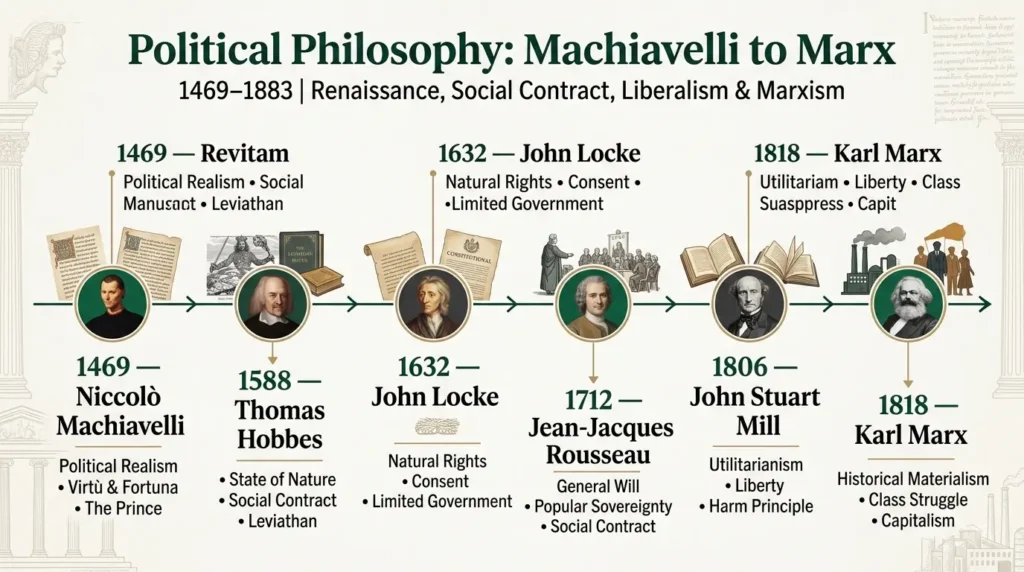
DU Previous Year Questions (PYQs)
DU Previous Year Questions
Frequently asked questions from DU exam papers on this topic. Tap a question to view a quick-answer guide.
1 Explain Machiavelli’s distinction between virtù and fortuna. +
2 Critically examine the principles of statecraft as expounded by Machiavelli. +
3 Write a short note on Hobbes’s view of human nature. +
4 Discuss Hobbes’s views on the state of nature. Do they differ from Locke’s? Give reasons. +
5 Analyse the notion of consent and the theory of resistance in Locke’s political writings. +
6 What is Rousseau’s concept of the General Will? How does it differ from the “will of all”? +
7 Discuss Rousseau’s idea of the social contract and popular sovereignty. +
8 Explain Mill’s Harm Principle. +
9 Critically examine Mill’s concept of liberty and his defence of freedom of expression. +
10 What is meant by “surplus value” in Marx’s theory? +
11 Discuss Marx’s theory of historical materialism and the base-superstructure model. +
12 Compare and contrast Locke’s and Marx’s views on private property. +
FAQs
What thinkers are covered in DU GE-6 Unit-2: Renaissance and Modern Political Philosophy?
The official syllabus covers Machiavelli, Hobbes, Rousseau, Mill, and Marx. This post also includes Locke as bonus reading since his ideas are essential background and frequently asked about in related DU papers.
What is the difference between Hobbes’s and Locke’s state of nature?
Hobbes sees the state of nature as a violent “war of all against all,” justifying an absolute sovereign. Locke sees it as relatively peaceful, governed by natural law, justifying only a limited government focused on protecting natural rights.
What is Rousseau’s General Will?
The General Will is the collective, rational will of a political community aimed at the common good — distinct from the “will of all,” which is just the sum of individual private preferences.
What is Mill’s Harm Principle in simple terms?
It states that society can only restrict an individual’s freedom to prevent harm to others — not to protect the individual from themselves or to enforce majority morality.
What is surplus value according to Karl Marx?
Surplus value is the extra value workers create through their labour beyond what they are paid in wages; capitalists appropriate this surplus as profit, which Marx identifies as the core mechanism of exploitation under capitalism.
Is Locke part of the official GE-6 Unit-2 syllabus?
Locke is not formally listed in the GE-6 Unit-2 syllabus (which covers Machiavelli, Hobbes, Rousseau, Mill, and Marx), but his ideas are commonly tested in related political theory papers, so we’ve included him for complete context.
What is the difference between Rousseau’s and Marx’s critique of private property?
Rousseau saw private property as the historical origin of social inequality and the corruption of natural human goodness. Marx went further, arguing that private ownership of the means of production under capitalism is the structural basis of class exploitation, to be abolished through revolution.
Which is more important for DU exams — Mill’s Harm Principle or his Utilitarianism?
Both are frequently asked. The Harm Principle tends to appear in questions on liberty and rights, while Utilitarianism (especially the quality vs quantity of pleasures) appears in questions comparing Mill to Bentham. Prepare both thoroughly.
Subscribe to keep reading
You've used your free notes for now. Get Delhi Pathshala Premium for unlimited access.
Subscribe — ₹29/30 days
Please also give notes on Karl Marx which is very important in WPP and in exam point of view
Kindly update the same as soon as possible as there is no specific notes for Karl Marx
Please update soon
Kindly pay attention