
Contents
- Quick facts
- What does “Delhi-i Kuhna” mean?
- Background: from Rai Pithora to a Sultanate capital
- Historical background and patronage
- Qutbuddin Aibak: the first mosque
- Iltutmish and the “Sanctuary of Islam”
- Alauddin Khalji: expansion and a new capital
- Exploration of the mosque’s architecture and design
- Plan and layout
- Pillars and reused material (spolia)
- The screen, arches and calligraphy
- The Iron Pillar in the courtyard
- Material and ornament: correcting the earlier version
- Later additions
- What should the mosque be called? Masjid-i Jami, Qubbat al-Islam or Quwwat-ul-Islam?
- Its place in the urban fabric of medieval Delhi
- Comparison: the Sultanate cities in Unit 2
- How historians read the mosque: a debate
- Criticism and limitations of the evidence
- Why this case study is worth choosing
- Quick revision
- Conclusion
- Continue reading
- University of Delhi previous year questions
- FAQs
These notes cover Unit 2 (Understanding the 10th and 14th Century Cities of Delhi) of the Generic Elective Delhi through the Ages, B.A. (Hons.) History, University of Delhi. In Unit 2 you study any two of the listed case studies; Dehli-i Kuhna’s Masjid-i Jami is one of them, alongside Anangpur Fort, Siri, Ghiyaspur-Kilukhari, Tughluqabad and Firuzabad. You can find every unit on the Delhi through the Ages notes page.
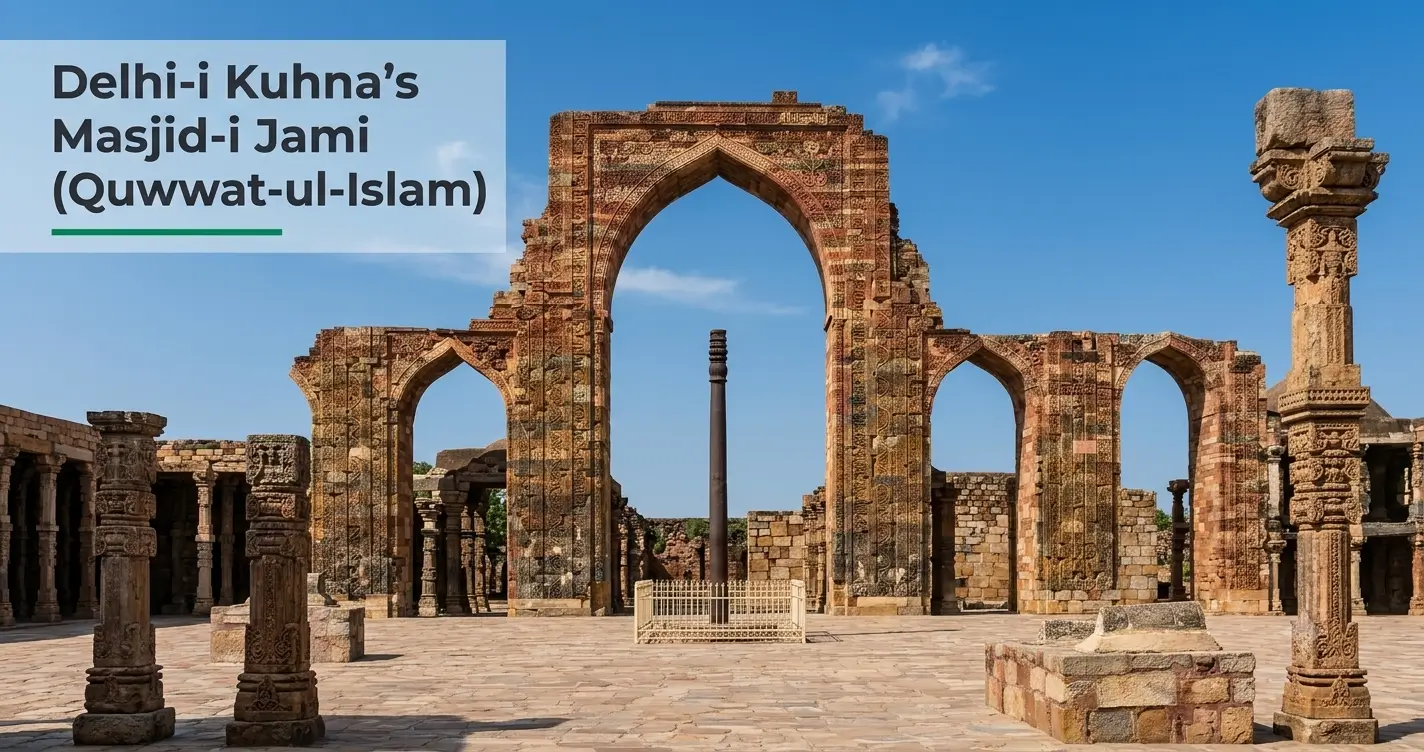
In one paragraph: Delhi-i Kuhna (“Old Delhi”) was the name the Sultanate chronicles used for the first city of the Delhi Sultans, raised around the older Rajput fort of Lal Kot and Qila Rai Pithora in what is now Mehrauli. Its Masjid-i Jami (congregational or Friday mosque) is the mosque in the Qutb complex that textbooks usually call Quwwat-ul-Islam. Qutbuddin Aibak began it in 1192 and Iltutmish and Alauddin Khalji enlarged it. It is Delhi’s first Friday mosque, and the debate over its name, its temple-material pillars and its inscriptions is exactly why the syllabus prescribes Sunil Kumar’s “Qutb in Modern Memory”.
Quick facts
| Point | Answer | Basis |
|---|---|---|
| Other names | Masjid-i Jami (of Delhi), Qutb Mosque, Quwwat-ul-Islam, Qubbat al-Islam (historians’ proposed earlier name) | UNESCO nomination file; The Wire (Sinha) summarising Sunil Kumar |
| Where | Qutb complex, Mehrauli, south Delhi, on the site of the Rajput fort (Qila Rai Pithora) | The Wire; DU syllabus gloss “old Delhi/Mehrauli” |
| Founder | Qutbuddin Aibak (Ghurid commander, later first Sultan of Delhi) | UNESCO; NCERT |
| Started | 1192, completed 1198 (UNESCO). Last decade of the twelfth century (NCERT) | UNESCO nomination; NCERT Class VII |
| Enlarged by | Iltutmish (1211–36); Alauddin Khalji (1296–1316) | UNESCO |
| Famous additions | Great arched screen; Iltutmish’s extension; Alauddin’s court and the Alai Darwaza (1311) | UNESCO; ASI summary |
| Why it matters | Delhi’s first Friday mosque; early Indo-Islamic architecture; a test case for how historians read conquest, reuse of temple material and memory | Prescribed readings (Athar Ali; Sunil Kumar) |
What does “Delhi-i Kuhna” mean?
Kuhna is Persian for “old”. In the Sultanate chronicles Dehli-i Kuhna (the DU syllabus spelling; also called Qutb Delhi in some accounts) is the oldest of the cities of Delhi, the one around the Qutb Minar and the mosque. NCERT’s Class VII textbook describes the Quwwat al-Islam mosque and minaret as the congregational mosque of the first city built by the Delhi Sultans, which the chronicles call Dehli-i Kuhna, “the old city”. Athar Ali, whose essay is on your reading list, describes how the early mosque, the Minar and a new fort north of it formed the nucleus of the Sultanate’s first imperial city.
Two cautions help in the exam:
- Delhi-i Kuhna is not Shahjahanabad. “Old Delhi” in today’s speech means the walled city of Shah Jahan, near the Red Fort and the Jama Masjid. In Unit 2, “old” means the twelfth-century site in Mehrauli, about four centuries earlier.
- Delhi-i Kuhna’s mosque is not the Qila-i-Kuhna mosque. The Qila-i-Kuhna Masjid stands inside the Purana Qila and is associated with Sher Shah Suri. It is a completely different monument, which is probably why the two names get confused in online notes.
Background: from Rai Pithora to a Sultanate capital
Historians reconstruct the setting like this. After Muhammad of Ghur defeated Prithviraj Chauhan, he returned home and left Delhi and Ajmer in the hands of his commander (and slave) Qutbuddin Aibak. When Ghuri died in 1206, Aibak became independent, and Delhi became the centre of what we now call the Delhi Sultanate. One of his first tasks was to build a congregational mosque. The site he chose was the former stronghold of the Rajput rulers, Rai Pithora; the older platform was enlarged to about twice its size to carry the new structure.
This is why the mosque matters in a unit about cities. It was not an isolated religious building. It was the religious, political and symbolic core of a new capital.
Historical background and patronage
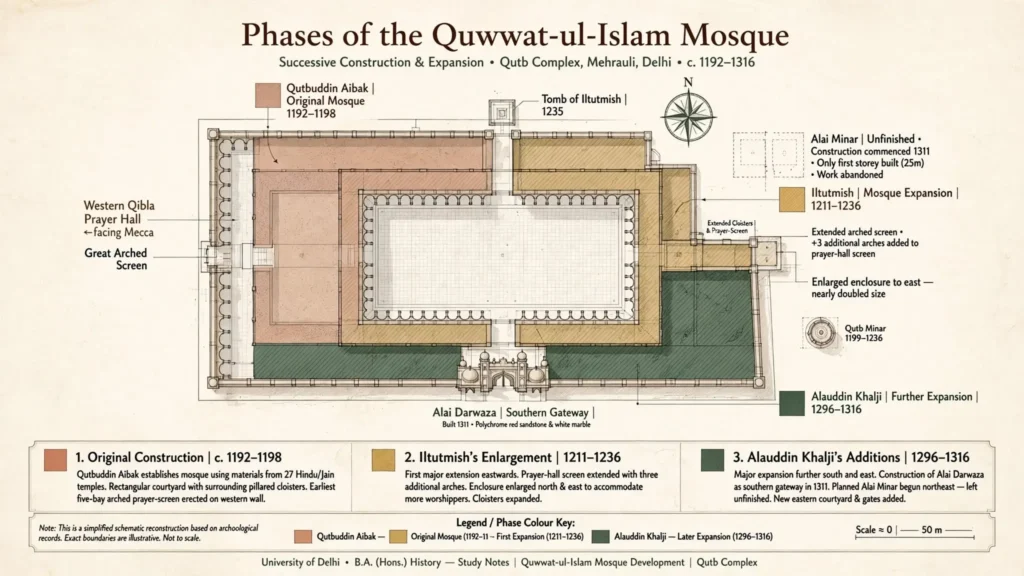
The mosque grew in stages, and exam answers score well when they name the patron for each stage. The timeline below follows the UNESCO nomination file, with other details marked by source.
| Phase | Patron | What happened | Source note |
|---|---|---|---|
| c. 1192–1198 | Qutbuddin Aibak | Original mosque begun in 1192 and completed in 1198, using the remains of demolished Hindu temples | UNESCO nomination file |
| c. 1193–1195 | Aibak / Muizz-ud-din Muhammad bin Sam (Ghur) | Inscriptions on the gateways are reported to record the conquest of the fort, the building of the Jami Masjid and, on the north gate, the Ghurid ruler’s command. Reported dates are AH 589 (1193 CE) and AH 592 (1195 CE) | Translations quoted in a secondary history blog; verify against ASI/Page before quoting a date in an exam |
| 1211–1236 | Iltutmish | Mosque enlarged; the prayer-hall screen extended with further arches. Chronicler Juzjani calls Delhi in his reign Qubbat al-Islam | UNESCO; Wire (Sinha on Kumar) |
| 1296–1316 | Alauddin Khalji | Further enlargement; Amir Khusrau records a new court added with Quranic inscriptions. Alai Darwaza (southern gateway) completed in 1311; a planned giant minaret (Alai Minar) abandoned | UNESCO; Amir Khusrau as quoted in DU SOL study material and secondary sources |
| 14th century | Firuz Shah Tughluq | His own memoir is reported to record the repair of the Delhi Jami Masjid | As quoted on a secondary blog; verify against the translation of the Futuhat-i Firuz Shahi |
| 1847 onwards | Colonial and modern scholarship | Sir Syed Ahmad Khan’s Asar-al-Sanadid (1847) lists the mosque under three names, one of which is Quwwat al-Islam; later ASI work under J. A. Page makes it the official name | The Wire (Sinha) |
Qutbuddin Aibak: the first mosque
Aibak’s mosque followed the plan of a rectangular open courtyard with pillared cloisters and a qibla wall. The builders used material from earlier temples, and the foundation inscription over the eastern gate is the most-quoted evidence. Its text, as translated, claims that materials from 27 temples were used. Treat that number as what the inscription says, not as an independently verified count.
Iltutmish and the “Sanctuary of Islam”
Iltutmish’s Delhi attracted people from across the Islamic world, especially after the Mongol invasions of the 1220s pushed many scholars and soldiers out of Central Asia, Iran and Afghanistan. The chronicler Minhaj-i Siraj Juzjani described the capital in glowing, religious terms, including the phrase Qubbat al-Islam. This matters for the name debate discussed below.
Alauddin Khalji: expansion and a new capital
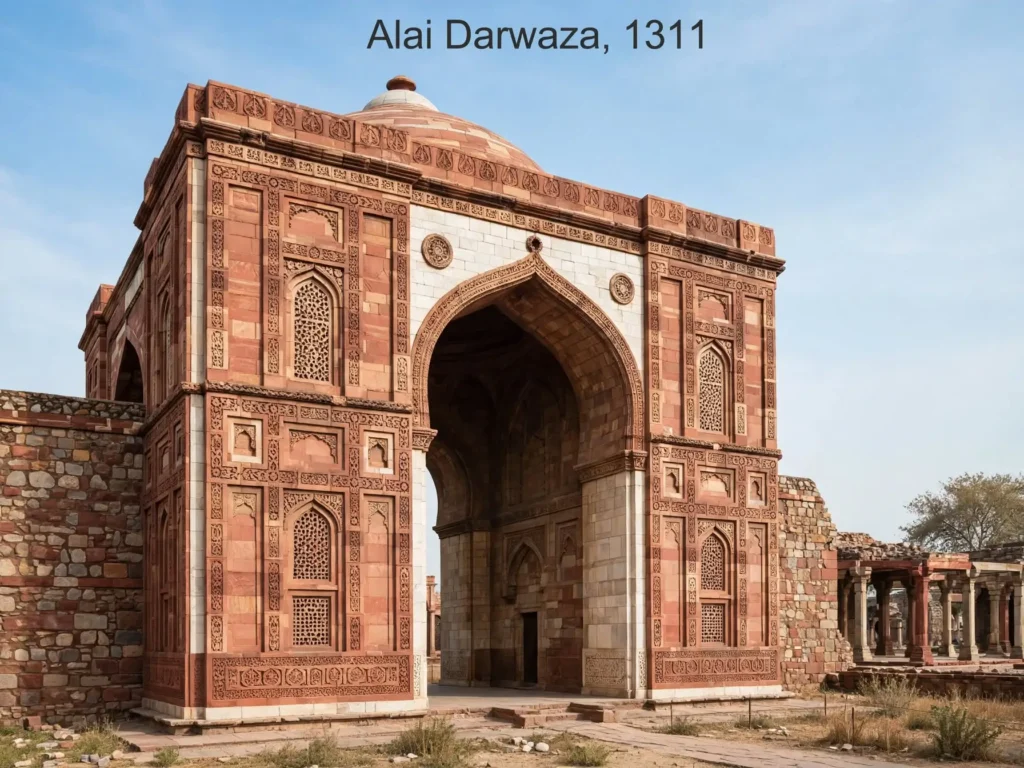
Alauddin Khalji enlarged the mosque and built the Alai Darwaza. UNESCO records that he also began the Alai Minar, which was to overtop the Qutb Minar but was abandoned after the first storey when he died. Notice the larger pattern the unit is asking about: Alauddin also founded Siri (1303), a new city, so the old city’s mosque stayed important but was no longer the only centre of the capital.
Exploration of the mosque’s architecture and design
Plan and layout
The mosque has a large courtyard, cloisters around it and a prayer hall on the western side facing Mecca. The qibla wall (the western wall of the prayer hall) carries the mihrab, the niche marking the direction of prayer. UNESCO describes the complex as consisting of a courtyard, cloisters and a prayer hall. The high arched screen in front of the prayer hall is the feature visitors notice first; sources disagree on exactly which arches belong to which ruler, so the safe exam statement is that the screen began under Aibak and was extended by Iltutmish.
Pillars and reused material (spolia)
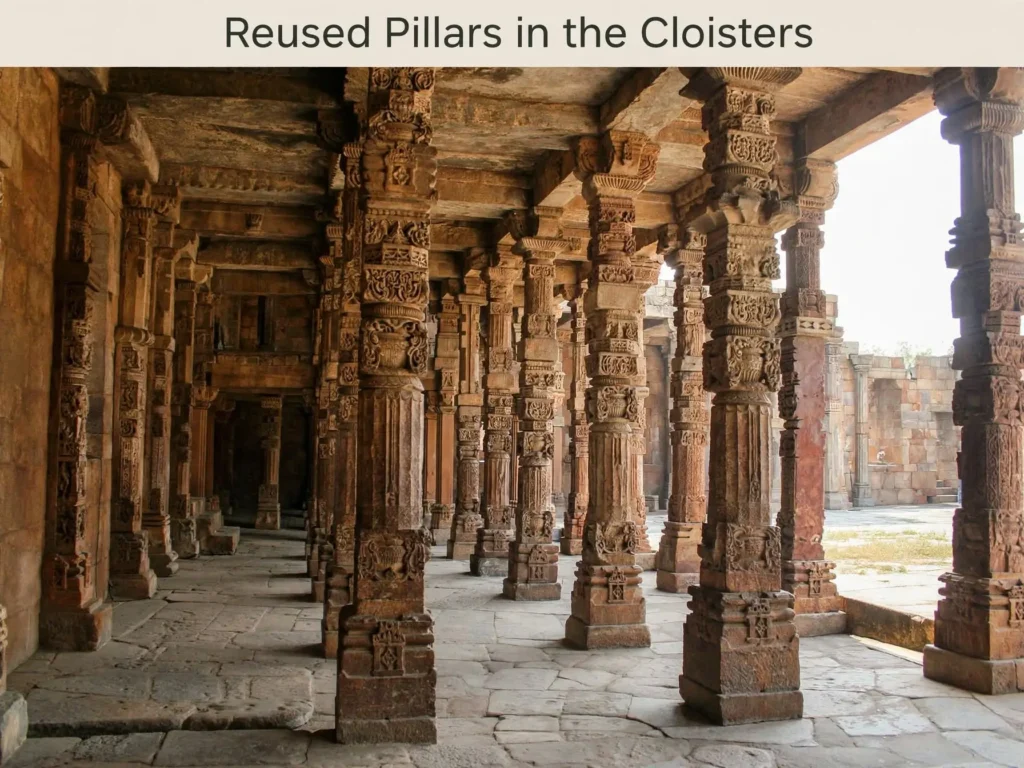
Inside the cloisters you can still see pillars with carved floral motifs, bells and chains, and traces of sculpted figures. Observers note that some shafts and bases do not match, because they came from different earlier pillars. The Wire’s account adds that the Sultanate builders preferred pillars with floral motifs for the colonnades. Do not reduce this to “temples were destroyed”. The better answer says that earlier material was reused, that Hindu artisans and Hindu ornament shaped the result, and that historians argue about how to read this reuse (see the historiography section).
The screen, arches and calligraphy
The great screen has a tall central arch flanked by smaller arches, covered with bands of Quranic inscription and curling vegetal ornament. Textbooks use this as a standard example of how Indo-Islamic architecture combined imported forms (arches, calligraphy) with local craft (carved stone, floral patterns). UNESCO’s description puts it differently: the mosque introduced to India the model of Islamic architecture developed in western Asia, while using carved temple elements.
The Iron Pillar in the courtyard
The mosque courtyard contains the Iron Pillar, which carries a Sanskrit inscription of the fourth century CE naming a ruler Chandra, believed to be the Gupta king Chandragupta II (375–413). Its original location is uncertain, and when and why it was moved to Delhi is debated. Our separate note on the Mehrauli Iron Pillar covers its inscriptions and the rust question.
Material and ornament: correcting the earlier version
The earlier version of this page described generic features such as marble paving, a central fountain and several minarets. These are features of other mosques, not verified for this one. For the Qutb complex, UNESCO and ASI sources stress red and buff sandstone and carved stone. The Qutb Minar next to the mosque is built of red and buff sandstone and rises to 72.5 m.
Later additions
| Addition | Ruler | Note |
|---|---|---|
| Great arched screen | Aibak, extended by Iltutmish | Attribution of individual arches differs between sources |
| Enlarged prayer hall and court | Iltutmish | The Minar came to stand inside the enlarged enclosure (secondary source) |
| New court with inscriptions | Alauddin Khalji | Amir Khusrau’s description |
| Alai Darwaza, southern gateway, 1311 | Alauddin Khalji | UNESCO; often described as an early use of true arches and domes in India |
| Alai Minar (unfinished) | Alauddin Khalji | Abandoned after the first storey |
Comparison point for answers: ASI-based summaries note that the mosque’s design resembles the Adhai-din-ka Jhonpra mosque at Ajmer, built by Aibak in the same period. Use this only as a short comparative line.
What should the mosque be called? Masjid-i Jami, Qubbat al-Islam or Quwwat-ul-Islam?
This is the most “DU-style” part of the topic, and it connects directly to Sunil Kumar’s prescribed essay.
| Name | Meaning | Where it comes from |
|---|---|---|
| Masjid-i Jami (of Delhi) | Friday or congregational mosque | The usual term in the Sultanate period; the syllabus uses it |
| Qubbat al-Islam | “Dome” or “Sanctuary” or “Axis” of Islam | Used by Juzjani for Iltutmish’s Delhi and linked in tradition to the Sufi Bakhtiyar Kaki; Sunil Kumar suggests the later name is a corruption of this |
| Quwwat-ul-Islam | “Might of Islam” | Not found in any surviving Sultanate inscription or chronicle, according to the Wire’s summary of Kumar. Entered common use through Sir Syed Ahmad Khan’s Asar-al-Sanadid (1847) and then colonial archaeological writing |
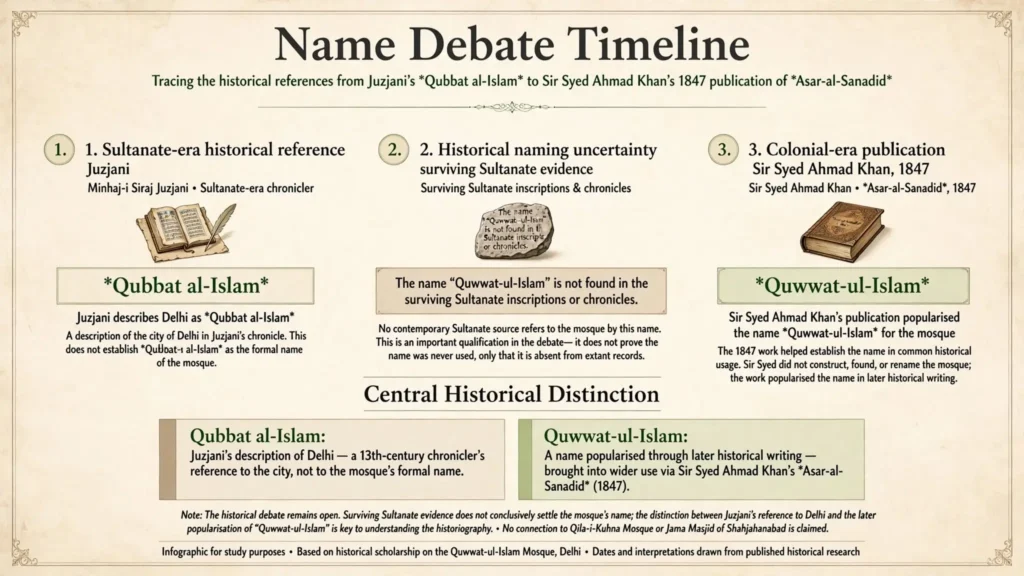
Why does this matter beyond trivia? “Might of Islam” suggests a monument of military triumph. “Sanctuary of Islam” suggests a spiritual centre in a city that was filling with refugees, scholars and Sufis. The name you choose frames the story you tell. Quwwat-ul-Islam is still the name on signboards and in most textbooks (NCERT uses it), so use it, but explain the debate.
Its place in the urban fabric of medieval Delhi
The mosque’s urban role is better supported by chronicles than the earlier version’s guesses about “poetry recitations” and “marketplaces”, which no source we could verify supports. Here is what the sources do allow.
- A religious and political centre. A Friday mosque is where the community gathers for the weekly congregational prayer and sermon (khutba), led by an imam. NCERT’s textbook explains the term masjid-i jami in exactly this sense. In a new capital, such a mosque also marked the arrival of a new ruling power.
- The nucleus of the first imperial city. Athar Ali’s account places the mosque, the Minar and the fort together as the core of Delhi’s first iteration as a Sultanate capital.
- A city of arrivals. After the 1220s, migrants from Central Asia and Iran reached Delhi. Juzjani’s language for Iltutmish’s capital reflects that: a place that kept the Muslim faith and drew people from across the Islamic world.
- A contested religious space. Sunil Kumar’s account, as summarised by the Wire, notes that early Delhi also included rival Turkish commanders (the Muizzi amirs), one of whom built a similar mosque at Bayana, and Sufi groups such as the followers of Nur Turk who criticised the ulama and even attacked the Qutb mosque. The picture is of a lively, divided city, not a single harmonious community.
- Sufi associations. The Minar’s popular name, Qutub Sahib ki lath, recalls the Sufi saint Bakhtiyar Kaki. Later saints such as Nizamuddin Auliya also belong to this broader story.
- Description by a traveller. Ibn Battuta, who visited in the 1330s, is reported to have described a vast stone mosque; this is known to us through a secondary quotation, so cite him cautiously.
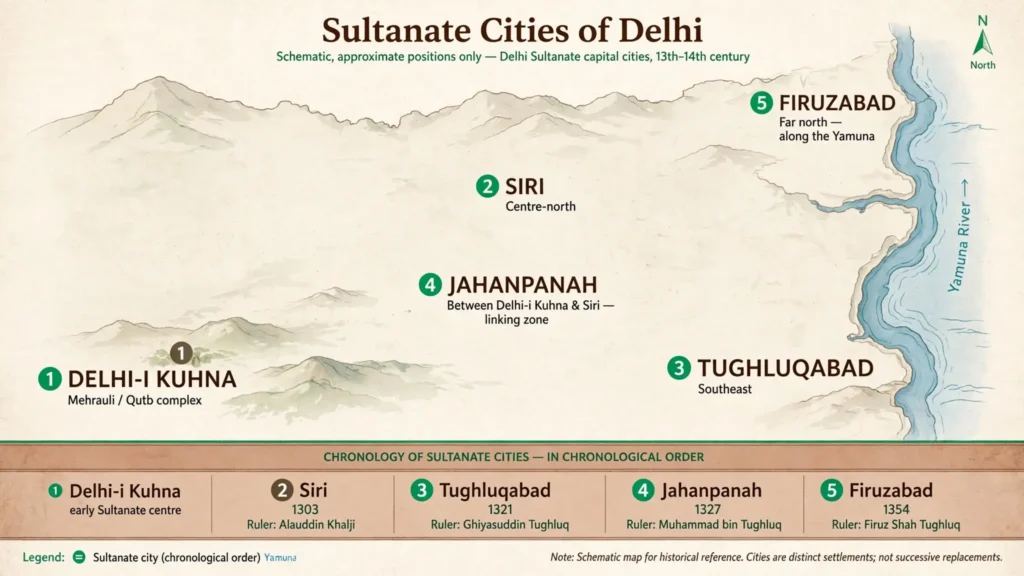
- Changing importance. When Alauddin founded Siri (1303) and later rulers founded Tughluqabad (1321), Jahanpanah (1327) and Firuzabad (1354), the centre of gravity moved. NCERT notes that under Muhammad bin Tughluq the oldest of Delhi’s cities, Dehli-i Kuhna, was emptied of its residents and soldiers garrisoned there in a period of military pressure. Read Peter Jackson’s “Delhi: The Problem of a Vast Military Encampment” (on your list) for the wider argument.
Comparison: the Sultanate cities in Unit 2
| City | Approximate foundation | Founder | Relation to Delhi-i Kuhna |
|---|---|---|---|
| Delhi-i Kuhna (Qutb Delhi) | 1192 onwards | Aibak, building on Rajput Lal Kot/Rai Pithora | The first city |
| Siri | 1303 | Alauddin Khalji | A new, separate fortified city to the north-east |
| Tughluqabad | 1321 | Ghiyasuddin Tughluq | New fortified capital further east |
| Jahanpanah | 1327 | Muhammad bin Tughluq | Joined Delhi-i Kuhna and Siri |
| Firuzabad | 1354 | Firuz Shah Tughluq | Riverside capital (Kotla) |
Dates follow a standard urban-geography table; check them against Athar Ali’s essay before quoting them in an exam.
How historians read the mosque: a debate
Where scholars disagree, write the debate with names. Here is a safe summary.
| Reading | Associated with | Core argument | Limitation |
|---|---|---|---|
| Conquest and iconoclasm narrative | Colonial historiography; later popular nationalist guides | The mosque shows a rupture between a Hindu and a Muslim period, built from the rubble of temples. The Wire’s summary links this to the colonial scheme of Hindu, Muslim and British periods that Romila Thapar criticises | Treats one inscription and one name as the whole story |
| Multi-layered history | Sunil Kumar | The reuse of temple material is only one layer. The site also holds stories of rival commanders, Sufi dissent, saintly veneration, Hindu craftsmen and the later influence of Sir Syed’s writing | Requires reading chronicles carefully against later memory |
| Inscription and re-attribution | Finbarr Barry Flood (as summarised in the Wire) | The foundation inscription’s form and chronology raise anomalies; it may belong to Iltutmish’s time rather than Aibak’s. Flood also notes plaster casts of the pillars were shown in the South Kensington Museum in London in the 1870s | Attribution is a scholarly argument, not settled fact |
Criticism and limitations of the evidence
- The inscription problem. The “27 temples” inscription is a medieval claim about a medieval act, and its dating and attribution are debated. Neither a modern nationalist nor a modern apologetic reading can rest only on it.
- Naming bias. Because “Quwwat-ul-Islam” entered usage through nineteenth- and twentieth-century writing, relying on it can carry later assumptions back into the thirteenth century.
- Source type. Our narrative sources (Juzjani, Amir Khusrau, Barani, Ibn Battuta, Firuz Shah’s memoir) were written at courts or by visitors, so each has a point of view.
- Reconstruction. Which arch belongs to which ruler is argued from style and inscription, not from a single complete record.
Why this case study is worth choosing
Because you study any two case studies, a common strategy is to pair a place-based case such as this mosque with a city-based case such as Siri or Tughluqabad. Delhi-i Kuhna’s Masjid-i Jami gives you the richest source debate (name, inscription, memory); the city case gives you the capital-shift argument. This is a study suggestion, not a syllabus rule. For the ancient background see Lal Kot.
Quick revision
| Question | One-line answer |
|---|---|
| Who began it and when? | Qutbuddin Aibak, 1192 (completed 1198, per UNESCO) |
| Where? | Qutb complex, Mehrauli, on the Rai Pithora site |
| Who enlarged it? | Iltutmish and Alauddin Khalji |
| What is Delhi-i Kuhna? | The old (first) Sultanate city of Delhi, around Mehrauli |
| Earlier name debate? | Qubbat al-Islam (Sunil Kumar’s suggestion) vs Quwwat-ul-Islam (common modern name) |
| Key sources? | Inscriptions; Juzjani; Amir Khusrau; Ibn Battuta; Firuz Shah’s memoir; Sir Syed’s Asar-al-Sanadid |
| Key historians? | Athar Ali; Sunil Kumar; Finbarr Flood; Peter Jackson |
| Not to confuse with? | Qila-i-Kuhna Masjid (Purana Qila, Sher Shah); Jama Masjid of Shahjahanabad |
Conclusion
Delhi-i Kuhna’s Masjid-i Jami is best understood as a building with layers: a Ghurid-era foundation on a Rajput fort, an Iltutmish-era extension in a capital that was filling with migrants and Sufis, an Alauddin-era enlargement as the centre of Delhi began to shift, and a modern name that itself needs explaining. For your answers, give the phases and patrons first, then explain the name and inscription debates with the historians’ names, and finally link the mosque to the larger Unit 2 question of why the Sultans kept moving their capital.
Continue reading
- Anangpur Fort case study: the Tomar-period settlement, the other early case study in Unit 2.
- Siri, the medieval city of Delhi: Alauddin Khalji’s new capital, the natural next topic.
- Mehrauli Iron Pillar: history and inscriptions: the pillar standing in this mosque’s courtyard.
- Lal Kot: the earlier fort on which the mosque was built.
- Tughluqabad case study: the next Sultanate capital after Siri.
University of Delhi previous year questions
DU Previous Year Questions
Frequently asked questions from DU exam papers on this topic. Tap a question to view a quick-answer guide.
1 Analyze the role played by any one of the following in the development of the Sultanate capital of Delhi: (a) Delhi-i-Kuhna’s Jami Masjid (b) Ghiyaspur-Kilokhri (c) Siri (d) Tughlaqabad (e) Jahanpanah (f) Ferozabad. — March 2021, Paper Code 12315110, Q.3 +
2 Examine the development and changing cityscape of Delhi between 10th to 14th centuries, with special reference to any one of the following — (a) Anangpur Fort, (b) Dili-i-Kunha’s Masjid-i-Jami, (c) Siri, (d) Ghiyaspur Kilukhari, (e) Tughluqabad and (f) Firuzabad. — NEP Sem I, Unique Paper Code 2314001002, Q.4 +
3 Analyze the meanings represented in the architectures of Jami Masjid in Delhi-i-Kuhna. — SGND Khalsa College Question Bank, GE-I, Q.5 +
4 What were the factors that shaped the developments in the cityscape of Delhi in the 13th-14th centuries? — March 2021, Paper Code 12315110, Q.2 +
5 Discuss the factors responsible for shifting of capitals in Delhi during 13th and 14th century. — SGND Khalsa College Question Bank, GE-I, Q.3 +
FAQs
What is Delhi-i Kuhna’s Masjid-i Jami?
It is the Friday mosque of the first city of the Delhi Sultans, usually called the Quwwat-ul-Islam mosque, in the Qutb complex at Mehrauli.
Was it built by Sikandar Lodi in 1494?
No. Some older notes say so, but UNESCO records that Qutbuddin Aibak began it in 1192, and Iltutmish and Alauddin Khalji later enlarged it. Sikandar Lodi is not its builder.
Why is it called Quwwat-ul-Islam if the name is debated?
The name became standard after Sir Syed Ahmad Khan’s 1847 book and later colonial archaeology. Sunil Kumar argues the earlier name was probably Qubbat al-Islam.
How many temples were used for the mosque?
The foundation inscription, as translated, says 27 temples. Treat this as the inscription’s claim and mention that historians debate its dating and attribution.
What is the difference between Delhi-i Kuhna’s mosque and the Qila-i-Kuhna mosque?
The Qila-i-Kuhna Masjid is inside the Purana Qila and is linked to Sher Shah Suri. Delhi-i Kuhna’s mosque is in Mehrauli and dates from the Sultanate’s beginnings.
Is the Iron Pillar part of this mosque?
It stands in the mosque’s courtyard, but it is much older (fourth century CE, Gupta period) and was moved there.
Why did the mosque lose its central place?
As capitals moved to Siri, Tughluqabad, Jahanpanah and Firuzabad, the centre of the city shifted; the mosque was nevertheless repaired and enlarged by several rulers.
Which readings should I use for this case study?
The DU syllabus lists Athar Ali’s “Capital of the Sultans”, Sunil Kumar’s “Qutb in Modern Memory”, “Courts, Capitals and Kingship” and “The Tyranny of Meta-Narratives”, and Peter Jackson’s essay on the military encampment.
Do I have to study every case study in Unit 2?
No. The syllabus says case studies of any two of the listed sites will be undertaken.
How should I write the name debate in an exam?
Give the three names, say who used each (Juzjani, Kumar, Sir Syed), explain why the name matters for how we read the monument, and avoid presenting any single view as settled.
Subscribe to keep reading
You've used your free notes for now. Get Delhi Pathshala Premium for unlimited access.
Subscribe — ₹29/30 days
1 thought on “Delhi-i Kuhna’s Masjid-i Jami Case Study: The Quwwat-ul-Islam Mosque (DU Notes)”