
Contents
- Exploring Perspectives: Colonialism and Nationalism in India
- Main Perspectives on Colonialism
- Liberalism
- Marxism
- Postcolonialism
- Comparing the Three Perspectives on Colonialism
- Approaches to the Study of Nationalism in India
- Nationalist Approach
- Imperialist Approach
- Marxist Approach
- Subaltern Approach
- Comparing the Four Approaches to Nationalism
- Previous Year Questions (DU DSC-3 / Colonialism and Nationalism in India, Unit 1)
- FAQs
In this post, notes on Unit 1: Colonialism and Nationalism from DSC-3: Colonialism and Nationalism in India are given, which is helpful for BA (Hons.) Political Science students of Delhi University preparing for their Semester 1 exams. This unit is divided into two parts: the main theoretical perspectives on colonialism, and the different approaches used to study the rise of nationalism in India.
Exploring Perspectives: Colonialism and Nationalism in India
This unit provides an overview of the varied theoretical perspectives on colonialism — liberalism, Marxism, and postcolonialism — along with the different approaches scholars use to study the rise of nationalism in India. It examines the economic, political, cultural, and humanitarian dimensions of colonial rule, and looks at how different schools of thought interpret both imperialism and the dynamics of the Indian nationalist movement. Each perspective offers a distinct lens through which to understand India’s complex historical and socio-economic landscape. For the historical background this unit builds on, see our notes on Colonial Rule in India and Its Impact (DSC-3, Unit 2).
Main Perspectives on Colonialism
Liberalism
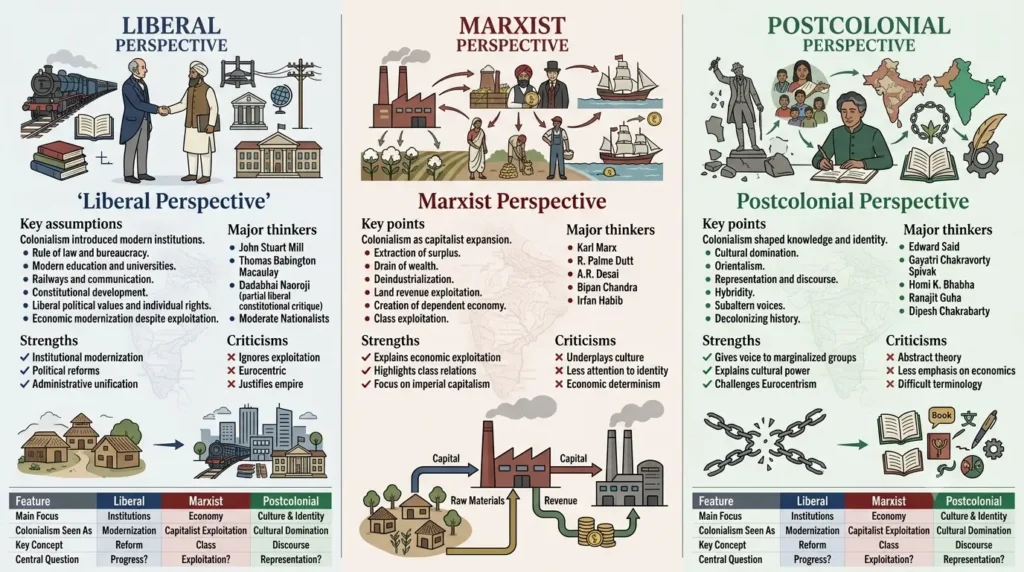
Liberalism, as a political and economic philosophy, offers several distinct perspectives on colonialism in India. It is important to note that liberalism is not a single, monolithic ideology — different liberal thinkers hold varying views on colonialism, and it is best understood through its economic, political, cultural, and humanitarian strands.
Economic Liberalism and Colonialism
Economic liberals generally emphasise free markets, individual liberty, and limited government intervention in economic affairs. Some economic liberals argue that British colonial rule in India, despite its exploitative nature, inadvertently introduced certain economic reforms that laid the groundwork for modernisation — the construction of railways and telegraph systems, and the establishment of a legal framework, are often cited as examples of positive by-products.
On the other hand, critics argue that economic policy during colonial rule was designed to benefit the British Empire at the expense of the Indian population. The extraction of resources, forced cultivation of cash crops, and unequal trade practices are considered by many liberal economists to be clear forms of economic exploitation.
Political Liberalism and Colonialism
Political liberals emphasise ideas such as individual rights, representative government, and the rule of law. From this perspective, the lack of political representation and self-determination during colonial rule in India is a significant concern. Liberals criticise the imposition of British political structures and the denial of basic political rights to the Indian population.
At the same time, liberals argue that the colonial experience fostered a desire for democratic governance and civil liberties among Indians. The struggle for independence, led by figures such as Mahatma Gandhi and Jawaharlal Nehru, is seen by some liberals as a testament to the resilience of liberal values in the face of colonial oppression.
Cultural Liberalism and Colonialism
Cultural liberals focus on the importance of cultural diversity, tolerance, and the protection of individual freedoms. From this perspective, the imposition of Western cultural values and the suppression of indigenous cultures during colonial rule in India are viewed critically.
Cultural liberals critique the ethnocentrism inherent in the colonial project, emphasising the importance of respecting and preserving local customs, languages, and traditions. At the same time, some highlight the positive aspects of cultural exchange that occurred during the colonial period, suggesting it contributed to a more interconnected world.
Humanitarian Liberalism and Colonialism
Humanitarian liberals are concerned with social justice, equality, and the protection of human rights. From this viewpoint, gross human rights violations during colonial rule — such as the Jallianwala Bagh massacre and famines exacerbated by British policies — are condemned as clear violations of liberal principles.
Humanitarian liberals argue that the colonial experience exposed the need for a global commitment to human rights and social justice, and that the atrocities committed during colonialism acted as a catalyst for the development of international human rights norms.
In summary, liberal views on colonialism in India are diverse. While some liberals highlight positive by-products such as economic reforms or cultural exchange, many liberals criticise the systemic exploitation, denial of political rights, and cultural oppression that characterised the colonial period. The struggle for independence is often seen as a manifestation of liberal ideals — self-determination, human rights, and representative governance. For the East India Company’s early administrative footprint that liberal historians point to, see the British East India Company on Wikipedia.
Marxism
Marxism offers a comprehensive framework for understanding colonialism in India, focusing on economic exploitation, class struggle, and the role of imperialism. Here are the key components of the Marxist perspective:
Economic Exploitation
Marxists argue that the primary driver of colonialism is economic exploitation. Colonial powers, including the British in India, were driven by the desire to extract surplus value from the colonies. This exploitation took various forms, including the plunder of resources, forced labour, and the imposition of unequal trade relations.
The British colonial administration systematically drained India of its wealth, extracting resources such as spices and textiles, and later raw materials for the Industrial Revolution. The establishment of a cash-crop economy and the imposition of heavy taxation further impoverished the Indian population, creating a stark economic divide between coloniser and colonised.
Class Struggle and Social Inequality
Marxist analysis emphasises class struggle as a driving force of historical development. In colonial India, Marxists contend that the colonial system worsened existing class divisions. British colonial rulers, along with a local elite that often collaborated with them, formed a ruling class that benefited from the exploitation of the working class and peasantry.
The introduction of private property, land revenue systems, and the concentration of wealth in the hands of a few landlords and capitalists contributed to social inequality. The majority of the Indian population — peasants and workers — faced harsh economic conditions, leading to widespread poverty and exploitation.
Imperialism and Capitalism
Marxists view imperialism as a stage of capitalism, in which advanced capitalist nations seek to expand their markets, access cheap labour, and secure raw materials. In colonial India, the British Empire served the interests of British capitalism by providing a lucrative market for finished goods and a source of cheap labour and raw materials.
The development of the Indian economy under colonial rule was subordinated to the needs of British capitalism, hindering the growth of indigenous industries. The export-oriented nature of the colonial economy led to de-industrialisation and promoted a distorted, agrarian economic structure.
National Liberation and the Anti-Colonial Struggle
Marxists argue that the anti-colonial struggle in India, culminating in independence in 1947, was a manifestation of the inherent contradictions of colonial capitalism. The working class and peasantry played vital roles in the struggle against colonial rule. Figures like Mohandas K. Gandhi and Jawaharlal Nehru were influenced by socialist ideas to varying degrees.
Marxists view the attainment of political independence as necessary but not sufficient for true liberation, arguing that the post-colonial period in India witnessed a continuation of economic exploitation and class division in new forms — highlighting the need for a broader social and economic transformation.
Legacy of Colonialism
According to Marxists, the legacy of colonialism in India is profound and enduring. The economic structures, social hierarchies, and patterns of development established during the colonial period continue to shape India’s socio-economic landscape. Marxists argue that the challenges of poverty, inequality, and underdevelopment in post-colonial India are rooted in historical processes set in motion by colonial capitalism, and call for a fundamental transformation of the socio-economic system to address these deep-seated problems.
Postcolonialism
Postcolonialism offers a critical lens through which scholars analyse the historical, cultural, and social implications of colonialism, emphasising the continued impact of colonial legacies in the post-colonial era.
Historical Critique
Postcolonial scholars critically examine the historical narrative of colonialism, challenging Eurocentric views and highlighting alternative narratives that were often suppressed during the colonial period. They argue that the history of India as presented by the colonisers tends to sanitise and justify the actions of imperial powers, and question the notion of “progress” associated with colonialism, arguing that the supposed benefits of modernisation were often unevenly distributed, leading to social, economic, and cultural dislocation.
Cultural Imperialism and Hybridity
Postcolonialism emphasises the cultural dimensions of colonialism, examining how the imposition of Western values, languages, and institutions affected indigenous cultures. Scholars like Homi K. Bhabha have explored the concept of cultural hybridity, suggesting that colonial encounters led to the blending and recombination of cultural elements from both the coloniser and the colonised.
In the Indian context, postcolonial analysis examines how British colonialism influenced and transformed Indian languages, literature, art, and traditions — and how cultural resistance and adaptation led to unique syntheses of Western and indigenous elements.
Subaltern Studies
The Subaltern Studies group, influenced by postcolonial theory, focuses on the experiences of subaltern groups — those marginalised and oppressed by colonial powers. Scholars like Ranajit Guha and Gayatri Chakravorty Spivak argue for a re-examination of history from the perspective of the subaltern, seeking to amplify the voices of those often silenced in traditional historical narratives.
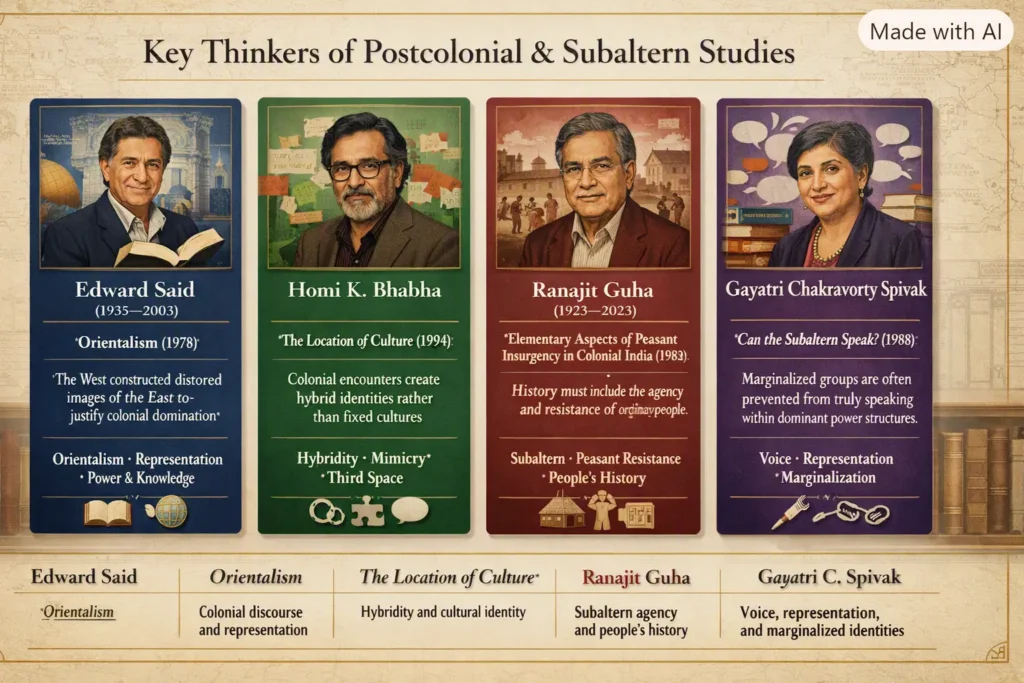
In the Indian context, Subaltern Studies has shed light on the experiences of peasants, tribal communities, and other marginalised groups, highlighting their agency and resistance in the face of colonial exploitation. Read more about this school of thought on the Subaltern (postcolonialism) Wikipedia entry.
Power and Resistance
Postcolonialism emphasises power dynamics and the various forms of resistance employed by colonised peoples. Scholars like Edward Said and Frantz Fanon have explored the psychological and political dimensions of resistance to colonial rule.
In the Indian context, postcolonial analysis examines strategies of resistance ranging from non-violent movements led by figures like Gandhi to more radical forms of resistance against economic exploitation, cultural imperialism, and political subjugation. For background on Said’s foundational text, see Orientalism (book) on Wikipedia.
Globalisation and Neocolonialism
Postcolonial perspectives extend beyond the colonial period to analyse how global power structures continue to perpetuate neocolonial relations. Scholars argue that globalisation often reinforces existing patterns of economic inequality and cultural dominance — a form of indirect colonialism. In India’s case, postcolonial theorists explore how the legacy of colonialism intersects with contemporary issues such as economic disparities, cultural commodification, and the influence of global institutions on local economies.
Identity and Nationalism
Postcolonialism investigates the construction of identity in the wake of colonialism, examining how notions of nationhood and nationalism emerged in response to colonial rule. Scholars examine the complexities of post-colonial identities, shaped by a negotiation between indigenous cultural heritage and the legacies of colonial influence. In India, postcolonial perspectives shed light on the multifaceted nature of Indian identity — encompassing diverse linguistic, religious, and regional identities within the framework of a post-colonial nation-state.
In summary, the postcolonial perspective on colonialism in India critically examines historical narratives, cultural adaptations, power dynamics, and ongoing struggles for justice and equality, offering a nuanced understanding of the enduring effects of colonial legacies on societies like India.
Comparing the Three Perspectives on Colonialism
| Aspect | Liberalism | Marxism | Postcolonialism |
|---|---|---|---|
| Core focus | Individual rights, free markets, rule of law | Economic exploitation and class struggle | Cultural, discursive and power-based legacies |
| View of colonialism | Mixed — exploitative but with some modernising by-products | A stage of capitalist expansion driven by surplus extraction | A system of cultural domination whose effects persist today |
| Key concern | Denial of political rights and representation | Class inequality and economic drain | Silencing of subaltern/marginalised voices |
| Key thinkers | Classical liberal economists and political theorists | Karl Marx-influenced Indian historians | Edward Said, Homi Bhabha, Gayatri Spivak, Ranajit Guha |
| View of independence | Triumph of liberal democratic values | Necessary but insufficient without economic transformation | Independence alone doesn’t erase colonial cultural/power structures |
Approaches to the Study of Nationalism in India
Nationalist Approach
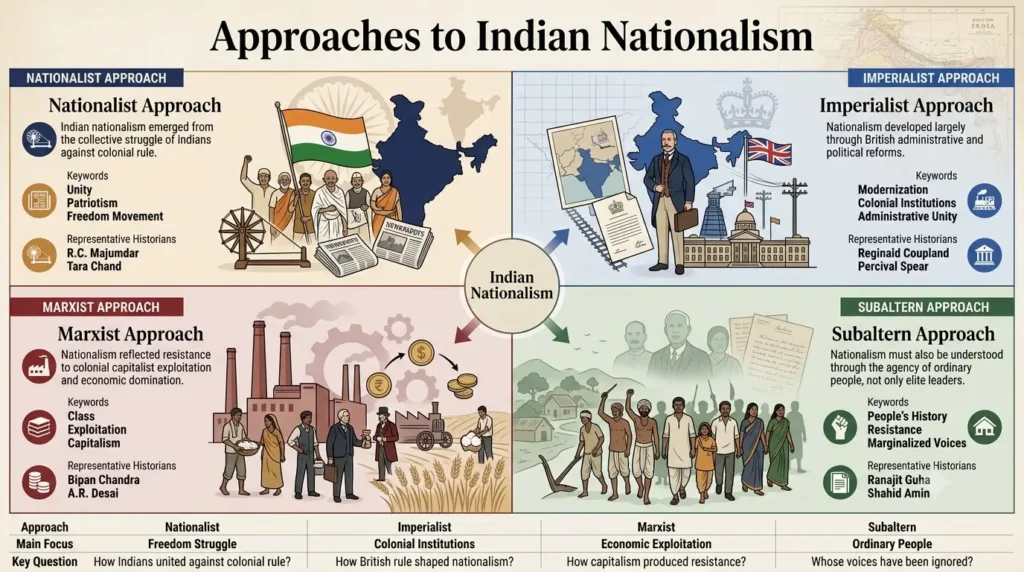
The nationalist approach to the study of nationalism in India focuses on understanding the emergence, development, and implications of Indian nationalism, particularly during the struggle for independence against British colonial rule. This approach is closely associated with the perspectives of leaders and thinkers who played key roles in the Indian independence movement.
- Historical Context: Nationalist scholars examine the historical context that led to the rise of nationalist sentiment — the impact of British colonialism, economic exploitation, cultural suppression, and the denial of political rights. The socio-economic changes brought about by colonial rule are studied as catalysts for the emergence of a distinct Indian identity.
- Colonial Exploitation and Resistance: Nationalist scholars highlight economic exploitation and political oppression under British rule as key drivers of nationalist sentiment, focusing on how various forms of resistance laid the foundation for a unified nationalist movement.
- Leadership and Ideology: The nationalist approach places significant importance on the role of key leaders and ideologues — Mahatma Gandhi, Jawaharlal Nehru, Subhas Chandra Bose, and others — studying their contributions to the ideological foundations of Indian nationalism, including non-violence, civil disobedience, and the pursuit of a united, independent India.
- Cultural Revival and Identity: Nationalist scholars explore efforts to revive and celebrate Indian culture, languages, and traditions as part of the wider nationalist movement, highlighting how cultural identity became a central element of the struggle for independence.
- Mass Mobilisation: This approach studies the mechanisms used for mass mobilisation during the independence movement, including the role of political organisations, grassroots movements, and public campaigns in rallying diverse sections of the population.
- Quest for Self-Determination: The nationalist approach emphasises the overarching goal of achieving self-rule and sovereignty for India, tracing how the demand for self-governance evolved, the negotiations with colonial authorities, and the eventual attainment of independence in 1947.
- Legacy of Nationalism: Nationalist scholars also study the legacy of Indian nationalism, both in terms of its impact on post-independence nation-building and its continuing influence on contemporary Indian politics and society.
For more on how this movement expanded over successive decades, see Indian National Movement: Dynamics within Social Movements.
Imperialist Approach
It is important to note that the term “imperialist approach” is not a widely recognised or standardised scholarly perspective in the study of nationalism in India. However, when considered in the context of historical analysis, it refers to an examination of how imperialism — particularly British imperialism — perceived and responded to nationalist movements in India, reflecting the views and policies of the imperial power rather than the perspective of Indian nationalists.
- British Colonial Perspectives: This approach involves examining British colonial records, writings, and policies to understand how the imperial power perceived and reacted to the rise of nationalist sentiment, drawing on official records, colonial administrators’ reports, and the writings of British intellectuals and policymakers.
- Divide and Rule Strategies: Scholars adopting this approach explore how British colonial authorities employed “divide and rule” strategies to control and manage diverse groups within India, examining instances where the British accentuated religious, linguistic, or regional differences to prevent the emergence of a unified nationalist movement.
- Repression and Co-option: This involves examining how the British responded to nationalist activities through both repressive measures and attempts at co-option — including the imposition of laws such as the Rowlatt Act, and the use of force to suppress dissent, alongside efforts to co-opt certain sections of the population through concessions or collaboration with local elites.
- Cultural Hegemony: This perspective explores how British colonial authorities sought to establish and maintain cultural hegemony in India — examining educational policies, the promotion of English as the medium of instruction, and the marginalisation of indigenous languages and cultural practices.
- Economic Exploitation and Control: This approach focuses on how the British Empire managed economic affairs in India to maintain imperial interests, including economic policies that favoured the extraction of resources from India.
- Reaction to Nationalist Movements: Scholars examine how the British government reacted to various stages of the nationalist movement, including responses to the Non-Cooperation Movement, the Civil Disobedience Movement, and the Quit India Movement.
- Impact on Imperial Policies: This approach also considers how the rise of nationalism in India influenced British imperial policy, including shifts in colonial administration and attempts to introduce limited political reforms.
Marxist Approach
The Marxist approach to the study of nationalism in India offers a lens through which scholars analyse the historical development, class dynamics, and socio-economic context of Indian nationalism. Rooted in Marxist theory, this perspective emphasises the role of economic systems, class struggle, and imperialism in shaping nationalist movements.
- Historical Materialism: This approach begins with historical materialism, which asserts that economic systems and material conditions are fundamental drivers of historical change — examining socio-economic conditions in colonial India and the impact of British imperialism on the Indian economy.
- Class Analysis: Central to this approach is the analysis of class dynamics within nationalist movements — how different classes, particularly the bourgeoisie and the proletariat, engaged with and influenced the nationalist struggle.
- Bourgeois Nationalism: This perspective distinguishes between different types of nationalism, particularly bourgeois nationalism, examining how the Indian bourgeoisie — industrialists, traders, and professionals — played a major role in the nationalist movement, seeking political representation and economic autonomy.
- Proletarian and Peasant Movements: In addition to bourgeois nationalism, this approach looks at the role of the working class and peasants in the nationalist struggle, exploring how these classes contributed to the broader movement through strikes, labour movements, and agrarian struggles.
- Imperialism and the Anti-Imperialist Struggle: Marxists highlight the role of imperialism in shaping nationalist movements, arguing that anti-imperialist struggles in India were fundamentally tied to the global context of imperialism.
- Cultural Hegemony and Ideology: This approach examines how cultural hegemony was maintained and challenged during the nationalist struggle, and how alternative ideologies — such as socialist or communist thought — influenced certain segments of the nationalist movement.
- Post-Independence Critique: The Marxist approach extends beyond independence, critically analysing the post-independence period — how economic structures inherited from colonialism persisted, and how promises of social and economic justice often went unfulfilled.
- Global Capitalism and Neocolonialism: This analysis also considers the role of global capitalism in shaping post-colonial realities, exploring how India became integrated into the global capitalist system, experiencing forms of neocolonialism.
Subaltern Approach
The Subaltern Studies approach to the study of nationalism in India emerged as a significant scholarly perspective in the late twentieth century, developed by a group of historians associated with the Subaltern Studies Collective. This approach seeks to uncover the histories and voices of marginalised and oppressed groups who were often excluded from dominant nationalist narratives.
- Subaltern Voices: The term “subaltern” refers to groups of people who are socially, politically, and economically marginalised. This approach emphasises the need to explore and amplify the voices of subaltern groups — peasants, tribal communities, lower castes, and other marginalised populations — moving beyond elite-focused narratives.
- Colonial Hegemony and Power Relations: Subaltern scholars examine how colonial powers established and maintained hegemony over various groups in India, exploring how power relations were structured along lines of class, caste, gender, and ethnicity.
- Everyday Forms of Resistance: Subaltern Studies focuses on everyday forms of resistance and agency exercised by subaltern groups against colonial oppression — not just organised political movements led by elites, but resistance through cultural practices, folklore, oral traditions, and localised forms of dissent.
- Crisis of Representation: Subaltern scholars critique the limitations of historical representation and the ways certain groups were historically excluded or misrepresented, questioning the authority of elite narratives and official histories.
- Fragmented Identities: This approach recognises the fragmented and complex nature of identities within subaltern communities, challenging essentialist views of identity and highlighting the intersections of class, caste, gender, and other markers of identity.
- Studies of Specific Communities: Subaltern Studies often involves detailed studies of specific subaltern communities, exploring their social structures, cultural practices, and historical experiences to recover their agency and autonomy.
- Postcolonial Critique: While Subaltern Studies originated as a critique of colonial historiography, it has also extended its critique to post-colonial states, examining how power relations persist and how subaltern groups continue to face marginalisation.
- Influence on Academic Discourse: The Subaltern Studies approach has significantly influenced academic discourse in history, cultural studies, and postcolonial studies, encouraging scholars to reconsider established narratives.
In summary, the Subaltern Approach seeks to offer a more inclusive and nuanced understanding of the nationalist movement by focusing on the experiences of marginalised groups and challenging dominant narratives — contributing to a more comprehensive and representative historiography of India’s complex history.
Comparing the Four Approaches to Nationalism
| Approach | Focus | Key figures/actors studied | Main critique it offers |
|---|---|---|---|
| Nationalist | Leadership, ideology, mass mobilisation, self-determination | Gandhi, Nehru, Subhas Chandra Bose | Emphasises unity but can underplay internal social divisions |
| Imperialist | British colonial policy and response to nationalism | Colonial administrators, imperial policymakers | Reflects the coloniser’s perspective, not the nationalists’ |
| Marxist | Class dynamics, economic structures, bourgeois vs proletarian roles | Indian bourgeoisie, working class, peasantry | Highlights class divisions within the nationalist movement |
| Subaltern | Marginalised voices, everyday resistance, fragmented identities | Peasants, tribal communities, lower castes | Challenges both elite-nationalist and Marxist elite-centred narratives |
Previous Year Questions (DU DSC-3 / Colonialism and Nationalism in India, Unit 1)
These are commonly recurring themes and question patterns from past Delhi University BA (Hons.) Political Science examinations covering this unit:
- Discuss the liberal perspective on colonialism in India. How does it differ from the Marxist critique?
- Critically examine colonialism through the postcolonial, Marxist, and subaltern approaches.
- “Colonialism cannot be understood without also understanding the nationalism it produced.” Comment.
- Examine the Marxist approach to the study of nationalism in India. How does it differ from the nationalist approach?
- What is the Subaltern Studies approach? How has it changed the way historians write about Indian nationalism?
- Critically examine the imperialist approach to the study of Indian nationalism.
- Discuss the concept of cultural hybridity as developed by Homi Bhabha in the context of colonial India.
FAQs
How did colonialism lead to the rise of nationalism in India?
Colonialism played a critical role in shaping the nationalist movement in India, as Indians responded to different forms of exploitation, economic drain, and social subjugation. Key factors include economic exploitation, oppressive land revenue policies, the drain of wealth, cultural and social suppression, denial of political rights and representation, the 1857 rebellion, the end of East India Company rule, social and religious reform movements, improved communication and connectivity, restrictive British policies and acts, the Partition of Bengal (1905), the Rowlatt Act and the Jallianwala Bagh massacre, and the economic pressures created by the two World Wars.
How are nationalism and colonialism related?
Nationalism and colonialism are deeply interconnected forces that shaped the course of modern history. Nationalism often emerged as a direct response to colonial oppression — fostering political awakening, organised resistance, and leadership figures who mobilised populations against colonial rule. The eventual success of nationalist movements in gaining independence had global repercussions, contributing to the dismantling of empires and reshaping the geopolitical landscape of the twentieth century.
What was colonialism in India?
Colonialism in India refers to the period during which European powers, principally the British, established political and economic control over the Indian subcontinent. The British East India Company initially gained a foothold in the 17th century, followed by direct rule by the British Crown after the Indian Rebellion of 1857. Key phases include the early European presence, East India Company rule (17th–19th century), the Bengal Famine of 1770 and subsequent economic exploitation, the Rebellion of 1857, the end of Company rule (1858), economic exploitation and de-industrialisation, social and cultural impact, the Partition of Bengal (1905), the World Wars and the Indian nationalist movement, and independence and Partition (1947).
What is the difference between the liberal, Marxist, and postcolonial perspectives on colonialism?
The liberal perspective focuses on individual rights, representative government, and economic reform, viewing colonialism’s legacy as mixed. The Marxist perspective centres on economic exploitation and class struggle, viewing colonialism as a stage of capitalist expansion. The postcolonial perspective focuses on cultural domination, identity, and the silencing of marginalised voices, arguing that colonial power structures persist well beyond formal independence.
What is the Subaltern Studies approach in Indian historiography?
The Subaltern Studies approach, developed by scholars like Ranajit Guha and Gayatri Spivak, focuses on recovering the histories and agency of marginalised groups — peasants, tribal communities, and lower castes — who were excluded from both colonial and elite-nationalist historical narratives.
Is this topic important for the DU BA Political Science exam?
Yes — this is Unit 1 of DSC-3 (Colonialism and Nationalism in India) and forms the theoretical foundation for the rest of the paper. The comparison between perspectives (liberal/Marxist/postcolonial) and approaches (nationalist/imperialist/Marxist/subaltern) is a frequently examined theme.
Read More: DU Official DSC-3 Syllabus (PDF)
Categories: Colonialism and Nationalism in India, B.A. (Hons.) Political Science, Semester 1
Previous: Women and Labor: Unpaid Labour, Reproductive and Care Work, Sex Work Next: Colonial Rule in India and Its Impact — DU DSC-3 (Unit 2) Notes
Subscribe to keep reading
You've used your free notes for now. Get Delhi Pathshala Premium for unlimited access.
Subscribe — ₹29/30 days