
Contents
- Constitutional Developments and the Colonial State
- Evolution of the East India Company
- The Regulating Act of 1773 and Pitt’s India Act of 1784
- The Charter Acts of 1813, 1833, and 1853
- The Government of India Acts of 1858, 1909, 1919, and 1935
- Colonial Ideology of the Civilizing Mission
- The Role of Utilitarians
- The Role of Missionaries
- Critique and Resistance to the Civilizing Mission
- Impact on Agriculture, Land Relations, Industry, and Ecology
- Land Tenure and Revenue Systems
- Commercialization of Agriculture
- Deindustrialization and the Drain of Wealth
- Ecological Degradation and Famines
- Top DU Exam Questions on This Unit
- FAQs
Delhi University B.A. (Hons.) Political Science — Semester 1 — Colonialism and Nationalism in India (DSC-3), Unit 2
Unit 2 of DSC-3 asks you to trace how a trading company turned into an empire, how that empire justified itself through the ideology of the “civilizing mission,” and how its economic policies reshaped Indian agriculture, industry, and ecology. This post covers all three sub-themes in exam-ready detail, with comparison tables, a PYQ bank, and FAQs at the end.
In this unit, we cover:
- Constitutional developments and the colonial state
- Colonial ideology of the civilizing mission: Utilitarians and Missionaries
- Impact on agriculture, land relations, industry, and ecology
Constitutional Developments and the Colonial State
Evolution of the East India Company
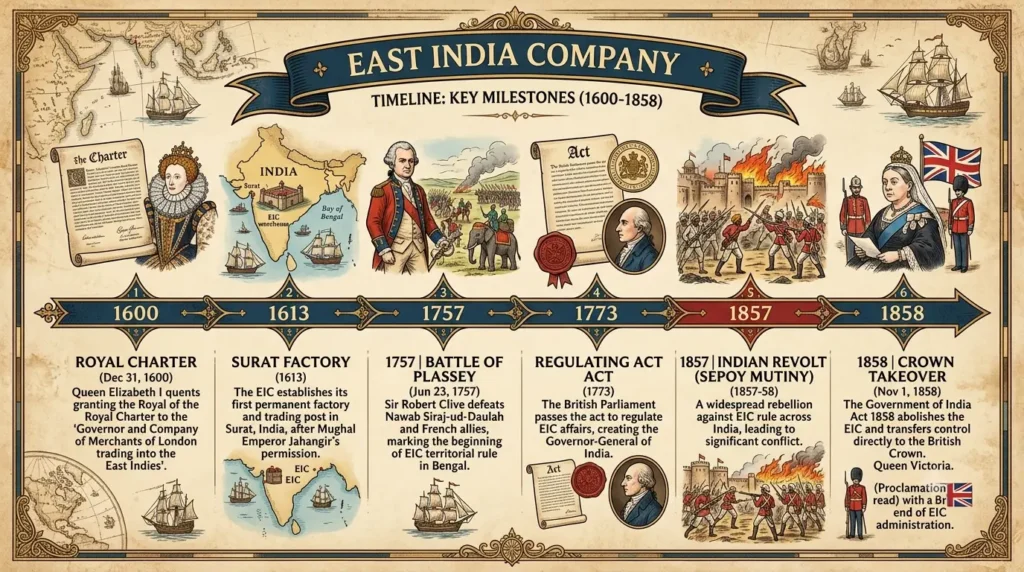
The East India Company (EIC) did not arrive in India as a colonial ruler — it arrived as a trading firm, and its transformation into the political master of the subcontinent unfolded over roughly two and a half centuries. Understanding this evolution is central to understanding how “colonial rule” as a constitutional category came into being.
1. Early Trade and First Footholds (1600–1700) Queen Elizabeth I granted the EIC a royal charter in 1600, giving it a monopoly over English trade with the East Indies. The Company set up trading posts — called “factories” — at Surat, Madras, and Calicut, and its focus at this stage was purely commercial: spices, textiles, and other goods.
2. Rivalry and Fortification (17th Century) Competition from the Dutch and Portuguese pushed the Company to fortify its trading posts. The construction of Fort St. George at Madras (now Chennai) marked an early shift from pure commerce toward armed protection of trade interests.
3. Military Ascendancy and Territorial Control (18th Century) The EIC gradually built its own army, largely composed of Indian soldiers (sepoys), and moved from trade to territorial control. The Battle of Plassey (1757), led by Robert Clive, was the turning point — it gave the Company control of Bengal, then one of the wealthiest provinces in India. The Company’s Indian holdings were organized into three presidencies: Bengal, Madras, and Bombay.
4. Dual Administration (18th Century) The EIC ran a “dual system” — separate wings for commercial and political functions — with the Governor-General of Bengal gradually emerging as the highest authority over the other presidencies.
5. Parliamentary Regulation (18th Century) Abuses and financial mismanagement led the British Parliament to step in through the Regulating Act of 1773 and Pitt’s India Act of 1784 (discussed in detail below). Warren Hastings became the first Governor-General of India (1774–1785) under this new framework.
6. Territorial Consolidation (18th–19th Century) Through wars, treaties, and the Doctrine of Lapse (annexing princely states that lacked a natural heir), the Company absorbed regions such as Oudh, Punjab, and the Carnatic.
7. The Revolt of 1857 and the End of Company Rule Grievances among sepoys and civilians erupted into the Indian Rebellion of 1857. In its aftermath, the British Crown took direct control of India via the Government of India Act of 1858, ending Company rule.
8. Legacy The EIC’s administrative apparatus — courts, revenue systems, and infrastructure like railways and telegraphs — became the institutional skeleton on which the later British Raj was built.
📌 For the broader ideological context of how this rule was justified, see Colonial State in India and Imperial Ideologies.
The Regulating Act of 1773 and Pitt’s India Act of 1784
These two acts were Parliament’s first serious attempts to bring the East India Company under British governmental oversight.
Regulating Act of 1773 — Background: Passed in response to the administrative and financial chaos in Bengal following the Battle of Plassey (1757), the Act addressed two core problems: the Company’s inefficient “dual system” of commercial and political administration, and rampant financial mismanagement.
Key Provisions:
- Created the office of Governor-General of Bengal (first held by Warren Hastings), with authority to superintend Madras and Bombay.
- Reduced the Governor-General’s Council to four members, with the Governor-General holding a casting vote.
- Established the Board of Control in London to supervise the Company’s affairs.
- Subjected the Company’s territorial revenues to British government oversight.
Pitt’s India Act of 1784 — Background: Named after Prime Minister William Pitt the Younger, this Act was a response to the continuing need for reform in Company governance.
Key Provisions:
- Reaffirmed the Governor-General-in-Council’s authority over subordinate presidencies.
- Strengthened the Board of Control (six members, including the Chancellor of the Exchequer).
- Provided for the Crown to appoint the Governors of Bombay and Madras on the Board’s recommendation.
- Introduced fixed terms for the Governor-General and Council members, and required regular financial reporting.
Impact: Together, these acts centralized power in British government hands, improved (on paper) the efficiency and accountability of Company administration, and laid the groundwork for the eventual transition to direct Crown rule after 1857.
The Charter Acts of 1813, 1833, and 1853
| Act | Trade Monopoly | Governance Change | Education/Social Provision |
|---|---|---|---|
| Charter Act of 1813 | Company’s monopoly renewed for 20 years, but trade with other countries eased | Charter simply renewed | ₹1 lakh set aside for education; missionaries permitted to operate in India |
| Charter Act of 1833 | Company’s trade monopoly ended (except tea and China trade) | Governor-General of Bengal became Governor-General of India; Legislative Council established | Bishops allowed to be appointed in India; further education funding |
| Charter Act of 1853 | — | Governor-General retitled Viceroy of India; Legislative Council expanded | Indian Civil Service (ICS) created with competitive exams; railway construction authorized |
These three acts, taken together, reflect a steady move from a trade-focused charter toward a full governance framework — and directly prepared the ground for Crown rule after 1858.
The Government of India Acts of 1858, 1909, 1919, and 1935
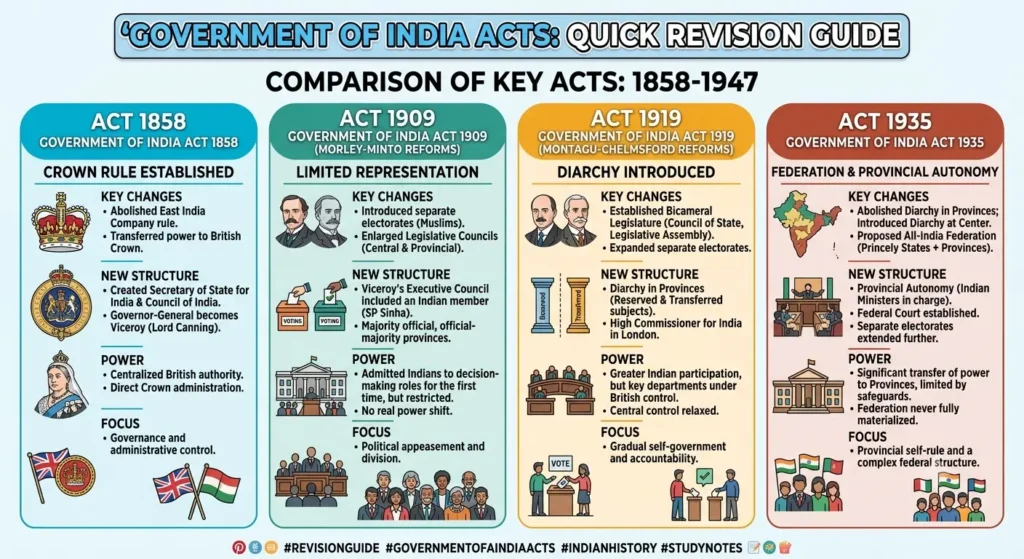
| Act | Trigger | Key Change |
|---|---|---|
| 1858 | Revolt of 1857 | Crown replaces Company rule; Secretary of State for India created; ICS formalized |
| 1909 (Morley-Minto Reforms) | Growing Indian demand for representation | Separate electorates for Muslims introduced; more elected Indian members in councils |
| 1919 (Montagu-Chelmsford Reforms) | Aftermath of World War I | Dyarchy introduced in provinces; franchise expanded; Central Legislative Assembly created |
| 1935 | Demand for greater autonomy | Federal structure proposed; provincial dyarchy abolished; provinces granted substantial autonomy |
The 1935 Act never came into full operation because of World War II, but its framework fed directly into the Indian Independence Act of 1947.
📌 These constitutional developments directly shaped the colonial state discussed in Colonial State in India and Imperial Ideologies — useful for cross-referencing Unit 2 with Unit 1.
🔗 External reference: Britannica — East India Company for a concise institutional history.
Colonial Ideology of the Civilizing Mission
The “civilizing mission” was the ideological scaffolding that justified British rule as something more than conquest — it was framed as a moral obligation to “improve” Indian society. Two groups drove this ideology from different directions: Utilitarians, who pushed for rational, codified, efficient governance, and Missionaries, who pushed for moral and religious transformation.
Core assumptions of the civilizing mission:
- Cultural superiority — the British saw their institutions as more advanced and their intervention as an “uplifting” duty.
- Religious justification — especially among missionaries, colonial rule was framed as a Christian obligation.
- Westernized education — English-medium schooling was meant to produce a class of Indian intermediaries loyal to colonial administration.
- Economic exploitation under moral cover — resource extraction was presented as “development.”
The Role of Utilitarians
Utilitarian philosophy — associated with Jeremy Bentham and pursued in India by James Mill and later Thomas Babington Macaulay — held that British rule should maximize the “greatest happiness for the greatest number.”
- Administrative reform: James Mill influenced the codification of Indian law along Western rational lines.
- Educational reform: Macaulay’s 1835 Minute on Indian Education argued for English-medium instruction over classical Indian languages, aiming to create “a class Indian in blood and colour, but English in taste, in opinions, in morals and intellect.”
- Economic policy: Utilitarians backed free trade and infrastructure (like railways) that, while framed as modernization, primarily served British commercial interests.
The Role of Missionaries
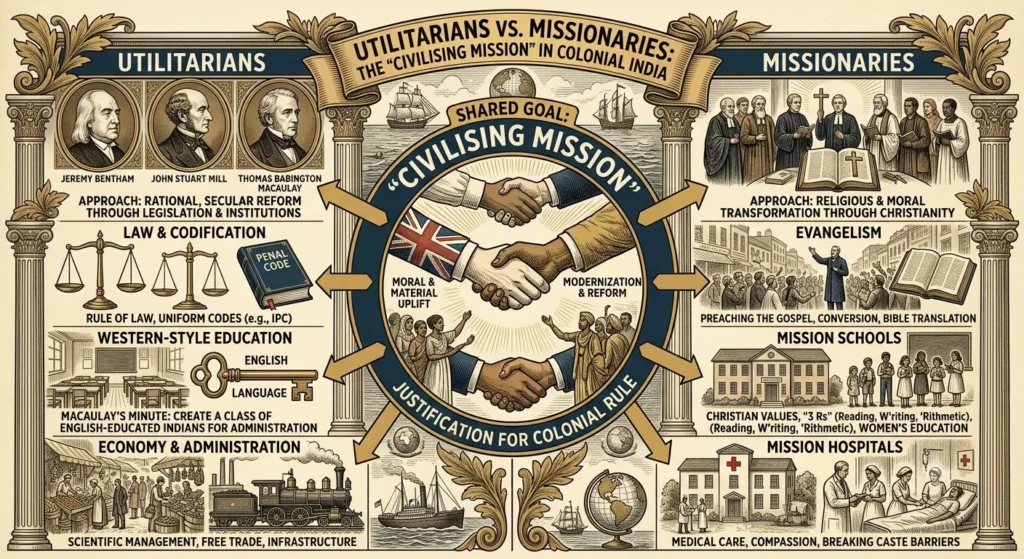
Missionaries approached the civilizing mission from a religious angle:
- Evangelism: They saw material and spiritual “upliftment” as inseparable goals.
- Institution-building: Missionary schools and hospitals spread across India, serving both social welfare and conversion purposes.
- Social critique: Missionaries campaigned against practices like sati and child marriage — a rare point of overlap with Utilitarian reform goals, most visibly in Lord William Bentinck’s 1829 abolition of sati.
Despite different motivations, Utilitarians and Missionaries frequently converged on education as the shared instrument of the civilizing mission — administrators wanted loyal clerks; missionaries wanted converts and moral reform.
Critique and Resistance to the Civilizing Mission
The civilizing mission did not go unchallenged. Resistance took several forms:
- Cultural backlash — indigenous communities upheld local customs, languages, and religious practice as acts of preservation.
- Nationalist rejection — leaders of the Indian National Congress, including Mahatma Gandhi and Jawaharlal Nehru, explicitly rejected the premise that Indian civilization needed Western “correction.”
- Intellectual synthesis — reformers like Raja Ram Mohan Roy and Rabindranath Tagore argued for combining Western scientific knowledge with Indian tradition, rather than wholesale replacement.
- Armed resistance — the Revolt of 1857 carried strong anti-civilizing-mission undertones, triggered partly by the cartridge controversy that was read as an attack on religious practice.
- Educational critique — critics argued English education alienated Indians from their own knowledge systems, fueling later movements for vernacular education.
📌 Read the fuller picture of organized resistance in Popular Resistance in the Period of Colonial India.
🔗 External reference: Wikipedia — Civilizing Mission for the comparative (French/British) framing of this concept.
Impact on Agriculture, Land Relations, Industry, and Ecology
Land Tenure and Revenue Systems
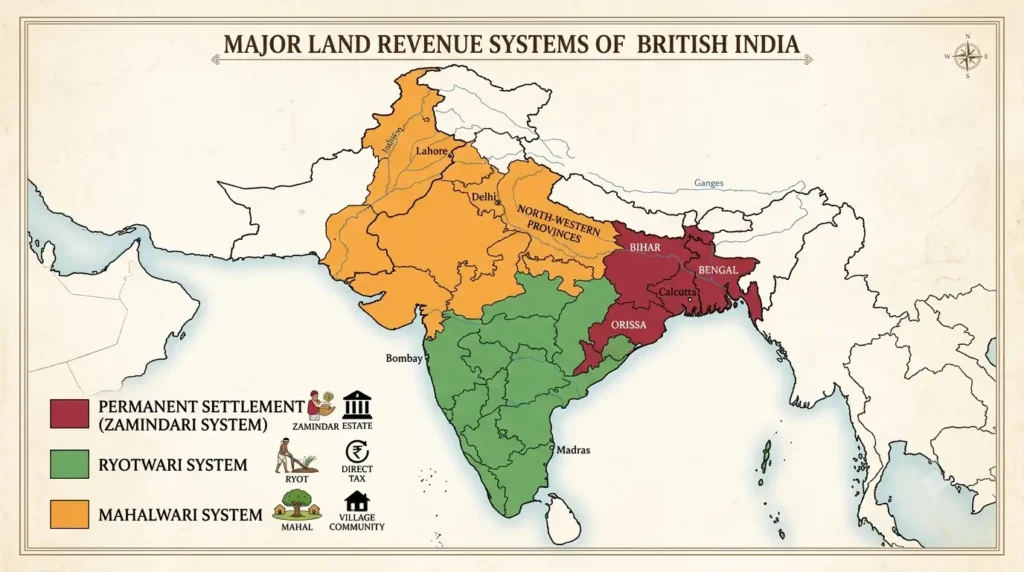
The British introduced three distinct revenue systems across India, each with different consequences for peasants and landholders.
| System | Region Introduced | Who Paid Revenue | Key Feature | Main Criticism |
|---|---|---|---|---|
| Permanent Settlement (1793) | Bengal, Bihar, Orissa (by Lord Cornwallis) | Zamindars (landlords) | Revenue fixed permanently — stability for landlords | Heavy, inflexible burden passed down to peasants |
| Ryotwari System | Madras & Bombay Presidencies | Individual peasants (ryots) directly | Revenue assessed per-plot based on land quality | Assessments often too high; no intermediary protection |
| Mahalwari System | North India (Punjab, North-Western Provinces, Oudh) | Village communities (mahals) | Headmen/lambardars collected revenue collectively | Collective liability created internal village pressure |
Consequences shared across all three systems:
- Encouraged commercialization of agriculture toward cash crops for the British market.
- Created new land-owning elites while increasing the vulnerability of small peasants.
- Left a legacy of land-ownership disparity that persisted well after 1947.
📌 For a deeper economic breakdown, see Introduction to Land Revenue Systems & Agricultural Commercialization.
Commercialization of Agriculture
British policy pushed Indian agriculture from subsistence farming toward export-oriented cash crop cultivation — indigo, opium, cotton, and jute.
- Market dependency: Farmers’ incomes became tied to volatile global commodity prices.
- New agrarian elites: A class of commercial farmers and intermediaries profited, altering rural social hierarchies.
- Monetization: Barter-based rural transactions gave way to cash transactions, integrating villages into a wider market economy.
- Environmental cost: Intensive single-crop cultivation (especially indigo) caused soil exhaustion.
- Peasant revolts: Exploitative cultivation contracts triggered uprisings such as the Indigo Revolt (1859–60) and the Deccan Riots (1875–77).
Deindustrialization and the Drain of Wealth
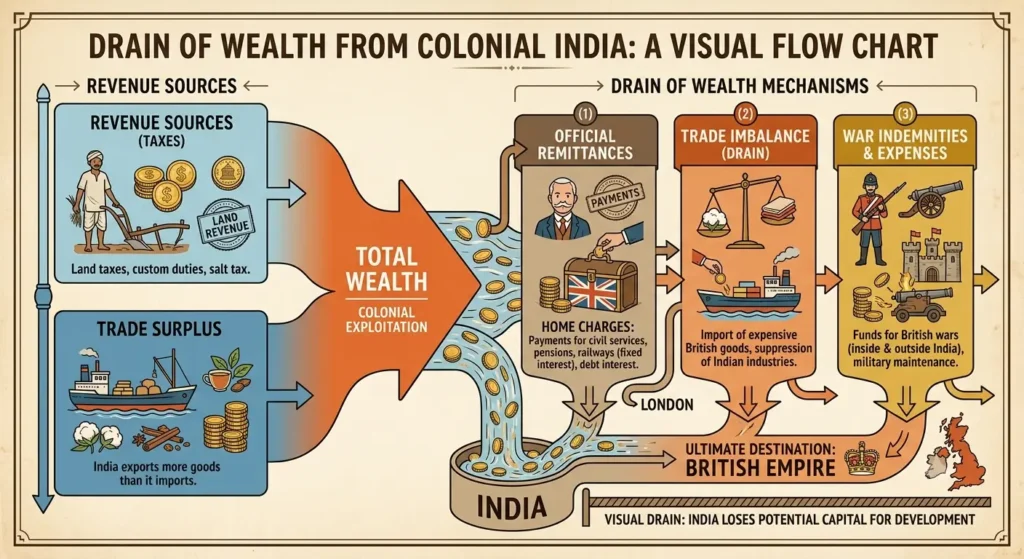
Two of the most economically significant — and most examined — consequences of colonial rule.
Deindustrialization:
- Tariff policy and the flood of cheap British manufactured goods undercut Indian handicrafts and cottage industries.
- India was pushed toward exporting raw materials (cotton, silk, indigo) and importing finished British goods — the classic colonial trade pattern.
- Railways, while marketed as modernization, were built primarily to move raw material to ports for export.
Drain of Wealth:
- Heavy land revenue and taxation extracted large surpluses from Indian peasants.
- Trade imbalances systematically favored Britain.
- Surplus Indian revenue was frequently invested in British industry rather than reinvested in India.
- Indemnity payments after wars, and high salaries/pensions for British officials, added to the outward flow of wealth.
Dadabhai Naoroji’s “Drain Theory”, along with critiques from Raja Ram Mohan Roy, gave this phenomenon its most influential intellectual articulation — and it remains central to postcolonial debates on reparations and economic history.
🔗 External reference: Dutt, R.C. — The Economic History of India under Early British Rule — foundational nationalist economic critique, useful for further reading.
Ecological Degradation and Famines
Ecological Degradation:
- Deforestation: Railway construction and commercial logging consumed vast timber reserves.
- Monoculture cash cropping: Reduced soil fertility and increased vulnerability to pests.
- Irrigation bias: Colonial irrigation projects were largely designed to support export crops, not sustainable local water management.
- Biodiversity loss: Habitat destruction and land-use change reduced species diversity.
Famines:
- Heavy taxation left peasants with little buffer against crop failure.
- The shift to cash crops displaced food-crop cultivation, worsening food insecurity during shortages.
- Colonial administrators often relied on market mechanisms rather than direct relief, worsening famine outcomes.
- Repeated famines led to Famine Inquiry Commissions and eventually Famine Codes, though their real-world effectiveness varied widely.
The combined ecological and economic strain of this period left rural India structurally vulnerable — a vulnerability that shaped policy debates well into the postcolonial era.
Top DU Exam Questions on This Unit
Based on the recurring pattern of DSC-3 (Colonialism and Nationalism in India) semester exams and internal assessments, these are the question types most frequently asked from Unit 2:
- Trace the evolution of the East India Company from a trading company to a political power in India.
- Discuss the significance of the Regulating Act of 1773 and Pitt’s India Act of 1784 in the constitutional history of colonial India.
- Critically examine the provisions and impact of the Charter Acts of 1813, 1833, and 1853.
- “The Government of India Act of 1919 was a limited experiment in self-government.” Discuss with reference to the concept of dyarchy.
- What was the “civilizing mission”? Analyze the roles of Utilitarians and Missionaries in shaping colonial ideology in India.
- Was British colonialism in India a “civilizing mission” or an economic exploitation project? Discuss critically.
- Compare and contrast the Permanent Settlement, Ryotwari, and Mahalwari systems of land revenue.
- Examine the process and consequences of deindustrialization in colonial India.
- Explain Dadabhai Naoroji’s “Drain of Wealth” theory with suitable examples.
- Discuss the ecological and social causes of famines in colonial India.
- Short note: Doctrine of Lapse.
- Short note: Macaulay’s Minute on Indian Education (1835).
FAQs
What was colonial rule in India and when did it take place?
Colonial rule in India began with the arrival of European trading powers from the 16th century onward and lasted until independence in 1947. The Portuguese were among the first to establish trading posts (Goa, Daman, and Diu), followed by the Dutch and French. The English East India Company, chartered in 1600, eventually became the dominant power, ruling directly until 1858, after which the British Crown took over until 1947.
Why is British rule in India called “colonial rule”?
It is called colonial rule because it involved the political, economic, and social control of India by a foreign power — Britain — through imposed administrative systems, economic exploitation, and legal structures, rather than through Indian self-governance.
What is the difference between the Permanent Settlement, Ryotwari, and Mahalwari systems?
The Permanent Settlement fixed revenue collection through zamindars in Bengal, Bihar, and Orissa. The Ryotwari system settled revenue directly with individual peasants in Madras and Bombay. The Mahalwari system settled revenue with village communities in North India. (See the comparison table above for full details.)
What was the “civilizing mission” in colonial ideology?
It was the ideological justification European powers used to legitimize colonial rule, framing it as a moral duty to “improve” colonized societies. In India, this was pursued through two overlapping strands — Utilitarian administrative and legal reform, and Missionary religious and educational activity.
What was Dadabhai Naoroji’s Drain Theory?
Naoroji’s Drain Theory argued that British colonial policies systematically transferred wealth out of India to Britain — through unequal trade, high taxation, remittances of British officials’ salaries, and reinvestment of Indian surplus into British industry — leaving India structurally impoverished.
How did colonial rule cause deindustrialization in India?
Colonial trade policy favored the export of raw materials from India and the import of finished British manufactured goods, undercutting Indian handicrafts and cottage industries that could not compete with cheaper factory-made British products.
Read next: Colonialism and Nationalism in India (Unit 1 overview) · Reform and Resistance for Freedom (Unit 3)
Official syllabus reference: DU DSC-3 Colonialism and Nationalism in India (PDF)
Subscribe to keep reading
You've used your free notes for now. Get Delhi Pathshala Premium for unlimited access.
Subscribe — ₹29/30 days