
Contents
- Part A: The 1857 War of Independence
- Background
- Causes of the Revolt
- Course of the Revolt
- Leaders and Storm Centres
- British Response and Repression
- Why the Revolt Failed
- Consequences of the Revolt
- Part B: Major Social and Religious Movements
- Comparison Table: Reformist vs Revivalist Movements
- Part C: Education and the Rise of the New Middle Class
- Impact on Indian Society and Politics
- Important DU Exam-Pattern Questions
- FAQs
- Internal Links
Unit 3 of DSC-3 covers three closely linked themes: the 1857 War of Independence, the major social and religious reform movements of the 19th century, and the rise of a new educated middle class under colonial rule. This note covers all three sections in an exam-ready format, with a comparison table of reform movements, DU-pattern practice questions, and FAQs.
Part A: The 1857 War of Independence
Background
The 1857 uprising — known variously as the Sepoy Mutiny, the Indian Rebellion of 1857, or the First War of Independence — was the most serious armed challenge to British rule before the 20th century. It did not erupt in isolation. Between 1757 (Battle of Plassey) and 1857, India saw a long chain of local revolts — peasant uprisings, tribal rebellions, and religious protests — against East India Company policy. By 1857, nearly every section of society — princes, sepoys, zamindars, peasants, artisans, and religious leaders — had a grievance against the Company. On 10 May 1857, sepoys at Meerut mutinied, marched to Delhi, and declared the aged Mughal emperor Bahadur Shah II their nominal leader, turning a military mutiny into a wider political revolt.
For the broader constitutional backdrop before 1857, see our notes on Colonial Rule in India and its Impact (DSC-3, Unit 2).
Causes of the Revolt
Rather than listing overlapping “causes and consequences” under each trigger separately, here is the complete picture organised by category:
1. Political Causes
- Doctrine of Lapse (Lord Dalhousie): annexation of princely states without a natural male heir — Satara, Jhansi, Nagpur, Awadh were absorbed, angering ruling elites.
- Annexation of Awadh (1856), done on grounds of “misgovernance,” was widely seen as a breach of trust.
- Denial of titles/pensions to Indian rulers, including refusal to recognise Bahadur Shah II’s successor.
2. Economic Causes
- Heavy land revenue under the Permanent Settlement and Ryotwari system impoverished peasants.
- Deindustrialisation: British trade policy destroyed Indian handloom and handicraft industries in favour of British manufactured goods.
- Peasants fell into debt traps with moneylenders, who emerged as the new landed class.
3. Military and Religious Causes
- Introduction of the Enfield rifle cartridges, rumoured to be greased with cow and pig fat, offended both Hindu and Muslim sepoys — the immediate trigger.
- Sepoys faced discrimination in pay, promotion, and the General Service Enlistment Act (1856), which required overseas service (loss of caste for Hindus).
- British interference in religious and social customs (missionary activity, social legislation) was viewed with suspicion.
4. Administrative Causes
- Corruption among junior officials and courts.
- British administration remained racially distant — “absentee sovereignty” in outlook, with little Indian participation in governance.
Course of the Revolt
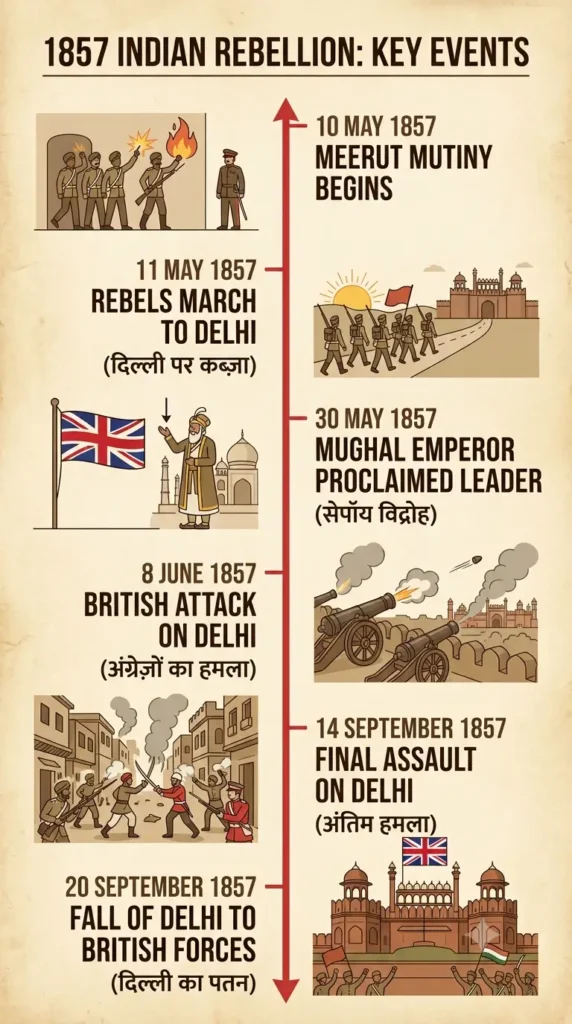
- 10 May 1857: Mutiny begins at Meerut; sepoys march to Delhi and proclaim Bahadur Shah II emperor.
- The revolt spreads across the upper Gangetic plain — Delhi, Kanpur, Lucknow, Jhansi, Bareilly, Gwalior, and Arrah (Bihar) become major centres.
- Civilians — peasants, artisans, zamindars, and religious mendicants — join sepoys, attacking moneylenders’ records, revenue offices, and courts, giving the revolt genuine popular character in these regions.
- British forces recapture Delhi on 20 September 1857, after prolonged siege warfare; Bahadur Shah II is captured and later exiled to Rangoon (1858), formally ending the Mughal dynasty.
- By the end of 1859, British control is restored, though guerrilla resistance under leaders like Tantia Tope continued into 1859.
Leaders and Storm Centres
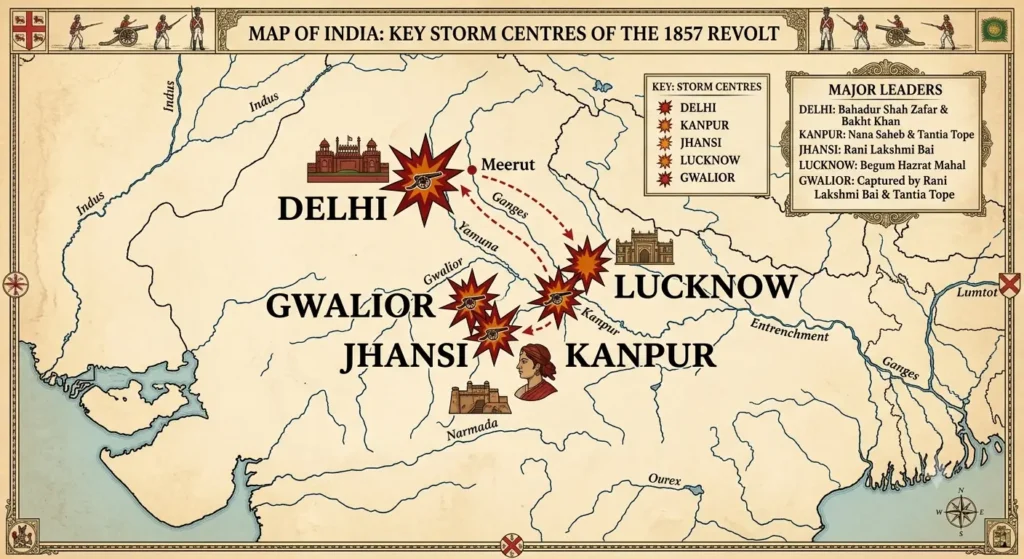
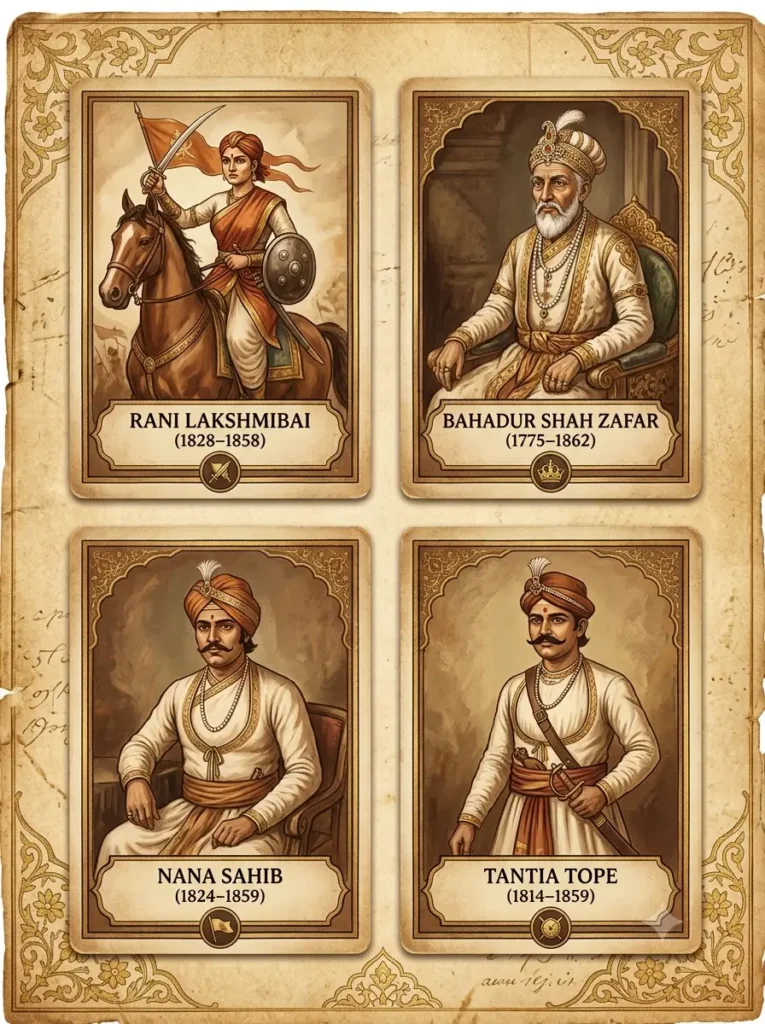
| Leader | Region/Centre | Role |
|---|---|---|
| Bahadur Shah II | Delhi | Symbolic emperor; rallying point for rebels |
| Nana Sahib | Kanpur | Led resistance after losing his pension claim |
| Tantia Tope | Kanpur/Gwalior | Military strategist; continued guerrilla resistance |
| Rani Lakshmibai | Jhansi | Fought British forces after denial of adoption rights; died in battle at Gwalior |
| Begum Hazrat Mahal | Lucknow (Awadh) | Led resistance after annexation of Awadh |
| Kunwar Singh | Bihar (Arrah) | Led anti-British forces in the eastern theatre |
| Maulvi Ahmadullah | Awadh | Religious and military leader |
| Mangal Pandey | Barrackpore | Early act of defiance (April 1857), symbolic catalyst |
British Response and Repression
- Martial law was declared in affected regions; suppression included mass executions, “blowing from cannon” as a deterrent punishment, and destruction of villages linked to rebellion (scorched-earth tactics).
- The Vernacular Press Act and Arms Act were later introduced to curb dissent and control the population.
- The British reorganised the army, increasing the ratio of European to Indian troops and adopting a “divide and rule” recruitment policy based on caste, region, and religion.
Why the Revolt Failed
- Limited geographical spread — southern, eastern, and western India remained largely unaffected.
- Lack of unified leadership and ideology — no shared political vision among rebel leaders.
- Educated Indians and large princes stayed away, seeing British rule as a path to modernisation rather than a threat.
- Military inferiority — poor weapons and no coordination versus a well-armed, telegraph-connected British force.
Consequences of the Revolt
1. Government of India Act, 1858
Ended East India Company rule; transferred governance directly to the British Crown. Created the post of Secretary of State for India and the India Council.
2. Queen Victoria’s Proclamation (1 November 1858)
Promised religious non-interference and equal treatment under law, formally inaugurating the British Raj.
3. Indian Councils Act, 1861
Expanded Legislative Councils and introduced limited, indirect, non-official representation — a modest first step, criticised by nationalists as inadequate.
4. Long-term political impact: the revolt planted the seeds of a shared anti-colonial consciousness, later channelled into organised nationalism through the Formation of the Indian National Congress in 1885, and eventually into mass movements led by leaders discussed in our note on Swaraj: Bal Gangadhar Tilak, Mohandas Karamchand Gandhi.
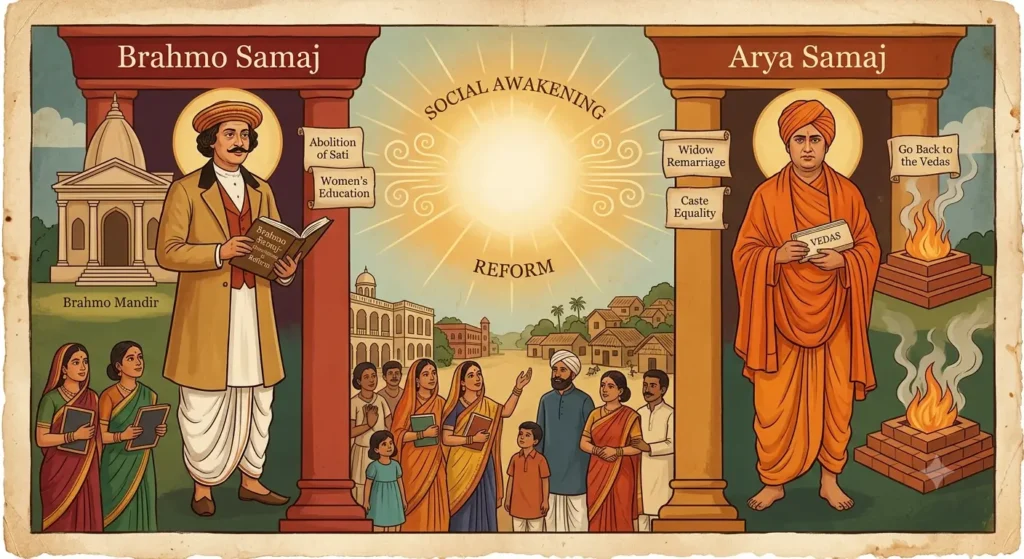
Part B: Major Social and Religious Movements
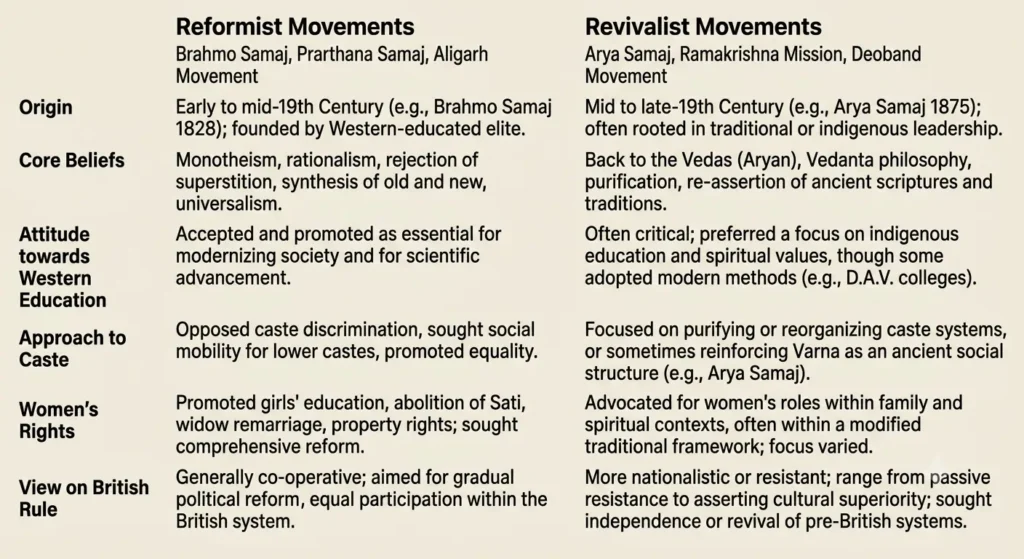
The 19th century saw a wave of reform and revivalist movements responding to colonial modernity, social evils, and religious orthodoxy. Broadly, they fall into two strands:
- Reformist movements (Brahmo Samaj, Satyashodhak Samaj, Self-Respect Movement) — sought to modernise society using reason and Western ideas of equality.
- Revivalist movements (Arya Samaj, Deoband, Singh Sabha) — sought to “purify” religion by returning to what they saw as original scriptural teachings.
Brahmo Samaj (1828) — Founded by Raja Ram Mohan Roy in Bengal. Rejected idol worship and polytheism, emphasised monotheism, and campaigned against Sati (abolished 1829), for widow remarriage, and women’s education.
Arya Samaj (1875) — Founded by Swami Dayananda Saraswati in Bombay. Advocated “Back to the Vedas,” opposed caste discrimination and idol worship, and promoted the Shuddhi movement and Vedic education.
Ramakrishna Mission (1897) — Founded by Swami Vivekananda, based on Vedanta philosophy; combined spiritual teaching with humanitarian service (education, healthcare, disaster relief).
Theosophical Society (1875, New York; HQ later Adyar, Chennai) — Founded by Helena Blavatsky and Henry Olcott; promoted comparative religion and universal brotherhood. Annie Besant later expanded its influence in India.
Aligarh Movement (1875) — Led by Sir Syed Ahmad Khan; founded the Mohammedan Anglo-Oriental College (later Aligarh Muslim University, 1920) to promote modern, scientific education among Muslims.
Deoband Movement (1867) — Founded at the Darul Uloom seminary in Deoband (UP); focused on reviving traditional Islamic scholarship along Hanafi jurisprudence, resisting Western cultural influence.
Sikh Reform Movement — Singh Sabha and Akali Movement — The Singh Sabha (from 1873) worked to rejuvenate Sikh teachings and counter missionary influence. Its later phase, the Akali Movement, led the Gurdwara Reform Movement, resulting in the Sikh Gurdwaras Act, 1925, which ended hereditary control of Gurdwaras by corrupt Mahants.
Dalit Movements
- Satyashodhak Samaj (1873) — Founded by Jyotirao Phule in Maharashtra; challenged caste hierarchy and Brahminical dominance, promoted education for lower castes and women.
- Self-Respect Movement — Led by E.V. Ramasamy (Periyar) in Tamil Nadu; challenged Brahminical dominance, later evolved into the Dravidar Kazhagam (1944), shaping Dravidian politics.
Comparison Table: Reformist vs Revivalist Movements
| Movement | Founder | Year | Type | Core Focus |
|---|---|---|---|---|
| Brahmo Samaj | Raja Ram Mohan Roy | 1828 | Reformist | Monotheism, anti-Sati, women’s education |
| Arya Samaj | Swami Dayananda Saraswati | 1875 | Revivalist | Vedic authority, anti-caste, Shuddhi |
| Ramakrishna Mission | Swami Vivekananda | 1897 | Reformist/Service-oriented | Vedanta, humanitarian service |
| Aligarh Movement | Sir Syed Ahmad Khan | 1875 | Reformist (Muslim community) | Modern/scientific education |
| Deoband Movement | Islamic scholars (Nanautawi et al.) | 1867 | Revivalist | Traditional Islamic scholarship |
| Singh Sabha/Akali Movement | Sikh reformers | 1873/1920s | Reformist–Political | Gurdwara reform, Sikh identity |
| Satyashodhak Samaj | Jyotirao Phule | 1873 | Reformist (anti-caste) | Caste equality, lower-caste education |
| Self-Respect Movement | E.V. Ramasamy (Periyar) | 1925 | Reformist–Political | Anti-Brahminism, Dravidian identity |
Part C: Education and the Rise of the New Middle Class
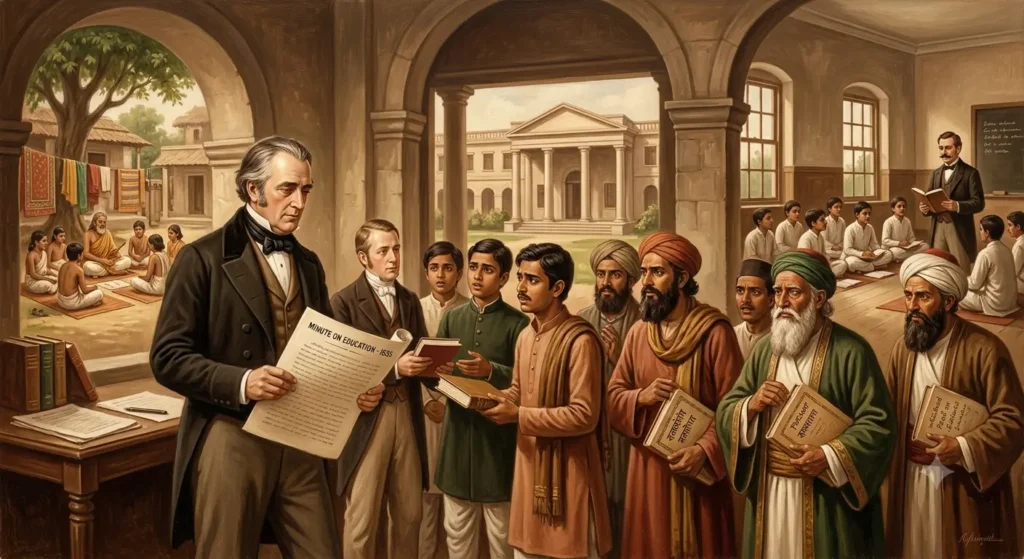
Macaulay’s Minute (1835) — Thomas Babington Macaulay argued for English as the medium of instruction, aiming to create, in his words, a class “Indian in blood and colour, but English in taste, in opinions, in morals, and in intellect.” This is famously known as the Downward Filtration Theory — educate a small elite in English, who would then pass on knowledge downward.
Wood’s Despatch (1854) — Often called the “Magna Carta of English education in India,” it recommended a structured education system from primary to university level, use of vernacular languages alongside English, and government-aided schools in every district — leading to the founding of the Universities of Calcutta, Bombay, and Madras (1857).
Growth of vernacular press and education — Missionaries and reform societies established vernacular-medium schools; a vibrant regional-language press emerged post-1857, shaping public opinion and nationalist sentiment.
Emergence of the new middle class — Colonial administration, law, journalism, and modern professions (lawyers, doctors, teachers) created a new English-educated middle class — mostly upper-caste, moderately privileged, but distinct from hereditary landed aristocracy. This class went on to lead early nationalist organisations, including the Indian National Congress.
Impact on Indian Society and Politics
- Rise of communalism: British “divide and rule,” separate electorates, and post-revolt collective punishment deepened Hindu-Muslim distinctions that had been far less rigid during the 1857 uprising itself.
- Social stratification: new landed and professional elites emerged, often through loyalty to the Crown, altering traditional hierarchies.
- Shift toward organised, ideological resistance: from a fragmented armed rebellion in 1857 to organised constitutional politics (INC, 1885) and eventually mass nonviolent movements under Gandhi.
Important DU Exam-Pattern Questions
- Discuss the causes and consequences of the Revolt of 1857. Was it a “sepoy mutiny” or the “First War of Independence”? (Long answer, 10 marks)
- Examine the role of social and religious reform movements in shaping modern Indian society. (10 marks)
- Differentiate between reformist and revivalist movements with suitable examples. (5 marks)
- Critically analyse Macaulay’s Minute on Education and its long-term impact on Indian society. (10 marks)
- “The 1857 Revolt failed due to lack of unity and a coherent political ideology.” Comment. (5 marks)
- Write short notes on: (a) Brahmo Samaj (b) Arya Samaj (c) Aligarh Movement (2.5 marks each)
- How did the new middle class emerge under colonial rule, and what role did it play in the nationalist movement? (10 marks)
- Discuss the significance of the Government of India Act, 1858 and Queen Victoria’s Proclamation. (5 marks)
FAQs
What was the immediate cause of the Revolt of 1857?
The introduction of Enfield rifle cartridges rumoured to be greased with cow and pig fat, which offended religious sentiments of both Hindu and Muslim sepoys, was the immediate spark — though deeper political, economic, and administrative grievances had been building for decades.
Why is the 1857 Revolt also called the “First War of Independence”?
Some historians, including V.D. Savarkar, argue it represented a broad-based, coordinated challenge to British rule involving sepoys, peasants, and rulers alike. Others describe it as a limited “sepoy mutiny” since it lacked all-India participation and a unified nationalist ideology.
What is the difference between reformist and revivalist movements?
Reformist movements (like Brahmo Samaj) used reason and Western liberal ideas to modernise religion and society. Revivalist movements (like Arya Samaj) sought to “purify” religion by returning to what they considered original scriptural authority, often rejecting Western influence.
What was the Downward Filtration Theory?
Proposed by Macaulay, it held that English education given to a small upper-class elite would gradually “filter down” knowledge and modern ideas to the masses — a theory later criticised for creating an elite disconnected from ordinary Indians.
How did the 1857 Revolt affect British policy in India?
It led directly to the end of East India Company rule via the Government of India Act, 1858, the transfer of power to the British Crown, and Queen Victoria’s Proclamation promising religious non-interference — while also prompting more repressive control mechanisms like the Vernacular Press Act.
Internal Links
Subscribe to keep reading
You've used your free notes for now. Get Delhi Pathshala Premium for unlimited access.
Subscribe — ₹29/30 days