ईंटें, मनके तथा अस्थियाँ (हड़प्पा सभ्यता) | Bricks Beads and Bones — Class 12 History Notes in Hindi (2026-27)
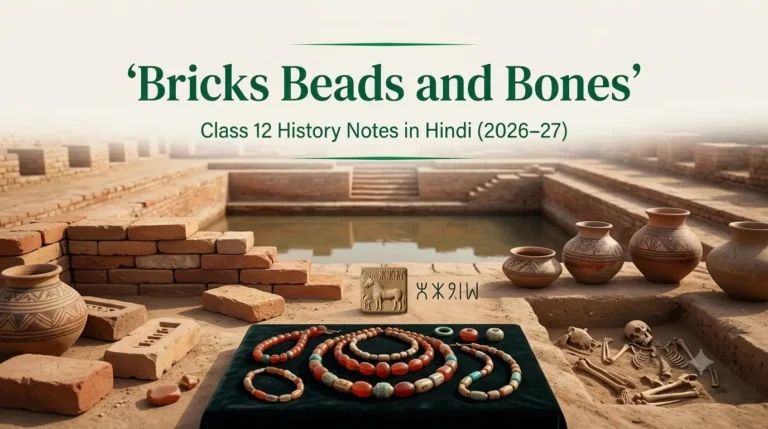
In this post, notes of 12th Class History Lesson – 1 Bricks Beads and Bones are given. These …

 Sawan Chauhan
In this post, notes of 12th Class History Lesson – 1 Bricks Beads and Bones are given. These …
In this post, notes of Unit 2 (Kalidasa’s Shakuntala (Abhijnana Shakuntalam)) from DSC – 1 (Indian Classical Literature) are given which is helpful for the students doing graduation this year.
In this post, notes of Unit 1 (Vyasa. Selections from The Mahabharata) from DSC – 3 (Indian Classical Literature) are given which is helpful for the students doing graduation this year.
In this post, notes of Unit 3 (Reading Drama – Mahesh Dattani: “Tara”) from DSC – 1 (Introduction to Literary Studies) are given which is helpful for the students doing graduation this year.
In this post, notes of Unit 2 (Reading Poetry – John Milton: ‘On his Blindness’) from DSC – …
DSC – 1 Introduction to Literary Studies Unit – 1: Reading Noval (Part – 1) Pride and Prejudice …
The Economics of Slavery: South vs. North The origins and development of slavery in the USA The origins …
Manifest Destiny Manifest Destiny: a concept and a slogan Manifest Destiny was a 19th-century belief that the expansion …
Marginalization and Displacement of Indigenous Tribes (Shawnee and Cherokee) Indigenous tribes: a conceptual category Indigenous tribes, such as …
Contribution of Indigenous Tribes, Indentured Servants, and Slave Labor in the Growth and Expansion of American Colonies: A …