
Contents
- How this unit maps to the DU syllabus
- Hindi–English key terms for quick revision (शब्दावली)
- A. Philosophy of the Constitution, the Preamble, and Features of the Constitution
- Introduction to the Indian Constitution
- History of Constitutional Development in India
- Effect of Colonial Rule on Constitutional Ideas
- From the Demand for Swaraj to the Constitution
- The Constituent Assembly of India
- Meaning of “Constituent Assembly” (संविधान सभा)
- Formation and Composition
- How the Assembly Worked: Stages of Constitution-Making
- Committees and Their Roles
- Objectives and Vision of the Assembly
- Key Debates and Discussions
- Was the Constituent Assembly Representative? A Scholarly Debate
- Philosophy of the Constitution
- Sources of the Indian Constitution
- Is the Indian Constitution a “Borrowed” Constitution? A Debate
- Core Philosophical Tenets
- Reflections of Gandhian, Nehruvian and Ambedkarite Ideas
- The Preamble of the Constitution
- Reading the Preamble
- Importance and Legal Status
- Meaning of Sovereign, Socialist, Secular, Democratic Republic
- Goals: Justice, Liberty, Equality and Fraternity
- Key Features of the Indian Constitution
- 1. Lengthy and Detailed Document
- 2. Balance of Rigidity and Flexibility
- 3. Federal System with Unitary Bias
- 4. Parliamentary Government
- 5. Secular State
- 6. Independent Judiciary
- 7. Universal Adult Franchise and Single Citizenship
- 8. Fundamental Rights and Duties
- 9. Directive Principles of State Policy
- 10. Emergency Provisions
- 11. Local Self-Government
- 12. Written Constitution and Supremacy
- The Basic Structure Doctrine
- Origin and Evolution
- Key Judgments: Kesavananda Bharati Case
- Components of the Basic Structure
- Implications for Constitutional Amendments
- Key Cases that Expanded the Basic Structure Doctrine
- Comparing the Indian Constitution with Other Constitutions
- Indian Constitution vs. Other Constitutions
- Adaptations and Innovations of the Indian Constitution
- Lessons from Other Democracies
- B. Citizenship, Fundamental Rights, Directive Principles, and Fundamental Duties
- Citizenship
- Constitutional Rules (Articles 5-11)
- The Citizenship Act, 1955
- Changes and Current Issues
- Debate on Dual Citizenship
- Rights and Responsibilities of Citizens
- Fundamental Rights (Part III)
- General Overview
- Right to Equality (Articles 14-18)
- Right to Freedom (Articles 19-22)
- Right Against Exploitation (Articles 23-24)
- Right to Freedom of Religion (Articles 25-28)
- Cultural and Educational Rights (Articles 29-30)
- Right to Constitutional Remedies (Article 32)
- Limitations and Reasonable Restrictions
- Landmark Cases and Judicial Interpretations
- Directive Principles of State Policy (Part IV)
- Concept and Importance
- Types of Directive Principles
- Main Points of DPSPs
- Relationship with Fundamental Rights
- Challenges in Implementation
- Judicial Role
- Fundamental Duties (Part IV-A)
- Introduction and Background
- List of Fundamental Duties (Article 51A)
- Significance and Relevance
- Enforceability and Legal Provisions
- Criticism and Suggestions for Improvement
- Connection Between Fundamental Rights, Directive Principles, and Fundamental Duties
- Working Together
- Court Decisions
- Role in Government
- Modern Relevance
- Current Issues and Discussions
- Citizenship Issues
- Rights vs. Duties
- Changing Nature of Fundamental Rights
- Directive Principles in Policy Making
- Conclusion
- Quick revision table
- Continue Reading
- University of Delhi Previous Year Questions
- FAQs
- Sources and Further Reading
In this post, you will find notes on Unit 1: The Constituent Assembly and the Constitution from DSC 9: Constitutional Government and Democracy in India, prepared for University of Delhi BA (Hons.) Political Science students. The unit has two halves, and these notes follow the same split: (a) the philosophy of the Constitution, the Preamble and the features of the Constitution, and (b) citizenship, Fundamental Rights, Directive Principles and Fundamental Duties.
The way to read this unit is to keep one question in mind: why does the Constitution look the way it does? The answer lies in the people who wrote it, the arguments they had, and the history they were reacting to. The Constitution was adopted on 26 November 1949 and came into force on 26 January 1950. Between those two dates and the Assembly’s first sitting on 9 December 1946 lies a story of compromise, disagreement and constitutional design that DU examiners expect you to narrate with names, dates and debates, not just with a list of features.
How this unit maps to the DU syllabus
| Syllabus item (DSC 9, Unit I) | Where it is covered below |
|---|---|
| Constituent Assembly: background, composition, debates | Section A → The Constituent Assembly of India |
| Philosophy of the Constitution | Section A → Philosophy of the Constitution |
| The Preamble | Section A → The Preamble of the Constitution |
| Features of the Constitution (including basic structure and comparisons) | Section A → Key Features, The Basic Structure Doctrine, Comparing the Indian Constitution with Other Constitutions |
| Citizenship (Part II) | Section B → Citizenship |
| Fundamental Rights (Part III) | Section B → Fundamental Rights |
| Directive Principles (Part IV) | Section B → Directive Principles of State Policy |
| Fundamental Duties (Part IV-A) | Section B → Fundamental Duties |
The official syllabus lists Granville Austin’s chapter on the Assembly, Rajeev Bhargava’s introduction to Politics and Ethics of the Indian Constitution, S.K. Chaube, Arun Thiruvengadam and Bipan Chandra’s India After Independence as core readings for part (a). These notes are meant to be read alongside them, not instead of them. A full reading list is given at the end.
Hindi–English key terms for quick revision (शब्दावली)
| English | हिन्दी | English | हिन्दी |
|---|---|---|---|
| Constituent Assembly | संविधान सभा | Fundamental Rights | मौलिक अधिकार |
| Drafting Committee | प्रारूप समिति | Directive Principles of State Policy | राज्य के नीति निदेशक तत्त्व |
| Objectives Resolution | उद्देश्य प्रस्ताव | Fundamental Duties | मौलिक कर्तव्य |
| Preamble | प्रस्तावना | Basic Structure | मूल ढाँचा |
| Citizenship | नागरिकता | Amendment | संशोधन |
A. Philosophy of the Constitution, the Preamble, and Features of the Constitution
Introduction to the Indian Constitution
The Indian Constitution is the longest written national constitution in the world and one of the most detailed. It reflects the social, political and cultural complexity of India. It was adopted on 26 November 1949 and came into force on 26 January 1950, when India became a democratic republic. (Some provisions, such as those on citizenship, elections, the provisional Parliament and transitional matters, took effect at once on 26 November 1949 under Article 394; the rest began on 26 January 1950.)
Why 26 January? On 26 January 1930 the Indian National Congress had observed “Independence Day” after its Lahore session declared Purna Swaraj (complete independence) in December 1929. The framers chose the same date for the Constitution’s commencement as a tribute to that pledge. A good exam answer mentions this, because it shows that the Constitution was seen as the fulfilment of the freedom struggle and not just as a legal document.
History of Constitutional Development in India
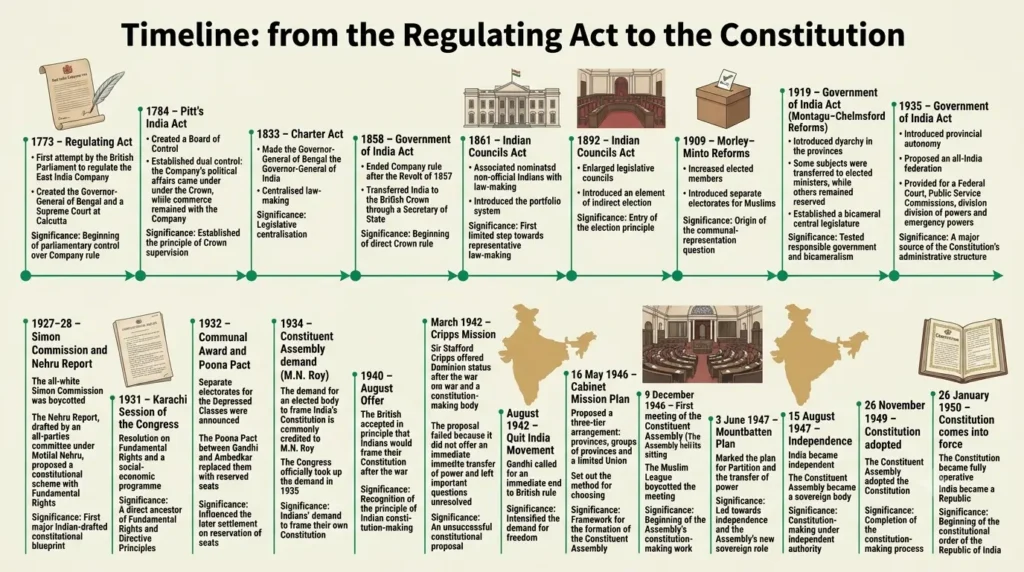
Many of the Constitution’s institutions can be traced to British-era laws. You do not need to memorise every Act, but you should know what each added and why the framers kept, changed or rejected it.
| Year | Act / Event | What it did | Why it matters for the Constitution |
|---|---|---|---|
| 1773 | Regulating Act | First attempt by the British Parliament to regulate the East India Company; created the Governor-General of Bengal and a Supreme Court at Calcutta. | Beginning of parliamentary control over Company rule. |
| 1784 | Pitt’s India Act | Created a Board of Control, so the Company’s political affairs came under the Crown while commerce stayed with the Company (“dual control”). | Established the principle of the Crown’s supervision. |
| 1833 | Charter Act | Made the Governor-General of Bengal the Governor-General of India; centralised law-making. | Legislative centralisation, a precursor of a unified legal system. |
| 1858 | Government of India Act | Ended Company rule after the 1857 revolt; India passed to the Crown through a Secretary of State. | Start of direct Crown rule. |
| 1861 | Indian Councils Act | Associated non-official Indians, nominated by the Viceroy, with law-making; introduced the portfolio system. | First, limited step towards representative law-making. |
| 1892 | Indian Councils Act | Enlarged councils and introduced an element of indirect election. | Entry of the election principle. |
| 1909 | Morley–Minto Reforms | Increased elected members; introduced separate electorates for Muslims. | Origin of the communal-representation question that the Assembly later had to settle. |
| 1919 | Government of India Act (Montagu–Chelmsford Reforms) | Dyarchy in the provinces (some subjects transferred to elected ministers, others reserved); a bicameral central legislature. | Tested responsible government and bicameralism. |
| 1927–28 | Simon Commission and the Nehru Report | All-white Simon Commission boycotted; the Nehru Report (1928) drafted by an all-parties committee under Motilal Nehru proposed a constitutional scheme with fundamental rights. | The first major Indian-drafted constitutional blueprint; the Nehru Report is listed among the “classics” in the DU syllabus. |
| 1931 | Karachi Session of the Congress | Resolution on Fundamental Rights and a social-economic programme. | A direct ancestor of Part III and Part IV. |
| 1932 | Communal Award and Poona Pact | Separate electorates for the Depressed Classes were announced, then replaced by reserved seats through the Poona Pact between Gandhi and Ambedkar. | Shapes the later settlement on reservation of seats. |
| 1935 | Government of India Act | Provincial autonomy, a proposed all-India federation, a Federal Court, Public Service Commissions, an elaborate division of powers and emergency powers. | The longest and most detailed pre-independence Act; a large part of the Constitution’s administrative structure follows it. |
Note on the 1935 Act. Scholars disagree about how much of the Constitution comes from it. Ivor Jennings, whose Some Characteristics of the Indian Constitution (1953) is on the DU reading list for the related GE paper, stressed its debt to the 1935 Act. Others, notably Granville Austin, argue that the framers used the Act’s administrative scaffolding but built a new democratic and social purpose on top of it. We return to this under Is the Indian Constitution a “borrowed” constitution?
Effect of Colonial Rule on Constitutional Ideas
Colonial rule shaped Indian constitutional thought in two opposite ways. On the one hand, British institutions such as the parliamentary system, the rule of law and a common legal framework gave Indians a vocabulary of rights and representation. On the other, the experience of arbitrary colonial power, press restrictions, preventive detention and communal electorates made nationalists wary of unchecked executive power and determined to write down rights.
The Indian National Congress (INC), founded in 1885, began by petitioning for greater representation and moved, over decades, towards self-rule. Leaders such as Mahatma Gandhi, Jawaharlal Nehru, Subhas Chandra Bose and B.R. Ambedkar, each in a different way, argued that political freedom had to be accompanied by social change. This is a thread you should carry through the whole unit: the Constitution aims at national unity, democracy and social transformation together. For more on the colonial background, see our notes on colonial rule in India and its impact.
From the Demand for Swaraj to the Constitution
The route from Swaraj to a written Constitution was neither straight nor peaceful. The main stages were:
- Swaraj as the national goal. Gandhi’s Hind Swaraj (1909) gave the word its moral meaning of self-rule. The Congress adopted attainment of Swaraj by legitimate and peaceful means as its objective at its Nagpur session in 1920, and declared Purna Swaraj at Lahore in December 1929.
- The idea of a Constituent Assembly. The demand that Indians should frame their own constitution through an elected body is commonly credited to M.N. Roy (1934); the Congress took it up officially in 1935. Some accounts trace an earlier demand to the Swaraj Party in the mid-1920s, so a careful answer says “the demand was articulated from the 1920s and 1930s and is commonly credited to M.N. Roy in 1934”.
- The August Offer (1940). The British accepted in principle that Indians would frame their constitution after the war.
- The Cripps Mission (March 1942). Sir Stafford Cripps offered Dominion status after the war and a constitution-making body. It failed because it did not offer immediate transfer of power and left the princely states and the question of provincial “non-accession” unresolved.
- The Quit India Movement (August 1942). Gandhi’s call for an immediate end to British rule made it clear that nothing short of freedom would be accepted.
- The Cabinet Mission (1946). Three British Cabinet ministers visited India. Their plan of 16 May 1946 rejected a fully sovereign Pakistan, proposed a three-tier arrangement (provinces, groups of provinces and a limited Union), and set out how a Constituent Assembly would be chosen. The Muslim League first accepted the plan, then withdrew its acceptance in July 1946, and the Assembly met without it.
- Partition and Independence (1947). After the Mountbatten Plan of 3 June 1947 and the Indian Independence Act, India became independent on 15 August 1947, and the Assembly became a sovereign body.
- Adoption and enforcement. The Constitution was adopted on 26 November 1949 and came into force on 26 January 1950.
This journey shows a move from colonial subjecthood to citizenship, from petitions to a constitution that begins with “We, the people of India”.
The Constituent Assembly of India
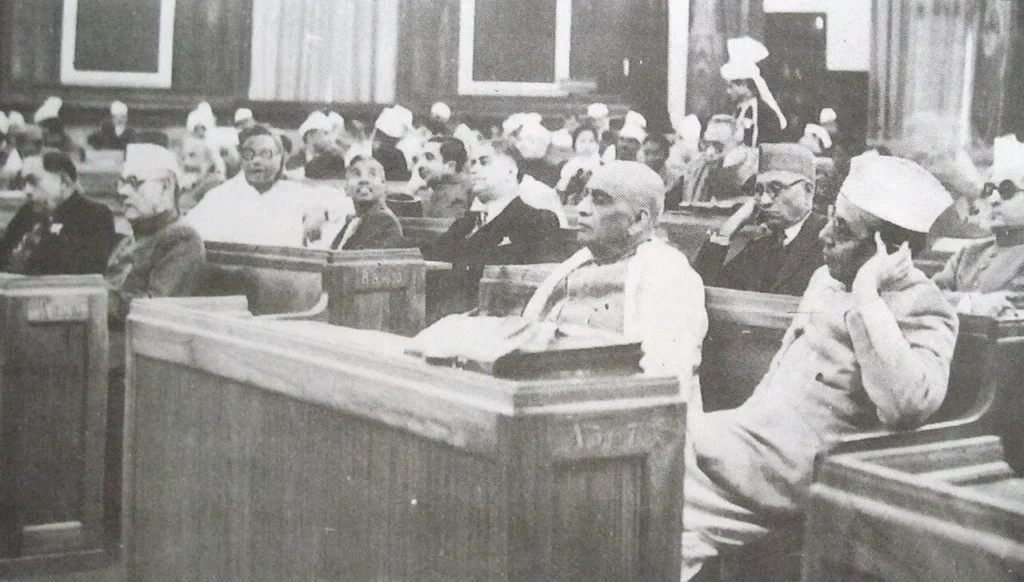
The Constituent Assembly was the body that gave India its democratic structure. Its task was to frame a constitution for a newly independent, deeply unequal and diverse society, and to do so while Partition violence was under way. It sat for about two years, eleven months and eighteen days, in eleven sessions spread over 165 days, before adopting the Constitution.
Meaning of “Constituent Assembly” (संविधान सभा)
A constituent assembly is a representative body whose special job is to frame or adopt a constitution, as distinct from an ordinary legislature that makes laws under an existing constitution. In Hindi it is called संविधान सभा. (The word “constituent” on its own can also mean a voter in a constituency, निर्वाचक, or a component part, घटक, but in this paper it always refers to the body that framed the Constitution.)
Formation and Composition
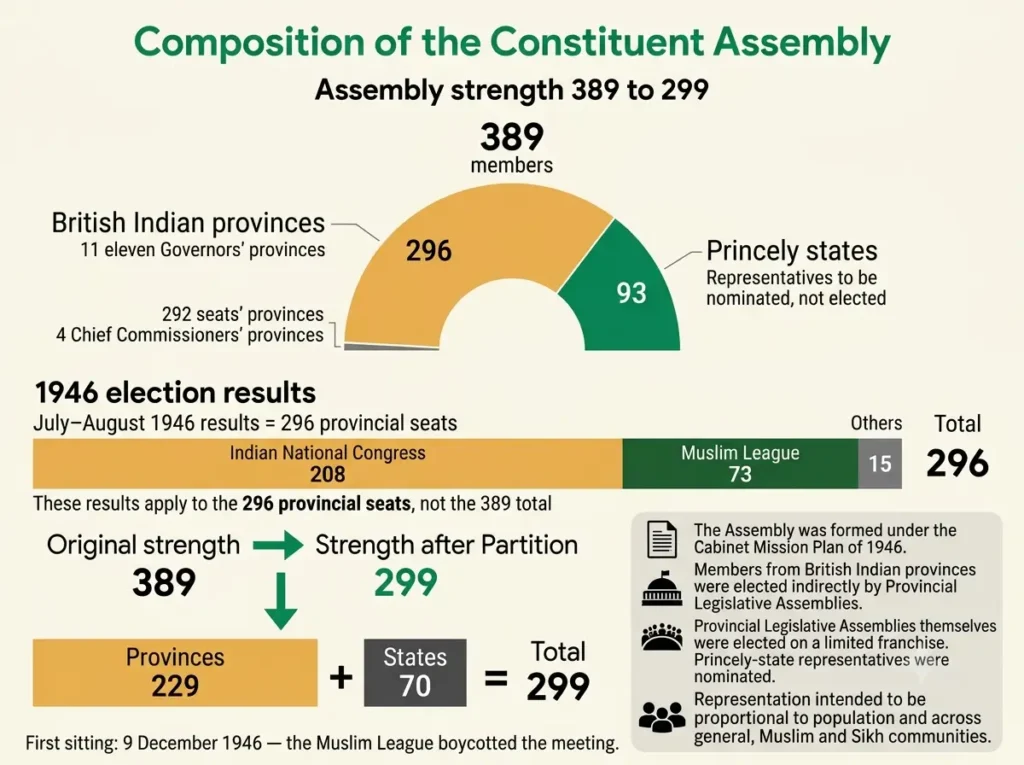
How the Assembly was formed. The Constituent Assembly was set up under the Cabinet Mission Plan of 1946. Its members were not elected directly by the people. They were chosen indirectly by the members of the Provincial Legislative Assemblies (themselves elected on a limited franchise), while representatives of the princely states were to be nominated.
| Feature | Detail |
|---|---|
| Original strength | 389 members |
| British Indian provinces | 296 seats (292 from the eleven Governors’ provinces and 4 from Chief Commissioners’ provinces) |
| Princely states | 93 seats (nominated, not elected) |
| Elections to the 296 seats | July–August 1946 |
| Result | Congress 208, Muslim League 73, others 15 |
| First sitting | 9 December 1946 (the Muslim League boycotted it) |
| Temporary chairman | Dr Sachchidananda Sinha |
| President | Dr Rajendra Prasad (elected 11 December 1946) |
| Constitutional Adviser | Sir B.N. Rau |
| Strength after Partition | 299 members (229 from the provinces and 70 from the states) |
Representation was meant to be proportional to population and across communities (general, Muslim and Sikh). Its members included Jawaharlal Nehru, Sardar Vallabhbhai Patel, B.R. Ambedkar, Rajendra Prasad, Maulana Abul Kalam Azad, K.M. Munshi, Alladi Krishnaswami Ayyar, N. Gopalaswami Ayyangar, Sarojini Naidu, Hansa Mehta, Durgabai Deshmukh, Jaipal Singh Munda and Frank Anthony, among others. Fifteen women are commonly cited as members. Notice that the Assembly’s character changed after August 1947: it was now both the body framing the Constitution and, under the same roof, the country’s interim legislature.
How the Assembly Worked: Stages of Constitution-Making
- Objectives and Procedure (Dec 1946–1947). The Objectives Resolution (13 December 1946) set the direction; committees on rules and on Union, provincial and fundamental-rights questions were formed.
- Advice and drafting (1947–Feb 1948). The Constitutional Adviser B.N. Rau prepared an initial draft in October 1947. The Drafting Committee (constituted on 29 August 1947) examined it and published a revised draft in February 1948.
- Public discussion (Feb–Oct 1948). The draft was circulated to provincial governments, legislators and others for comment.
- Debates on the draft (4 November 1948–17 October 1949). Ambedkar introduced the Draft Constitution on 4 November 1948. It was then discussed clause by clause.
- Third reading and adoption (14–26 November 1949). The Constitution was passed on 26 November 1949 and signed by members on 24 January 1950, after which the Assembly became the Provisional Parliament until the first general elections of 1951–52.
Committees and Their Roles
The Assembly worked through a number of committees, many of them chaired by Nehru, Patel or Rajendra Prasad. The ones you should know are:
| Committee | Chair | Role |
|---|---|---|
| Drafting Committee (29 Aug 1947) | B.R. Ambedkar | Examined B.N. Rau’s draft and prepared the Draft Constitution; seven members originally. |
| Rules of Procedure Committee | Rajendra Prasad | Framed the Assembly’s rules of working. |
| Steering Committee | Rajendra Prasad | Organised the Assembly’s business. |
| Union Powers Committee | Jawaharlal Nehru | Examined the division of powers at the Union level. |
| Union Constitution Committee | Jawaharlal Nehru | Framed principles for the Union’s structure. |
| Provincial Constitution Committee | Vallabhbhai Patel | Drew up the model for provincial governments. |
| Advisory Committee on Fundamental Rights, Minorities and Tribal and Excluded Areas | Vallabhbhai Patel | Worked through sub-committees (Fundamental Rights, chaired by J.B. Kripalani; Minorities, chaired by H.C. Mukherjee; and others). |
| States Committee | Jawaharlal Nehru | Negotiated the entry of princely states. |
Drafting Committee members: B.R. Ambedkar (chairman), N. Gopalaswami Ayyangar, Alladi Krishnaswami Ayyar, K.M. Munshi, Syed Mohammad Saadulla, and B.L. Mitter (replaced later by N. Madhava Rau) and D.P. Khaitan (replaced later by T.T. Krishnamachari).
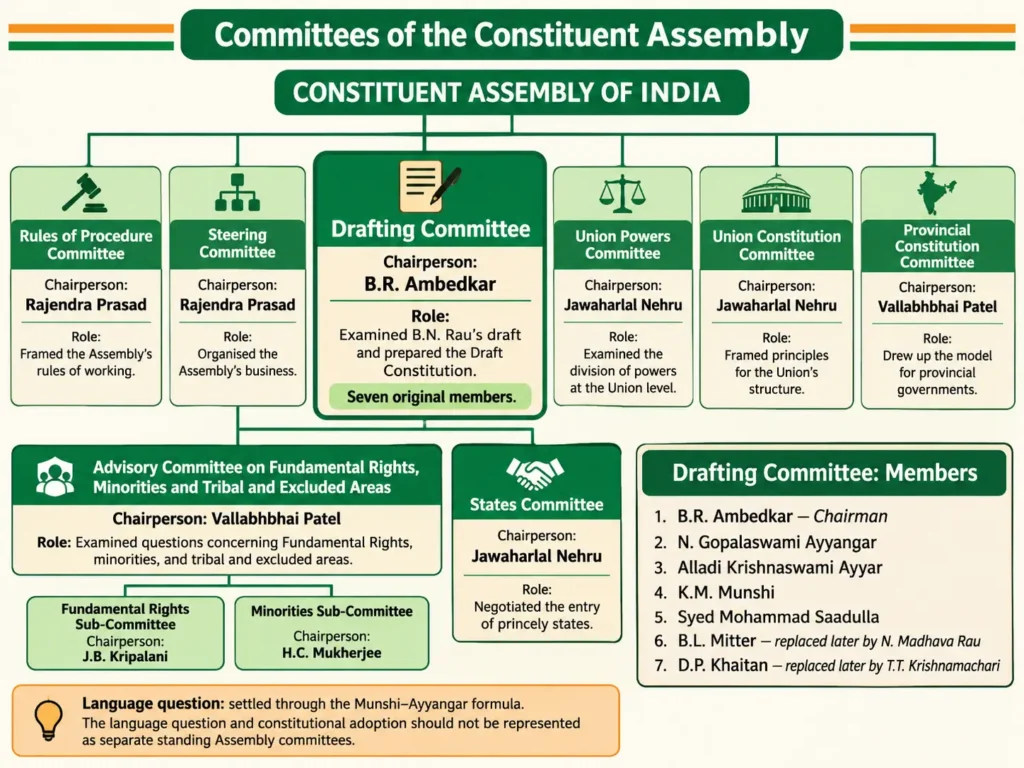
Correction to a common error: many notes list a separate “Language Committee” and “Adoption Committee” as Assembly committees. Neither was a standing committee of the Assembly. The language question was settled through negotiation, in the Munshi–Ayyangar formula, and the Constitution was adopted by the Assembly as a whole on 26 November 1949.
Objectives and Vision of the Assembly
The Assembly’s vision was set by Nehru’s Objectives Resolution, moved on 13 December 1946 and adopted on 22 January 1947. It declared India an independent sovereign republic, a Union of states with autonomous units, with all power derived from the people, and promised social, economic and political justice, equality, freedom and safeguards for minorities, backward and tribal areas and depressed classes. Much of its language reappears in the Preamble.
The main goals can be summarised as follows:
- Democratic Republic: a state with elected representatives and universal adult franchise, regardless of sex, caste or religion.
- Secular State: a state that treats all religions equally.
- Protection of Rights: guarantees of equality and freedoms against the state.
- Social Justice: special attention to Dalits, tribal communities and women.
- Welfare State: a commitment to education, health and employment.
The framers were guided by justice, liberty, equality and fraternity, but they also knew that these were distant goals in a society divided by caste and poverty. This tension is central to Ambedkar’s closing speech in the Assembly (25 November 1949), discussed below.
Key Debates and Discussions
The Assembly’s strength was that it argued openly, and the Constituent Assembly Debates (CAD) run to twelve volumes. The DU course asks you to understand how consensus was reached on contested questions. The main debates were:
1. Federalism and a strong Centre
- Should India be a loose federation, as the Cabinet Mission had implied, or a strong union? Partition, the violence of 1947 and the integration of over five hundred princely states strengthened the case for a strong Centre.
- The result is that India is described in Article 1 as a “Union of States” with a strong Centre, a Concurrent List, emergency powers and a single citizenship. Ambedkar explained that the Constitution was federal in structure but not a compact among states that could secede.
2. Language and cultural integration
- The question was which language should be the official language. Some members wanted Hindi or Hindustani; others from non-Hindi regions feared domination.
- The compromise, often called the Munshi–Ayyangar formula, made Hindi in the Devanagari script the official language of the Union, with English to continue for fifteen years for official purposes (Articles 343–351). Austin calls this a “half-hearted compromise” in his chapter on language, which is on the DU reading list for the related DSE.
- The Eighth Schedule originally listed 14 languages. It now lists 22, following later amendments.
3. Minority rights and political representation
- The Assembly’s Advisory Committee on minorities concluded in 1949 that separate electorates should be abandoned. The Assembly accepted reserved seats in legislatures for Scheduled Castes and Scheduled Tribes (and, initially, for Anglo-Indians) instead of separate electorates.
- This is the opposite of the claim sometimes made in notes that “separate electorates were created for SCs and STs”. Separate electorates were the colonial arrangement (1909, 1932); the Constitution replaced them with joint electorates and reserved seats.
- Religious freedom and minority educational rights (Articles 25–30) were agreed after long argument, including a debate on whether the right to “propagate” religion should be included.
4. Fundamental Rights and the right to property
- The framers disagreed about whether property should be a Fundamental Right, given the plan for zamindari abolition. The compromise text of Article 31 led to repeated amendments and finally to the removal of the right to property from Part III by the 44th Amendment (1978); it is now a constitutional right under Article 300A.
5. Personal liberty and preventive detention
- Draft Article 15-A (now Article 22) became one of the most contested debates. Members were uneasy about permitting preventive detention in peacetime. The DU DSE reading list points to the Assembly debates of 15–16 September 1949 on this question.
6. Uniform Civil Code and personal laws
- The debate on what became Article 44 (a Directive Principle on the Uniform Civil Code) took place on 23 November 1948. Members from minority communities opposed compulsion; the compromise was to place it among Directive Principles, not Fundamental Rights.
7. Village republics and the Gandhian critique
- Gandhi’s followers argued that the draft ignored village self-government. A DU “classic” reading, Shriman Narayan’s Gandhian Constitution for Free India (1946, with a foreword by Gandhi), set out a village-based alternative. The result was a compromise: Article 40 (organising village panchayats) was placed among the Directive Principles, and panchayats received constitutional status only through the 73rd Amendment (1992).
8. Universal adult franchise
- The Assembly accepted universal adult franchise without a literacy or property test, a bold decision in a largely illiterate society. The voting age was originally 21 and was reduced to 18 by the 61st Amendment (1988).
The Assembly worked hard to balance interests to create a document that most of its members could accept.
Was the Constituent Assembly Representative? A Scholarly Debate
Whether the Assembly truly represented India is a favourite exam question. Present it as a debate, not as settled fact.
| View | Argument | Associated with |
|---|---|---|
| Critical | The members were chosen indirectly by provincial legislatures elected on a limited franchise, not by universal adult suffrage; the Congress held about 69% of the seats and the Assembly was dominated by lawyers and by upper-caste, male members; the Muslim League boycotted it; princely-state members were nominated. | Frequently made in critical writing on the Assembly; Austin himself records the Congress’s dominance. |
| Defending | The Congress was a broad coalition; the Assembly included members who disagreed with it (Ambedkar from outside the Congress mainstream, representatives of tribal groups and of minorities); decisions were reached by long deliberation and accommodation rather than by majority fiat. | Granville Austin, who in The Indian Constitution: Cornerstone of a Nation describes the Assembly as a “microcosm” in which the country’s argument was conducted. |
| Procedural | Its authority did not come from a vote of the people on the final text, and the Constitution was never put to a referendum; yet it has been accepted and sustained for over seven decades. | Common point in legal and political theory discussions of constitutional legitimacy. |
A good answer concludes that while the Assembly was far from a perfect mirror of Indian society, its debates were open, members could and did dissent, and the final document was widely accepted.
Takeaway for revision: The Assembly was formed under the Cabinet Mission Plan, met first on 9 December 1946, had 389 members that fell to 299 after Partition, worked through committees with Ambedkar’s Drafting Committee at the centre, and took decisions through accommodation of competing interests.
Philosophy of the Constitution
The Indian Constitution rests on the ideas of democracy, social justice and secularism. Its philosophy is best understood as an attempt to combine liberal-democratic institutions with a commitment to transforming a hierarchical society. Granville Austin describes three strands of this aim: protecting national unity and integrity, establishing the institutions of democratic government, and fostering a social revolution that would bring the benefits of freedom to the common person. He calls them a “seamless web”, because the framers saw them as interdependent and not as competing goals. Rajeev Bhargava’s introduction to Politics and Ethics of the Indian Constitution (a DU essential reading) approaches the same question from political theory, treating the Constitution as an expression of a public, shared political morality and not just a set of legal rules.
Sources of the Indian Constitution
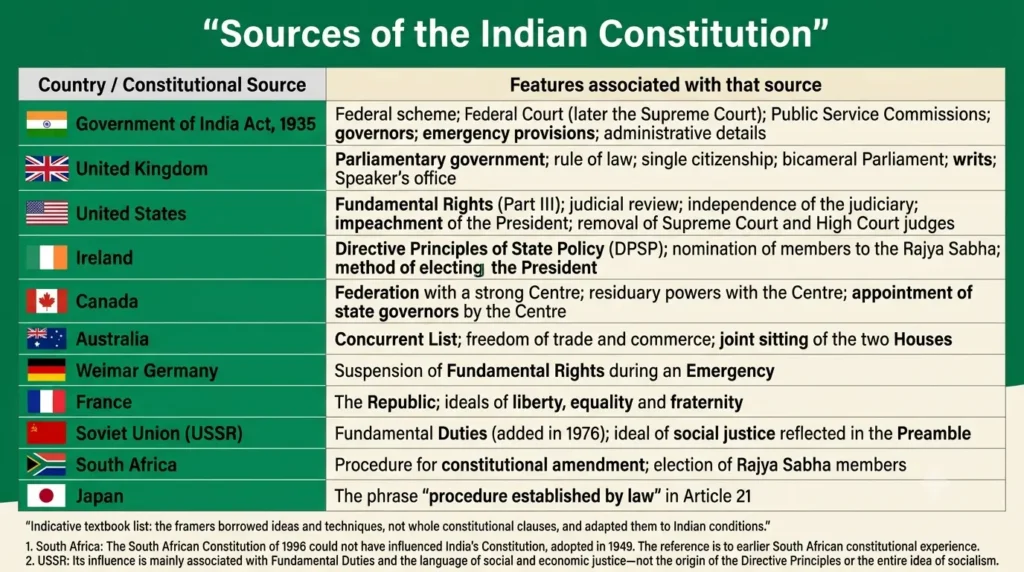
The Constitution draws on many sources and combines them with local experience. The usual textbook list of foreign influences is useful for revision, but it is best treated as indicative, because the framers borrowed ideas and techniques, not whole clauses, and adapted them heavily.
| Source | What is commonly said to have been drawn from it |
|---|---|
| Government of India Act, 1935 | Federal scheme, Federal Court (later the Supreme Court), Public Service Commissions, governors, emergency provisions, administrative details |
| United Kingdom | Parliamentary government, rule of law, single citizenship, bicameral Parliament, the writs, Speaker’s office |
| United States | Fundamental Rights (Part III), judicial review, independence of the judiciary, impeachment of the President, removal of Supreme Court and High Court judges |
| Ireland | Directive Principles of State Policy, nomination of members to the Rajya Sabha, method of electing the President |
| Canada | A federation with a strong Centre, residuary powers with the Centre, appointment of state governors by the Centre |
| Australia | Concurrent List, freedom of trade and commerce, joint sitting of the two Houses |
| Weimar Germany | Suspension of Fundamental Rights during an Emergency |
| France | The Republic and the ideals of liberty, equality and fraternity |
| Soviet Union (USSR) | Fundamental Duties (added in 1976) and the ideal of social justice that appears in the Preamble |
| South Africa | Procedure for constitutional amendment and election of Rajya Sabha members (as listed in standard textbooks) |
| Japan | The phrase “procedure established by law” in Article 21 |
Two corrections to commonly repeated claims. First, the South African Constitution of 1996 cannot have influenced a Constitution adopted in 1949, so any such influence refers to earlier South African constitutional experience. Second, the USSR did not supply the Directive Principles or the whole idea of socialism; its influence is mainly traced in the Fundamental Duties and the language of social and economic justice. Notes that say the Soviet Constitution “influenced India’s welfare state” are overstating the case.
Indigenous ideas and traditions. Alongside foreign models, Indian thinkers drew on local traditions:
- Gandhian ideals of non-violence, truth, decentralisation and “welfare of all” (sarvodaya) influenced the Directive Principles, especially village panchayats, cottage industries and prohibition.
- Bhakti and Sufi traditions are often cited as sources of a culture of coexistence that supports Indian secularism, though this is an interpretation and not a documented drafting influence.
- Ancient texts and the dharmashastra tradition. Some textbooks claim that the Manusmriti shaped the Constitution. This is contested and should be handled carefully. Ambedkar was a lifelong critic of the Manusmriti, and the Constitution’s commitment to equality is better understood as a break from caste hierarchy, not an inheritance from it. A safe formulation is: the Constitution draws on a range of Indian political ideas about duty, justice and kingship, but its core commitments to equality and individual rights are modern and in part directed against traditional hierarchies. The related DU GE page on basic features and sources lists the traditional-text sources in more detail.
Is the Indian Constitution a “Borrowed” Constitution? A Debate
One of the oldest criticisms is that the Constitution is a patchwork of borrowings. You should present both sides:
- The critics’ view. Ivor Jennings, in Some Characteristics of the Indian Constitution (1953), emphasised how closely the document follows the Government of India Act, 1935, and other critics in the Assembly itself complained that it was too Western and too far from Gandhian ideas of village self-government.
- The defence. B.R. Ambedkar replied in the Assembly (4 November 1948) that borrowing is no cause for shame, since the basic ideas of a constitution are common to all, and what matters is how provisions are adapted to local conditions. Austin argues that the framers worked as innovators: they used comparative models selectively and shaped them to India’s needs, as in the Directive Principles, the combination of enforceable rights with non-enforceable social goals, reservations and the unusual emergency provisions.
- The balanced conclusion. The Constitution borrowed techniques but created an unusual combination: parliamentary democracy plus federalism with a strong Centre, civil liberties plus social-revolutionary goals, and judicial review plus parliamentary amendment.
Core Philosophical Tenets
1. Justice: Social, Economic and Political
- Social justice aims to dismantle hierarchies, especially caste, through measures such as abolition of untouchability (Article 17) and reservations in education, jobs and legislatures.
- Economic justice is pursued mainly through the Directive Principles, which direct the State to reduce inequalities and secure livelihood for all.
- Political justice means equal political rights, including the right to vote and contest elections.
2. Liberty, Equality and Fraternity
The Preamble’s triad was drawn from the French revolutionary motto, but Ambedkar read it differently. In his Assembly speech he said the three should be seen as a union and not separately, because equality without liberty would stifle individual initiative, and liberty without equality would create the dominance of the few. He added that without fraternity, liberty and equality could not become a natural course of things.
- Liberty is protected by Fundamental Rights, subject to reasonable restrictions.
- Equality is protected by Articles 14–18 and by affirmative action.
- Fraternity, in the Preamble’s words, assures the dignity of the individual and the unity and integrity of the Nation.
3. Secularism and Socialism
- Secularism in India does not mean the strict separation of religion and state found in the United States or France. Rajeev Bhargava describes Indian secularism as based on “principled distance”: the state may engage with religion, for example by reforming practices that violate equality (as with temple entry and untouchability), but must not favour any one religion.
- Socialism here is not state ownership of everything. The word was added to the Preamble only by the 42nd Amendment (1976), but the commitment to reduce inequality appears in the original Directive Principles (Articles 38 and 39).
4. Constitutional morality and social democracy (Ambedkar’s closing speech)
On 25 November 1949, the day before the Constitution was adopted, Ambedkar gave a speech that every DU student should know. He raised three warnings: that Indians must hold to constitutional methods of agitation (what he called the “grammar of anarchy”) now that constitutional means were open; that they must not indulge in hero-worship in politics, since devotion may be a road to salvation in religion but in politics leads to dictatorship; and that political democracy could not last unless it rested on social democracy, a way of life that recognises liberty, equality and fraternity as principles of life. He also described the contradiction of entering a life in which there would be equality in politics (one person, one vote) and inequality in social and economic life (one person, one value). The speech is in the Constituent Assembly Debates, Volume XI, and the DU DSE reading list cites it.
Reflections of Gandhian, Nehruvian and Ambedkarite Ideas
| Strand | Core ideas | Where it appears in the Constitution |
|---|---|---|
| Gandhian | Decentralisation, village self-government, moral politics, non-violence, cottage industry, prohibition | Article 40 (panchayats), Article 43 (cottage industries), Article 47 (prohibition), Article 48 (cow protection and animal husbandry) and, later, the 73rd Amendment |
| Nehruvian | Modernity, scientific temper, planning, secularism, industrial growth, democratic socialism | Preamble’s secular and socialist language, Article 51A(h) on scientific temper, the Directive Principles on social and economic justice, universal adult franchise |
| Ambedkarite | Annihilation of caste, social democracy, constitutional morality, equality and rights as a remedy for hierarchy | Articles 14–17, Article 32, reservations, safeguards for Scheduled Castes and Tribes, emphasis on fraternity |
Note: the Constitution neither adopted the Gandhian village-republic model nor the Nehruvian-socialist model in full. It is a compromise among several visions, which is why it includes both individual rights and directive principles.
Takeaway for revision: the philosophy of the Constitution is a synthesis. It combines borrowed liberal institutions, Indian social-reform traditions and a commitment to social revolution, held together by the framers’ emphasis on constitutional methods and fraternity.
The Preamble of the Constitution
The Preamble is the Constitution’s opening statement. It introduces the document, names its source of authority (“We, the people of India”), states its ideals, and gives the date of adoption.
Reading the Preamble
The text, as amended by the 42nd Amendment (1976), reads:
WE, THE PEOPLE OF INDIA, having solemnly resolved to constitute India into a SOVEREIGN SOCIALIST SECULAR DEMOCRATIC REPUBLIC and to secure to all its citizens:
JUSTICE, social, economic and political;
LIBERTY of thought, expression, belief, faith and worship;
EQUALITY of status and of opportunity;
and to promote among them all
FRATERNITY assuring the dignity of the individual and the unity and integrity of the Nation;
IN OUR CONSTITUENT ASSEMBLY this twenty-sixth day of November, 1949, do HEREBY ADOPT, ENACT AND GIVE TO OURSELVES THIS CONSTITUTION.
Two points are often gotten wrong in student answers. The ideal is fraternity, not “brotherhood” as some notes translate it, and the phrase is “the unity and integrity of the Nation”, where “integrity” was added in 1976. Before 1976 the Preamble described India as a “Sovereign Democratic Republic”.
Hindi text (official): संपूर्ण प्रभुत्व-संपन्न समाजवादी पंथनिरपेक्ष लोकतंत्रात्मक गणराज्य; न्याय, स्वतंत्रता, समता और बंधुता।
Importance and Legal Status
The Preamble helps interpret the Constitution, but it is not directly enforceable in court. Whether it forms part of the Constitution has been decided in stages:
| Case | Year | Position |
|---|---|---|
| In re Berubari Union | 1960 | The Preamble is a key to the minds of the framers but not a part of the Constitution and not a source of power. |
| Kesavananda Bharati v. State of Kerala | 1973 | The Preamble is a part of the Constitution and can be amended under Article 368, but its basic features cannot be destroyed. |
| S.R. Bommai v. Union of India | 1994 | Secularism, reflected in the Preamble, is part of the basic structure. |
| LIC of India v. Consumer Education and Research Centre | 1995 | The Preamble is an integral part of the Constitution. |
Corrections to commonly repeated claims. Some notes state that the Preamble “cannot be changed”. In fact, it has been amended once, by the 42nd Amendment (1976), which added the words “Socialist”, “Secular” and “integrity”. Under Kesavananda, it can be amended so long as the basic structure is not destroyed. Another common error is citing Union of India v. Naveen Jindal (2004) as a Preamble case; that case concerned the right to fly the national flag, and the Preamble’s status is better cited through Berubari, Kesavananda and the LIC case. Likewise, Minerva Mills (1980) is usually cited for the principle that Parliament’s amending power is limited and that harmony between Parts III and IV is part of the basic structure; it is not a “Preamble case” as such.
Meaning of Sovereign, Socialist, Secular, Democratic Republic
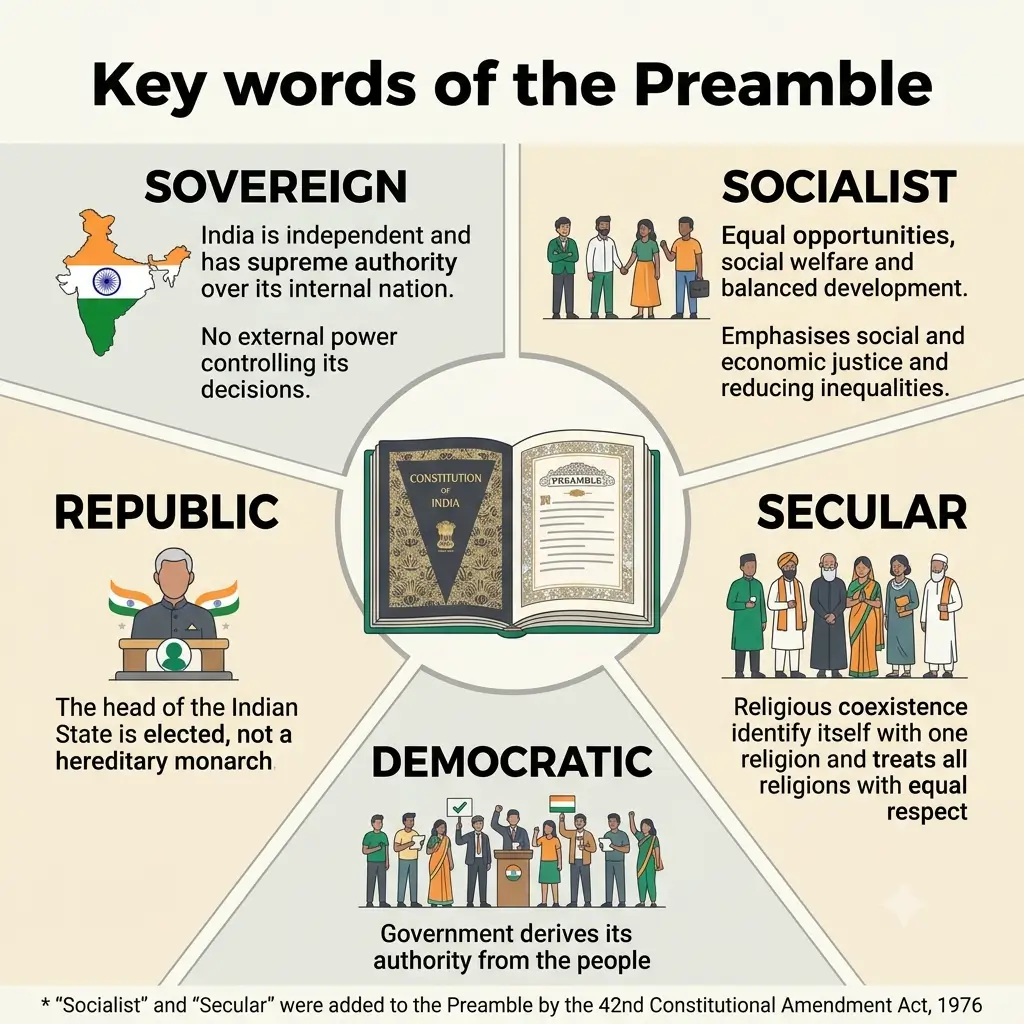
- Sovereign: India is independent of external control and has supreme authority within its territory. The phrase “We, the people” signals that political sovereignty rests with the people.
- Socialist: added in 1976. It signals a commitment to reducing inequalities of income and status and a welfare orientation, reflected in the Directive Principles. The Supreme Court has read it flexibly and not as a mandate for any single economic system.
- Secular: also added in 1976, although secularism was already present in Articles 14–16 and 25–28 and was held to be part of the basic structure in Bommai. The State has no official religion and treats all religions with equal respect.
- Democratic: government is based on popular consent, with periodic free and fair elections, accountability and political freedoms.
- Republic: the head of state is elected, not hereditary. India’s President is elected indirectly by an electoral college.
Goals: Justice, Liberty, Equality and Fraternity
| Goal | Preamble wording | Constitutional expression (examples) |
|---|---|---|
| Justice | social, economic and political | Articles 15–17, 23–24, 38–39, reservation provisions, Article 326 |
| Liberty | thought, expression, belief, faith and worship | Articles 19, 21, 25–28 |
| Equality | of status and of opportunity | Articles 14–18 |
| Fraternity | dignity of the individual; unity and integrity of the Nation | Article 17, Article 51A(e), provisions on single citizenship |
Takeaway: the Preamble states the Constitution’s aims and the “mood” in which its provisions should be read. It is not itself a source of rights, but it guides interpretation.
Key Features of the Indian Constitution
The Indian Constitution was adopted on 26 November 1949 and came into force on 26 January 1950. (Some notes say it was “adopted on 26 January 1950”, which is the date of commencement, not adoption.) It is long, detailed and carefully balanced. Its key features are given below, and the related GE notes on basic features of the Indian Constitution give a shorter parallel overview.
1. Lengthy and Detailed Document
The Indian Constitution is the longest written national constitution in the world. The original text had 395 articles in 22 Parts and 8 Schedules. After many amendments, standard sources now describe it as having about 448 articles in 25 Parts and 12 Schedules (and 106 amendments up to the Constitution (106th Amendment) Act, 2023, the Nari Shakti Vandan Adhiniyam; check for later amendments before exams).
Why so detailed?
- Diversity: India’s many languages, religions, castes and regions needed explicit accommodation.
- Wide coverage: the Constitution includes administrative details, such as citizenship, official language, services, elections and emergency provisions, that other countries leave to ordinary law.
- Inheritance of the 1935 Act: the 1935 Act was already detailed, and the framers carried much of its administrative structure forward.
- Need for stability after independence: an explicit, detailed text was seen as a safeguard against uncertainty and conflict.
Schedules. The Schedules deal with administrative and governance details. For example, the First Schedule lists states and union territories, the Seventh Schedule contains the Union, State and Concurrent Lists, the Eighth lists the recognised languages, the Ninth protects certain laws from review on the ground of violating Fundamental Rights (although laws placed there after 24 April 1973 can be tested against the basic structure), the Tenth deals with anti-defection, and the Eleventh and Twelfth list the functions of panchayats and municipalities.
2. Balance of Rigidity and Flexibility
The Constitution combines rigidity and flexibility so that it can adapt without losing its core.
Amendment procedure (Article 368 and other provisions):
- Simple majority of Parliament: some matters (for example, the formation of new states under Articles 3 and 4, and the amendment of several Schedules) can be changed by ordinary legislation, and these changes are not treated as amendments under Article 368.
- Special majority: most provisions require a majority of the total membership of each House and a two-thirds majority of members present and voting.
- Special majority plus ratification by at least half of the states: needed for matters such as the election of the President, the distribution of legislative powers, the representation of states in Parliament, the Supreme Court and High Courts, and Article 368 itself.
Comparison.
- The US Constitution is far more rigid, requiring two-thirds of both Houses of Congress and ratification by three-fourths of the states.
- The UK constitution is unwritten and flexible; Parliament can change constitutional rules by ordinary legislation.
Since Kesavananda Bharati (1973), the flexibility of Article 368 is limited by the basic structure doctrine.
3. Federal System with Unitary Bias
India is a federation in which powers are divided between the Union and the States. Article 1 calls it a “Union of States”, and the Constitution intentionally weights power towards the Centre.
Division of powers (Seventh Schedule):
| List | Subjects | Examples |
|---|---|---|
| Union List | Only Parliament legislates | Defence, foreign affairs, currency |
| State List | Normally only State legislatures legislate | Public order, police (subject to the Union’s powers), agriculture |
| Concurrent List | Both can legislate; Union law prevails in a conflict | Education, criminal law, marriage and divorce |
Unitary features: a strong Centre with residuary powers, single citizenship, an integrated judiciary, governors appointed by the President, Parliament’s power to reorganise states and, above all, the emergency provisions (Articles 352, 356 and 360). During a national emergency or under President’s Rule, the Union can take over a great deal of state functions. The Supreme Court’s decision in S.R. Bommai (1994) held federalism to be part of the basic structure and made the use of Article 356 subject to judicial review. See our notes on Federalism and Decentralization for Unit 3 and on Constitutional Provisions and National Security Laws for emergency provisions.
4. Parliamentary Government
India has a parliamentary system in which the executive is collectively responsible to the legislature.
- The Prime Minister and the Council of Ministers are drawn from Parliament and are collectively responsible to the Lok Sabha (Article 75).
- The President is the constitutional head of state (Article 74 requires the President to act on the advice of the Council of Ministers). Real executive power lies with the Prime Minister and Cabinet.
- India’s parliamentary system draws on Britain but differs from it in several ways: it has a written constitution, a federal structure, a republican (elected) head of state and judicial review. See Organs of Government for Unit 2.
5. Secular State
India has no official religion, and the Constitution treats all religions with equal respect.
- Article 25 guarantees freedom of conscience and the right to profess, practise and propagate religion, subject to public order, morality and health.
- Article 26 allows religious denominations to manage their own affairs.
- Article 27 says that no person shall be compelled to pay taxes for the promotion of any particular religion.
- Article 28 prohibits religious instruction in institutions wholly maintained out of State funds.
Challenges and debates. Scholars disagree about how secularism works in practice. Some argue that state involvement in reforming religious practices, or in granting rights to minority institutions, is consistent with equal respect (the “principled distance” view), while critics argue that it leads to inconsistent treatment. This debate is also visible in discussions about the Uniform Civil Code.
6. Independent Judiciary
The Constitution provides for an integrated and independent judiciary with the Supreme Court at the top, High Courts in the States and subordinate courts below.
- The Supreme Court is the guardian of the Constitution and Fundamental Rights (Article 32) and has the power of judicial review.
- Judicial independence is protected by security of tenure, and in the Second Judges Case (1993) and the Supreme Court Advocates-on-Record Association case (2015), which struck down the 99th Amendment and the National Judicial Appointments Commission, the Court treated judicial independence as part of the basic structure.
- The courts have developed public interest litigation (PIL) and expanded the meaning of Article 21, a development that is often described as judicial activism.
7. Universal Adult Franchise and Single Citizenship
Universal adult franchise. Under Article 326, elections to the Lok Sabha and State Legislative Assemblies are on the basis of adult suffrage, “one person, one vote”. The voting age was 21 in the original Constitution and was reduced to 18 by the 61st Amendment (1988). The Election Commission of India (Article 324) supervises elections.
Single citizenship. Unlike the United States, where a person is a citizen of both the Union and a state, India has a single citizenship. This is a unitary feature intended to promote unity. (Some notes say it was borrowed from Britain; the idea is commonly traced to that tradition.)
8. Fundamental Rights and Duties
Fundamental Rights (Part III, Articles 12–35) are enforceable guarantees against the State. They include the Right to Equality, Right to Freedom, Right against Exploitation, Right to Freedom of Religion, Cultural and Educational Rights and the Right to Constitutional Remedies. Detailed notes follow in Section B and in the related GE note on Fundamental Rights. Fundamental Duties (Article 51A) were added in 1976.
9. Directive Principles of State Policy
The Directive Principles of State Policy (Part IV, Articles 36–51) are guidelines for the State in making policy. They are non-justiciable, but Article 37 declares them “fundamental in the governance of the country”. Their aim is a welfare state. See the detailed discussion in Section B and the related GE note on obligations of the State and duties of citizens.
10. Emergency Provisions
The Constitution provides for three kinds of emergency: national emergency (Article 352), failure of constitutional machinery in a state (Article 356, “President’s Rule”) and financial emergency (Article 360). During a national emergency the federal balance shifts towards the Centre and Fundamental Rights can be suspended (except Articles 20 and 21 under the 44th Amendment). The 44th Amendment (1978) replaced “internal disturbance” with “armed rebellion” as a ground, a response to the misuse of Emergency powers in 1975–77.
11. Local Self-Government
The 73rd and 74th Amendments (1992) added Parts IX and IX-A, giving constitutional status to panchayats and municipalities and adding the Eleventh and Twelfth Schedules. This partly answers the Gandhian demand for village self-government that the Assembly had not accepted in the original text.
12. Written Constitution and Supremacy
India has a written Constitution, which is the supreme law; laws inconsistent with Part III are void to that extent (Article 13), and the Supreme Court interprets the Constitution authoritatively.
Takeaway: the key features reflect the framers’ attempt to balance unity and diversity, stability and change, individual freedom and social justice.
The Basic Structure Doctrine
The Basic Structure Doctrine says that Parliament’s power to amend the Constitution under Article 368 is wide but not unlimited: it cannot be used to destroy or alter the Constitution’s essential features. The doctrine was developed by the Supreme Court, and it is arguably the most important judge-made principle of Indian constitutional law.
Origin and Evolution
The doctrine emerged from a long argument about whether Fundamental Rights could be amended.
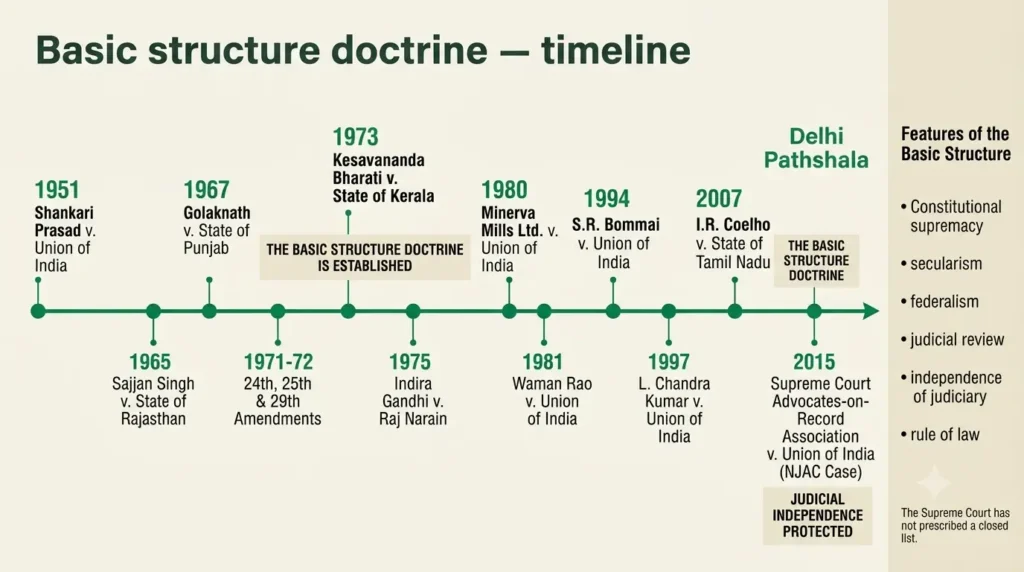
| Case / Event | Year | Holding / significance |
|---|---|---|
| Shankari Prasad v. Union of India | 1951 | Parliament can amend Fundamental Rights under Article 368. |
| Sajjan Singh v. State of Rajasthan | 1965 | The Court reaffirmed that view, though some judges expressed doubts. |
| Golaknath v. State of Punjab | 1967 | An eleven-judge bench held (6:5) that Parliament cannot amend Fundamental Rights, treating amendments as “law” under Article 13. |
| 24th, 25th and 29th Amendments | 1971–72 | Parliament responded by declaring its power to amend any part of the Constitution, restricting property-related review and placing the Kerala land reform laws in the Ninth Schedule. |
| Kesavananda Bharati v. State of Kerala | 1973 | A thirteen-judge bench held (7:6) that Parliament can amend any provision but cannot alter the basic structure. Golaknath was overruled. |
The petitioner, Swami Kesavananda Bharati, was head of the Edneer Mutt in Kerala, and his challenge was to Kerala land-reform laws that restricted the mutt’s property. The case is notable for the size of the bench, the number of separate opinions and the narrowness of the result. Chief Justice S.M. Sikri headed the bench. Standard accounts note that a summary of the majority’s conclusions was signed by nine of the thirteen judges.
Key Judgments: Kesavananda Bharati Case
- Core holding: the amending power under Article 368 is wide, but it cannot be used to damage or destroy the Constitution’s basic structure or framework.
- No fixed list: the judges did not agree on one list of basic features. Each opinion gave examples. Chief Justice Sikri’s list included the supremacy of the Constitution, the republican and democratic form of government, the secular character of the Constitution, the separation of powers and the federal character. Other judges added sovereignty, unity, individual freedom and the welfare-state mandate.
- Judicial review: it is for the courts to decide whether an amendment violates the basic structure.
Scholarly debate. Supporters see the doctrine as a safeguard against majoritarian abuse of the amending power. Critics, including some legal scholars, argue that it gives unelected judges a very wide power to strike down constitutional amendments. The DU DSE reading list includes work by Pratap Bhanu Mehta and Sudhir Krishnaswamy on this tension.
Components of the Basic Structure
The Court has never produced a closed list. The following are commonly cited features recognised in decided cases; each has been held to belong to the basic structure in one or more judgments, and the list keeps growing:
- Supremacy of the Constitution
- Sovereign, democratic and republican form of government
- Secularism (Bommai, 1994)
- Separation of powers
- Federalism (Bommai, 1994)
- Judicial review (Chandra Kumar, 1997)
- Free and fair elections (Indira Gandhi v. Raj Narain, 1975)
- Rule of law
- Fundamental Rights and the balance between Part III and Part IV (Minerva Mills, 1980)
- Independence of the judiciary (Second and Fourth Judges Cases, 1993 and 2015)
- Parliamentary democracy
- Unity and integrity of the nation
Caution: some notes say that “the President must be elected” or that specific items such as “an elected head of state” are part of the basic structure. The safer formulation is that the republican form of government is part of it.
Implications for Constitutional Amendments
- Limit on Parliament’s power: Parliament can amend the Constitution but cannot “amend away” its essential identity.
- Judicial oversight: courts can strike down amendments that violate the basic structure.
- No fixed definition: the content of the doctrine develops case by case.
- Ninth Schedule review: in I.R. Coelho v. State of Tamil Nadu (2007), the Court held that laws placed in the Ninth Schedule after 24 April 1973 are open to review on the basis of the basic structure.
Key Cases that Expanded the Basic Structure Doctrine
- Indira Gandhi v. Raj Narain (1975): struck down a part of the 39th Amendment that had tried to place the Prime Minister’s election beyond judicial scrutiny; free and fair elections and the rule of law were held to be part of the basic structure.
- Minerva Mills Ltd. v. Union of India (1980): struck down clauses of the 42nd Amendment (the new clauses (4) and (5) of Article 368) that had tried to make Parliament’s amending power unlimited, holding that a limited amending power is itself part of the basic structure, and that Part III and Part IV together form the Constitution’s “balance”.
- Waman Rao v. Union of India (1981): confirmed that the doctrine applies to amendments made after 24 April 1973 (the date of Kesavananda).
- S.R. Bommai v. Union of India (1994): secularism and federalism are part of the basic structure; the use of Article 356 is subject to judicial review.
- L. Chandra Kumar v. Union of India (1997): the High Courts’ and Supreme Court’s power of judicial review is part of the basic structure.
- Supreme Court Advocates-on-Record Association v. Union of India (2015): struck down the 99th Amendment and the National Judicial Appointments Commission Act, holding that judicial independence is part of the basic structure.
Takeaway: the doctrine is a restraint on the amending power. It stands for the idea that a constitution has an identity that even a large parliamentary majority cannot erase.
Comparing the Indian Constitution with Other Constitutions
Comparison helps you see which features are distinctive and which are shared. Use it in exam answers as a way of showing analysis.
Indian Constitution vs. Other Constitutions
| Dimension | India | USA | UK | Others |
|---|---|---|---|---|
| Form | Written, very long | Written, short (7 articles, 27 amendments) | Unwritten, uncodified | France: written, shorter; Germany: Basic Law (1949) |
| Amendment | Mixed: ordinary law, special majority, special majority plus states | Rigid (two-thirds of Congress plus three-fourths of states) | Flexible (Parliament by ordinary law) | Switzerland: referendums prominent |
| Federalism | Federation with a strong Centre (“Union of States”) | Strong states’ rights | Unitary state (devolution in parts) | Germany: strong states; Canada: strong Centre, similar to India |
| Government | Parliamentary | Presidential | Parliamentary | France: semi-presidential |
| Secularism | “Principled distance”; state engages with religion to ensure equality | Strict separation (no establishment) | Established Church (Church of England) | France: strict laïcité |
| Rights | Enforceable Fundamental Rights plus non-enforceable Directive Principles | Bill of Rights (civil and political) | Common law and statutes (Human Rights Act 1998) | Germany: rights plus social-state principle |
| Judiciary | Single integrated judiciary; judicial review; PIL | Dual court system; judicial review | Parliamentary sovereignty; no strong review | Germany: constitutional court |
A correction. Some notes say that Indian Fundamental Rights cover social and economic rights while the American Bill of Rights covers only civil and political rights. In fact, Part III is mainly civil and political, and most social and economic aspirations are placed in the Directive Principles (Part IV), though the courts have read some of them into Article 21.
Adaptations and Innovations of the Indian Constitution
- Combining enforceable rights with non-enforceable social goals (Parts III and IV), which is unusual in constitutional design.
- Reservations and affirmative action built into the constitutional text (Articles 15(4), 16(4), 330, 332 and others).
- Language accommodation: an Eighth Schedule that recognises twenty-two languages.
- Emergency provisions that give the Union far-reaching powers, broader than in many federations.
- Asymmetric federalism, with special provisions for some states and regions (the Fifth and Sixth Schedules; Articles 371 to 371-J).
Lessons from Other Democracies
- Amendment: the US Constitution has been amended only 27 times in over two centuries, while India’s has been amended over a hundred times. The lesson is that frequent amendment shows adaptability but also political convenience, which is why the basic structure doctrine matters.
- Checks and balances: the American model emphasises strict separation of powers, while India’s parliamentary system fuses executive and legislature, and so depends heavily on judicial review and constitutional conventions.
- Secularism: comparing France, the US and India shows that there is more than one model of secular state.
Takeaway: the Indian Constitution is a deliberate blend. Its strength is its adaptability, and its risk is that long, detailed texts can be amended for short-term political reasons.
B. Citizenship, Fundamental Rights, Directive Principles, and Fundamental Duties
Citizenship
Citizenship defines who belongs to the political community and has full political rights. In India, Part II of the Constitution (Articles 5–11) and the Citizenship Act, 1955 set out who is a citizen and how citizenship is acquired and lost. Valerian Rodrigues’s essay “Citizenship and the Indian Constitution” and Anupama Roy’s Citizenship in India, both on the DU reading list, are the best scholarly guides.
Constitutional Rules (Articles 5-11)
Part II dealt with the initial body of citizens at the commencement of the Constitution (26 January 1950). The Assembly debated these provisions on 10–12 August 1949 against the backdrop of Partition and mass migration.
| Article | What it says |
|---|---|
| Article 5 | Citizenship at the commencement of the Constitution: a person domiciled in India who was born in India, or either of whose parents was born in India, or who had been ordinarily resident in India for at least five years before commencement. |
| Article 6 | People who migrated to India from Pakistan before 19 July 1948 (and, if after that date, who registered) became citizens under specified conditions. |
| Article 7 | Persons who migrated from India to Pakistan after 1 March 1947 are not citizens, except those who returned under a permit for resettlement. |
| Article 8 | Persons of Indian origin residing outside India can register as citizens through Indian diplomatic offices. |
| Article 9 | A person who voluntarily acquires foreign citizenship is not an Indian citizen. |
| Article 10 | Persons who are citizens under Part II continue to be so, subject to Parliament’s law. |
| Article 11 | Parliament has the power to regulate citizenship by law. |
Corrections. Many notes reverse Articles 6 and 7 or describe them as being about people who “left for Pakistan and want to come back”. Article 6 is about migrants into India; Article 7 is about migrants from India to Pakistan and those who later returned under a resettlement permit.
The Citizenship Act, 1955
The Act lists the ways of acquiring citizenship:
- By birth (Section 3): every person born in India between 26 January 1950 and 30 June 1987 is a citizen by birth. For those born on or after 1 July 1987 and before 3 December 2004, at least one parent must be an Indian citizen at the time of birth. For those born on or after 3 December 2004, both parents must be Indian citizens, or one must be a citizen and the other not an illegal migrant. (Several notes wrongly say that both parents must be citizens for all births after 1987.)
- By descent (Section 4): a person born outside India to an Indian parent, subject to registration conditions.
- By registration (Section 5): for example, persons of Indian origin ordinarily resident in India for the required period, or spouses of Indian citizens.
- By naturalisation (Section 6): a foreigner who satisfies the residence and other requirements of the Third Schedule.
- By incorporation of territory (Section 7): when a territory becomes part of India, Parliament specifies who becomes a citizen.
Loss of citizenship: by renunciation (Section 8), by termination when a person voluntarily acquires another country’s citizenship (Section 9), and by deprivation (Section 10) on specified grounds such as citizenship obtained by fraud. (Voluntary acquisition of foreign citizenship is termination, not “deprivation”, as some notes put it.) The current text of the Act can be checked on India Code, linked in the references.
Changes and Current Issues
Citizenship (Amendment) Act, 2019 (CAA). The CAA made persons belonging to Hindu, Sikh, Buddhist, Jain, Parsi and Christian communities who came to India from Afghanistan, Bangladesh and Pakistan on or before 31 December 2014 eligible for citizenship under a fast-track route (inserted as Section 6B). The CAA Rules were notified on 11 March 2024, bringing the Act into operation.
- For: supporters argue that it provides relief to persecuted religious minorities in three neighbouring states.
- Against: critics argue that using religion as a criterion conflicts with the equality principle in Article 14 and with the secular character of the Constitution, because Muslims (and others such as persecuted minorities from other countries) are not included.
- The Act is the subject of constitutional challenges. Present the arguments on both sides and avoid concluding that it has been decided one way or another unless you cite the judgment.
A correction: many notes omit Christians from the list of communities.
National Register of Citizens (NRC). Assam’s NRC was first prepared in 1951 and updated through a process monitored by the Supreme Court, resulting in a final list in August 2019 that left out a large number of applicants. The exercise showed how difficult it is to prove citizenship through documents. Whether to extend a national register is a political debate and should be presented as such.
Section 6A of the Citizenship Act (Assam Accord). Section 6A deals with the citizenship of migrants into Assam between 1966 and 1971. Reports state that a Constitution Bench of the Supreme Court upheld its validity in October 2024; verify the details from the judgment before citing.
Debate on Dual Citizenship
India does not allow dual citizenship (Article 9 and Section 9 of the Act). The Overseas Citizen of India (OCI) scheme gives long-term residence and certain benefits to people of Indian origin, but OCI cardholders are not citizens, cannot vote and cannot hold constitutional offices.
- Supporters of dual citizenship: argue that it would strengthen ties with the diaspora.
- Opponents: raise concerns about divided loyalty, taxation, voting and security.
Rights and Responsibilities of Citizens
Some Fundamental Rights are available only to citizens (Articles 15, 16, 19, 29 and 30), while others are available to all persons (Articles 14, 20, 21, 21A, 22, 25 and others). This distinction is a standard exam point. The Constitution’s list of citizens’ duties is in Part IV-A (Article 51A), discussed below. Paying taxes is a legal obligation under tax laws, but it is not listed among the Fundamental Duties in Article 51A.
Takeaway: citizenship in India begins with Part II, is governed by the 1955 Act, is single and non-dual, and is today at the centre of debates about religion, documentation and equality.
Fundamental Rights (Part III)
Fundamental Rights in Part III (Articles 12–35) protect individual liberty and equality against the State. Granville Austin called the Fundamental Rights and Directive Principles the “conscience of the Constitution” and DU’s reading list includes his chapters on them.
General Overview
- Enforceability: Fundamental Rights are justiciable. A person can approach the Supreme Court directly under Article 32 or a High Court under Article 226.
- Article 12 and 13: “State” is defined in Article 12, and Article 13 declares that laws inconsistent with Fundamental Rights are void to the extent of the inconsistency.
- Not absolute: most rights can be subjected to reasonable restrictions.
- Original and current position: the original Constitution listed seven rights; the right to property was removed from Part III by the 44th Amendment (1978) and is now a constitutional right under Article 300A, leaving six categories.
Comparison with the US Bill of Rights. Both protect individual freedoms. Indian Fundamental Rights are drafted with explicit grounds for reasonable restriction, while many American rights are framed as absolute prohibitions, though American courts have also developed limits. India’s Part III is mainly about civil and political rights; the social and economic rights are mostly in Part IV.
| Right | Articles | Available to |
|---|---|---|
| Right to Equality | 14–18 | Art. 14: all persons; Arts. 15–16: citizens only; Arts. 17–18: all |
| Right to Freedom | 19–22 | Art. 19: citizens only; Arts. 20–22: all persons (Art. 22 has special rules on detention) |
| Right against Exploitation | 23–24 | All persons |
| Right to Freedom of Religion | 25–28 | All persons |
| Cultural and Educational Rights | 29–30 | Citizens (Art. 29); minorities (Art. 30) |
| Right to Constitutional Remedies | 32 | All persons |
Right to Equality (Articles 14-18)
- Article 14 – Equality before law and equal protection of the laws. The Supreme Court allows “reasonable classification” but strikes down arbitrariness. In E.P. Royappa (1974) and Maneka Gandhi (1978), the Court treated arbitrariness as contrary to equality.
- Article 15 – Prohibition of discrimination on grounds of religion, race, caste, sex or place of birth. It allows special provisions for women and children, and for socially and educationally backward classes, SCs and STs.
- Article 16 – Equality of opportunity in public employment, with provisions for reservations. In Indra Sawhney v. Union of India (1992) the Supreme Court upheld reservation for Other Backward Classes, subject to a general ceiling of fifty per cent and the exclusion of the “creamy layer”.
- Article 17 – Abolition of untouchability. Its practice is an offence; the Protection of Civil Rights Act, 1955 gives effect to it.
- Article 18 – Abolition of titles, other than military and academic distinctions. State awards such as the Bharat Ratna were upheld by the Court in Balaji Raghavan v. Union of India (1996) as not being “titles”.
Right to Freedom (Articles 19-22)
- Article 19(1) guarantees six freedoms to citizens: (a) speech and expression, (b) assembly peacefully and without arms, (c) association or union, (d) free movement throughout India, (e) residence in any part of India, and (g) any profession, occupation, trade or business. (The freedom to acquire property, (f), was removed in 1978.) Restrictions are allowed on specific grounds listed in Articles 19(2) to 19(6), such as public order, decency and morality, security of the State and sovereignty and integrity of India. In Shreya Singhal v. Union of India (2015) the Court struck down Section 66A of the Information Technology Act as an unconstitutional restriction on speech.
- Article 20 – protection in respect of conviction for offences: no ex post facto criminal law, no double jeopardy, and no compulsion to be a witness against oneself.
- Article 21 – protection of life and personal liberty “except according to procedure established by law”. After Maneka Gandhi v. Union of India (1978) the procedure must be just, fair and reasonable, and Article 21 has been expanded to cover rights such as dignity, livelihood, a clean environment and privacy. Article 21A (inserted by the 86th Amendment, 2002) makes elementary education for children aged six to fourteen a Fundamental Right.
- Article 22 – protection against arbitrary arrest and detention, including the right to be informed of the grounds and to consult a lawyer, with special rules for preventive detention.
Right Against Exploitation (Articles 23-24)
- Article 23 prohibits human trafficking and forced labour (begar).
- Article 24 prohibits the employment of children below fourteen in factories, mines or other hazardous work. (Notes that list child labour under Article 23 are mistaken.)
Right to Freedom of Religion (Articles 25-28)
- Article 25 – freedom of conscience and the right to profess, practise and propagate religion, subject to public order, morality, health and the other Fundamental Rights.
- Article 26 – freedom of religious denominations to manage their own religious affairs.
- Article 27 – no person can be compelled to pay taxes whose proceeds are used for promoting a particular religion.
- Article 28 – no religious instruction in institutions wholly maintained out of State funds.
The Court uses an “essential religious practices” test in deciding what is protected.
Cultural and Educational Rights (Articles 29-30)
- Article 29 – protection of the language, script and culture of any section of citizens.
- Article 30 – the right of religious and linguistic minorities to establish and administer educational institutions of their choice. For Delhi University students, St. Stephen’s College v. University of Delhi (1992) is a well-known case on how minority institutions can admit students.
Right to Constitutional Remedies (Article 32)
Article 32 gives citizens the right to move the Supreme Court directly for the enforcement of Fundamental Rights, and it is itself a Fundamental Right. B.R. Ambedkar described it in the Assembly as the soul and heart of the Constitution (see CAD, December 1948). The Supreme Court (Article 32) and High Courts (Article 226) can issue five writs:
| Writ | Meaning | Use |
|---|---|---|
| Habeas Corpus | “You must have the body” | To produce a person detained unlawfully before the court. |
| Mandamus | “We command” | To direct a public authority to perform a public duty. |
| Prohibition | To forbid | To stop a lower court or tribunal from exceeding its jurisdiction. |
| Certiorari | “To be certified” | To quash an order already passed by a lower court or tribunal. |
| Quo Warranto | “By what authority” | To challenge a person’s right to hold a public office. |
Limitations and Reasonable Restrictions
Rights may be restricted on grounds written into the articles themselves, for instance:
- sovereignty and integrity of India, security of the State, friendly relations with foreign states
- public order, decency or morality
- contempt of court, defamation and incitement to an offence
The Court examines whether a restriction is reasonable and proportionate. Under Article 359 the right to move courts for enforcement of Fundamental Rights can be suspended during an Emergency, except for Articles 20 and 21.
Landmark Cases and Judicial Interpretations
| Case | Year | Importance |
|---|---|---|
| A.K. Gopalan v. State of Madras | 1950 | A narrow reading of Article 21, treating each Fundamental Right as a separate silo. |
| Golaknath v. State of Punjab | 1967 | Held Fundamental Rights cannot be amended; overruled in Kesavananda (1973). |
| Maneka Gandhi v. Union of India | 1978 | Brought Articles 14, 19 and 21 together and required fair, just and reasonable procedure. |
| Francis Coralie Mullin v. Administrator, Delhi | 1981 | Read the right to live with human dignity into Article 21. |
| K.S. Puttaswamy v. Union of India | 2017 | A nine-judge bench held that the right to privacy is a Fundamental Right under Article 21. |
Correction: some notes say Maneka Gandhi itself established “living with dignity”; the dignity strand is more closely associated with later cases such as Francis Coralie Mullin.
Takeaway: Part III has grown from a text of listed rights into a rich body of judicial interpretation.
Directive Principles of State Policy (Part IV)
The Directive Principles of State Policy (DPSPs) in Part IV (Articles 36–51) are guidelines for the government in making laws and policies. They are non-justiciable: no court can compel the State to implement them. But Article 37 calls them “fundamental in the governance of the country” and makes it the State’s duty to apply them in making laws. Austin called Parts III and IV together the “conscience of the Constitution”. The idea was taken from the Irish Constitution of 1937.
Concept and Importance
- Non-justiciable but binding in spirit: citizens cannot sue to enforce them, but they shape legislation, budgets and judicial interpretation.
- Goal of a welfare state: they translate the Preamble’s promise of social and economic justice into policy goals.
Types of Directive Principles
The usual three-fold classification (as in standard textbooks such as Laxmikanth) is:
| Type | Key Articles | Examples |
|---|---|---|
| Socialistic | 38, 39, 39A, 41, 42, 43, 43A, 47 | Reduce inequality (38); adequate livelihood, equal pay for equal work, no concentration of wealth (39); free legal aid (39A, added 1976); right to work and public assistance (41); just and humane working conditions and maternity relief (42); worker participation in management (43A, added 1976); nutrition and public health (47) |
| Gandhian | 40, 43, 43B, 46, 47, 48 | Village panchayats (40); cottage industries (43); cooperative societies (43B, added by the 97th Amendment, 2011); promotion of the educational and economic interests of SCs, STs and weaker sections (46); prohibition of intoxicating drinks (47); organisation of agriculture and animal husbandry (48) |
| Liberal-intellectual | 44, 45, 48A, 49, 50, 51 | Uniform Civil Code (44); early childhood care and education up to age six (45, as amended in 2002); protection of environment, forests and wildlife (48A, added 1976); protection of monuments (49); separation of judiciary from executive (50); international peace and security (51) |
Main Points of DPSPs
- Adequate means of livelihood and equal pay for equal work (Article 39). The Supreme Court in Randhir Singh v. Union of India (1982) used Article 39(d) with the Preamble and Article 14 to support equal pay.
- Education and public health (Articles 45 and 47).
- Village panchayats (Article 40), which led eventually to the 73rd Amendment.
- Environment and wildlife (Article 48A), which has fed environmental jurisprudence along with Article 51A(g).
- Uniform Civil Code (Article 44), a continuing debate between those who see it as a path to gender justice and national integration and those who see it as a threat to religious and cultural diversity.
- International peace (Article 51): respect for international law, arbitration and peaceful relations.
Relationship with Fundamental Rights
- Complementary: Part III protects liberty, Part IV pursues social and economic justice.
- Conflict and resolution: in State of Madras v. Champakam Dorairajan (1951) the Court held that Fundamental Rights prevail over DPSPs, and the first amendments followed. Article 31C (added in 1971) gave priority to certain DPSPs (Articles 39(b) and (c)) over some rights. The 42nd Amendment tried to extend this to all DPSPs, but Minerva Mills (1980) struck that down, holding that the Constitution rests on a balance between Parts III and IV. Since then, the Court has tried to read both together, treating DPSPs as aids in interpreting rights (for example, reading livelihood into Article 21 in Olga Tellis, 1985).
Challenges in Implementation
- Resources and capacity: many DPSP goals require large public expenditure.
- Political will: because they are not enforceable, they can be postponed. Some, such as Article 44 and Article 47, remain politically contentious.
- Judicial role: the courts cannot order the State to enact a policy, but they have translated some DPSPs into enforceable rights through Article 21.
Judicial Role
The Supreme Court has influenced how DPSPs are understood in legal cases. Though they are not enforceable, the Court uses them to interpret rights and to test whether classifications are reasonable. See also our notes on public policy for how constitutional goals enter policymaking.
Takeaway: DPSPs are the Constitution’s social programme. They are the main place where the aim of social revolution is written into the text.
Fundamental Duties (Part IV-A)
Fundamental Duties are moral obligations of citizens listed in Article 51A (Part IV-A).
Introduction and Background
- Not in the original Constitution. The Assembly did not include duties.
- Added in 1976. On the recommendation of the Swaran Singh Committee set up during the Emergency, the 42nd Amendment (1976) inserted Part IV-A with ten duties. The Committee had also recommended penalties for non-compliance, which Parliament did not adopt.
- Eleventh duty. The 86th Amendment (2002) added clause (k).
- Soviet influence. The idea of listing citizens’ duties is usually traced to the Soviet Constitution.
- Timing and debate. Because the duties were added during the Emergency, some critics saw them as a way of balancing rights with obligations on the State’s terms; supporters said they simply reminded citizens that rights and duties go together.
List of Fundamental Duties (Article 51A)
It shall be the duty of every citizen of India:
| Clause | Duty (summary) |
|---|---|
| (a) | To abide by the Constitution and respect its ideals and institutions, the National Flag and the National Anthem |
| (b) | To cherish and follow the noble ideals which inspired the national struggle for freedom |
| (c) | To uphold and protect the sovereignty, unity and integrity of India |
| (d) | To defend the country and render national service when called upon |
| (e) | To promote harmony and the spirit of common brotherhood among all the people of India, transcending religious, linguistic and regional or sectional diversities; to renounce practices derogatory to the dignity of women |
| (f) | To value and preserve the rich heritage of our composite culture |
| (g) | To protect and improve the natural environment, including forests, lakes, rivers and wildlife, and to have compassion for living creatures |
| (h) | To develop the scientific temper, humanism and the spirit of inquiry and reform |
| (i) | To safeguard public property and to abjure violence |
| (j) | To strive towards excellence in all spheres of individual and collective activity |
| (k) | Who is a parent or guardian, to provide opportunities for education to his child or ward between the ages of six and fourteen years (added in 2002) |
Corrections. Some notes list “respect for parents and elders”, “voting”, “paying taxes” and “promoting the welfare of the country” as Fundamental Duties. These are not in Article 51A. The list above follows the text of the article, which is also available on the official constitutional resources linked in the references. There are eleven duties today, not ten.
Significance and Relevance
- Duties remind citizens that rights depend on a shared civic culture.
- Several duties echo constitutional values: harmony (e), composite culture (f), scientific temper (h) and the environment (g).
Enforceability and Legal Provisions
- Non-justiciable: like DPSPs, the duties are not directly enforceable. Courts have, however, used them in interpreting laws and in assessing the reasonableness of restrictions on rights. The Court has relied on Article 51A(g) in environmental cases such as the Doon Valley litigation and the M.C. Mehta cases.
- Laws that give effect to some duties: the Prevention of Insults to National Honour Act, 1971 (flag, anthem and Constitution), the Protection of Civil Rights Act, 1955, and environmental laws such as the Wildlife (Protection) Act, 1972 and the Environment (Protection) Act, 1986.
- A committee on operationalising duties. The DU syllabus lists the 1999 report of the committee appointed by the Government of India to operationalise the teaching of Fundamental Duties (MHRD, 1999) as a reading.
Criticism and Suggestions for Improvement
- No legal sanction: critics say duties without consequences are largely symbolic. Others argue that attaching penalties to vague duties such as “cherishing noble ideals” would be unworkable and open to misuse.
- Vague language: duties such as “to value the composite culture” can be interpreted in many ways.
- Awareness: many citizens are unaware of the duties; the 1999 report recommended teaching them in schools.
- Balance with rights: the main debate is whether duties are preconditions of rights, as the Emergency-era Committee implied, or only moral reminders that do not qualify rights.
Takeaway: Fundamental Duties are the least litigated part of the Constitution, but they matter as statements of civic ideals.
Connection Between Fundamental Rights, Directive Principles, and Fundamental Duties
| Fundamental Rights | Directive Principles | Fundamental Duties | |
|---|---|---|---|
| Part / Articles | Part III, 12–35 | Part IV, 36–51 | Part IV-A, 51A |
| Addressed to | The State (rights of individuals) | The State (policy goals) | Citizens |
| Enforceable? | Yes (Articles 32, 226) | No | No |
| Original? | Yes | Yes | No (1976) |
| Nature | Civil and political | Social and economic | Civic and moral |
| Source / inspiration | USA, UK, Constituent Assembly debates | Ireland, Gandhian thought, Karachi Resolution | USSR, Swaran Singh Committee |
Working Together
- Fundamental Rights restrain the State; DPSPs direct it; duties remind citizens of their role.
- The courts have attempted to read them harmoniously. In Minerva Mills the Court spoke of a balance between Parts III and IV.
- Rights such as free speech are protected, but they can be limited on public order or security grounds, in line with the State’s responsibility to protect everyone.
Court Decisions
- Kesavananda Bharati (1973): protected the Constitution’s basic structure, including the commitments in both Parts III and IV.
- Minerva Mills (1980): neither Part III nor Part IV can be given absolute priority.
- Maneka Gandhi (1978): widened Article 21 and so provided the base for enforcing many social and economic aims.
Role in Government
- DPSPs guide policy areas such as health, education and livelihood; rights allow citizens to challenge government actions.
- Duties encourage citizens’ participation in environmental protection, harmony and public property protection.
Modern Relevance
Debates about privacy and surveillance, digital rights and the environment all draw on this three-part structure. In K.S. Puttaswamy v. Union of India (2017), privacy was read into Article 21, while DPSPs about citizens’ welfare enter debates about how far data and technology can be regulated.
Takeaway: the three Parts form one scheme: rights for individuals, goals for the State and duties for citizens.
Current Issues and Discussions
The Constitution continues to be tested by new questions. This section is for background and for essay-style answers; present each issue as a debate.
Citizenship Issues
- Migration, refugees and documentation. India has no general refugee law, and the CAA and NRC debates raise questions about equality (Article 14), secularism and proof of citizenship.
- Nationalism and identity. Debates on nationalism and on a shared national identity must be set against the Constitution’s commitment to pluralism and fraternity.
Rights vs. Duties
- A durable debate is whether stressing duties strengthens democracy or weakens rights. Present both views.
- Education and civic sense. Teaching constitutional values in schools and universities is a frequently proposed remedy.
Changing Nature of Fundamental Rights
- Privacy (Puttaswamy, 2017). A nine-judge bench held privacy to be a Fundamental Right under Article 21, which has fed debates on data protection and surveillance.
- Internet and digital rights. In Anuradha Bhasin v. Union of India (10 January 2020) the Supreme Court held that freedom of speech and expression and the freedom to carry on trade or business over the internet are protected by Article 19(1)(a) and 19(1)(g), and that internet shutdown orders must be reasoned, proportionate and subject to review. (Several notes wrongly cite Puttaswamy (2019) for this; Puttaswamy was decided in 2017 and concerned privacy.) The Kerala High Court’s decision in Faheema Shirin (2019) also linked internet access with the right to education and privacy.
Directive Principles in Policy Making
- Social welfare schemes. Programmes such as the Mahatma Gandhi National Rural Employment Guarantee Act (MGNREGA), the Pradhan Mantri Awas Yojana and the Swachh Bharat Abhiyan are often linked to Directive Principles on livelihood, housing and public health, although they are policy choices and not constitutional mandates. See our notes on social welfare policies.
- Environment and sustainable development. Article 48A and Article 51A(g) underpin environmental policy and judicial decisions on pollution and forests.
- Women’s representation. The Constitution (106th Amendment) Act, 2023, the Nari Shakti Vandan Adhiniyam, provides for reservation of seats for women in the Lok Sabha and State Assemblies; check the implementation timeline before citing details.
Conclusion
The Indian Constitution is the supreme law of the land and a document meant to be worked and interpreted. It came out of a long freedom struggle and an Assembly that debated its terms for nearly three years. Its Preamble states its ideals; its features balance unity and diversity; its Fundamental Rights, Directive Principles and Fundamental Duties together express a commitment to liberty, social justice and civic responsibility; and the basic structure doctrine protects its core.
Ambedkar’s warning in 1949 still frames the unit: the Constitution can give political equality, but it cannot by itself deliver social democracy, which depends on how citizens and institutions behave. The questions in the previous section (citizenship, privacy, the environment, the balance of rights and duties) show that the Constitution remains a living and contested document. For exams, remember to connect each provision to a debate, a case and a date.
Quick revision table
| Topic | Remember |
|---|---|
| Assembly | 389 → 299 members; first sitting 9 Dec 1946; Objectives Resolution 13 Dec 1946; Drafting Committee 29 Aug 1947; adopted 26 Nov 1949; in force 26 Jan 1950 |
| Preamble | Amended once (1976); part of the Constitution per Kesavananda; not enforceable |
| Basic structure | Kesavananda (1973), 13 judges, 7:6; no closed list |
| Citizenship | Part II, Articles 5–11; Citizenship Act 1955; single, not dual; CAA 2019 (rules 2024) |
| Fundamental Rights | Part III, Articles 12–35; Article 32 remedy; right to property removed 1978 |
| DPSPs | Part IV, Articles 36–51; non-justiciable; Irish source; balance with Part III (Minerva Mills) |
| Fundamental Duties | Article 51A; 42nd Amendment (1976); 11 duties after 2002 |
Continue Reading
- Organs of Government – DSC 9, Unit 2: the next unit, covering Parliament, the executive and the judiciary.
- Federalism and Decentralization – DSC 9, Unit 3: develops the “federal with unitary bias” discussion.
- Constitutional Provisions and National Security Laws – DSC 9, Unit 4: emergency provisions and preventive detention.
- Constitutional antecedents and the making of the Constitution of India (GE-2, Unit 1): a shorter treatment of the historical background.
- DU BA Political Science PYQs 2024–2025: includes the DSC 9 question-paper file.
University of Delhi Previous Year Questions
DU Previous Year Questions
Frequently asked questions from DU exam papers on this topic. Tap a question to view a quick-answer guide.
1 Examine the composition of the Constituent Assembly and analyze how it reflected the social and political diversity of India. (DU, May/June 2026) +
2 Elaborate “Preamble is the Heart and Soul of the Indian Constitution”. (DU, May/June 2026) +
3 What were the challenges faced by the Constituent Assembly while framing the Constitution? Discuss. (DU, Previous Year Paper) +
FAQs
What is a Constituent Assembly, and what does संविधान सभा mean?
It is a body elected or constituted to frame a constitution. India’s Constituent Assembly framed the Constitution between 1946 and 1949.
Who was the President of the Constituent Assembly, and what was Ambedkar’s role?
Dr Rajendra Prasad was the President. Ambedkar chaired the Drafting Committee, which prepared the Draft Constitution, and piloted it through the Assembly.
Was the Assembly directly elected by the people?
No. Members from British India were chosen by the provincial legislatures, and princely-state members were nominated. Whether this undermines its legitimacy is a scholarly debate.
Why did the Muslim League not take part?
It boycotted the Assembly after withdrawing its acceptance of the Cabinet Mission Plan in 1946, and later many of its members went to Pakistan after Partition.
Why did the Assembly have 389 members at first and 299 later?
After Partition, members from areas that became Pakistan left, and the strength fell to 299.
Which committees mattered most?
The Drafting Committee, the Advisory Committee on Fundamental Rights and Minorities, the Union Powers and Union Constitution Committees, and the Provincial Constitution Committee.
Why was 26 January chosen for commencement when the Constitution was adopted on 26 November?
To honour 26 January 1930, when the Congress observed Independence Day after the Lahore declaration of Purna Swaraj.
Is the Preamble legally enforceable?
No, but it is part of the Constitution and guides interpretation. It can be amended, subject to the basic structure.
Is the Indian Constitution a copy of the Government of India Act, 1935?
Not exactly. It took over much administrative structure from the 1935 Act, but added universal adult franchise, Fundamental Rights, judicial review and a social agenda. Scholars differ on how much to emphasise the continuity.
Why is the basic structure doctrine controversial?
Supporters see a safeguard against majoritarian misuse; critics say it gives judges too much power over amendments.
Can an Indian citizen hold dual citizenship?
No. India allows OCI status, which is not citizenship.
How many Fundamental Duties are there?
Eleven, in Article 51A. Ten were added in 1976 and one in 2002.
Sources and Further Reading
DU syllabus (DSC 9, Unit I) readings: Granville Austin, “The Constituent Assembly: Microcosm in Action”, in The Indian Constitution: Cornerstone of a Nation (OUP); Rajeev Bhargava, “Introduction: Outline of a Political Theory of the Indian Constitution”, in Politics and Ethics of the Indian Constitution (OUP, 2008); Arun Thiruvengadam, The Constitution of India: A Contextual Analysis (2017); D.D. Basu, Introduction to the Constitution of India; S.K. Chaube, The Making and Working of the Indian Constitution (NBT); Bipan Chandra et al., India After Independence; Madhav Khosla, The Indian Constitution (OUP, 2012); Valerian Rodrigues, “Citizenship and the Indian Constitution”; Anupama Roy, Citizenship in India; and the “classics” listed in the syllabus (the Nehru Committee Report, 1928; Shriman Narayan, Gandhian Constitution for Free India, 1946; B. Shiva Rao, The Framing of India’s Constitution).
Official and authoritative links:
Subscribe to keep reading
You've used your free notes for now. Get Delhi Pathshala Premium for unlimited access.
Subscribe — ₹29/30 days