
Contents
- Basic Features vs. Basic Structure Doctrine — Quick Clarification
- Basic Features of the Indian Constitution
- 1. Lengthiest Written Constitution
- 2. Blend of Rigidity and Flexibility
- 3. Federal System with Unitary Features
- 4. Parliamentary Form of Government
- 5. Independent Judiciary and Judicial Review
- 6. Fundamental Rights, Directive Principles, and Fundamental Duties
- 7. Single Citizenship
- 8. Emergency Provisions
- 9. Universal Adult Franchise and Single Election Commission
- The Basic Structure Doctrine
- Sources of the Indian Constitution
- 1. Historical Sources
- 2. Foreign Sources
- 3. Contemporary Sources
- Schedules of the Indian Constitution
- Previous Year Questions (PYQ)
- FAQs
- Key Takeaways
GE-2, Unit II: Introduction to the Indian Constitution
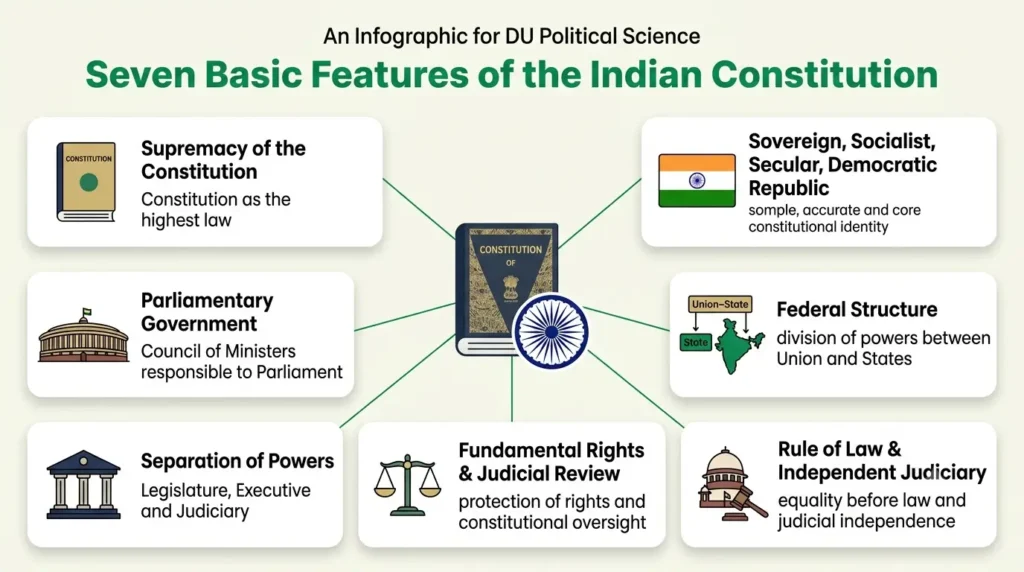
The phrase “basic features of the Indian Constitution” gets asked in two different senses, and this unit expects you to know both. Most of the time it means the Constitution’s general characteristic features — the lengthiest-written-constitution, federal-with-unitary-bias, rigid-and-flexible list that this article walks through in detail. Sometimes, especially in a case-law or amendment-power context, it means the Basic Structure Doctrine — the Supreme Court’s rule that Parliament cannot amend certain core elements of the Constitution even under Article 368. This article covers the general-features list in full (with the relevant case law woven in), gives you a concise, exam-ready grounding in the Basic Structure Doctrine, and links out to a full doctrinal deep-dive for anyone who needs more.
Basic Features vs. Basic Structure Doctrine — Quick Clarification
| General Basic Features | Basic Structure Doctrine | |
|---|---|---|
| What it is | Descriptive characteristics of the Constitution as drafted (length, federalism, rigidity-flexibility, etc.) | A judge-made limitation on Parliament’s amending power |
| Where it comes from | The text of the Constitution itself | Kesavananda Bharati v. State of Kerala (1973) |
| Can it change? | Yes — most features can be altered by amendment | No — by definition, it cannot be destroyed even by a constitutional amendment |
| Covered in | This article (below) | This article (brief) + full case-law breakdown on the DSC-9 “Constituent Assembly and the Constitution” post |
Basic Features of the Indian Constitution
1. Lengthiest Written Constitution
The Indian Constitution is the world’s longest written constitution. Adopted on 26 January 1950, it originally contained 395 Articles in 22 Parts with 8 Schedules; it now runs to about 470 Articles across 25 Parts, with 12 Schedules and 5 Appendices. The length reflects the scale of the task — governing a vast, socially and linguistically diverse country required the framers to spell out administrative detail (like Centre-State relations and the public services) that shorter constitutions, such as the US Constitution’s seven Articles, leave to convention or later legislation.
2. Blend of Rigidity and Flexibility
Article 368 lays down three different amendment routes: some provisions (like the formation of new states) can be changed by a simple majority in Parliament; most others require a special majority (two-thirds of members present and voting, and a majority of the total membership, in each House); and provisions touching the federal structure need that special majority plus ratification by at least half the state legislatures. This graded system is why the Constitution is described as neither wholly rigid (like the US Constitution) nor wholly flexible (like the UK’s unwritten constitution) but a deliberate blend of both.
3. Federal System with Unitary Features
Powers are divided between the Union and the States through the Seventh Schedule’s three lists — Union, State, and Concurrent. In ordinary times this functions like a federation, but the Constitution tilts toward the Centre in several respects: a single citizenship, an integrated judiciary, all-India services, Centrally-appointed Governors, and — critically — emergency powers under which the Centre can take over state administration. This is why India is often called “quasi-federal” or “federal with a unitary bias” rather than purely federal. (For the fuller Centre-State relations picture, including the 73rd/74th Amendment decentralization framework, see the dedicated Centre-State Relations and Decentralization unit.)
4. Parliamentary Form of Government
India follows the Westminster (British-style) model: the President is the ceremonial head of state, while real executive power sits with the Prime Minister and Council of Ministers, who are collectively responsible to the Lok Sabha. This is distinct from a presidential system like the United States’, where the head of state and head of government are the same elected office and the executive isn’t directly answerable to the legislature on a day-to-day basis.
5. Independent Judiciary and Judicial Review
The Constitution sets up a single, integrated judiciary headed by the Supreme Court, with High Courts and subordinate courts below it. Judges enjoy security of tenure and fixed service conditions specifically to keep the judiciary insulated from executive and legislative pressure. Article 13 empowers courts to strike down any law inconsistent with Fundamental Rights, and this power of judicial review — examining the constitutionality of both legislative and executive action — is itself a feature the Supreme Court later held to be part of the Constitution’s basic structure (L. Chandra Kumar v. Union of India, 1997).
6. Fundamental Rights, Directive Principles, and Fundamental Duties
These three, taken together, are as central to the Constitution’s identity as the structural features above:
- Fundamental Rights (Part III, Articles 12–35) are justiciable guarantees — equality, freedom, protection against exploitation, freedom of religion, cultural and educational rights, and the right to constitutional remedies. (For the full Article-by-Article treatment, see the Fundamental Rights unit.)
- Directive Principles of State Policy (Part IV, Articles 36–51) are non-justiciable guidelines directing the state toward a welfare-oriented, socially and economically just society.
- Fundamental Duties (Part IV-A, Article 51A), added by the 42nd Amendment in 1976, are the moral obligations of citizens toward the nation.
(For DPSP and Fundamental Duties in full detail, including how courts have balanced them against Fundamental Rights, see the Obligations of State and Duties of Citizens unit.)
7. Single Citizenship
Unlike federations such as the United States, where a person holds citizenship of both the federal government and their state, India provides for one, uniform citizenship — every Indian is a citizen of India alone, with no separate state citizenship. This was a deliberate choice to strengthen national unity in a country with immense regional diversity.
8. Emergency Provisions
The Constitution provides for three kinds of emergency: a National Emergency (Article 352, for war, external aggression, or armed rebellion), President’s Rule or state emergency (Article 356, when a state’s constitutional machinery breaks down), and a Financial Emergency (Article 360, for threats to India’s financial stability). During a National Emergency, the Centre can issue directions to any state and Parliament can legislate on State List subjects — the clearest illustration of the unitary bias described in Feature 3.
9. Universal Adult Franchise and Single Election Commission
Every citizen aged 18 or above has the right to vote, regardless of caste, religion, gender, or economic status (Article 326), and elections at every level are conducted by a single, independent Election Commission of India. The Supreme Court has held free and fair elections to be part of the basic structure itself (Indira Gandhi v. Raj Narain, 1975).
📌 Constitutional Note — 42nd Amendment, 1976
The 42nd Amendment Act, 1976, often called the “Mini Constitution,” made extensive changes to the Constitution, including adding the words “Socialist” and “Secular” to the Preamble and introducing Fundamental Duties.
The Basic Structure Doctrine
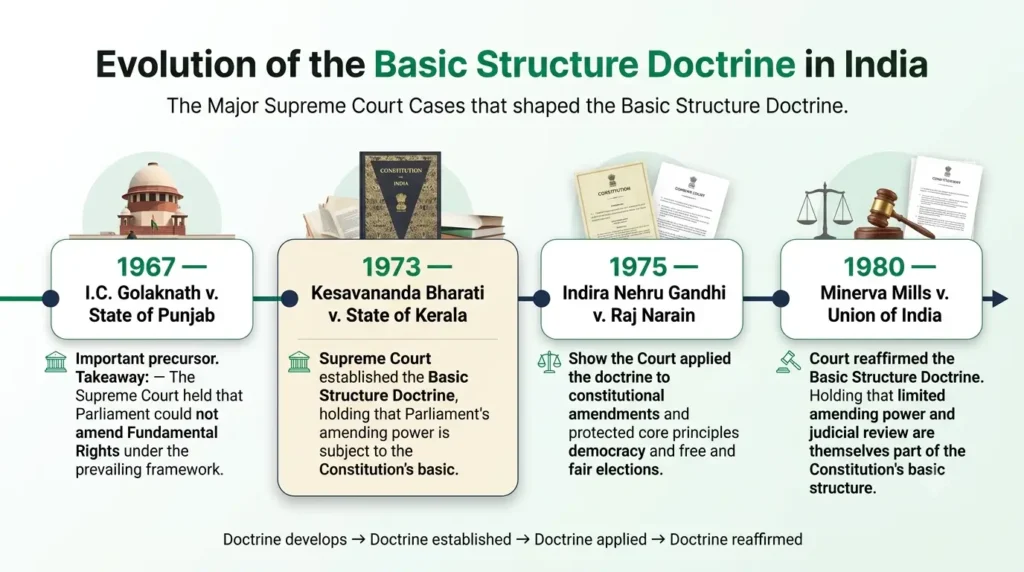
The Basic Structure Doctrine holds that Parliament’s power to amend the Constitution under Article 368 is not unlimited — certain core features cannot be altered or destroyed by any amendment, however procedurally valid. The doctrine was established in Kesavananda Bharati v. State of Kerala (1973), decided by a 13-judge bench (the largest in Supreme Court history) by a narrow 7–6 majority. It overturned the Court’s earlier position in Golaknath v. State of Punjab (1967), where Fundamental Rights had been held completely unamendable.
The Court did not lay down an exhaustive list of what counts as “basic structure,” but later cases have identified elements including: the supremacy of the Constitution, the sovereign, democratic and republican nature of the polity, secularism, the separation of powers, federalism, and judicial review. Two follow-on cases matter most for exam purposes:
- Indira Gandhi v. Raj Narain (1975) — struck down a constitutional amendment that sought to place the Prime Minister’s election beyond judicial scrutiny, holding free and fair elections to be part of the basic structure.
- Minerva Mills Ltd. v. Union of India (1980) — held that the harmonious balance between Fundamental Rights and Directive Principles is itself part of the basic structure, and struck down 42nd Amendment provisions that tried to give DPSPs unconditional primacy over Fundamental Rights.
This is a deep, case-law-heavy topic in its own right — for the full breakdown (including Golaknath, judge-by-judge analysis, and later expansions of the doctrine), see the complete Basic Structure Doctrine section on the Constituent Assembly and the Constitution post.
Sources of the Indian Constitution
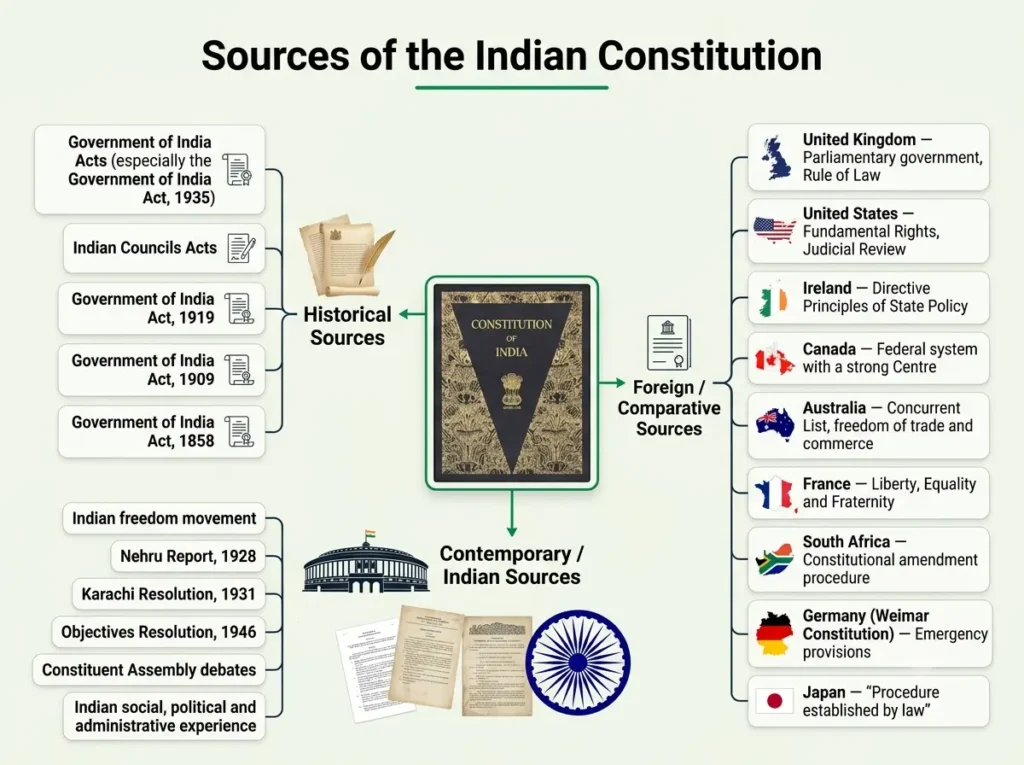
1. Historical Sources
- Rig Veda — the oldest Hindu sacred text, containing hymns and rituals reflecting early social and political organization.
- Manu Smriti (Laws of Manu) — an ancient legal text on social conduct, ethics, and governance.
- Arthashastra by Kautilya (Chanakya) — a treatise on statecraft and economic policy that influenced political thought in ancient India.
- Dharma Shastras — texts discussing moral and ethical principles for individuals and society.
2. Foreign Sources
- Government of India Act, 1935 — the single largest borrowing; the federal structure, the office of Governor, the public service commissions, and the administrative framework all draw heavily from this Act, passed during British rule.
- British Constitution — parliamentary government, the rule of law, and single citizenship.
- US Constitution — Fundamental Rights, judicial review, and the federal structure itself.
- (Also commonly cited: Fundamental Duties from the USSR, Directive Principles from Ireland, and the amendment procedure partly from South Africa — worth a one-line mention for completeness since competing content covers this breadth.)
3. Contemporary Sources
- Constitutional Conventions — unwritten practices followed by constitutional functionaries.
- Judicial Decisions — interpretations that shape how constitutional principles are understood and applied.
- Customs and Usages — social practices that inform the working Constitution in practice.
The framers didn’t copy these sources wholesale — they adapted borrowed principles to India’s own social and political context, which is why B.R. Ambedkar described the Constitution as being framed “after ransacking all the known constitutions of the world” but shaped to India’s specific needs.
Schedules of the Indian Constitution
| Schedule | Covers |
|---|---|
| First | States and Union Territories, with their territorial extent |
| Second | Emoluments, allowances and privileges of the President, Governors, Speaker, judges, CAG, and other constitutional authorities |
| Third | Forms of oaths and affirmations for ministers, election candidates, judges, and the CAG |
| Fourth | Allocation of Rajya Sabha seats to states and Union Territories |
| Fifth | Administration and control of Scheduled Areas and Scheduled Tribes |
| Sixth | Administration of tribal areas in Assam, Meghalaya, Tripura, and Mizoram |
| Seventh | Division of powers — Union List, State List, and Concurrent List |
| Eighth | The 22 languages officially recognised by the Constitution |
| Ninth | Laws (originally 13, now 282) protected from judicial review on fundamental-rights grounds, added by the 1st Amendment — chiefly land reform and zamindari-abolition legislation |
| Tenth | Anti-defection provisions, added by the 52nd Amendment |
| Eleventh | 29 subjects assigned to Panchayats, added by the 73rd Amendment |
| Twelfth | 18 subjects assigned to Municipalities, added by the 74th Amendment |
Quick answer: The Indian Constitution has 12 Schedules — it started with 8 in 1950 and grew to the current 12 through subsequent amendments.
Previous Year Questions (PYQ)
DU Previous Year Questions — GE-2: Introduction to the Indian Constitution
Paper Code: 2324000002 (2026 Datesheet)
Unit: Unit-II — Basic Features of the Indian Constitution
Exam Pattern: 3 Hours | Maximum 90 Marks | Attempt Any Five Questions
Section A — Most Repeated Long Answer Questions
1 Describe the salient features of the Indian Constitution. +
2 Discuss the basic features of the Indian Constitution. +
3 Examine the debate on whether India is a federation or a unitary state with strong federal features. +
4 Discuss the salient features of the Indian Constitution. (2023 Paper) +
5 “The Indian Constitution is federal in form but unitary in substance.” Explain. +
6 Indian Constitution seeks to harmonize the claims of individual freedoms with the demand of social justice by incorporating the Directive Principles along with the Fundamental Rights. Critically examine. +
Section B — Concepts & Short Notes
7 What is constitutionalism? How does the Indian Constitution reflect the principles of constitutionalism? +
8 Why is the Constitution of India called a “Bag of Borrowings”? Mention some of the sources of the Indian Constitution. +
9 Mention the nature of the Indian Constitution. +
10 Write short notes on: (a) The Preamble (b) Key Features of the Indian Constitution (c) Federalism (d) Sovereignty. +
Section C — SGND Khalsa College Question Bank
11 Examine the philosophical foundations of the Preamble to the Indian Constitution. +
12 Critically analyze the concept of judicial review in the Indian Constitution. +
13 Discuss the significance of the Objectives Resolution moved by Jawaharlal Nehru. +
Section D — High-Priority Preparation Areas
1 Salient / Basic Features of the Indian Constitution +
2 Federal vs Unitary Nature of the Indian Constitution +
3 Sources / Borrowed Features and the Detailed Nature of the Indian Constitution +
FAQs
What are the basic features of the Indian Constitution?
The key features include: the lengthiest written constitution in the world, a blend of rigidity and flexibility, a federal system with unitary bias, a parliamentary form of government, an independent judiciary with the power of judicial review, single citizenship, and emergency provisions — along with the Fundamental Rights, Directive Principles, and Fundamental Duties that structure the relationship between the state and citizens.
What is the difference between basic features and the Basic Structure Doctrine?
“Basic features” usually refers to the Constitution’s general characteristics as drafted — its length, federalism, rigidity-flexibility blend, and so on. The “Basic Structure Doctrine” is a specific legal rule from Kesavananda Bharati v. State of Kerala (1973), holding that certain core elements of the Constitution cannot be amended away by Parliament, even through a valid constitutional amendment.
How many schedules does the Indian Constitution have?
12. The Constitution originally had 8 Schedules in 1950; the Ninth, Tenth, Eleventh, and Twelfth were added later through separate amendments.
Is the Indian Constitution rigid or flexible?
Both — it’s a deliberate blend. Some provisions can be amended by a simple parliamentary majority, others need a special (two-thirds) majority, and provisions affecting the federal structure additionally require ratification by at least half the state legislatures.
What are the sources of the Indian Constitution?
Three broad categories: historical sources (Rig Veda, Manu Smriti, Arthashastra, Dharma Shastras), foreign sources (chiefly the Government of India Act 1935, plus the British and US Constitutions), and contemporary sources (constitutional conventions, judicial decisions, and customs).
What was decided in the Kesavananda Bharati case?
A 13-judge Supreme Court bench ruled by a 7–6 majority that Parliament can amend any part of the Constitution under Article 368, but cannot alter or destroy its “basic structure” — core features that remain beyond the reach of even a validly passed amendment.
Why is the Indian Constitution called “quasi-federal”?
Because while power is normally divided between the Union and the States (a federal feature), the Constitution gives the Centre significant unitary powers — a single citizenship, an integrated judiciary, Centrally-appointed Governors, and the ability to take over state administration during an emergency.
What is the 42nd Amendment and why is it called the “Mini Constitution”?
The 42nd Amendment Act, 1976, made sweeping changes across the Constitution — including adding “Socialist” and “Secular” to the Preamble and inserting Part IV-A (Fundamental Duties) — earning it the nickname “Mini Constitution” for the sheer scale of what it altered.
Key Takeaways
- The Indian Constitution’s basic features span structural characteristics (length, federal-unitary blend, parliamentary government, independent judiciary) and citizen-facing guarantees (Fundamental Rights, Directive Principles, Fundamental Duties).
- The Basic Structure Doctrine, established in Kesavananda Bharati v. State of Kerala (1973), is a distinct concept — a judicially-created limit on Parliament’s amending power, not part of the Constitution’s original text.
- The Constitution draws on historical (Rig Veda, Arthashastra), foreign (chiefly the Government of India Act 1935), and contemporary sources, adapted to India’s own context rather than copied wholesale.
- It has 12 Schedules today, having grown from 8 at adoption in 1950.
Continue Reading — GE-2: Introduction to the Indian Constitution
Subscribe to keep reading
You've used your free notes for now. Get Delhi Pathshala Premium for unlimited access.
Subscribe — ₹29/30 days