
Contents
- What is Liberal Democracy?
- Liberal democracy vs electoral democracy
- “Liberal” does not mean a political party
- Key terms in English and Hindi
- The Principles of Liberal Democracy
- Individual rights and freedoms
- Rule of law and constitutionalism
- Separation of powers and checks and balances
- Quick revision: three pillars
- Liberalism and Democracy: A Tension Worth Understanding
- Macpherson’s four models of liberal democracy
- Capitalism and Liberal Democracy
- Critiques from the Left
- Marxist perspectives on liberal democracy
- The critique of economic inequality and capitalism
- Social justice and the welfare state
- The feminist critique
- The critique from exclusion: Ambedkar on social democracy
- Critiques from the Right
- Conservative perspectives on liberal democracy
- The role of tradition and social cohesion
- The critique of moral relativism and cultural decay
- Other critiques associated with the Right
- Left vs Right critique: comparison table
- Alternative Models of Democracy
- Participatory democracy
- Deliberative democracy
- Radical and direct democracy
- Comparison: participatory, deliberative, and radical and direct democracy
- Liberal Democracy in India
- Conclusion
- Five-line revision
- Continue Reading
- University of Delhi Previous Year Questions
- Frequently Asked Questions
- Sources and Further Reading
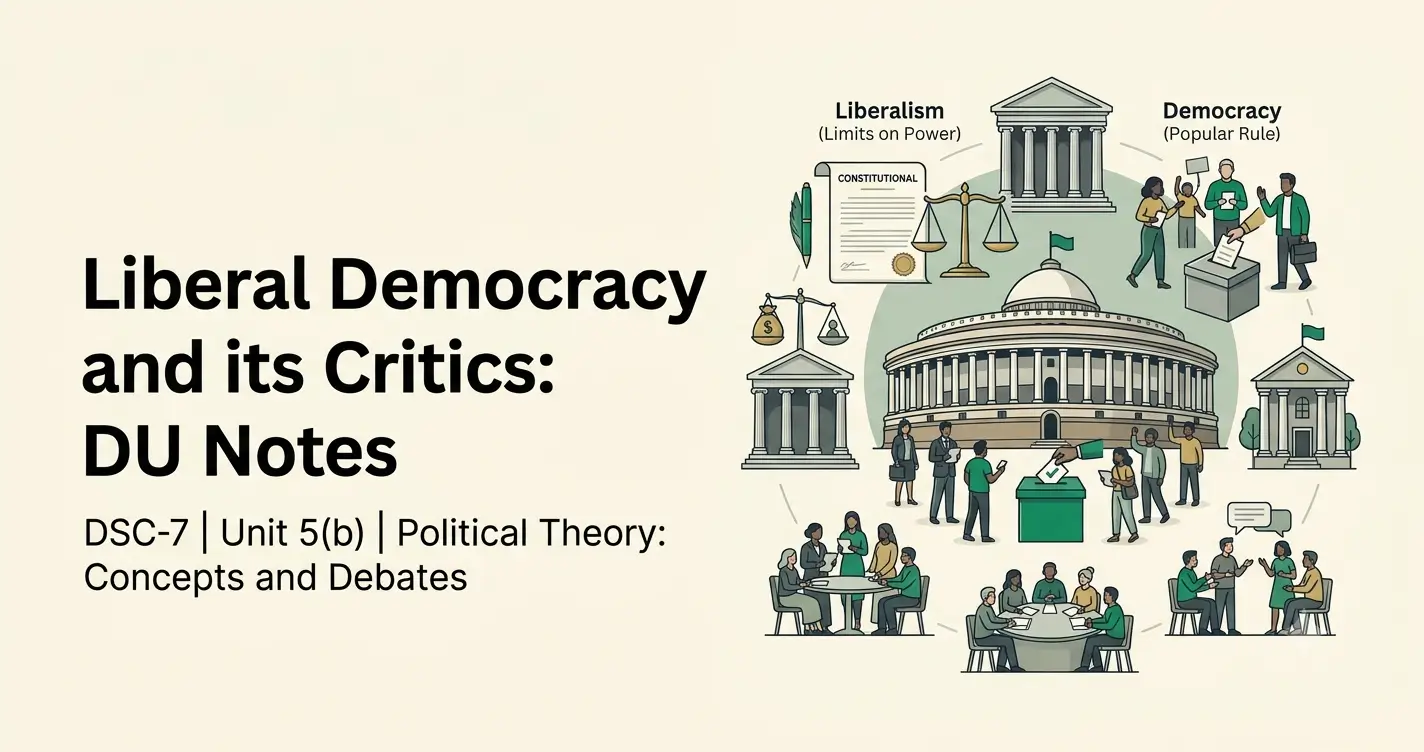
These are the notes for Unit 5: Democracy, (b) Liberal Democracy and its Critics from DSC-7: Political Theory: Concepts and Debates (BA (Hons.) Political Science, Semester 3, University of Delhi). The unit asks two connected questions. What exactly does liberal democracy promise? And why do thinkers from the Left, the Right and from feminist and radical traditions say that the promise is not kept, or is not enough?
This page covers part (b). For the other parts of the unit, read (a) Democracy: Idea and Practice, (c) Multiculturalism and Toleration and the debate Representation vs. Participation. The official DU syllabus lists Srinivasan (2008), Owen (2003) and Christiano (2008) among the essential readings for Unit 5, and Dryzek (2000) and Arblaster (1994) among the additional resources (DU Semester III syllabus, Department of Political Science). Use these notes alongside those readings, not instead of them.
A note on names. Robert Dahl also wrote a famous book called Democracy and Its Critics (1989), and Carter and Stokes edited a volume called Liberal Democracy and its Critics (1998). Neither is the DU unit. Dahl’s book is useful for the theory of democracy, and you can cite it in an answer, but the unit as taught at DU is about the liberal-democratic model and the debates around it.
What is Liberal Democracy?
Liberal democracy is a system of government in which the people choose their rulers through free and fair competitive elections, and in which the power of those rulers is limited by law, a constitution and protected individual rights.
Put simply, it joins two ideas that did not start out together:
- Liberalism is about limits on power: individual freedom, rights, the rule of law.
- Democracy is about who rules: the people, on the basis of political equality.
A regime can have one without the other. A country can hold elections but let the government jail critics and ignore the courts. A monarchy can respect legal rights but give ordinary people no say. Liberal democracy is the combination: popular rule that is also constrained and rights-protecting.
Liberal democracy vs electoral democracy
Students often meet these two terms together, and exam answers improve when you can separate them.
| Point | Electoral democracy | Liberal democracy |
|---|---|---|
| Elections | Free, competitive, regular | Free, competitive, regular |
| Rights and freedoms | May be weakly protected | Strongly protected (speech, assembly, religion, privacy) |
| Courts and law | May be dependent on the government | Independent judiciary; government is bound by law |
| Limits on majority | Weak or absent | Constitutional limits protect minorities and individuals |
| Typical worry | Majority or ruler dominates | Rights exist, but inequality may empty them of meaning |
The journalist and scholar Fareed Zakaria called regimes that hold elections but violate constitutional liberties “illiberal democracies” in a 1997 article in Foreign Affairs. Political scientists continue to debate where exactly the boundary lies and how to measure it, so treat any country ranking as one index’s judgement, not a settled fact.
“Liberal” does not mean a political party
In the phrase “liberal democracy”, liberal refers to the philosophy of liberalism (Locke, Montesquieu, Mill). It has nothing to do with “liberal” as a label for left-leaning parties in the United States, or with any Indian party. This confusion is behind searches like “is democracy liberal or conservative”, and it is worth clearing up in the first paragraph of an exam answer.
Key terms in English and Hindi
For students who prepare in Hindi or switch between languages, these are standard textbook equivalents. Check the exact wording against your prescribed Hindi-medium reading before using them in an exam.
| English | Hindi |
|---|---|
| Liberal democracy | उदार लोकतंत्र |
| Rule of law | विधि का शासन |
| Constitutionalism | संविधानवाद |
| Separation of powers | शक्तियों का पृथक्करण |
| Tyranny of the majority | बहुमत का अत्याचार |
| Welfare state | कल्याणकारी राज्य |
| Participatory democracy | सहभागी लोकतंत्र |
| Deliberative democracy | विमर्शात्मक लोकतंत्र |
The Principles of Liberal Democracy
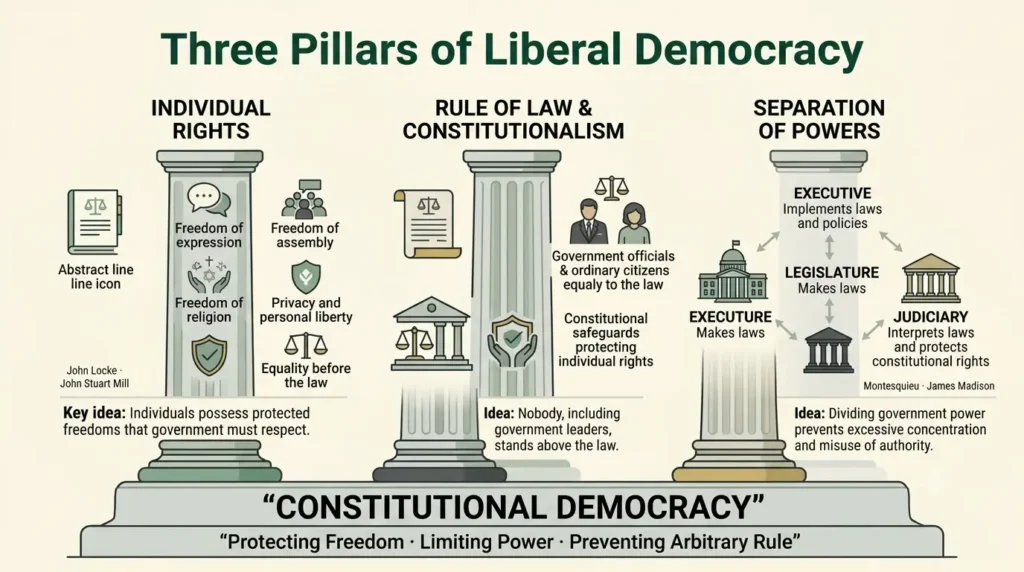
Liberal democracy is a way of governing that focuses on protecting people’s rights and freedoms, following the law, and preventing too much power from being held by one person or group. Three ideas stand at its core.
Individual rights and freedoms
What it means. Liberal democracy values personal freedoms: the right to speak freely, assemble peacefully, practise any religion, and keep personal matters private. The roots of this idea lie in John Locke’s argument, in the Two Treatises of Government (1689), that individuals have natural rights to life, liberty and property that government exists to protect. John Stuart Mill later gave the most influential defence of individual liberty in On Liberty (1859), arguing that society may restrict a person’s freedom mainly to prevent harm to others.
Main points.
- Freedom of expression: people can share ideas without fear of punishment from the government.
- Freedom of assembly: people can gather, protest and organise peacefully.
- Civil liberties: basic protections for life, liberty and property.
- Equality before the law: everyone has the same legal rights, so no one can be treated unfairly because of race, gender or similar grounds. Note that this is formal equality. Much of the Left critique below begins by asking whether formal equality is enough.
Rule of law and constitutionalism
What it means. The rule of law means that everyone, including government leaders, must follow the same laws. Constitutionalism means that the government’s powers are defined and limited by a constitution.
Main points.
- Equality before the law: people are treated alike by the law, whatever their status or wealth.
- Supremacy of law: law binds the government as well as citizens, which prevents arbitrary action.
- Constitutional safeguards: a constitution sets up the legal system and protects rights, often through a bill of rights, so the government acts within the law.
Separation of powers and checks and balances
What it means. The separation of powers divides government into parts with distinct duties. Checks and balances are the ways each part can limit the others. Montesquieu’s The Spirit of the Laws (1748) is the classic source, and James Madison developed the logic of controlling factions and power in Federalist No. 10 (1787) and related papers.
Main points.
- Separation of powers: government is usually divided into the executive (president or prime minister), the legislature (parliament or congress) and the judiciary (courts).
- Checks and balances: each branch can limit the others. Correction to the earlier version of this page: the example that the executive can reject laws and the legislature can override that rejection describes the presidential system of the United States (veto and override). It is not a universal rule. In parliamentary systems such as the United Kingdom and India, the executive is drawn from the legislature, so the separation is softer and the main checks are parliamentary questions, committees, confidence votes and judicial review.
- Independent judiciary: courts must be free of political pressure so they can protect rights and test whether laws and government actions follow the constitution.
Together, these principles aim to protect personal freedom, prevent misuse of power, and keep government open and fair.
Quick revision: three pillars
| Pillar | Core idea | Classic source | Main safeguard |
|---|---|---|---|
| Individual rights | People have protected freedoms | Locke; Mill | Bill of rights, civil liberties |
| Rule of law and constitutionalism | Law binds the rulers too | Constitutional tradition | Written or unwritten constitution, courts |
| Separation of powers | Power divided and checked | Montesquieu; Madison | Independent institutions |
Liberalism and Democracy: A Tension Worth Understanding
Many critiques make sense only once you see that liberalism and democracy are not natural allies. They answer different questions.
- Democracy asks who should rule? and answers: the many, on equal terms.
- Liberalism asks how much should any ruler be allowed to do? and answers: not everything, because individuals have rights that no ruler may override.
This produces a standing tension. Suppose a large majority votes to restrict a minority’s freedom. A democrat may say the majority decides. A liberal will say that some decisions are off limits. Alexis de Tocqueville worried about the “tyranny of the majority” in Democracy in America (1835, 1840), and Mill took the worry over into On Liberty. Liberal democracies manage the tension through constitutions and courts that can overrule majorities. Critics then reply that unelected judges overruling elected legislatures is itself a democratic problem. Scholars still disagree about where the balance should lie, and you should present it as an open debate in your answer.
Macpherson’s four models of liberal democracy
C. B. Macpherson, in The Life and Times of Liberal Democracy (1977), argued that liberal democracy has evolved through several models. This framework is a strong way to show examiners that you know the theory behind the critiques.
| Model | Associated thinkers | Core idea | View of the citizen |
|---|---|---|---|
| 1. Protective democracy | Bentham, James Mill | Voting protects individuals from rulers’ abuse | Self-interested individual |
| 2. Developmental democracy | J. S. Mill | Participation develops the moral and intellectual capacities of citizens | Person capable of growth |
| 3. Equilibrium (pluralist-elitist) democracy | Joseph Schumpeter and later pluralists such as Dahl | Democracy is competition among elites for votes; citizens mainly choose | Consumer of political goods |
| 4. Participatory democracy | Macpherson’s proposal; Carole Pateman | More direct, grassroots participation, including in workplaces | Active co-decision-maker |

Joseph Schumpeter’s Capitalism, Socialism and Democracy (1942) defined democracy as a method: an arrangement in which leaders win power by competing for the people’s votes. This “minimalist” or “competitive elitist” view is realistic and influential, but critics say it reduces citizens to voters and leaves little room for equality or participation. Macpherson’s own view is that models 3 and 4 correspond to the two directions in which critics push: either accept limited democracy, or deepen it.
Capitalism and Liberal Democracy
Historically, liberal democracy developed alongside capitalism, and defenders and critics read this relationship very differently. This section answers a question many students search for directly.
The defenders’ argument. Market-liberal thinkers such as Friedrich Hayek (The Constitution of Liberty, 1960) and Milton Friedman (Capitalism and Freedom, 1962) argued that economic freedom and private property support political freedom, because a society where the state controls all jobs and resources gives rulers too much power over citizens.
The critics’ argument. Marxists and many social-democratic thinkers argue the opposite: that capitalism produces inequalities of wealth and power which empty political equality of its content. Charles Lindblom, in Politics and Markets (1977), argued that business enjoys a “privileged position” in democracies because governments depend on private investment for jobs and growth, so they must keep business confident whatever voters want. Even Robert Dahl, a defender of liberal democracy, accepted that unequal resources distort political equality.
The liberal-egalitarian response. Thinkers such as John Rawls argue that liberal democracy can be reformed rather than abandoned. In his later work he insists that the “fair value” of political liberties must be protected, so that wealth does not translate into political power. For his theory of justice, see our notes on John Rawls’s Theory of Justice.
Contemporary illustration. In Association for Democratic Reforms v. Union of India (15 February 2024), a five-judge Constitution Bench of the Supreme Court of India unanimously struck down the Electoral Bonds Scheme, holding that anonymous electoral bonds violated voters’ right to information under Article 19(1)(a). The case is a useful live example of the money-and-politics worry that the Left critique raises, and of an independent judiciary acting as a check, which is exactly what the liberal-democratic design promises.
Critiques from the Left
Critics from the Left point to problems and unfairness in liberal democracy, especially around wealth gaps, capitalism and social justice. They argue that while liberal democracies talk about individual rights and freedoms, these rights mean little if they do not address deeper problems of power, wealth and fairness. The Left is not one school. This section separates four strands that the earlier version of the page ran together: the Marxist critique, the critique of economic inequality, the feminist critique, and the radical-democratic critique of exclusion.
Marxist perspectives on liberal democracy
What it says. Marxists see liberal democracy as a system that mainly benefits the wealthy class (the bourgeoisie) rather than truly representing the working class (the proletariat).
Key points.
- Rights and the bourgeois order. In On the Jewish Question (1843), Marx distinguished political emancipation (equal legal and political rights) from human emancipation (freeing people from the social conditions that dominate them). Liberal rights, he argued, give political emancipation but leave economic domination untouched.
- Class conflict. Marxists argue that liberal democracies do not resolve the basic conflict between owners and workers. Political freedoms are offered, but the economic system that produces inequality is unchanged. In the Communist Manifesto (1848), Marx and Engels described the modern state’s executive as managing the common affairs of the bourgeoisie as a whole.
- False consciousness. Marxists argue that ideas such as individual rights can keep workers from seeing their exploitation, so that workers appear to have power while the existing system stays intact. Correction to the earlier version: the page used the phrase “false awareness”. The standard term is false consciousness, and the phrase itself is usually traced to Engels’s later writing (a letter of 1893), not to Marx’s own major works.
- The state is not neutral. Marxists believe the state in a liberal democracy is used by the dominant class to protect its interests, so political reform alone cannot end economic exploitation.
Debates within Marxism, with attribution. Marxists disagree about how the state serves capital. Ralph Miliband (The State in Capitalist Society, 1969) stressed the personal and social ties between state elites and the business class. Nicos Poulantzas argued that the state has “relative autonomy” and serves capital through its structure, not through personal control. Antonio Gramsci’s idea of hegemony adds that dominant classes rule partly by winning consent, through culture and institutions.
Marx and Lenin on what comes next. Marx praised the Paris Commune (The Civil War in France, 1871) because its officials were elected, paid workers’ wages and could be recalled, a very different idea from periodic parliamentary elections. Lenin (The State and Revolution, 1917) described bourgeois democracy as democracy for a small class and called for a new state. Other socialists, notably Eduard Bernstein and Karl Kautsky in their different ways, argued that democracy, including universal suffrage and civil liberties, was essential to socialism, not a disguise for capitalism. So the Left is divided between those who want to replace liberal democracy and those who want to extend it.
The critique of economic inequality and capitalism
What it says. A major criticism from the Left is that liberal democracy does not fix the serious economic inequalities caused by capitalism. Political freedoms often offer little protection against huge gaps in wealth and power.
Key points.
- Wealth concentration. Critics argue that liberal democracy allows wealth to gather in a few hands or in large companies. This gives them excessive political influence and makes participation harder for most people.
- Economic exploitation. In capitalist systems, the Left argues, workers are exploited by owners who profit from their labour. The exploitation continues in liberal democracies, where businesses try to maximise profit while keeping wages low and conditions poor.
- Inequality and political power. Economic inequality gives the rich more power to influence elections and laws, which undermines the political equality that liberal democracy claims to uphold. (See the section on capitalism above for the Lindblom and Rawls arguments.)
Social justice and the welfare state
What it says. From a social-justice viewpoint, liberal democracy’s emphasis on individual rights often overlooks the needs of the community and existing inequalities. The Left wants a larger role for government in ensuring fairness, sharing wealth and providing essential services such as healthcare, education and housing.
Key points.
- Social justice. Social justice aims to correct deep inequalities affecting marginalised groups, including those defined by race, gender, sexual orientation and social class. Formal equality may exist, but the Left says true equality is often missing for historically disadvantaged groups. For the conceptual background, read our notes on Egalitarianism: Background Inequalities and Differential Treatment.
- Welfare state. The Left supports a strong welfare state to reduce poverty, provide universal healthcare and meet basic needs. It criticises market-centred liberal democracies for relying too heavily on market solutions.
- Economic and social rights. Left thinkers argue that liberal democracy should go beyond political rights and ensure economic rights, such as housing, education and healthcare, which are essential for dignity and real freedom. This links to the debate between civil-political and socio-economic rights in our notes on Natural, Moral and Legal Rights.
The feminist critique
Feminist theorists challenge both the history and the practice of liberal democracy.
- Carole Pateman, in The Sexual Contract (1988), argued that the social contract tradition that underlies liberal democracy rested on an unspoken sexual contract that placed women under men in the private sphere. She also wrote Participation and Democratic Theory (1970), a landmark of the participatory tradition.
- Susan Moller Okin (Justice, Gender and the Family, 1989) argued that liberal theories of justice largely ignored the family, where inequalities shape women’s chances in public life.
- Anne Phillips (The Politics of Presence, 1995) argued that who represents us matters, not only what ideas are represented, which supports measures such as quotas.
- Iris Marion Young (Justice and the Politics of Difference, 1990; Inclusion and Democracy, 2000) argued that structural inequalities and group differences need to be recognised in democratic design, not treated as irrelevant “private” characteristics.
Liberal reply. Liberal feminists answer that the framework of rights and equality can be, and has been, extended to women through suffrage, equal-pay laws and anti-discrimination law. The dispute is whether this extension is enough or whether the framework needs deeper change.
India link: the 73rd Constitutional Amendment (1992) reserves one-third of seats in panchayats for women, an instrument often discussed in debates on representation and presence.
The critique from exclusion: Ambedkar on social democracy
B. R. Ambedkar’s speech to the Constituent Assembly on 25 November 1949 is one of the clearest Indian statements of this critique. He warned that India was entering a life of contradictions: political equality (one person, one vote) alongside deep social and economic inequality. He argued that political democracy cannot last unless it rests on social democracy, a way of life that recognises liberty, equality and fraternity as principles of social life. Use this in answers on Left critiques or on India’s democracy to show that the critique is not only Western.
In conclusion, critiques from the Left argue that liberal democracy offers political freedoms but fails to address the deeper social and economic inequalities that come with capitalism. They call for significant changes in political and economic systems, pushing for policies that support social justice, economic equality and a greater role for government in caring for all citizens. Defenders respond that liberal institutions can themselves be used to reduce inequality, which is why the Left is divided between reformers and those seeking replacement.
Critiques from the Right
The Right often argues that while liberal democracy supports personal freedoms, it can harm social traditions, moral values and community bonds. Focusing too much on individualism, conservatives say, can weaken society, damage established institutions and lead to moral decline.
Two clarifications. First, the “Right” includes several different traditions that disagree with each other: traditional conservatives, authoritarian critics of parliamentary democracy, elitist thinkers, and market-liberal critics of unlimited majority rule. Second, in many countries conservatives work inside liberal democracy and defend it. The critique below is therefore a set of arguments by particular thinkers, not the view of all conservatives.
Conservative perspectives on liberal democracy
What it says. Conservative critics argue that liberal democracy, with its emphasis on individual rights, can put personal freedom above social stability, order and tradition. They fear this causes instability and breaks down long-standing norms.
Key points.
- Concern about rapid change. Edmund Burke’s Reflections on the Revolution in France (1790) is the founding text here. He criticised revolutionary politics built on abstract rights and argued that society is an inherited arrangement that should change gradually. Conservatives fear that fast political and social change can damage structures such as family, religion and community.
- The role of government. Liberals see government as a neutral guardian of individual rights. Conservative thinkers often see it as a defender of tradition and moral order that should support shared norms and values.
- Scepticism about abstract reason. Michael Oakeshott (Rationalism in Politics, 1962) criticised the idea that politics can be run by abstract principles; he preferred practical knowledge built up in a tradition.
Correction to the earlier version: the page listed “resistance to big changes” as a criticism of liberal democracy and also said conservatives oppose changing it, which was contradictory. The accurate point is that traditionalist conservatives are suspicious of rapid, rationalist reform, and some of them also doubt that liberal principles can hold a society together.
The role of tradition and social cohesion
What it says. A main criticism from the Right is that liberal democracy downplays tradition, community and shared identity. Focusing on individual freedom, conservatives argue, can lead to a loss of common moral and cultural values.
Key points.
- Value of tradition. Tradition, whether religious or cultural, gives people meaning and purpose, and liberal democracy often overlooks the need to keep it alive.
- Community and stability. Strong communities rest on shared values. Conservatives worry that liberal individualism divides people and makes social harmony and common purpose harder to achieve.
- Importance of institutions. Family, church and other institutions pass on values and keep order, and conservatives believe liberalism weakens them.
A related critique: communitarianism. Communitarian philosophers such as Michael Sandel (Liberalism and the Limits of Justice, 1982) and Alasdair MacIntyre (After Virtue, 1981) also argue that liberalism has a thin, “unencumbered” picture of the self, which ignores how communities shape who we are. Communitarians are not simply conservatives, and many are on the centre-left, but their argument overlaps with the conservative concern for community. This connects to the debates in our notes on Multiculturalism and Toleration.
The critique of moral relativism and cultural decay
What it says. Many conservative thinkers criticise liberal democracy for promoting moral relativism and cultural decline, arguing that the emphasis on individual freedom weakens shared moral values.
Key points.
- Moral relativism. The Right argues that liberal democracy lets many lifestyles and beliefs exist without a clear idea of right and wrong, which weakens the shared moral values that guide society.
- Cultural decline. Conservatives point to weakened traditional families, rising secularism and the loss of community values as signs of cultural problems caused by liberal freedom.
- Weakening of authority. They also argue that stressing rights over established norms erodes respect for authority in families and institutions.
Liberal reply, with attribution. Liberals reject the charge of relativism. John Rawls, in Political Liberalism (1993), distinguishes “reasonable pluralism”, the fact that reasonable people hold different deep beliefs, from relativism. He argues liberal democracy rests on a shared political commitment to fair terms of cooperation, not on the claim that all beliefs are equally true. Mill argued that diversity and “experiments in living” are good for society. Whether this answers the conservative worry about shared moral foundations is itself a contested question.
Other critiques associated with the Right
- Authoritarian critique (Carl Schmitt). In The Crisis of Parliamentary Democracy (1923), Schmitt argued that parliamentary liberalism, with its endless debate, cannot deal with real political conflict and emergencies, and that democracy rests on homogeneity of the people, not on liberal pluralism. He is a standard example of an anti-liberal critic of liberal democracy. His ideas are studied critically, and his later association with the Nazi regime is part of why they are treated with caution.
- Elite theory. Gaetano Mosca and Vilfredo Pareto argued that every society is ruled by a small organised minority. Robert Michels (Political Parties, 1911) formulated the “iron law of oligarchy”: even democratic organisations end up run by a few leaders. This challenges the claim that “the people” rule.
- Market-liberal and public-choice critique. Hayek and, in The Calculus of Consent (1962), James Buchanan and Gordon Tullock argued that unlimited majority rule can threaten property and liberty, and that politicians respond to organised interests and vote-seeking, so constitutional limits on government are needed. This is a critique of democracy from within liberalism.
In conclusion, critiques from the Right focus on the belief that liberal democracy’s emphasis on individualism and personal freedom can weaken social bonds, traditional values and clear morals. Conservatives argue that by focusing on rights while neglecting responsibilities, liberal democracy contributes to cultural decline, social fragmentation and weaker institutions. They call for a return to traditional values and social structures. Liberal defenders reply that freedom and pluralism are strengths, and that a society can hold shared civic values without enforcing one moral doctrine.
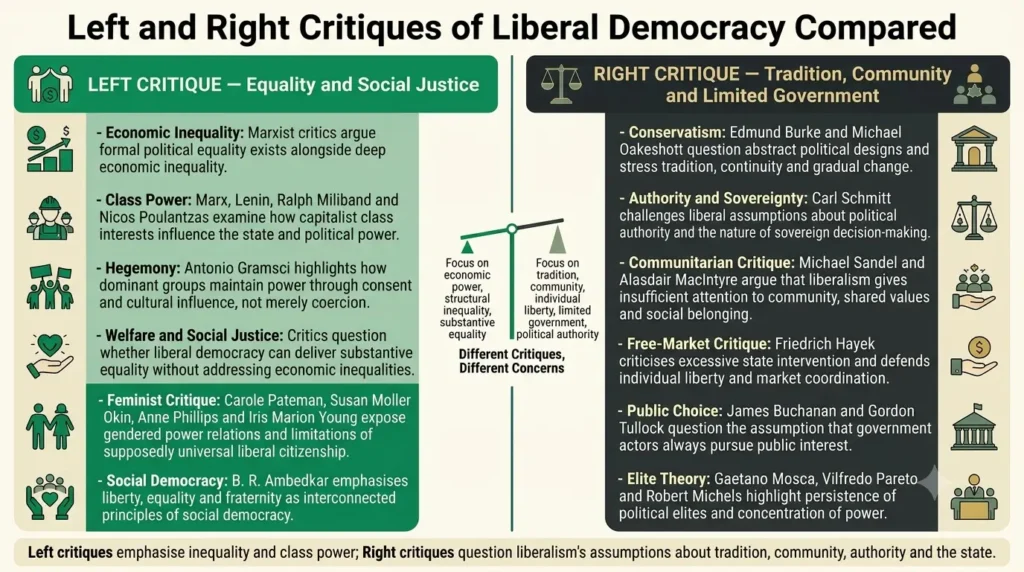
Left vs Right critique: comparison table
| Point | Critique from the Left | Critique from the Right |
|---|---|---|
| Main complaint | Rights are formal; inequality of wealth and power persists | Individualism weakens tradition, community and moral order |
| Chief targets | Capitalism, class power, exclusion | Relativism, rapid change, weakened institutions, unlimited majorities |
| Representative thinkers | Marx, Lenin (revolutionary strand); Macpherson, Pateman, Young (reformist and participatory strands) | Burke, Oakeshott, Schmitt; Hayek and Buchanan (market-liberal strand) |
| View of the state | Should reduce inequality and provide welfare | Should protect order and tradition (conservative) or be tightly limited (market-liberal) |
| Remedy | Social and economic equality, wider participation | Tradition, institutions, constitutional limits |
| Liberal reply | Reform: welfare state, fair value of political liberties | Pluralism is not relativism; shared civic values are enough |
Alternative Models of Democracy
Liberal democracy is often treated as the standard model of democracy today, though whether it is the most common form is debated, because many regimes hold elections without protecting liberal rights. Several alternative models point out its weaknesses and aim for deeper popular involvement. They stress participation, discussion and more far-reaching change. Here are three main alternatives.
Participatory democracy
What it is. This model encourages citizens to take an active part in decisions, not only to vote in elections. It promotes a system in which people help shape the rules and policies that affect their lives. Carole Pateman’s Participation and Democratic Theory (1970) is the standard academic source, and the 1962 Port Huron Statement of the American student movement Students for a Democratic Society helped popularise the phrase.
Main points.
- Direct involvement. Citizens engage in local governance and community life, with more public involvement at all levels of decision-making.
- Local control. Local communities get more power to decide, allowing solutions that suit their needs.
- Active citizenship. It aims to close the gap between elected officials and citizens through town meetings and citizen councils that give people a direct say in how resources are used.
- Critique of traditional democracy. It criticises representative democracy for being passive, with citizens voting and then disengaging.
Examples. Participatory budgeting in Porto Alegre, Brazil (started 1989), and the People’s Plan Campaign in Kerala (1996) are frequently cited. In India, the Gram Sabha under the panchayati raj system is the constitutional space for participation at the village level.
Deliberative democracy
What it is. This model focuses on thoughtful discussion among citizens when making political decisions. The legitimacy of decisions comes from collective reasoning, in which people share ideas and test them against each other. Key sources are Jürgen Habermas (Between Facts and Norms, 1992), Amy Gutmann and Dennis Thompson (Democracy and Disagreement, 1996) and John Dryzek (Deliberative Democracy and Beyond, 2000), which is on the DU additional-readings list.
Main points.
- Reasoned discussion. Rational conversations in which citizens share views and work toward well-considered conclusions.
- Inclusive dialogue. Everyone can take part, including ordinary citizens and experts.
- Consensus. Instead of simply following the majority, the model aims at agreements that reflect collective reasoning. Note a debate: not all deliberative theorists demand full consensus. Gutmann and Thompson accept that disagreement often remains and that decisions may still be made by voting after deliberation.
- Public reasoning. People give reasons for their positions that others can examine, which supports fairness.
- Critique of simple voting. It challenges the idea that democracy is only adding up individual votes.
Criticism. Iris Marion Young and others argued that “reasoned” debate can favour the articulate and the educated and so can exclude people whose style of speech is different. Chantal Mouffe argued that the search for rational consensus hides the fact that politics involves real conflict.
Radical and direct democracy
A clarification. The earlier version of this page treated “radical democracy” and “direct democracy” as one thing. They are related but different, and it helps to separate them.
Direct democracy means citizens decide issues themselves rather than through representatives. Examples include the Athenian assembly, the Swiss cantonal assemblies and referendums, and New England town meetings.
Radical democracy is a broader family of ideas that aims to deepen and extend democracy into economic and social life and to challenge hierarchies. It is often linked to anarchist and socialist movements. In contemporary theory, Ernesto Laclau and Chantal Mouffe (Hegemony and Socialist Strategy, 1985) developed radical and plural democracy, and Mouffe’s later idea of agonistic pluralism (The Democratic Paradox, 2000) holds that democratic politics should turn enemies into adversaries who contest each other legitimately, not seek a final consensus. This version of radical democracy does not abolish representation.
Main points.
- Direct action. Citizens make decisions themselves, by voting directly on issues or taking part in policy-making.
- Changing power structures. Radical democrats call for major change in institutions to remove oppressive power relations and give people control over political and economic life.
- Focus on equality. The aim is to reduce social and economic inequality and empower marginalised groups.
- Self-management. Some strands promote self-managed communities and workplaces, such as workers’ councils.
- Critique of representative democracy. Advocates argue that rule by a few representatives produces inequality and often serves the powerful.
- Historical examples. The Paris Commune (1871) and the workers’ councils (soviets) of the Russian revolutions are often cited as attempts at radical, council-based democracy, though how democratic they were is debated.
Criticism. Direct democracy is hard to run in large, complex societies, and it can allow majorities to override minorities, which was the original liberal worry.
Comparison: participatory, deliberative, and radical and direct democracy
| Feature | Participatory | Deliberative | Radical and direct |
|---|---|---|---|
| Core idea | More citizen involvement in decisions | Decisions legitimate when based on public reasoning | Deepen democracy or let people decide directly |
| Main thinkers | Pateman, Macpherson | Habermas, Gutmann and Thompson, Dryzek | Laclau and Mouffe; Marx on the Commune |
| Where it focuses | Local government, workplaces, budgets | Quality of discussion | Power structures, equality, self-management |
| View of voting | Not enough on its own | Should follow reasoned debate | Direct voting or council decisions |
| Main criticism | Time, scale, unequal participation | Excludes the less articulate | Scale; risk of majority rule |
For the connected exam debate, read Debate: Representation vs. Participation.
In conclusion, these alternative models highlight the shortcomings of liberal democracy, especially its focus on representation and its concentration of power. Participatory democracy calls for more citizen engagement, deliberative democracy values informed discussion in decision-making, and radical and direct democracy challenges traditional systems in order to create a fairer and more participatory approach. These models aim at a more inclusive and active democratic experience, in which power is held more directly by the people and less by a distant political class.
Liberal Democracy in India
India is often discussed as a liberal democracy because it has a written constitution, fundamental rights, an independent judiciary with the power of judicial review, and regular competitive elections. The unit asks you to evaluate critiques, and India offers examples on both sides.
- Constitutional limits on majorities. In Kesavananda Bharati v. State of Kerala (1973), the Supreme Court held that Parliament cannot alter the “basic structure” of the Constitution. Supporters see this as protection against majority overreach. Critics ask whether unelected judges should hold such power, which is the democratic objection mentioned earlier.
- Strain on liberal safeguards. The Emergency (1975–77) suspended civil liberties and curtailed press freedom, which shows how formal safeguards can be weakened.
- Social democracy. Ambedkar’s 1949 warning (above) links the liberal-democratic framework to the question of caste and class inequality.
- Money and politics. The 2024 electoral bonds judgment (above) addresses the Left’s concern about wealth and political influence.
- Participation. The Gram Sabha and the panchayati raj system are often discussed as experiments in participatory democracy.
Scholars disagree about how to classify India in comparative indices, and the ratings change from year to year. When writing an answer, present such classifications as contested.
Conclusion
Liberal democracy combines popular rule with limits on power: free elections, individual rights, the rule of law and a division of powers. Its critics do not all say the same thing. The Left argues that rights without economic equality are hollow, and Marxists add that the state serves capital, though other Left thinkers want to extend liberal democracy, not abolish it. Feminists and theorists of difference argue that its universal language hides gendered and group-based exclusion. The Right argues that individualism and relativism weaken community and tradition, and market-liberal and elitist critics argue that unlimited majority rule or the “iron law of oligarchy” undermines liberty or genuine popular rule. Alternative models, namely participatory, deliberative, and radical and direct democracy, each try to supply what they think liberal democracy lacks: participation, reasoned discussion, and real equality of power.
For exams, the strongest answers do three things. They define liberal democracy precisely, separate liberalism from democracy, and treat the critiques as a debate in which each critic and each liberal reply is attributed to a thinker.
Five-line revision
- Liberal democracy = competitive elections + protected rights + rule of law + limited government.
- Liberalism limits power; democracy distributes it. The tension between them drives most critiques.
- Left critique: formal rights, real inequality (Marx, Macpherson, Pateman, Ambedkar).
- Right critique: individualism and relativism erode tradition and community (Burke, Oakeshott, Schmitt, with Hayek and Buchanan from the market-liberal side).
- Alternatives: participatory (Pateman), deliberative (Habermas, Gutmann and Thompson), radical and direct (Mouffe; council democracy).
Continue Reading
Read the rest of Unit 5 and the connected concepts in order:
| Article | Why read it next |
|---|---|
| (a) Democracy: Idea and Practice | Origins, types and challenges of democracy; the base for this unit |
| (c) Multiculturalism and Toleration | The next part of Unit 5; extends the communitarian and difference debates |
| Debate: Representation vs. Participation | The unit’s closing debate, which builds on the alternative models above |
| John Rawls’s Theory of Justice | The liberal-egalitarian reply to inequality critiques |
| Egalitarianism: Background Inequalities and Differential Treatment | Concept behind the Left critique of formal equality |
University of Delhi Previous Year Questions
DU Previous Year Questions
Frequently asked questions from DU exam papers on this topic. Tap a question to view a quick-answer guide.
1 Discuss the core features of liberal democracy and provide the Marxian critique of it. [DU 2026, Q.7] +
2 Define democracy. How does deliberative democracy differ from participatory democracy? +
3 Write a short note on: Deliberative Democracy. [DU 2026, Q.10(c)] +
4 Write a short note on: Republican Theory of Democracy. +
5 Discuss the importance of freedom of speech and expression in a democratic society. Analyse the ethical and legal limits imposed on this freedom in democracy. [DU 2026, Q.2] +
6 Discuss the importance of freedom of speech and expression as articulated by J.S. Mill. +
Frequently Asked Questions
What is the difference between liberal democracy and democracy?
Democracy means rule by the people on the basis of equality. Liberal democracy adds limits on those who rule: protected individual rights, the rule of law and constitutional checks. A democracy without these limits can still hold elections but may violate liberties.
Is “liberal” in liberal democracy the same as a liberal political party?
No. It refers to liberalism as a philosophy that stresses individual freedom and limited government, drawing on thinkers such as Locke and Mill.
What is the difference between liberal democracy and electoral democracy?
Both hold competitive elections. Liberal democracy also protects civil liberties and judicial independence, while an electoral democracy may do so weakly. Scholars debate how to measure the difference.
Why do Marxists criticise liberal democracy?
They argue that equal political rights leave economic power unchanged, so the state tends to serve the owning class. Marx drew a line between political emancipation and human emancipation.
Do all critics from the Left want to abolish liberal democracy?
No. Revolutionary Marxists such as Lenin wanted to replace it, but social democrats, liberal egalitarians such as Rawls, and participatory theorists such as Pateman and Macpherson want to reform or deepen it.
What is Macpherson’s contribution to this unit?
In The Life and Times of Liberal Democracy (1977), he described four models: protective, developmental, equilibrium and participatory. They help to organise the critiques and show how the theory changed.
Is the conservative critique the same as the Right-wing critique?
Not exactly. The “Right” includes traditional conservatives (Burke, Oakeshott), authoritarian critics (Schmitt) and market-liberal critics (Hayek, Buchanan). They disagree among themselves, and many conservatives support liberal democracy.
Does liberalism lead to moral relativism?
Conservative critics say it does. Liberals such as Rawls reply that liberalism accepts “reasonable pluralism” while resting on shared political principles, so it is not relativism. Treat this as an open debate.
How is deliberative democracy different from participatory democracy?
Participatory democracy stresses more people taking part in decisions. Deliberative democracy stresses the quality of reasoning behind decisions. They can work together but answer different problems.
Which Indian examples can I use in an answer?
Ambedkar’s 1949 speech on social democracy, the basic structure doctrine from Kesavananda Bharati (1973), the Emergency (1975–77), the 2024 electoral bonds judgment, and panchayati raj institutions. State each in one or two sentences and link it to the argument.
Should I memorise the thinkers’ book titles and years?
Name the thinker and the main idea first; add the title and year where you are sure of them. Accuracy matters more than the number of names.
Are Dahl’s Democracy and Its Critics and this unit the same?
No. Dahl’s book is a major work on democratic theory and is a good source to cite, but the DU unit is broader and built around the liberal-democratic model and its critiques.
Sources and Further Reading
Subscribe to keep reading
You've used your free notes for now. Get Delhi Pathshala Premium for unlimited access.
Subscribe — ₹29/30 days