
Contents
- Who Was Kalidasa and When Did He Live?
- Famous Works of Kalidasa
- Abhijnana Shakuntalam at a Glance
- Abhijnana Shakuntalam Summary (Act-wise)
- Act 1: Shakuntala Meets Dushyanta
- Act 2: The King’s Growing Love
- Act 3: The Gandharva Marriage
- Act 4: The Curse of Durvasa
- Act 5: Rejection at the Royal Court
- Act 6: The Ring Is Found
- Act 7: Reunion in the Heavens
- Conclusion
- Main Themes of Abhijnana Shakuntalam
- 1. Love and Romance
- 2. Duty and Responsibility (Dharma)
- 3. Memory and Forgetfulness
- 4. Nature and Beauty
- Abhijnana Shakuntalam Characters Analysis
- Shakuntala
- King Dushyanta
- Sage Durvasa
- Sage Kanva
- Anasuya and Priyamvada
- Madhavya
- Sutradhara (Stage Manager)
- What Is the Curse of Shakuntala in Abhijnana Shakuntalam?
- Background of the Story
- The Curse by Sage Durvasa
- The Ring and Its Importance
- Breaking the Curse
- Importance of the Curse in the Story
- How Is Abhijnana Shakuntalam Relevant to Indian Culture and Literature?
- The Original Story in the Mahabharata vs. Kalidasa’s Adaptation
- Context in the Mahabharata
- How Kalidasa Innovated on the Original
- Poetic Language, Imagery and Symbolism in the Play
- Ancient Indian Aesthetics in the Play: Rasa, Alamkara, Dhvani
- Influence of Bharata’s Natyashastra
- Important Questions on Abhijnana Shakuntalam (DU Exam Prep)
- FAQs on Abhijnana Shakuntalam
- Further Reading
In this post, notes of Unit 2 (Kalidasa’s Shakuntala – Abhijnana Shakuntalam) from DSC – 3 (Indian Classical Literature) are given, which will help students doing their graduation this year. This post covers the full act-wise summary, themes, character analysis, the famous curse of Durvasa, and important exam questions for DU BA English (Hons.) students.
Who Was Kalidasa and When Did He Live?
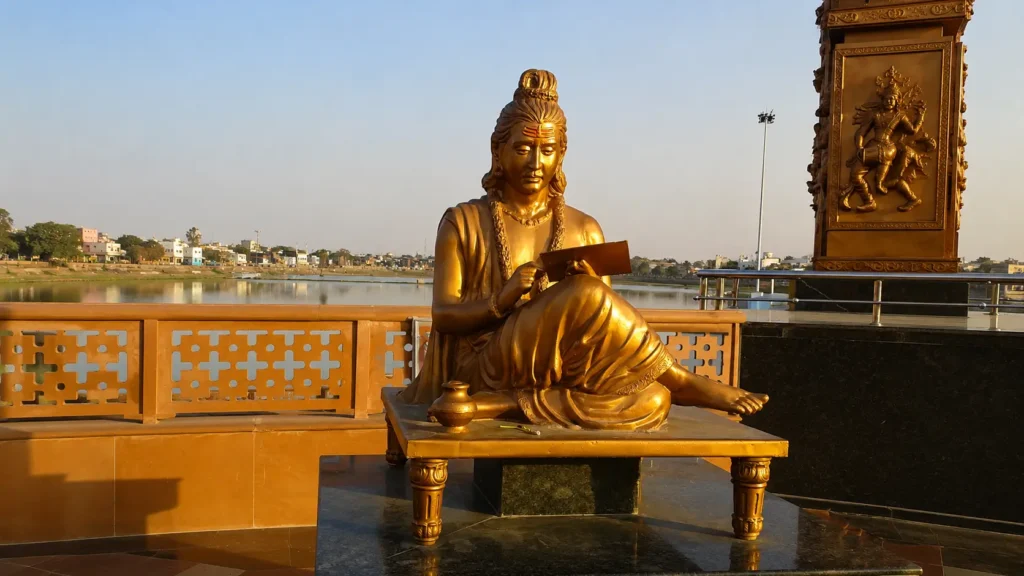
Kalidasa was a classical Sanskrit poet and playwright, widely regarded as one of the greatest writers in the Sanskrit language. Unfortunately, very little is known about his life, and there is significant uncertainty regarding the exact period in which he lived. The traditional consensus places Kalidasa in the 4th or 5th century CE, likely during the Gupta period — often called the Golden Age of Indian culture.
It’s important to note that historical details about Kalidasa’s life are not well-documented; much of what is known is based on legend and later tradition. Despite this, his literary contributions have left an indelible mark on classical Indian literature, and Kalidasa is often referred to as the “Shakespeare of India.”
Famous Works of Kalidasa
- Shakuntala (Abhijnana Shakuntalam): Kalidasa’s most famous play, telling the story of King Dushyanta and Shakuntala. A masterpiece of Sanskrit drama, renowned for its lyrical beauty.
- Meghaduta (The Cloud Messenger): A lyric poem where a Yaksha, separated from his beloved, instructs a passing cloud to carry his message to her.
- Raghuvamsha: An epic poem (mahakavya) narrating the lineage of the Raghu dynasty, focusing especially on the life of Lord Rama.
- Kumarasambhava: An epic narrating the birth of the god Kartikeya and the marriage of Shiva and Parvati.
- Ritusamhara: A lyrical work celebrating the six seasons of India.
Related reading: Mahabharata by Vyasa – Summary, Themes, Character Analysis | Cilappatikaram Summary and Analysis
Abhijnana Shakuntalam at a Glance
| Detail | Information |
|---|---|
| Author | Kalidasa |
| Language | Sanskrit (with Prakrit dialogues for some characters) |
| Genre | Natika (romantic drama) |
| Number of Acts | 7 |
| Source | An episode from the Adi Parva of the Mahabharata |
| Famous English Translation | The Loom of Time by Chandra Rajan (Penguin Classics) |
| Central Theme | Love, memory, duty (dharma), and recognition |
Abhijnana Shakuntalam Summary (Act-wise)
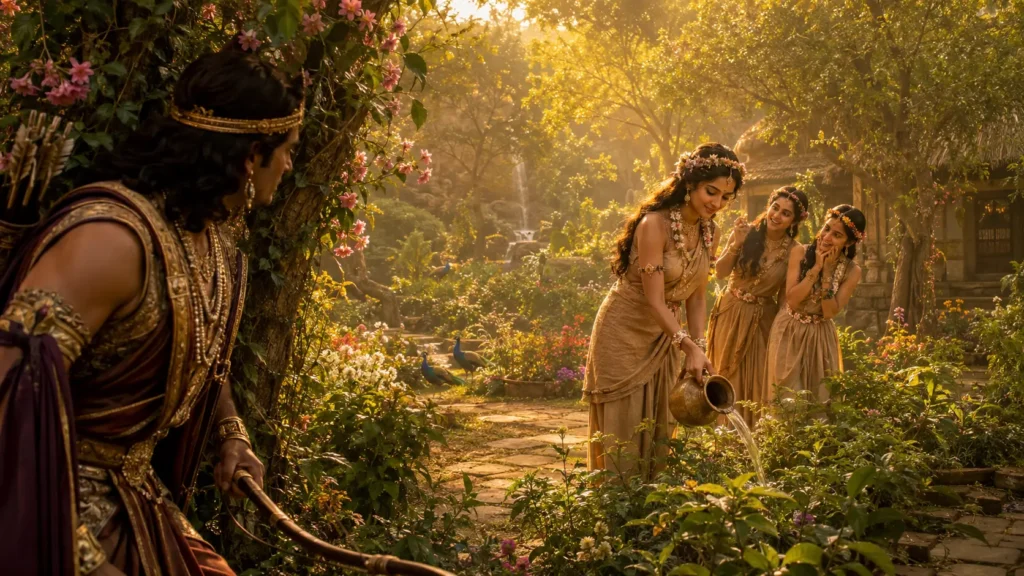
Abhijnana Shakuntalam, also called Shakuntala, is a famous Sanskrit play by Kalidasa. It expands on a story from the Mahabharata about love, duty, and fate, and unfolds across seven acts.
Act 1: Shakuntala Meets Dushyanta
While hunting, King Dushyanta chases a deer into the forest and arrives at the hermitage of Sage Kanva. There he meets Shakuntala — raised by Kanva after being abandoned as a baby — and falls in love with her beauty and virtue.
Act 2: The King’s Growing Love
Dushyanta stays on in the hermitage, torn between his royal duties and his feelings for Shakuntala. His comic companion, the court jester Madhavya, provides humorous commentary during this act.
Act 3: The Gandharva Marriage
Shakuntala and Dushyanta marry through Gandharva Vivaha, a form of marriage based on mutual consent, without formal rituals. Dushyanta gives her a royal ring as a token of their union before being called back to his kingdom.
Act 4: The Curse of Durvasa
After Dushyanta leaves, Shakuntala becomes lost in thoughts of him. When the short-tempered Sage Durvasa visits the hermitage, she fails to greet him properly. Durvasa curses her: Dushyanta will completely forget her. Her friends persuade the sage to soften the curse — it will be lifted the moment Dushyanta sees a personal token of their marriage.
Act 5: Rejection at the Royal Court
Shakuntala, now pregnant, travels to Hastinapura to reunite with Dushyanta. Because of the curse, he doesn’t recognise her. She reaches for the ring as proof — but it was lost while she bathed in a river on the way. Heartbroken and humiliated, Shakuntala is taken away, and a celestial being carries her off.
Act 6: The Ring Is Found
A fisherman discovers the ring inside a fish and brings it to Dushyanta. The moment he sees it, his memory returns, and he is overwhelmed with remorse for rejecting his own wife.
Act 7: Reunion in the Heavens
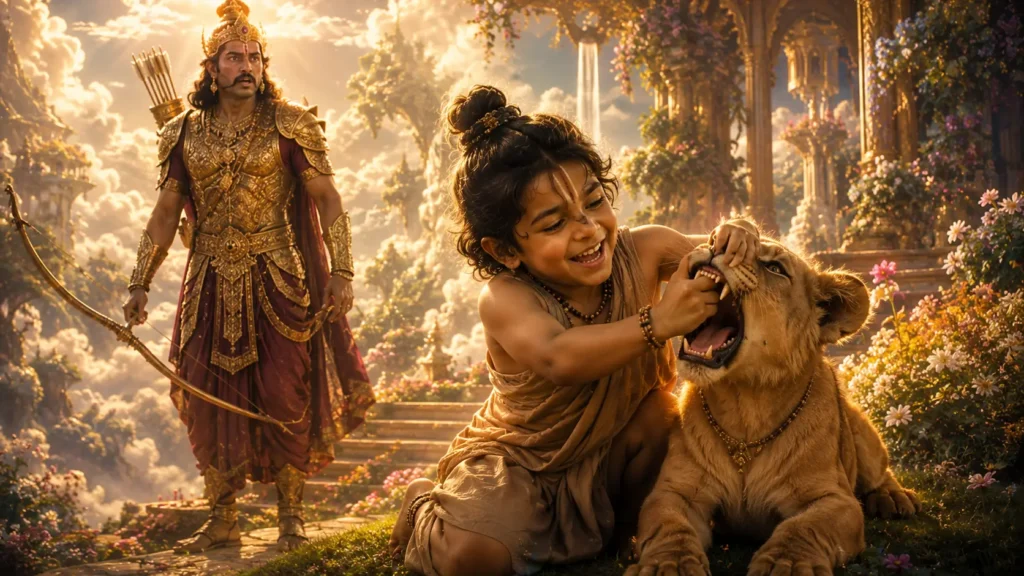
Years later, Dushyanta encounters a young boy prising open a lion cub’s mouth at a hermitage in the heavens — the boy turns out to be his own son. This leads to his joyful reunion with Shakuntala. The play closes with the family united, blessed by sage Marica and the gods.
Conclusion
Abhijnana Shakuntalam is a touching story about love, identity, and the challenges of fate. Kalidasa skilfully combines romance, drama, and comedy, making it a timeless tale. The couple’s son, Bharata, later becomes a legendary emperor — and is traditionally linked to the name Bharatavarsha, one of India’s own names.
Related reading: Aristophanes’ Lysistrata – Summary, Analysis, Poetic Devices | Sophocles’ Antigone – Summary and Analysis
Main Themes of Abhijnana Shakuntalam
1. Love and Romance
The central theme is the love between King Dushyanta and Shakuntala — marked by intensity and purity, moving through infatuation, deep affection, and the pain of separation.
2. Duty and Responsibility (Dharma)
The play underscores the tension between personal desire and royal duty. As a king, Dushyanta must prioritise his kingdom and subjects over private matters.
3. Memory and Forgetfulness
A pivotal twist occurs when Dushyanta forgets his own marriage because of Durvasa’s curse. This “consequence of forgetfulness” drives the rest of the plot and raises questions about the reliability of memory itself.
4. Nature and Beauty
Kalidasa weaves rich descriptions of nature throughout the play — the changing seasons, flowers, and landscapes mirror the emotional states of the characters.
Abhijnana Shakuntalam Characters Analysis
Shakuntala
The daughter of Sage Vishwamitra and the celestial nymph Menaka. Abandoned at birth, she is raised by Sage Kanva in his hermitage. Kalidasa portrays her with innocence, vulnerability, and deep poetic sensibility — she matures from a naive girl into a resilient woman over the course of the play.
King Dushyanta
A powerful king of Hastinapura who falls in love with Shakuntala and marries her through Gandharva Vivaha. He is portrayed as a complex figure — a romantic hero who is also genuinely at fault for his forgetfulness, and whose remorse and redemption are central to the play’s emotional arc.
Sage Durvasa
Known for his short temper, Durvasa curses Shakuntala when she fails to greet him properly. This curse becomes the catalyst for the entire second half of the play.
Sage Kanva
Shakuntala’s foster father, who raises her in his hermitage with compassion and wisdom. Before she leaves for Dushyanta’s court, Kanva gives her advice on how to conduct herself as a wife.
Anasuya and Priyamvada
Anasuya and Priyamvada are Shakuntala’s two closest friends in the hermitage. They support her through her romance with Dushyanta, plead with Durvasa to soften his curse, and accompany her in her hour of need.
Note: Anasuya here should not be confused with the Anasuya of Puranic legend who is married to Sage Atri — in Kalidasa’s play, Anasuya is simply Shakuntala’s hermitage friend.
Madhavya
The king’s Vidushaka (court jester/companion) — a Brahmin friend of Dushyanta who provides comic relief and often voices the audience’s own doubts about the king’s actions.
Sutradhara (Stage Manager)
A theatrical device introduced by Kalidasa: the Sutradhara opens the play, interacts with the audience, and sets the tone before the main action begins.
What Is the Curse of Shakuntala in Abhijnana Shakuntalam?
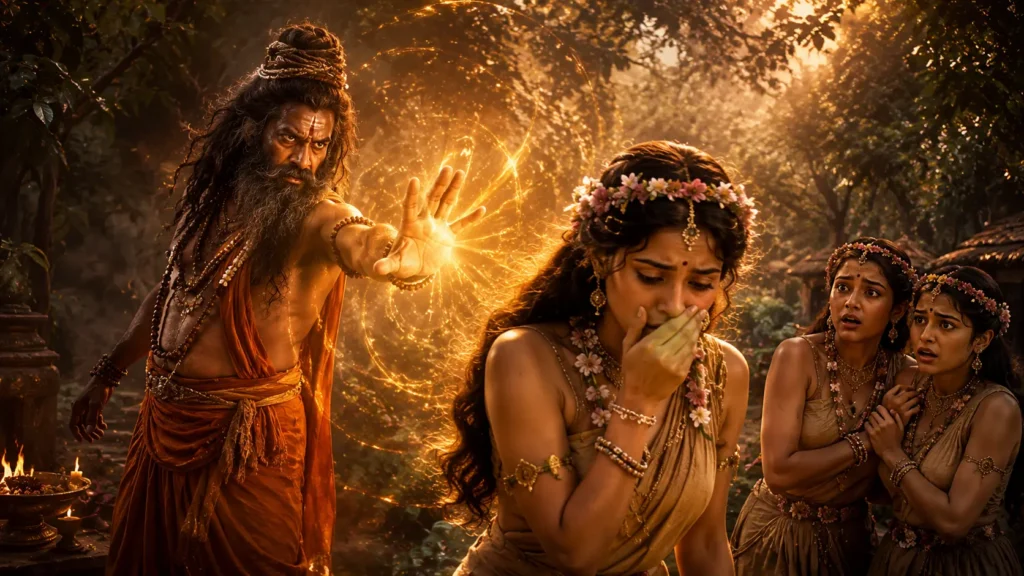
In Abhijnana Shakuntalam (“The Recognition of Shakuntala”), the curse of Sage Durvasa is the pivot around which the entire plot turns.
Background of the Story
Shakuntala, daughter of Sage Vishwamitra and the nymph Menaka, is raised in Kanva’s hermitage. King Dushyanta meets her while hunting, and they marry through Gandharva Vivaha. He leaves for his kingdom, promising to return.
The Curse by Sage Durvasa
Lost in thoughts of Dushyanta, Shakuntala fails to greet the visiting Sage Durvasa properly. Enraged, he curses her: the man she is dreaming of will forget her entirely, just as she forgot her duty to a guest. Her friends’ pleas soften the curse slightly — it can be lifted if Dushyanta sees a personal token of their bond.
The Ring and Its Importance
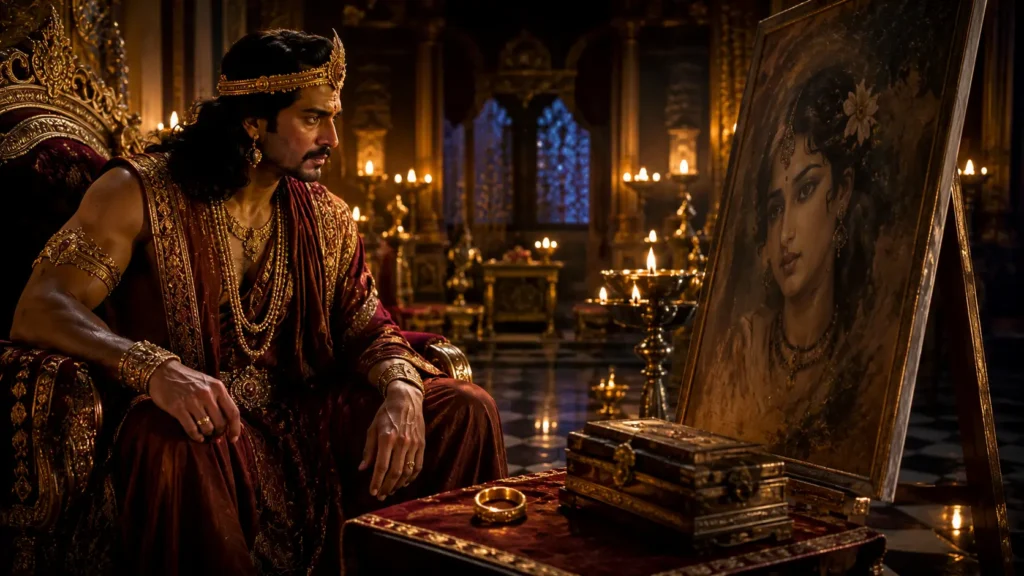
Shakuntala’s friends advise her to carry the royal ring Dushyanta gave her as proof of their marriage. But she loses it in a river on the way to his court — leaving her without any way to prove her identity.
Breaking the Curse
A fisherman later finds the ring inside a fish and brings it to Dushyanta. The sight of the ring restores his memory instantly, and he is consumed by guilt for rejecting her.
Importance of the Curse in the Story
- Test of Love – The curse tests the strength of Shakuntala and Dushyanta’s bond.
- Fate and Divine Help – It shows how divine forces intervene in human lives, while true love still triumphs.
- Symbolic Journey – It creates the separation-and-reunion arc that deepens their relationship.
- Moral Lessons – Kalidasa uses it to comment on hospitality, memory, and social duty.
How Is Abhijnana Shakuntalam Relevant to Indian Culture and Literature?
- Cultural Values – Reflects ancient Indian ideals of virtue, duty, and righteousness, especially around royal responsibility.
- Love and Relationships – Celebrates the sanctity of marriage and enduring familial bonds.
- Nature and Aesthetics – Kalidasa’s descriptions of seasons and landscapes reflect the Indian tradition of finding divinity in nature.
- Dharma and Moral Dilemmas – Explores the tension between personal desire and righteous duty.
- Mythology and Spirituality – Weaves in sages, apsaras, and curses from Indian mythology.
- Literary Legacy – Cemented Kalidasa’s place as one of the greatest poets in Sanskrit literature.
- Adaptations and Influences – Reinterpreted across regional languages, dance, and theatre — it even influenced Goethe’s Faust.
- Universality of Human Emotions – Its themes of love, separation, and joy remain relatable across cultures and eras.
- Educational and Scholarly Impact – Continues to be studied for its linguistic richness and poetic beauty.
The Original Story in the Mahabharata vs. Kalidasa’s Adaptation
Context in the Mahabharata
The story of Shakuntala and Dushyanta appears in the Adi Parva (Book of the Beginning) of the Mahabharata, in the section known as the Adivamsavatarana Parva — the genealogy of the heroes. Shakuntala’s son, Bharata, becomes a significant ancestor of the Kuru dynasty, giving this episode importance for establishing the Bharata lineage central to the entire epic.
How Kalidasa Innovated on the Original
While the Mahabharata’s version is comparatively simple and free of a curse-driven twist, Kalidasa transformed it into a poetic masterpiece through several original additions:
- The Ring Episode – Not present in the Mahabharata; Kalidasa invented the loss and recovery of the ring as the dramatic hinge of the plot.
- Refined Characterisation of Shakuntala – A more nuanced, emotionally complex portrayal emphasising her innocence and vulnerability.
- The Kama Scene – A poetic, sensuous depiction of Shakuntala daydreaming about Dushyanta.
- The Sutradhara – A theatrical device that engages directly with the audience.
- Elaboration of Minor Characters – Kanva, Priyamvada, Anasuya, and Madhavya are all given individual depth absent from the epic source.
- The Ritusamhara-style Treatment of Seasons – Seasonal imagery is used symbolically to mirror the characters’ emotional states.
- Humour – Witty court-scene dialogues, largely carried by Madhavya, lighten the emotional intensity.
Poetic Language, Imagery and Symbolism in the Play
- Poetic Language: Lyrical verses rich in metaphor, simile, and rhythmic dialogue.
- Imagery: Extensive nature imagery — seasons, flowers, and landscapes — alongside tastefully handled romantic imagery.
- Symbolism: The royal ring symbolises the challenges and eventual resolution of the couple’s relationship; seasonal changes symbolically track the emotional arc of the story.
- Dramatic Techniques: Detailed stage directions, the Sutradhara as narrative bridge, humour through Madhavya, and introspective monologues.
Ancient Indian Aesthetics in the Play: Rasa, Alamkara, Dhvani
Kalidasa’s mastery lies in his application of classical Sanskrit aesthetic theory:
- Rasa (emotional essence): The play moves through Sringara (romantic), Karuna (pathos), Hasya (comic), and Shanta (tranquil) rasas — as outlined in Bharata Muni’s Natyashastra.
- Alamkara (poetic ornamentation): Metaphors and similes elevate the emotional and aesthetic quality of the verses.
- Dhvani (suggestion): Meaning that resonates beyond the literal words, per Anandavardhana’s Dhvanyaloka.
- Vakrokti (oblique expression): Indirect, figurative speech that engages the audience’s intellect.
- Riti (style): The tone and language are matched carefully to the emotional content of each scene.
Influence of Bharata’s Natyashastra
Kalidasa closely follows Bharata Muni’s classification of the nine rasas, character typology (Nayika/Nayaka), and technical guidance on staging — making Abhijnana Shakuntalam a textbook application of classical Sanskrit dramatic theory.
Important Questions on Abhijnana Shakuntalam (DU Exam Prep)
- Discuss the theme of love and duty in Abhijnana Shakuntalam.
- How does Kalidasa depart from the Mahabharata’s original version of the Shakuntala story?
- What is the significance of the ring in the play?
- Explain the curse of Sage Durvasa and its role in the plot.
- Write a character sketch of Shakuntala / Dushyanta.
- What is the role of the Sutradhara in the play?
- Discuss the role of nature imagery in Abhijnana Shakuntalam.
- What is the function of Madhavya (the Vidushaka) in the play?
- How does the play reflect the concept of rasa as outlined in the Natyashastra?
(Tip: pair each of these with the relevant section above while revising — the answers you need are already covered act-wise and theme-wise in this post.)
FAQs on Abhijnana Shakuntalam
Who wrote Abhijnana Shakuntalam?
Abhijnana Shakuntalam was written by the classical Sanskrit poet and playwright Kalidasa, believed to have lived in the 4th–5th century CE.
How many acts does Abhijnana Shakuntalam have?
The play has seven acts, tracing the story from Shakuntala and Dushyanta’s meeting to their eventual reunion in the heavens.
What is the central theme of Abhijnana Shakuntalam?
The central themes are love, duty (dharma), memory and forgetfulness, and recognition — how true love ultimately overcomes even a divine curse.
Why is the ring important in the play?
The royal ring is the token of Shakuntala and Dushyanta’s marriage. Its loss causes Dushyanta to disbelieve her identity, and its recovery restores his memory, resolving the central conflict.
Who are Shakuntala’s parents?
Shakuntala is the daughter of Sage Vishwamitra and the celestial nymph Menaka. She is raised by the sage Kanva after being abandoned as an infant.
What episode did Kalidasa add that isn’t in the Mahabharata?
The episode of the ring being lost and later found inside a fish is Kalidasa’s own invention — it does not appear in the Mahabharata’s version of the story.
Related: Mahabharata by Vyasa Summary, Themes, Character Analysis
Further Reading
📖 Want to read Kalidasa’s original play in full?
Read Full English Translation →Subscribe to keep reading
You've used your free notes for now. Get Delhi Pathshala Premium for unlimited access.
Subscribe — ₹29/30 days