
Contents
- What is Versification?
- Elements of Versification
- Meter
- Rhyme
- Stanza
- Free Verse vs. Blank Verse
- Rhythm
- Elements of Poetic Syntax
- Types and Patterns of Versification
- Functions and Effects of Versification
- Variations and Deviations in Versification
- Important Questions from This Unit (Exam-Focused)
- FAQs
- Related Notes
In this post, notes of Unit 2 (Reading Poetry – Introduction to Versification and Poetic Syntax) from DSC-1 (Introduction to Literary Studies) are given, based on Margaret Ferguson, Mary Jo Salter, and Jon Stallworthy’s essay in The Norton Anthology of Poetry — helpful for DU BA English (Hons) students this semester.
Versification and poetic syntax are the two structural pillars of poetry. Versification governs the sound pattern of a poem — rhyme, meter, and stanza — while poetic syntax governs the arrangement of words and sentences for rhythmic and rhetorical effect. Together, they turn ordinary language into verse.
What is Versification?
Versification is the art of composing verse — the technical arrangement of rhyme, meter, and stanzaic form that gives a poem its musical shape.
What is Poetic Syntax?
Poetic syntax is the deliberate arrangement of words, phrases, and sentence order in a poem to create rhythm, emphasis, or ambiguity — often departing from normal prose word order.
Elements of Versification
Meter
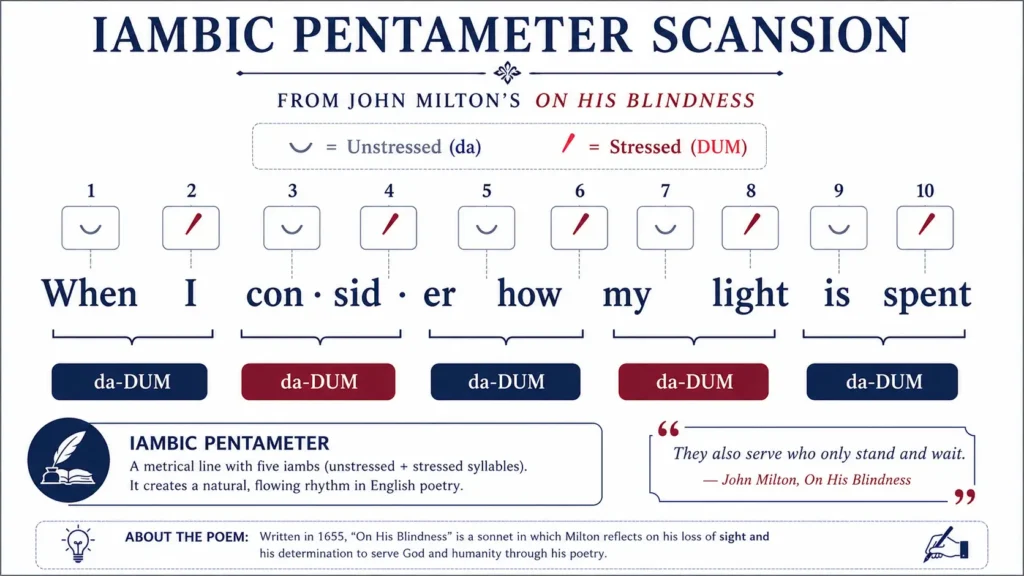
The rhythmic pattern of stressed and unstressed syllables in a line.
- Iambic Pentameter – 10 syllables per line, unstressed-stressed pattern (e.g., Shakespearean sonnets, and Milton’s “On His Blindness” — see our notes on Milton’s sonnet for a full scansion breakdown).
- Trochaic Tetrameter – four trochees (stressed–unstressed) per line.
- Anapestic Hexameter – six anapests (two unstressed + one stressed) per line.
Quick example (scansion): “When I | conSID | er HOW | my LIGHT | is SPENT” — five iambic feet = iambic pentameter (Milton, “On His Blindness”).
Rhyme
- End Rhyme – words at line-ends rhyme.
- Internal Rhyme – rhyming words within the same line.
- Slant Rhyme (Half Rhyme) – similar but not identical sounds.
- Rhyme Scheme – the pattern of rhymes, marked with letters (ABAB, AABB).
Stanza
A stanza is a group of lines separated by space: Couplet (2 lines) · Tercet (3) · Quatrain (4) · Sestet (6) · Octave (8).
Free Verse vs. Blank Verse
- Free Verse – no fixed rhyme scheme or meter; allows expressive freedom.
- Blank Verse – unrhymed iambic pentameter, common in dramatic and narrative poetry.
Rhythm
The overall pattern of stresses and pauses that gives a poem its musicality and flow.
Elements of Poetic Syntax
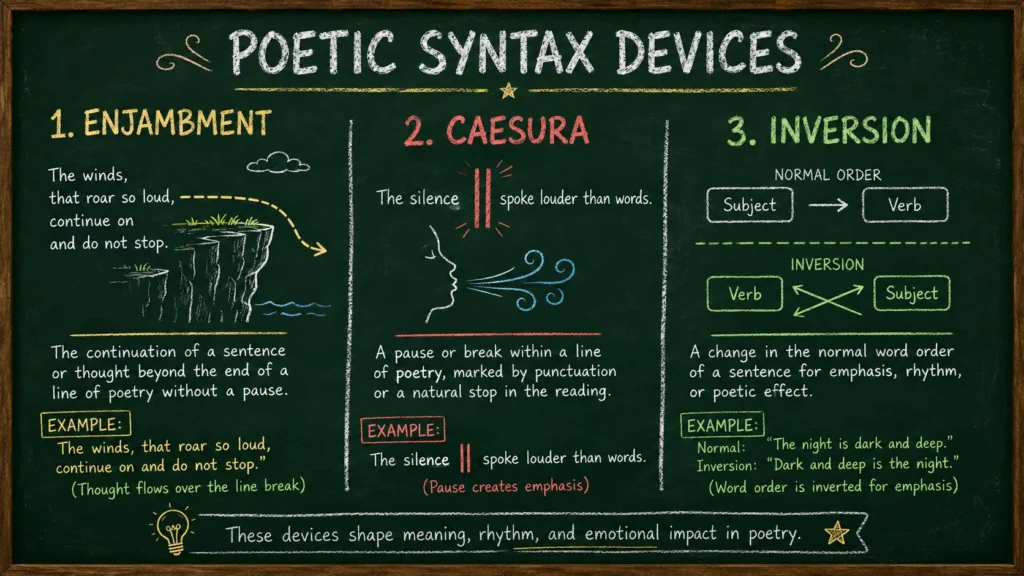
- Enjambment – a sentence/phrase continues onto the next line without a pause, creating a flowing rhythm.
- Caesura – a deliberate pause within a line, usually marked by punctuation, adding emphasis or reflection.
- Inversion – reversing normal word order for poetic emphasis or to meet metrical needs.
- Ellipsis – omission of words, creating ambiguity or letting the reader fill the gap.
- Parallelism – repetition of similar grammatical structures for balance and rhythm.
- Repetition – recurrence of words/phrases/sounds to emphasize ideas or build musicality.
- Diction – the poet’s word choice, shaping tone and mood.
- Imagery – vivid, sensory language that helps readers visualize and connect emotionally.
Example: In Wordsworth’s “Composed Upon Westminster Bridge,” the opening line (“Earth has not any thing to show more fair”) uses inversion — normal syntax would read “Earth has not anything more fair to show” — to place emphasis on “fair” at the line’s end. (See our notes on Wordsworth’s sonnet for the full analysis.)
Types and Patterns of Versification
| Type | Definition | Example |
|---|---|---|
| Accentual Verse | Fixed number of stressed syllables; unstressed count varies | Old English poetry |
| Syllabic Verse | Based on total syllable count per line | Haiku (5-7-5) |
| Accentual-Syllabic Verse | Combines stress count + syllable count | Iambic pentameter (Shakespeare) |
| Trochaic Verse | Lines of trochees (stressed–unstressed) | Tennyson’s “Charge of the Light Brigade” |
| Iambic Verse | Lines of iambs (unstressed–stressed) | Shakespearean sonnets |
| Anapestic Verse | Lines of anapests (unstressed–unstressed–stressed) | “The Night Before Christmas” |
| Dactylic Verse | Lines of dactyls (stressed–unstressed–unstressed) | Longfellow’s “Evangeline” |
Quatrain & Sonnet Forms: A quatrain is a four-line stanza; a sonnet is a 14-line poem, typically iambic pentameter, in Shakespearean (ABABCDCDEFEFGG) or Petrarchan (ABBAABBA CDCDCD) form.
Functions and Effects of Versification
Versification shapes a poem in several ways at once:
- Rhythm & Musicality – meter and stress patterns create flow and make the poem memorable.
- Meaning & Emphasis – line breaks and pauses (enjambment, caesura) direct the reader’s attention.
- Structural Unity – stanza and rhyme-scheme choices unify the poem’s form and theme.
- Pacing & Tone – short lines can create urgency; longer lines invite reflection.
- Imagery & Symbolism – rhythm and sound reinforce the vividness of images.
Variations and Deviations in Versification
Beyond the core devices already covered above (enjambment, caesura, inversion, ellipsis, parallelism, repetition), poets also use:
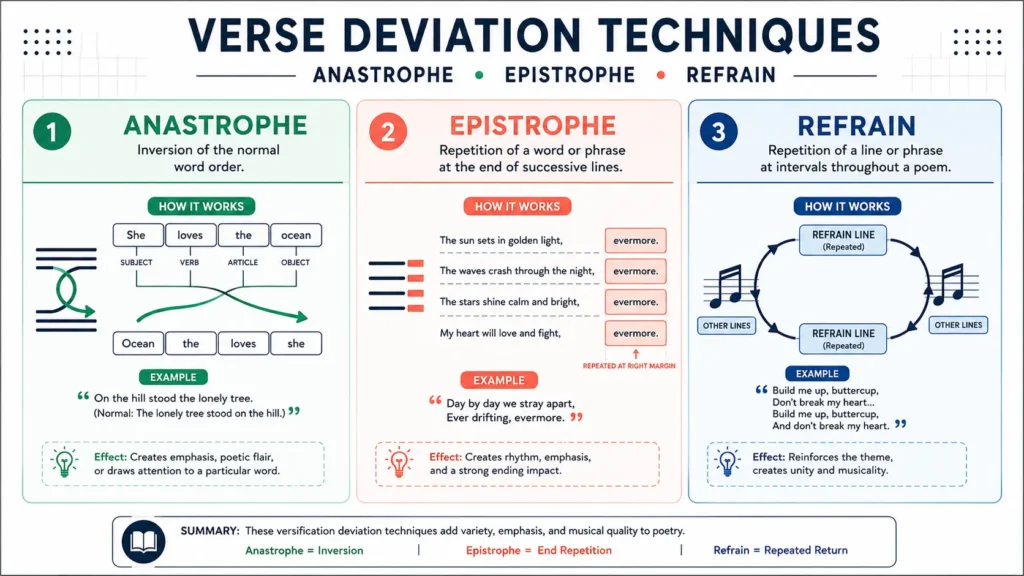
- Anastrophe – inversion of typical syntactic word order, drawing attention to the rearranged words.
- Epistrophe – repetition of a word/phrase at the end of successive clauses, for emphasis.
- Polysyndeton – multiple conjunctions in close succession, creating a flowing rhythm.
- Asyndeton – omission of conjunctions, creating a faster, urgent pace.
- Refrain – repetition of a line or stanza at intervals, reinforcing key themes.
Important Questions from This Unit (Exam-Focused)
Q1. What is the difference between versification and poetic syntax? Versification deals with the sound structure of poetry (rhyme, meter, stanza), while poetic syntax deals with word/sentence arrangement (inversion, ellipsis, parallelism) for rhythmic and rhetorical effect.
Q2. Define enjambment with an example. Enjambment is when a sentence continues from one line into the next without a pause. It’s common in blank verse and creates a sense of continuity or urgency.
Q3. What is the difference between blank verse and free verse? Blank verse follows a fixed meter (unrhymed iambic pentameter); free verse has no fixed meter or rhyme scheme at all.
Q4. Explain caesura and its effect on a poem. Caesura is a deliberate pause within a line, usually marked by punctuation. It slows the rhythm and creates emphasis or a moment of reflection.
Q5. How does inversion contribute to poetic meaning? Inversion reorders normal sentence structure to meet metrical requirements or to throw emphasis onto a particular word, often giving the line a more formal or heightened tone.
FAQs
What is versification in simple words?
Versification is the technique of writing poetry using rhyme, meter, and stanza structure — it’s what turns ordinary sentences into “verse.”
What is poetic syntax in one line?
Poetic syntax is the poet’s deliberate rearrangement of word order and sentence structure to create rhythm, emphasis, or meaning.
Is this topic part of DU’s DSC-1 syllabus?
Yes — it’s from Unit 2 (Reading Poetry) of DSC-1: Introduction to Literary Studies, based on the Ferguson, Salter & Stallworthy essay in The Norton Anthology of Poetry.
What is the easiest way to remember the types of meter?
Focus on the stress pattern of each foot: iamb (da-DUM), trochee (DUM-da), anapest (da-da-DUM), dactyl (DUM-da-da) — practice tapping them out loud.
What’s the difference between rhyme scheme and meter?
Rhyme scheme is the pattern of end rhymes in a poem (e.g., ABAB); meter is the pattern of stressed/unstressed syllables within each line. They’re independent — a poem can have one without the other.
Are enjambment and caesura opposites?
In a sense, yes — enjambment removes the pause at a line-end (continuity), while caesura inserts a pause within a line (interruption).
Related Notes
Subscribe to keep reading
You've used your free notes for now. Get Delhi Pathshala Premium for unlimited access.
Subscribe — ₹29/30 days