
Contents
- Introduction to G.J. Watson
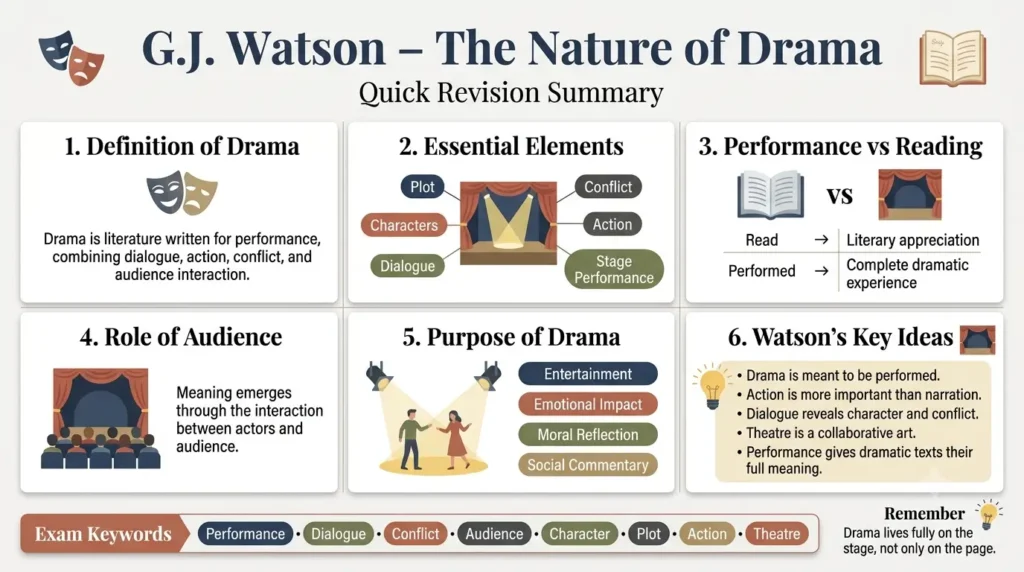
- 1. Definitions of Drama
- 2. Origins and Universality
- 3. Stage Conditions
- 4. The Physicality of the Stage
- 5. Plot and Action
- 6. The Language of Drama
- 7. Reading and Seeing
- Greek vs Elizabethan Stage — Comparison Table
- Key Elements of Drama (Quick Reference)
- Forms/Genres of Drama
- Tragedy Drama
- Comedy Drama
- Other Forms of Drama
- Tragicomedy:
- Melodrama:
- History Plays:
- Absurdist Drama:
- Epic Theater:
- Musical Theater:
- The Role of the Audience
- Engagement and Interpretation
- Engagement:
- Interpretation:
- Impact on Performance
- Top DU Previous Year Questions
- FAQs
- Important Links
In this post, we cover complete notes of Unit 3 (Reading Drama) from DSC-1: Introduction to Literary Studies, based on G.J. Watson’s chapter “The Nature of Drama” — the opening chapter of his book Drama: An Introduction (1983). These notes cover every section prescribed in the DU syllabus: Definitions, Origins and Universality, Stage Conditions, The Physicality of the Stage, Plot and Action, The Language of Drama, and Reading and Seeing — along with important exam questions and FAQs at the end.
Note on the source: G.J. Watson’s essay “The Nature of Drama” is Chapter 1 of his book Drama: An Introduction (St. Martin’s Press / Palgrave Macmillan, 1983) — it is a chapter/essay, not a standalone book title.
Introduction to G.J. Watson
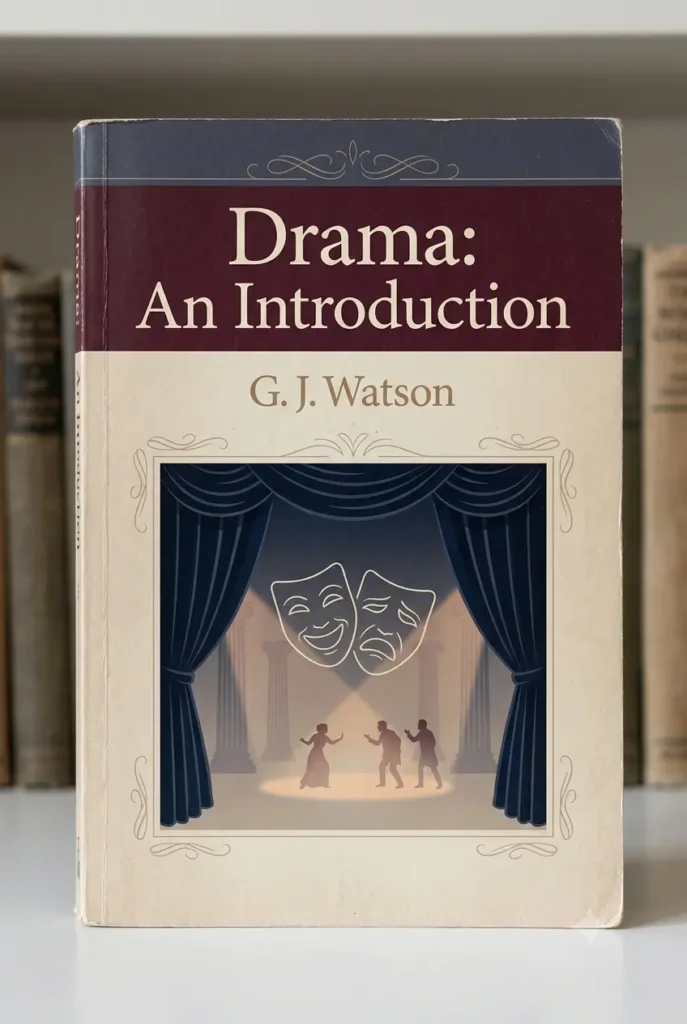
George J. Watson (1942–2009) was a scholar of Early Modern English literature and theatre, and later a prominent figure in Irish Studies. He is best known academically for Drama: An Introduction (1983) — a widely used critical study of theatre — and internationally for Irish Identity and the Literary Revival (1979), a major study of W.B. Yeats, James Joyce, J.M. Synge, and Sean O’Casey. He was a founding member of the British Association for Irish Studies (1985) and directed the Yeats International Summer School in Sligo (1998–2000).
In “The Nature of Drama,” Watson sets out the essential features that distinguish drama from poetry and prose fiction: performance, physicality, and the special relationship between the written word and the stage.
1. Definitions of Drama
There are many definitions of drama offered by different critics, and Watson opens his chapter by surveying a few of them before drawing out common threads.
- G.B. Tennyson describes drama in terms of a story acted out before an audience.
- Eric Bentley reduces the theatrical situation to its simplest form — one person playing a role while someone else watches.
- Marjorie Boulton stresses that a play is not meant to be read like a novel; it only becomes “three-dimensional” — literature that walks and talks — in performance.
From these, Watson draws the essential elements of drama: it is an art that needs live performance for its full effect; it involves real people pretending to be imagined people; and it places unusual emphasis on concentrated, intense action, unlike the more reflective pace of the novel or poem.
2. Origins and Universality
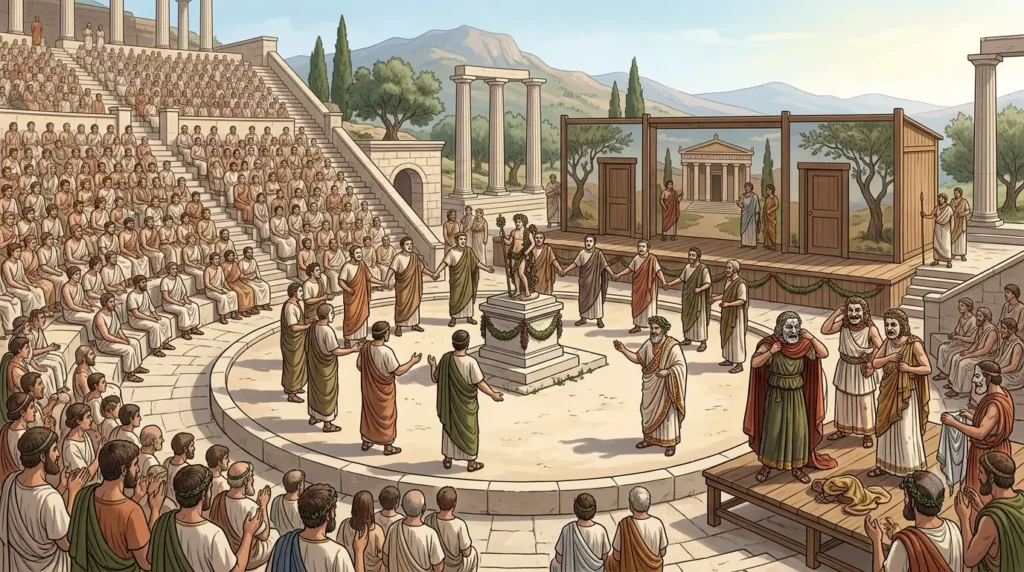
Watson traces drama’s roots to communal, ritual origins — primitive fertility rites and religious ceremonies performed before a group. This communal aspect, he argues, is what gives drama its enduring, universal appeal.
- He cites Wole Soyinka, whose plays draw directly on Yoruba religion and myth — for example, The Road (1965), which is built around the Egungun ceremony of ritual possession by the god Ogun.
- Both Greek and British drama began as forms of religious worship and were secularised only gradually, which is why classical and Elizabethan plays can still call on powerful ritualised effects (processions, choruses, ceremony) when needed.
- Watson is careful to note that drama’s universal appeal doesn’t come merely from how old the form is — it comes from how natural the impulse to dramatise is to human beings across cultures.
3. Stage Conditions
Because drama exists as much on the stage as on the page, Watson argues that readers need some grounding in historical stage conditions to properly imagine how a play would have worked in performance.
- Greek theatre: staged in huge open-air amphitheatres holding up to 15,000 spectators, seated in tiers almost fully surrounding a stage roughly 60–70 feet across.
- Elizabethan playhouse: smaller and partly enclosed, built around a projecting platform stage with the audience standing or seated on three sides — wealthier spectators sat in covered galleries above the stage.
- Proscenium (picture-frame) stage: from the late 17th century, this format grew popular and pushed drama toward greater realism in both acting style and stage setting — the format most people associate with a “traditional” theatre today.
Neither the Greek nor the Elizabethan stage was naturalistic — though Elizabethan staging allowed more intimacy between actor and audience because of physical proximity.
4. The Physicality of the Stage
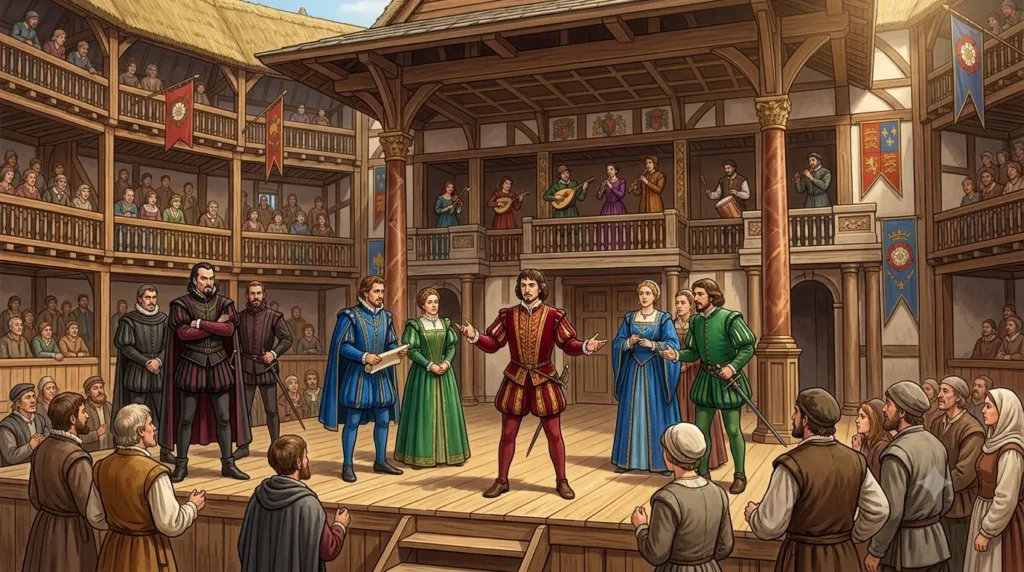
Watson identifies the physical, visual nature of performance as the single biggest thing separating drama from the other literary arts. Key physical tools available to a playwright and director include:
- The grouping of actors on stage to create meaning through spatial arrangement
- The use of colour for visual and symbolic impact
- The ability to juxtapose different dramatic voices, characters, or moods side by side for instant contrast or comparison
None of this is available to the novelist or poet — it is unique to drama’s staged, embodied form.
5. Plot and Action
Because a play must be performed within a limited time — what Shakespeare in Henry V calls “the two hours’ traffic of our stage” — Watson argues that plot and action in drama must be highly selective, bold, and clear. Unlike the novel, which can develop over hundreds of pages, drama has to compress conflict, character, and consequence into a tight, stageable structure.
6. The Language of Drama
In drama, dialogue carries the entire weight of the text. Unlike a novelist, a playwright cannot step in with explanatory or descriptive passages — everything must be conveyed through what characters say to each other. Watson notes that dialogue in a good play does several things simultaneously:
- Advances the plot
- Reveals character
- Creates atmosphere or tone
- Helps the audience grasp the underlying theme
He also references critic Una Ellis-Fermor, who observed that dramatic poetry can help drama overcome the disadvantage of brevity that live performance demands.
7. Reading and Seeing
Watson closes the chapter with an important distinction: a play exists both as text (something read in a study or library) and as performance (something that achieves its “fullest life” on stage). He argues there’s no reason a reader can’t activate their own “theatrical imagination” while reading — good reading helps good seeing, and good seeing helps good reading. Drama, in Watson’s view, is fundamentally a hybrid art form, and its long survival across human history is a sign of how healthy and adaptable that hybrid form is.
Greek vs Elizabethan Stage — Comparison Table
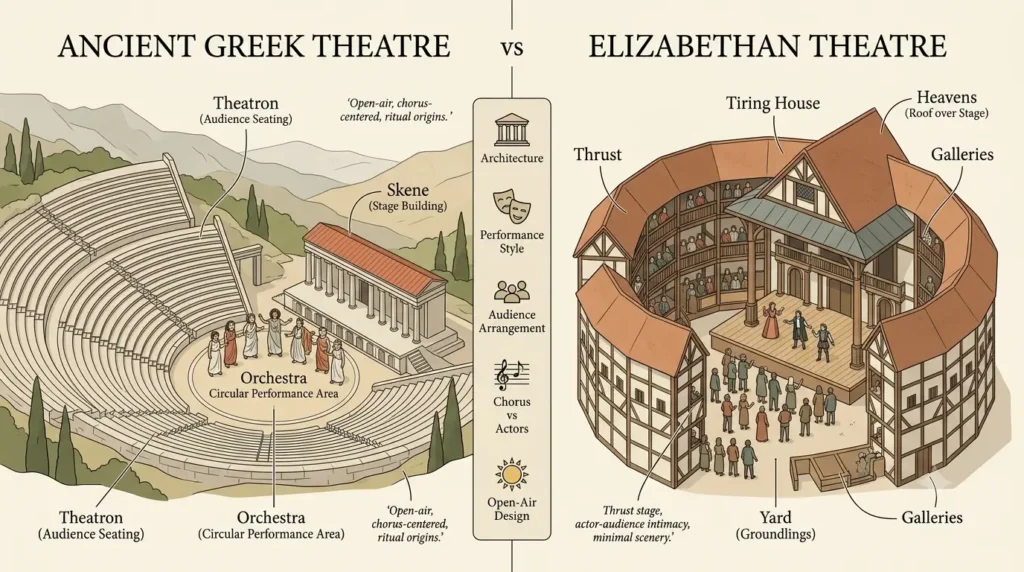
| Feature | Greek Theatre | Elizabethan Theatre |
|---|---|---|
| Setting | Open-air amphitheatre | Partly enclosed playhouse |
| Capacity | Up to ~15,000 spectators | Much smaller |
| Stage shape | Circular, ~60–70 ft across | Projecting platform stage |
| Audience position | Tiered seating, almost fully surrounding stage | Standing/seated on three sides; wealthy patrons in galleries |
| Actor–audience distance | Relatively distant | Close, more intimate |
| Style | Non-naturalistic, formal | Non-naturalistic but less formal than Greek |
Key Elements of Drama (Quick Reference)
Watson, in “The Nature of Drama,” identifies important parts that help us understand and analyze drama. These parts work together to create a complete theatrical experience.
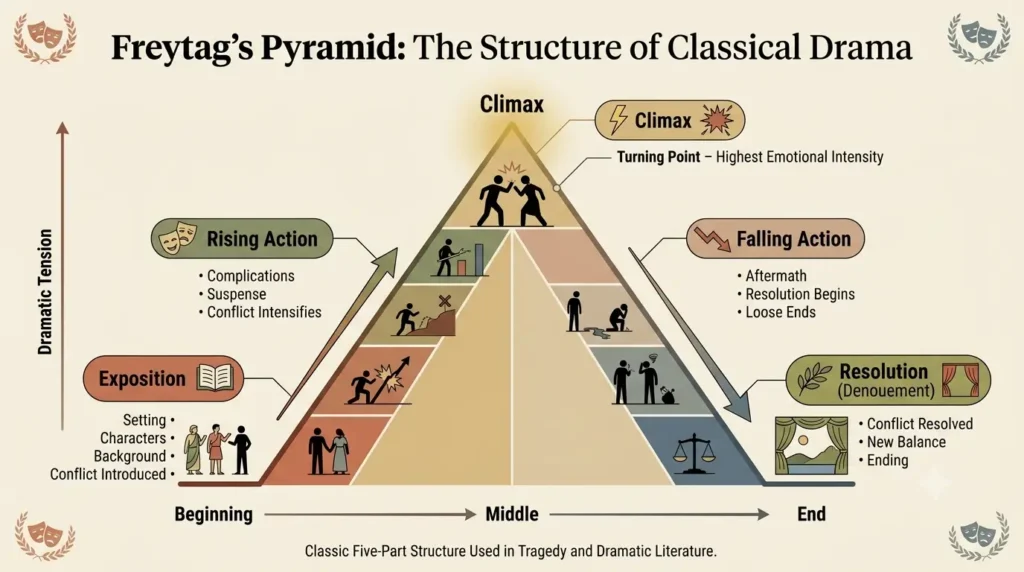
- Plot:
- The plot is the series of events in a drama. It usually follows this order:
- Exposition: Introduces characters, setting, and situation.
- Rising Action: Builds tension through conflicts.
- Climax: The peak of tension and conflict.
- Falling Action: The aftermath of the climax.
- Resolution: The conflict is resolved, and the story ends.
- Action and conflict drive the plot, often focusing on key decisions or struggles of the characters.
- Character:
- Characters are the people who tell the story through their actions and interactions. In drama, we learn about characters mainly through what they say and do.
- Characters can be:
- Protagonists: The main characters facing a big challenge.
- Antagonists: Those who oppose the protagonists, creating conflict.
- Supporting Characters: Others who affect the plot but are not central to the main conflict.
- Dialogue:
- Dialogue is the spoken words between characters. It is the main way to convey the plot, themes, and character relationships.
- Unlike other forms of writing, drama uses dialogue to show the setting and characters’ feelings and motives.
- Watson emphasizes that dialogue should both advance the plot and reflect character relationships.
- Conflict:
- Conflict is what drives drama. Without it, there would be no story. Conflicts can be:
- Internal Conflict: A character struggling with their own feelings or values.
- External Conflict: A struggle between characters or with outside forces.
- Social Conflict: Conflicts between individuals and societal rules or expectations.
- The way conflict is resolved or continues adds depth to the drama.
- Theme:
- The theme is the main idea or message of the drama, often about universal topics like love, justice, or identity.
- Watson notes that themes in drama are often shown through character interactions and the plot rather than explained directly.
- Themes encourage the audience to think about larger social or philosophical questions.
- Setting:
- The setting is where and when the drama takes place, including the physical location and the broader historical or cultural context.
- Settings can be specific, like a castle, or symbolic, representing a character’s feelings or thematic ideas.
- Spectacle:
- Spectacle includes all the visual and sound elements of a performance, like costumes, sets, lighting, and sound.
- Watson points out that modern theater has made spectacle more important as technology allows for more complex staging.
- Some dramas focus on visual effects, while others rely on dialogue and characters.
- Music and Sound:
- Music, whether part of the story or background, helps set the mood and atmosphere of the drama.
- In some theater traditions, music is essential to enhance emotions or signal changes in themes.
- Performance and Acting:
- The most important part of drama is its performance. Unlike other forms of writing, drama is meant to be acted out in front of an audience.
- Acting brings characters and dialogue to life, turning the written script into a moving experience.
- How an actor plays a character can greatly affect how the audience understands the story.
Final Thoughts
Drama, as Watson describes, is a mix of writing and performance. Its meaning and range show its ability to capture human experiences in many ways, from classical tragedies to modern experimental plays. Each part of drama, from plot to spectacle, adds to its storytelling power, making it capable of sparking thought, evoking feelings, and engaging audiences.
Forms/Genres of Drama
Drama is a way of telling stories that comes in different forms, each with its own style and themes. The two main types are tragedy and comedy, but there are other kinds that have developed over time, each offering different ways to tell stories about people and life.
Tragedy Drama
Definition:
Tragedy is a serious type of drama that usually involves the main character, often someone important, facing a major downfall. It looks at deep issues, like fate and human struggles, and often ends sadly.
Key Characteristics:
- Tragic Hero: The main character is usually someone significant, like a king. They have a major flaw, such as pride or jealousy, which leads to their downfall.
- Catharsis: Tragedies aim to make the audience feel strong emotions like pity and fear, leading to a sense of relief when the story ends.
- Themes: Common themes include fate vs. free will, moral choices, death, and the conflict between what people want and what they can have.
Examples:
- Oedipus Rex by Sophocles
- Hamlet by William Shakespeare
- Death of a Salesman by Arthur Miller
Comedy Drama
Definition:
Comedy is a lighter type of drama that aims to entertain and make people laugh. It often involves funny situations and misunderstandings, and usually ends happily.
Key Characteristics:
- Comic Characters: The characters are often regular people with funny traits that lead to humorous events. Unlike tragic heroes, comic characters usually find clever ways to solve their problems.
- Happy Endings: Comedies often end with good outcomes, such as weddings or reconciliations.
- Themes: Comedy often looks at social issues like class differences and love, using humor to highlight these topics.
Subtypes of Comedy:
- Farce: Features exaggerated situations and physical humor (e.g., Noises Off by Michael Frayn).
- Romantic Comedy: Focuses on love and relationships, ending happily (e.g., Shakespeare’s Much Ado About Nothing).
- Satirical Comedy: Uses humor to criticize society or politics (e.g., The Importance of Being Earnest by Oscar Wilde).
Examples:
- A Midsummer Night’s Dream by William Shakespeare
- The Importance of Being Earnest by Oscar Wilde
- The Odd Couple by Neil Simon
Other Forms of Drama
Besides tragedy and comedy, there are other types of drama that combine elements from both or create new styles.
Tragicomedy:
Definition: A mix of tragedy and comedy, featuring serious situations with funny moments or a happy ending.
Key Characteristics: These plays have serious characters but may not end in a downfall, balancing sad and funny tones.
Examples:
- The Winter’s Tale by William Shakespeare
- Waiting for Godot by Samuel Beckett
Melodrama:
Definition: A dramatic form with strong emotions and clear good and evil characters.
Key Characteristics: Typically features one-dimensional characters and dramatic plots with intense emotions and conflicts.
Themes: Common themes include good vs. evil and romantic love.
Examples:
- The Octoroon by Dion Boucicault
- A Woman of No Importance by Oscar Wilde
History Plays:
Definition: Plays that focus on historical events and figures, often showing political struggles and battles.
Key Characteristics: Based on real history but may take creative liberties to enhance drama.
Examples:
- Henry V by William Shakespeare
- A Man for All Seasons by Robert Bolt
Absurdist Drama:
Definition: This type explores the idea that life has no clear meaning and often shows chaotic or illogical situations.
Key Characteristics: Features unusual plots and characters doing pointless things, highlighting themes of confusion and isolation.
Examples:
- Waiting for Godot by Samuel Beckett
- The Bald Soprano by Eugène Ionesco
Epic Theater:
Definition: A style created by Bertolt Brecht that encourages audiences to think critically about social issues rather than just getting lost in the story.
Key Characteristics: Uses techniques like breaking the fourth wall and songs to keep the audience engaged intellectually. Often has a social or political message.
Examples:
- Mother Courage and Her Children by Bertolt Brecht
- The Threepenny Opera by Bertolt Brecht and Kurt Weill
Musical Theater:
Definition: Combines spoken dialogue with music and dance to tell stories, known for being entertaining and emotional.
Key Characteristics: Songs are essential to the story, expressing feelings and moving the plot along. Musicals can be fun or serious.
Examples:
- Les Misérables by Alain Boublil and Claude-Michel Schönberg
- Hamilton by Lin-Manuel Miranda
Key Takeaways
Drama comes in many forms, showing the wide range of human experiences, from happy moments in comedy to sad times in tragedy. Other types like tragicomedy and absurdist theater add variety to this rich storytelling tradition, each offering different views on life and society. Through performances, dialogue, and themes, drama continues to engage and challenge audiences everywhere.
The Role of the Audience
The audience is very important in drama. They are not just watching; they are part of the experience. Drama is meant to be performed live, and how well it works often depends on how involved the audience is. The way the audience reacts can change the meaning and feeling of the play.
Engagement and Interpretation
Engagement:
– The audience’s involvement is key to a drama’s success. They react emotionally and intellectually to what happens on stage. This involvement can be:
– Emotional Engagement: Audiences may feel sorry for characters or experience joy, sadness, fear, or excitement. For example, in a sad play, they might feel pity for the main character. In a funny play, they might laugh at silly situations.
– Intellectual Engagement: Some plays make the audience think about important themes or social issues. Instead of just feeling emotions, they are encouraged to analyze and question what they see.
Interpretation:
– Drama allows for different interpretations, and the audience affects this. Each person brings their own experiences and backgrounds, which shape how they understand the play. Important factors include:
– Cultural Context: Different audiences may see the same play differently based on their own culture or history. A play about social class might feel different in a place with big economic gaps compared to one where people are more equal.
– Personal Experience: People may connect with certain characters or situations based on their own lives. A character’s struggles might hit home for someone based on their own feelings or beliefs.
– Ambiguity in the Play: Some plays leave things unclear, inviting the audience to think for themselves. For example, in certain dramas, not having a clear ending might lead the audience to ponder deeper questions.
Impact on Performance
The audience’s reactions can greatly affect the performance itself. Unlike movies, where viewers are separate from the actors, live theater is shared. This creates a special connection where the audience’s involvement can change the energy of the show.
Live Feedback:
– Emotional Reactions: Actors notice how the audience feels—like laughter in funny scenes or gasps in tense moments. These reactions can change how the actors perform. For instance, if the audience laughs a lot, the actors might pause to let the laughter continue.
– Energy Exchange: The audience’s excitement can boost the actors’ energy. A responsive audience can inspire actors to perform more passionately, while a quiet audience might make them less confident, though skilled actors usually stay focused.
Audience Participation:
– In some types of drama, especially interactive shows, the audience might take part directly, influencing the story or interacting with characters. This makes the audience a crucial part of the drama.
– Epic Theater: Bertolt Brecht’s style aims to keep the audience from getting too lost in the story. He used techniques like having actors talk directly to the audience to encourage them to think critically and stay aware that they are watching a performance.
Cultural and Historical Influence:
– In different times, the audience’s role has changed. In classical Greek theater, audience reactions were seen as essential. Festivals decided which plays were successful. In Shakespeare’s time, audiences often shouted and cheered during performances.
– In modern theater, audiences usually watch quietly, but some shows still invite interaction, allowing viewers to help shape the story.
Overview
The audience is crucial in shaping the experience of drama. Through their involvement, interpretations, and reactions, they influence the meaning and energy of the performance. Whether they are deeply moved or critically observing, the audience actively participates in the drama, making each show unique.
Top DU Previous Year Questions
Based on the recurring pattern of DSC-1 (Introduction to Literary Studies) papers — Part A (short notes, 10 marks) and Part B (long answers, 20 marks) — here are representative, exam-style questions on this chapter.
- Write a short note on Watson’s definition of drama with reference to Tennyson, Bentley, and Boulton. (10 marks)
- Discuss the origins and universality of drama according to G.J. Watson. (20 marks)
- What does Watson mean by the “physicality of the stage”? Explain with examples. (10 marks)
- Compare Greek and Elizabethan stage conditions as discussed by Watson. (20 marks)
- “Drama exists both as text and as performance.” Discuss with reference to Watson’s chapter “The Nature of Drama.” (20 marks)
- Write a short note on the language of drama and the role of dialogue. (10 marks)
- How does Watson distinguish drama from the novel and poetry as a literary form? (20 marks)
FAQs
Is “The Nature of Drama” a separate book by G.J. Watson?
No. “The Nature of Drama” is the first chapter of G.J. Watson’s book Drama: An Introduction, published in 1983.
What is the DU syllabus unit for this topic?
It falls under DSC-1 (Introduction to Literary Studies), Unit 3: Reading Drama, alongside Mahesh Dattani’s Tara, Habib Tanvir’s It Must Flow: A Life in Theatre, and Gary Day’s Class.
What are the main sections covered in Watson’s chapter?
Definitions, Origins and Universality, Stage Conditions, The Physicality of the Stage, Plot and Action, The Language of Drama, and Reading and Seeing.
What does Watson say makes drama unique compared to poetry and the novel?
Drama depends on live performance, physical staging, and dialogue alone to carry meaning — unlike poetry or the novel, which can rely on a narrating or descriptive voice.
Who are the critics Watson quotes in his definition of drama?
G.B. Tennyson, Eric Bentley, and Marjorie Boulton.
Important Links
Subscribe to keep reading
You've used your free notes for now. Get Delhi Pathshala Premium for unlimited access.
Subscribe — ₹29/30 days