
Contents
- Introduction to the Theatre of the Absurd
- What Makes a Play “Absurd”?
- Historical Background
- Key Playwrights
- Eugène Ionesco: Life and Influences
- Early Life
- Literary Beginnings
- Famous Works
- Influence of Personal Experience
- “Rhinoceros” (1959): Background and Overview
- Background and Inspiration
- Publication and Premiere
- Place in Ionesco’s Body of Work
- Rhinoceros by Eugène Ionesco: Summary
- Act I
- Act II
- Act III
- Characters in Rhinoceros
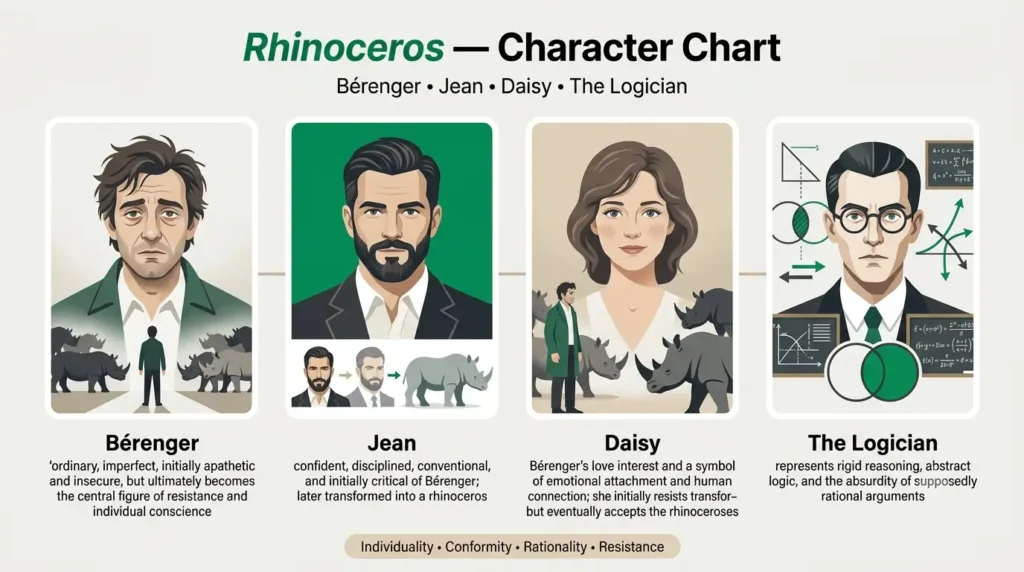
- Bérenger
- Jean
- Daisy
- Supporting Characters
- Themes in Rhinoceros
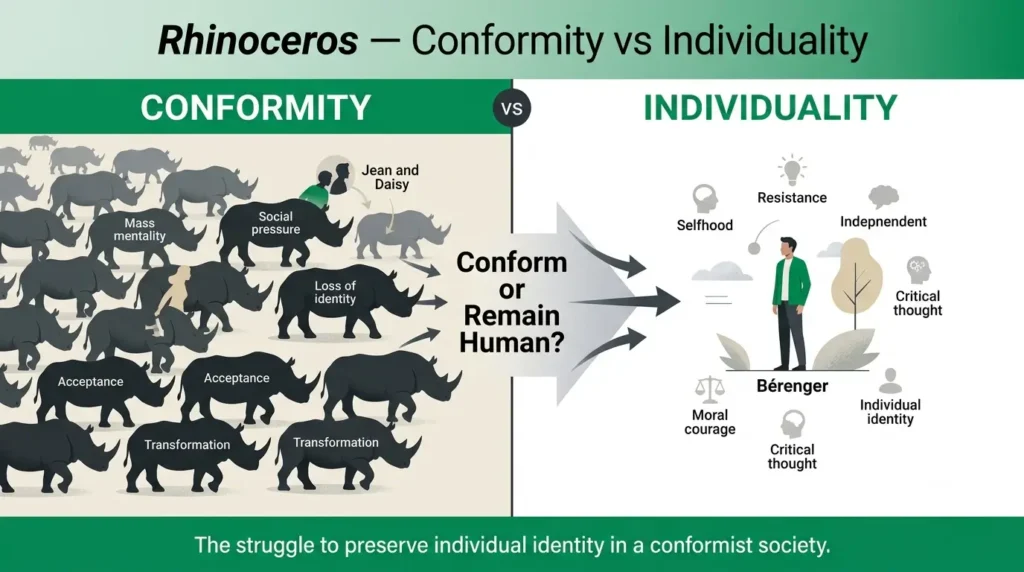
- Conformity vs. Individuality
- The Fragility of Human Reason
- Totalitarianism and Fascism
- Communication Breakdown
- Existentialism and Absurdity
- Symbolism in Rhinoceros
- Dramatic Techniques and Style
- Key Scenes Explained
- Jean’s Transformation
- The Logician’s Arguments
- The Final Scene
- Rhinoceros: Quick Revision Table
- Previous Year Questions (DU DSC-16 — Exam Pattern)
- FAQs
- Conclusion
In this post, we’ve compiled complete notes on Unit 3: Rhinoceros by Eugène Ionesco from DSC-16: Modern European Drama, part of the BA (Hons.) English Semester 6 syllabus at Delhi University. These notes cover the play’s summary, characters, themes, symbolism, and previous year–style exam questions.
[IMAGE 1 — Featured image here]
Introduction to the Theatre of the Absurd
The Theatre of the Absurd is a mid-20th-century European dramatic movement that portrays human existence as fundamentally illogical and without inherent meaning. It dramatizes the widening gap between humans’ need to find purpose and an indifferent, chaotic universe.
What Makes a Play “Absurd”?
- Post-war disillusionment: The devastation of World War II shattered European faith in religion, rational politics, and linear progress, leaving playwrights searching for new dramatic forms to express that disorientation.
- Rejection of conventional narrative: Absurdist plays abandon linear plots, psychologically consistent characters, and tidy resolutions in favor of circular structures, repetitive dialogue, and irrational events.
- Embrace of the illogical: By foregrounding nonsensical dialogue and random action, these plays argue that the search for meaning is itself part of the absurdity of life.
Historical Background
- A continent in ruins: The physical and psychological devastation of WWII forced European society to re-examine long-held assumptions about human nature and social order.
- Existentialist roots: The movement drew heavily on Jean-Paul Sartre and Albert Camus, whose existentialist philosophy held that life has no inherent meaning and that individuals must construct their own purpose within an indifferent cosmos.
Key Playwrights
- Samuel Beckett — Waiting for Godot, defined by endless, purposeless waiting.
- Jean Genet — The Balcony, The Maids; explores identity, power, and the failure of language.
- Harold Pinter — The Homecoming, The Caretaker; blends realism with absurdist tension through calculated pauses.
- Philosophical anchors: Camus’s idea that seeking meaning in an indifferent world is itself absurd, and Sartre’s concept of “bad faith” — self-deception that lets people avoid confronting a purposeless existence — both directly shape Absurdist drama’s central preoccupations.
Eugène Ionesco: Life and Influences
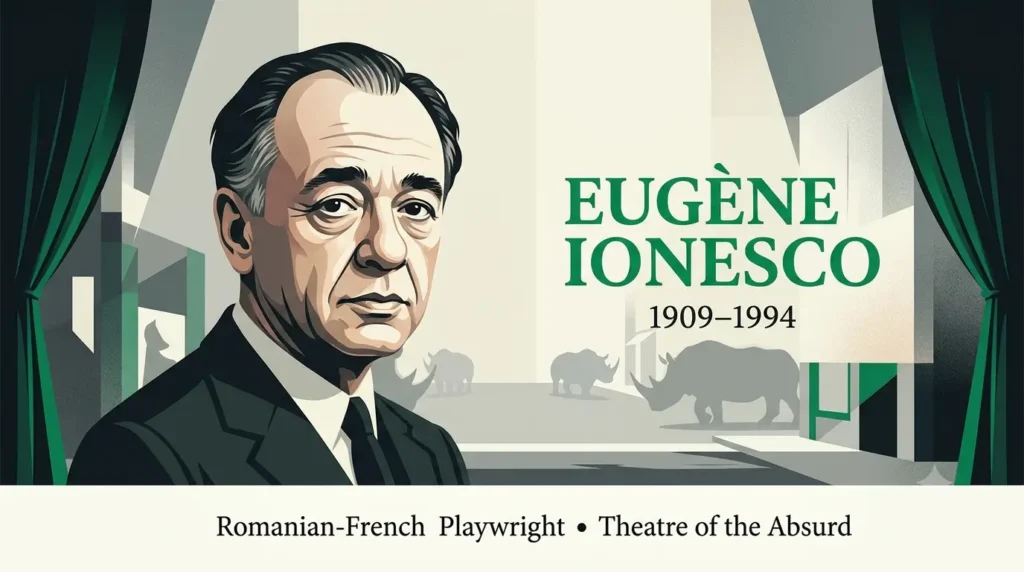
Eugène Ionesco (1909–1994) was a Romanian-French playwright and one of the founding figures of the Theatre of the Absurd, known for his radical experiments with language, identity, and alienation. He was later elected to the Académie française in 1970. A fuller biographical account is available via Encyclopaedia Britannica’s entry on Ionesco.
Early Life
- Dual heritage: Born in Slatina, Romania, in 1909 to a Romanian father and a French mother, giving him a bicultural identity from childhood.
- Between two homelands: Raised partly in France before returning to Romania as a teenager, an experience of displacement that later fed his recurring themes of alienation and fractured identity.
Literary Beginnings
- Ionesco began as a poet and literary critic, studying at the University of Bucharest before working as a teacher and translator.
- His pivot to playwriting came in 1950 with The Bald Soprano, a deliberate reaction against the stale conventions of bourgeois theatre, which established him as a defining voice of Absurdist drama.
Famous Works
- The Bald Soprano (1950) — a couple’s nonsensical conversation exposes the emptiness of routine communication.
- The Chairs (1952) — an elderly couple prepares guests who never arrive, dramatizing isolation and the futile search for meaning.
- The Lesson (1951) — a private lesson spirals into violence, critiquing how language can be weaponised for control.
Influence of Personal Experience
Ionesco witnessed the rise of totalitarian sympathies among people he knew in interwar Romania — an experience that directly shaped Rhinoceros and its portrait of ordinary people succumbing to mass ideology.
“Rhinoceros” (1959): Background and Overview
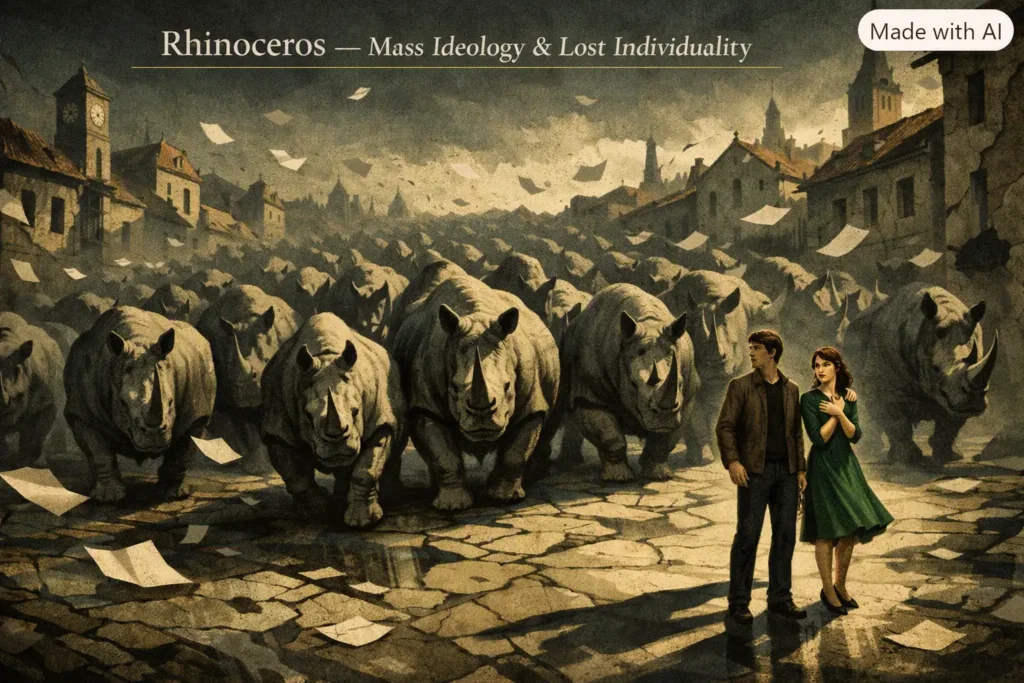
Rhinoceros dramatizes a small town’s population gradually transforming into rhinoceroses, using this metaphor to interrogate conformity, the appeal of totalitarian ideology, and the fragility of individual reason.
Background and Inspiration
Written against the backdrop of the Cold War, the play channels Ionesco’s direct experience of both Nazism and Communism — his memory of watching acquaintances rationalise their way into fascist sympathy shapes the mechanics of the “rhinoceritis” that spreads through the town.
Publication and Premiere
Rhinoceros premiered in Düsseldorf in 1959, later transferred to the Théâtre de l’Odéon in Paris, and became one of Ionesco’s most widely performed works internationally.
Place in Ionesco’s Body of Work
Where Ionesco’s earlier one-act plays (The Bald Soprano, The Lesson) focused narrowly on the absurdity of language, Rhinoceros is longer and more structurally conventional, fusing Absurdist technique with an explicit, legible social critique of mass conformity.
Rhinoceros by Eugène Ionesco: Summary
Act I
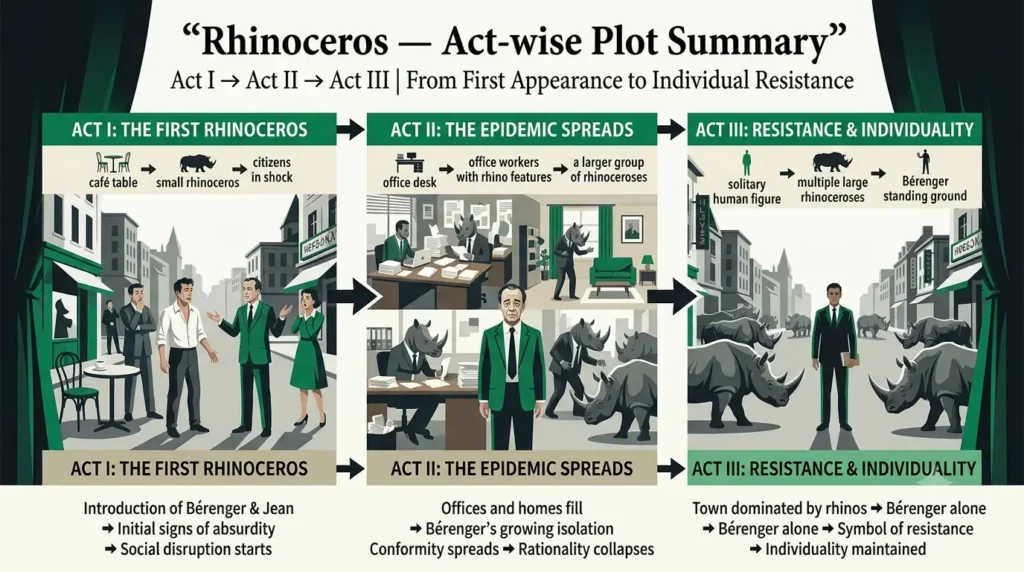
The play opens in a quiet provincial town. Bérenger, disheveled and indifferent, meets his more composed friend Jean. A rhinoceros suddenly charges through the town square, and the townspeople argue over what they saw rather than confronting what it means — an early sign of the play’s central theme: the failure of reason to process the irrational.
Act II
- Scene 1: More rhinoceroses appear. People begin transforming outright, and the responses range from denial to enthusiastic justification.
- Scene 2: Jean transforms in front of Bérenger, moving from scornful resistance to eager acceptance of the change — dramatizing how easily a confident, “rational” man can be absorbed by a mass ideology once it promises belonging and strength.
Act III
Bérenger, now almost entirely alone, watches even Daisy — his one remaining source of emotional support — succumb to the transformation. In the play’s famous closing lines, Bérenger declares he will not capitulate, resolving himself to remain human even if he is the last one left.
Characters in Rhinoceros
Bérenger
The reluctant everyman-protagonist — unkempt, apathetic, and prone to drinking at the start. His arc from passive indifference to active resistance is the emotional and moral center of the play, and his refusal to conform is Ionesco’s clearest statement on the value of individual conscience.
Jean
Initially Bérenger’s confident, rule-bound foil, Jean’s transformation into a rhinoceros illustrates how “rational” people can rationalise their way into an ideology that ultimately consumes them.
Daisy
Represents warmth, love, and hope amid the crisis. Her eventual capitulation — despite genuinely caring for Bérenger — shows how even close emotional bonds can’t always withstand the pull of mass conformity.
Supporting Characters
- The Logician — satirises rigid, decontextualised logic that fails the moment it meets real chaos.
- Botard and Dudard — represent two failure modes of denial: conspiracy-driven refusal to accept reality, and intellectualised justification of it.
- Papillon — embodies self-interested indifference to the unfolding crisis.
Themes in Rhinoceros
Conformity vs. Individuality
The central tension of the play: as more townspeople transform, staying human comes to feel like the deviant choice rather than the ordinary one — inverting the usual social pressure and isolating Bérenger for the very trait that should be unremarkable.
The Fragility of Human Reason
Characters repeatedly try to explain the transformations using logic and repeatedly fail — Ionesco’s argument that rational thought alone is an inadequate defense against mass irrationalism.
Totalitarianism and Fascism
The town’s rhinocerisation operates as a close allegory for how fascist ideology spreads: incrementally, through peer pressure and the promise of belonging, until resistance itself starts to look abnormal.
Communication Breakdown
As the crisis deepens, dialogue grows more repetitive and less meaningful, dramatizing the collapse of language as a tool for genuine connection.
Existentialism and Absurdity
Bérenger’s struggle to find meaning in an increasingly irrational world reflects existentialist concerns about constructing purpose in a universe that offers none by default.
Symbolism in Rhinoceros
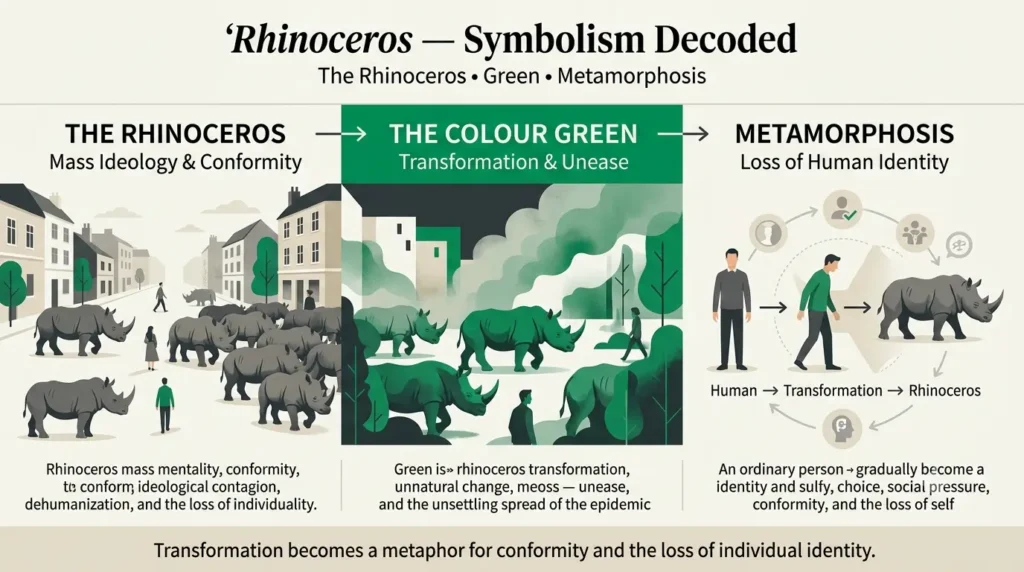
- The rhinoceros — mindless, mass-scale irrationality and violence; the physical form of ideology takes when it overwhelms individual judgement.
- Metamorphosis — an outward marker of an inward moral surrender; the loss of empathy and independent thought that precedes it.
- The set/environment — the town’s descent from order to visible chaos mirrors the psychological unravelling of its people.
- The color green — associated throughout with the transformed characters, functioning as a visual shorthand for both contagion and moral decay.
Dramatic Techniques and Style
- Repetitive dialogue underlines the uselessness of conversation in an increasingly irrational world.
- Bizarre, unexplained events (rhinoceroses appearing without cause) reject conventional dramatic logic.
- No neat resolution — the play ends on Bérenger’s isolated defiance, not a resolution, consistent with Absurdist rejection of tidy meaning.
- Detailed stage directions for the physical transformations turn a metaphor into a visceral, staged reality.
Key Scenes Explained
Jean’s Transformation
The clearest dramatization of ideology appeal: Jean doesn’t resist so much as getting seduced, arguing that joining the rhinoceroses is an act of strength rather than surrender.
The Logician’s Arguments
A satirical set-piece showing how formal logic, applied without regard to reality, becomes not just useless but actively complicit in normalising the absurd.
The Final Scene
Bérenger’s closing monologue — his refusal to become a rhinoceros even in total isolation — is the play’s emotional and thematic climax, affirming individual conscience as a value worth defending even without external validation.
Rhinoceros: Quick Revision Table
| Aspect | Detail |
| Playwright | Eugène Ionesco |
| First performed | 1959, Düsseldorf |
| Genre | Theatre of the Absurd / political allegory |
| Central symbol | The rhinoceros — mass ideology and lost individuality |
| Protagonist | Bérenger |
| Central theme | Conformity vs. individual conscience |
| Historical allegory | Rise of fascism/Nazism in 1930s–40s Europe |
| DU Paper | DSC-16, Modern European Drama, Unit 3, Semester 6 |
Previous Year Questions (DU DSC-16 — Exam Pattern)
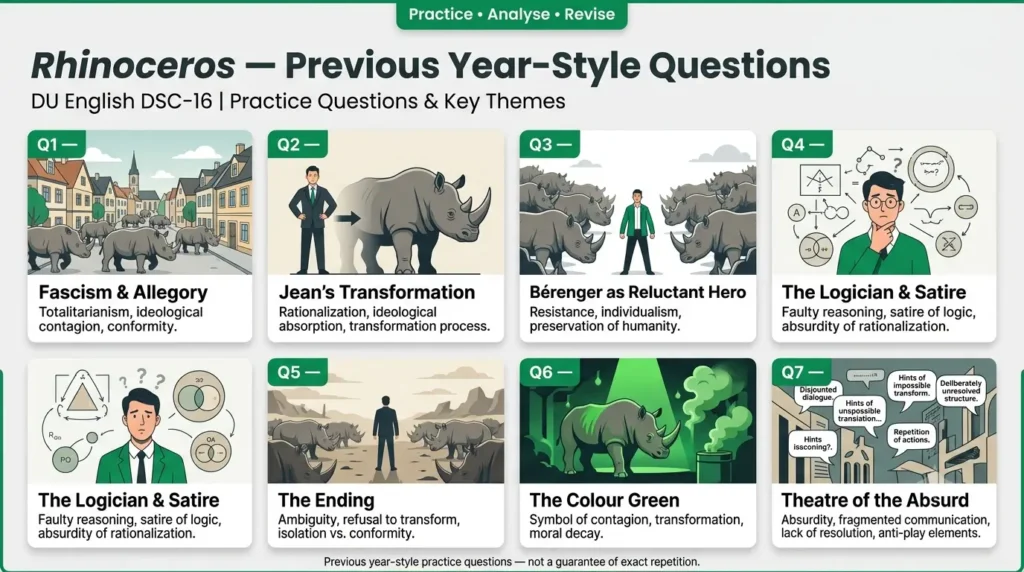
These are frequently repeated question patterns based on the official DU DSC-16 exam format and study material for this unit — use them for practice, not as a guarantee of exact repetition.
DU Previous Year Questions
Frequently asked questions from DU exam papers on this topic. Tap a question to view a quick-answer guide.
1 Discuss Rhinoceros as an allegory of the rise of fascism. +
2 Critically analyse Jean’s transformation into a rhinoceros. +
3 Bérenger is called the “reluctant hero” of Rhinoceros. Discuss. +
4 What role does the Logician play in the satire of Rhinoceros? +
5 Comment on the significance of the ending of Rhinoceros. +
6 Write a short note on the symbolism of the colour green in Rhinoceros. +
7 How does Rhinoceros reflect the conventions of the Theatre of the Absurd? +
FAQs
Who wrote Rhinoceros and when was it first performed?
Rhinoceros was written by Eugène Ionesco and first performed in Düsseldorf, Germany, in 1959.
What does the rhinoceros symbolise in the play?
The rhinoceros symbolises the spread of totalitarian ideology and mass conformity — the loss of individual reason and humanity when people submit to a collective, unquestioned belief system.
Why does Bérenger refuse to become a rhinoceros?
Bérenger refuses because he values his individual identity and moral conscience over the safety of belonging to the crowd, even at the cost of total isolation.
Is Rhinoceros an allegory for a specific historical event?
It’s widely read as an allegory for the rise of fascism and Nazism in Europe before and during World War II, though its critique of blind conformity applies to any totalitarian ideology.
Which unit and paper are Rhinoceros part of in the DU BA English syllabus?
It is Unit 3 of DSC-16: Modern European Drama, taught in Semester 6 of the BA (Hons.) English programme at Delhi University.
What genre does Rhinoceros belong to?
It belongs to the Theatre of the Absurd, a mid-20th-century dramatic movement portraying life as fundamentally irrational and without inherent meaning.
Conclusion
Rhinoceros remains one of Ionesco’s most powerful and widely studied plays, using the absurd image of mass transformation to interrogate very real questions about conformity, ideology, and individual conscience. For DU DSC-16 students, the play rewards close attention to Bérenger’s arc, the mechanics of Jean’s transformation, and the symbolism woven through the staging — all of which show repeatedly across exam patterns.
Subscribe to keep reading
You've used your free notes for now. Get Delhi Pathshala Premium for unlimited access.
Subscribe — ₹29/30 days