
Contents
- Introduction to Modern European Drama
- The Start of Modernism
- Theatrical Innovations
- Cultural and Social Context
- Henrik Ibsen: The Father of Modern Drama
- Childhood in Norway
- Literary Career
- Legacy and Contribution
- Ghosts (1881): Background, Publication and Censorship
- How Ghosts Came to Be
- Publication and the First Performances
- Censorship Across Europe
- Importance in Ibsen’s Work
- Ghosts by Henrik Ibsen Summary
- Act I: Secrets Beneath the Surface
- Act II: The Truth About Captain Alving
- Act III: Fire, Revelation, and the Final Choice
- Ghosts by Henrik Ibsen Characters
- Mrs. Helene Alving
- Pastor Manders
- Oswald Alving
- Regine Engstrand
- Jacob Engstrand
- Captain Alving (deceased) and Johanna
- Ghosts by Henrik Ibsen Themes
- The Haunting of the Past
- Hypocrisy and Institutional Morality
- Freedom versus Conformity
- Heredity and Disease
- Light and Darkness
- Literary Techniques and Style
- Realism and Naturalism
- Symbolism
- Dramatic Irony and Subtext
- Ghosts vs A Doll’s House: A Quick Comparison
- Critical Reception and Legacy
- Key Takeaways
- Continue Reading
- University of Delhi Previous Year Questions
- FAQs
In this post, you’ll find complete notes on “Unit 1: Ghosts by Henrik Ibsen” from DSC-16: Modern European Drama, part of the BA (Hons.) English Semester 6 syllabus at Delhi University. These notes cover the historical context of modern European drama, Ibsen’s life and career, a detailed act-wise summary of Ghosts, its characters, themes, and literary techniques — along with previous-year-pattern questions and FAQs to help you prepare for your exams.
Introduction to Modern European Drama
The Start of Modernism
Modern European drama marks a decisive break from Romanticism, moving toward a more realistic and socially engaged way of telling stories on stage.
- From Romanticism to Realism: Romanticism showed life in an idealised way, focused on feeling and individual experience. By the late 1800s, playwrights had begun turning to realism, presenting life with all its problems and contradictions. Writers like Henrik Ibsen and Anton Chekhov wrote about ordinary people and pressing social issues, aiming to put real life on stage. This shift moved away from the heroism and beauty typical of Romantic drama toward a much more grounded view of the world.
- Impact of Industrialisation: The Industrial Revolution reshaped European society. As factories and cities grew, social structures shifted with them. Playwrights began writing about class conflict, social mobility, and the human cost of industrial progress. The working class, in particular, became a serious subject for the stage in a way it rarely had been before.
Theatrical Innovations
- Breaking the “Fourth Wall”: In traditional theatre, the “fourth wall” is the invisible barrier separating actors from the audience. Later, playwrights such as Bertolt Brecht (whose Mother Courage and Her Children is Unit 2 of this same paper) began deliberately breaking this convention, making audiences aware of their own role as spectators and encouraging critical, rather than passive, viewing.
- Naturalistic Techniques: Naturalism aimed to represent life as accurately as possible, influenced by the scientific temper of the age. Playwrights such as Émile Zola and Henrik Ibsen called for detailed sets, psychologically complex characters, and dialogue that sounded like real speech — creating a “slice of life” on stage rather than an idealised picture of it.
Cultural and Social Context
- Growth of the Middle Class: Industrialisation and urbanisation expanded the middle class, whose members were often caught between the aristocracy above and the working class below. Playwrights increasingly explored middle-class domestic life, family conflict, and social ambition — a marked shift away from the aristocratic settings common in earlier European theatre.
- Challenging Traditional Values: Modern European drama questioned inherited assumptions about marriage, religion, and authority. Ibsen, in particular, examined women’s position in a male-dominated social order. Theatre’s purpose itself was being redefined: from merely reflecting society to actively provoking thought and pressing for change.
Henrik Ibsen: The Father of Modern Drama
Childhood in Norway
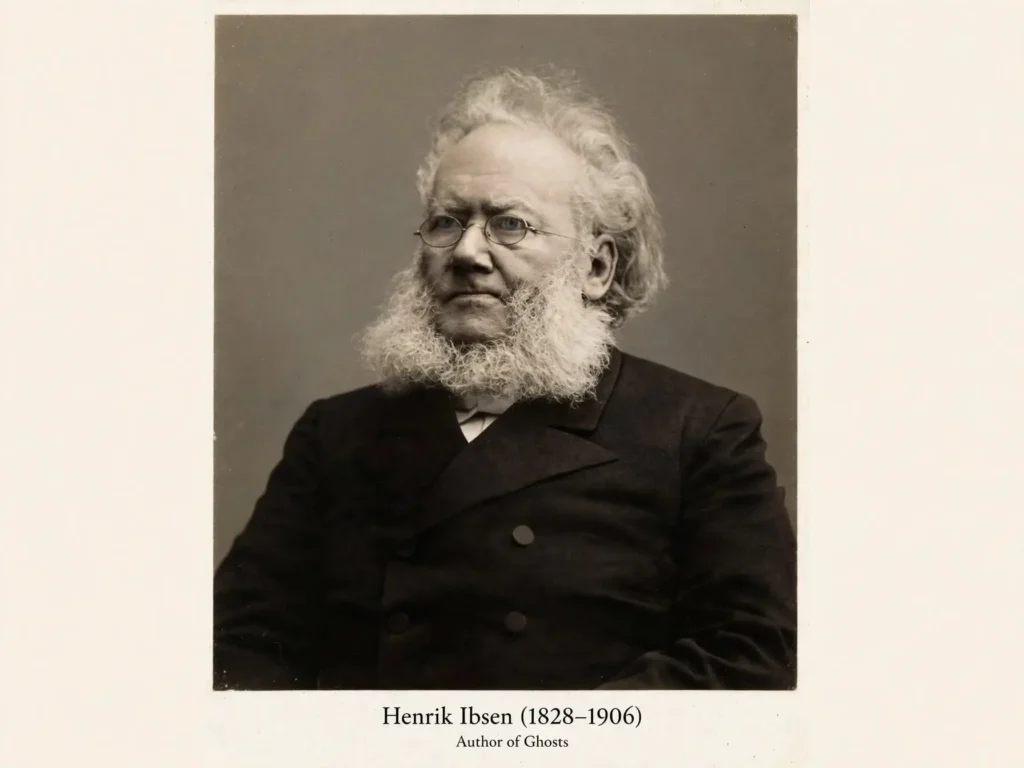
Henrik Ibsen was born on 20 March 1828 in Skien, a small coastal town in southern Norway, to a well-off merchant family. When Ibsen was around seven, his father Knud suffered a serious financial collapse, and the family’s circumstances declined sharply — a rupture that left a lasting mark on Ibsen’s sense of social respectability and appearances, themes he would return to throughout his career, including in Ghosts. At fifteen, he moved to the coastal town of Grimstad to work as a pharmacist’s apprentice, a period during which he also began writing poetry and his earliest drama.
Literary Career
- Early Works: Ibsen’s first play, Catiline (Catilina, written 1848–49, published 1850), was a historical verse drama rejected by Christiania’s only theatre and published only because his friend Ole Schulerud financed it privately. His second play, The Burial Mound (Kjæmpehøien, 1850), became his first play to actually reach the stage, premiering at the Christiania Theatre on 26 September 1850. Both works were shaped by Romanticism, drawing on saga material, myth, and the conflict between the individual and inherited tradition — concerns Ibsen would later transpose into a realist, domestic key.
- Turn to Realism: Over the following decades, Ibsen moved from historical and poetic drama toward the contemporary “problem plays” for which he is best known. A Doll’s House (1879) was his breakthrough in this realist mode, shocking audiences with Nora Helmer’s decision to leave her husband and children in pursuit of self-determination.
- Exile Years: Ibsen left Norway in 1864 and spent the next twenty-seven years largely in Italy and Germany — in Rome, Dresden, and Munich — returning to Norway only for visits before permanently settling back in Christiania in 1891. This long exile gave him distance from Norwegian social conservatism and closer contact with wider European intellectual currents. It was during this period that he wrote his major realist plays, including A Doll’s House (1879), Ghosts (1881), and Hedda Gabler (1890).
Legacy and Contribution
Ibsen is widely called the “father of modern drama” (and, by some critics, “the father of realism”) for shifting European theatre from idealised, heroic narratives to psychologically grounded studies of ordinary people confronting real social pressures. In A Doll’s House, Nora’s exit was a bold assertion of individual freedom against the institution of marriage; in Ghosts, Ibsen went further still, confronting inherited disease, concealed infidelity, and what he called society’s “dead ideas” head-on. His influence on later dramatists — Chekhov, Strindberg, Shaw, and eventually Brecht and the Theatre of the Absurd playwrights — is difficult to overstate, and he remains, after Shakespeare, the most frequently performed playwright in the world.
Ghosts (1881): Background, Publication and Censorship
How Ghosts Came to Be
Ibsen wrote Ghosts in the summer of 1881 while staying in Sorrento, Italy, shortly after the controversy over A Doll’s House had subsided. Where A Doll’s House had questioned the institution of marriage, Ghosts pushed further into taboo territory: inherited venereal disease, euthanasia, and what the play frames as incest between half-siblings. Ibsen was preoccupied with how the concealed sins of one generation are silently passed on to, and destroy, the next.
Publication and the First Performances
Ghosts (Gengangere in the original Dano-Norwegian) was published in Copenhagen in December 1881. The reaction was immediate and hostile: Scandinavian newspapers denounced it, bookshops were reportedly ashamed to display it, and unsold copies were returned to the publisher in large numbers. Every major theatre in the three Scandinavian capitals — Christiania (Oslo), Copenhagen, and Stockholm — declined to stage it.
As a direct result, Ghosts had its world premiere not in Scandinavia at all, but at the Aurora Turner Hall in Chicago, on 20 May 1882, performed in Norwegian/Danish for an audience of Scandinavian immigrants. Its first European staging followed at Helsingborg, Sweden, on 22 August 1883, under the Swedish actor-director August Lindberg, who also played Oswald; the production then toured Scandinavia, reaching Norwegian soil for the first time at Christiania’s Møllergaden Theatre on 17 October 1883, where — once the initial shock had passed — it was received far more warmly than the published text had been.
Censorship Across Europe
Ghosts went on to be refused public licence or actively censored in several countries over the following decades:
- Germany: The play was first staged only privately, in Augsburg in April 1886, with Ibsen himself present. A public production had to wait until Berlin’s independent Freie Bühne staged it in September 1889 as its opening production; state censorship on public performances was not lifted until November 1894.
- England: London’s official censor (the Lord Chamberlain) refused Ghosts a performance licence altogether. It was staged only once, in 1891, at the Royalty Theatre, under the banner of J. T. Grein’s private “Independent Theatre” society — a members-only club structure specifically used to sidestep the licensing requirement. The press response was savage; several reviewers called the play obscene and diseased.
- Elsewhere: Ghosts also faced restrictions at various points in Russia, Spain (notably under the Franco regime), and other countries where its treatment of venereal disease, religion, and euthanasia was considered unfit for public performance.
Importance in Ibsen’s Work
Ghosts marks the point at which Ibsen abandoned any remaining Romantic gesture and committed fully to realism: ordinary, respectable people, undone not by melodrama but by the slow, structural consequences of concealment. Its influence on the development of modern drama — and on later playwrights such as Chekhov, Strindberg, and Shaw, all of whom took up its unflinching treatment of personal and social decay — is one of the reasons it remains a set text in university drama courses like this one.
Ghosts by Henrik Ibsen Summary
Ghosts is a three-act play that unfolds entirely within a single day, inside and just outside Mrs. Alving’s house on one of the large fjords of western Norway — a compressed, “analytic” structure in which nearly everything that matters has already happened before the play begins, and the drama consists of that past being uncovered.
Act I: Secrets Beneath the Surface
The play opens the morning before the dedication of an orphanage that the widowed Mrs. Helene Alving has built in memory of her late husband, Captain Alving, on the tenth anniversary of his death. Regine Engstrand, Mrs. Alving’s young maid, is confronted at the door by her father, the carpenter Jacob Engstrand, who has finished his work on the orphanage and wants her to leave service and help him run a new venture — a home for sailors. Regine, who has ambitions above her station, refuses and sends him away.
Mrs. Alving’s son, Oswald, has just returned from Paris, where he has spent years training and working as a painter. Pastor Manders, an old family friend and moral authority, arrives to help with the orphanage’s opening and is visibly troubled by Oswald’s bohemian, “modern” opinions about art, marriage, and freedom — opinions Oswald picked up from the artistic circles he lived in abroad. Beneath the surface courtesies, tension simmers: Manders is uneasy around Mrs. Alving, referencing — without quite naming — her attempt, many years earlier, to leave her husband, from which Manders himself had talked her out of, insisting on her “duty.” It becomes clear that Captain Alving’s public reputation as an upright, generous citizen conceals a very different private history.
Act II: The Truth About Captain Alving
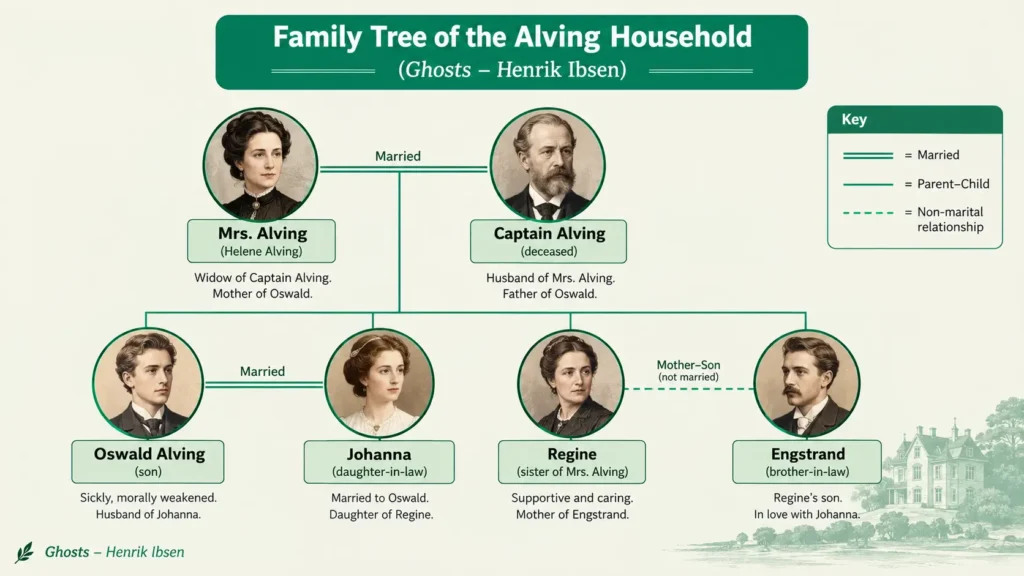
Alone with Manders after dinner, Mrs. Alving finally tells him the truth she has hidden for over two decades. Captain Alving was not the respectable man his memorial honours — he was a heavy drinker and serially unfaithful. Mrs. Alving reveals that she once discovered him making advances on their housemaid, Johanna, and that Johanna later gave birth to a daughter — Regine — whom Captain Alving fathered. To keep the matter quiet, Alving paid Johanna a sum of money, and Johanna was subsequently married off to Engstrand, who agreed to raise the child as his own (for a price). Regine, in other words, is Captain Alving’s illegitimate daughter and Oswald’s half-sister — though neither of them yet knows this.
Mrs. Alving explains that she sent Oswald away as a young child specifically to keep him from his father’s corrupting influence, and that every letter home describing his father as an admirable man was, in effect, a lie she felt compelled to maintain for the sake of appearances and for Oswald’s inheritance. The orphanage itself, she confesses, was deliberately built using the entirety of Captain Alving’s estate — not out of devotion to his memory, but so that Oswald would not inherit a single krone tainted by his father’s money, and so the family’s respectable name could finally be laid to rest along with the fortune.
The conversation is interrupted when Mrs. Alving and Manders overhear Oswald, in the next room, making advances on Regine — an echo, Mrs. Alving realises with horror, of the exact scene between Captain Alving and Johanna that she witnessed years before. “I almost think we are all of us ghosts,” she tells Manders — not only the inherited traits from one’s parents, but “all sorts of dead ideas, and lifeless old beliefs” that continue to control the living long after they should have lost their force. It is this speech that gives the play its title.
Separately, it emerges that Oswald has been diagnosed abroad with a serious illness — one the doctors describe as congenital. Oswald himself does not yet fully understand what this means, but the audience, and increasingly Mrs. Alving, understand exactly what is being implied: Oswald has inherited venereal disease (syphilis, though the play never names it directly) from a father he still believes was virtuous.
Act III: Fire, Revelation, and the Final Choice
That night, the newly built orphanage — uninsured, at Manders’s own earlier insistence, because insuring a charitable institution would supposedly signal a lack of faith in providence — burns to the ground. Engstrand, who had been working there with a candle, deftly shifts the blame onto Manders and offers to shoulder the public responsibility himself, in exchange for Manders’s backing and funding for his sailors’ home — a venture whose real, more disreputable purpose the play leaves pointedly ambiguous. Manders, anxious above all to protect his own reputation, agrees.
Meanwhile, Mrs. Alving finally tells Oswald and Regine the truth: that Regine is Captain Alving’s daughter, and that she and Oswald are half-siblings. Regine, furious at having been kept in the dark about a parentage that would have entitled her to a very different upbringing, immediately decides to leave with Engstrand rather than stay on as, in effect, a servant to her own half-brother.
Alone with his mother as dawn breaks, Oswald finally explains the full truth of his illness: it is progressive, and the doctors have told him a final attack will destroy his mind entirely, leaving him a helpless invalid — “like a child again,” in his words. He begs his mother to promise that if this happens, she will give him a fatal dose of morphine pills he has been carrying rather than let him live on in that state. Mrs. Alving, horrified, at first refuses, but is eventually persuaded of the terrible necessity of the promise.
As the sun rises over the fjord — a moment of literal light that Oswald has been longing for throughout the play — the attack strikes. Oswald’s mind collapses into a vacant, childlike repetition of the words “the sun — the sun,” and Mrs. Alving is left alone on stage, the morphine pills in her hand, facing an agonising and explicitly unresolved choice. Ibsen ends the play here, without showing what she decides — a deliberately open ending that has been debated by critics and students ever since.
read the full play
Ghosts by Henrik Ibsen Characters
Mrs. Helene Alving
Mrs. Alving is the play’s emotional and moral centre. For thirty years she has protected her husband’s public reputation, sacrificing her own happiness and honesty to the demands of social appearance and Pastor Manders’s idea of “duty.” Her long, painful confession in Act II — followed by the collapse of everything she tried to protect in Act III — makes her both the play’s most sympathetic figure and its clearest embodiment of its central theme: the impossibility of escaping a past one has spent a lifetime concealing. Her final, unresolved choice is the play’s emotional crux.
Pastor Manders
Manders represents institutional religious and social conservatism. He is not simply a villain; Ibsen makes him sincere in his convictions, which is precisely what makes him dangerous — his insistence, years earlier, that Mrs. Alving return to a cruel marriage out of “duty,” and his later refusal to insure the orphanage for fear it would look like a lack of faith, both directly cause the play’s central catastrophes. His willingness, at the end, to let Engstrand take the blame for the fire in exchange for funding the sailors’ home exposes the self-interest beneath his moral posturing.
Oswald Alving
Oswald embodies the younger generation’s pull toward individual freedom and artistic self-expression, shaped by his years among Parisian artists. Yet his body carries the literal, physical consequence of his father’s “sins” in the form of an inherited illness he cannot outrun through willpower or distance. His repeated longing for sunlight — for “the joy of life,” as he calls it — makes his final collapse, at the very moment the sun rises, one of the play’s most devastating ironies.
Regine Engstrand
Regine is ambitious and practical, hoping to use her position in the Alving household — and her attractiveness to Oswald — to escape a life of domestic service. The revelation of her true parentage devastates these hopes in a different way than she expects: rather than elevating her, it disqualifies her as a match for Oswald and exposes the same hypocrisy about “who counts” as respectable that has shaped her entire life. Her decision to leave with Engstrand rather than remain in a household that concealed the truth from her is one of the play’s few genuinely self-directed acts.
Jacob Engstrand
Engstrand, a carpenter with a disabled leg, married Regine’s mother Johanna while she was already pregnant by Captain Alving, in exchange for money from Alving. Outwardly pious and self-pitying, he is in fact manipulative and opportunistic throughout — most clearly in Act III, where he engineers the fire’s cover-up to extract patronage from Manders for his new venture. Ibsen uses Engstrand as a lower-class mirror to Manders: both men perform virtue while pursuing self-interest, differing mainly in social class and the scale of the hypocrisy they get away with.
Captain Alving (deceased) and Johanna
Captain Alving never appears on stage — he died ten years before the play begins — yet his actions drive the entire plot. Publicly a respected “pillar of society,” he was privately dissolute and unfaithful, fathering Regine with the family’s housemaid, Johanna, and passing his disease on to his legitimate son, Oswald. Johanna, likewise unseen, is the silenced figure at the bottom of the play’s social hierarchy: paid off, married away, and dead before the action starts, her fate a quiet reminder of who bears the real cost of a “gentleman’s” hidden conduct.
Ghosts by Henrik Ibsen Themes
The Haunting of the Past
The play’s title refers to more than literal ghosts. As Mrs. Alving puts it, “we are all of us ghosts” — not only inherited traits, but “dead ideas, and lifeless old beliefs” that continue to control the living. Captain Alving’s disease resurfacing in Oswald, and his illegitimate daughter reappearing as a maid in his own house, are the most literal instances of this haunting; Mrs. Alving’s own inherited, unexamined deference to social duty is a subtler one.
Hypocrisy and Institutional Morality
Ibsen is sharply critical of institutions — organised religion and rigid social convention chief among them — that prize appearances over honesty. Manders’s insistence on protecting reputation at every turn, even at direct cost to Mrs. Alving’s wellbeing and the literal safety of the orphanage, is Ibsen’s clearest indictment of a morality that has become detached from actual human welfare. The play also exposes a sharp gender double standard: Captain Alving’s infidelities are quietly absorbed and covered up, while Mrs. Alving alone bears the social and emotional cost of maintaining the fiction.
Freedom versus Conformity
Mrs. Alving’s earlier, failed attempt to leave her marriage, and her late decision to finally speak the truth, are acts of resistance against a conformist social order — bought at a devastating personal price. Oswald, too, represents a generational pull toward personal and artistic freedom, but his freedom is ultimately foreclosed by a body he did not choose and a past he cannot escape, making the play’s treatment of “freedom” considerably darker and more constrained than that of A Doll’s House.
Heredity and Disease
Oswald’s illness functions as both literal medical fact and extended metaphor: a father’s “sins” made physically manifest in a son who did nothing to deserve them. Through this, Ibsen engages the nineteenth-century scientific interest in heredity (influenced by contemporary debates in naturalism and medicine) while also asking a moral question — how far can, or should, one generation be held responsible for the last?
Light and Darkness
The recurring image of sunlight — which Oswald longs for throughout the play and which appears only in the final, devastating moments — works as the play’s central visual symbol: truth and clarity, arriving too late to save anyone. The burning of the orphanage functions similarly: the destruction of a monument built on a lie, occurring at the exact moment the lie itself is finally being dismantled in conversation inside the house.
Literary Techniques and Style
Realism and Naturalism
Ghosts is written almost entirely in ordinary, restrained dialogue, set within a single domestic interior, following the unities of time and place closely — the entire play takes place within about 24 hours in one location. This tight, “analytic” structure, borrowed loosely from Greek tragedy’s technique of starting near the crisis point, means the actual drama is one of revelation rather than action: nearly everything that “happens” has already happened before the curtain rises.
Symbolism
Beyond light and fire, Ibsen uses the constant, oppressive rain of Act I (which clears only as the truth begins to surface) and the recurring word “ghosts” itself — spoken first by Mrs. Alving and echoed at each major turning point — as structural motifs that reinforce the play’s themes without resorting to direct authorial commentary.
Dramatic Irony and Subtext
Much of the play’s tension comes from what characters do not say. The audience understands the implications of Oswald’s illness, and of Regine’s parentage, well before the characters fully articulate them to each other, creating sustained dramatic irony. Ibsen’s dialogue is famous for this kind of subtext — characters talk around the truth for most of the play, and the moments where the subtext finally breaks the surface (Mrs. Alving’s “ghosts” speech, Oswald’s confession) land with disproportionate force precisely because of the restraint that precedes them.
Ghosts vs A Doll’s House: A Quick Comparison
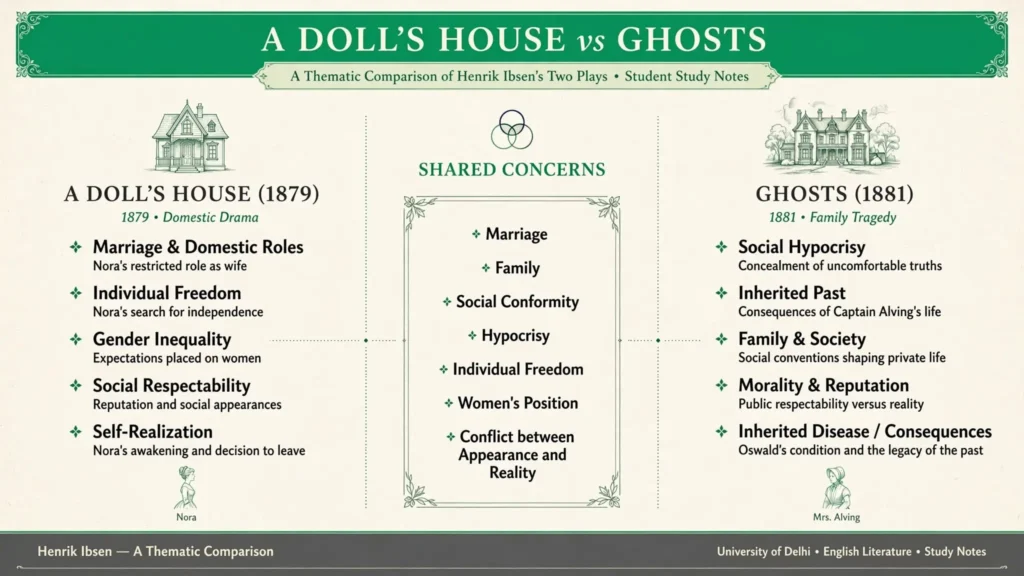
A comparison that frequently comes up in DU exam answers, since both plays are studied as companion pieces in Ibsen’s realist period:
| Aspect | A Doll’s House (1879) | Ghosts (1881) |
|---|---|---|
| Central conflict | A wife’s right to individual self-determination | A widow’s concealment of a husband’s hidden disease and infidelity |
| Ending | Nora leaves — an open but active act of freedom | Mrs. Alving is left with an unresolved, passive choice |
| Treatment of “freedom” | Freedom is achievable, if costly | Freedom is structurally foreclosed by heredity and social pressure |
| Central target of critique | The institution of marriage | Organised religion, inherited disease, and social hypocrisy |
| Public reception | Scandalous, but staged immediately in Copenhagen (1879) | So controversial it was refused by every major Scandinavian theatre |
Critical Reception and Legacy
Contemporary reviewers in 1881–82 were, almost without exception, hostile — Ibsen himself predicted correctly that no German or Scandinavian theatre would risk staging it. Encyclopaedia Britannica’s assessment captures the scale of what the play attempted: an “attack on conventional morality and on the results of hypocrisy,” built ostensibly around congenital venereal disease but really concerned with “the power of ingrained moral contamination to undermine the most determined idealism.”
Later critics, including theatre historian Maurice Valency, have argued that Ghosts marks a genuinely new direction for tragedy — earlier tragedy dealt with the consequences of breaking a moral code, while Ghosts deals with the far bleaker consequences of dutifully keeping to one. This reversal is a large part of why the play is still read as a foundational text of modern, as opposed to classical, tragedy — and why it remains a natural entry point into this unit’s broader study of the shift from Romantic to realist and naturalist European drama.
Key Takeaways
- Ghosts (1881) is Ibsen’s most controversial “problem play,” dealing with inherited venereal disease, concealed infidelity, and institutional hypocrisy.
- It was refused by every major Scandinavian theatre and premiered instead in Chicago (1882), reaching Europe only in 1883 (Sweden) and later still in Germany (public premiere 1894) and England (single private performance, 1891).
- The play’s central irony is that Mrs. Alving’s lifelong effort to protect appearances is precisely what allows the past to resurface and destroy the next generation.
- Its open, unresolved ending — Mrs. Alving alone with the morphine — is central to its status as a modern rather than classical tragedy.
Continue Reading
If you’re working through DSC-16: Modern European Drama, these related notes cover the other units on this paper:
Continue Reading
University of Delhi Previous Year Questions
University of Delhi Previous Year Questions
Section A — Short Answer Questions (DU-pattern / Probable)
1 What does the title Ghosts signify in the context of the play? +
Hint: Refer to Mrs. Alving’s speech in Act II and discuss both the literal and metaphorical meanings of “ghosts.”
Suggested Answer Focus: Inherited ideas, social conventions, memories of the past, moral hypocrisy, and the continuing influence of the dead upon the living. Probable
2 Comment on the character of Pastor Manders. +
Hint: Focus on the tension between his apparent sincerity and his complicity in concealing wrongdoing.
Suggested Answer Focus: Conventional morality, concern for social reputation, religious authority, hypocrisy, and his role in maintaining the Alving family’s public image. Probable
3 What role does the orphanage play in the structure of Ghosts? +
Hint: Connect its purpose, its lack of insurance, and its destruction to the play’s theme of concealment.
Suggested Answer Focus: The orphanage as a memorial to Captain Alving, Mrs. Alving’s attempt to protect Oswald, Pastor Manders’s opposition to insurance, and its eventual destruction as a dramatic turning point. Probable
4 Briefly explain the significance of the play’s final scene. +
Hint: Discuss the symbolism of the rising sun and the unresolved ending.
Suggested Answer Focus: Oswald’s deteriorating condition, his request for morphine, the rising sun as a possible symbol of hope or cruel irony, and the ambiguity of Mrs. Alving’s final decision. Probable
Section B — Long Answer Questions (DU-pattern / Probable)
1 Discuss Ghosts as a critique of nineteenth-century social and religious hypocrisy. +
Hint: Draw on Pastor Manders, the orphanage subplot, and the gender double standard surrounding Captain Alving’s conduct.
Suggested Answer Focus: Social respectability, religious morality, concealment of truth, Manders’s conventionalism, Captain Alving’s private life, and unequal moral expectations placed upon men and women. Probable
2 Examine the theme of heredity and its dramatic function in Ghosts. +
Hint: Connect Oswald’s illness to naturalist ideas about inherited traits and to the play’s broader meaning of “ghosts.”
Suggested Answer Focus: Oswald’s inherited illness, the consequences of Captain Alving’s past, heredity versus environment, naturalist dramatic ideas, and the way the past continues to shape the present. Probable
3 Compare Ibsen’s treatment of individual freedom in Ghosts and A Doll’s House. +
Hint: Contrast Nora’s active decision to leave with Mrs. Alving’s constrained choices and the unresolved ending of Ghosts.
Suggested Answer Focus: Individual choice, social conventions, marriage, gender roles, personal autonomy, Nora’s departure, and Mrs. Alving’s inability to escape the consequences of her past choices. Probable
4 “Ghosts deals with the consequences of not breaking the moral code.” Discuss this statement with reference to the play’s central irony. +
Hint: Discuss how dutifully upholding convention, rather than openly challenging it, contributes to the destruction of the Alving family.
Suggested Answer Focus: Mrs. Alving’s concealment of Captain Alving’s conduct, concern for reputation, Pastor Manders’s conventional morality, the orphanage, Oswald’s illness, and the irony of social duty producing destructive consequences. Probable
Section C — Exam Writing Tip
Section D — PYQ Verification Note
FAQs
What is the summary of Ghosts by Henrik Ibsen?
Ghosts follows the widowed Mrs. Alving as she prepares to dedicate an orphanage in memory of her husband, whose respectable public reputation conceals a life of infidelity and disease. As her son Oswald falls ill with what turns out to be an inherited condition, and her maid Regine is revealed to be her husband’s illegitimate daughter, Mrs. Alving is forced to confront the truths she spent decades concealing.
Who wrote Ghosts, and when was it published?
Ghosts was written by the Norwegian playwright Henrik Ibsen and published in December 1881. It was refused by every major Scandinavian theatre and premiered instead in Chicago, USA, in May 1882.
What disease does Oswald have in Ghosts?
The play never names the illness directly, but it is universally understood by critics and contemporary audiences to be congenital syphilis, inherited from his father, Captain Alving.
Is Regine Captain Alving’s daughter?
Yes. Regine is the illegitimate daughter of Captain Alving and Johanna, a former housemaid in the Alving household. She is raised believing Jacob Engstrand is her father, and only learns the truth — that she and Oswald are half-siblings — near the end of the play.
Why was Ghosts so controversial when it was published?
The play openly dealt with venereal disease, incest between half-siblings, euthanasia, and a sharp critique of organised religion and marriage — subjects considered unfit for public discussion, let alone the stage, in 1881. It was banned or refused a public licence in several countries for years afterward.
What does the title Ghosts mean?
Beyond the literal echo of Captain Alving’s actions reappearing in the next generation, Mrs. Alving uses “ghosts” to describe inherited ideas and beliefs — social, religious, and moral — that continue to control people’s lives long after they have lost any real validity.
How does Ghosts end?
The play ends with Oswald’s mind collapsing due to his illness just as the sun rises, and Mrs. Alving left alone on stage holding the morphine pills he had asked her to use on him if this happened. Ibsen does not show what she chooses to do — the ending is deliberately left open.
What is the relationship between Ghosts and A Doll’s House?
Both are realist “problem plays” from Ibsen’s most controversial period, and both interrogate the gap between social respectability and private truth. A Doll’s House (1879) ends with Nora’s active decision to leave; Ghosts (1881), written two years later, offers a bleaker variation in which the protagonist’s options are far more constrained.
What are the major themes of Ghosts?
The haunting power of the past, hypocrisy in religious and social institutions, the conflict between personal freedom and social conformity, heredity and disease, and the recurring symbolic opposition of light and darkness.
Why is Pastor Manders an important character in Ghosts?
Manders embodies institutional religious conservatism. His advice years earlier that Mrs. Alving return to her unhappy marriage, and his later refusal to insure the orphanage out of a concern for appearances, directly cause two of the play’s central catastrophes — making him central to Ibsen’s critique of duty-bound, appearance-driven morality.
Who is Jacob Engstrand and what is his role in the play?
Engstrand is a carpenter who married Regine’s mother, Johanna, while she was pregnant by Captain Alving, and who raised Regine as his own daughter. In Act III, he manipulates Pastor Manders into funding his planned “sailors’ home” in exchange for taking the blame for the orphanage fire, making him a lower-class mirror of Manders’s own self-interested hypocrisy.
Is Ghosts considered a tragedy?
Yes — but critics such as Maurice Valency have argued it represents a distinctly modern kind of tragedy. Classical tragedy typically shows the consequences of breaking a moral code; Ghosts shows the far bleaker consequences of dutifully upholding one.
Subscribe to keep reading
You've used your free notes for now. Get Delhi Pathshala Premium for unlimited access.
Subscribe — ₹29/30 days