
Contents
- Amar Jiban at a Glance
- 1. Introduction to Rassundari Devi and Amar Jiban
- 1.1 Rassundari Devi: A Pioneer of Women’s Autobiography
- Early life and background
- Why she matters as a woman author
- 1.2 Overview of Amar Jiban (My Life)
- When and why it was written
- What the book is about
- Effect on Bengali literature and women’s writing
- 2. Historical and Cultural Context
- 2.1 Nineteenth-Century Bengal: Society and Gender Norms
- The role of women in traditional Bengali society
- Attitudes towards female education and literacy
- 2.2 Vaishnava Devotion and the Chaitanya Tradition (not “the Bhakti movement” in general)
- The religious world of the text
- Spirituality and the pursuit of knowledge
- 3. Learning in Secret: The Quest for Reading
- 3.1 The Forbidden Wish to Learn
- Rassundari’s desire to read a religious text
- Obstacles: custom, fear and the household
- 3.2 Stealth and Determination
- How she taught herself
- Learning as an act of defiance, or as a devotional act?
- What it meant
- 4. Life at Home: Marriage, Labour and Self-Improvement
- 4.1 Marriage and Household Responsibilities
- From girlhood to married life
- Daily tasks of a wife and mother
- 4.2 Balancing Personal Dreams and Family Duties
- Finding time for herself
- Sacrifice and satisfaction
- 5. Spiritual Thought and Religious Influences
- 5.1 Faith as a Source of Strength
- Faith in Rassundari’s life
- Reading religious texts for comfort
- 5.2 Understanding Religious Texts
- A personal relationship with the divine
- How spirituality shaped her view of life
- 6. Independence, Voice and Self-Expression
- 6.1 Voice and Identity in a Male-Dominated Society
- Why writing her own story mattered
- Challenges of individuality in a restrictive society
- 6.2 Writing as a Way to Gain Freedom
- Literacy as a route to self-narration
- Writing as release and as legacy
- 7. Literary Analysis of the Excerpt (pp. 192–202)
- 7.1 Narrative Style and Technique
- First-person voice and recollection
- Simple language, deep meaning
- The devotional frame
- 7.2 Imagery and Metaphor: Cage, Prisoner and Net
- The caged bird
- From confinement to freedom
- Light and knowledge: a reading, not the text’s own motif
- Comparison with the confinement imagery of Gilman and Rokeya
- 8. Critical Debates: How Have Scholars Read Amar Jiban?
- 8.1 Four ways of reading the text
- 8.2 The age question
- 8.3 What is not in dispute
- 9. Important Views and Critiques
- 9.1 Feminist Views
- Gender, resistance and voice
- The text as a statement in a traditional era
- 9.2 Social and Cultural Critiques
- Social norms and their effects
- Class, caste, gender and education
- 10. Comparative Studies
- 10.1 Amar Jiban and Other Works of its Time
- Women’s and men’s life-writing
- Differences in theme and expression
- 10.2 Reading Across Your Unit 2 Texts
- 11. Impact on Women’s Writing and Legacy
- 11.1 Early Women Writers and Rediscovery
- 11.2 Social Awareness and Women’s Education
- Education
- Gender equality
- 12. Contemporary Relevance
- 13. Study Questions with Model Answers
- 13.1 Personal freedom
- 13.2 Education as empowerment
- 13.3 Spirituality and self-realisation
- 14. Quick Revision
- 14.1 Timeline
- 14.2 Key terms
- 14.3 Facts students often get wrong
- Conclusion: What Amar Jiban Leaves Us With
- Continue Reading
- Frequently Asked Questions
- Sources and Further Reading
Amar Jiban (My Life) is the autobiography of Rassundari Devi (c. 1809/10 – c. 1899/1900), a Bengali housewife from a zamindar family in eastern Bengal who taught herself to read in secret when she was in her mid-twenties and went on to write what is widely described as the first full-length autobiography in the Bengali language and the first by an Indian woman. Her name is also spelt Rashsundari, Rasasundari, Rassundari Debi or Rasundari, and the title appears as Amar Jiban, Amar Jibon, Aamar Jiban or Amar Jibon. They all refer to the same author and the same book.
These notes cover Unit 2c of DSC-18: Women Writings in the BA (Hons.) English programme of the University of Delhi. The syllabus prescribes the Excerpts from Amar Jiban translated by Enakshi Chatterjee in Susie Tharu and K. Lalita (eds.), Women Writing in India, Vol. 1 (Oxford University Press, New Delhi, 1989), pp. 192–202. In the same unit you read Charlotte Perkins Gilman’s The Yellow Wallpaper (Unit 2A) and Begum Rokeya’s Sultana’s Dream (Unit 2B), so this page also points out where Rassundari’s text speaks to theirs. The full semester list is on the BA English notes page.
Read the notes below alongside your own copy of the prescribed excerpt. Quotations in these notes are kept short and should be checked against the pages in your edition, because different translations of Amar Jiban (Enakshi Chatterjee’s, and Tanika Sarkar’s in Words to Win) word the same passages differently.
Amar Jiban at a Glance
| Point | Detail |
|---|---|
| Author | Rassundari Devi (Rashsundari / Rasasundari Debi), c. 1809 or 1810 – c. 1899 (some sources give 1900) |
| Born | Potajia village, Pabna district, eastern Bengal (now Bangladesh), into a zamindar family; her father Padmalochan Roy died while she was a small child |
| Married | At about the age of 12 (sources agree on 12 for the most part; one academic paper gives 14), to Sitanath Sarkar, a zamindar of Ramdia in Faridpur district |
| Learned to read | In her mid-twenties (about 25–26), in secret, in the kitchen of her husband’s household |
| Widowed | 1868, at about 59 |
| Book | Amar Jiban (“My Life”), written in Bengali prose |
| Structure | Two parts. The first has sixteen shorter compositions (rachanas); the second, written when she was about 88, has fifteen. Each composition is preceded by a devotional poem addressed to her chosen deity, Dayamadhav (a form of Krishna/Vishnu) |
| Dates | First part composed by 1868; first book edition 1876; expanded edition with the second part 1897 (a later printing of 1906 is also cited). See the note below |
| Prefaces | Jyotirindranath Tagore (elder brother of Rabindranath Tagore) and Dinesh Chandra Sen, in the later edition |
| Genre | Autobiography / life writing / devotional memoir |
| Text prescribed at DU | Excerpts, tr. Enakshi Chatterjee, in Tharu & Lalita, Women Writing in India, Vol. 1 (OUP, 1989), pp. 192–202 |
| Key themes | Secret literacy; domestic labour; devotion to God; confinement; self-expression; women’s education |
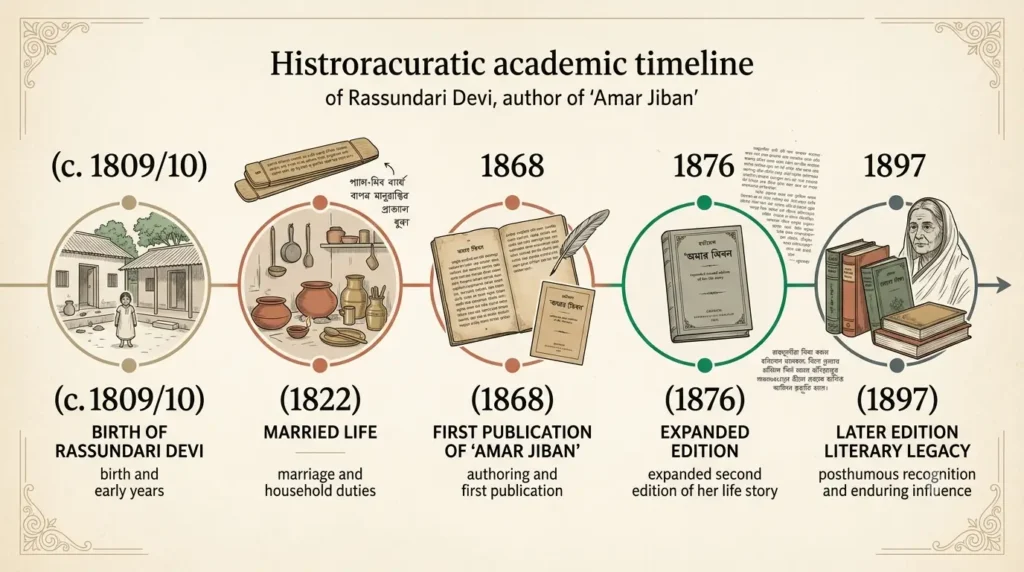
A note on dates (important for exams). Sources do not agree on when Amar Jiban was published. The date you will see most often is 1876, and this is the safest date for an exam answer. Some scholars say the first part appeared as early as 1868, the year she was widowed, and nearly everyone agrees that the second part and the expanded edition came out in 1897, when she was about 88. A few sources mention 1906 for a later printing. In an answer you can write: “first published in 1876 (some scholars give 1868 for the first part), with an expanded edition in 1897”. Two other dates you may see on notes websites are wrong: the book was not published in 1902, and Rassundari Devi was not born in 1856.
1. Introduction to Rassundari Devi and Amar Jiban
1.1 Rassundari Devi: A Pioneer of Women’s Autobiography
Early life and background
Rassundari Devi was born around 1809–1810 in the village of Potajia in the Pabna district of eastern Bengal. Her father, Padmalochan Roy, died when she was very young, and her mother and relatives brought her up. Like almost every girl of her time and class, she was not sent to school. The idea that a girl might need to read and write simply did not enter the planning of her family.
She was married at about twelve to Sitanath Sarkar and moved to her husband’s family home at Ramdia, in what is now Rajbari district. Over the next two decades she gave birth to twelve children (some sources and papers say eleven), and she ran a large zamindar household, which meant cooking, serving and managing for a great many people. Her days belonged to other people.
Within this life she developed a strong wish to read, and specifically to read a religious book, the Chaitanya Bhagavata. She had no teacher and no permission. So she taught herself to read, in secret, at about twenty-five or twenty-six. Decades later, after her husband’s death in 1868, she wrote the story of her life. It is for this act of writing, and not only for the secret learning, that she is remembered.
Why she matters as a woman author
Rassundari Devi’s importance is partly one of priority and partly one of perspective.
- Priority. Amar Jiban is widely described as the first full-length autobiography in the Bengali language and the first autobiography by an Indian woman. A careful student should know that “first” claims are always made with qualifications: scholars usually say “first full-fledged autobiography in Bengali” or “first published autobiography by a Bengali woman”, and some add “perhaps the first printed in any Indian language”. In an exam answer, “widely regarded as” is safer than a flat “was the first”.
- Perspective. Almost all the writing of her time that reached print was by men. Amar Jiban shows a woman’s working day, her fears, her prayers and her desire to learn, written from the kitchen rather than from the reform meeting. Dinesh Chandra Sen, who introduced the book, said it was more than one woman’s account: it was “a story of all Hindu women of her time”.
1.2 Overview of Amar Jiban (My Life)
When and why it was written
Rassundari Devi wrote the first part of Amar Jiban in the years after her husband’s death in 1868, when she was about 59, and she added the second part nearly three decades later, in her late eighties. The book was not written as a manifesto. She does not announce a campaign for women’s education. She presents herself as an old woman recalling her life and giving thanks to God for having brought her through it, and the text is organised around devotion: every composition opens with a poem to Dayamadhav.
The usual way of reading it as a protest against male-dominated norms is therefore an interpretation by later readers, not the stated purpose of the author. This is an important point and one that scholars like Tanika Sarkar make carefully (see Section 8, “Critical Debates”). The text does not need to be a manifesto to be radical. It is radical because of what it records and because a woman wrote it down.
What the book is about
The book moves through her childhood and her mother’s fear-based discipline, her tearful departure from her mother’s house after marriage, the endless work of the zamindar household, the birth and loss of children, the long struggle to learn the alphabet, and finally her peace in devotion. The first part has sixteen compositions; the second, written when she was about 88, has fifteen.
Effect on Bengali literature and women’s writing
Amar Jiban was welcomed when it appeared. Jyotirindranath Tagore praised its “simple sweetness” of expression, and Dinesh Chandra Sen called it a document that Bengali literature could not do without. In the twentieth century the book was rediscovered by feminist historians, and the Kali for Women edition of Tanika Sarkar’s Words to Win (1999) and the inclusion of the Tharu and Lalita extract in Women Writing in India made it a standard text for women’s studies and English literature courses across India, including at the University of Delhi.
It showed Indian readers that a woman’s ordinary domestic life could be the subject of a book. Later women’s autobiographies in India, including those you may meet elsewhere in your course, work in a field that this book helped open. It would be too strong to say that later writers were directly inspired by Rassundari Devi unless a specific writer says so, and these notes do not make that claim.
2. Historical and Cultural Context
2.1 Nineteenth-Century Bengal: Society and Gender Norms
The role of women in traditional Bengali society
In nineteenth-century Bengal, respectable women, particularly in upper-caste Hindu households and in the countryside, lived inside the home. Marriage came very early, often before puberty, and a bride moved to her husband’s family, where she was expected to obey her husband and her elders, cook, serve and bear children. A woman’s standing in the household depended on her sons and on her unquestioning service.
Caste and class shaped this life. Women of upper-caste landed families, such as Rassundari’s, were bound by rules of seclusion (purdah-like norms of covering the head and avoiding being seen) that women of working families could not always keep. Lower-caste women were largely shut out of any formal schooling. At the same time, reform and education reached some women, mostly in Calcutta and mostly from a few progressive households. Rassundari lived in a rural zamindari household in eastern Bengal, far from those debates.
Reform movements were active during her lifetime. Raja Rammohun Roy campaigned against sati, which was banned by law in 1829, and Ishwar Chandra Vidyasagar’s work led to the Hindu Widows’ Remarriage Act of 1856. The Bethune School for girls was opened in Calcutta in 1849. For a deeper background on these movements, read our notes on 19th Century: Reforms and Revival. But change was slow, and reformers’ debates reached rural zamindari homes like hers late and unevenly.
Attitudes towards female education and literacy
In traditional Bengali households, a literate woman was seen with suspicion. A widespread superstition, which both Tanika Sarkar and other scholars refer to, held that a woman who learned to read and write would be punished by God with widowhood. Elders could look at a girl or a young wife with a book or even a piece of paper in her hands with deep disapproval. Rassundari herself describes how people despised women of learning, and she says she was angry with herself for wanting to read, because “girls did not read”.
Some reformers and missionaries were already arguing for women’s schooling, and this caused a sharp conflict within Hindu society. But the education they imagined was often meant to produce better wives and mothers, and it went into a few urban families. Rassundari’s autobiography stands outside these public debates. As Tanika Sarkar’s work, and later readings of it, observe, her text does not directly enter the mid-century arguments about women’s education. What it provides instead is a rare, inside view of what it was like to want to read in a household where nobody would have helped her.
This is what makes her case striking: she was not given an education, she did not belong to a reforming circle, and yet she found a way in.
2.2 Vaishnava Devotion and the Chaitanya Tradition (not “the Bhakti movement” in general)
The religious world of the text
Many notes describe the background of Amar Jiban as “the Bhakti movement”. That is too broad to be useful. Bhakti, the tradition of loving, personal devotion to God, is centuries older than Rassundari and spread across India in many regional forms. The specific tradition in her life was Vaishnavism, and in Bengal in particular the devotional tradition that grew around Chaitanya (1486–1534), the saint who taught intense love of Krishna. The text she longed to read, the Chaitanya Bhagavata (a sixteenth-century biography of Chaitanya by Vrindavana Dasa), belongs to this world.
Her chosen deity was Dayamadhav, “the merciful Madhav”, a name of Krishna. Every composition in her book is preceded by a short devotional poem addressed to him. She presents God as a close, forgiving presence who looks after her through hard times. Her trust in God began with her mother, who told her to turn to Dayamadhav when she was frightened.
Spirituality and the pursuit of knowledge
This religious language does two jobs in the book. First, it is her genuine faith. Second, scholars such as Tanika Sarkar and Meenakshi Malhotra have noted that it is also her way of making her transgression acceptable: when she describes doing something unusual, such as learning to read, she attributes it to God’s mercy and leela (divine play), and the prayers tend to come just before the passages in which she departs from the rules, so that the departure sounds less shocking. Learning the alphabet becomes a devotional act, not a revolt, and this helped her tell a story that readers of her time could accept.
So the link between faith and learning in the book is real and central, but it is a link with Chaitanya Vaishnavism, not with a general nineteenth-century Bhakti movement, and not with the Bhagavad Gita, the Ramayana or the Bible, which are sometimes wrongly named in student notes. The book that drove her to learn was the Chaitanya Bhagavata.
3. Learning in Secret: The Quest for Reading
3.1 The Forbidden Wish to Learn
Rassundari’s desire to read a religious text
Rassundari’s desire to read was above all a devotional desire. She knew many sacred stories and verses by heart. What she wanted was to read the Chaitanya Bhagavata herself, to see the words that she had only heard recited. Jyotirindranath Tagore, in his preface, stressed this point: she did not want to read plays and novels, she wanted to read the Chaitanya Bhagavata.
According to her own account, she grew restless with this wish. She was so busy with housework that she hardly noticed how the days passed, yet the wish grew stronger. At the same time she was angry with herself for having it, because girls were not supposed to read and the community looked down on learned women. She could not, as she says, quite accept this view all the same.
Obstacles: custom, fear and the household
There was no school for her, no teacher, and no one who would have supported her. The household was full of people, and privacy was rare. She was afraid of being found out, and she was afraid, too, of the superstition that female literacy brought widowhood. She describes herself as a woman who trembled with fear for much of her life. What the book teaches us is that the barrier to learning was not only a rule. It was a complete atmosphere of fear, shame and constant work.
3.2 Stealth and Determination
How she taught herself
Her path to literacy was slow and secret, and scholars have pieced together its stages from her own narrative:
- Watching the boys. In her early life, boys studied in lessons held in the household’s school (accounts differ on the details; some mention a school run by a missionary woman in her father’s house), where they wrote the letters of the Bengali alphabet on the ground and repeated them aloud. She says she was nearby and learned the thirty-four letters by watching and listening.
- The hidden page. Years later, in her husband’s house, she found a way to get hold of a single page of a copy of the Chaitanya Bhagavata belonging to her husband, and hid it near the kitchen, among the cooking things.
- The dream. Before she managed to begin, she saw a dream in which she herself was reading the Chaitanya Bhagavata. Scholars note that she treats this dream as a sign of divine encouragement.
- Matching sound to letter. Because she already knew verses and names by heart, she was able to compare the sounds she remembered with the shapes on the page, slowly recognising letter after letter, practising in stolen moments between household tasks, often at night or in the kitchen, and hiding what she was doing.
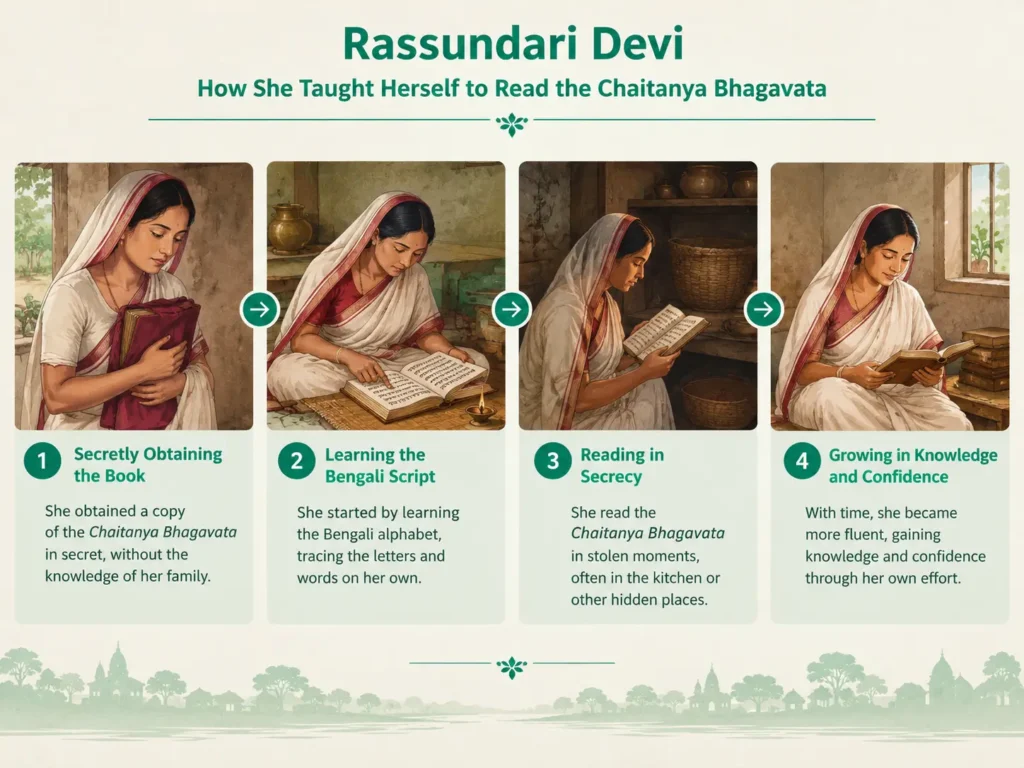
This was a long and lonely process, full of mistakes and fear. She was learning alone, without a teacher, in about her mid-twenties.
Learning as an act of defiance, or as a devotional act?
The common student reading is that Rassundari’s secret learning was “an act of rebellion”. There is truth in this. She did break the rules of her household and community, and she did it in secret because she knew it would be forbidden. Her self-education claims the right to knowledge for women and challenges the belief that women are less capable.
But a careful reader should hold two readings together:
- Resistance: her learning defies the idea that women should stay uneducated and that female literacy brings disaster.
- Legitimation through devotion: she explains her learning as God’s gift and her purpose as devotion, which made her act easier to accept. Scholars read this as a clever and very effective strategy, as well as a sincere faith.
Notes that say only “rebellion” miss the second half, and notes that say only “devotion” miss the first. The best exam answers keep both.
What it meant
Her later success, becoming a literate woman and then an author, is a quiet but real victory over those who tried to keep women silent. It also reminds us that literacy is not only a skill. For Rassundari, reading brought her closer to God, gave her a sense of her own mind, and eventually gave her a way of telling her own story. For a longer look at how another nineteenth-century woman argued for women’s education in print, see our notes on Tarabai Shinde’s Stri Purush Tulana.
4. Life at Home: Marriage, Labour and Self-Improvement
4.1 Marriage and Household Responsibilities
From girlhood to married life
Rassundari’s marriage at about twelve ended her childhood abruptly. One of the most affecting parts of the early narrative is her account of leaving her mother. She describes the parting as extremely painful, and she describes the fear and loneliness of arriving among strangers. Her mother had earlier used frightening stories (such as the tale of a “child-lifter” who carries children away in a bag) to keep her indoors and obedient, and the book shows how fear was used as a way of controlling children, especially girls.
Her husband, Sitanath Sarkar, was the head of a landed household in Ramdia. As a new bride she was expected to learn the work of the house quickly and to keep her face covered before elders and men.
Daily tasks of a wife and mother
Rassundari’s days were consumed by cooking for a large household, serving food, and caring for children, and in time she bore twelve children (some sources and papers say eleven). One scholar notes that, with so many children to look after, she had hardly any time for anything else. Despite the family’s wealth (a zamindar household with many servants), the cooking and serving in her household fell to her. This is a useful corrective to a common assumption: wealth did not free her. Class helped a family afford servants, but it did not give a wife control over her own time, or permission to read.
This is why scholars treat the kitchen as the central space of the book. It is her prison and her workplace, and it is also the place where she learned to read.
4.2 Balancing Personal Dreams and Family Duties
Finding time for herself
Rassundari did not give up her duties in order to learn. She learned in the gaps: in the moments when she was alone in the kitchen, when the household was busy, or when others were asleep. The book is, in large part, an account of this struggle to find time for herself in a life organised around everyone else.
Sacrifice and satisfaction
She also reflects on the cost. Her own wishes were repeatedly put aside, and she describes the feeling of being unable to leave the house or visit her ailing mother freely. In one of the best-known images of the book, she says she was like a caged bird, kept by others for their pleasure. In another, she compares the occasional visit home to being a prisoner let out on parole, expected to be back within a few days.
And yet the book is not simply a complaint. She finds real satisfaction in her devotion and in her slowly growing ability to read. She is able to see her household work as part of her service to God, and this gives her the strength to continue. The balance between duty and personal growth, and the way she holds both together, is the emotional centre of the narrative.
5. Spiritual Thought and Religious Influences
5.1 Faith as a Source of Strength
Faith in Rassundari’s life
Faith was the frame of Rassundari’s whole life and writing. When she was frightened as a child, her mother told her to take refuge in Dayamadhav. When she was lonely or overworked as a wife, she turned to God. Scholars point out that God also becomes a kind of absent father for a girl who lost her father early, a presence she could depend on.
She understands good and bad events alike as the will of God. That does not make her passive. By placing herself under God’s protection, she was also able to claim a certain freedom, since she could say that what she did, including learning to read, was something God had granted her.
Reading religious texts for comfort
Reading was, for her, a religious practice. The Chaitanya Bhagavata, the biography of the saint Chaitanya, spoke of a God who loved devotees whatever their caste or condition. Some scholars suggest that she understood from it how sacred texts could include and uplift the marginalised, a group that in her experience included women. Being able to read it herself, instead of hearing it recited by men, was therefore an act of spiritual independence.
5.2 Understanding Religious Texts
A personal relationship with the divine
Rassundari’s devotion is personal and emotional. She does not describe a ritual religion mediated by priests. She describes a relationship with Dayamadhav, whom she addresses in the poems that open each composition, and she even describes what scholars call “personalised” experiences, such as dreams that guided her. One scholar’s reading of the book describes her as reshaping the image of God in her own way, while still staying within accepted religious forms.
Some notes say that she was drawn to the idea of dharma (duty) from the Bhagavad Gita, and that the Gita shaped her understanding. These claims are not supported by any of the sources consulted for this update. What is documented is her devotion to the Vaishnava deity Dayamadhav and her wish to read the Chaitanya Bhagavata. If you want to bring in dharma in an answer, present it as a general idea of duty that frames her domestic life, not as a reading of the Gita.
How spirituality shaped her view of life
Spirituality changed how she saw her days. Household tasks became service; hardship became God’s will; and the desire to read became a gift. This vision gave dignity to a life that otherwise had little recognition. At the same time, modern readers have asked whether this religious framing also made her suffering easier for others to ignore. This is one of the open questions about the text, which Section 8 discusses.
6. Independence, Voice and Self-Expression
6.1 Voice and Identity in a Male-Dominated Society
Why writing her own story mattered
For a woman of her time to write about herself at all was unusual. Women’s lives were told, if at all, by men, and usually in terms of their roles as wives and mothers. By writing Amar Jiban in the first person, Rassundari gave herself the position of a subject. She tells us what she saw, what she feared and what she wanted. In doing so she says, without needing to argue it, that a woman’s inner life is worth recording.
An important detail adds to this. By the time the book appeared, she was not a young wife. She was an elderly woman whom the family respected for her experience, as Tanika Sarkar has pointed out, and this respected position may have made it easier for her to speak.
Challenges of individuality in a restrictive society
Women were expected to be silent and obedient. Self-expression could mean criticism, gossip or loss of standing. Rassundari did not write openly against anyone. She wrote carefully, preceded her departures from custom with prayers, and gave God the credit. The courage in the text lies partly in this careful way of speaking truthfully in a society that did not want to hear it.
6.2 Writing as a Way to Gain Freedom
Literacy as a route to self-narration
The story of learning to read is inseparable from the story of writing. Her reading let her write; her writing let her give her life a shape. The first, secret step of recognising a few letters on a stolen page led, decades later, to a book. This is why one scholar describes Amar Jiban as, at bottom, an account of her struggle with reading and writing.
Writing as release and as legacy
Writing gave her a place outside the household’s roles. Through the book she appears not only as a wife and mother but as a person with a history and a voice. And once published, her writing served other women as proof that such a life could be written about. In that sense it was both a personal release and a public record.
7. Literary Analysis of the Excerpt (pp. 192–202)
Use this section together with your own copy of the prescribed pages. These notes describe the features of the book as a whole, as scholars describe them; the exact passages in the Tharu and Lalita excerpt should be matched against your edition.
7.1 Narrative Style and Technique
First-person voice and recollection
The book is a first-person retrospective narrative. The older woman who writes looks back at the girl and young wife she once was. This gives the narrative two levels: the experience, and the mature reflection on it. Scholars note that the text also has two levels of address, because the story of the devotee’s life is told in dialogue with the story of God’s grace, so that the two seem intertwined.
She tells us she is writing whatever she can recall, and the narrative is not strictly chronological. It moves by memory and by the emotional weight of events, in the sixteen compositions of the first part.
Simple language, deep meaning
The language is plain prose. Jyotirindranath Tagore singled out its plain, unforced charm. There is little ornament, and this directness is part of the book’s force: the fear, the tiredness and the longing arrive without decoration. Because she is a woman with no literary training, writing in the plain Bengali of daily speech, the simplicity also tells us something about who is speaking.
The devotional frame
Each composition begins with a devotional poem to Dayamadhav. This structure is a distinctive literary feature. It places the whole narrative inside an act of prayer and gives the autobiography the shape of an offering, which, as noted earlier, also protects its more daring passages.
7.2 Imagery and Metaphor: Cage, Prisoner and Net
The caged bird
The most memorable image in the book is that of the bird in a cage. In one passage she says people keep birds in cages for their own amusement, and “I was like a caged bird”. Elsewhere she writes of a bird shut behind the bars and a fish fallen into a net when she describes her arrival in her husband’s house (the wording differs by translation). She also compares her rare visits to her mother’s home to being a prisoner let out on parole.
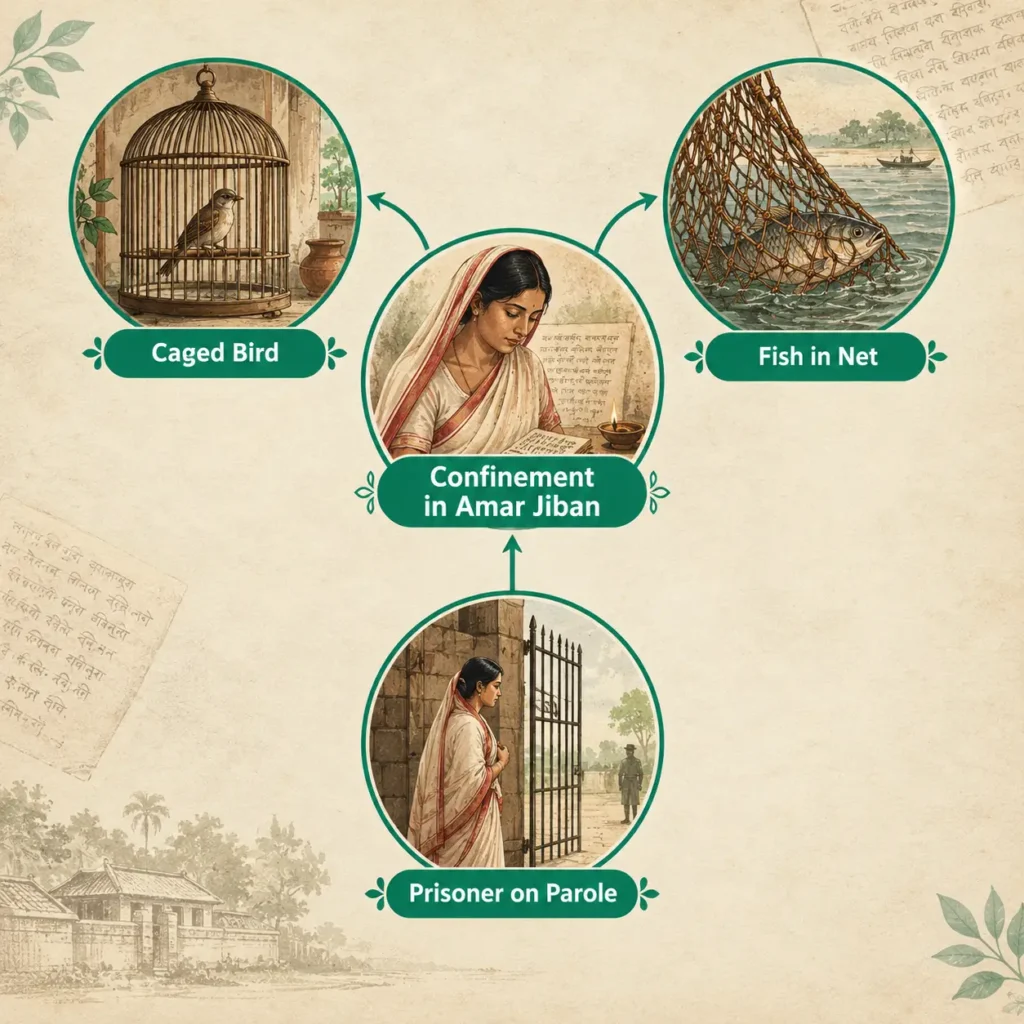
These images are not decorative. They express the feeling of confinement without possibility of escape, the central experience of a woman who was moved from her mother’s house into a household she could not leave. Notice also that the images are of creatures kept for the pleasure of others, which points to how she saw her position: useful and cared for, but not free.
From confinement to freedom
If confinement is the dominant image, the book’s movement is slowly and quietly towards a kind of freedom. It does not come through leaving the household, which she never does, but through reading and then writing. The cage is not broken; it is, in a sense, opened from inside.
Light and knowledge: a reading, not the text’s own motif
Some student notes describe a “darkness and light” pattern in the book, with ignorance as darkness and literacy as light. This is an interpretive extension that students may use if they can support it from the excerpt, but it should not be presented as the text’s central motif. The images that scholars consistently identify in Amar Jiban are the caged bird, the fish in the net and the prisoner on parole. If you use the light–knowledge idea in an exam, label it as your own reading and connect it to a passage in your edition.
Comparison with the confinement imagery of Gilman and Rokeya
The cage image makes the text easy to compare with The Yellow Wallpaper, where the narrator is confined to a room and sees a woman behind the wallpaper’s bars, and with Sultana’s Dream, where Rokeya reverses purdah by confining men. All three texts examine confinement, but in very different registers: Gilman’s is a gothic psychological story, Rokeya’s a satirical utopia, and Rassundari’s a plain, devotional memoir. We discuss the comparison in Section 10.
8. Critical Debates: How Have Scholars Read Amar Jiban?
Students often write that Rassundari Devi was “a feminist” and leave it there. Scholars are more careful, and the disagreement is itself exam material. The positions below are attributed to the scholars and writers who hold them; none should be presented as settled fact.
8.1 Four ways of reading the text
| Reading | Who argues it | The argument | Evidence it uses | Its limit |
|---|---|---|---|---|
| An early feminist text | Many feminist readers and women’s-studies writers | Writing her life, and claiming literacy, is itself a feminist act; she exposes the harm done by patriarchy | The caged-bird images; the secret learning; the fact of authorship | She did not call herself a feminist and was not part of any reform or women’s-rights group |
| A devotional text that uses devotion strategically | Tanika Sarkar; Meenakshi Malhotra | She builds a persona of the devotee and presents each departure from custom as God’s leela; prayers tend to come before her transgressions, to soften them | The opening poems; her attribution of literacy to God’s mercy | Risks making her sound calculating; her faith appears sincere throughout |
| A text outside the reform debates | Tanika Sarkar, as discussed by later critics such as Srija Sanyal | The book belongs to a world before, and apart from, the public reform arguments about women’s education; it speaks of problems (domestic labour, widowhood, fear) that male reformers did not address | Its rural zamindari setting; absence of reformers’ vocabulary | Its later reception did become part of the history of women’s education |
| A critique of idealised domesticity | Writers in contemporary women’s studies | Instead of praising her as the perfect “domestic goddess”, we should recognise her heavy unpaid labour as patriarchal exploitation | The long account of cooking, serving and childbearing | Her own text treats much of this work as devotion |
8.2 The age question
Tanika Sarkar has drawn attention to a feature that is easy to miss: the book appeared when Rassundari was an elderly woman, whose knowledge and experience were respected by her family, and not a timid young wife. Readers who build on this idea argue that Amar Jiban challenges the link between learning and youth, and that it is a record of late-life learning, since she learned to read in her mid-twenties and wrote her book in her sixties and again in her late eighties.
8.3 What is not in dispute
Everyone agrees that she was self-taught, that the Chaitanya Bhagavata was central to her wish to read, that her book is in two parts with devotional poems before each composition, and that it is one of the earliest full-length autobiographies in Bengali. The debate is about meaning, not about these facts.
9. Important Views and Critiques
9.1 Feminist Views
Gender, resistance and voice
From a feminist standpoint, Amar Jiban matters for three reasons. First, it makes a woman’s experience the subject of a book. Second, it exposes how fear, early marriage and endless labour were used to keep women in place. Third, it shows a woman finding agency in the one tool most closely guarded from her, literacy.
Her thoughts on her roles as wife, mother and cook, set beside her wish to grow, express a tension that feminist criticism has taken up. Women were taught to put everyone else first; Rassundari quietly asserts that she too has needs, without ever calling this a right.
The text as a statement in a traditional era
To call the book “an act of feminist resistance” is a modern way of reading it, and a reasonable one if you remember what Section 8 says: she was not a campaigner, and her resistance is written in the language of devotion. In a period when many believed women were less capable of learning, the book is evidence of what a woman could do, and that evidence was strong enough to persuade the prefacers of her day to praise it.
9.2 Social and Cultural Critiques
Social norms and their effects
The book exposes how social expectations shaped her from childhood: her mother’s fear-based discipline, her removal from her home, the superstition that literate women invited widowhood, the demand that she cover her face, and the rule that she stay within the household. It does so mostly by description, not argument, which is why it has been so valuable to historians as a source on the life of a Hindu woman in a landed household.
Class, caste, gender and education
Here the original draft of these notes needs a correction. It said that Rassundari came from a “modest background” and that her struggle was made harder by class. The sources say otherwise: she belonged to a rural zamindari family, and she married into another. She was upper-caste and (by the standards of her place) well-off. The more accurate point is this:
- Gender cut across wealth. A woman in a wealthy, upper-caste household could have servants and still be forbidden to read. In some ways the strictness of upper-caste norms made her situation more restricted than that of some women of poorer families.
- Caste and class gave her a particular position. Her access to a Vaishnava devotional literature, a copy of a sacred book in the house, and a respected old age were all tied to her family’s standing.
- Her story is not the story of all women. Women from lower castes, from poorer families, or from Muslim households faced different barriers and are largely absent from the book. Dinesh Chandra Sen presented the book as the story of the Hindu women of her day, but a careful reader will note that it describes one section of them, mainly upper-caste and Hindu, rather than all women.
10. Comparative Studies
10.1 Amar Jiban and Other Works of its Time
Women’s and men’s life-writing
Autobiography in nineteenth-century Bengal was largely a male genre, and men wrote about public careers, reform and religion. Amar Jiban appeared in 1876, decades before Rabindranath Tagore’s Jibansmriti (My Reminiscences, 1912), and where male accounts usually look outward to public life, hers looks at the household and at the inner life of a woman who never left it.
It is not enough, however, to say “men wrote about politics, women wrote about the home”. Her book is different not because it is “private” but because it treats domestic life as a serious subject and because its form is devotional. Be cautious about sweeping generalisations in an exam answer; name the texts you are comparing.
Differences in theme and expression
Rassundari’s style is plain and devotional, built from sixteen short compositions each opened by a prayer. Male life-writing of the period was more likely to be shaped around reform, intellectual development or a public career. Women’s life-writing of later decades, including the work of Lakshmibai Tilak (Smritichitre, in Marathi) and Baby Kamble (Jina Amucha, in Marathi), takes up other communities and other kinds of oppression, which helps us see how much of Rassundari’s world was that of an upper-caste Hindu housewife.
10.2 Reading Across Your Unit 2 Texts
| Rassundari Devi, Amar Jiban | Gilman, The Yellow Wallpaper | Rokeya, Sultana’s Dream | |
|---|---|---|---|
| Form | Autobiography (non-fiction), Bengali | Short story, English (1892) | Utopian satire, English (1905) |
| Setting | Rural zamindari household, eastern Bengal | A rented country house, USA | “Ladyland”, an imagined land |
| How confinement appears | Cage, net, prisoner on parole; kitchen and household | The nursery room; the bars of the wallpaper pattern | Purdah reversed: men are confined to the mardana |
| Response to confinement | Slow self-education; devotion; later writing | Breakdown and a kind of escape | Imagined reversal; education and science for women |
| Role of knowledge | Literacy as a personal and spiritual gain | Writing is forbidden to the narrator | Education is the basis of Ladyland’s progress |
| Role of religion | Central: Vaishnava devotion frames everything | Marginal | Ladyland’s religion is “love and truth” |
| Tone | Plain, devotional, reflective | Gothic, psychological | Satirical, hopeful |
Read together, the three texts let you write strong comparative answers on confinement, women’s access to knowledge, and the forms women used to speak when open protest was not possible.
11. Impact on Women’s Writing and Legacy
11.1 Early Women Writers and Rediscovery
Amar Jiban stands near the beginning of published women’s writing in Bengali. It appeared at a time when few women’s voices reached print, and its example, a woman telling her own life, was an important one. Later Bengali women writers, including Rokeya Sakhawat Hossain and Kamini Roy, wrote in a literary world in which women’s writing had begun to find readers. Whether they were influenced by Rassundari directly is not established in the sources used here, so these notes do not claim it.
What is well documented is the book’s rediscovery in the twentieth century. Tanika Sarkar’s translation and study Words to Win: The Making of Amar Jiban (Kali for Women, 1999; Zubaan, 2014) and the inclusion of an extract in Susie Tharu and K. Lalita’s Women Writing in India made it a central text of Indian women’s history and literary studies. Note that the Tharu and Lalita anthology exists in different editions (for example Oxford University Press, 1989, which DU cites, and The Feminist Press, 1991), so page numbers can differ between copies.
11.2 Social Awareness and Women’s Education
Education
The book raises the question of women’s education through experience rather than argument. It shows how much a woman wanted to learn and what stood in her way. In this it did a different job from the writings of reformers: it gave their cause a face.
Gender equality
Amar Jiban does not demand equality in political language. But by describing her confinement and her persistence honestly, it questions the roles that kept women at home. The case for equality is in the story, not in a slogan.
12. Contemporary Relevance
Amar Jiban continues to be read for reasons that go beyond its place in literary history:
- Unpaid domestic labour. Her account of cooking, serving and caring is a historical record of work that still goes largely unrecognised.
- Access to education. Many women in India still face barriers to schooling and continued learning, especially in poorer and rural settings. Her story reminds us that formal opportunity and real access are not the same thing.
- Late-life learning. The book is an early example of an adult woman learning to read, a topic that adult-education and literacy movements still care about.
- Life writing as evidence. Women’s autobiographies are now an important source for historians and feminist critics, and this book was a pioneer.
Legal and social progress since her time has been considerable. Women today vote, inherit and enter universities and professions in ways she could not have imagined. But early marriage, the burden of care work and unequal access to education persist in many places, and for this reason her story is not only history. For the longer history of these developments, see our notes on the History of the Women’s Movements in India.
13. Study Questions with Model Answers
These questions test your reading of the excerpt. Use them for revision, and adapt the points to the wording of your question.
13.1 Personal freedom
How does Rassundari Devi redefine freedom? For Rassundari, freedom is less about moving about than about having a mind of her own. She never leaves her husband’s household, yet she gains the ability to read and, later, to write. Her freedom is therefore intellectual and spiritual, and she achieves it from inside the constraints. It is a quiet freedom, gained in the gaps of the working day.
How does her journey show the challenges women faced? Her story shows early marriage, separation from her mother, constant labour, fear of public disapproval, and the belief that literacy would bring widowhood. Her difficulties were typical of many women of her class, which is why scholars treat her book as a record of a wider condition and not only of one life.
13.2 Education as empowerment
What is the power of reading and writing in the text? Literacy lets her read the religious text she wanted, gives her a way to understand herself, and finally allows her to write her own life. It moves her from being someone whose life is described by others to someone who describes it herself.
How does learning in secret challenge social rules? It breaks the rule that women should not learn, and it undermines the idea that women are incapable of learning. But it does so quietly, and she explains it as God’s gift. A strong answer keeps both the defiance and the devotional framing in view.
13.3 Spirituality and self-realisation
How does spirituality shape her identity? Her identity is that of a devotee of Dayamadhav. Faith comforts her, gives meaning to her labour, and also supports her decision to learn. The texts she sought were from the Chaitanya tradition (the Chaitanya Bhagavata), not the Gita or the Bible, which are sometimes wrongly named in notes.
How do her beliefs connect with her desire to learn? Her wish to read arises from devotion: she wants to read a sacred text herself. And her learning deepens her devotion. In her narrative the two feed each other.
14. Quick Revision
14.1 Timeline
| Year | Event | Note |
|---|---|---|
| c. 1809–1810 | Rassundari Devi born at Potajia, Pabna | Sources differ slightly on the year |
| c. 1822 | Married at about 12 to Sitanath Sarkar of Ramdia | One paper gives 14 |
| c. 1834–35 | Teaches herself to read, in her mid-twenties | Approximate; derived from her age |
| 1868 | Husband dies; she is about 59 | First part composed around now (some scholars date its first publication here) |
| 1876 | First book edition of Amar Jiban | Most widely cited date |
| 1897 | Expanded edition with second part, when she was about 88 | Preface by Jyotirindranath Tagore |
| c. 1899–1900 | Death | Sources differ |
| 1999 | Tanika Sarkar’s Words to Win (Kali for Women); Chatterjee’s English translation (Writers Workshop) | Two modern translations/studies |
14.2 Key terms
| Term | Meaning in the context of Amar Jiban |
|---|---|
| Dayamadhav | The “merciful Madhav”, a name of Krishna; her chosen deity, addressed in the poem before each composition |
| Rachana | A “composition”, the unit into which the book is divided |
| Chaitanya Bhagavata | A sixteenth-century Bengali biography of the Vaishnava saint Chaitanya; the book she longed to read |
| Zamindar | Landholder who collected revenue; her father’s and her husband’s family background |
| Leela | God’s divine play; the idea she uses to explain events, including her literacy |
| Retrospective narrative | Story told by an older narrator looking back |
| Life writing | The wider category (autobiography, memoir, diary) that includes the book |
14.3 Facts students often get wrong
| Common claim in notes | What the sources support |
|---|---|
| Born in 1856 | Born c. 1809–1810 |
| Published in 1902 | First edition 1876 (first part possibly 1868); expanded edition 1897 |
| Married at 11 | About 12 in most sources |
| Wanted to read the Bhagavad Gita / Ramayana | Wanted to read the Chaitanya Bhagavata |
| Read “the Bible” | Not supported by any source |
| From a poor or “modest” family | From a zamindari family |
| Part of the Bhakti movement of the 19th century | Followed Chaitanya Vaishnavism, a devotional tradition several centuries old |
| Inspired Kamini Roy, Kamala Das, Arundhati Roy and others | No direct influence is documented in the sources consulted |
Conclusion: What Amar Jiban Leaves Us With
Rassundari Devi was a woman with no schooling who learned to read in secret in a crowded kitchen, taught herself with a stolen page of a sacred book, and later wrote one of the earliest autobiographies in Bengali. Amar Jiban matters because of what it records (the daily life of a woman in a landed Hindu household), because of how it records it (plain, devotional, honest) and because of the fact that she wrote it at all.
For your DU answers, remember three things. First, get the facts right: c. 1809/10 birth, marriage at about twelve, the Chaitanya Bhagavata, 1876 and 1897. Second, hold two readings together: the text is both a quiet act of resistance and a devotional memoir that makes resistance acceptable. Third, use the text: the cage image, the kitchen, the fear and the learning are what examiners want you to discuss. Her story also reminds us that learning is a long journey for many women still, and that giving women the chance to tell their stories changes what we know about the past.
Continue Reading
More from DSC-18: Women Writings
- The Yellow Wallpaper Summary – Unit 2A: Gilman’s story of confinement, a close companion text for this unit
- Begum Rokheya: Sultana’s Dream – Unit 2B: Rokeya’s utopian reply to purdah and women’s exclusion from education
- Alice Walker: The Color Purple Summary – Unit 1: another story of a woman finding her voice through writing
- Advice to Women and Bequest by Eunice De Souza – Unit 3C: the same questions in modern Indian poetry
- History of the Women’s Movements in India – the wider history behind this text
University of Delhi Previous Year Questions | दिल्ली विश्वविद्यालय पिछले वर्ष के प्रश्न
Part A – 10 Marks | Direct / Verified PYQs
1. Rassundari Debi in Amar Jiban discusses how she educates herself despite her domestic responsibilities. +
Paper / Unit: DSC-18: Women Writings – Unit II, Rassundari Devi, Amar Jiban
Marks: 10
Suggested Answer Focus: Secret literacy, domestic responsibilities, patriarchal restrictions on women’s education, determination to read, and education as an act of self-assertion.
Direct PYQ
2. Discuss Rassundari’s caged bird existence. +
Paper / Unit: DSC-18: Women Writings – Unit II, Rassundari Devi, Amar Jiban
Marks: 10
Suggested Answer Focus: Explain the “caged bird” metaphor through purdah, confinement, domestic labour, restricted mobility, separation from family, and the denial of education. Connect the metaphor with Rassundari’s desire for literacy and self-expression.
Key Quote: “Even now I remember those days. The caged bird, the fish caught in the net.”
Direct PYQ Repeated
3. Pandita Ramabai and Rassundari Devi experience education differently. Discuss. +
Paper / Unit: Women’s Writing – Rassundari Devi / Pandita Ramabai
Marks: 10
Suggested Answer Focus: Compare the different circumstances of women’s education, access to learning, patriarchal restrictions, and the ways education becomes connected with selfhood and resistance in the two women’s writings.
Direct PYQ Comparison
4. Give an overview of the position of nineteenth century women in India with reference to any one text in your course. +
Paper / Unit: Women’s Writing – nineteenth-century women’s experience
Marks: 10
Suggested Answer Focus: This question can be developed through Amar Jiban: purdah, domestic confinement, child marriage, household labour, restrictions on literacy, limited mobility, separation from natal family, motherhood, and Rassundari’s gradual assertion of an independent self.
Direct PYQ Exam Pattern
Part B – 20 Marks | Direct / Verified PYQs
5. How have women’s autobiographical writings redefined the politics of self-representation? Discuss with reference to two texts from your course. +
Paper / Unit: Women’s Writing – Autobiographical Writing
Marks: 20
Suggested Answer Focus: Use Amar Jiban as one of the texts. Discuss women’s autobiographical writing as an assertion of voice, memory and subjectivity; the transformation of domestic experience into literary testimony; and the challenge to patriarchal control over women’s self-representation.
Direct PYQ Long Answer
6. Analyze Amar Jiban as the first full-fledged autobiography by an Indian woman. Why is it considered pioneering? +
Paper / Unit: DSC-18: Women Writings – Rassundari Devi, Amar Jiban
Marks: 20
Suggested Answer Focus: Explain the pioneering nature of Rassundari’s autobiographical voice, the representation of domestic women’s lives, the struggle for literacy, religious devotion, patriarchal restrictions, and the transformation of everyday experience into autobiography.
Key Fact: Amar Jiban (My Life) is widely described in the course material as the earliest autobiography by an Indian woman and was published in 1876.
Direct PYQ Long Answer
7. Discuss the theme of secret literacy in Amar Jiban. How did Rassundari learn to read Chaitanya Bhagabat despite the restrictions imposed on women’s education? +
Paper / Unit: DSC-18: Women Writings – Unit II
Marks: 20
Suggested Answer Focus: Discuss Rassundari’s desire to read, the prohibition on women’s literacy, her secret attempts to learn, her use of the kitchen as the site of learning, and her reading of Chaitanya Bhagabat. Connect secret literacy with resistance to patriarchal control.
Direct PYQ Long Answer
8. Discuss the use of bhakti and devotion as a legitimizing framework in Amar Jiban. How does Rassundari invoke Dayamadhav to justify her desire to read? +
Paper / Unit: DSC-18: Women Writings – Rassundari Devi, Amar Jiban
Marks: 20
Suggested Answer Focus: Examine how devotion provides Rassundari with a culturally acceptable framework for her desire for literacy. Discuss Dayamadhav, religious aspiration, reading as devotional practice, and the tension between patriarchal restrictions and spiritual self-assertion.
Direct PYQ Long Answer
9. Comment on domesticity as both prison and site of agency in Rassundari Devi’s Amar Jiban. +
Paper / Unit: DSC-18: Women Writings – Unit II
Marks: 20
Suggested Answer Focus: Discuss child marriage, separation from her mother, extensive household labour, pregnancy and motherhood, responsibility for the household, restrictions on visiting her dying mother, and the ways in which the domestic sphere simultaneously confines Rassundari and becomes the space from which she develops literacy and self-expression.
Direct PYQ Long Answer
DSC-18 – Expected / Repeated Answer Areas
10. Rassundari’s transgressive desires are at the centre of her life narration in Amar Jiban. Discuss with reference to education, purdah and the “caged bird” metaphor. +
Expected Marks: 20
Suggested Answer Focus: Combine the three recurring Unit II themes: secret education, the restrictions of purdah, and the “caged bird” metaphor. Show how the desire to read becomes a form of transgression and self-assertion within a patriarchal domestic structure.
Probable Practice Exam Pattern
11. How does Amar Jiban portray everyday drudgery, bodily experiences of pregnancy and childbirth, and hunger as feminist testimony? +
Expected Marks: 20
Suggested Answer Focus: Treat domestic labour and bodily experience as important autobiographical testimony. Discuss household work, motherhood, pregnancy and childbirth, hunger, exhaustion and the invisibility of women’s labour, showing how Rassundari turns everyday private experience into a record of patriarchal social conditions.
Probable Practice Exam Pattern
DU Exam Pattern & Answer Focus
12. How should an answer on Rassundari Devi’s Amar Jiban be structured for a 10-mark or 20-mark DU question? +
Paper: DSC-18: Women Writings
Marks Pattern: Part A – 10 marks × 3; Part B – 20 marks × 3; Total – 90 marks
Suggested Answer Focus: For a 10-mark answer, define the central issue and explain it through Rassundari’s experience. For a 20-mark answer, build an argument around the text’s representation of patriarchy, domesticity, literacy, selfhood and resistance.
Three Key Textual Anchors:
1. Caged bird: “People put birds in cages for their own amusement. Well, I was like a caged bird…”
2. Veil and domestic labour: covering the face, the veil extending to the chest, and work continuing from dawn to midnight.
3. Secret learning: Rassundari’s attempt to learn reading and her engagement with Chaitanya Bhagabat within the restrictions of the kitchen and purdah.
Answer Focus Exam Pattern
Frequently Asked Questions
Who wrote Amar Jiban, and what does the title mean?
Amar Jiban was written by Rassundari Devi (also spelt Rashsundari Devi). The title is Bengali for “My Life” (amar = my, jiban = life). It is sometimes spelt Amar Jibon or Aamar Jiban.
When was Amar Jiban published: 1868, 1876 or 1897?
All three dates appear in sources. The first part was composed after her husband’s death in 1868 (some scholars give this as the first publication year); 1876 is the most commonly cited date of the first book edition; and 1897 is the date of the expanded edition with the second part. For exams, “1876, with an expanded edition in 1897” is the safest.
Is Amar Jiban really the first autobiography by an Indian woman?
It is widely described that way, and also as the first full-length autobiography in Bengali. Scholars qualify the claim in different ways, for example “first full-fledged autobiography in Bengali” or “perhaps the first printed in any Indian language”. Write “widely regarded as” in your answer.
Which book did Rassundari want to read, and how did she learn?
She wanted to read the Chaitanya Bhagavata, a Vaishnava biography of Chaitanya. She learned letters by watching boys’ lessons, then used a hidden page of the book and her memory of verses to recognise letters, practising in secret in the kitchen. She was not reading the Bhagavad Gita or the Bible, as some notes claim.
Was Rassundari Devi a feminist?
Scholars disagree. Many read her as an early feminist because of her authorship and her account of confinement. Others, such as Tanika Sarkar, stress that she built a devotional persona and was outside the reform debates. The best answer presents both.
How old was she when she married, and when did she learn to read?
Most sources say about twelve at marriage (one paper says fourteen) and about twenty-five or twenty-six when she learned to read.
Was she from a poor family?
No. Sources describe her natal family and her husband’s family as zamindars. Her difficulty was gender and custom, not poverty.
Which translation does DU prescribe?
The DSC-18 syllabus prescribes Excerpts from Amar Jiban translated by Enakshi Chatterjee in Tharu and Lalita’s Women Writing in India, Vol. 1, pp. 192–202. This is different from Tanika Sarkar’s translation and study, Words to Win, which is useful for further reading.
Why did people believe that a literate woman would be widowed?
It was a superstition, noted by Tanika Sarkar and others, that a woman who learned to read and write would be punished by God with widowhood. It was one of the reasons families discouraged girls from learning.
What does the caged-bird image mean?
It expresses confinement. She says that people keep birds in cages for their own amusement and that she was like a caged bird. It sums up how she felt about her position in her husband’s household.
How is the book structured?
It has two parts. The first has sixteen short compositions (rachanas) and the second has fifteen, and each is preceded by a devotional poem to Dayamadhav. (Some sources count the first part’s compositions differently.)
Sources and Further Reading
- University of Delhi, BA (Hons.) English DSC-18 syllabus (Semester VI) – official prescribed text and page range
- Ved Prakash, “Writing Self, Documenting Resistance: A Study of Rassundari Devi’s Amar Jiban” (Impetus, St Xavier’s College, Jaipur, 2019) – cage imagery and domestic space
- Srija Sanyal, “Reading Amar Jiban in South Asian Context” (Journal of Comparative Literature and Aesthetics, 43.3, 2020) – relation to reform debates
- Wikipedia: Rassundari Devi and Wikipedia: Amar Jiban – quick reference; check dates against the sources above
- Tanika Sarkar, Words to Win: The Making of Amar Jiban, a Modern Autobiography (Kali for Women, 1999; Zubaan, 2014)
- Rassundari Devi, Amar Jiban, tr. Enakshi Chatterjee (Writers Workshop, Calcutta, 1999)
Subscribe to keep reading
You've used your free notes for now. Get Delhi Pathshala Premium for unlimited access.
Subscribe — ₹29/30 days