
Contents
- Quick Overview: Reformist vs Revivalist Movements
- 1.1 Introduction to Reform and Revival Movements
- Common Objectives
- Ideological Differences
- 1.2 Young Bengal Movement
- Origins and Key Figure: Henry Louis Vivian Derozio
- Key Contributions
- Lasting Influence
- 1.3 Brahmo Samaj
- Founding and Early Leaders: Raja Ram Mohan Roy, Debendranath Tagore
- Key Principles and Reforms
- Influence on Indian Society and Later Movements
- 1.4 Prarthana Samaj
- Goals of the Prarthana Samaj
- Key Leaders
- Impact on Maharashtrian Society
- 1.5 Faraizi Movement
- Background and Goals
- Leadership of Haji Shariatullah
- Impact on Muslim Agrarian Communities in Bengal
- 1.6 Wahabi Movement
- Origins and Influence of Wahabi Ideology in India
- Key Leader: Syed Ahmed Barelvi
- Efforts to Purify Islam and Resistance Against British Rule
- 1.7 Arya Samaj
- Founding by Swami Dayananda Saraswati
- Principles: Vedic Revivalism and Social Reform
- Significant Activities and Educational Reforms
- 1.8 Aligarh Movement — Sir Syed Ahmed Khan
- Background
- Key Contributions
- Ideological Position
- 2. Discourse on Gender and Caste in Reform and Revival Movements
- 2.1 Gender Reforms
- Key Issues: Sati Abolition, Widow Remarriage, and Female Education
- Role of Reformers: Ishwar Chandra Vidyasagar and Jyotirao Phule
- 2.2 Caste Reform Movements
- 2.3 Role of Women in Movements
- Publications and Speeches by Female Reformers
- 2.4 Social and Legal Reforms
- 2.5 Intersection of Caste and Gender
- Previous Year Questions (PYQs) — DU DSC-2, Unit 5
- Frequently Asked Questions (FAQs)
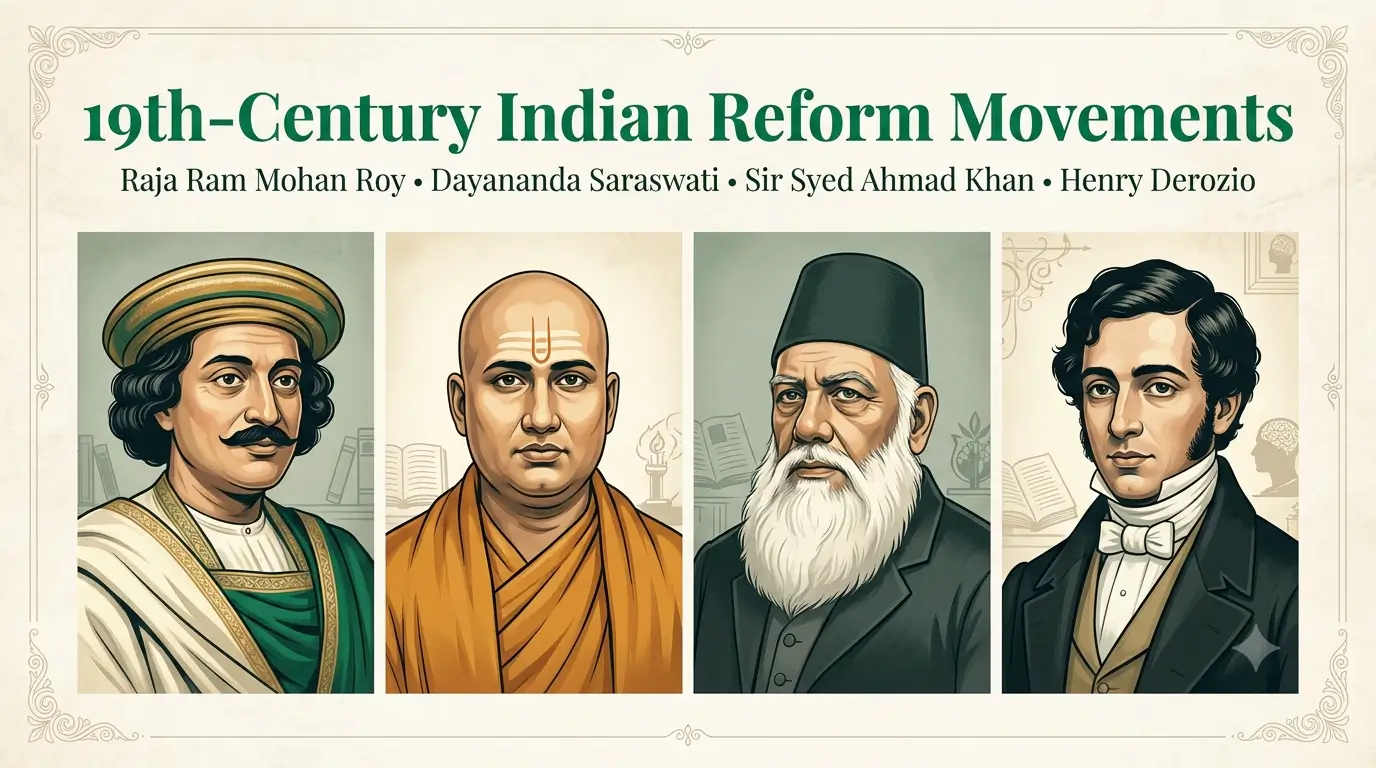
In this post, notes of “Unit 5: 19th Century: Reforms and Revival” from DSC-2: History of India-6 (c. 1750–1857) are given, covering every reform and revival movement asked in DU History (Hons.) exams — Young Bengal, Brahmo Samaj, Prarthana Samaj, Faraizi, Wahabi, Arya Samaj, the Aligarh Movement, and the intersection of caste and gender in 19th-century reform.
Quick Overview: Reformist vs Revivalist Movements
Before going movement-by-movement, it helps to place each one in the two broad categories DU examiners commonly ask about:
| Category | Approach | Key Movements | Core Idea |
|---|---|---|---|
| Reformist | Used reason, Western education, and modern values to challenge outdated practices from within | Brahmo Samaj, Young Bengal, Prarthana Samaj, Aligarh Movement | “Adopt modern, rational values to fix social evils” |
| Revivalist | Looked back to ancient scriptures/traditions for authority to justify reform, rejecting Western influence | Arya Samaj, Wahabi Movement, Faraizi Movement | “Return to the pure, original form of our own tradition” |
1.1 Introduction to Reform and Revival Movements
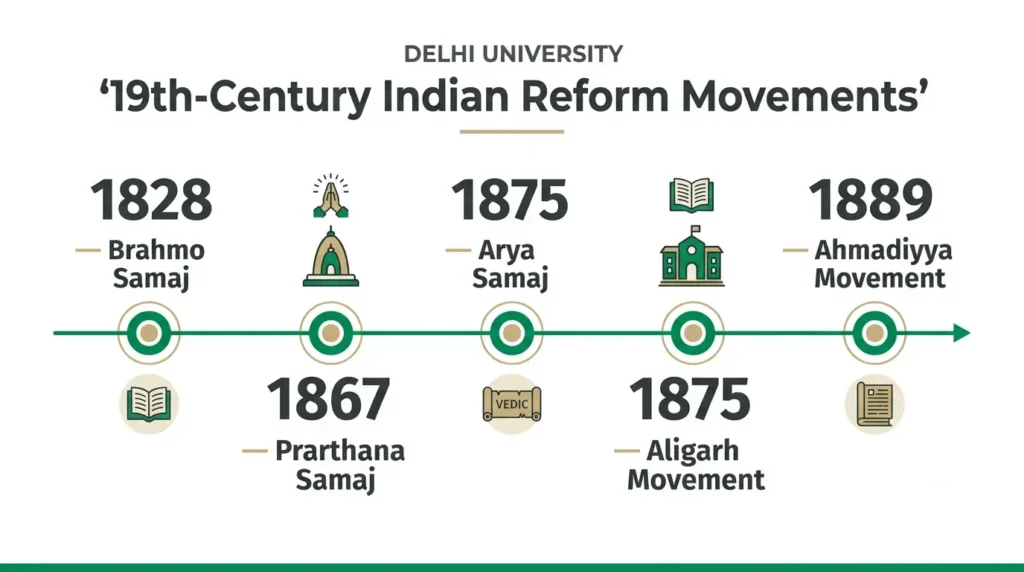
The 19th century was a period of major social and religious change in India. Reform and revival movements emerged as a response to British colonial rule, entrenched social injustices, rigid religious orthodoxy, and cultural stagnation. These movements drew on Western ideas — liberalism, rationalism, human rights — while simultaneously trying to revive and purify traditional Indian religious and cultural practices. Historians often describe this period as part of the wider Indian/Bengal Renaissance.
Common Objectives
Despite their differences, these movements shared several key goals:
- Social Reforms: Eliminating caste discrimination, child marriage, sati (widow immolation), untouchability, and the mistreatment of women.
- Religious Reforms: Cleansing Hinduism and Islam of superstitions and practices reformers believed had distorted the true essence of faith.
- Emphasis on Education: Promoting education, especially for women and marginalised groups, as the engine of social and economic progress.
- Equality and Justice: Challenging unfair social hierarchies, particularly around caste and gender.
- Nationalism and Self-Identity: Laying groundwork for the Indian nationalist movement by asserting the dignity and rights of Indians under colonial rule.
Ideological Differences
- Bengal Renaissance vs. Religious Orthodoxy: Some reformers combined Western education with traditional Indian values; others, like the Brahmo Samaj, actively rejected practices they saw as outdated.
- Religious Reform vs. Secularism: Arya Samaj focused narrowly on reforming Hinduism, while Young Bengal and Brahmo Samaj engaged with secular ideas across religions.
- Modernisation vs. Revivalism: Brahmo Samaj and Arya Samaj pushed a scientific approach to religion, while the Wahabis and Faraizis sought a return to earlier, “purer” forms of Islam.
- Social Justice vs. Religious Focus: Prarthana Samaj centred religious reform, while Faraizi and Wahabi movements folded socio-political goals into religious revival.
1.2 Young Bengal Movement
The Young Bengal Movement was a radical intellectual and social reform current in early 19th-century Bengal, led by young thinkers inspired by Western ideas of freedom and progress.
Origins and Key Figure: Henry Louis Vivian Derozio
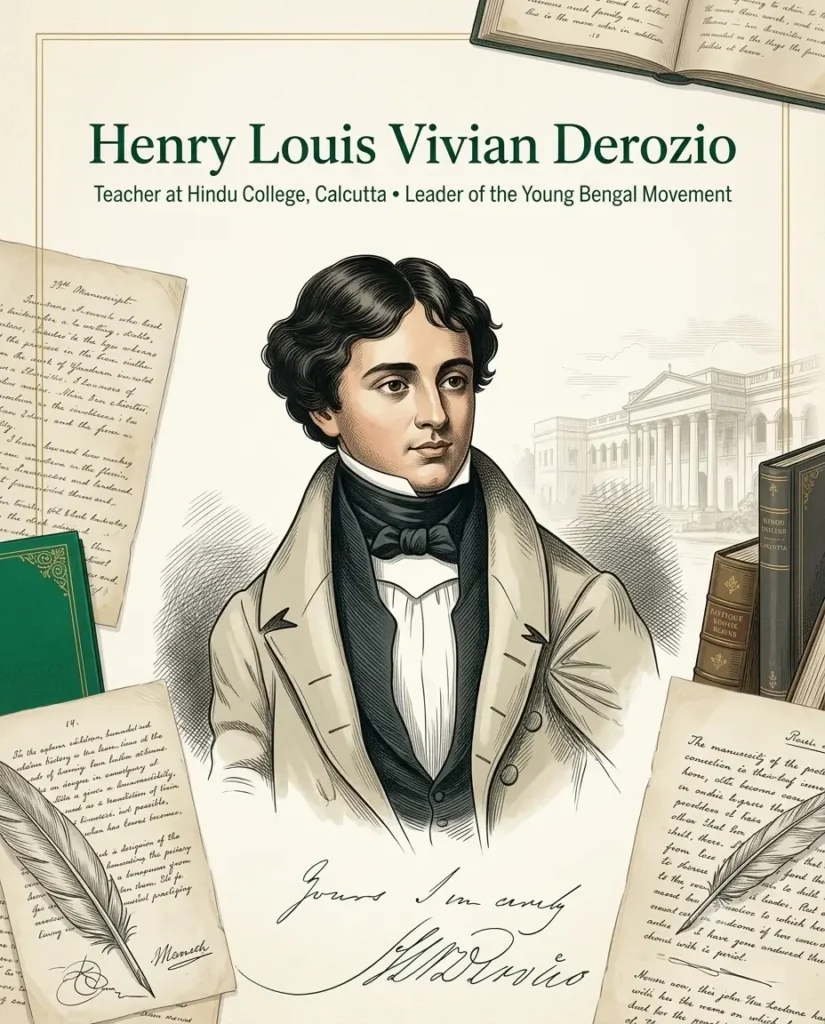
The movement was shaped by Henry Louis Vivian Derozio, a dynamic teacher at The Hindu College in Calcutta in the early 1800s. Of mixed heritage and inspired by European Enlightenment ideas, Derozio pushed his students to question established beliefs — especially in religion — and embrace reason, logic, and scientific thinking. This mentorship produced a cohort of young intellectuals known as “Young Bengal.”
Notable members included:
- Keshab Chunder Sen — later a key Brahmo Samaj leader, shaped early by Derozio’s teaching.
- Radhanath Sikdar — mathematician and surveyor who contributed to scientific knowledge in India.
- Tarachand Dutt, Peary Chand Mitra, Harinath Sanyal — Derozio’s students and central figures of the movement.
Key Contributions
- Emphasis on Reason and Science — questioning religious superstition and social custom through logic.
- Criticism of Superstition and Tradition — opposing idol worship and rigid caste practices, influenced by Unitarianism.
- Social Reform — fighting caste discrimination, mistreatment of women, and sati; advocating women’s rights and education.
- Adoption of Western Ideas — comparing Indian social injustice to European struggles for freedom and equality.
- Literary Engagement — essays, articles, and plays in English that spread critique of society to a wider audience.
Lasting Influence
Young Bengal’s ideas fed directly into later reformers like Raja Ram Mohan Roy’s circle and Keshab Chunder Sen, shaped the trajectory of Hindu College as an institution, and helped seed the secularism and nationalism that matured into the independence movement.
Conclusion: Though short-lived, Young Bengal’s legacy of rationalism and reform influenced generations of Indian nationalists and social reformers who followed.
1.3 Brahmo Samaj
The Brahmo Samaj was a landmark reform movement that shaped modern Indian political thought and challenged traditional Hindu religious practice.
Founding and Early Leaders: Raja Ram Mohan Roy, Debendranath Tagore
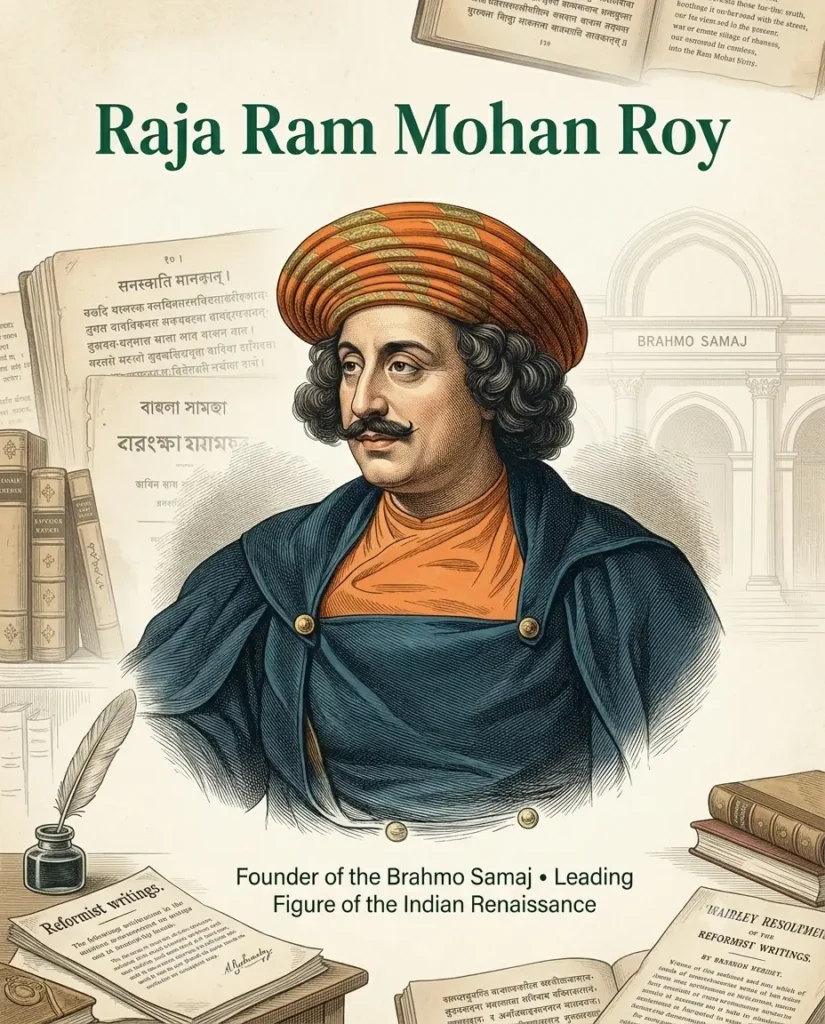
- Raja Ram Mohan Roy founded the Brahmo Samaj in 1828, known as the “Father of the Indian Renaissance.” He worked to eliminate superstition, idol worship, and unnecessary ritual, introducing monotheism shaped by both Indian and Western thought. Read more on Brahmo Samaj at Britannica.
- Debendranath Tagore — father of poet Rabindranath Tagore — took over after Roy’s death in 1833, organising the Samaj around spirituality and worship of one God.
Key Principles and Reforms
- Monotheism — rejecting idol worship in favour of one formless God.
- Abolition of Sati — Roy’s activism helped secure the Sati Regulation Act of 1829.
- Widow Remarriage — challenging the social stigma faced by widows.
- Promotion of Education — especially for women and marginalised groups.
- Social Equality — rejecting caste-based discrimination.
- Reform of Hindu Rituals — pushing marriage and inheritance-law reform.
Influence on Indian Society and Later Movements
Brahmo Samaj’s rationalism influenced the Arya Samaj, the Prarthana Samaj, and eventually the Indian National Congress, while advancing religious tolerance and nationalism in India.
Conclusion: Founded by Ram Mohan Roy and carried forward by Debendranath Tagore, the Brahmo Samaj’s push for monotheism, equality, and justice reshaped India’s religious and social landscape.
1.4 Prarthana Samaj
Established in 1867 in Bombay, the Prarthana Samaj promoted social change and personal religious reflection, especially in Maharashtra, building on the reformism debates of the era.
Goals of the Prarthana Samaj
Founded by Atmaram Pandurang, its main goals were:
- Religious Reform — purifying Hinduism of caste discrimination and idol worship.
- Social Reform — fighting untouchability and child marriage; supporting widow remarriage.
- Education — for women and marginalised groups.
- Unity Among Hindus — a rational, ethical religious practice cutting across caste lines.
Key Leaders
- Atmaram Pandurang — founding leader.
- M.G. Ranade — prominent reformer who advanced caste discrimination, women’s rights, and education debates.
Impact on Maharashtrian Society
The Samaj’s advocacy contributed to the Hindu Widow Remarriage Act of 1856, fought caste discrimination through education, and championed women’s schooling and the raising of the marriage age.
Conclusion: Led by Atmaram Pandurang and M.G. Ranade, the Prarthana Samaj’s focus on widow remarriage, caste reform, and women’s education left a lasting mark on Maharashtrian and Indian society.
1.5 Faraizi Movement
The Faraizi Movement was a socio-religious reform movement among Muslim peasant farmers in 19th-century Bengal, tackling religious, social, and economic distress under British rule and local landlordism.
Background and Goals
Founded by Haji Shariatullah, the name comes from the Arabic “Fard” (duty) — the goal was to strip away un-Islamic accretions (bidat) and return to essential obligations like prayer and fasting, while addressing exploitation of Muslim farmers by landlords and moneylenders. Read the full history at Wikipedia: Faraizi Movement.
Key goals:
- Religious Purification — rejecting practices seen as un-Islamic.
- Social Justice and Equality — fair land distribution for Muslim farmers.
- Opposition to British Rule — resisting taxation and exploitation.
- Simplicity and Frugality — a lifestyle aligned with Islamic values.
Leadership of Haji Shariatullah
Shariatullah organised farmers against landlords and colonial authorities, rejected mixed Hindu-Muslim rituals, and called for Islamic justice. After his death, his son Dudu Miyan continued the movement’s agrarian mobilisation.
Impact on Muslim Agrarian Communities in Bengal
The movement empowered Muslim peasants, built religious and social unity, fed growing anti-colonial sentiment, and triggered local uprisings against landlords, shaping Bengali Muslim identity going into the 20th century.
Conclusion: Under Haji Shariatullah, the Faraizi Movement combined religious purification with peasant resistance, leaving a lasting legacy in Bengal’s socio-political consciousness.
1.6 Wahabi Movement
The Wahabi Movement was an Islamic reform movement rooted in Wahhabism (founded by Muhammad ibn Abd al-Wahhab in 18th-century Arabia), which in India combined religious revival with active resistance to British colonial rule.
Origins and Influence of Wahabi Ideology in India
Wahhabi ideas reached India via trade and pilgrimage links with Arabia, appealing to reformists frustrated with saint-worship and shrine-visiting practices among Indian Muslims, particularly within Sufi and Barelvi circles. British colonial records referred to this current in India as the “Wahhabi movement,” though scholars today often call it the Mujahidin Movement.
Key Leader: Syed Ahmed Barelvi
Syed Ahmed Barelvi (1786–1831), born in Rae Bareli and educated in Delhi, led the movement’s purification drive and organised armed resistance against British rule:
- Rejected grave-worship and saint veneration, insisting on strict Qur’an and Hadith adherence.
- Established Wahhabi centres in Peshawar and Kohat in the North-Western Frontier.
- Led Jihad campaigns against British rule, including a major 1826 expedition into the North-West Frontier and Afghanistan.
- Died in 1831 fighting Sikh forces in Punjab.
Efforts to Purify Islam and Resistance Against British Rule
The Wahabi movement tied religious purification to political resistance, participated actively in armed uprisings, and — despite failing to establish an independent Muslim state — significantly shaped later Muslim nationalism in India.
Conclusion: Led by Syed Ahmed Barelvi, the Wahabi Movement’s blend of religious purity and anti-colonial resistance left a durable imprint on Indian Islamic and anti-colonial thought.
1.7 Arya Samaj
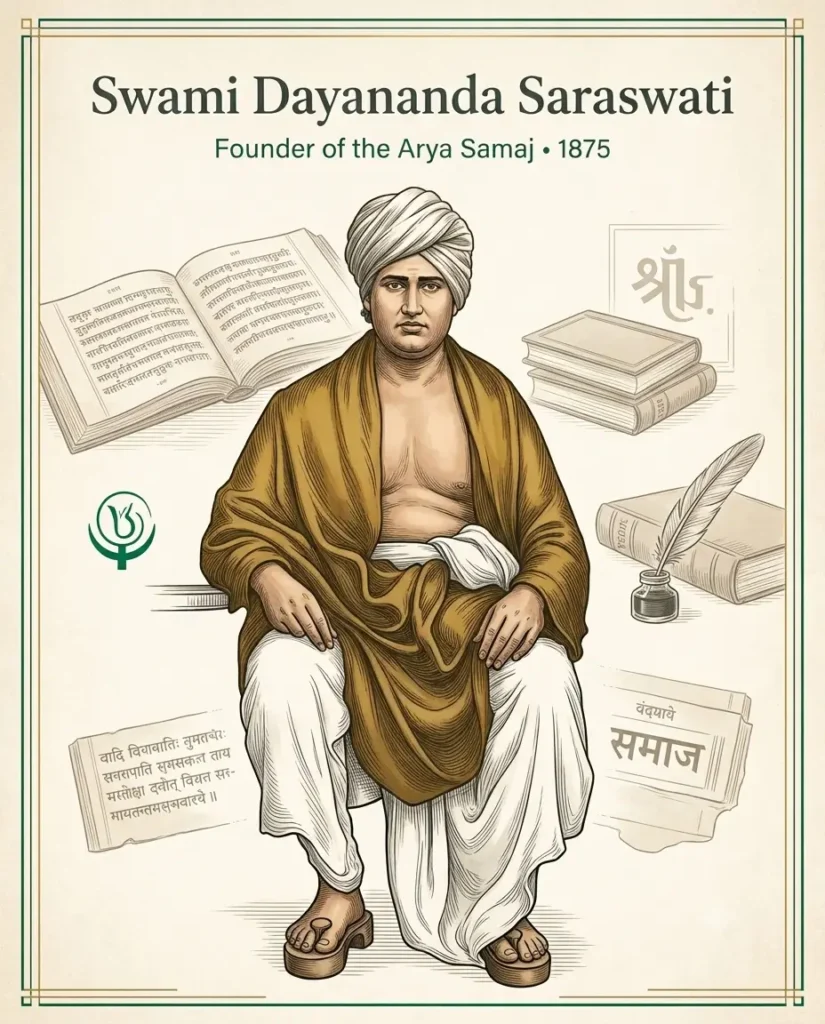
The Arya Samaj, founded by Swami Dayananda Saraswati in 1875, sought to revive the original teachings of the Vedas while pushing social reforms for the oppressed. Read more at Britannica: Arya Samaj.
Founding by Swami Dayananda Saraswati
Founded on 10 April 1875 in Bombay, Dayananda aimed to eliminate corrupt practices — idol worship, the caste system, and priestly control — that he believed had crept into Hinduism over centuries.
Principles: Vedic Revivalism and Social Reform
- Vedic Monotheism — one formless God.
- Rejection of Superstition and Ritualism — a rational, ethical approach based on Vedic teaching.
- Social Reform — ending the caste system, supporting widow remarriage, empowering women, fighting child marriage.
- Educational Reform — combining Vedic principles with modern, scientific education.
Significant Activities and Educational Reforms
The Arya Samaj founded Dayanand Anglo-Vedic (DAV) Schools (first opened in Lahore, 1886, by Lala Hansraj) and Arya College, Lahore, promoted vernacular languages (especially Hindi), and ran public campaigns against social inequality.
Conclusion: Dayananda Saraswati’s Arya Samaj fused Vedic revivalism with tangible social reform — its DAV school network remains active proof of its educational legacy today.
1.8 Aligarh Movement — Sir Syed Ahmed Khan
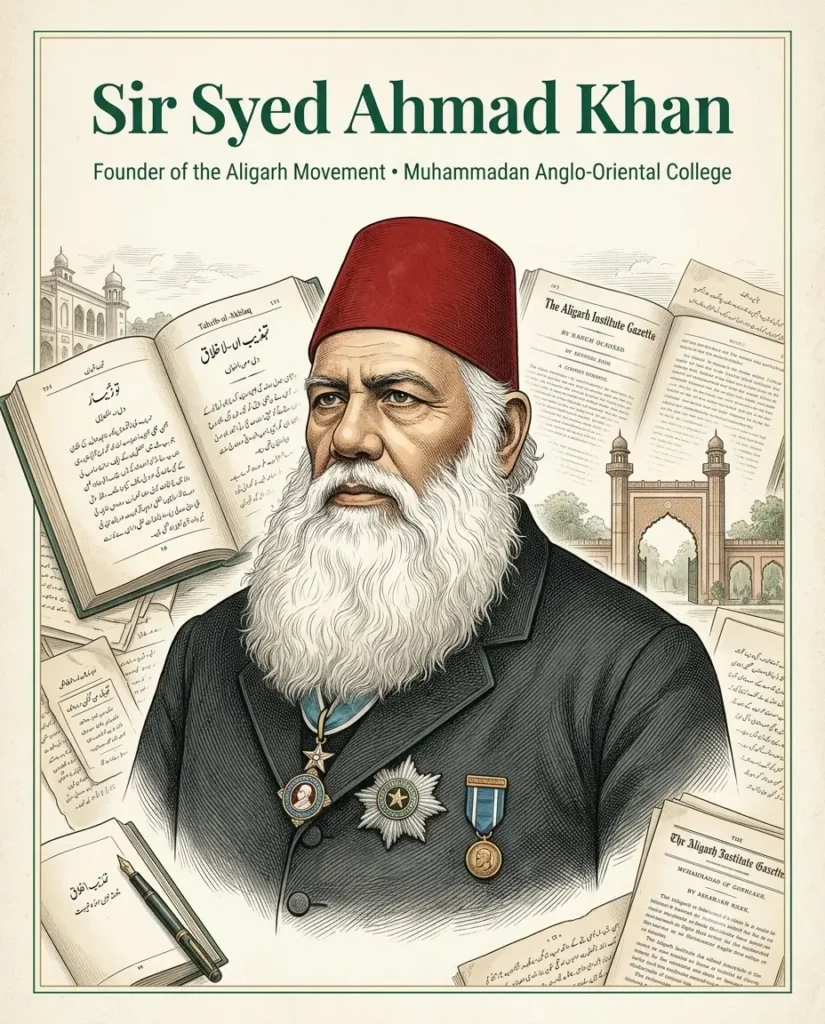
The Aligarh Movement, led by Sir Syed Ahmed Khan, was the major socio-religious reform movement among Indian Muslims of the late 19th century — and a frequently tested topic in DU exams that was missing from earlier notes on this unit.
Background
After the failure of the 1857 revolt, Sir Syed Ahmed Khan observed that Indian Muslims were falling behind educationally, socially, and economically compared to Hindus, who had embraced English education earlier. He concluded that modern, Western-style education — not political agitation — was the path to Muslim revival. Read the full biography at Britannica: Sir Sayyid Ahmad Khan.
Key Contributions
- Scientific Society (1864) — translated Western scientific works into Urdu.
- Muhammadan Anglo-Oriental (MAO) College, Aligarh (1875) — blended modern Western education with Islamic studies; later became Aligarh Muslim University (AMU).
- Tahdhib al-Akhlaq journal — a reform-focused Urdu/English magazine promoting “social reform.”
- All-India Muhammadan Educational Conference (1886) — a national platform for Muslim education before the founding of the Muslim League.
- Causes of the Indian Revolt — his influential critique of British administrative errors that also reassured colonial authorities of Muslim loyalty.
Ideological Position
Unlike the Wahabi and Faraizi movements, the Aligarh Movement was firmly modernist and reformist rather than revivalist — it discouraged political agitation and encouraged Muslims to work within, and benefit from, British-era institutions.
Conclusion: Sir Syed Ahmed Khan’s Aligarh Movement reshaped Muslim education in India, establishing an institutional legacy (AMU) that outlasted every other reform movement of the century.
2. Discourse on Gender and Caste in Reform and Revival Movements
2.1 Gender Reforms
19th-century gender reform movements challenged patriarchy and improved women’s status through education, marriage law, and the fight against sati, driven by both British-influenced discourse and homegrown reformers.
Key Issues: Sati Abolition, Widow Remarriage, and Female Education
- Abolition of Sati — Raja Ram Mohan Roy’s activism led to the Bengal Sati Regulation Act of 1829.
- Widow Remarriage — Ishwar Chandra Vidyasagar’s campaign led to the Widow Remarriage Act of 1856.
- Female Education — Vidyasagar established girls’ schools; Jyotirao Phule also championed women’s education as vital to social progress.
Role of Reformers: Ishwar Chandra Vidyasagar and Jyotirao Phule
- Vidyasagar — leading Bengal Renaissance figure; promoted widow remarriage and girls’ schools.
- Phule — opened the first school for girls in Pune (1848); his book Gulamgiri (1873) linked women’s oppression to the caste system.
2.2 Caste Reform Movements
Caste discrimination disproportionately harmed lower castes (“dalits”/untouchables). Reformers like Jyotirao Phule and Narayana Guru worked to dismantle the system through education and social integration.
- Phule founded the Satyashodhak Samaj (1873) to fight caste oppression and promote social justice.
- Narayana Guru challenged caste discrimination in Kerala, opening schools and temples to all castes.
- These movements fed directly into later political mobilisation by leaders like Dr. B.R. Ambedkar.
2.3 Role of Women in Movements
Women played active roles despite a male-dominated society:
- Begum Roquiah Sakhawat Hossain — women’s rights leader in Bengal, author of “Sultana’s Dream.”
- Sarojini Naidu — supported women’s rights and the abolition of child marriage.
- Pandita Ramabai — founded the Arya Mahila Samaj, focused on widows’ education.
- Kasturba Gandhi — supported rural women’s education and organised women’s protests.
Publications and Speeches by Female Reformers
Begum Rokeya’s periodical writing and Pandita Ramabai’s “The High-Caste Hindu Woman” were central to raising awareness of women’s social, legal, and educational needs.
2.4 Social and Legal Reforms
- Sati Regulation Act (1829) — made sati illegal in British-controlled areas.
- Hindu Widows’ Remarriage Act (1856) — legalised widow remarriage, promoted by Vidyasagar.
The colonial state’s role was mixed — enacting these laws while cautiously negotiating with Indian elites like Roy, who had to work within a still-conservative colonial bureaucracy.
2.5 Intersection of Caste and Gender
Women from lower castes faced double oppression — from both gender and caste hierarchies. Reformers like Phule, Ambedkar, and Narayana Guru connected the two struggles directly:
- Phule’s schools served both untouchables and girls simultaneously.
- Narayana Guru’s temple-entry campaigns advanced both caste and gender equality.
- The Satyashodhak Samaj and Narayana Guru’s Kerala movement remain the key DU-exam case studies on this intersection.
Previous Year Questions (PYQs) — DU DSC-2, Unit 5
DU Previous Year Questions
Frequently asked questions from DU exam papers on this topic. Tap a question to view a quick-answer guide.
1 Discuss the role of Raja Ram Mohan Roy in the abolition of Sati. +
2 “The Arya Samaj was revivalist in form but reformist in content.” Critically examine. +
3 Compare the objectives of the Faraizi and Wahabi movements. +
4 What was the significance of the Young Bengal Movement despite its short life? +
5 How did the Aligarh Movement differ ideologically from the Wahabi and Faraizi movements? +
6 Examine the intersection of caste and gender in 19th-century reform movements. +
Frequently Asked Questions (FAQs)
What is the difference between reformist and revivalist movements in 19th-century India?
Reformist movements (Brahmo Samaj, Young Bengal, Aligarh Movement) used reason and modern Western education to challenge social evils directly. Revivalist movements (Arya Samaj, Wahabi, Faraizi) sought the same social outcomes but justified them by appealing to a “purer,” original form of their own religious tradition rather than Western values.
Who founded the Brahmo Samaj and in which year?
The Brahmo Samaj was founded by Raja Ram Mohan Roy in 1828 in Calcutta. It is considered the starting point of India’s modern socio-religious reform movement.
What was the main aim of the Arya Samaj?
Founded by Swami Dayananda Saraswati in 1875, the Arya Samaj aimed to revive the original teachings of the Vedas, reject idol worship and caste discrimination, and promote education and social equality through the slogan “Back to the Vedas.”
What was the significance of the Aligarh Movement?
Led by Sir Syed Ahmed Khan, the Aligarh Movement modernised Muslim education in India through the Muhammadan Anglo-Oriental College (later Aligarh Muslim University), encouraging Muslims to embrace English education instead of political agitation after the failed 1857 revolt.
What legal reforms resulted from 19th-century social reform movements?
Two landmark laws emerged directly from reformer activism: the Sati Regulation Act (1829), which banned widow immolation, and the Hindu Widows’ Remarriage Act (1856), which legalised widow remarriage.
Who was Haji Shariatullah and what movement did he lead?
Haji Shariatullah founded the Faraizi Movement in early 19th-century Bengal, an Islamic reform movement among Muslim peasant farmers that combined religious purification with resistance to landlord and colonial exploitation.
How did women participate in 19th-century reform movements?
Women were active participants and leaders, not just subjects of reform — figures like Begum Roquiah Sakhawat Hossain, Pandita Ramabai, and Sarojini Naidu led campaigns for women’s education, widow welfare, and legal rights, alongside male reformers.
Why is the Young Bengal Movement considered important despite being short-lived?
Although it lasted only a decade, the Young Bengal Movement under Henry Louis Vivian Derozio introduced rationalism and critical questioning into Indian intellectual life at Hindu College, directly shaping later reformers and the broader Bengal Renaissance.
Subscribe to keep reading
You've used your free notes for now. Get Delhi Pathshala Premium for unlimited access.
Subscribe — ₹29/30 days